Differences of millennials and non-millennials
privacy and security perceptions and their
influence on online shopping behavior.
Author: Denise Althaus
University of Twente P.O. Box 217, 7500AE EnschedeThe Netherlands
ABSTRACT
Purpose - Internet is entrenched in our daily lives and more and more people are buying online. With the increase in online shopping, privacy and security concerns increased. These in turn negatively affect online shopping behavior as research shows. What is not observed yet is how age groups relate to this relationship.
Aim & Method - This paper investigates the impact the two age groups, Millennials and Generation X, have on the relationship of the independent variable privacy and security perceptions and the dependent variable online shopping behavior. This is done by an online survey which is shared with family, friends and on Facebook. Results & Conclusion - Millennials perceive risks different than Generation X’ers as the correlation table shows. A significant negative relationship between perceived risk and online shopping behavior was found. The relationship between all three variables is not significant. Further no significant relationship between the age groups and perceived trust could be found as well as between perceived trust and online shopping behavior. Theoretical & Practical Implications -This is the first paper to observe the relationship between the age groups, Millennials and Generation X, and privacy and security perceptions. Therefore it adds to the already existing literature of perceived risk and perceived trust. Companies which offer online shops should take their (potential) customers’ security and privacy perceptions, in terms of perceived risk, into account. If they are able to address these properly and give their customers a safe feeling, customers are more willing to shop online.
Supervisors:
PhD(c) I. (Raja) Singaram
Dr. A.H. (Rik) van Reekum
Keywords
Millennials, Perceived Privacy, Perceived Security, Risk, Trust, Online Shopping Behavior
Permission to make digital or hard copies of all or part of this work for personal or classroom use is granted without fee provided that copies are not made or distributed for profit or commercial advantage and that copies bear this notice and the full citation on the first page. To copy otherwise, or republish, to post on servers or to redistribute to lists, requires prior specific permission and/or a fee.
7th IBA Bachelor Thesis Conference, July 1st, 2016, Enschede, The Netherlands.
1.
INTRODUCTION
Internet is entrenched in our daily lives and more and more people are buying online. According to a study of the Centre of Retail Research, “E-commerce is the fastest growing retail market in Europe and North America” (“Online Retailing: Britain, Europe, US and Canada 2016”, n.d.). Nowadays, one can buy everything online. Often it is more convenient, easier and cheaper to buy online than offline. With the increase in online shopping also privacy and security concerns increased. Several authors ascribed reluctance of online purchasing to apparent barriers including privacy and security issues (Hoffman, Novak & Peralta, 1999; Jacobs, 1997; Belanger, Hiller & Smith, 2002). Research found out that the perceived risks of Internet credit card stealing and supplying personal information crucially affect current and future internet users as well as the amount of internet usage (Liebermann & Stashevsky, 2002).
Even though the topic of privacy and security risks of Online Shopping is not new, it is still an issue for many consumers. This is mainly because several cases show that even big companies are not always able to protect the private data of their customers. In 2014 eBay’s online network and website was hacked and the hackers were able to steal private data of eBay’s 145 million customers (Lata, 2014). Fortunately no financial data was stolen. “This is because the data is stored on a separate and encrypted network” (Lata, 2014). If the company would not have a separate encrypted network, financial data of 145 million people could have been accessed. Not all online shops, especially the smaller ones, are able to fulfill this security standard. Therefore it is advisable for consumers to be cautious.
Research also investigated the relationship between Age and perceived risk. A study by Liebermann and Stashevsky (2002) found that older people perceive some risk elements significantly higher than younger people. Supplying personal information and information reliability were two of these risk elements.
Even though age, privacy and security perceptions and online shopping behavior were related in several studies, no study differentiated online perceptions of Millennials and Non-Millennials and its effect on online shopping behavior, at least to my best knowledge. Also most aforementioned studies were conducted more than ten years ago; this makes the applicability today questionable. In this research paper the security and privacy perceptions of Germans is tested and whether it has an impact on the online shopping behavior. Further it will distinguish between two age groups: Millennials and non-Millennials. The purpose of the present study is to answer the research question: How do privacy and security perceptions of millennials compared to non-millennials affect online shopping behavior?
In order to answer the main research question, I formulated several sub-questions.
SQ1: Is there a significant difference between Millennials’ and Generation Xers’ risk perceptions?
SQ2: Is there a significant difference between Millennials’ and
Generation Xers’ trust perceptions?
SQ3: To what extent does perceived risk have an impact on online shopping behavior?
SQ4: To what extent does perceived trust have an impact on online shopping behavior?
In the next section I will introduce previous literature of the main topics. The following methods section explains the
methodology which is used to analyze the data. Subsequently, in the results section I will illustrate the main findings of the study. Finally, in the conclusion I will summarize the main findings and discuss these.
1.1
Relevance of the study
The study will contribute to the already existing literature about privacy and security perceptions’ influence on online shopping behavior and distinguishes itself by looking at how age relates to these variables. I will focus on German people in my study. Therefore online marketers in Germany and other Western European countries can use my research to adapt their marketing strategies to it. I assume that age has an influence on privacy and security perceptions and thus online shopping behavior. If my assumption is true, marketers for online shopping should base their strategies on age and the according risk perceptions. The conclusions I draw from this study will help B2C companies which offer online shopping to understand what privacy and security perceptions they need to address on their websites or in their marketing to target different age groups. If the companies can give their consumers a safe feeling, they are more likely to buy from the companies’ websites. The new marketing strategies will give these companies an advantage over competitors who do not address the privacy and security needs properly.
2.
AGE GROUPS
In my research I include two age groups: Millennials and non-millennials. I define non-millennials as people who are between 25 and 34 when they fill out the survey. Generation Xers include people born between 1965 and 1980 (Nnambooze & Brijball Parumasur, 2016). Therefore the non-millennial age group falls into Generation X, since they are 35 to 49 years old when they fill out the survey.
2.1
Generation X
Generation X “are the children of the workaholic Baby Boom Generation and tend to feel overlooked and less appreciated. These latch-key kids were taught to be self-reliant individuals” (Crampton et al., 2011, p.2). This generation is also called the me generation or baby busters (Crampton and Hodge, 2011). They want to learn easy and fast and want information straightforward. This is because they value time and want to enjoy life next to academics. In addition they see education only as a mean to an end (Johnson & Romanello, 2005). They are also less loyal to corporations, and tend to embrace change (Crampton et al., 2011). Further they are independent, survival oriented, lost, cynical, and wasted (Keeling, 2003). Events like the introduction of Tandy and Apple personal computers shaped this generation, since they are the first generation to use technology, specifically Computers, regularly (Crampton et al., 2011). Bickel and Brown (2005) highlight that Generation X “had an extended adolescence and married later or remained single, consider technology a fact of life, and openly disdain hierarchy” (p.206). Bickel et al. (2005) also assume that growing up with divorced parents or both parents working lead to Generation X putting a great emphasis on family and trying to balance work and family.
2.1.1
Online Shopping Behavior of Generation X
The main reasons for Generation X, in the U.S., to do online grocery shopping are better prices and time savings during check out (“U.S. Generation X (Gen X): Grocery Shopping Behavior”., n.d.).
want clear product benefits. Marketers can reach Generation X through both traditional and digital advertising since they are accustomed to both. Generation X is brand loyal. Thus, by providing high quality and good customer service, firms can have lifelong customer relationships with generation X. (Williams, n.d.).
Due to high education levels Generation X “pays high attention to price, quality and companies’ advertising efforts” (Valkama, 2015).
2.2
Millennials
Several names and definitions are used to describe the age group followed by Generation X. Some of the names given to this generation are Digital natives (Prensky, 2001), Net Generation (Sandars & Morrison, 2007), Millennials (Oblinger & Oblinger, 2005), Generation Y (Crampton et al., 2011; Bolton, Parasuraman, Hoefnagels, Migchels, Kabadayi, Gruber, Loureiro & Solnet, 2013; Coombes, 2009) or Generation C (Dye, 2007). Often those names are used interchangeably (Coombes, 2009; Bolton et al. 2013) since they talk about the same age group. For this research I will only use the term Millennials to make the text more coherent. The literature also does not agree on the exact birth years defining Millennials. Crampton et al. (2011) take the birth years 1980 to 1999 into account whereas Oblinger et al. (2005) only include the years 1981 to 1994. For this research I define Millennials as people who are between 25 and 35 when taking the survey, as previously mentioned.
Donald Tapscott (n.d) was the first author to describe the new age group. He states that Millennials are “exceptionally curious, self-reliant, contrarian, smart, focused, able to adapt, high in self-esteem” and have a global orientation (Tapscott, n.d, para. 7, The Demographic Revolution Meets the Digital Revolution). He adds that “they are a new generation who, in profound and fundamental ways learn, work, play, communicate, shop, and create communities very differently than their parents” (Tapscott, n.d. para. 5, The Demographic Revolution Meets the Digital Revolution). This is mainly because the millennial generation is the first to grow up with extensive access to technology (Oblinger & Oblinger, 2005). Since they were always confronted with the Internet and technological change, Millennials have an “almost ‘intuitive’ knowledge of how to use technology” (Coombes, 2009, p. 31). Millennials are described as sheltered and team oriented (Keeling, 2003). They use the digital content to shape their networks, relationships and identity (Dye, 2007). Oblinger and Oblinger (2005) found out that even though Millennials feel “comfortable using technology without an instruction manual, their understanding of the technology or source quality may be shallow” (p.16). The early and frequent technology confrontation has negative and positive influences on cognitive emotional and social aspects of a person’s life (Immordino-Yang, Christodoulou & Singh 2012).
2.2.1
Online Shopping Behavior of Millennials
Millennials spend more money online than any other age group even though they have less income (Smith, 2015). Millennials attach high importance to online reviews and make their online purchases dependent on it (Mangold& Smith, 2012). External events like the global recession affected the Millennials, their buying behavior and their social media use (Bolton et al., 2013). Millennials were early exposed to customized products and personalized services (Ansari & Mela, 2013; Berry, Bolton, Bridges, Meyer, Parasuraman & Seiders, 2010) and are able to contact and buy from suppliers anywhere in the world (Mangold & Smith, 2012). Marketers need to adapt to the new
generation’s needs since Millennials do not purchase the brands their parents like (Mangold & Smith, 2012).
Millennials and Generation X have different values, different skills and different knowledge. Especially in regards to the use and knowledge of Internet these two generations differ. This might lead to different perceptions of privacy and security of the Internet and Online Purchasing.
3.
SECURITY AND PRIVACY
PERCEPTIONS
“Almost 95% of Web users have declined to provide personal information to Web sites at one time or another when asked” (Hoffman et al., 2008, p.82), the question now is why this is the case. The most likely answer is that security and privacy perceptions of consumer prevent them from it. Rust, Kannan and Peng (2002) define “privacy as the degree to which personal information is not known by others” (p.456). Privacy on the internet decreases since the internet makes it easy for “new data to be automatically collected and added to databases” (Cranor, 1999, p.29). Personal information can also be recorded during online purchase transactions. Security of online shopping “is the protection of e-commerce assets from unauthorized access, use, alteration, or destruction” (E -commerce securities, n.d.). A study by Ranganathan and Ganapathy (2002) actually shows that security is the “best predictor of online purchase intent” (p.462) and privacy comes right after it. While researching security and privacy perceptions of online shopping, two concepts appear most frequently: Online Purchasing Risks and Trust. Hence I will use these two concepts to measure security and privacy perceptions. A literature review for both concepts will follow in the next two sections.
3.1
Online Purchasing Risks
supposes. I will elaborate on the Trust concept in the next section, since Trust generally affects the privacy and security perceptions one has.
Transaction security risk involves risks occurring during the Internet purchase including credit card fraud (Kim, Ferrin & Rao, 2008). Security threats for consumers’ online purchasing involves two definitions according to Belanger et al. (2002); “(1) economic hardship encompasses damages to privacy (loss of information) as well as theft, for example, of credit information and (2) authentication issues for consumers will be reversed; as in whether the Web site is ‘real’ rather than whether the purchaser’s identity is real” (p.249). Both definitions display the transaction security risk, but the second one also represents the source risk. Therefore security is part of transaction security risk and source risk.
3.2
Trust in relation to Online Shopping
Trust in E-Commerce “is important because it helps consumers overcome perceptions of uncertainty and risk and engage in “trust-related behaviors” with Web-based vendors, such as sharing personal information or making purchases” (Mcknight, Choudhury & Kacmar, 2002). This definition shows how intertwined the concepts of risk and trust are. Research shows that trust can positively influence the intent to purchase online (Eastlick et al., 2006; Shergill & Chen, 2005). Actually all studies Chang, Cheung and Lai (2005) observed in their literature review show a significant positive impact between overall trust and purchase intention and usage (Gefen, 2000; Gefen, 2002; Gefen, Karahanna & Straub, 2003; Mcknight et al., 2002; Yoon, 2002). Trust in relation to online shopping is the consumer’s subjective perception that the online shop will do the transaction and its obligation as the consumer understands it (Kim et al., 2008). If customers do not trust a website they are less likely to provide personal information to that website. A study found out that lack of trust is the main reason, with 63% of all respondents, not to provide personal information (Hoffman et al., 1999).
Several authors measured trust and used different dimensions for it (Ganesan, 1994; Kim et al., 2008). Kim et al. mention four trust dimensions for electronic commerce entities, namely Cognition (observation)-based, Affect-based, Experience-based and Personality-oriented (2008). For my research I will focus on the cognition- and affect-based trust dimensions, since they are best suitable for determining privacy and security perceptions of online shopping.
Cognition-based trust is related to consumer’s observations and perceptions. This is determined amongst other factors by the information quality, perceived privacy and security perceptions and brand image. Affect-based trust is based on indirect interactions with the consumer through inputs from a third party like recommendations or third-party seals (Kim et al., 2008). Their research showed that “all of the cognition-based and affect-based antecedents except third party seals (TPS) had strong positive effects on consumer trust” (Kim et al., 2008, p.556).
There are also studies observing the relationship between trust and risk perceptions (Eastlick et al., 2006; Ganesan 1994, Kim et al., 2008). Kim et al.’s study found out that perceived trust has a strong negative effect on a consumer’s perceived risk (2008). Including the relationship between trust and risk perceptions in this research extends the scope of my study.
4.
ONLINE SHOPPING BEHAVIOR
Of 82 million Germans, 68 million have Internet access and 37 million of them shop online. Especially clothing, electronics and books are bought by Germans online. These are mainly
paid with an invoice (“Germany E-Commerce Market Profile”, n.d.). Approximately “58% of the online customers order online and pay afterwards” (“Germany E-Commerce Market Profile”, n.d.) in Germany. RetailMeNot and the Centre for Retail Research conducted a study about E-Commerce (2015). Germany’s online trading turnover was approximately 43 billion Euros in 2014. This is ten percent of the overall trading turnover in Germany and a 25 percent compared to 2013. While the online turnover of all participating countries is growing, the offline turnover is decreasing. The average amount spent online by a single person in 2014 was approximately 532 Euros. This amount is estimated to grow in the following two years. When you look at the turnover per E-Shopper in 2014, the amount is even higher with more than 1.000 Euros per E-Shopper. Approximately 17 times a year, an E-Shopper is buying online (“Internationale E-Commerce-Studie 2015”, n.d.). The two leading online shops with almost half of the market share are Amazon and Otto (Ecommerce in Germany, n.d.).
people are also more likely to purchase online and buy more frequently (Li et al., 1999) whereas price-orientation and time consciousness of people have no effect (Li et al., 1999;Sin & Tse, 2002). This, even though time saving as a relative advantage has a significant positive effect (Raijas & Tuunainen, 2001). For the level of internet usage, most studies found a significant positive impact on online shopping intention and usage (Bhatnagar et al., 2000; Goldsmith & Goldsmith, 2002, Liao & Cheung, 2001) and for internet purchase experience all studies found a significant positive impact (Foucalt & Scheufele, 2002; Goldsmith et al., 2002; Shim, Eastlick, Lotz & Warrington 2001). Several dimensions of risk and trust were also included in the literature review of Chang et al. (2005), but the results are already mentioned in the trust and risk part of this paper.
As the literature review shows, perceived risk and perceived trust represent the independent variables of this research which form together security and privacy perceptions. Online Shopping Behavior is then the dependent variable.
5.
ASSUMPTIONS
The literature review gave some insights about the different variables of my research which allows me to make some assumptions about the outcome of this study.
Millennials and Generation X’ers are two very distinct age groups. Especially the early exposure to technology shaped the Millennials and distinguishes it from Generation X.
Generation X is probably more cautious with technology and therefore perceives higher risks than Generation X’ers. The same applies to perceived trust, which is probably lower for Generation X.
As the literature proposes, perceived risk is significantly negatively correlated with online shopping behavior. In my research I will most likely get the same result, since almost all studies agreed on this relationship.
The results of studies observing the relationship between perceived trust and online shopping behavior show a significant positive correlation. Thus higher perceived trust leads to heavier online shopping; this is what I also expect to find out in my study.
If all these assumptions turn out to be true, Millennials will
perceive lower risks and higher trust than Generation X’ers
when shopping online, which leads to Millennials shopping
more online than Generation X’ers.Since “Internet users with a high degree of information privacy concerns are likely to be low on trusting beliefs and high on risk beliefs” (Malhotra, Kim, Agarwal (2004), I assume that Millennials have lower privacy perceptions than Generation X’ers and thus shop more online. I assume the same applies to security perceptions.
6.
RESEARCH METHOD
6.1
Survey Construction
To answer the main research question and the four sub-questions and to (de)validate my previous formulated assumptions, I constructed a survey including questions about perceived risk, perceived trust and online shopping behavior. For the survey construction we created a group of five students who all compare Millennial’s privacy and security perceptions of online shopping with another age group. After an extensive literature review we agreed to use perceived risk and perceived trust as measurements for security and privacy perceptions. These two concepts have several dimensions. For perceived risk we used the dimensions of Lee et al. (2015) and for perceived trust we agreed on Kim et al.’s (2008) dimensions. To adjust the
concepts to privacy and security perceptions in the online shopping context, we had to exclude some of the dimensions. For the remaining dimensions we looked for suitable definitions in the literature. Unfortunately we did not have access to any surveys about perceived risk or perceived trust; therefore we had to come up with items ourselves. We used the definitions of the dimensions to derive appropriate items for the survey. This way we came up with eleven statements for perceived risk and six for perceived trust. For these 17 questions, respondents were asked to make a choice from a 7-point-likert scale where 1 indicates “Entirely disagree” and 7 “Entirely agree”. A table with all the dimensions, definitions, items and sources for the two variables can be found in Appendix 13.1.
Next to demographics and questions about perceived risk and perceived trust, we asked questions about the dependent variable online shopping behavior. We came up with 12 questions for general online shopping behavior and eight questions about online shopping behavior which relate to privacy and security. Later I will form two variables of these questions, one for Online Shopping Behavior and one for Privacy Behavior, which shows how people behave online to secure their privacy. The full survey can be found in Appendix 13.2. All items were set to forced responses, except the last question which is voluntary. The respondents were asked to share any bad experiences they had while shopping online. Before we published the survey in China, the Netherlands and Germany, we used the translation function of Qualtrics to translate the survey into Chinese, Dutch and German. We adjusted the grammar and spelling of the translation if necessary. In order to be sure that we translated it correctly, the survey was back translated by a third party who is confident in both languages.
6.2
Data Collection
To examine the privacy and security perceptions of different age groups in online shopping, I will analyze the data from 134 respondents. We published the survey with Qualtrics which is a private research software company. Qualtrics provided us with a link for the survey, which made it easier to share it among friends, family and in Facebook groups.
6.3
Data Analysis
6.4
Reliability
In order to evaluate the internal consistency of the different statements of the two concepts, I conducted a reliability analysis via SPSS. This can be done through calculating the Cronbach’s Alpha of different items; this value will have an alpha between 0 and 1. A higher alpha depicts higher internal consistency.
For perceived risk I found a Cronbach’s Alpha of 0.58. By deleting “I buy from online shops without a physical store” and “I believe that my personal information is protected during online shopping”, Cronbach’s Alpha increased to 0.62 which shows a “questionable” (George & Mallery, 2003, p.231) consistency between the items. Perceived trust showed a Cronbach’s Alpha of 0.44, which is an “unacceptable” (George et al., 2003, p.231) correlation between the different statements. Tavakol and Dennick state that a low Cronbach’s Alpha can result from a “low number of questions, poor inter-relatedness between items or heterogeneous constructs” (2011). Dropping any of the perceived trust items, would not increase Cronbach’s Alpha much, therefore all items are kept. In the observation of perceived trust I will keep the low internal consistency of the items in mind and consider it as a limitation of this research. For the online shopping behavior variable I chose the questions “How often did you shop online in the past year?” and “How much money do you spend on average per month for online shopping in Euros?”. These represent the online shopping behavior the best. The reliability analysis showed that the Cronbach’s Alpha is .72which is “acceptable” (George at al., 2003, p.231), even though it only consists of two variables. To observe the internal consistency of five privacy behavior statements, I calculated the Cronbach’s Alpha. The included items can be found in Appendix 13.4. The Cronbach’s Alpha for the five items is .72. By deleting “Would you refuse to give information to an online shop, if you think it is too personal or not necessary for the transaction?”, the Cronbach’s Alpha increases to .81. According to George et al. (2003) this outcome is “good” (p.231). The deleted item did not fit to the others most likely because it measured two things (too personal/ and not necessary).
6.5
Validity
After doing a reliability analysis, I checked for the validity of the measures perceived risk and perceived trust. To test the validity I used a factor analysis. The factor analysis assigns the items of a variable to predetermined factors. The amount of factors in my research represents the dimensions of each variable. The output of the factor analyses can be found in the Appendix 13.5 and 13.6.
The factor analysis of perceived risk showed that all items measure what they intend to measure. Only “I receive newsletters/mails from online shops I did not register for.”, could not be assigned to any dimension. Therefore I deleted this item, which decreased the Cronbach’s Alpha slightly, but rounded it is still .62. This item probably had to be deleted because it does not measure a perceived risk, but more a risk which actually occurred.
Also one item for perceived trust could not be assigned to one of the two dimensions, namely “I expect mainstream online shops to fulfill basic digital security protection(s).” The item was deleted, Cronbach’s Alpha decreased to .41. The other perceived risk items were correctly assigned to the dimensions. In the upcoming results section I will first mention some descriptives of the analyzed sample, then I will observe correlations and in the last part I will perform a univariate analysis of variance.
7.
RESULTS
7.1
Descriptives
There is almost an equal sample size for each age group in this study. 63 (47%) of the respondents of this study fall into the older Millennial age group. Thus, 71 (53%) fall into the younger Generation X age group. Surprisingly more than three-fourth of all respondents were female with 105 people (78.4%). Due to the age span only 7 (5.2%) are students. 102 people (76.1%) are employed and 11 (8.2%) are self-employed. Moreover, 1 person (0.7%) is unemployed and 10 (7.5%) are stay-at-home Mom’s or Dad’s. Most of them have an associate degree with 35.1% (47 people). Four respondents (3%) only graduated high school and 23 (17.2%) people finished their trade, technical or vocational training. A bachelor degree was obtained by 17 people (12.7%) and 25 (18.7%) even have their master degree. Further there are 18 college graduates (13.4%). For privacy behavior, the independent variables perceived risk and perceived trust, as well as the dependent variable online shopping behavior, I calculated means. The privacy behavior mean is 2.85 out of 7. 1 stands for low privacy behavior and 7 stands for high privacy behavior. A high privacy behavior means people behave more cautious online like reading terms and conditions of websites. The standard deviation of this variable is 1.30. The perceived risk mean is 4.16 of 7 with a standard deviation of 0.75. Perceived trust is slightly higher with a mean of 4.21 of 7 and a standard deviation of 0.80. For both variables, 1 is low and 7 high. The heavy shopping mean variable, consists of the questions “How often did you shop online in the past year?” and “How much money do you spend on average per month for online shopping in Euros?”. The calculated mean is 2.74 of 5, where 5 is high online shopping. The standard deviation amounts to 0.88.
fake online shop. A lot of people answered with no and said that they are only buying from reliable online stores.
7.2
Correlation
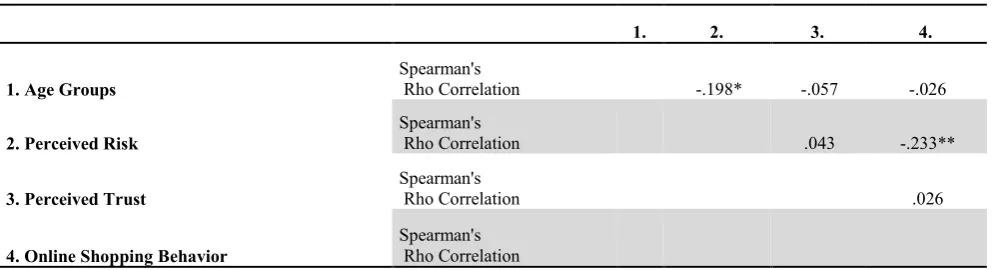
As a next step, I calculated the correlations between the age groups, demographics, the two independent variables perceived risk and trust and the dependent variable online shopping behavior via SPSS. The included demographics are gender, highest education and occupation; they all serve as control
[image:7.595.51.552.179.314.2]variables. I used Spearman’s rho to calculate the correlations since Pearson’s correlation is only used for interval and ratio variables. The results of the main concepts of this paper can be found in Table 1. In the following I will analyze the presented results. I used the book “Stats: Data and Models” of De Veau, Velleman and Bock (2011) for the interpretation of the results. As we can see in table 1, there is a significant negative correlation between the age groups and perceived Table 1. Correlation Table of the variables
1. 2. 3. 4.
1. Age Groups
Spearman's
Rho Correlation -.198* -.057 -.026
2. Perceived Risk
Spearman's
Rho Correlation .043 -.233**
3. Perceived Trust
Spearman's
Rho Correlation .026
4. Online Shopping Behavior
Spearman's
Rho Correlation
* Correlation is significant at the 0.05 level (2-tailed)
** Correlation is significant at the 0.01 level (2-tailed)
risk (Spearman’s r= -.20, p= .02). This means that there is a significant difference of risk perceptions between the age groups.
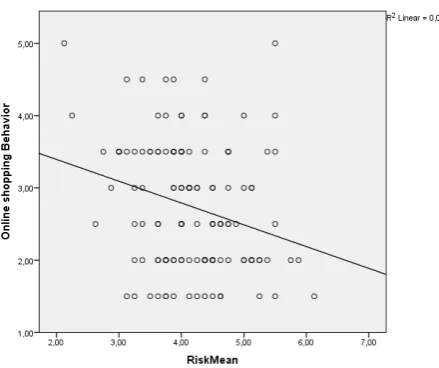
In addition there is a negative significant correlation between perceived risk and online shopping behavior (Spearman’s r= -.23, p= .01). Since the correlation is significant at the .01 level (2-tailed), we can be more certain that the correlation is genuine. This result shows that the more risk perceived by a person, the less likely he or she is to shop heavy online. A scatterplot to show the relationship between the two variables can be found in Figure 1.
The age groups are not statistically correlated to the perceived trust variable (Spearman’s r= -.06, p= .51). This means that being a Millennial is not associated with higher or lower levels of perceived trust compared to members of Generation X. Further perceived trust is not statistically correlated with online shopping behavior (Spearman’s r= .03, p= .77). This means that higher trust is not associated with higher or lower online shopping behavior.
Also no significant relationship between the age groups and online shopping behavior (Spearman’s r= -.03, p= .76) was found. Therefore, Millennials do not shop more or less online than Generation X’ers.
The two independent variables perceived risk and perceived trust show no significant correlation either (Spearman’s r= 0.4, p= .62). Thus, higher perceived risk is not associated with higher or lower perceived trust.
In addition to the main variables of this research, I observed the privacy behavior of the respondents as well. The variable has a significant positive correlation with perceived risk (Spearman’s r= 25, p= .00) and perceived trust (Spearman’s r= .22, p= .01). This means that higher privacy behavior is associated with higher perceived risk and higher perceived trust. Further the variable has a significant negative correlation with online shopping behavior (Spearman’s r= - .20, p= .02). Therefore higher privacy behavior is associated with lower online shopping behavior.
Lastly, neither the two independent variables nor the dependent variable or privacy behavior have a significant relationship with any of the control variables, in this case the demographics. The significant relationship between perceived risk and online shopping behavior is therefore not explained by any of the demographics. The full correlation table can be found in the Appendix 13.13.
According to explorable.com there is a weak correlation when the correlation coefficient falls between -0.3 to -0.1 or 0.1 to 0.3 (Statistical correlation, Abstract “Coefficient of Correlation”, 2009). All significant correlations in this research are therefore weak, since they all have a correlation coefficient which falls into that range.
Figure 1. Scatterplot for correlation Perceived Risk & Online Shopping Behavior
7.3
Univariate Analysis of Variance
(Unianova):
Analysis of variance determines whether “the means of a number of groups are equal” (Huizingh., 2007, p.277). A univariate analysis of variance (Unianova) indicates how the relationship between an independent and dependent variable is moderated by another variable (Huizingh, 2007).
The model of the independent variable perceived trust and the dependent variable online shopping behavior showed no statistically significant effect (F=(1;128) = .55, p= .46). Therefore I did not investigate the main effects or interaction effects further in my analysis.
The model of the independent variable perceived risk on the dependent variable online shopping behavior is statistically significant (F=(1;128) = 9.9, p < .01). Therefore I further investigated whether main effects or interaction effects were present. The main effect of perceived risk on the dependent variable online shopping behavior is statistically significant (see Table 2). This means that higher risk is associated with a decrease in online shopping behavior.
However I found no interaction effect for the age group variable with perceived risk (F=(1; 128) = .56, p= .46), denoting that higher perceived risk leads to more (or less) online shopping behavior, but is not moderated by the age groups.
Table 2. Unianova Tests of Between-Subjects Effects
The analyses so far showed that there is no significant relationship between the first independent variable, perceived risk, and the dependent variable, online shopping behavior. For the second independent variable, perceived risk, a significant negative relationship with the dependent variable was found. However the age groups, Millennials and Generation X, do not serve as a moderating variable.
8.
CONCLUSION
The results of the performed analyses of the previous sections help to answer the sub-questions and ultimately the main research question of this paper:
SQ1. Is there a significant difference between Millennials’ and Generation Xers’ risk perceptions?
SQ2. Is there a significant difference between Millennials’ and Generation Xers’ trust perceptions?
SQ3. To what extent does perceived risk have an impact on online shopping behavior?
SQ4. To what extent does perceived trust have an impact on online shopping behavior?
RQ. How do privacy and security perceptions of millennials compared to non-millennials affect online shopping behavior? The correlation and regression analyses showed that age does not have a significant relationship with perceived trust. They also showed that there is no significant relationship between perceived trust and the dependent variable online shopping behavior.
For the other independent variable, perceived risk, the correlation table indicates that Millennials perceive risks significantly different than members of Generation X. Perceived risk in turn has a weak significant negative relationship with the dependent variable online shopping behavior. This fits to the results of other research done in the field. The UNIANOVA showed that this relationship is not moderated by the age groups.
This means that even though the correlation analysis showed a significant difference of Millennials and Generation X’ers risk perceptions, the difference is not stable enough to still exist when the relationship of all three variables is observed. This might be explained by the weak correlation of the age groups on perceived risk or because correlations are “only appropriate for examining the relationship between meaningful quantifiable data (e.g. air pressure, temperature) rather than categorical data such as gender, favorite color etc.” (Statistical Correlation, Abstract “Coefficient of Correlation”, 2009)
Further no significant relationship between risk and trust and between the age groups and online shopping behavior was found. The control variables were also observed but did not show any relationships with the independent and dependent variables either.
Interestingly, all of the independent and dependent variables show a correlation with privacy behavior. Perceived risk and perceived trust show a significant positive correlation, whereas online shopping behavior is significantly negative correlated with privacy behavior. I assume that people with higher risk perceptions, try to secure their privacy with a cautious online shopping behavior which would explain the positive correlation. The positive correlation between perceived trust and privacy behavior might be that people are more cautious online and can therefore trust the online shopping companies since they already secured their information. Further the more people shop online, the less they do for their privacy online. This is most likely because people get more comfortable or lazy when shopping more online and reading all terms and conditions for example takes a lot of time. The actual directions of these relationships should be observed in future research. As mentioned before internet shoppers with a high degree of privacy and security perceptions perceive more risk and lower trust. Since only perceived risk showed a significant
B
Std.
Error T Sig.
95% Confidence Interval Perceived Risk -0.39
6 0.143 -2.77
5 0.0
relationship with only shopping, one can say that those people who perceive higher risk, have a high degree of privacy and security perceptions.
With this information I can answer the research question: Privacy and security perceptions’ effect on online shopping behavior is not significantly different between Millennials and Generation X’ers. Anyway, perceived risk on its own, as measure of security and privacy perceptions, has a significant negative impact on online shopping behavior.
8.1
Validation/Rejection of assumptions
These results reject most assumptions I made earlier in this paper. Millennials perceive risks significantly different than Generation X’ers, but I could not find out which one perceives more since the relationship diminishes when including online shopping behavior. All assumptions for the relationships of perceived trust are rejected, as no significant relationships were found. Since the Cronbach’s Alpha was that low, the results might be biased due to the low internal consistency of the perceived trust items. The assumption that higher perceived risk leads to a decrease in online shopping was validated in this research.
8.2
Scientific Relevance
This paper adds to the existing literature of privacy and security perceptions’ effect on online shopping behavior. As in Section 3.1 discussed, most researchers found a significant negative relationship between perceived risk and online shopping behavior. My paper came to the same conclusion even though the relationship seems to be weak. Moreover the literature of perceived trust and its effect on online shopping behavior showed mixed results, as examined in Section 3.2. This research could not find a significant relationship between the two variables. In addition, this is the first paper to observe the relationship between the age groups, Millennials and Generation X, and privacy and security perceptions. The analysis showed that Millennials perceive risk significantly different than members of Generation X. Unfortunately this relationship diminishes when we add the third variable online shopping behavior. The age groups turned out to have no effect on perceived trust.
8.3
Practical Relevance
This research showed that privacy and security perceptions, measured by perceived risk, of online shopping are still a current topic. This might be one of the reasons why physical stores are still popular and are not fully replaced by online stores yet.
Companies who offer online shops and their marketers should take this research into account. The topic of perceived risk, as measure of privacy and security perceptions, and its negative relationship with online shopping behavior is not new. Yet, it seems that there are still a lot of people who are cautious in buying online because of the possible security and privacy infringements. The first step for companies to do is to make their online shops as safe as possible. Thus making sure that private information is only stored for the intended use and neither 3rd parties nor hackers are able to steal that information.
The next step for the companies and their marketers is to communicate the safety values to their customers and potential customers. This can be communicated through the website of the online shop or through their advertisements. These people will then perceive less risk when using that particular online shop. This will increase the frequency of online purchases and the amount to be spent. I can conclude that taking perceived risks of online shopping into account, can serve as a competitive advantage for that company. The difference of the
age groups’ risk perceptions found through the correlation table indicates that one of the age groups perceives risk higher than the other. Therefore taking age and age groups into account when developing their marketing efforts to address the online shopping risks, is very important.
This research observed only German respondents, thus generalizing these results must be done with caution.
9.
LIMITATIONS
This study has several limitations which need to be addressed. First of all we did not establish our own concepts or measures for security and privacy perceptions of online shopping. Perceived risk and perceived trust might not be suitable to measure privacy and security perceptions even though they were used before. We adjusted the perceived risk and trust dimensions according to our topic, but maybe some dimensions we still kept do not fit to privacy and security perceptions of online shopping. Furthermore some dimensions might be missing since the concepts were not specifically designed for our topic. The items used to measure the perceived risk and trust dimensions were made up by our group, since we could not find an appropriate survey online. Thus necessary items could be missing or some of the items we have do not measure what we intended to measure The low Cronbach’s Alpha of perceived risk and perceived trust show that the items we created, need to be improved to measure more reliable results. Trust even had an unacceptable Cronbach’s Alpha which might explain why I could not find any significant relationships for that variable. . In order to increase the reliability and validity of perceived trust and perceived risk I deleted some items. Those items were formulated to measure all dimensions fully, which might not be the case anymore after deleting the items. We also created the items for online shopping behavior ourselves, which depicts the same question as for the other variables. Looking at some items now, we realize that they were not asked well. Some questions or statements ask two things at the same time. Secondly, we mostly reached people through Facebook. Thus people without an account were not able to participate in this survey as well as people who did not see this link during the limited time frame. This means that only people who use the internet, especially Facebook a lot, participated in this survey. This might have an influence on the findings. People who think online shopping infringes their privacy or security needs might also avoid Facebook and were not reached.
Moreover, the generalizability of the findings of this study is questionable. The sample size is relatively small (n=134) and only German respondents were taken into account. In other countries culture, values and other factors might change how privacy and security are perceived and how it relates to online shopping behavior. Also correlations were determined for categorical variables, which is not appropriate, as mentioned earlier.
Lastly, other factors than age might be moderating the relationship between perceived risk and online shopping behavior, which were not observed during this research.
10.
FUTURE RESEARCH
First, this study should be repeated in a more extended research. The sample size should be increased and the survey questions should be tested.
dimensions are influencing online shopping behavior the greatest.
Another research direction is the examination of other variables which might increase the risk perceptions.
Future research should also consider taking age, or especially the age groups I proposed in this paper, into account since a weak correlation with perceived risk was found. A more elaborate study might find some interesting differences between age groups. This might be true not only for perceived risk and online shopping behavior, but also for other research topics. The next step then would be to find out why the age groups perceive privacy and security different.
As mentioned in the conclusion, the privacy behavior and its relationship to the variables should be observed in future research.
11.
ACKNOWLEDGMENTS
First of all, I would like to thank my first supervisor Raja I. Singaram for his support and feedback on this thesis. Further I would like to thank my group for the great collaboration. I would also like to thank Theresa Lösing and Liana Brüseke for their help and support and Alena Fiona Kaiser for her help, support and peer review. Lastly, I would like to thank my family and friends which supported and encouraged me throughout the entire bachelor’s program at the University of Twente.
12.
REFERENCES
Ansari, A., & Mela, C. F. (2003). E-Customization. Journal of Marketing Research, 40(2), 131-145.
Belanger, F., Hiller, J. S., & Smith, W. J. (2002). Trustworthiness in electronic commerce: The role of privacy, security, and site attributes. The Journal of Strategic Information Systems, 11(3-4), 245-270.
Berry, L. L., Bolton, R. N., Bridges, C. H., Meyer, J., Parasuraman, A., & Seiders, K. (2010). Opportunities for Innovation in the Delivery of Interactive Retail Services.
Journal of Interactive Marketing, 24(2), 155-167.
Bhatnagar, A., Misra, S., & Rao, H. R. (2000). On risk, convenience, and Internet shopping behavior. Communications of the ACM Commun. ACM, 43(11), 98-105.
Bickel, J., & Brown, A. J. (2005). Generation X: Implications for Faculty Recruitment and Development in Academic Health Centers. Academic Medicine, 80(3), 205-210.
Bolton, R. N., Parasuraman, A., Hoefnagles, A., Migchels, N., Kabadayi, S., Gruber, T., Komarova Loureiro, Y. & Solnet, D. 2013. Understanding Generation Y and their use of social media: a review and research agenda. Journal of Service Management 24 (3), 245-267.
Burke, R. J., & Ng, E. (2006). The changing nature of work and organizations: Implications for human resource management. Human Resource Management Review, 16(2), 86-94.
Chang, M. K., Cheung, W., & Lai, V. S. (2005). Literature derived reference models for the adoption of online shopping.
Information & Management, 42(4), 543-559.
Coombes, B. 2009. Generation Y: Are they really digital natives or more like digital refugees? Synergy 7 (1), 31-40. Crampton, S. M., & Hodge, J. W. (2011). Generation Y: Unchartered Territory. Journal of Business & Economics Research (JBER) JBER, 7(4).
Cranor, L. F. (1999, February 01). Internet privacy.
Communications of the ACM Commun. ACM, 42(2), 28-38.
Davis, F. D. (1989). Perceived Usefulness, Perceived Ease of Use, and User Acceptance of Information Technology. MIS Quarterly, 13(3), 319.
De Veaux, R. D., Velleman, P. F., & Bock, D. E. (2011). Stats: Data and models. (Vol. 3) Upper Saddle River, NJ: Pearson Education.
Eastlick, M. A., Lotz, S. L., & Warrington, P. (2006). Understanding online B-to-C relationships: An integrated model of privacy concerns, trust, and commitment. Journal of Business Research, 59(8), 877-886.
Ecommerce in Germany - Ecommerce News. (n.d.). Retrieved April 6, 2016, from http://ecommercenews.eu/ecommerce-per-country/ecommerce-germany/
E-commerce securities. (n.d.). Retrieved June 20, 2016, from http://www.uky.edu/~dsianita/390/390wk4.html
Featherman, M. S., Miyazaki, A. D., & Sprott, D. E. (2010). Reducing online privacy risk to facilitate e‐service adoption: The influence of perceived ease of use and corporate credibility.
Journal of Services Marketing, 24(3), 219-229.
Featherman, M. S., & Pavlou, P. A. (2003). Predicting e-services adoption: A perceived risk facets perspective. International Journal of Human-Computer Studies,59(4), 451-474.
Foucault, B. E., & Scheufele, D. A. (2002). Web vs campus store? Why students buy textbooks online. Journal of Consumer Marketing, 19(5), 409-423.
Ganesan, S. (1994). Determinants of Long-Term Orientation in Buyer-Seller Relationships. Journal of Marketing, 58(2), 1. Gefen, D. (2000). E-commerce: The role of familiarity and trust. Omega-International Journal of Management Science, 28(6), 725-737.
Gefen, D. (2002). Nurturing clients’ trust to encourage engagement success during the customization of ERP systems.
Omega-International Journal of Management Science, 30(4), 287-299.
Gefen, D., Karahanna, E., & Straub, D. W. (2003). Trust and TAM in Online Shopping: An Integrated Model. MIS Quarterly, 27(1), 51-90.
Gefen, D., & Straub, D. (2000). The Relative Importance of Perceived Ease of Use in IS Adoption: A Study of E-Commerce Adoption. Journal of the Association for Information Systems, 1(1).
George, D., & Mallery, P. (2003). SPSS for Windows Step by Step: A Simple Guide and Reference, 11.0 Update (Vol. 4). Boston: Allyn & Bacon.
Germany E-Commerce Market Profile. (n.d.). Retrieved May 10, 2016, from https://www.about-payments.com/knowledge-base/market/germany
Goldsmith, R. E., & Goldsmith, E. B. (2002). Buying apparel over the Internet. Journal of Product & Brand Management Jnl of Product & Brand Mgt, 11(2), 89-102.
Hansen, T., Jensen, J. M., & Solgaard, H. S. (2004). Predicting online grocery buying intention: A comparison of the theory of reasoned action and the theory of planned behavior.
International Journal of Information Management, 24(6) Hoffman, D. L., Novak, T. P., & Peralta, M. (1999). Building consumer trust online. Communications of the ACM Commun. ACM, 42(4), 80-85.
extension of the theory of planned behavior. International Journal of Human-Computer Studies, 64(9), 889-904.
Huizingh, E. (2007). Applied statistics with SPSS. London: SAGE.
Immordino-Yang, M. H., Christodoulou, J. A., & Singh, V. (2012). Rest Is Not Idleness: Implications of the Brain's Default Mode for Human Development and Education. Perspectives on Psychological Science, 7(4), 352-364.
Internationale E-Commerce-Studie 2015. (n.d.). Retrieved May 10, 2016, from http://www.retailmenot.de/studien/e-commerce-studie-2015
Jacobs P. Privacy: what you need to know. InfoWorld 1997;19(44):111–2
Johnson, S. A., & Romanello, M. L. (2005). Generational Diversity. Nurse Educator, 30(5), 212-216.
Keeling, S. (2003). Advising the Millennial Generation.
NACADA Journal, 23(1-2), 30-36.
KIM, Dan J.; FERRIN, Donald L.; and RAO, H. Raghav. A Trust-Based Consumer Decision Model in Electronic Commerce: The Role of Trust, Risk, and Their Antecedents. (2008).Decision Support Systems. , 44(2) , 544-564.
Lata, M. (2014, May 22). EBay probing massive user accounts hack, urges password change. Retrieved May 18, 2016, from http://www.techtimes.com/articles/7364/20140522/ebay- probing-massive-user-accounts-hack-urges-password-change.htm
Lee, H., & Moon, H. (2015). Perceived Risk of Online Apparel Mass Customization: Scale Development and Validation.
Clothing and Textiles Research Journal, 33(2), 115-128. Li, H., Kuo, C., & Rusell, M. G. (1999). The Impact of Perceived Channel Utilities, Shopping Orientations, and Demographics on the Consumer's Online Buying Behavior.
Journal of Computer-Mediated Communication, 5(2), 0-0. Liao, Z., & Cheung, M. T. (2001). Internet-based e-shopping and consumer attitudes: An empirical study. Information & Management, 38(5), 299-306.
Liebermann, Y., & Stashevsky, S. (2002). Perceived risks as barriers to Internet and e‐commerce usage. Qualitative Mrkt Res: An Int J Qualitative Market Research: An International Journal, 5(4), 291-300.
Lim, N. (2003). Consumers’ perceived risk: Sources versus consequences. Electronic Commerce Research and Applications, 2(3), 216-228.
Lim, W. M., & Ting, D. H. (2012). E-shopping: An Analysis of the Technology Acceptance Model. Modern Applied Science MAS, 6(4), 49-62.
Malhotra, N. K., Kim, S. S., & Agarwal, J. (2004). Internet Users' Information Privacy Concerns (IUIPC): The Construct, the Scale, and a Causal Model. Information Systems Research,15(4), 336-355.
Mangold, W. G., & Smith, K. T. (2012). Selling to Millennials with online reviews. Business Horizons, 55(2), 141-153. Mcknight, D. H., Choudhury, V., & Kacmar, C. (2002). The impact of initial consumer trust on intentions to transact with a web site: A trust building model. The Journal of Strategic Information Systems, 11(3-4), 297-323.
Miyazaki, A. D., & Fernandez, A. (2001). Consumer Perceptions of Privacy and Security Risks for Online Shopping.
Journal of Consumer Affairs, 35(1), 27-44.
Monsuwé, T. P., Dellaert, B. G., & Ruyter, K. D. (2004). What drives consumers to shop online? A literature review. Int J of Service Industry Mgmt International Journal of Service Industry Management, 15(1), 102-121.
Nnambooze, B. E., & Brijball Parumasur, S. (2016). Understanding the multigenerational workforce: Are the generations significantly different or similar? Corporate Ownership & Control, 13(2), 224-237.
Oblinger, D., & Oblinger, J. L. (2005). Educating the net generation. Retrieved May 2, 2016, from
http://www.educause.edu/research-and-publications/books/educating-net-generation
Online Retailing: Britain, Europe, US and Canada 2016. (n.d.).
Retrieved April 20, 2016, from
http://www.retailresearch.org/onlineretailing.php
Prensky, M. (2001). Digital Natives, Digital Immigrants Part 1.
On the Horizon, 9(5), 1-6.
Raijas, A., & Tuunainen, V. K. (2001). Critical factors in electronic grocery shopping. The International Review of Retail, Distribution and Consumer Research, 11(3), 255-265.
Ranganathan, C., & Ganapathy, S. (2002). Key dimensions of business-to-consumer web sites. Information & Management, 39(6), 457-465.
Rust, R. T., Kannan, P. K., & Peng, N. (2002). The Customer Economics of Internet Privacy. Journal of the Academy of Marketing Science,30(4), 455-464.
Sandars, J., & Morrison, C. (2007). What is the Net Generation? The challenge for future medical education. Medical Teacher, 29(2-3), 85-88.
Shergill, G. S., & Chen, Z. (2005). WEB-BASED SHOPPING:
CONSUMERS’ ATTITUDES TOWARDS ONLINE
SHOPPING IN NEW ZEALAND. Journal of Electronic Commerce Research, 6(2), 79-94.
Shim, S., Eastlick, M. A., Lotz, S. L., & Warrington, P. (2001). An online prepurchase intentions model. Journal of Retailing, 77(3), 397-416.
Sin, L., & Tse, A. (2002). Profiling Internet Shoppers in Hong Kong. Journal of International Consumer Marketing, 15(1), 7-29.
Smith, C. (2015, April 27). Gen X and baby boomers present a huge opportunity for online retailers. Retrieved May 7, 2016, from http://www.businessinsider.de/the-age-demographics-of-who-shops-online-and-on-mobile-2015-4?r=US&IR=T Statistical Correlation. (May 2, 2009). Retrieved Jun 14, 2016 from Explorable.com: https://explorable.com/statistical-correlation
Tapscott, D. (n.d.). Growing Up Digital: The Rise of the Net Generation. Retrieved May 03, 2016, from https://www.ncsu.edu/meridian/jan98/feat_6/digital.html Tavakol, M., & Dennick, R. (2011). Making sense of Cronbach's alpha. Int. J. Medical Education International Journal of Medical Education, 2, 53-55.
U.S. Generation X (Gen X): Grocery Shopping Behavior. (n.d.).
Retrieved May 07, 2016, from
http://www.statista.com/topics/1865/us-millennials-grocery-shopping-behavior/
May 3, 2016, from https://jyx.jyu.fi/dspace/handle/123456789/48373
Williams, E. (n.d.). Generation X Consumer Behavior.
Retrieved May 07, 2016, from
http://yourbusiness.azcentral.com/generation-x-consumer-behavior-9585.html
Yoon, S. (2002). The antecedents and consequences of trust in online-purchase decisions. Journal of Interactive Marketing,
13.
APPENDIX
13.1
Table Item Creation Perceived Risk and Perceived Trust
Conce
pt Dimension Definition Item Source
Privacy Risk
“consumer’s subjective evaluative assessment
of potential losses to the privacy of confidential
1. I believe that my personal information is
protected during online shopping
Featherma n, Miyazaki and Sprott (2010)
identifying information, including the assessment
of potential misuse of that information that may
2. I am aware that my private data can be
given to 3rd parties by online
shopping sites
result in identity theft” (p.220). 3. I am aware that advertisement is based
on my prior searches and shopping
behavior
4. I receive newsletters/mails from online
shops I did not register for Source
Risk
The risk that businesses are not trustworthy
leading to its customers to suffer.
5. The possibility that online shops are
fake is high
Lim (2003)
Risk
6. The possibility that my online purchase
will not be delivered is high 7. I buy from online shops without a physical store
Transactio n
Involves risks occurring during the Internet
8. I am afraid to use my credit card online Kim, Ferrin & Rao Security Risk
purchase including credit card fraud. 9. The possibility that hackers will steal my
credit card information is low
.(2008)
10. The possibility that my credit card
information is sold to third parties is
high
11. In general I trust mainstream online
payment methods
Cognition -based
Is related to consumer’s observations and
perceptions.
12. The product information I get in online
shops is complete and understandable
Kim, Ferrin &
Rao (2008)
Trust 13. Privacy policies in online shops
are
easily accessible and understandable
Trust
14. I expect mainstream online shops to
fulfill basic digital security protection(s)
Affect-based
trust
Based on indirect interactions with the consumer through inputs from a third party like recommendations or third-party seals
15. I check for safety logos and certification
(eg. trusted e-shops) in online shops before I purchase. Kim, Ferrin & Rao (2008)
16. I ask friends and family for recommendations of an online shop before I
17. I read reviews of an online shop before I
purchase
13.2
Survey English
In order to get the necessary data for the analysis, we made a survey with Qualtrics. We distributed the following survey among family, friends and Facebook.
How do you shop online? - Bachelor Thesis Final Version
Introduction
Dear participants,
Thank you for taking your time to participate in the Online Shopping survey. It will only take 5 - 10 minutes to answer this survey. It is part of our bachelor thesis at the University of Twente, Enschede, The Netherlands. We truly value the information you will provide. Please answer the questions honestly and choose the answer you first think of. All the data you provide will be confidential.
The data is protected against unauthorized publishing, manipulation or damage. The information collected is only used for the purposes of academic research. Your participation in this study is voluntary, you can stop the survey anytime without giving any reasons. Of course we still appreciate if you answer the whole survey - the more answers the better our survey result.
Please click on the ">>" button to move to the next page.
Q47 Page: 1/6
Demographics 1 How old are you? (fill in the number only, e.g. 56)
Demographics 2 What is you gender?
Male (1)
Female (2)
Demographics 3 What is your nationality?
German (1)
Dutch (2)
Belgian (3)
Chinese (4)
Other (please fill in below) (5) ____________________
Demographics 4 What is your current occupation?
Student (1)
Employed (2)
Self-employed (3)
Unemployed (4)
Retired (5)
Stay-at-home (6)
Demographics 5 What is your highest education?
Below High school (1)
High school graduate (2)
College graduate (8)
Trade/technical/vocational training (3)
Associate degree (4)
Bachelor degree (5)
Master degree (6)
Doctorate degree (7)
Professional degree (14)
Q48 Page: 2/6
Online Shopping 1 Online Shopping Behavior
The following questions will help us to get to know your individual shopping behavior. Please answer openly and truthfully. Click on your most appropriate choice.
Online Shopping 2 How often do you use the Internet?
Several times a day (4)
Once a day (3)
Several times a week (9)
Once a week (6)
Seldom (8)
Online Shopping 3 I use the Internet to search for a product, but actually buy the product in a retail store
1 (1) 2 (2) 3 (3) 4 (4) 5 (5) 6 (6) 7 (7)
Never:Always (1)
Online Shopping 4 I look for product information in a retail store, but buy the product in an online shop
1 (1) 2 (2) 3 (3) 4 (4) 5 (5) 6 (6) 7 (7)
Never:Always (1)
Online Shopping 5 I search for product information on the Internet and buy the product in an online shop
1 (1) 2 (2) 3 (3) 4 (4) 5 (5) 6 (6) 7 (7)
Never:Always (1)
Online Shopping 6 For how long have you been shopping online?
Less than 1 year (1)
1-3 years (2)
4 years or more (3)
Online Shopping 7 How often did you shop online in the past year?
Never (1)
6 - 10 times a year (3)
Once a month (4)
Several times a month (5)
Online Shopping 8 What type of products do you usually buy online? (multiple answers possible)
Fashion (1)
Electronics & Software (2)
Books, Music, Films etc. (3)
Mobile Phone Apps (4)
Health care/ Pharmaceutical products (5)
Travel (6)
Home and Garden (7)
Sports (8)
Motors (cars, equipment, etc.) (9)
Groceries (10)
Cosmetic products (12)
Others (please fill in below) (11) ____________________
Online Shopping 9 How much money do you spend on average per month for online shopping in Euros?
0-50 (1)
50-100 (2)
100-200 (3)
200-500 (4)
500+ (5)
Online Shopping 10 Which online payment methods do you know and use? (multiple answers possible)
Credit card (1)
PayPal (2)
iDeal (3)
Klarna (4)
Cash on delivery (5)
Direct debit (6)
In-app purchases (7)
Digital wallet (8)
Bitcoin (9)
AliPay (10)
Wechat (11)
Other (please fill in below) (12) ____________________
Online Shopping 11 What is the payment method you feel most safe with?
Credit card (1)
PayPal (2)
iDeal (3)
Klarna (4)
Cash on delivery (5)
Direct debit (6)
In-app purchases (7)