Efficient Parsing of Well-Nested Linear Context-Free Rewriting Systems
Carlos Gómez-Rodríguez1, Marco Kuhlmann2, and Giorgio Satta3
1Departamento de Computación, Universidade da Coruña, Spain,[email protected] 2Department of Linguistics and Philology, Uppsala University, Sweden,
3Department of Information Engineering, University of Padua, Italy,
Abstract
The use of well-nested linear context-free rewriting systems has been empirically moti-vated for modeling of the syntax of languages with discontinuous constituents or relatively free word order. We present a chart-based pars-ing algorithm that asymptotically improves the known running time upper bound for this class of rewriting systems. Our result is obtained through a linear space construction of a binary normal form for the grammar at hand.
1 Introduction
Since its earliest years, one of the main goals of computational linguistics has been the modeling of natural language syntax by means of formal gram-mars. Following results by Huybregts (1984) and Shieber (1985), special attention has been given to formalisms that enlarge the generative power of con-text-free grammars, but still remain below the full generative power of context-sensitive grammars. On this line of investigation, mildly context-sensitive grammar formalismshave been introduced (Joshi, 1985), including, among several others, the tree ad-joining grammars (TAGs) of Joshi et al. (1975).
Linear context-free rewriting system (LCFRS), in-troduced by Vijay-Shanker et al. (1987), is a mildly context-sensitive formalism that allows the deriva-tion of tuples of strings, i.e., discontinuous phrases. This feature has been used to model phrase structure treebanks with discontinuous constituents (Maier and Søgaard, 2008), as well as to map non-projective de-pendency trees into discontinuous phrase structures (Kuhlmann and Satta, 2009).
Informally, in an LCFRSG, each nonterminal can generate string tuples with a fixed number of compo-nents. Thefan-outofGis defined as the maximum number of tuple components generated byG. During a derivation of an LCFRS, tuple components gener-ated by the nonterminals in the right-hand side of a production are concatenated to form new tuples, possibly adding some terminal symbols. The only re-striction applying to these generalized concatenation operations is linearity, that is, components cannot be duplicated or deleted.
The freedom in the rearrangement of components has specific consequences in terms of the computa-tional and descripcomputa-tional complexity of LCFRS. Even for grammars with bounded fan-out, the universal recognition problem is NP-hard (Satta, 1992), and these systems lack Chomsky-like normal forms for fixed fan-out (Rambow and Satta, 1999) that are es-pecially convenient in tabular parsing. This is in con-trast with other mildly context-sensitive formalisms, and TAG in particular: TAGs can be parsed in poly-nomial time both with respect to grammar size and string size, and they can be cast in normal forms having binary derivation trees only.
It has recently been argued that LCFRS might be too powerful for modeling languages with discontin-uous constituents or with relatively free word order, and that additional restrictions on the rearrangement of components might be needed. More specifically, analyses of both dependency and constituency tree-banks (Kuhlmann and Nivre, 2006; Havelka, 2007; Maier and Lichte, 2009) have shown that rearrange-ments of argument tuples almost always satisfy the so-calledwell-nestedness condition, a generalization
of the standard condition on balanced brackets. This condition states that any two componentsx1, x2of some tuple will never be composed with any two componentsy1, y2 of some other tuple in such a way that a ‘crossing’ configuration is realized.
In this paper, we contribute to a better understand-ing of the formal properties of well-nested LCFRS. We show that, when fan-out is bounded by any inte-gerϕ≥1, these systems can always be transformed, in an efficient way, into a specific normal form with no more than two nonterminals in their productions’ right-hand sides. On the basis of this result, we then develop an efficient parsing algorithm for well-nested LCFRS, running in timeO(ϕ· |G| · |w|2ϕ+2), where Gand w are the input grammar and string, respectively. Well-nested LCFRS with fan-outϕ= 2
are weakly equivalent to TAG, and our complex-ity result reduces to the well-known upper bound
O(|G| · |w|6) for this class. Forϕ > 2, our upper bound is asymptotically better than the one obtained from existing parsing algorithms for general LCFRS or equivalent formalisms (Seki et al., 1991).
Well-nested LCFRS are generatively equivalent to (among others) coupled context-free grammars (CCFG), introduced by Hotz and Pitsch (1996). These authors also provide a normal form and de-velop a parsing algorithm for CCFGs. One difference with respect to our result is that the normal form for CCFGs allows more than two nonterminals to appear in the right-hand side of a production, even though no nonterminal may contribute more than two tuple com-ponents. Also, the construction in (Hotz and Pitsch, 1996) results in a blow-up of the grammar that is ex-ponential in its fan-out, and the parsing algorithm that is derived runs in timeO(4ϕ· |G| · |w|2ϕ+2). Our result is therefore a considerable asymptotic improve-ment over the CCFG result, both with respect to the normal form construction and the parsing efficiency. Finally, under a practical perspective, our parser is a simple chart-based algorithm, while the algorithm in (Hotz and Pitsch, 1996) involves two passes and is considerably more complex to analyze and to imple-ment than ours.
Kanazawa and Salvati (2010) mention a normal form for well-nested multiple context-free grammars.
Structure In Section 2, we introduce LCFRS and the class of well-nested LCFRS that is the focus of
this paper. In Section 3, we discuss the parsing com-plexity of LCFRS, and show why grammars using our normal form can be parsed efficiently. Section 4 presents the transformation of a well-nested LCFRS into the normal form. Section 5 concludes the paper.
2 Linear Context-Free Rewriting Systems
We write[n]to denote the set of positive integers up to and includingn:[n] ={1, . . . , n}.
2.1 Linear, non-erasing functions
Let Σ be an alphabet. For integers m ≥ 0 and
k1, . . . , km, k≥1, a total function
f : (Σ∗)k1× · · · ×(Σ∗)km →(Σ∗)k
is called alinear, non-erasing functionoverΣwith typek1× · · · ×km → k, if it can be defined by an equation of the form
f(hx1,1, . . . , x1,k1i, . . . ,hxm,1, . . . , xm,kmi) =~α,
where~αis ak-tuple of strings over the variables on the left-hand side of the equation andΣ with the property that each variable occurs in~αexactly once. The valuesmandkare called therankand the fan-outoff, and denoted byρ(f)andϕ(f).
2.2 Linear Context-Free Rewriting Systems
For the purposes of this paper, alinear context-free rewriting system, henceforth LCFRS, is a construct
G= (N, T, P, S), whereN is an alphabet of nonter-minal symbols in which each symbolAis associated with a positive integerϕ(A)called itsfan-out,T is an alphabet of terminal symbols,S∈N is a distin-guished start symbol withϕ(S) = 1; andPis a finite set of productions of the form
p = A→f(A1, . . . , Am),
wherem≥0,A, A1, . . . , Am∈N, andf is a linear, non-erasing function over the terminal alphabetT
with typeϕ(A1)× · · · ×ϕ(Am)→ϕ(A), called the composition operationassociated withp. Therank ofGand thefan-outofGare defined as the maximal rank and fan-out of the composition operations ofG, and are denoted byρ(G)andϕ(G).
The sets ofderivation treesofGare the smallest indexed family of setsDA,A∈N, such that, if
N ={S, R}, T ={a, b, c, d}, P ={p1 =S→f1(R), p2 =R→f2(R), p3 =R→f3}, where: f1(hx1,1, x1,2i) =hx1,1x1,2i, f2(hx1,1, x1,2i) =ha x1,1b, c x1,2di, f3 =hε, εi.
Figure 1: An LCFRS that generates the string language{anbncndn|n≥0}.
is a production ofGandti ∈ DAi for alli∈ [m],
thent =p(t1, . . . , tm) ∈ DA. By interpreting pro-ductions as their associated composition operations in the obvious way, a derivation treet∈DA evalu-ates to aϕ(A)-tuple of strings overT; we denote this tuple byval(t). Thestring languagegenerated byG, denoted byL(G), is then defined as
L(G) = {w∈T∗ |t∈DS, hwi=val(t)}.
Two LCFRS are called weakly equivalent, if they generate the same string language.
Example Figure 1 shows a sample LCFRSGwith
ρ(G) = 1and ϕ(G) = 2. The sets of its deriva-tion trees are DR = {pn2(p3) | n ≥ 0} and
DS = {p1(t) | t ∈ DR}. The string language generated byGis{anbncndn|n≥0}.
2.3 Characteristic strings
In the remainder of this paper, we use the following convenient syntax for tuples of strings. Instead of
hv1, . . . , vki, we write v1$· · ·$vk,
using the$-symbol to mark the component bound-aries. We call this thecharacteristic stringof the tu-ple, and an occurrence of the symbol$agap marker. We also use this notation for composition operations. For example, the characteristic string of the operation
f(hx1,1, x1,2i,hx2,1i) = ha x1,1x2,1, x1,2bi isa x1,1x2,1$x1,2b. If we assume the variables on the left-hand side of an equation to be named ac-cording to the schema used in Section 2.1, then the characteristic string of a composition operation deter-mines that operation completely. We will therefore freely identify the two, and write productions as
p = A→[v1$· · ·$vk](A1, . . . , Am), where the string inside the brackets is the charac-teristic string of some composition operation. The substringsv1, . . . , vk are called thecomponentsof the characteristic string. Note that the character-istic string of a composition operation with type
k1 × · · · × km → k is a sequence of terminal symbols, gap markers, and variables from the set
{xi,j |i ∈[m], j ∈ [ki]}in which the number of gap markers isk−1, and each variable occurs exactly once. When in the context of such a composition op-eration we refer to ‘a variable of the formxi,j’, then it will always be the case thati∈[m]andj∈[ki].
The identification of composition operations and their characteristic strings allows us to construct new operations by string manipulations: if, for example, we delete some variables from a characteristic string, then the resulting string still defines a composition operation (after a suitable renaming of the remaining variables, which we leave implicit).
2.4 Canonical LCFRS
To simplify our presentation, we will assume that LCFRS are given in a certain canonical form. Intu-itively, this canonical form requires the variables in the characteristic string of a composition operation to be ordered in a certain way.
Formally, the defining equation of a composition operationf with typek1× · · · ×km →kis called canonical, if (i) the sequence obtained fromf by reading variables of the formxi,1from left to right has the formx1,1· · ·xm,1; and (ii) for eachi∈[m], the sequence obtained fromf by reading variables of the form xi,j from left to right has the form
xi,1· · ·xi,ki. An LCFRS is calledcanonical, if each
of its composition operations is canonical.
We omit the proof that every LCFRS can be trans-formed into a weakly equivalent canonical LCFRS. However, we point out that both the normal form and the parsing algorithm that we present in this paper can be applied also to general LCFRS. This is in con-trast to some left-to-right parsers in the literature on LCFRS and equivalent formalisms (de la Clergerie, 2002; Kallmeyer and Maier, 2009), which actually depend on productions in canonical form.
2.5 Well-nested LCFRS
defines well-nested multiple context-free grammars, which are weakly equivalent to well-nested LCFRS. A composition operation is calledwell-nested, if it does not contain a substring of the form
xi,i1· · ·xj,j1· · ·xi,i2· · ·xj,j2, wherei6=j. For example, the operationx1,1x2,1$x2,2x1,2is well-nested, whilex1,1x2,1$x1,2x2,2is not. An LCFRS is called well-nested, if it contains only well-nested composition operations.
The class of languages generated by well-nested LCFRS is properly included in the class of languages generated by general LCFRS; see Kanazawa and Sal-vati (2010) for further discussion.
3 Parsing LCFRS
We now discuss the parsing complexity of LCFRS, and motivate our interest in a normal form for well-nested LCFRS.
3.1 General parsing schema
A bottom-up, chart-based parsing algorithm for the class of (not necessarily well-nested) LCFRS can be defined by using the formalism of parsing schemata (Sikkel, 1997). The parsing schemata approach con-siders parsing as a deduction process (as in Shieber et al. (1995)), generating intermediate results called items. Starting with an initial set of items obtained from each input sentence, a parsing schema defines a set of deduction steps that can be used to infer new items from existing ones. Each item contains information about the sentence’s structure, and a suc-cessful parsing process will produce at least onefinal itemcontaining a full parse for the input.
The item set used by our bottom-up algorithm to parse an input stringw=a1· · ·anwith an LCFRS
G= (N, T, P, S)will be
I ={[A,(l1, r1), . . . ,(lk, rk)]|A∈N ∧
0≤li ≤ri≤n ∀i∈[k]},
where an item[A,(l1, r1), . . . ,(lk, rk)]can be inter-preted as the set of those derivation trees t ∈ DA ofGfor which
val(t) = al1+1· · ·ar1 $· · ·$alk+1· · ·ark.
The set of final items is thusF ={[S,(0, n)]}, con-taining full derivation trees that evaluate tow.
For simplicity of definition of the sets of initial items and deduction steps, let us assume that pro-ductions of rank>0in our grammar do not contain
terminal symbols in their right-hand sides. This can be easily achieved from a starting grammar by cre-ating a nonterminalAafor each terminala ∈ T, a corresponding rank-0productionpa=Aa→[a](), and then changing each occurrence ofain the char-acteristic string of a production to the single variable associated with the fan-out1nonterminalAa. With this, our initial item set for a stringa1· · ·anwill be
H={[Aai,(i−1, i)]|i∈[n]},
and each productionp=A0 → f(A1, . . . , Am)of
G(excluding the ones we created for the terminals) will produce a deduction step of the form given in Figure 2a, where the indexes are subject to the fol-lowing constraints, imposed by the semantics off.
1. If thekth component of the characteristic string off starts withxi,j, thenl0,k =li,j.
2. If thekth component of the characteristic string off ends withxi,j, thenr0,k =ri,j.
3. Ifxi,jxi0,j0is an infix of the characteristic string off, thenri,j =li0,j0.
4. If thekth component of the characteristic string off is the empty string, thenl0,k =r0,k.
3.2 General complexity
The time complexity of parsing LCFRS with respect to the length of the input can be analyzed by counting the maximum number of indexes that can appear in an instance of the inference rule above. Although the total number of indexes isPm
i=02·ϕ(Ai), some of these indexes are equated by the constraints.
[A1,(l1,1, r1,1), . . . ,(l1,ϕ(A1), r1,ϕ(A1))] · · · [Am,(lm,1, rm,1), . . . ,(lm,ϕ(Am), rm,ϕ(Am))]
[A0,(l0,1, r0,1), . . . ,(l0,ϕ(A0), r0,ϕ(A0))]
(a) The general rule for a parsing schema for LCFRS
[B,(l1, r1), . . . ,(lm, rm)] [C,(l01, r01), . . .(l0n, r0n)]
[A,(l1, r1), . . . ,(lm, r01), . . .(l0n, r0n)]
rm=l01
(b) Deduction step for concatenation
[B,(l1, r1), . . . ,(lm, rm)] [C,(l01, r
0
1), . . .(l
0
n, r
0
n)]
[A,(l1, r1), . . . ,(li, r01), . . .(l0n, ri+1), . . . ,(lm, rm)]
ri=l10, r0n=li+1
[image:5.612.183.502.113.220.2](c) Deduction step for wrapping
Figure 2: Deduction steps for parsing LCFRS.
Thus, theparsing complexity(Gildea, 2010) of a productionp=A0 →f(A1, . . . , Am)is determined byϕ(A0)l-indexes and
P
i∈[m]ϕ(Ai)r-indexes, for a total complexity of
O(|w|ϕ(A0)+Pi∈[m]ϕ(Ai))
where|w|is the length of the input string. The pars-ing complexity of an LCFRS will correspond to the maximum parsing complexity among its productions. Note that this general complexity matches the result given by Seki et al. (1991).
In an LCFRS of rankρand fan-outϕ, the maxi-mum possible parsing complexity isO(|w|ϕ(ρ+1)), obtained by applying the above expression to a pro-duction of rankρand where each nonterminal has fan-outϕ. The asymptotic time complexity of LCFRS parsing is therefore exponential both in its rank and its fan-out. This means that it is interesting to trans-form LCFRS into equivalent trans-forms that reduce their rank while preserving the fan-out. For sets of LCFRS that can be transformed into abinaryform (i.e., such that all its rules have rank at most2), theρfactor in the complexity is reduced to a constant, and complex-ity is improved toO(|w|3ϕ)(see Gómez-Rodríguez et al. (2009) for further discussion). Unfortunately, it is known by previous results (Rambow and Satta, 1999) that it is not always possible to convert an LCFRS into such a binary form without increasing the fan-out. However, we will show that it is always possible to build such a binarization forwell-nested LCFRS. Combining this result with the inference rule and complexity analysis given above, we would obtain a parser for well-nested LCFRS running in
O(|w|3ϕ) time. But the construction of our binary normal form additionally restricts binary composition operations in the binarized LCFRS to be of two spe-cific forms,concatenationandwrapping, which fur-ther improves the parsing complexity toO(|w|2ϕ+2), as we will see below.
3.3 Concatenation and wrapping
A composition operation is called aconcatenation operation, if its characteristic string has the form
x1,1$· · ·$x1,mx2,1$· · ·$x2,n,
wherem, n≥1. Intuitively, such an operation corre-sponds to the bottom-up combination of two adjacent discontinuous constituents into one. An example of a concatenation operation is the binary parsing rule used by the standard CKY parser for context-free grammars, which combines continuous constituents (represented as1-tuples of strings in the LCFRS nota-tion). In the general case, a concatenation operation will take an m-tuple and ann-tuple and return an
(m+n−1)-tuple, as the joined constituents may have gaps that will also appear in the resulting tuple.
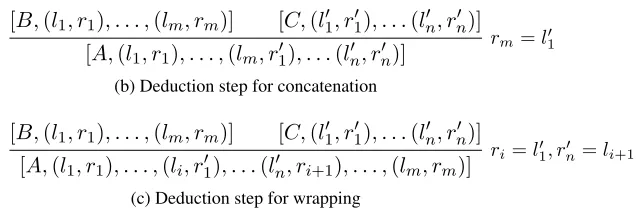
If we apply the general parsing rule given in Fig-ure 2a to a productionA→conc(B, C), whereconc is a concatenation operation, then we obtain the de-duction step given in Figure 2b. This step uses2m
before: p · · ·
t1 tm
after: p0
q
· · ·
tq,1 tq,mq
r
· · ·
[image:6.612.96.274.67.213.2]tr,1 tr,mr
Figure 3: Transformation of derivation trees
A linear, non-erasing function is called awrapping operation, if its characteristic string has the form
x1,1$· · ·$x1,ix2,1$· · ·$x2,nx1,i+1$· · ·$x1,m,
wherem, n≥1andi∈[m−1]. Intuitively, such an operation wraps the tuple derived from a nontermi-nalBaround the tuple derived from a nonterminalC, filling theith gap in the former. An example of a wrapping operation is the adjunction of an auxiliary tree in tree-adjoining grammar. In the general case, a wrapping operation will take anm-tuple and ann -tu-ple and return an(m+n−2)-tuple of strings: the gaps of the argument tuples appear in the obtained tuple, except for one gap in the tuple derived fromB
which is filled by the tuple derived fromC.
By applying the general parsing rule in Figure 2a to a productionA → wrapi(B, C), wherewrapi is a wrapping operation, then we obtain the deduction step given in Figure 2c. This step uses2mdifferentl -andr-indexes, and2n−2differentl0- andr0-indexes (discounting l01 andrn0 which are equal to other in-dexes), for a total of2m+2n−2 = 2(m+n−2)+2
indexes. Since the fan-out ofAism+n−2, this means that a wrapping operation needs at most2ϕ+2
indexes for an LCFRS of fan-outϕ.
From this, we conclude that an LCFRS of fan-out ϕ in which all composition operations are ei-ther concatenation operations, wrapping operations, or operations of rank0or1, can be parsed in time
O(|w|2ϕ+2). In particular, nullary and unary compo-sition operations do not affect this worst-case com-plexity, since their associated deduction steps can never have more than2ϕindexes.
4 Transformation
We now show how to transform a well-nested LCFRS into the normal form that we have just described.
4.1 Informal overview
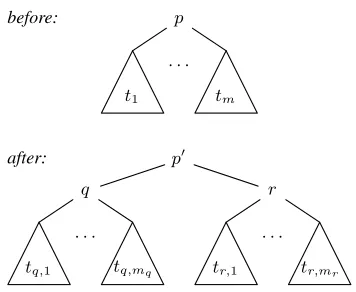
Consider a production p = A → f(A1, . . . , Am), wherem≥2andf is neither a concatenation nor a wrapping operation. We will construct new produc-tionsp0, q, rsuch that every derivation that usespcan be rewritten into a derivation that uses the new pro-ductions, and the new productions do not license any other derivations. Formally, this can be understood as implementing atree transformation, where the input trees are derivations of the original grammar, and the output trees are derivations of the new grammar. The situation is illustrated in Figure 3. The tree on top represents a derivation in the original grammar; this derivation starts with the rewriting of the nontermi-nalAusing the productionp, and continues with the subderivationst1, . . . , tm. The tree at the bottom rep-resents a derivation in the transformed grammar. This derivation starts with the rewriting ofAusing the new productionp0, and continues with two independent subderivations that start with the new productionsq
andr, respectively. The sub-derivationst1, . . . , tm have been partitioned into two sequences
t1,1, . . . , t1,m1 and t2,1, . . . , t2,m2.
The new productionp0 will be either a concatenation or a wrapping operation, and the rank of bothqandr
will be strictly smaller than the rank ofp. The trans-formation will continue withq andr, unless these have rank one. By applying this strategy exhaustively, we will thus eventually end up with a grammar that only has productions with rank at most 2, and in which all productions with rank2are either concate-nation or wrapping operations.
4.2 Constructing the composition operations
To transform the productionp, we first factorize the composition operationf associated withpinto three new composition operationsf0, g, has follows. Re-call that we represent composition operations by their characteristic strings.
property can be ensured, without affecting the asymp-totic complexity, by adding intermediate steps to the transformation that we report here; we omit the de-tails due to space reasons. When this property holds, we are left with the following two cases. Let us call a sequence of variablesjoint, if it contains all and only variables associated with a given nonterminal.
Case 1 f = x1f1x2· · ·xk−1fk−1xkf∗, wherek≥1,x1, . . . , xkare joint variables, and the suffixf∗contains at least one variable. Let
g = x1f1x2· · ·xk−1fk−1xk,
leth =f∗, and letf0 =conc. Asf is well-nested, bothgandhdefine well-nested composition opera-tions. By the specific segmentation off, the ranks of these operations are strictly smaller than the rank off. Furthermore, we haveϕ(f) = ϕ(g) +ϕ(h)−1.
Case 2 f = x1f1x2· · ·xk−1fk−1xk,
wherek≥2,x1, . . . , xkare joint variables, and there exist at least oneisuch that the sequencefi contains at least one variable. Choose an indexjas follows: if there is at least oneisuch thatficontains at least one variable and one gap marker, letjbe the minimal suchi; otherwise, letjbe the minimalisuch thatfi contains at least one variable. Now, let
g = x1f1x2· · ·xj$xj+1· · ·xk−1fk−1xk, leth=fj, and letf0 =wrapj. As in Case 1, bothg
and h define well-nested composition operations whose ranks are strictly smaller than the rank off. Furthermore, we haveϕ(f) = ϕ(g) +ϕ(h)−2.
Note that at most one of the two cases can apply tof. Furthermore, sincef is well-nested, it is also true that at least one of the two cases applies. This is so because for two distinct nonterminalsAi, Ai0, either all variables associated withAi0 precede the leftmost variable associated with Ai, succeed the rightmost variable associated withAi, or are placed between two variables associated withAiwithout an-other variable associated withAiintervening. (Here, we have left out the symmetric cases.)
4.3 Constructing the new productions
Based on the composition operations, we now con-struct three new productionsp0, q, ras follows. LetB
andCbe two fresh nonterminals withϕ(B) =ϕ(g)
and ϕ(C) = ϕ(h), and let p0 = A → f0(B, C). The production p0 rewrites A into B and C and
combines the two subderivations that originate at these nonterminals using either a concatenation or a wrapping operation. Now, letAq,1, . . . , Aq,mq and
Ar,1, . . . , Ar,mr be the sequences of nonterminals
that are obtained from the sequenceA1, . . . , Amby deleting those nonterminals that are not associated with any variable ingorh, respectively. Then, let
q=B →g(Aq,1, . . . , Aq,mq) and
r=C →h(0Ar,1, . . . , Ar,mr).
4.4 Example
We now illustrate the transformation using the con-crete productionp=A→f(A1, A2, A3), where
f = x1,1x2,1$x1,2$x3,1.
Note that this operation has rank3and fan-out3. The composition operations are constructed as fol-lows. The operationf matches the pattern of Case 1, and hence induces the operations
g1=x1,1x2,1$x1,2, h1 = $x3,1, f10 =conc.
The productions constructed from these are
p01=A→conc(B1, C1),
q1=B1 →g1(A1, A2), r1=C1 →h1(A3).
whereB1 and C1 are fresh nonterminals with fan-out2. The productionr1has rank one, so it does not require any further transformations. The transforma-tion thus continues withq1. The operationg1matches the pattern of Case 2, and induces the operations
g2 =x1,1$x1,2, h2=x2,1$, f20 =wrap1.
The productions constructed from these are
p02 =B1→wrap1(B2, C2),
q2=B2→g2(A1), r2 =C2→h2(A2), whereB2 and C2 are fresh nonterminals with fan-out2. At this point, the transformation terminates. We can now deletepfrom the original grammar, and replace it with the productions{p01, r1, p02, q2, r2}.
4.5 Correctness
To see that the transformation is correct, we need to verify that each production of the original grammar is transformed into a set of equivalent normal-form productions, and that the fan-out of the new grammar does not exceed the fan-out of the old grammar.
rank of a production is at most2and the production does not use a concatenation or wrapping operation. That the new productions are equivalent to the old ones in the sense of Figure 3 can be proved by induc-tion on the length of a derivainduc-tion in the original and the new grammar, respectively.
Let us now convince ourselves that the fan-out of the new grammar does not exceed the fan-out of the old grammar. This is clear in Case 1, where
ϕ(f) = ϕ(g) +ϕ(h)−1
implies that bothϕ(g) ≤ ϕ(f) andϕ(h) ≤ ϕ(f). For Case 2, we reason as follows. The fan-out of the operationh, being constructed from an infix of the characteristic string of the original operationf, is clearly bounded by the fan-out off. Forg, we have
ϕ(g) = ϕ(f)−ϕ(h) + 2,
Now suppose that the indexjwas chosen according to the first alternative. In this case,ϕ(h)≥2, and
ϕ(g) ≤ ϕ(f)−2 + 2 = ϕ(f).
For the case wherej was chosen according to the second alternative, ϕ(f) < k (since there are no immediate repetitions of gap markers), ϕ(h) = 1, andϕ(g)≤k. If we assume that each nonterminal is productive, then this means that the underlying LCFRS has at least one production with fan-outkor more; therefore, the fan-out ofgdoes not increase the fan-out of the original grammar.
4.6 Complexity
To conclude, we now briefly discuss the space com-plexity of the normal-form transformation. We mea-sure it in terms of thelengthof a production, defined as the length of its string representation, that is, the stringA→[v1$· · ·$vk](A1, . . . , Am).
Looking at Figure 3, we note that the normal-form transformation of a productionpcan be understood as the construction of a (not necessarily complete) binary-branching tree whose leaves correspond to the productions obtained by splitting the characteristic string ofpand whose non-leaf nodes are labeled with concatenation and wrapping operations. By construc-tion, the sum of the lengths of leaf-node productions isO(|p|). Since the number of inner nodes of a bi-nary tree with nleaves is bounded by n−1, we know that the tree hasO(ρ(p))inner nodes. As these nodes correspond to concatenation and wrapping
operations, each inner-node production has length
O(ϕ(p)). Thus, the sum of the lengths of the produc-tions created from|p|isO(|p|+ρ(p)ϕ(p)). Since the rank of a production is always smaller than its length, this is reduced toO(|p|ϕ(p)).
Therefore, the size of the normal-form transfor-mation of an LCFRSGof fan-outϕisO(ϕ|G|)in the worst case, and linear space in practice, since the fan-out is typically bounded by a small integer. Taking the normal-form transformation into account, our parser therefore runs in timeO(ϕ· |G| · |w|2ϕ+2) where|G|is the original grammar size.
5 Conclusion
In this paper, we have presented an efficient parsing algorithm for well-nested linear context-free rewrit-ing systems, based on a new normal form for this formalism. The normal form takes up linear space with respect to grammar size, and the algorithm is based on a bottom-up process that can be applied to any LCFRS, achievingO(ϕ· |G| · |w|2ϕ+2)time complexity when applied to LCFRS of fan-out ϕ
in our normal form. This complexity is an asymp-totic improvement over existing results for this class, both from parsers specifically geared to well-nested LCFRS or equivalent formalisms (Hotz and Pitsch, 1996) and from applying general LCFRS parsing techniques to the well-nested case (Seki et al., 1991).
The class of well-nested LCFRS is an interest-ing syntactic formalism for languages with discon-tinuous constituents, providing a good balance be-tween coverage of linguistic phenomena in natu-ral language treebanks (Kuhlmann and Nivre, 2006; Maier and Lichte, 2009) and desirable formal prop-erties (Kanazawa, 2009). Our results offer a further argument in support of well-nested LCFRS: while the complexity of parsing general LCFRS depends on two dimensions (rank and fan-out), this bidimen-sional hierarchy collapses into a single dimension in the well-nested case, where complexity is only conditioned by the fan-out.
References
Éric Villemonte de la Clergerie. 2002. Parsing mildly context-sensitive languages with thread automata. In
19th International Conference on Computational Lin-guistics (COLING), pages 1–7, Taipei, Taiwan. Daniel Gildea. 2010. Optimal parsing strategies for linear
context-free rewriting systems. InHuman Language Technologies: The Eleventh Annual Conference of the North American Chapter of the Association for Compu-tational Linguistics, Los Angeles, USA.
Carlos Gómez-Rodríguez, Marco Kuhlmann, Giorgio Satta, and David J. Weir. 2009. Optimal reduction of rule length in linear context-free rewriting systems. InHuman Language Technologies: The 2009 Annual Conference of the North American Chapter of the Asso-ciation for Computational Linguistics, pages 539–547, Boulder, CO, USA.
Jiˇrí Havelka. 2007. Beyond projectivity: Multilin-gual evaluation of constraints and measures on non-projective structures. In45th Annual Meeting of the As-sociation for Computational Linguistics (ACL), pages 608–615.
Günter Hotz and Gisela Pitsch. 1996. On parsing coupled-context-free languages.Theoretical Computer Science, 161(1–2):205–233.
Riny Huybregts. 1984. The weak inadequacy of context-free phrase structure grammars. In Ger de Haan, Mieke Trommelen, and Wim Zonneveld, editors,Van periferie naar kern, pages 81–99. Foris, Dordrecht, The Nether-lands.
Aravind K. Joshi, Leon S. Levy, and Masako Takahashi. 1975. Tree Adjunct Grammars. Journal of Computer and System Sciences, 10(2):136–163.
Aravind K. Joshi. 1985. Tree Adjoining Grammars: How much context-sensitivity is required to provide reason-able structural descriptions? In Natural Language Parsing, pages 206–250. Cambridge University Press. Laura Kallmeyer and Wolfgang Maier. 2009. An
incre-mental Earley parser for simple range concatenation grammar. InProceedings of the 11th International Con-ference on Parsing Technologies (IWPT 2009), pages 61–64. Association for Computational Linguistics. Makoto Kanazawa and Sylvain Salvati. 2010. The
copy-ing power of well-nested multiple context-free gram-mars. InFourth International Conference on Language and Automata Theory and Applications, Trier, Ger-many.
Makoto Kanazawa. 2009. The pumping lemma for well-nested multiple context-free languages. In Develop-ments in Language Theory. 13th International Confer-ence, DLT 2009, Stuttgart, Germany, June 30–July 3, 2009. Proceedings, volume 5583 ofLecture Notes in Computer Science, pages 312–325.
Marco Kuhlmann and Mathias Möhl. 2007. Mildly context-sensitive dependency languages. In45th An-nual Meeting of the Association for Computational Lin-guistics (ACL), pages 160–167.
Marco Kuhlmann and Joakim Nivre. 2006. Mildly non-projective dependency structures. In21st International Conference on Computational Linguistics and 44th An-nual Meeting of the Association for Computational Lin-guistics (COLING-ACL), Main Conference Poster Ses-sions, pages 507–514, Sydney, Australia.
Marco Kuhlmann and Giorgio Satta. 2009. Treebank grammar techniques for non-projective dependency parsing. InTwelfth Conference of the European Chap-ter of the Association for Computational Linguistics (EACL), pages 478–486, Athens, Greece.
Wolfgang Maier and Timm Lichte. 2009. Characterizing discontinuity in constituent treebanks. In14th Confer-ence on Formal Grammar, Bordeaux, France.
Wolfgang Maier and Anders Søgaard. 2008. Treebanks and mild context-sensitivity. In13th Conference on Formal Grammar, pages 61–76, Hamburg, Germany. Owen Rambow and Giorgio Satta. 1999. Independent
parallelism in finite copying parallel rewriting systems.
Theoretical Computer Science, 223(1–2):87–120. Giorgio Satta. 1992. Recognition of Linear
Context-Free Rewriting Systems. In30th Annual Meeting of the Association for Computational Linguistics (ACL), pages 89–95, Newark, DE, USA.
Hiroyuki Seki, Takashi Matsumura, Mamoru Fujii, and Tadao Kasami. 1991. On Multiple Context-Free Gram-mars.Theoretical Computer Science, 88(2):191–229. Stuart M. Shieber, Yves Schabes, and Fernando Pereira.
1995. Principles and implementation of deductive pars-ing.Journal of Logic Programming, 24(1–2):3–36. Stuart M. Shieber. 1985. Evidence against the
context-freeness of natural language. Linguistics and Philoso-phy, 8(3):333–343.
Klaas Sikkel. 1997. Parsing Schemata: A Framework for Specification and Analysis of Parsing Algorithms. Springer.