ARTICLE
The de
fi
nition of the museum through its social role
KAREN BROWN , AND FRANCßOIS MAIRESSEAbstract For the seventh time in its history the ICOM1Definition of a Museum is under discussion, with a view to possible revision to be agreed at the General Conference in Kyoto in September 2019. As part of this process, ICOFOM initiated an academic debate on the Definition, welcoming museologists, museum professionals and policy makers to a suite of symposia held around the world in 2017. In this article, we consider the results of symposia held in France, Argentina, Brazil, and Scotland in the light of the changing social role of museums, and reveal how the museum has come to perceive itself differently in relation to museum values, participation and social inclusion in Europe and Latin America.
INTRODUCTION
Everyone thinks they know what a “mu-seum” is, but the boundaries of that definition are constantly evolving. The last century has seen the purpose and values of the museum lar-gely transformed to the point where, it could be argued, collections–once so central to museums
–are considered of secondary importance today. Since its inception in 1977, ICOFOM – the International Committee for Museology of ICOM – has interrogated a number of key questions in museology, including the museum’s economic role, its social function, and the necessity of carrying out research. Currently, these questions are resurfacing with force in
debates that have practical implications for the ICOM Definition. Entering into a process of re-evaluating that Definition, ICOM has put in place a Standing Committee on the Museum Definition, Prospects and Potentials (MDPP), presided over by Jette Sandahl, and it will be informed by thinking generated through ICO-FOM. In embarking on its international reflec-tion, it drew on its Regional Alliances, ICOFOM LAC (Latin America and the Car-ibbean) and ICOFOM ASPAC (Asia and the Pacific), to engage in cross-cultural, inter-regio-nal and multi-lingual dialogue in order to garner an understanding of the purposes and values of “museum” past, present and future. This paper is written by two museologists who formerly
Karen Brown ([email protected]) is Senior Lecturer in Art History and Museum and Gallery Studies in the University of St Andrews, and Director of the Museums, Galleries and Collections Research Institute. She cur-rently serves on the Boards of ICOM ICOFOM and ICOM Europe. She is Coordinator of the EU Horizon2020 pro-ject EU-LAC-MUSEUMS (2016–2020), which focuses on the topic of museums, community and sustainability in Europe, Latin America and the Caribbean. Her research currently focuses on cultural memory and heritage at risk, and she has published several articles concerning eco- and community museums. Francßois Mairesse ([email protected]) is Professor of museology and cultural economics at the Universite Sorbonne nou-velle (Paris 3). He also teaches museology at the Ecole du Louvre. He is President of the International
worked as a museum director and curator, rather than from the position of museum audiences or users. Similarly, the vast majority of symposia participants came from the museum profession or the academy, as it is anticipated that the work of the MDPP will solicit a wider range of partic-ipation from museum audiences/users around the globe.
One of the major lessons learned from ICOFOM’s global endeavour was the consider-able differences in notions of what a museumis across the world and in different linguistic con-texts. In today’s world of global migration and demographic shifts, public expectations of museums are ever-changing, as many prospec-tive studies on the future of museums show.2 Moreover, transnational understandings of the museum have been largely erased by the hege-mony of Anglophone literature on the subject, indicative of the growing imposition of English as the lingua franca of the academic world at large. By contrast, ICOFOM’s methodology creates a counterbalancing multi-lingual approach, taking account of emerging scholar-ship in the French, Brazilian Portuguese, Latin American Spanish, and English-speaking worlds. Considered through this prism, the overarching rationale for the current article is to analyse the outcomes of four symposia from 2017 held at the Universite Sorbonne, Paris (9– 11 June), the Universidad Nacional de Avel-laneda, Buenos Aires (9–10 November), the Universidade Federal do Estado do Rio de Janeiro (16–17 November), and the University of St Andrews, Scotland (25 November).3The dialogue, debate and subsequent publications generated through these networked endeavours have highlighted ways in which we are working in a fractured, unequal world where the concept of “museum” differs significantly, sometimes completely, from one institution to another, from one country to another, one culture to
another, and one language to another. This immediately raises the question: how can ICOM conceive of a hegemonic Definition fit that will serve an imagined international museum community and which balances local politics with “the will of the global commu-nity”? (see Fraser 2016).
According to the ICOMStatutes, Article 3, Section 1: “A museum is a non-profit, perma-nent institution in the service of society and its development, open to the public, which acquires, conserves, researches, communicates and exhibits the tangible and intangible heritage of humanity and its environment for the pur-poses of education, study and enjoyment” (ICOM Definition of a museum 2007). When in November 2015 UNESCO adopted ICOM’s Definition in its “Recommendation on the Protection and Promotion of Museums and Collections” (the first since 1960), it was subse-quently adopted by all 195 of its member states (UNESCO 2015), thereby conferring an even more significant role to ICOM’s Definition. Such apparently positive recognition raises many related questions: what is the purpose of such a Definition?; who is it for?; where else does it appear in legislation? (Rivet 2017); which museums are included in the Definition, and which are excluded?; in what ways has the Definition been adapted by national museum associations? (Botte et al. 2017). Above all, what are the underlying values communicated by this Definition?
America especially– the development of new, experimental museums that challenge the canon and prompt us to ask whether we can still insist on the museum being a permanent “institution” rather than a more inclusive kind of organisa-tion, and whether the phrase “in the service of society and its development” is sufficient to evoke the role played by the museums of the new millennium? In the wake of political upheaval museums can witness pedagogical reformation, and–as we shall elucidate– espe-cially in Latin America, a museum can be understood as a form of resistance.
Numerous authors have worked on the museum definition in the past, including Henry Cole who wrote about the educational role of the South Kensington Museum, and George Brown Goode who theorised about the “Mutual Responsibilities of the Community and the Museum” towards each other as early as 1895 (see Desvallees and Mairesse 2011). In recent decades, options for museum definitions inside and outside ICOM continue to be discussed by scholars, including Weil’s rethinking of the museum (1990), Ginsburgh and Mairesse’s quantitative analysis of museum missions in Belgium (1997), and Heumann Gurian’s propo-sition for different museum types or categories (2002).2However, as predicted by Fleming, the past decade has seen increased democratisation of museums and blurred boundaries between concepts such as “professional” and “public”, bringing about fundamental change in museum values (Fleming 2005). As a result of ICOFOM research, these changes seem to us to be domi-nant, and are equally present in various forecast reports and documents produced in museum fora (see note 2). One could remark, of course, that other considerable changes have taken place in the world of museums, sparked by the spec-tacular development of Chinese museums (Jacobson 2014; Lu 2014; Schiele 2016). If
certain transformations appear at the core of several Asian countries such as Japan, notably concerning the link to collections (see Morishita 2010), the reflection on the museum itself appears still relatively limited with regard to the Occidental vision of the museum.
In what follows, having first outlined the origins of the social role of the museum and referred to some of that history’s most impor-tant protagonists, we shall revisit the turning point of the 1970s when a new approach to museology began, a moment that set in motion, at once, the creation of a new type of museum (ecomuseums, neighbourhood museums, etc.) and a new focus on museums for the collective good. Significantly, both of these moments occurred at the same as a reflection on the evolv-ing ICOM Definition and its relationship to society. We shall then analyse the current state of these reflections in the light of contributions and discussions from the first symposia organ-ised by ICOFOM around the world.
MILESTONES IN A SOCIAL HISTORY OF THE MUSEUM
Museum models such as the French revolu-tionary model of the Louvre, or the Museum of French Monuments aimed to associate the museum with the nation and the constitution of a unified collective, if not of a universal memory. In parallel with this construction, small local museums were established by local intellectuals (private cabinets, academies and history or archaeology societies), or by philanthropists working alongside ordinary citizens. The small local museum of Wimbledon conceived by Joseph Toynbee is one remarkable example of where, in order to develop a local initiative, a community without significant heritage was able to simultaneously locate itself in collections coming from the land and be enriched intellec-tually (Toynbee 1863). Similarly, the Scottish polymath and urbanist Patrick Geddes sought to implement the Outlook Tower in Edin-burgh, and conceived the museum by integrat-ing it in town plannintegrat-ing. “Every active-minded citizen would thus find the museum to be the
most accessible and convenient place in the town for getting up all he wants to know about his city’s life and affairs; he would also be aroused to new interests, and learn things he never thought of before”, he wrote (Geddes 1908; Jarron 2006). During the nineteenth cen-tury, a number of museums with a community focus also developed in a more or less sponta-neous manner, for example, in France with the initiative of Edmond Groult and cantonal museums (Mairesse 2000), or in Germany through the heimatmuseum or country houses (Charlety 2005). The idea also emerged in the USA, where it was masterfully deployed by John Cotton Dana at Newark Museum, “a museum it will profit a city to maintain” (Dana 1920).
(1971) calls for the museum to open itself to society and become a place of debate between citizens. It is in this context that the first major social histories of museums appeared (see Burt 1977; Hudson 1975). Such propositions also influenced officials of ICOM at that time, most notably its director, Hugues de Varine, and its former director and permanent advisor, Georges Henri Riviere.
SANTIAGO DE CHILE AND THE BIRTH OF THE LATIN NEW MUSEOLOGY
From the late 1960s onwards, ICOM, through its director and the review Museum International, became aware of the develop-ment of several new museums, such as the National Museum of Niger at Niamey, or the Anacostia Neighborhood Museum in Wash-ington DC, the latter managed by John Kinard (see Hudson 1977). These new initiatives, based more closely on the needs of the popula-tion than tradipopula-tional museums, formed an ideo-logical backdrop to the historic “Round Table on the role of museums in relation to the social and economic needs of modern day Latin America”, held in Santiago de Chile in 1972 and which brought together museologists from Central and South America, rural development specialists, and representatives from UNESCO and ICOM. Discussions were conducted in Spanish, and the resulting “Declaration of San-tiago de Chile” (1972), published by UNESCO in Museumin 1973, puts forward the concept that museums have a primary responsibility to meet the needs of their communities. The idea that a museum should be “at the service of soci-ety and its development”, a phrase found in the UNESCO Declaration of 1972, was also reproduced in the 1974 ICOM Definition of a Museum; it has continued to be included right up to the present day.
These changes in the 1970s marked a shift from a museum focused on traditional values of custodianship, preservation and interpretation to one where the needs of the community are located at its core. The so-called Latin New Museology4was born at this time, affecting the working practices of museums that were often functioning in contexts outside the confines of the ICOM Definition in countries such as Bra-zil, Mexico, Canada, China and Japan (de Var-ine 2017a). Ultimately, these anti-elitist ideas and practices challenged existing structures in society, and worked towards cultural decoloni-sation. As described by De Varine, a signatory of the 1972 Declaration, such a nexus of politi-cal, social and cultural forces both inside and outside Europe led to the conception of what we now know as the ecomuseum during an ICOM conference held in France in the early 1970s – a kind ofintegral museumthat would become, first and foremost, an “agent of local development” (de Varine 2017b; 11).5Such a fluid and open concept is far removed from the ICOM Definition, and even further from the Oxford English Dictionary Online’s museum definition as “a building in which objects of his-torical, scientific, artistic, or cultural interest are stored and exhibited”.
Davis 2008). The 1984 Declaration restated the importance of the new museology and emphasised the role community museums could play in recovering the natural and cultural identities of regional spaces (De Carli 2006). Then, in 1993, the National Programme for Community Museums in Mexico defined a community museum as one that was born in, created, run and managed by the community, thereby marking a shift from the ICOM con-ception of a museum located at the centre and being “at the service” of a given society to one where the local community is an active agent throughout all stages of the museum develop-ment. A community museum founded in this manner is one that can be socially sustainable, and it draws its strength from support networks (Camarena Ocampo and Morales Lerch 2016). The benefits of such community-generated ini-tiatives are manifold, as people are given the chance to take control of their own history and tell their own story, a story with which they can identify outside the national museum model with all of its attendant problems of colonial-ism, imperialcolonial-ism, nationalism and elitism affecting identity formation (Brown et al. 2018a; Macdonald 2003).
While the aspirations of such museums can be very meaningful for inclusive and reflective societies, they have been interrogated in the past for their utopian side (Hudson 1975), and the challenge for the ICOM Definition in incorpo-rating these types of museums can be under-stood as a reduction of emphasis on “core” functions such as collecting, conservation and research. An exaggerated focus on societal bene-fit can effectively tip the balance of semantic emphasis within the ICOM Definition. Indeed, Jean Chatelain, Director of the Musees de France during the 1970s, even rejected the idea of ecomuseums, stating that “a museum without collections is not a museum” (Debary 2002, 40),
while De Varine argues that the museum in the ICOM sense of the word is simply not compati-ble with the ecomuseum: “The museum is an institution. An ecomuseum is an invention. It is something that is invented by people, by usually several people, to answer local questions” (2017a). According to him, as soon as an eco- or community museum gets a real collection, it is no longer an ecomuseum; it is a museum busy with conserving the collection, exhibiting the collection and acquiring more objects to com-plete the collections (a trajectory he traces in L’Ecomusee du Creusot).
DISCUSSIONS ON THE MUSEUM
DEFINITIONS AND ITS SOCIAL ROLE IN THE TWENTY-FIRST CENTURY
implemented by different decision-making actors (policy makers, lawyers, funders) in the global community.
In Europe in particular, the world of eco-museums and that of the Latin New Museology experienced a diminution in popularity in the 1990s, owing in part to the commercial turn adopted by the museum world at a time when new, contemporary architectures, blockbuster shows and museum marketing was embraced (Mairesse 2002). Thus, an edited guide from the beginning of the twenty-first century reported only around 200 ecomuseums in Eur-ope, compared to many thousands of other more classical museums (Maggi 2002). The inaugura-tion of very big museums, often of contempo-rary art and of spectacular architecture designed by “starchitects”, participated in a new urban dynamic (Frey 1998). The triumph of certain economic markets and of superstar museums like Guggenheim Bilbao, conceived by Frank Gehry, were born of a logic totally at odds with that of the integral museum. In this context, mass tourism and the attraction of what came to be coined the “creative industries” within neoliberal markets was privileged over the social role.
These changes in how the museum per-ceived itself were occurring even before the financial crisis of 2007, which had a significant impact on museums, and marked a turning point regarding not only their current role but also their future mission. These trends can be seen in studies of museum prospects edited by museum associations outside ICOM, studies that predict, notably, a general diminution in the intervention of public authorities in the world of museums and the development of collaborations and work with communities (Museums Association 2012; Nederlandse Museumvereniging 2010; Center for the Future of Museums 2008). Once again, the link
between the museum and its community was in the spotlight. The most striking example of this trend is the British report Museums 2020 and the resulting document,Museums Change Lives, which envisaged the impact of museums and positioned them in living connection with the individual – the community, society and the environment. More recently, ideas of a “sense of place” linked to “well-being” have also adopted increased agency for policymakers and muse-ums, like the successful UK “Happy Museum” project led by Tony Butler.6 Internationally, museum education programmes for social inclu-sion have also led to growing capacity within large networks such as ICOM CECA (the Committee for Museum Education, now the largest committee within ICOM), or the Inclu-sive Museum Network and Common Ground, as well as national bodies such as the Group for Education in Museums (GEM). Such a grow-ing output of activities and books on the social work of the museum, especially questions of social inclusion, demonstrates a tendency that certain authors such as Graham Black (2012) suggest will become increasingly important for decades to come.7The trend also nods to the limitations of this article, with our research findings viewed through the lens of museology rather than that of museum audiences or users.8
REFLECTIONS ON A NEW ICOM DEFINITION OF A MUSEUM
workshops on the Definition, have brought together a large number of interventions, some of which have already been published while others are in process (Brown et al. 2018b; Mair-esse 2017). The volume by Brown, Brulon and Nazor includes only four written contributions from Buenos Aires, but in fact eight invited pro-fessors presented their positions to the confer-ence, and then chaired workshops discussing their subjects and provided their inputs, as described in the symposium summary (ICO-FOM website summary). The conferences’ objective has been to enlighten the work of the Standing Committee MDPP and the decisions that will be taken at the General Assembly by presenting the changes which, according to the participants, should be made to the current ICOM Definition.
The analysis of this material, constituting over 60 written contributions and syntheses of symposia that engaged over 500 people,9 allows us to explore some of the main propositions for changes in the Definition. In what follows we have sought to classify the proposed changes through a simple typology. Working from the corpus of emerging ideas, we have developed five categories that seem to us to reflect the major concerns raised by the written contributions.
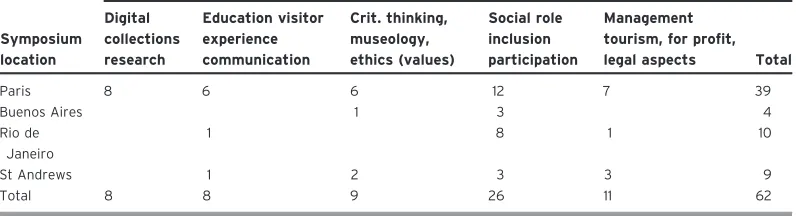
The first category is grounded in a classical reading of the museum, founded on collections or on research, and acknowledges challenges faced by museums, notably the digitization of collections, and the way in which a new Defi-nition should reflect them. A second category adopts the point of view of museums as places of education and considers the visitor as medi-ator, learner, someone out for an experience, someone to communicate with. A third cate-gory takes a critical or museological reading of the museum, insisting on its colonial role, for example, or the values it must defend. The fourth category focuses more directly on the social role of the museum, and embraces con-cepts such as participation, social inclusion and societal development. Finally, the fifth cate-gory looks at the administrative or financial background of the museum and its role at the level of tourism, international legislation and so on (Table 1).
[image:8.504.36.434.537.645.2]It would be presumptuous to draw defini-tive conclusions from this summary and limited panel. Nevertheless, if we consider these differ-ent intervdiffer-entions as indicators of the direction in which the institution is oriented in Europe and especially in Latin America, the results are interesting, to say the least. The first thing to
Table 1.
Suggested propositions for change
Symposium location
Number of contributions written on the following themes
Digital collections research
Education visitor experience communication
Crit. thinking, museology, ethics (values)
Social role inclusion participation
Management tourism, for profit, legal aspects Total
Paris 8 6 6 12 7 39
Buenos Aires 1 3 4
Rio de Janeiro
1 8 1 10
St Andrews 1 2 3 3 9
remark on is the relatively low interest in the “classical” vision of the museum and in ques-tions of digitization. One knows, however, the importance that digitization measures have adopted and, in a more general manner, the principle of the digital museum, through the internet and social media (Deloche 2001; Parry 2010), and most of the reports on museal prospectives, like that of Trendswatch or the Centre of the Future of Museums (see note 2), evoke digitization as one of the sources of trans-formation of museums. The same goes for col-lections, considered as being located at the heart of the museum institution for decades. A certain number of participants continue to insist on the role of the collection and that of research. But these contributions represent a minority in rela-tion to the other changes suggested. Other authors insist on aspects that have more to do with the administration or management of museums, whether through international tools (the use of the ICOM Code of Ethics, Recom-mendations and treaties), or via direct manage-rial decisions (the question of tourism or of the non-profit profile of the museum). These administrative or institutional reflections appear relatively minor compared to those that would have an impact on the public or on society at large.
The reflections that lean towards the sec-ond category of the educational role of the museum, those which see that as one of its basic functions, also constitute a fairly classic view of museums. The number of proposed changes relating to this theme is roughly the same as those relating to the first category. The contri-butions concerning the social role of the museum or adopting a more critical vision of the institution in relation to people, stand out from these reflections, indicating an educational vision firmly anchored in the societal challenges facing the institution.
The third approach is related to the differ-ent critical currdiffer-ents affecting the museum today, notably critical museology, postcolonial studies or museology in a broader sense, focusing in particular on the underlying values that the museum highlights (the need to be “competi-tive” in a creative economy, Western domina-tion, etc.) or on those that it should rely on more directly (humanism, democracy, cultural diver-sity and the elimination of social barriers). It is striking to note that in this context the relative notions of the social role of the museum, efforts to integrate and socially include, and the partici-pation of different public audiences dominates almost half of all proposals. This fact illustrates in a striking way that, for a majority of the par-ticipants who contributed to the discussions, the social dimension of the museum is of para-mount importance, and that society seems to expect it from the institution nowadays, notably in Europe, but even more so in Latin America where this dimension seems completely domi-nant, thus confirming the evolution of the con-cept of museums.
redressed through investment in the ICOM Standing Committee MDPP Round Tables in multiple countries, the results of which will not be fully known until 2019.
However, even with ICOFOM’s symposia and ICOM’s practical exercises highlighting an undeniable push towards the museum’s social role, this trend must, in the end, be examined in the light of museal history. If we have insisted at length on social history for the purposes of this article, it is because it casts light on the contem-porary movement. Yet history teaches us that museums do not evolve in a uniform and linear way. Rather, focusing especially on European and Latin American axiological changes, we have noted how following the first evocations of the social role of the museum in the 1930s, other dimensions (especially education) seem to have taken firmer hold. Indeed, while the social func-tion of museums has been strengthened since the 1970s through the bias of the Latin New Museology–in Latin America and continental Europe alike–it should be noted that the early museums who took this direction (such as the Anacostia Neighborhood Museum, the Casa del Museo and the Ecomuseum of Creusot) have largely evolved to the point where they dis-appeared or resemble classical museums. The Latin New Museology, presented as an alterna-tive to the crisis of the museums of the early 1970s, has thus seen a growth in Latin America through the distinctive movement of themuseos comunitariosand other grass roots initiatives in the 1990s, but seen a manifest decline in Europe as discussed above. Of most interest, in this regard, is the melding once again of European and Latin American perspectives through the inscription of the 1973 Declaration of Santiago de Chile within the 2015 UNESCO “Recom-mendation on the Protection and Promotion of Museums and Collections”, marking an about turn, in effect, to reinstate the value and
principles of the integral museum concept for museums of the twenty-first century.
Viewed through this historical perspective, would it not be better to speak of cycles of strengthening and weakening of traditional museum boundaries? It is interesting to note that the periods during which the social role of the museum is most discussed correspond to periods of economic crisis or socio-political unrest and resistance, be it in Europe or Latin America. This was the case in the Western world following the financial crisis of 2007–8, but it was also the case in the 1970s after the first oil shock, and earlier, in 1930 when the first articles on the social role of museums emerged. To be provocative, we might therefore ask whether crises and threats to cultural identity lead museums, in the most difficult moments, to concentrate on the social role and the com-munity surrounding them? If one were to adopt this position and offer a counter-narrative to the current museological debate, we could view museal evolution as cyclical, and sooner or later it would mean that the social function of the museum, which seems currently so popular, will in turn be eclipsed by other museum functions, such as research, creativity, economic develop-ment or collections managedevelop-ment.
CONCLUSIONS
In this article, we have focused for the most part on the social role of the museum, which appears to be of paramount concern to the museum world today and somewhat underval-ued by the present Definition. While ethical investment in the social role of museums has witnessed high and low points in modern Eur-ope, in Latin America the socially oriented museum has continued to reinvent itself since the 1970s, with the lives and issues faced by peo-ple taken as a starting point. ICOFOM research highlighting emerging decolonial perspectives in particular makes the ICOM Definition vul-nerable in a way that could lead to a moment of crisis, followed by positive change towards greater balance between local politics and “the will of the global community”. However, in order to achieve this maturity the endeavour of ICOFOM and the MDPP needs to invest – through a combination of democratic participa-tion and strategic funding–in reaching as many diverse voices as possible. Our authorial posi-tion as academics and museum managers will inevitably lead to limitations in our research findings. Nevertheless, our Table of Proposi-tions above, representing a museum manage-ment rather than audience/user demographic, has highlighted some disparities even within Europe, with the view from Paris signalling a more or less collective understanding of what a museum is (built upon its collections), a plat-form from which pressing concerns such as digi-tization and research ethics can be debated. On the other hand, the symposium in Scotland weighed more heavily towards the socio-politi-cal role of museums and focused on many levels on museum principles. The fact is that in 2017– 18, many professionals perceive the museum differently to the model inscribed in the ICOM Definition, and participation and social action matter to museum professionals, academics and museum audiences alike. An axiological shift
has effectively taken place between 2007 (when the Definition was last agreed and the financial crisis began) and 2017, and ICOM must take notice.
However, answers to questions concerning the role of museums in today’s world and the future of museums and their priorities in the twenty-first century need not echo each other. By taking a longer view of museum purposes and values, reaching back to the nineteenth cen-tury and taking stock of the pivotal museologi-cal moments not least in the 1970s, the social trends of today can be more clearly understood. Moving beyond the ICOFOM symposia remit to “Define the Museum of the 21st Century”, there is a longer history to research that enables us to understand the Definition through reflec-tion on the past balanced with concerns of the present and aspirations for possible futures. Pre-ceding decades have taught us that change in the museum world is nothing new, but at the same time, seeing elements of the 1972 Declara-tion cited in the 2015 UNESCO Recommen-dation marks a significant return to hearing the Latin American museological voice and its chal-lenges to concepts of museum, heritage, com-munity, territory, and environment.
of professionals anxious to preserve the nature of the museum from its classic functions– per-manence, collection, research–will also need to be evidenced and accounted for. More than ever, without a doubt, the museum thus appears as a complex hybrid, torn between its collec-tions, its public, and its researchers or, in a more global manner, its users. The categories pre-sented in this study insist on one of the facets of museums, referring to different points of view, whether professional, museological or public relating to the museum, and it appears that the museal reality, especially that experienced by professionals daily on the ground, balances a mix of categories, rather than one aspect out-weighing the others.
What that body of professionals, currently under-represented in ICOFOM and ICO-FOM-LAM research, might argue for is that while certain needs evolve, others remain, a fac-tor revealed throughout the decades with more or less force. Should the museum’s global Defi-nition focus on the most current trends and the institution continue to see itself differently, or is there an “essence” of an “institution” that should be protected? This could be the first question to tackle regarding the role of the ICOM definition. In origin the definition is administrative or linked to ICOM’s statutes, but its use surpasses this frame. The question of the definition largely exceeds the problems of membership to an international organisation and its use authoritative use, as well as national and international legislations. It enlightens professionals on their understanding of their function, but it also affects the public or pivate authorities that subsidise them, while aiming to take into account the evolution of the museum for future years. These are the fundamental issues that are dealt with here, and which go far beyond the members of ICOM. Would such issues not be worthy of writing about much
more precisely, and rather than offering in a single sentence, what is meant by “museum”, to continue permanently, after 2019, such a reflec-tion exercise? This contentious quesreflec-tion leads us inexorably to focus on ways of comprehend-ing the latter: what are the pillars of the museum as a “permanent institution”? What is its fundamental role as such? Can we consider, moreover, a Definition sufficiently precise to evoke the multiple dimensions that the entity has adopted over the years? The original con-cept of the museum, born in modern Europe and exported around the world, has become a cultural hybrid, and clearly one model no longer offers groups and sub-groups of people the possibility to narrate their own paths. To respect the commonalities within our differ-ences will pose a challenge to any diplomatic organisation such as ICOM, and the museum will remain a place of rich reflection on many of the issues facing the human race beyond its boundaries.
ACKNOWLEDGMENTS
Bi-regional research for this article carried out by Karen Brown was funded by the EU-LAC-MUSEUMS research project. This project has received funding from the European Union’s Hori-zon 2020 Research and innovation programme under
grant agreement No 693669. END
NOTES
1. The International Council of Museums (ICOM) was established in 1946. Today, it has over 37,000 members, including experts from 141 countries and territories.
(https://www.aam-us.org/programs/center-for-the-future-of-museums/). Similar reports were also prepared by the British Museums Associa-tion (2012) or the Dutch Nederlandse Museumv-ereniging (2010).
3. The St Andrews Defining the Museum of the 21st Century conference was organized under the auspices of the EU-LAC-MUSEUMS Hori-zon2020 project, bringing together scholars from Europe, Latin America and the Caribbean to share their different museum realities (http:// www.eulacmuseums.net. Accessed October 18 2018).
4. Mairesse and Desvallees (2007) also worked towards a thesaurus on the evolution of the museum concept.
5. The principles of the New Museology should not be confused with those referred to by Peter Vergo in his book (1989), which derive largely from the academic milieu and the sector of cul-tural studies.
6. See also Davis (2011) and Raffaella (2017) for recent long studies on the ecomuseum.
7. https://www.museumsassociation.org/cam-paigns/museum-funding/museums-in-the-uk. Accessed 1 February 2018; http://happymu seumproject.org/what-we-do/cantie-museums/. Accessed 1 February 2018. Seventy-four per cent of museums in the UK engage with local commu-nity groups, 48% engage with “well-being” provi-ders in 2017–18.
8. The favourable reception given to the participa-tion theory developed by Nina Simon (2010), fur-ther illustrates the popularity of ideas about the social role of the museum and its renewed focus on the community.
9. Approximately 190 people participated in the Paris work (of which around 60 participated in the ateliers), 60 people in Beijing, 137 in Buenos Aires, 128 in Rio de Janeiro, and 75 in St Andrews. To join the debate in the run up to ICOM Kyoto 2019, interested readers should contact the authors, or Jette Sandahl, President of MDPP (through ICOM Secretary). Readers are also invited to feed in to the survey “What is a Community Museum in Your Region?”, available here: URL: https://goo.gl/H8yVDy
REFERENCES
Alexander, E. P. (ed.) 1983. “Henry Cole and the
South Kensington Museum.” InMuseum
Masters, Their Museums and Their Influence, 142– 75. Nashville: American Association for State and Local History.
American Alliance of Museums. Accessed May 12, 2018. Retrieved from https://www.aam-us.org. August, R. S.. 1983. “Museum: A Legal Definition.”
Curator26(2): 137–53.
Black, G. 2012.Transforming Museums in the Twenty-First Century. London: Routledge. Bonython, E., and A. Burton. 2003.The Great
Exhibitor. The Life and Work of Henry Cole. London: V & A Publications.
Botte, J., A. Doyen, and L. Uzlyte. 2017. “Ceci n’est pas un musee: panorama geographique et historique des definitions du musee.” InDefinir le musee du XXIe siecle. Materiaux pour une discussion, edited by F. Mairesse, 17–38. Paris: ICOFOM.
Brown Goode, G. 1895. “The Relationships and Responsibilities of Museums.”Science. New Series 2(4): 197–209.
Brown, K., J. Brown, T. Mu~noz Brenes, and A. Soto Chaves. 2018a. “Community Crafts and Cultures: Empowering Indigenous
Communities.” InHERITAGE 2018.
Proceedings of the 6th International Conference on Heritage and Sustainable Development Conference, Vol. 1, edited by R. Amoeda, S. Lira, C. Pinheiro, J. M. S. Zaragoza, J. C. Serrano and F. G. Carillo, 677–87. Barcelos, Portugal: Green Lines Institute.
Brown, K., B. Brulon Soares, and O. Nazor (eds.). 2018b.Definir los Museos del Siglo XXI: Experiencias Plurals. Paris: ICOFOM. Burt, N. 1977. Palaces for the People: A Social
History of the American Museum. Boston: Little Brown.
Cameron, D. 1968. “A Viewpoint: The Museum as a Communication System and
Implications for Museum Education.”Curator 11: 33–40.
Cameron, D. (ed.). 1969.Are Art Galleries Obsolete?. Toronto: Peter Martin Associate Limited. Cameron, D. 1971. “The Museum, a Temple or a
Forum.”Curator14: 11–24.
Capart, J. 1936.Le Temple des Muses, 2nd edn. Bruxelles: Musees royaux d’Art et d’Histoire. Center for the Future of Museums. 2008.Museums
and Society 2034: Trends and Potential future. Washington, DC: American association of museums.
Charlety, V. 2005.Itineraire D’un Musee, le Heimatmuseum. Paris: l’Harmattan. Chaumier, S. 2018.Altermuseologie. Manifeste
expologique sur les tendances et le devenir des expositions, Paris: Hermann.
Crooke, E. 2007.Museums and Community: Ideas, Issues and Challenges. London: Routledge. Dana, J. C. 1920.A Plan for a New Museum–The
Kind of Museum it Will Profit a City to Maintain. Woodstock: Elm Tree Press.
Davis, P. 2008. “New Museologies and the Ecomuseum.” InThe Ashgate Research
Companion to Heritage and Identity, edited by B. Graham and P. Howard., 397–414. Aldershot: Ashgate.
——— 2011.Ecomuseums: A Sense of Place, 2nd edn. London: Continuum.
De Carli, G. 2006.Un Museo Sostenible: Museo y Comunidad en la Preservacion Activa de su Patrimonio. Costa Rica: UNESCO.
Debary, O. 2002.La fin du Creusot ou L’art D’accomoder les Restes. Paris: Editions du C.T.H.S.
Deloche, B. 2001.Le Musee Virtuel. Paris: Presses universitaires de France.
Desvallees, A. 2000. “Introduction.” InEcomusee: r^eve ou realite, Special Issue,Publics et Musees17– 18:11–31.
Desvallees, A., and F. Mairesse (ed.). 2011. Dictionnaire Encyclopedique de Museologie. Paris: Armand Colin.
Fleming, D. 2005. “Managing Change in Museums.” Keynote Address at the INTERCOM
international conference on The Museum and Change, Prague.
Foster, H. 2001. “Why All the Hoopla?”London Review of Books23(6): 24–6.
Fraser, J. 2016. “Principles and Politics.”Curator59 (4): 327–30.
Frey, B. 1998. “Superstar Museums: An Economic Analysis.”Journal of Cultural Economics22: 113– 25.
Geddes, P. 1908. “The Museum and the City.” Museums Journal7(11): 373.
Ginsburgh, V., and F. Mairesse. 1997. “Defining a Museum: Suggestions for an Alternative
Approach.”Museum Management and
Curatorship16(1): 15–33.
Heumann Gurian, E. 2002. “Choosing Among the Options: An Opinion About Museum Definitions.”Curator45(2): 75–88. Hudson, K. 1975.A Social History of Museums.
London: Macmillan.
Hudson, K. 1977.Museums for the 1980s–A Survey of World Trends. London: Unesco-Mac Millan. ICOM. 2007. Definition of a Museum. Accessed
May 17, 2018. Retrieved from http://icom.muse um/the-vision/museum-definition/
Jacobson, C. 2014.New Museums in China. New York: Princeton Architectural Press.
Jarron, M. 2006. “Patrick Geddes and Museum Ideas
in Dundee and Beyond.”Museum Management
and Curatorship21(2): 88–94.
Low, T. L. 1942.The Museum as a Social Instrument. New York: American Association of Museums. Lu, T. L.-D. (ed.). 2014.Museums in China, Power,
Politics and Identity. London: Routledge. Macdonald, S. 2003. “Museums, National,
Postnational and Transcultural Identities.” Museum and Society1: 1–16.
Maggi, M. 2002.Ecomusei. Guida Europea. Torino: Umberto Allemandi.
Mairesse, F. 2000. “La Belle Histoire, aux Origines de la Nouvelle Museologie.” InPublics et Musees: 33–56.
——— 2002.Le Musee, Temple Spectaculaire. Lyon: Presses Universitaires de Lyon.
Mairesse, F. (ed.). 2017.Definir le Musee du XXIe Siecle. Materiaux Pour une Discussion. Paris: ICOFOM.
Morishita, M. 2010.The Empty Museum. Western Cultures and the Artistic Field in Modern Japan, Farnham: Ashgate.
Murtas, D., and P. Davis. 2009. “The Role of The Ecomuseo Dei Terrazzamenti E Della Vite (Cortemilia, Italy) in Community
Development.”Museum and Society7(3): 150– 86.
Museums Association. 2012.Museums 2020 Discussion Paper, London, Museums Association. Accessed May 12, 2018. Retrieved from https:// www.museumsassociation.org/home.
Nederlandse Museumvereniging. 2010.Agenda 2023. Study on the Future of the Dutch Museum Sector, Amsterdam, September. Accessed October 11, 2018. Retrieved from https://www. museumvereniging.nl/media/agenda_2026_ pdf_v4_35231_eng_hi-res.pdf.
Parry, R. (ed.). 2010.Museums in a Digital age. London: Routledge.
Payne, G. 1893. “Local Museums.” t.a.p.,The Antiquary, 163, vol. xxvii.
Portia, J. 1996. “Building a Community-Based Identity at Anacostia Museums.”Curator39(1): 19–44.
Raffaella, R. (ed.). 2017.Ecomuseums and Cultural Landscapes. State of the art and Future Prospects. Accessed May 12, 2018. Retrieved from https:// re.public.polimi.it/handle/11311/1041602.Wvb HiC-ZPGI.
Rivet, M. 2017. “La Definition du Musee: Que Nous Disent les Droits Nationaux?” InDefinir le Musee du XXeme Siecle, edited by F. Mairesse., 53–79. Paris: ICOFOM.
Riviere, G. H. 1985. “The Ecomuseum–An Evolutive Definition.” InImages of the ecomuseum (dedicated to the memory of Georges Henri Riviere),MuseumNo. 148 (vol. XXXVII, no. 4): 182–3.
Sandell, R. (ed.). 2002.Museums, Society, Inequality. London: Routledge.
Sandell, R. 2016.Museums, Moralities and Human Rights. London: Routledge.
Schiele, B. 2016. “Quels Musees Pour la Chine D’aujourd’hui ?’.” InNouvelles Tendances de la Museologie, edited by F. Mairesse., 95–110. Paris: La documentation francßaise.
Silverman, H. L. 2010.The Social Work of Museums. London: Routledge.
Simon, N. 2010.The Participatory Museum. Santa Cruz: Museum 2.0.
Toynbee, J. 1863.Hints on the Formation of Local Museums. By the Treasurer of the Wimbledon Museum Committee. London: Robert Hardwicke.
UNESCO. 1960.Recommendation Concerning the Most Effective Means of Rendering Museums Accessible to Everyone. Accessed January 17, 2018. Retrieved from http://portal.unesco.org/en/ev. php-URL_ID=13063&URL_DO=DO_ TOPIC&URL_SECTION=201.html. UNESCO. 2015.Recommendation Concerning the
Protection and Promotion of Museums and Collections. Accessed January 17, 2018. Retrieved from http://www.unesco.org/new/en/culture/ themes/museums/recommendation-on-the- protection-and-promotion-of-museums-and-collections/.
de Varine, H. 2017a. Interview With Karen Brown, Paris.
——— 2017b.L’Ecomusee Singulier et Pluriel. Un Temoignage sur Cinquante ans de Museologie Communautaire Dans le Monde. Paris: L’Harmattan.
Vergo, P. 1989.The New Museology. London: Reaktion Books.