Obesity appears to be associated with altered muscle protein synthetic and breakdown responses to increased nutrient delivery in older men, but not reduced muscle mass or
contractile function.
Andrew J. Murton1, Kanagaraj Marimuthu1, Joanne E. Mallinson1, Anna L. Selby2, Kenneth
Smith2, Michael J. Rennie1 and Paul L. Greenhaff1
MRC/ARUK Centre for Musculoskeletal Ageing Research, 1.School of Life Sciences,
University of Nottingham Medical School, Queen’s Medical Centre, Nottingham, NG7 2UH,
United Kingdom.
2. School of Medicine, Division of Medical Sciences and Graduate Entry Medicine, Royal
Derby Hospital, Derby, DE22 3DT, United Kingdom.
Running title: Obesity and muscle metabolism in older men
Corresponding author: Paul Greenhaff, School of Life Sciences, The Medical School, University of Nottingham, Nottingham, UK.
Tel: +44 (0)115 823 0133
Fax: +44 (0)115 823 0142
e-mail: [email protected]
Abstract
Obesity is increasing, yet despite the necessity to maintain muscle mass and function with
age, the effect of obesity on muscle protein turnover in older adults remains unknown. Eleven
obese (BMI 31.9 ±1.1) and 15 healthy weight (HW; BMI 23.4 ±0.3) older men (55-75 years
old) participated in a study that determined muscle protein synthesis (MPS) and leg protein
breakdown (LPB) under absorptive (hypoinsulinaemic euglycaemic clamp) and
post-prandial (hyperinsulinemic hyperaminoacidaemic euglycaemic clamp) conditions. Obesity
was associated with systemic inflammation, greater leg fat mass, and patterns of mRNA
expression consistent with muscle deconditioning, whilst leg lean mass, strength and work
done during maximal exercise were no different. Under post-absorptive conditions, MPS and
LPB were equivalent between groups, while insulin and amino acid administration increased
MPS in only HW subjects and was associated with lower leg glucose disposal (LGD, 63%) in
obese. Blunting of MPS in the obese was offset by an apparent decline in LPB, which was
absent in HW subjects. Lower post-prandial LGD in obese subjects and blunting of MPS
responses to amino acids suggests obesity in older adults is associated with diminished
muscle metabolic quality. However this doesn’t appear to be associated with lower leg lean
Introduction
Aging is strongly associated with a decline in muscle mass and strength (1). This has been in
part attributed to the failure of protein nutrition to increase the rate of muscle protein
synthesis (MPS) to that observed in the young (2), and the inability of hyperinsulinaemia to
inhibit leg protein breakdown (LPB) in older people (3). However, even after correcting for
muscle mass loss, ageing has been allied with a decline in muscle strength and metabolic
quality (4), signifying that physiological drivers other than muscle mass must contribute to
weakness and diminished quality of muscle in older adults (5).
It is widely reported that the prevalence of obesity is increasing in the developed world across
all ages, including in older adults (6). Of concern, a longitudinal study in older adults showed
that the temporal decline in lean mass and leg extension strength relative to leg mass (the
latter used as an index of muscle quality) could be predicted by the degree of fat mass evident
at time of recruitment (7). Furthermore, this relationship remained even when differences in
physical activity levels were taken into account (8). The implication that older adults may be
particularly at risk of accelerated muscle deterioration from obesity is supported by a
cross-sectional study involving 2,039 older men and women showing that the combination of low
muscle strength and obesity was associated with poorer physical function than either in
isolation (9). Crucially, whether the derangements in MPS and LPB described above for
normal weight older adults (2; 3) are further exacerbated in obese older adults is unknown and
forms the focus of the current study.
Several reports provide credence that MPS and LPB may be negatively affected in obese
individuals. When visceral fat mass is enlarged, plasma concentrations of TNFα, interleukin-6
plasma IL-6, c-reactive protein (CRP) and TNFα concentrations in older adults have been
associated with the development of insulin resistance (11) and the decline of muscle mass and
strength (12; 13). Moreover, in pre-clinical models characterised by systemic increases in
TNFα and IL-6, cytokine mRNA expression in muscle is markedly elevated and processes
involved in the promotion of protein synthesis inhibited in parallel to enhanced proteolysis
(14; 15).
Therefore, the aim of this study was to investigate if the response of MPS and LPB to
experimentally induced post-absorptive and post-prandial conditions was different in obese
older men compared to healthy weight older men, and if so, whether these responses could
underlie any deficits in muscle mass and contractile function observed in obese older
Research Design and Methods
Study participants
Men between the ages of 55 and 75 were recruited and assigned to either a healthy weight
(control) group if they were found to have a BMI < 26 and a serum CRP < 1.35 µg.ml-1
(n=15) or obese group if a BMI > 29 and CRP > 1.35 µg.ml-1 (n=11). This benchmark was
based on previous reports that serum CRP concentrations greater than 1.35 µg.ml-1 associate
with increased levels of IL-6 and TNFα in obese individuals (16). All other individuals not
meeting these criteria were excluded from participating. Subjects underwent a medical
examination and were unable to participate if they had: type-II diabetes, previous diagnosis of
cancer, unresolved hypertension, cardiovascular disease, on-going musculoskeletal
complaints, frailty (underweight and self-reporting of exhaustion, weakness, slowness, and
low physical activity levels; (17)) or any other chronic condition. Furthermore, subjects were
not allowed to participate if they smoked, were trying to lose weight, were participating in
regular organised sports, or taking anti-inflammatories, anti-depressants or statin medication.
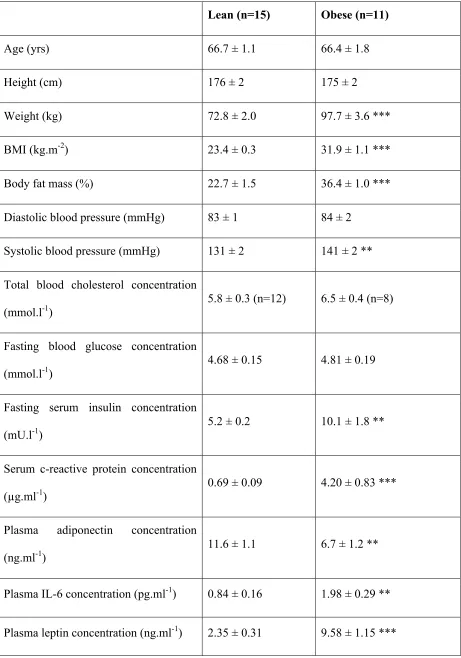
Characteristics of included subjects are presented in Table 1. Informed written-consent was
obtained from volunteers and the study was approved by the University of Nottingham
Medical School Ethics Committee and conducted in accordance with the Declaration of
Helsinki.
Muscle function protocol
Subjects were instructed to refrain from alcohol and exercise for 48 h prior to each visit and
attend the laboratory at 08:00 in a fasted state. On arrival, a whole-body dual-energy x-ray
absorptiometry (DXA) scan was performed to assess lean and fat masses (Lunar Prodigy; GE
underwent isometric and isokinetic leg muscle function measurements as described in detail
elsewhere (18).
Metabolic study protocol
A minimum of 72 h was allowed to elapse from the muscle function assessment visit before
subjects returned to the laboratory to undergo detailed assessment of multiple whole-body and
muscle metabolic parameters utilising an insulin-clamp protocol described previously (18). In
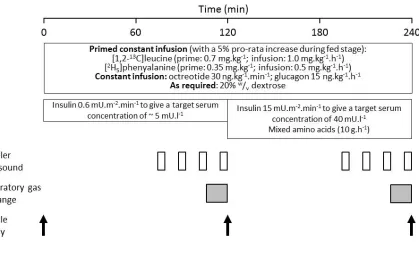
short, a 240 min euglycaemic (4.5 mmol.l-1) insulin clamp began at t=0 with an insulin
infusion rate of 0.6 mU.m-2.min-1 to maintain serum insulin concentrations similar to the
fasting condition (~ 5mU.l-1) with octreotide (30 ng.kg-1.min-1) and glucagon (15 ng.kg-1.h-1)
administered to block endogenous insulin production and maintain serum glucagon
concentrations, respectively (Figure 1). At t=120 the insulin infusion rate was increased to 15
mU.m-2.min-1 to achieve a serum insulin concentration equivalent to the post-prandial state
(~40 mU.l-1). In parallel a mixed amino acid infusion (10 g.h-1; Glamin®, Fresenius Kabi,
Germany) commenced which was maintained for the remaining 120 min of the study period.
Throughout the entire 240 min period of the insulin clamp, a primed constant infusion of the
stable-isotope labelled amino acids [1,2-13C2]-leucine and [ring-D5]-phenylalanine were
administered (Figure 1).
Muscle biopsies were obtained from the vastus lateralis by percutaneous needle biopsy at t=0,
120 and 240 min. Arterialised-venous (a-v) blood samples were obtained at 5 min intervals
for the determination of blood glucose (YSI2300 automated analyser, Yellow Springs, USA)
and serum insulin concentrations by enzyme-linked immunosorbent assay (ELISA; DRG
Diagnostics, Germany)); an additional sample taken at t=0 was used to determine circulating
UK). Femoral venous blood samples taken in tandem with a-v blood samples at regular
intervals were analysed for blood glucose concentrations to determine leg glucose disposal
(LGD) between the period 210 to 240 min, reflecting steady-state under fed conditions.
Arterialised-venous and femoral venous blood samples were obtained at t=0, 75, 90, 105, 120,
195, 210, 225 and 240 min for the determination of [1,2-13C2]-leucine and [ring-D5
]-phenylalanine enrichment as previously described (19). Femoral artery blood flow was
determined in the contralateral limb at these same time points using Doppler ultrasound
(Aplio XV, Toshiba). Prior to the end of the 0.6 mU.m-2.min-1, and 15 mU.m-2.min-1 clamps,
the respiratory exchange ratio (RER) was determined using a ventilated-hood indirect
calorimetry system (GEM, GEM Nutrition Ltd, UK).
Muscle protein synthesis
Myofibrillar proteins were extracted from ~30 mg of muscle tissue as previously described
(19). Following extraction, proteins were hydrolysed into their constituent amino acids via
acid hydrolysis and purified using ion exchange chromatography (20). The resultant amino
acids were derivatised as their N-acetyl-N-propyl esters and the incorporation of [1,2-13C2
]-leucine into protein determined by capillary gas chromatography combustion isotope ratio
mass spectrometry (Delta-plus XL; Thermo Fisher Scientific, UK) according to established
methods (20). The rate of MPS was determined by measuring the incorporation of [1,2-13C2
]-leucine in successive biopsies, with the labelling of blood α-KIC (alpha-ketoisocaproate) used
as a surrogate measure for the immediate precursor for protein synthesis, leucyl-t-RNA (20).
Leg protein turnover
Whole-blood was used to determine labelling (atom % excess) and concentration of a-v and
supernatant neutralised prior to purification by cation exchange chromatography. The
subsequent eluent was dried under nitrogen prior to derivatisation of amino acids to their
tert-butyldimethylsilyl derivatives using standard techniques (21). Concentrations and
enrichments were determined by gas-chromatography mass-spectrometry (Trace DSQ,
Thermo Scientific, UK) with the use of norleucine and d2-phenylalanine as internal standards.
For each 120 min post-absorptive and post-prandial period, the values for enrichment and
concentration were determined from the mean of 4 separately analysed samples, collected
over the final 45 min. Leg protein synthesis (LPS) was calculated as the disappearance of
phenylalanine into the leg and LPB as the arteriovenous dilution of [ring-D5]-phenylalanine as
previously described (20).
Gene expression analysis
Total RNA was extracted from muscle biopsy specimens and cDNA synthesised using
standard protocols (18). mRNA expression levels for 90 genes spanning carbohydrate
metabolism, fat metabolism, insulin signalling and proteolysis were examined via the use of
low-density microfluidic cards (Applied Biosystems, USA; see Table 2 for a comprehensive
list of genes examined) and analysed on an Applied Biosystems 7900 Real-Time PCR system.
Data was normalised to the geometric average of the housekeeping genes: alpha-actin, β
2-microglobulin, 18S and RNA polymerase 2A, with suitability of the housekeeping genes
confirmed by the RealTime StatMiner software (Integromics, Spain). Gene expression was
calculated via use of the 2-ΔΔCt method and significance determined by the linear modelling
approach (LIMMA). The false discovery rate was assessed via the Benjamin and Hochberg
method (22).
Cytosolic proteins were extracted from 30 mg of muscle tissue and analysed by western blot
using established methods (23). Membranes were incubated overnight at 4°C with a
polyclonal antibody for either total or phosphorylation-specific forms of AKT1 (Thr308) or
mTOR (Ser2448; Cell Signaling Technology Inc., USA) or as a loading control, beta-actin
(Sigma, UK). Following washing in TBS-T, membranes were probed with a
fluorescently-labelled anti-mouse or anti-rabbit secondary antibody as appropriate (Dylight® conjugate,
Cell Signaling Technology Inc., USA) and imaged on an electronic image acquisition system
(Odyssey CLx, Licor Biosciences, USA). Band densities were determined using proprietary
software supplied with the imaging system and normalised to the loading control.
Statistics
Statistical differences in subject characteristics, body composition, muscle functional data,
plasma adipokine concentrations, and area under the curve data for serum insulin and glucose
disposal rate (GDR) were determined using unpaired 2-tailed Student’s t-tests. Differences in
RER, femoral blood-flow, protein turnover measurements and western blot data were
determined using a two-way ANOVA with repeated measures. When a significant interaction
between main effects was observed, a Student’s t-test with Šidák correction was performed to
locate differences. Correlation between changes in MPS with feeding and leg fat mass were
assessed by linear regression analysis. Statistical analysis was performed using the Prism v6.0
for Windows software (GraphPad Software Inc., USA). Data are reported as means ± SEM
Results
Adipokine expression
Subjects were recruited based upon both their body mass index and basal serum CRP
concentration. As a consequence, serum CRP concentration was greater in the obese versus
the healthy weight individuals (P<0.001; Table 1). This selection strategy was effective at
recruiting obese individuals with chronic low-grade inflammation relative to their healthy
weight study counterparts, as evidenced by the greater plasma concentrations of leptin,
resistin, TNFα and IL-6 in the obese individuals. Conversely, plasma concentrations of
adiponectin were significantly lower in obese versus healthy weight subjects (Table 1) as
anticipated (10).
Body composition, muscle strength and muscle fatigue
As expected, BMI was greater in the obese than that of the healthy weight participants (31.9 ±
1.1 and 23.4 ± 0.3 kg.m-2, respectively; P<0.001). When examined in further detail using
DXA, significantly greater fat masses were observed in the obese compared to the healthy
weight subjects in all 5 body compartments interrogated (Figure 2A; P<0.001). Lean mass
was also significantly greater in the obese individuals in the trunk (18% higher), android
(26%) and gynoidal (14%) regions compared to the healthy weight subjects (Figure 2B). Lean
tissue mass in the arms and legs of the lean and obese subjects was no different between the
two subject groups.
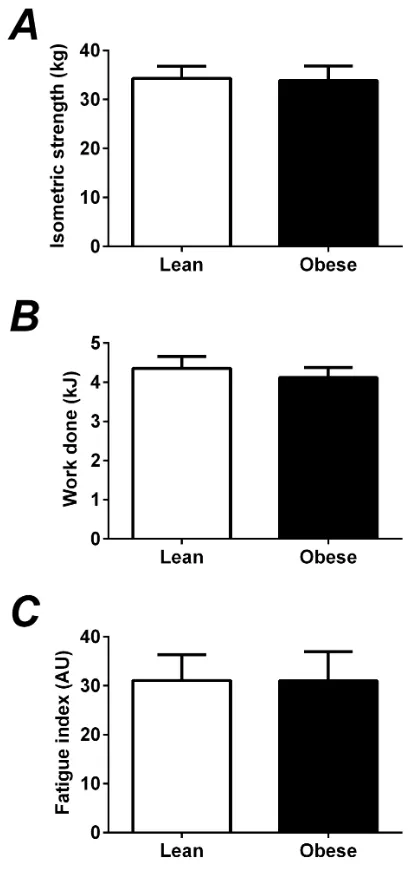
There was no significant difference in the isometric strength of the knee extensors between
the healthy weight and obese individuals (34.3 ± 2.5 versus 33.9 ± 3.0 kg, respectively; Figure
was equivalent between subject groups (Figure 3B), as was a measure of fatigue calculated
from changes in torque output over time (Figure 3C).
Gene expression analysis
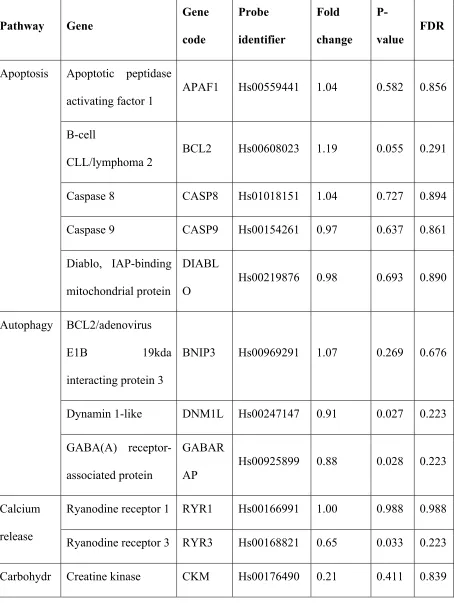
mRNA expression levels for 90 genes spanning inflammation, carbohydrate and fat
metabolism, insulin signalling and proteolysis were examined. Using a false discovery rate
(FDR) < 0.10, 7 transcripts appeared differentially expressed in obese compared to lean
volunteers (Table 2). Cytochrome c, peroxisome proliferator activated receptor-α, PPAR-γ
coactivator 1-α and transcription factor A mitochondrial, all associated with either
mitochondrial biogenesis or the control of mitochondrial oxidative phosphorylation, were
expressed at lower levels in the muscle of obese individuals. Similarly, CD34, a marker of
satellite cell quiescence, and the solute carrier organic anion transporter family member 1B1,
involved in hepatic drug metabolism, were both lower in the obese. In contrast, the expression
of myostatin, which has been shown to be a negative regulator of muscle growth, was greater
in obese skeletal muscle (1.80-fold compared to controls; P<0.01). These changes are
consistent with a general deconditioning of muscle in the obese subjects relative to healthy
weight volunteers. Interestingly, in spite of the systemic low-grade inflammation seen in the
obese volunteers, muscle mRNA levels for TNFα and IL-6 were not elevated.
Carbohydrate metabolism
Serum insulin concentrations under clamp conditions are presented in Figure 4A. The insulin
infusions rates of 0.6 and 15 mU.m-2.min-1 produced steady-state serum insulin concentrations
of 5.2 ± 1.2 and 69.7 ± 5.4 mU.L-1 in the lean, respectively, and 4.2 ± 0.3 and 78.7 ± 4.4
mU.L-1 in the obese; there was no significant difference in either absolute serum insulin
4A). The 0.6 mU.m-2.min-1 insulin infusion resulted in negligible LGD in both subject groups
(data not shown). In contrast, under steady-state conditions (210 to 240 min) the greater
insulin infusion rate (15 mU.m-2.min-1) resulted in an increased rate of LGD in both sets of
individuals, but was more marked in the lean (3.7 ± 0.4 g.min-1) than that of the obese (1.3 ±
0.2 g.min-1) subjects over the 30 min period examined (Figure 4B; P<0.001). The RER was
no different between subject groups in the simulated post-absorptive state (0.72 ± 0.02 and
0.68 ± 0.01 in lean and obese subjects, respectively; Figure 4C). As expected, the simulated
post-prandial state increased the RER in the healthy weight individuals (0.82 ± 0.03;
P<0.001), but had no effect on obese volunteers where RER remained unchanged (0.71 ±
0.01).
Muscle protein turnover
During the 0.6 mU.m-2.min-1 insulin infusion when mixed-amino acids were not being
provided, the rates of MPS, LPS and LPB were equivalent between the healthy weight and
obese volunteers (Figure 5A, 5C and 5D). Under these conditions, the rate of LPB exceeded
LPS and as such, net leg phenylalanine balance was negative but equivalent between groups
(Figure 5E).
When serum insulin concentrations were increased and mixed-amino acids provided, arterial
plasma phenylalanine concentrations doubled, from 60-80 µM to 130-150 µM in all
volunteers (data not shown). Similarly, a doubling of the myofibrillar protein fractional
synthetic rate was observed in healthy weight individuals (0.047 +/- 0.004 during fasted
conditions versus 0.099 ± 0.011 %.h-1 under fed conditions; P<0.001), but no significant
increase was observed in the obese volunteers (Figure 5A). When LPS was assessed by
than muscle FSR), this difference between groups was still apparent but not significant
(Figure 5C). While a main effect of hyperinsulinemia and hyperaminoacidemia to decrease
LPB rates was observed, along with a trend towards an interaction between main effects
(P=0.10; Figure 5D), proceeding with post-hoc tests revealed the decrease in LPB rates was
confined to the obese (48.5 ± 9.5 fasted versus 29.9 ± 5.5 nmol.min-1.100 g leg mass-1 fed;
P<0.01). Importantly, femoral blood flow, which impacts upon the determination of LPB
rates, was equivalent between subject groups during both the fasted and fed clamps (Table 3).
The culmination of these individual effects on LPS and LPB was that net leg phenylalanine
balance was significantly enhanced in both subject groups (25.4 ± 6.7 versus 12.6 ± 5.1
nmol.min-1.100 g leg mass-1 in the lean and obese, respectively; Figure 5E). Comparison of
leg fat mass with the net change in muscle protein synthesis rates in the simulated
post-prandial state revealed a weak but significant (P=0.05) negative correlation between the two
variables (Figure 5B).
Anabolic signalling
Under simulated post-absorptive conditions, total and phosphorylated protein levels of
anabolic signalling intermediaries AKT and mTOR were of comparable magnitude between
muscle samples of obese individuals and their healthy weight counterparts (Figure 5F). The
simulated post-prandial state resulted in a significant and equivalent increase in AKT Thr308
Discussion
Here we present novel evidence to suggest that obesity in non-frail, older men is not
associated with deficits in lean mass, quadriceps strength or fatigability compared to healthy
weight men of comparable age, despite systemic (but not muscle) inflammation being evident.
Furthermore, we demonstrate for the first time that the ability of amino acids to increase MPS
is blunted in obese, older men compared to their healthy weight counterparts, but that net leg
phenylalanine balance is not affected due to a concomitant decrease in LPB in these
individuals. In short, obesity appears to be associated with systemic inflammation, and altered
MPS and LPB responses to increased nutrient delivery in older, non-frail men, but not
reduced muscle mass or contractile function. Despite this, differences in whole body RER,
LGD, and muscle mRNA changes consistent with a decline in overall muscle metabolic
quality in obese older men were evident. These findings represent an important contribution
to our understanding of the impact and interaction of systemic inflammation, ageing and
obesity on muscle health.
In the present study the lean masses of all body regions examined were found to be equivalent
or greater in obese men compared with healthy weight counterparts of similar age. Moreover,
isometric strength, and work output and fatigability during repeated maximal isokinetic
contractions were identical between groups. This stands in contrast to the suggestion that
obesity in old age accelerates muscle mass loss and functional decline (7; 8). Our lack of
evidence to support the existence of increased sarcopenia or dynapenia in older, non-frail,
obese men is however perhaps not surprising. In young individuals, obesity is typically
associated with a 36% greater lean mass compared to lean counterparts of similar stature (24),
thought due to the additional contractile work performed by the obese individual during
in a subset of obese older adults with prevalence of the condition largely equivalent between
lean (36%) and obese (27%) individuals (9), suggesting that dynapenia occurs independently
of obesity. However, we acknowledge that our observations need to be confirmed in a larger
cohort using more sensitive measures of lean tissue mass than DXA, such as MRI or
D3-creatine dilution.
While previous studies have attempted to detail the effects of obesity on MPS in young adults,
a consensus has not emerged. For example, obesity has been associated with lower (25) and
elevated (26) MPS in the post-absorptive state. Furthermore, whilst greater rates of
whole-body protein synthesis have been observed in obese younger volunteers in the fed state (27;
28), the magnitude of increase in MPS from the post-absorptive to simulated fed state was
comparable between non-obese and obese volunteers (25). In contrast, we report here that
under post-absorptive conditions where muscle FSR is at its lowest, the rate at which muscle
proteins were being synthesised was comparable between healthy weight and obese older
men. More importantly, the stimulatory effect of increased amino acid provision during
hyperinsulinaemia on MPS in the older obese adult was blunted when compared to their
healthy weight counterparts. The exact basis for this “anabolic resistance” to amino acid
provision is unclear, but is unlikely to be related to muscle inflammation given we could find
no evidence of this despite clear systemic inflammation. One potential contributor is the
increased intracellular accumulation of lipids within the muscles of obese individuals. A
negative correlation between leg fat mass and the degree of stimulation of leg protein
synthesis was observed (P<0.05), suggesting that the resistance to the anabolic actions of
amino acids within the muscle tissue was as a direct result of the increased fat mass.
Moreover, it has recently been shown that acute intravenous administration of a lipid
euglycaemic clamp concomitant to amino acid feeding (29). However, whether this is a direct
effect of lipid species on the mechanisms responsible for MPS, or is mediated via changes in
insulin sensitivity cannot be deduced from the studies performed to date.
The possible role of chronically reduced habitual physical activity levels in the anabolic
resistance observed in the present study cannot be underestimated. Indeed, a recent study
demonstrated that reducing daily step count by ~76% for 14 days in older individuals resulted
in a 26% reduction in post-prandial rates of MPS and a 43% reduction in insulin sensitivity,
but did not impact protein synthetic rates under post-absorptive conditions (30). Our own data
demonstrate overt traits of muscle deconditioning were evident in the obese volunteers of the
present study. For example, steady-state LGD and whole body carbohydrate oxidation rates
were blunted in the obese volunteers, both of which are known to accompany inactivity (31).
Furthermore, between group differences in muscle mRNA expression clearly indicates
mitochondrial biogenesis and oxidative metabolism were dampened. Importantly, whilst daily
physical activity levels were not measured in the present study, evidence suggests that even a
1 hr period of daily vigorous exercise cannot compensate for the effects of inactivity on blood
markers of poor musculoskeletal health if the remainder of the day is spent sitting (32). These
findings support the assertion that greater muscle deconditioning had occurred in the obese
individuals in the present study.
Despite a failure of amino acids to stimulate MPS in the older obese men, the ability of
insulin and amino acids to stimulate AKT and mTOR phosphorylation was unperturbed. A
discord between AKT/mTOR signalling and MPS is not without precedent. Following
stepwise increases in serum insulin concentration during conditions of hyperaminoacidemia in
but was not matched by further increases in MPS and mTOR phosphorylation (20),
suggesting AKT phosphorylation reflects insulin concentration rather than any measure of
protein synthesis. Likewise, with its suggested role as an amino acid sensor, mTOR
phosphorylation may reflect extracellular amino acid availability rather than commitment of
the muscle cell to enhance MPS. As such, our results show clearly that the failure of amino
acids to stimulate MPS in the older obese men is not due to an inability to phosphorylate AKT
and mTOR.
Whole-body protein breakdown has been found to be inhibited less in the fed state in obese
versus non-obese younger subjects (25). However, given muscle is reported to account for
only 25% of whole-body proteolysis in the basal state (33), the implications of these findings
remain unclear. Despite obese individuals being in a heightened systemic-inflammatory state
in the present study, this did not translate into increased LPB under post-absorptive
conditions. Indeed, our results suggest that the rate of LPB in the post-prandial state was
lower in obese than healthy weight volunteers. Therefore, the inability of amino acids to
stimulate MPS in the obese appeared largely offset by a concomitant decline in the rate of
LPB, culminating in the magnitude of change in net phenylalanine balance between the
post-absorptive and post-prandial state being equivalent between lean and obese subjects. This
represents one potential mechanism for the equivalent leg lean mass seen between groups,
although the consequence of assessing volunteers under acute conditions in the rested state is
that the contribution of habitual physical activity levels and dietary behaviour on chronic
muscle protein turnover and thereby muscle mass, remains unknown.
Obesity in older men is aligned with systemic, but not muscle, inflammation. We found no
or impaired contractile function (strength and fatigability) compared to their healthy weight
counterparts. However, our results highlight the negative effect that obesity has on the
metabolic quality of skeletal muscle in older adults. The exact role that inactivity plays in the
decline in muscle metabolic health in the older obese adult remains unclear, but it could prove
Acknowledgments
We are grateful to the volunteers that took part in the study and also Dr Liz Simpson, Mrs
Aline Nixon and Mrs Sara Brown (Life Sciences, The University of Nottingham) for their
technical assistance. We also acknowledge the support provided by the Biotechnical and
Biological Sciences Research Council, UK in their funding of the study (BB/G011435/1).
Author contributions were as follows: A.J.M., K.S., M.J.R. and P.L.G. designed the study;
A.J.M., K.M., J.E.M. and A.L.S. conducted the research; A.J.M., A.L.S., K.S. and P.L.G.
analysed the data; A.J.M. and P.L.G. drafted the manuscript; A.J.M., K.M., J.E.M., K.S. and
P.L.G. edited and revised the manuscript; A.J.M. and P.L.G. are the guarantors of this work
and, as such, had full access to all the data in the study and take responsibility for the integrity
of the data and the accuracy of the data analysis. The authors have no conflicts of interest to
References
1. Lindle RS, Metter EJ, Lynch NA, Fleg JL, Fozard JL, Tobin J, Roy TA, Hurley BF: Age and gender comparisons of muscle strength in 654 women and men aged 20-93 yr. J Appl Physiol 1997;83:1581-1587
2. Cuthbertson D, Smith K, Babraj J, Leese G, Waddell T, Atherton P, Wackerhage H, Taylor PM, Rennie MJ: Anabolic signaling deficits underlie amino acid resistance of wasting, aging muscle. FASEB J 2005;19:422-424
3. Wilkes EA, Selby AL, Atherton PJ, Patel R, Rankin D, Smith K, Rennie MJ: Blunting of insulin inhibition of proteolysis in legs of older subjects may contribute to age-related sarcopenia. Am J Clin Nutr 2009;90:1343-1350
4. Conley KE, Esselman PC, Jubrias SA, Cress ME, Inglin B, Mogadam C, Schoene RB: Ageing, muscle properties and maximal O(2) uptake rate in humans. J Physiol 2000;526 Pt 1:211-217
5. Clark BC, Manini TM: Sarcopenia =/= dynapenia. J Gerontol A Biol Sci Med Sci 2008;63:829-834
6. Fakhouri TH, Ogden CL, Carroll MD, Kit BK, Flegal FM: Prevalence of obesity among older adults in the United States, 2007-2010. NCHS Data Brief 2012;106:1-8
7. Koster A, Ding J, Stenholm S, Caserotti P, Houston DK, Nicklas BJ, You T, Lee JS, Visser M, Newman AB, Schwartz AV, Cauley JA, Tylavsky FA, Goodpaster BH, Kritchevsky SB, Harris TB, Health ABCs: Does the amount of fat mass predict age-related loss of lean mass, muscle strength, and muscle quality in older adults? J Gerontol A Biol Sci Med Sci 2011;66:888-895
8. Roubenoff R: Sarcopenic obesity: does muscle loss cause fat gain? Lessons from rheumatoid arthritis and osteoarthritis. Ann N Y Acad Sci 2000;904:553-557
9. Bouchard DR, Janssen I: Dynapenic-obesity and physical function in older adults. J Gerontol A Biol Sci Med Sci 2010;65:71-77
10. Ouchi N, Parker JL, Lugus JJ, Walsh K: Adipokines in inflammation and metabolic disease. Nat Rev Immunol 2011;11:85-97
11. Barzilay JI, Abraham L, Heckbert SR, Cushman M, Kuller LH, Resnick HE, Tracy RP: The relation of markers of inflammation to the development of glucose disorders in the elderly: the Cardiovascular Health Study. Diabetes 2001;50:2384-2389
12. Schaap LA, Pluijm SM, Deeg DJ, Harris TB, Kritchevsky SB, Newman AB, Colbert LH, Pahor M, Rubin SM, Tylavsky FA, Visser M, Health ABCS: Higher inflammatory marker levels in older persons: associations with 5-year change in muscle mass and muscle strength. J Gerontol A Biol Sci Med Sci 2009;64:1183-1189
13. Schaap LA, Pluijm SM, Deeg DJ, Visser M: Inflammatory markers and loss of muscle mass (sarcopenia) and strength. Am J Med 2006;119:526 e529-517
14. Murton AJ, Alamdari N, Gardiner SM, Constantin-Teodosiu D, Layfield R, Bennett T, Greenhaff PL: Effects of endotoxaemia on protein metabolism in rat fast-twitch skeletal muscle and myocardium. PLoS One 2009;4:e6945
Frailty in older adults: evidence for a phenotype. J Gerontol A Biol Sci Med Sci 2001;56:M146-156
18. Mallinson JE, Marimuthu K, Murton AJ, Selby A, Smith K, Constantin-Teodosiu D, Rennie MJ, Greenhaff PL: Statin myalgia is not associated with reduced muscle strength, mass or protein turnover in older male volunteers, but is allied with a slowing of time to reach peak power output, insulin resistance and differential muscle mRNA expression. J Physiol 2015; 593:1239-1257.
19. Wilkinson SB, Phillips SM, Atherton PJ, Patel R, Yarasheski KE, Tarnopolsky MA, Rennie MJ: Differential effects of resistance and endurance exercise in the fed state on signalling molecule phosphorylation and protein synthesis in human muscle. J Physiol 2008;586:3701-3717
20. Greenhaff PL, Karagounis L, Peirce N, Simpson EJ, Hazell M, Layfield R, Wackerhage H, Smith K, Atherton P, Selby A, Rennie MJ: Disassociation between the effects of amino acids and insulin on signalling, ubiquitin-ligases and protein turnover in human muscle. Am J Physiol Endocrinol Metab 2008;295:E595-604
21. Williams JP, Phillips BE, Smith K, Atherton PJ, Rankin D, Selby AL, Liptrot S, Lund J, Larvin M, Rennie MJ: Effect of tumor burden and subsequent surgical resection on skeletal muscle mass and protein turnover in colorectal cancer patients. Am J Clin Nutr 2012;96:1064-1070
22. Benjamini Y, Hochberg Y: Controlling the false discovery rate: a practical and powerful approach to multiple testing. J R Statist Soc B 1995;57:289-300
23. Constantin D, Constantin-Teodosiu D, Layfield R, Tsintzas K, Bennett AJ, Greenhaff PL: PPARdelta agonism induces a change in fuel metabolism and activation of an atrophy programme, but does not impair mitochondrial function in rat skeletal muscle. J Physiol 2007;583:381-390
24. James WP, Davies HL, Bailes J, Dauncey MJ: Elevated metabolic rates in obesity. Lancet 1978;1:1122-1125
25. Guillet C, Delcourt I, Rance M, Giraudet C, Walrand S, Bedu M, Duche P, Boirie Y: Changes in basal and insulin and amino acid response of whole body and skeletal muscle proteins in obese men. J Clin Endocrinol Metab 2009;94:3044-3050
26. Nair KS, Garrow JS, Ford C, Mahler RF, Halliday D: Effect of poor diabetic control and obesity on whole body protein metabolism in man. Diabetologia 1983;25:400-403
27. Welle S, Barnard RR, Statt M, Amatruda JM: Increased protein turnover in obese women. Metabolism 1992;41:1028-1034
28. Bruce AC, McNurlan MA, McHardy KC, Broom J, Buchanan KD, Calder AG, Milne E, McGaw BA, Garlick PJ, James WP: Nutrient oxidation patterns and protein metabolism in lean and obese subjects. Int J Obes 1990;14:631-646
29. Stephens FB, Chee C, Wall BT, Murton AJ, Shannon CE, van Loon LJ, Tsintzas K: Lipid induced insulin resistance is associated with an impaired skeletal muscle protein synthetic response to amino acid ingestion in healthy young men. Diabetes 10.2337/db14-0961
30. Breen L, Stokes KA, Churchward-Venne TA, Moore DR, Baker SK, Smith K, Atherton PJ, Phillips SM: Two weeks of reduced activity decreases leg lean mass and induces "anabolic resistance" of myofibrillar protein synthesis in healthy elderly. J Clin Endocrinol Metab 2013;98:2604-2612
31. Sonne MP, Alibegovic AC, Hojbjerre L, Vaag A, Stallknecht B, Dela F: Effect of 10 days of bedrest on metabolic and vascular insulin action: a study in individuals at risk for type 2 diabetes. J Appl Physiol 2010;108:830-837
exercise (cycling) in sedentary subjects when energy expenditure is comparable. PLoS One 2013;8:e55542
Table 1: Subject characteristics
Lean (n=15) Obese (n=11)
Age (yrs) 66.7 ± 1.1 66.4 ± 1.8
Height (cm) 176 ± 2 175 ± 2
Weight (kg) 72.8 ± 2.0 97.7 ± 3.6 ***
BMI (kg.m-2) 23.4 ± 0.3 31.9 ± 1.1 ***
Body fat mass (%) 22.7 ± 1.5 36.4 ± 1.0 ***
Diastolic blood pressure (mmHg) 83 ± 1 84 ± 2
Systolic blood pressure (mmHg) 131 ± 2 141 ± 2 **
Total blood cholesterol concentration
(mmol.l-1)
5.8 ± 0.3 (n=12) 6.5 ± 0.4 (n=8)
Fasting blood glucose concentration
(mmol.l-1)
4.68 ± 0.15 4.81 ± 0.19
Fasting serum insulin concentration
(mU.l-1)
5.2 ± 0.2 10.1 ± 1.8 **
Serum c-reactive protein concentration
(µg.ml-1)
0.69 ± 0.09 4.20 ± 0.83 ***
Plasma adiponectin concentration
(ng.ml-1)
11.6 ± 1.1 6.7 ± 1.2 **
Plasma IL-6 concentration (pg.ml-1) 0.84 ± 0.16 1.98 ± 0.29 **
Plasma resistin concentration (ng.ml-1) 4.93 ± 0.34 6.43 ± 0.49 *
Plasma TNFα concentration (pg.ml-1) 1.21 ± 0.20 2.28 ± 0.47 *
Medications
Aspirin 75 mg daily
(n=1)
Atenolol 50 mg daily
(n=1); aspirin 75 mg daily
(n=1); lisinopril 40 mg
daily; germaloids cream as
required (n=1).
Values represent means ± SEM. *** P<0.001, ** P<0.01, * P<0.05 significantly different
Table 2: Changes in mRNA levels of several transcripts associated with metabolism or muscle growth in skeletal muscle of obese older men.
Pathway Gene
Gene code Probe identifier Fold change P-value FDR
Apoptosis Apoptotic peptidase
activating factor 1
APAF1 Hs00559441 1.04 0.582 0.856
B-cell
CLL/lymphoma 2 BCL2 Hs00608023 1.19 0.055 0.291
Caspase 8 CASP8 Hs01018151 1.04 0.727 0.894
Caspase 9 CASP9 Hs00154261 0.97 0.637 0.861
Diablo, IAP-binding
mitochondrial protein
DIABL
O
Hs00219876 0.98 0.693 0.890
Autophagy BCL2/adenovirus
E1B 19kda
interacting protein 3
BNIP3 Hs00969291 1.07 0.269 0.676
Dynamin 1-like DNM1L Hs00247147 0.91 0.027 0.223
GABA(A)
receptor-associated protein
GABAR
AP
Hs00925899 0.88 0.028 0.223
Calcium
release
Ryanodine receptor 1 RYR1 Hs00166991 1.00 0.988 0.988
Ryanodine receptor 3 RYR3 Hs00168821 0.65 0.033 0.223
ate
metabolis
m
Lactate
dehydrogenase B LDHB Hs00929956 0.91 0.919 0.985
NADH
dehydrogenase
[ubiquinone] 1 alpha
subcomplex subunit
5
NDUFA
5 Hs00606273 0.83 0.008 0.102
Pyruvate
dehydrogenase
kinase, isozyme 4
PDK4 Hs00176875 1.10 0.786 0.932
Solute carrier family
22 (organic
cation/ergothioneine
transporter),
member 4
GLUT4 Hs00268200 0.89 0.814 0.953
Inflammati
on
Interleukin 6 IL-6 Hs00985639 0.67 0.405 0.839
Metallothionein 1A MT1A Hs00831826 0.84 0.533 0.856
Tumor necrosis
factor α
TNFα Hs99999043 0.80 0.423 0.839
Insulin
signalling
Eukaryotic
translation initiation
factor 2B, subunit 2
beta
Mitogen-activated
protein kinase 3
MAPK3 Hs00385075 0.90 0.06 0.306
Mitogen-activated
protein kinase kinase
1
MAP2K
1
Hs00605615 1.04 0.568 0.856
Phosphoinositide-3-kinase, regulatory
subunit 1 (alpha)
PIK3R1 Hs00933163 0.59 0.148 0.489
Protein kinase,
AMP-activated, alpha 1
catalytic subunit
PRKAA
1
Hs01562308 0.94 0.141 0.482
Ras homolog family
member Q RHOQ Hs00817629 1.07 0.183 0.550
RAS p21 protein
activator (gtpase
activating protein) 1
RASA1 Hs00243115 0.98 0.710 0.890
Ras-related GTP
binding A
RRAGA Hs00538975 1.01 0.779 0.932
V-akt murine
thymoma viral
oncogene homolog 2
Lipid metabolis m Carnitine palmitoyltransferase 1B
CPT1B Hs00993896 0.78 0.080 0.322
Carnitine transporter
OCTN2
SLC22A
5
Hs00161895 0.69 0.164 0.524
Farnesyl diphosphate
synthase
FDPS Hs00266635 0.95 0.666 0.876
Fatty acid binding
protein 3
FABP3 Hs00269758 0.79 0.107 0.411
Fatty acid synthase FASN Hs00188012 1.12 0.489 0.856
Fatty acid
translocase/CD36
CD36 Hs00169627 0.93 0.413 0.839
Heat shock 70kda
protein 5
HSPA5 Hs99999174 1.04 0.575 0.856
NADH
dehydrogenase
(ubiquinone) Fe-S
protein4
NDUFS
4
Hs00942568 0.87 0.068 0.322
Protein kinase C,
alpha,
PRKCA Hs00925195 0.94 0.555 0.856
epsilon
Protein kinase C, iota PRKCI Hs00702254 1.06 0.548 0.856
Protein kinase C,
theta PRKCQ Hs00989970 0.97 0.630 0.861
Stearoyl-coa
desaturase 1
SCD Hs01682761 1.30 0.550 0.856
Myogenesi
s
CD34 molecule CD34 Hs00990732 0.79 0.004 0.068
m-cadherin 15 CDH15 Hs00170504 1.09 0.292 0.700
Met proto-oncogene MET Hs01565584 1.13 0.191 0.556
Myogenic factor 5 MYF5 Hs00271574 1.21 0.029 0.223
Ras homolog
enriched in brain
RHEB Hs00950800 1.00 0.971 0.985
Ras homolog family
member A
RHOA Hs00236938 1.06 0.247 0.659
Ras homolog family
member B RHOB Hs00269660 1.09 0.367 0.820
Rho-associated,
coiled-coil containing
protein kinase 1
ROCK1 Hs00178463 1.00 0.949 0.985
V-Ha-ras Harvey rat
sarcoma viral
oncogene homolog
Organic
anion
transporter
Solute carrier organic anion transporter family, member 1B1
SLCO1 B1
Hs00272374 0.05 0.004 0.068
Oxidative
phosphoryl
ation /
Electronic
Transport
Chain
Coenzyme Q10
homolog B
COQ10
B
Hs00257861 1.24 0.497 0.856
COX-I, Cytochrome
C oxidase I MT-CO1 Hs02596864 0.81 0.031 0.223
COXII, Cytochrome
C Oxidase2
MT-CO2 Hs00153133 0.71 0.472 0.856
Cytochrome c CYCS Hs01588974 0.70 0.000 0.014
Cytochrome c
oxidase subunit viia
polypeptide 1
COX7A
1
Hs00156989 0.85 0.074 0.322
Succinate
dehydrogenase
complex II
SDHA Hs00188166 0.89 0.077 0.322
Ubiquinol-cytochrome c
reductase, complex
III
UQCRQ Hs00416927 0.85 0.055 0.291
Proteolysis Calpain 1 CAPN1 Hs00559804 1.03 0.513 0.856
Calpain 3, (p94) CAPN3 Hs00544975 1.03 0.593 0.856
Calpastatin CAST Hs00156280 1.01 0.943 0.985
Cathepsin L1 CTSL1 Hs00377632 0.92 0.201 0.568
F-box protein 32 MAFbx Hs01041408 1.02 0.840 0.963
Matrix
metallopeptidase 2
MMP2 Hs01548727 1.06 0.595 0.856
Proteasome subunit,
beta 1
PSMB1 Hs00427357 1.04 0.666 0.876
Proteasome subunit,
beta 2
PSMB2 Hs01002946 1.03 0.604 0.856
Proteasome subunit,
beta 5
PSMB5 Hs00605652 1.02 0.714 0.890
Tripartite motif
containing 63, E3
ubiquitin protein
ligase
MuRF1 Hs00261590 0.85 0.310 0.726
Ubiquitin B UBB Hs00430290 1.00 0.975 0.985
Ubiquitin C UBC Hs00824723 1.06 0.548 0.856
Ubiquitin specific
peptidase 19
USP19 Hs00324123 1.06 0.226 0.619
Regulator
of cell
growth
Transcripti
on factor
Activating
transcription factor 3
ATF3 Hs00231069 0.89 0.606 0.856
Forkhead box O1 FOXO1 Hs00231106 1.01 0.959 0.985
Forkhead box O3 FOXO3 Hs00818121 0.96 0.704 0.890
Inhibitor of kappa
light polypeptide
gene enhancer in
B-cells, kinase beta
IKBKB Hs00233287 0.95 0.532 0.856
Jun proto-oncogene JUN Hs00277190 1.08 0.380 0.829
Myocyte enhancer
factor 2C
MEF2C Hs00231149 1.00 0.972 0.985
Myogenic
differentiation 1
MYOD1 Hs00159528 1.01 0.924 0.985
Myogenin (myogenic
factor 4)
MYOG Hs00231167 1.19 0.046 0.286
Nuclear factor of
kappa light
polypeptide gene
enhancer in B-cells 1
NFKB1 Hs00765730 1.12 0.048 0.286
Nuclear factor of
polypeptide gene
enhancer in B-cells 2
(p49/p100)
Peroxisome
proliferator-activated receptor alpha
PPARA Hs00231882 0.77 0.002 0.068
Peroxisome
proliferator-activated
receptor delta
PPARD Hs00602622 0.94 0.273 0.676
Peroxisome
proliferator-activated
receptor gamma
PPARG Hs01115513 0.85 0.081 0.322
Peroxisome
proliferator-activated receptor gamma,
coactivator 1 alpha
PPARG C1A
Hs01016724 0.67 0.002 0.068
Sterol regulatory
element binding
transcription factor 1
SREBF1 Hs01088691 1.11 0.428 0.839
Sterol regulatory
element binding
transcription factor 2
Transcription factor A, mitochondrial
TFAM Hs01082775 0.88 0.006 0.088
V-rel
reticuloendotheliosis
viral oncogene
homolog A
RELA Hs00153294 1.00 0.96 0.985
Seven genes, highlighted in bold and underlined, satisfied the criteria FDR < 0.1 and were
Table 3: Femoral blood flow in healthy weight and obese volunteers as assessed by Doppler ultrasound at baseline and in the last 30 minutes of the fasted and fed clamps.
Lean (n=15) Obese (n=11)
Baseline 385 ± 34 358 ± 30
Fasted state insulin clamp
(insulin 0.6 mU.m-2.min-1)
512 ± 48 472 ± 56
Fed state insulin clamp
(insulin 15 mU.m-2.min-1 plus
mixed amino acid infusion (10
g.h-1)
529 ± 45 450 ± 51
Results expressed in ml/min and values represent mean ± SEM. A significant main effect of
insulin treatment was observed (P<0.001). No significant main effect of BMI stratification
[image:36.595.66.528.127.379.2]Figure 2: Regional fat and lean masses in healthy weight and obese older men. Mean values ± SEM for fat mass (A) and lean mass (B) in lean and obese volunteers separated by
anatomical region. C) Diagrammatic representation of the approximate trunk, android and
gynoid regions determined by the DXA imaging software. *** P<0.001, ** P<0.01,
[image:38.595.83.503.240.539.2]Figure 3: Isometric strength, total work output and fatigue index during 30 maximal isokinetic knee extensions (at 90°.s-1) in older healthy weight and obese men. Values represent mean ± SEM for isometric strength (A), work done (B) and fatigue index ((peak
torque-minimum torque)/peak torque) (C). No significant differences were observed between
[image:39.595.76.281.246.682.2]Figure 4: Serum insulin concentration, leg glucose uptake and respiratory exchange ratio in fasted and fed state conditions in older healthy weight and obese men. Mean ± SEM concentration of serum insulin (A) and leg glucose disposal (B) in response to a
hypoaminoacidemia/hypoinsulinemic (0-120 min; insulin data only shown) clamp and a
hyperaminoacidemia/hyperinsulinemic (120-240 min) euglycaemic clamp. Enclosed bar chart
denotes area under the insulin curve (A) or leg glucose disposal rate (B) calculated over the
last 30 min of the hyperaminoacidaemic hyperinsulinaemic clamp (shaded region on graphs A
and B). Mean values ± SEM for respiratory exchange ratio (C) in healthy weight and obese
older adults in both the post-absorptive and post-prandial states. Where relevant, P-values as
determined by 2-way ANOVA for each main effect and interaction between main effects
displayed alongside corresponding graph. NS: not significant; *** P<0.001, ** P<0.01
significantly different from healthy weight individuals; ††† P<0.001, significantly different
Figure 5:Muscle protein turnover and associated signalling in absorptive and post-prandial states in older healthy weight and obese men. Myofibrillar fractional synthetic rate (A) assessed in healthy weight and obese individuals following simulated fasted or fed
conditions. A negative correlation was observed between leg fat mass and change in muscle
protein synthesis with feeding (B) which was significant by linear regression analysis
(P=0.05). Leg protein synthesis rate (C), leg protein breakdown rate (D) and phenylalanine
balance across the leg (E). To delineate the processes underpinning the observed changes in
MPS, total protein levels and main phosphorylated forms of AKT and mTOR were
determined by western blot (F). Bars represent mean values ± SEM. Where relevant, P-values
as determined by 2-way ANOVA for each main effect and interaction between main effects
displayed alongside corresponding graph. NS: not significant; ** P<0.01, significantly
different from lean individuals; ††† P<0.001, †† P<0.01, significantly different from fasted