Siebe-Thijs Hoogwout
Integral process optimization of the plaster cast room at AMC
2
Integral process optimization of the plaster cast room at AMC
MSc. Graduation ThesisS.T. Hoogwout
Dr. Ir. E.W. Hans
Associate professor University of Twente School of Management and Governance
Dep. of Operational Methods for Production and Logistics N. Kortbeek, Msc.
PhD Candidate University of Twente
School of Electrical Engineering, Mathematics, and Computer Science Dep. of Applied Mathematics
Academic Medical Center (AMC), Amsterdam Dep. of Quality Assurance and Process Innovation
P.E. Joustra, Msc.
Academic Medical Center (AMC), Amsterdam Dep. of Quality Assurance and Process Innovation
3
MANAGEMENT SUMMARY
INTRODUCTION
This report describes the research of the plaster cast room in the outpatient clinic Orthopedics, Traumatology, and Plastic Surgery at Academic Medical Center, Amsterdam. The cast room annually treats 6,300 patients, which include both inpatients and outpatients. This research focuses on the improvement of the cast room process regarding the interaction between patient flow and capacity.
PROBLEM DESCRIPTION
The cast room has an unbalance in patient waiting time, quality of labor, and quality of care. Hereby, the workload during the week as well as during shifts is not balanced. In addition, the cast room capacity in terms of personnel is not constant as Orthopedic Cast Technicians (OCTS) encounter unscheduled unavailability during the day. The combination of peaks in workload and continuous changes in capacity result in patient waiting time. In addition, the quality of care decreases during busy periods as a result of disturbances during patient treatment. Hereby, quality of labor decreases as shifts both combine high peaks in workload and moments of idle time. The quality of labor further decreases as a result of overtime.
RESEARCH OBJECTIVE
The objective of the research is to design and evaluate several recommendations to improve the performance and service level of the current cast room performance as well as balance the OCT workload per shift. This research uses average patient waiting time and the average number of patients seen within 20 minutes of waiting as the service level measures.
RESEARCH APPROACH
First, this research provides a detailed context analysis of the current cast room process, its actors, and its performance according to the key performance indicators patient waiting time, utilization, and overtime. We connect the findings regarding the cast room performance to the literature and our practical insight of the situation. Hereby, we formulate several recommendations to improve the current situation. These recommendations vary in required commitment, dedication, and resources to improve the current situation. This research focuses on the recommendations regarding appointment planning, staff scheduling, and patient prioritization. We group our recommendations in three interventions:
Intervention 1: Less invasive improvement actions
Intervention 1 combines recommendations regarding improvements in communication and behavior of both the OCTs as the DAs. The goal of intervention 1 is to decrease or remove delay in the cast room process. Hereby, we mean delay as a result of lack in communication between the OCTs and DAs, as well as timeliness of the OCTs at the start of shifts.
Intervention 2: Redesign of the agenda system and of the appointment scheduling
4
moments to stimulate the balance in workload during the entire shift. Hereby, the goal of intervention 2 is to balance the workload for OCTs throughout the shift. Intervention 2 also uses intervention 1.
Intervention 3: More invasive improvement actions
Intervention 3 requires additional personnel resources and commitment compared to interventions 1 and 2. Hereby, the sub-interventions of intervention 3 include further alterations in the agenda system regarding the slot duration, improvement in communication regarding the lack in appointment scheduling of walk-in patients and same-day patients, reducing the percentage of no-shows and cancellations, and adjustments in the outpatient clinic capacity to further improve the performance of our interventions in the cast room. Intervention 3 also uses intervention 1 and 2.
RESULTS
We use a computer simulation model to analyze the current situation and evaluate our (sub)-interventions, extensions, and capacity evaluation. We determine a base situation as representation of the current situation. The service level of the base situation is 72.3% with an average patient waiting time of 18.3 minutes. Hereby, the average OCT overtime for the morning and afternoon equals 4.3 minutes and -7.6 minutes respectively. We compare our interventions with this base situation according to 95% confidence interval to evaluate if changes are significant.
Intervention 1 increases the service level to 77.7% with an average patient waiting time of 13.9 minutes. The OCT overtime remains 4.3 minutes overtime in the morning, and increases to -11.1 minutes undertime in the afternoon. Furthermore, we find that we decrease the patient waiting time at the start of shifts.
Intervention 2 increases the service level to 81.3% with an average patient waiting time of 11.4 minutes. The OCT undertime increases to 13.7 minutes overtime in the morning, and decreases to -0.6 minutes undertime in the afternoon.
The best case of Intervention 3 increases the service level to 95%, which is our target service level. However, this situation is hard to implement. The best case situation assumes the elimination of OCT unavailability, the extensive use of a DA to reduce or remove process delays and disturbances, and the spread of specialists’ consulting hours. Hereby, the OCT overtime decreases to -6.7 minutes overtime in the morning, and to -46.3 minutes n the afternoon.
CONCLUSIONS & RECOMMENDATIONS
5
PREFACE
This report describes my research of the plaster cast room of AMC hospital, Amsterdam. This research is the conclusion of my master Production and logistics management (Industrial Engineering & Management) at University of Twente, Enschede. During my research, I was part of the department Quality & Process Innovation (KPI) – Patient oriented Logistics.
Overall, I am satisfied with my research projects and its results. The project included many different stages, which kept the entire process interesting for me. However, throughout the project, it seems that all rumours about a graduation thesis are true, both in positive and less positive aspects. However, that is all in the past now!
This research resulted in several additional documents to this report. These include the detailed analysis report for the observation period, and the recommendations document. Hereby, I am especially satisfied to see that part of the recommendations, as described in this report, already is being implemented at the moment of writing.
To conclude, I thank the following people who were indispensable to my research:
the Orthopedic Cast Technicians Anja, Bas, Francis, Frank, José, Michel, as well the outpatient clinic personnel. It is a pleasure to see how enthusiastic these people perform their work in and around the cast room every day. In addition, they are always eager to answer my questions and discuss process considerations.
the cast room project group including Anja, Betty, Dicky, and Matthias. These people are the key stakeholders in the cast room process and provided me with value input and insight of the cast room process and its relation to the outpatient clinic Orthopedics, Traumatology, and Plastic Surgery. the KPI project group including Delphine, Nikky, and Paul. These people acted in several roles during
our cast room collaboration. Their expertise and skills regarding both logistics as well as coping with the hospital culture and people is a major contribution to my research.
my KPI colleagues. The ambiance in the KPI department was very pleasant, thanks to my KPI colleagues, who always allowed for amusement and variation to the tasks at hand.
Special gratitude is in place for the supervisors of this research project: Nikky Kortbeek and Erwin Hans. Nikky Kortbeek started this project in December 2008, and played a key role in my research project. We had several meetings to discuss the scope and aspects of the cast room leading to the results included in this report. Erwin Hans is my supervisor from University of Twente. His extensive experience regarding the application of operations research in hospitals is highly valuable. In addition, Erwin made sure that I continuously kept track of the end goal, a high level academic report.
To conclude, I am very proud to finish my master at University of Twente with this report and its findings. But this is not an end, nor is it a beginning, as I just passed another stop on the railway towards the future.
6
TABLE OF CONTENTS
Management summary ... 3
Preface ... 5
Chapter 1 - Introduction ... 8
1.1 Context description ... 8
1.2 Problem description ... 8
1.3 Research objective & approach ... 9
Chapter 2 - Context analysis of the current situation ... 12
2.1 Actors in the cast room process ... 12
2.2 Description of the cast room process ... 14
2.3 Performance of the current situation ... 21
Chapter 3 -Formulation of solution approach ... 31
3.1 Framework for hospital planning and control ... 31
3.2 Formal problem description ... 32
3.3 Organizational interventions ... 33
3.4 Discussion for evaluation tool ... 38
Chapter 4 -Simulation study... 41
4.1 Conceptual design of the model ... 41
4.2 Data gathering: fitting data to probability distributions ... 47
4.3 Technical design of the model ... 55
4.4 Verification and validation of the simulation model ... 55
4.5 Experimental interventions ... 61
Chapter 5 -Results of the simulation study ... 75
5.1 Base situation ... 75
5.2 Intervention 1: Less invasive improvement actions ... 78
5.3 Intervention 2: Redesign of the agenda system and appointment scheduling ... 83
7
Chapter 6 -Organizational implementation ... 100
6.1 intervention 1: Less invasive improvement actions ... 100
6.2 Intervention 2: Redesign of the agenda system and appointment scheduling ... 102
6.3 Intervention 3: More invasive improvement actions... 102
Chapter 7 -Conclusions & Recommendations ... 105
7.1 Conclusions ... 105
7.2 Recommendations ... 106
7.3 Further research ... 107
References ... 109
Appendix A: Description of the patient groups ... 112
Appendix B: specialist consulting hours schedule ... 113
Appendix C: Specification of the treatment types ... 114
Appendix D: Glossary for formal problem description ... 115
Appendix E: Shift specifications for validation ... 117
8
CHAPTER 1 -
INTRODUCTION
The orthopedic plaster cast room (cast room) of Academic Medical Center (AMC) in Amsterdam, The Netherlands, has an unbalance between supply and demand that results in increased patient waiting times and decreased quality of labor and quality of care. In this report, we describe our research in detail. This includes an in-depth overview of the current cast room performance followed by our research to identify and evaluate several organizational interventions in order to improve the current performance.
This chapter provides an introduction to the research topic. We start with a short context description of AMC (Section 1.1). Next, we formulate the problem description of the cast room (Section 1.2). To conclude, we present the research objectives and approach to reach the research objectives in this report (Section 1.3).
1.1 CONTEXT DESCRIPTION
AMC consists of the Academic Hospital and the Faculty of Medicine of the University of Amsterdam. The core activities of AMC are patient care, scientific education and scientific research (AMC, 2007).
AMC has three cast rooms, namely the cast room at the outpatient clinic Orthopedics, Traumatology and Plastic Surgery, the cast room at the Emergency department and the cast room at the Pediatric outpatient clinic. We focus our research on the first cast room. This cast room annually performs about 6,300 treatments. The cast room treats mainly patients with bone fractures by placing a plaster cast around the broken bone. These patients visit the cast room for a check of the healing process as they already have a cast around their fracture. The first cast is given to a patient at the Emergency department or at an operating room. Furthermore, patients with weakened physical bone conditions visit the cast room. These patients receive a cast or corset as a support for their bone conditions. During treatment at the cast room, an Orthopedic Cast Technician (OCT) removes a patient’s cast, after which in some cases a specialist inspects the healing process of the fracture or the bone conditions. Subsequently, the OCT treats the patient if the fracture has not healed yet or if the patient does not have to visit another AMC-department first. We provide a detailed process description in Section 2.1.
1.2 PROBLEM DESCRIPTION
The stakeholders in the cast room process experience an unbalance between cast room capacity and patient demand. The unbalance results in a decrease of both quality of care and quality of labor. Highly fluctuating workloads during both day and week lead to increasing patient waiting times and practitioner overtime. The fluctuating workload and overtime lead to a decrease in practitioner satisfaction and quality of labor, whereas fluctuating workload and waiting times both decrease the patient-centeredness and quality of care. Furthermore, high patient waiting times conflict with the maximum allowable waiting time per patient as stated in the AMC Patient Manifest. AMC has introduced the AMC Patient Manifest in 2009. That document states several duties for practitioners to fulfill in the patient care process. We quote the following statement about maximum allowable waiting time per patient:
9
Walk-in patients, patients without a prescheduled appointment at the cast room, represent a large and more unpredictable part of the total amount of patients (35 % of the total amount of cast room patients in 2008 (Section 2.2)). These patients contribute to an increase in waiting time for both walk-in patients as scheduled patients. This increase results in times that exceed the maximum allowable waiting time per patient of 20 minutes.
Second, the number of patients fluctuates during both week and day. In addition, capacity decreases as a result of arbitrary external treatments and meetings (Section 2.2). Together, these factors result in highly fluctuating workloads and overtime for the OCTs. Subsequently, OCT-satisfaction and patient friendliness decrease during workload peaks.
Finally, the process of scheduling patients lacks clear communication between patients, doctors’ assistants (DAs), OCTs and specialists. For example, this could result in patients visiting the cast room with an appointment on their patient card while the appointment is not registered in the cast room schedule. In addition, a lack of organization in the outpatient clinic contributes to the lack in clear communication.
Based on these facts, we formulate the problem statement for the cast room:
“The cast room in AMC has an unbalance in supply and demand that results in increased patient waiting times and decreased quality of care and quality of labor.”
1.3 RESEARCH OBJECTIVE & APPROACH
Given the problem statement, we derive the main research objective as follows:
“What organizational interventions for OCT capacity and appointment scheduling can we design and evaluate in optimizing the cast room performance”
In order to reach the main research objective, we answer the following research questions and investigative sub questions:
1. What is the current performance of the cast room process?
What are the actors in the cast room process?
We observe the cast room process to identify the actors and we interview both patients as cast room personnel. Due to a lack in availability of both historical and detailed data, we also use the observation to register detailed information about the actors in the cast room process. In addition to the observation period, we gather actor data from the hospital information system and cast room reports from the past. We analyze the gathered data to identify characteristics in order to group actors if necessary. Section 2.1 describes the main actors of the cast room process.
What is the cast room process?
10
What are key performance indicators of the cast room process?
We identify process key performance indicators from the literature and from our collaboration with the cast room stakeholders. We use these indicators to measure the current performance of the cast room process. Section 2.3.1 describes the key performance indicators.
What is the performance of the cast room process for the key performance indicators?
During our observation period, we gather detailed information about the cast room process from difference sources. We combine and analyze the data to find scores for the key performance indicators and visualize the performance through graphs and tables. Section 2.3.3 summarizes the current performance of the cast room process for the key performance indicators as well as other interesting figures. The document ‘Optimalisatie logistiek gipskamer: Analyserapport’ (2009) includes the detailed analysis of the current cast room performance.
Furthermore, we use a personnel questionnaire to identify strengths and potential improvement points of the cast room process. Section 2.3.3 includes the results of the personnel questionnaire. What are bottlenecks in the current cast room process?
We evaluate the results of our observation period to identify bottlenecks in the cast room process (Section 2.3.4). In addition, we formulate recommended approaches for these bottlenecks.
2. What organizational interventions can we develop to improve the current performance?
What topics relate to the cast room process and its problems?
We link subjects from the literature to our process bottlenecks, and we choose the bottlenecks and subjects for further research (Section 2.3.4).
What concepts/theories can we find in the literature when searching with the key terms and topics?
We use the literature subjects to find relevant concepts and theories. In Section 3.3, we discuss and summarize the literature that is related to the cast room process and bottlenecks.
What organizational interventions can we develop from the literature and the observation results?
We connect our literature findings to the process bottlenecks to design recommendations. In addition, we organize a workshop with the cast room stakeholders to further identify possible recommendations. The report ‘Verbeteracties gipskamer’ (2009) describes the recommendations. We group the recommendations in organizational interventions for evaluation (Section 4.5).
3. What is the performance of the organizational interventions?
What technique can we use to evaluate the organizational interventions?
11
What data do we need to build the evaluation model?
We need detailed information about the cast room process, the patients, their treatments, capacity and a floor plan of the cast room. We use the data from the observation period and the data from the hospital information systems. We fit these data to probability distributions to estimate arrival times and process duration. We use these distributions as the input parameters for the model. Section 4.1 describes the conceptual model of our evaluation model according to the modeling framework of Robinson (2004). Section 4.2 describes the input parameters for the current situation. Section 4.5 describes the adjustments in input parameters to model the organizational interventions.
How do we know that the evaluation model is a good measurement tool?
We need to build an evaluation model that satisfies the measurement criteria validity, reliability and practicality (Cooper, et al., 2008). In order to answer to these criteria, the model needs to represent the actual situation. We validate the model by imitating the observation period. Section 4.4 describes the verification and validation of our model.
What are the results of the study?
We simulate the organizational interventions according to the adjustments in the input factors (see Section 4.5). Chapter 5 presents an analysis of the results based on the computational output from the simulation study. We evaluate the performance based on the key performance indicators.
4. How can we explain the findings from our study?
We analyze and explain the results from the simulation study in Chapter 5. We describe and explain our expectations in combination with our actual findings. Hereby, we clarify both expected and unexpected findings.
5. How can we implement the organizational interventions to improve the current performance?
12
CHAPTER 2 -
CONTEXT ANALYSIS OF THE CURRENT SITUATION
Chapter 2 provides a context analysis of the current situation at the cast room. Section 2.1 briefly discusses the main actors in the process. Section 2.2 provides a detailed description of the cast room situation and its process. Section 2.3 describes the performance of the cast room based on key performance indicators. We conclude with a summary of our findings in Section 2.3.4 and narrow down our research on specific literature topics.
2.1 ACTORS IN THE CAST ROOM PROCESS
We identify the actors in the cast room process as patients, orthopedic cast technicians (OCTs), specialists and desk employees (receptionists/doctors’ assistants).
2.1.1 PATIENTS
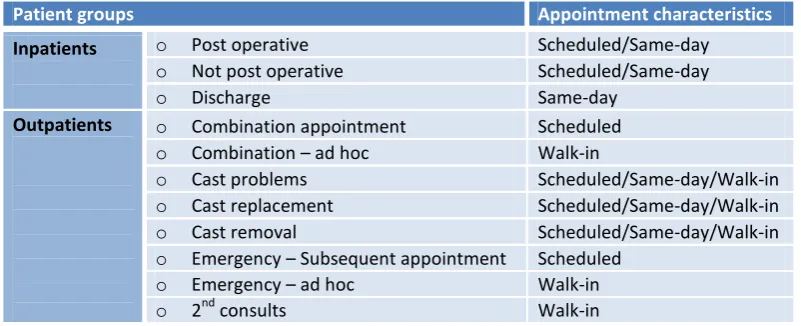
We distinguish eleven patient groups at the cast room. These groups are either inpatients or outpatients: Inpatients: patients whose care requires a stay in the hospital.
Outpatients: a patient who is not an inpatient (not hospitalized) but instead is cared for elsewhere – as in a doctor’s office, clinic, or day surgery center (Med09).
Furthermore, we find that these patient groups are scheduled, walk-in or same-day patients: Scheduled patients: patients with a pre-scheduled appointment.
[image:12.595.98.499.462.625.2] Same-day patients: patients request an appointment that is scheduled on the same day. Walk-in patients: patients without an appointment.
Table 2.1 displays the eleven patient groups based on the described characteristics.
Patient groups Appointment characteristics
Inpatients o Post operative Scheduled/Same-day
o Not post operative Scheduled/Same-day
o Discharge Same-day
Outpatients o Combination appointment Scheduled
o Combination – ad hoc Walk-in
o Cast problems Scheduled/Same-day/Walk-in
o Cast replacement Scheduled/Same-day/Walk-in
o Cast removal Scheduled/Same-day/Walk-in
o Emergency – Subsequent appointment Scheduled
o Emergency – ad hoc Walk-in
o 2nd consults Walk-in
Table 2.1: Patient groups in the cast room process (Observation period 2009, N=556)
13
2.1.2 ORTHOPEDIC CAST TECHNICIANS
The OCTs treat patients in the cast room. Patients are not bound to a specific OCT for treatment. The cast room currently has six OCTs (4,39 FTE) of which one is an OCT in training. The OCT in training cannot execute all treatments and he needs supervision of another OCT during most of his treatments. Table 2.2 shows the OCT availability during the week as planned for 2009.
OCT capacity per shift Even weeks Odd weeks
Monday a.m. 4 4
p.m. 3 3
Tuesday a.m. 5 5
p.m. 4 5
Wednesday a.m. 3 3
p.m. 3 3
Thursday a.m. 5 5
p.m. 5 5
Friday a.m. 3 3
[image:13.595.206.394.503.583.2]p.m. 3 3
Table 2.2: OCT schedule for 2009 (consulting hours: 8:30-12:15 a.m. , 13:00-16:30 p.m.)
This schedule is based on past experiences and shows the number of OCTs present in the hospital during the week. However during the consulting hours, the OCTs encounter temporary decreases in actual cast room capacity, which Table 2.2 does not show. We distinguish two types of OCT unavailability:
Scheduled OCT unavailability: Part of the temporary decrease in capacity is scheduled and known in advance:
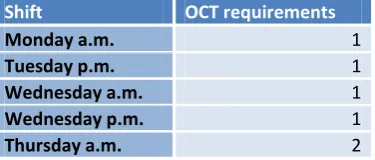
o Pediatric outpatient clinic: During certain shifts, at most two OCTs treat patients at the Pediatric outpatient clinic. Table 2.3 provides an indication of the schedule. It is possible that these OCTs return to the cast room before the end of a shift. This occurs when there are few patients at the Pediatric outpatient clinic.
Shift OCT requirements
Monday a.m. 1
Tuesday p.m. 1
Wednesday a.m. 1
Wednesday p.m. 1
Thursday a.m. 2
Table 2.3: OCT requirements for the Pediatric outpatient clinic (2009)
o External treatments: An OCT might be called in to perform an external treatment in the operating room, intensive care, or emergency room. The operating room schedule is known one week in advance. However, the exact time of treatment is not clear.
14
Unscheduled OCT unavailability: The remainder of temporary decreases in capacity is not scheduled and not known in advance:
o Additional Pediatric outpatient clinic requirements: During busy hours at the Pediatric outpatient clinic, an additional OCT is called in to perform treatments.
o External treatments: An OCT might be called in to perform an external treatment in the operating room, intensive care, or emergency room. Treatments at the Intensive Care and Emergency room are arbitrary. An OCT is called in when needed.
2.1.3 SPECIALISTS
Specialist with cast room patients are either from the department Orthopedics, Traumatology or Plastic Surgery. These departments use a two-week schedule for consulting hours. Table 2.4 shows the consulting hours of the specialists during the week. Appendix B includes the schedule of the specialist’s consulting hours during the two-week cycle.
Department a.m. p.m. Orthopedics 8:30-11:30 13:00-15:30 Traumatology 9:00-11:30 13:00-15:30 Plastic Surgery 9:00-11:30 13:00-15:30
Table 2.4: Consulting hours per specialist’s department (2009)
Unlike the OCTs, each specialist sees patients that are only treated by this specialist. In most cases, specialists receive patients during consulting hours in their office. However, it is also possible that a specialist is called in to perform a patient check at the cast room. We describe this possibility in Section 2.2.
2.1.4 DESK EMPLOYEES
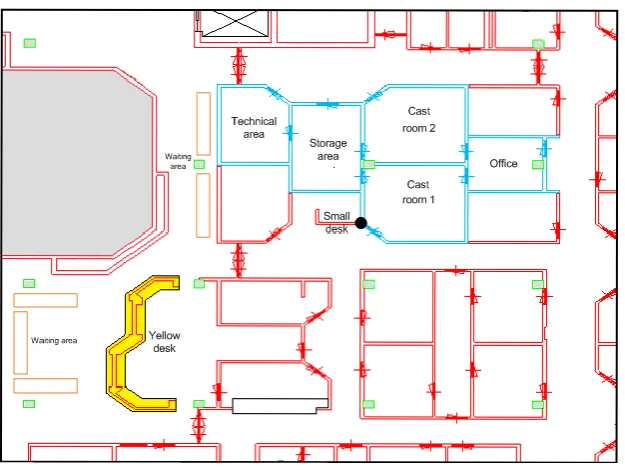
There are two desks related to the cast room process in the outpatient clinic, namely the yellow desk and the small desk (see figure 2.1, Section 2.2). At the yellow desk, receptionists welcome arriving patients and they handle several administrative tasks. At the small desk, doctors’ assistants schedule appointments for patients and they perform several supporting tasks for the outpatient clinic (see Section 2.2).
2.2 DESCRIPTION OF THE CAST ROOM PROCESS
The cast room process can be described per actor. We focus on patient flow and OCT flow in our process description. Before describing the process, we describe the cast room floor plan. To conclude, we identify disturbances in the cast room process in Section 2.2.4 and we explain the current way of scheduling appointments in Section 2.2.5.
2.2.1 DESCRIPTION OF THE CAST ROOM FLOOR PLAN
15
Figure 2.1: The cast room floor plan
The following places are of interest in the cast room process:
Cast room 1: There are two beds for patient treatment. Inpatients are not treated in this room, because of space limitations.
Cast room 2: There are two beds for patient treatment. Before an inpatient is treated in this room, the OCTs move the beds to the side of the room. Subsequently, the OCT moves the bed with the inpatient in between the two beds on the sides. During inpatient treatment, the other beds cannot be used for treatment.
Storage area: The OCTs use the storage area to store equipment and materials for treatment.
Technical area: The OCTs use the technical area for making (detachable) patient braces. Also, the OCTs use this area as a changing area at the beginning and end of the day.
Office area: The office area has a computer to input patient records in the hospital information system after treatment. A telephone is present for scheduling walk-in patients or inpatients on the same day. Also, the OCTs use the office area for coffee breaks.
Yellow desk: Patients who visit the outpatient clinic first indicate their presence at the yellow desk. Note that these are not only cast room patients.
Small desk: DAs use the small desk to schedule future appointments for any outpatient clinic patient. Waiting area: Patients wait in the waiting area before treatment.
Patient appointment card box (PAC-box) (displayed by the black dot between the small desk and cast room 1): This box contains the patient appointment cards (PACs) of patients waiting to visit the cast room. Note that PACs are only put in the PAC-box after patients have indicated their presence at the outpatient clinic.
16
2.2.2 PATIENT FLOW PROCESS
We identify the main steps in the patient flow process as patient arrival, patient treatment, and patient departure. Figure 2.2 displays the patient flow process.
Patient arrival Patient departure
Patient call-in Removal and/or
cleaning Limb treatment
Patient treatment
Figure 2.2: Patient flow process
PATIENT ARRIVAL
As described in Section 2.1.1, we identify the following groups for arriving patients:
Outpatients:
Scheduled/Same-day outpatient: These patients visit the yellow desk to notify their presence by handing over their patient appointment card. A doctor’s assistant puts this card in the PAC-box at the cast room according to a first come first serve principle.
Walk-in outpatient (cast replacement, cast problems, cast removal, emergency – subsequent appointment): These patients visit the yellow desk to notify their presence by handing over their PAC. Next, a doctor’s assistant puts the card in the PAC-box at the cast room according to a first come first serve principle.
Walk-in outpatient (combination – ad hoc): Specialists refers these walk-in patients to the cast room. After a visit to the specialist, these referrals take place in the waiting area. The specialist puts the patient appointment card in the PAC-box at the cast room according to a first come first serve rule. Walk-in outpatient (2nd consults): When the patients are notified of the need to visit the cast room for
a second time on a day, these 2nd consult patients come back to the small desk to indicate the need for a second consult and hand over their PAC. Next, a doctor’s assistant puts the card in the PAC-box at the cast room according to a first come first serve principle.
Inpatients:
Scheduled inpatient: These patients are brought to the cast room by an employee of the AMC patient transportation service. This employee notifies the OCTs when the inpatient is present outside the cast room.
Same-day inpatient: When an inpatient requires cast room treatment, a doctor of the clinic calls to the cast room to check whether the OCTs have time to treat the inpatient. The OCTs determine when the inpatient can come to the cast room:
o Direct: sometimes it is possible that capacity is available to treat an inpatient immediately at the cast room.
17
In either of the two possibilities, the inpatient is brought to the cast room by an employee of the AMC patient transportation service. This employee notifies the OCTs when the inpatient is present outside the cast room.
PATIENT TREATMENT
The cast room has many different treatment types. We include a list of treatment types and their slot duration for appointments, as devised by the OCTs, in Appendix C. We identify three phases in the patient treatment process:
1) Patient call-in
For patient call-in, we identify two situations for any patient:
Outpatient: The patient is called by an OCT and enters the cast room with the OCT.
Inpatient: The patient is moved from the corridor into cast room 2 by the AMC patient transportation employee assisted by an OCT.
When the patient takes place on the bed in the cast room or when the bed with the inpatient is in position, it is time for the next treatment phase.
2) Removal and/or cleaning
For removal and/or cleaning, we identify the following possible situations:
Patient with a cast: the cast is cut open after which the patient or the OCT cleans the limb. Patient with a (detachable) brace:
o If a check of the healing process is needed, the brace is removed after which the patient or the OCT cleans the limb.
o If a check of the brace is needed, it is either possible that the brace is removed or not. Patient without a cast/brace: the limb to be treated is freed from clothing.
3) Limb treatment
For limb treatment, we identify several possible situations. These situations are not mutually exclusive, i.e. combinations are possible:
Specialist’s advice is required: In this instance, it is not clear for the OCT what treatment is required. The OCT notifies the patient’s specialist by placing the PAC in the specialist’s appointment box. When the specialist arrives, the OCT and specialist together discuss the steps to be taken.
Placement of a cast, (detachable) brace or corset: The OCT places a cast, brace or corset around the limb.
o Cast: the patient is ready after cast placement
o (Detachable) brace: the brace is a reworked cast. First, an OCT places a cast around the limb. Next, the OCT cuts open and removes the cast, after which the OCT reworks the cast into a brace in the technical area.
o Corset: the corset is created by the orthopedic workshop and is brought to the cast room before treatment. During treatment, the OCT attaches the corset to the patient.
18
No further treatment is required: In this instance, the limb does not require further treatment in the cast room at this moment. It is possible that the patient returns to the cast room for a 2nd consult (Patient departure) after visiting the X-ray department, rehabilitation department or a specialist. During a peak moment in terms of the total number of patients waiting for a cast room treatment, OCTs may decide to move patients waiting for advice from a specialist or patients waiting for a brace outside the cast room to free capacity.
PATIENT DEPARTURE
After treatment, the patient leaves the cast room. We identify four possible situations. Each patient is in either one of these situations:
The patient is finished at AMC:
o Outpatient: The patient receives a yellow appointment scheduling card. The yellow card contains information about the date and location (specialist/cast room/department) of the required appointment. The patient leaves the cast room and visits the small desk with the PAC and the yellow card to schedule a new appointment, after which the patient leaves AMC.
o Inpatient: The OCT informs the AMC patient transportation service that the inpatient is ready to be moved back to the inpatient clinic. Next, the OCT moves the inpatient outside the cast room to the corridor to wait for an AMC patient transportation service employee.
The patient visits a specialist: The patient will take place in the waiting room of the specialist, while the OCT puts the PAC in the specialist’s appointment card box. It is possible that the specialist refers the patient back to the cast room for a second treatment.
The patient visits the X-ray department: The patient regains his/her PAC and heads over to the X-ray department. After the X-ray process, it is possible that the patient requires additional treatment at the cast room. In this instance, the patient heads back to the cast room.
The patients visits the rehabilitation department: The patient regains his/her PAC and heads over to the rehabilitation department. It is possible that the patient is referred back to the cast room for additional treatment. In this instance, the patients heads back to the cast room.
2.2.3 ORTHOPEDIC CAST TECHNICIAN FLOW PROCESS
We identify the steps in the OCT flow process related to patient treatment as patient call-in, patient treatment and treatment completion. If no patients are present in the waiting room during consulting hours, OCTs either perform administrative tasks, clean the cast rooms, or they resupply the cast materials in the cast rooms. A doctor’s assistant knocks on the door to notify that a patient is waiting for treatment. Figure 2.3 displays the OCT flow process for patient treatment.
Patient call-in Treatment
completion
Removal and/or
cleaning Limb treatment
Patient treatment
19
PATIENT CALL-IN
Outpatient: the OCT takes the first appointment card from the appointment box. Next, the OCT checks the patient status. This is done by checking the hardcopy patient status or the digital patient status. Next, the OCT calls in the patient from the waiting area. In some cases, the OCT checks the patient status after calling in the patient in the cast room, just before starting treatment.
Inpatient: the OCT moves the beds in cast room 2 to the sides of the room. Next, the OCT moves the inpatient in between the beds in the cast room, after which the OCT checks the patient status.
PATIENT TREATMENT
See description of patient treatment at 2.2.2, starting at removal and/or cleaning.
TREATMENT COMPLETION
After patient treatment, three possible situations can take place:: The patient is ready:
o Outpatient: the OCT fills in the yellow appointment schedule card and returns the PAC with the yellow card to the patient and gives some additional information.
o Inpatient: The OCT informs the AMC patient transportation service that the inpatient is ready to be moved back to the inpatient clinic. Next, the OCT moves the inpatient outside the cast room in the corridor next to cast room 2.
The OCT refers the patient to a specialist: the OCT gives the patient some additional information and sends the patient to the specialist waiting room, after which the OCT puts the PAC in the appointment card box of the specialist.
The OCT refers the patient to the X-ray or rehabilitation department: the OCT returns the PAC to the patient and gives some additional information.
When the patient leaves the cast room, the OCT cleans the used bed and fills in a patient registration form. This form has to be put directly in the hospital information system. However in practice, this registration mostly takes place during idle time or after consulting hours.
2.2.4 DISTURBANCES IN THE CAST ROOM PROCESS
Patient treatment is not without disturbances. We identify the following possible disturbances during patient treatment:
Telephone calls: the cast room receives several telephone calls during the day. Either outpatients or clinic personnel (for inpatients) use these telephone calls to check whether the OCTs have capacity available to treat another patient on that day. In some cases, OCTs have to call back later, because it is not clear yet whether capacity is available.
Questions by a third party: it is possible that either a doctor’s assistant, specialist, OCT or even a patient disturbs a treatment in the cast room with questions. The OCT tries to answer these questions as fast as possible, keeping delay to the minimum.
20
at that time, this takes some time. The OCT uses this time to perform administrative tasks, clean the cast room, resupply cast materials or even treat another patient if a cast room bed is available, until the specialist arrives.
2.2.5 APPOINTMENT SCHEDULING IN THE CAST ROOM PROCESS
The cast room uses two agendas for scheduling patients, namely agenda 1 and agenda 2. When an agenda is open, the slots of the agenda allow for appointment scheduling. The cast room scheduling system uses treatment slots of 15 minutes. When the expected treatment time is longer than 15 minutes, the system combines multiple slots in order to fit the expected duration. During any slot, the system schedules only one patient in Agenda 2. However as we will explain later on in this section, Agenda 1 does allow for overbooking, thus scheduling an additional patient in a slot. Table 2.5 displays the available time intervals for scheduling patients in either agenda 1 or 2. The times are based on patient numbers during the week in combination of the number of OCTs present.
Cast room agendas Agenda 1 Agenda 2 Monday a.m. 08:30-12:00 08:30-11:00
p.m. 13:00-16:00 13:00-15:00 Tuesday a.m. 08:30-12:00 09:00-12:00 p.m. 13:00-16:00 13:00-15:00
Wednesday a.m. 09:00-12:00 -
p.m. 13:00-16:00 -
Thursday a.m. 08:30-12:00 08:30-12:00 p.m. 13:00-16:00 13:00-15:00
Friday a.m. 08:30-12:00 -
p.m. 13:00-16:00 -
Table 2.5: Available time intervals for scheduling appointments in cast room agendas (Quickscan cast room 2009)
At the small desk, doctor’s assistants (DAs) schedule appointments for the cast room patients as well as other outpatients. After treatment, the patient hands over the yellow appointment card (see Section 2.2.2 – Patient treatment – Patient departure) to the doctor’s assistant. The yellow appointment card contains the following information:
Required appointment location: this field indicates the required appointment location. In case of a required visit to the cast room, the expected treatment type is filled in as well. This treatment type corresponds with a specific treatment duration. We include the list of cast room treatments in Appendix C.
Required visit information: name of the specialist, doctor’s assistant to visit (if applicable).
Required date to schedule: this field indicates in how many weeks the next appointment should take place. According to possibly appointment requirements, the DA determines the allowed days for appointment during the specified week. If the card does not show specific requirements, the DA uses the patient’s preference for a day during the specified week to find available agenda slots.
The doctor’s assistant fills in the information in the scheduling system. Next, the system searches in agenda 1 and 2 for free treatment slots combining the listed information. In most cases, a patient needs a combination appointment with a specific specialist.
21
system allows the combination appointment at the cast room to take place before 9.00 AM or after 11.30 AM if no other appointment slots are allowed. It is possible that the system does not find any available appointment slots given the listed information on the yellow appointment card (for either a combination appointment or not). In this instance, overbooking is used. As stated before, agenda 1 allows for overbooking. The doctor’s assistant notifies the patient of the slot possibilities, after which the patient chooses the most preferred slot if more than one slot is available.
It is also possible that patients call to the small desk to schedule an appointment, for instance in case of cast problems. Then, the doctor’s assistant asks for the required information. Subsequently, the doctor’s assistant follows the process as described in this section.
2.3 PERFORMANCE OF THE CURRENT SITUATION
This paragraph presents the current performance of the cast room. First, we define key performance indicators (Section 2.3.1). Second, we outline the required data and data gathering method (Section 2.3.2). Third, we evaluate the cast room performance based on the key performance indicators according to the gathered data (Section 2.3.3). We include only a summary of the most important findings in this report, as we describe the current performance in detail in the report ‘Optimalisatie logistiek gipskamer: Analyserapport’ (2009). For detailed insight in the current cast room performance, we refer to the analysis report. Finally, we summarize our findings in a problem summary to conclude this chapter (Section 2.3.4).
2.3.1 DEFINITION OF KEY PERFORMANCE INDICATORS
In order to measure the current performance of the cast room process, we need to identify key performance indicators. First, we define possible process indicators. Subsequently, we discuss these with cast room stakeholders to determine which indicators to use during our research. Table 2.6 shows the key performance indicators for our research. These performance indicators are in line with Cayirli et al. (2003), Klassen et al. (2004) and Hutzschenreuter (2004).
Measure Definition
Patient waiting time (PWT) Scheduled/same-day patients: Time between the cast room appointment time and the actual start time of appointment (in minutes per patient). When the patient arrives late for his appointment time, the waiting time is the time between arrival in the waiting area and start time of treatment. Walk-in patients: Time between arrival in the waiting area and start time of treatment (in minutes per patient)
OCT overtime (OOT) Time between the end of the last treatment and the end of the consulting hours (in minutes per shift). We refer to negative overtime as undertime (underutilized time during a shift)
OCT utilization (UTIL) Proportion of the actual available session length that OCTs treat patients*
Table 2.6: Key performance indicators
*
22
In addition to the indicators of Table 2.6, cast room stakeholders mention quality of labor and quality of care as important performance indicators as well. Both quality of labor and quality of care are hard to quantify. First, Lee et al. (2002) use workload as an important performance indicator for quality of labor. Workload depends on the balance between demand (the number of cast room patients) and supply (the number of available OCTs) during a shift. A peak in workload is a result of a high demand over supply ratio. If supply and demand balance, patient waiting time improves. In addition, we find that quality of labor increases if overtime decreases.
Second, the quality of care increases if a treatment is carried out with patience rather than rushing a treatment. This results in fewer or no mistakes in the process at all, and the patient experiences a higher quality of care as well. To be able to perform treatments with patience, OCTs should not experience any pressure during treatment. Pressure could increase as a result of a peak in workload. Also, disturbances during treatment could increase OCT pressure or impatience. Disturbances and peaks in workload both result in an increase of patient waiting time.
To conclude, we will not measure quality of labor nor quality of care, but we argue that both measures are positive correlated with the performance indicators patient waiting time and OCT overtime. In addition, we conclude that patient waiting time is the most important indicator in analyzing the performance of the current situation, as we link patient waiting time to both quality of labor and quality of care. Together with the cast room stakeholders, we set the following target for patient waiting time by which we use the AMC Patient Manifest (see Section 1.2):
“At least 95 % of all cast room patients is served within 20 minutes.”
2.3.2 GATHERING DATA FOR PERFORMANCE ANALYSIS
In order to comment on the current performance of the cast room, we need data to measure our key performance indicators. AMC uses two information systems to store information: XCare and the Diagnosebehandelcombinatie-database (DBC). XCare is the agenda system of AMC. Every patient appointment is scheduled in XCare. DBC stores information about the actual treatments. Both systems lack in providing detailed process data. Key performance indicators are not stored in the current situation. Therefore, we cannot make use of relevant historical information other than the total number of treated patients per day. In order to evaluate the actual performance in the current situation, we gather detailed information through a four-week observation period.
During the observation period, we gather information about cast room patients, treatments and capacity through three forms:
Patient waiting time form: this form registers patient waiting time, the reason to visit and patient origin.
Patient treatment form: this forms registers treatment type, duration of treatment phases and possible disturbances.
23
2.3.3 CURRENT CAST ROOM PERFORMANCE
This section summarizes the current cast room performance based on the results from our four-week observation period. For the detailed analysis report, we refer to the document ‘Optimalisatie logistiek gipskamer: Analyserapport’ (2009). This document contains the cast room performance evaluation and recommendations to improve the current performance. Please note that this document also contains the observation period forms.
We start with a description of patient supply followed by the cast room capacity. Subsequently, we discuss the results for the key performance indicators that follow from the interaction between supply and capacity. To conclude, we describe the results of the employee satisfaction questionnaire.
PATIENT SUPPLY
Patient groups
Table 2.7 shows the number of patients per patient group as a percentage of the total number of patients during the observation period. We find that at least 56% of all patients is related to an appointment with a specialist during the same day (Combination appointment + Combination – ad hoc). The percentage is at least 56%, because both cast replacement and cast removal usually require a combination appointment with a specialist as well. Thus, we conclude that the specialists have a high impact on the number of patients visiting the cast room during a shift.
Patient groups Percentage
Inpatients o Post operative 3%
o Not post operative 7%
o Discharge 1%
Outpatients o Combination appointment 40%
o Combination – ad hoc 16%
o Cast problems 4%
o Cast replacement 14%
o Cast removal 3%
o Emergency – Subsequent appointment 1%
o Emergency – ad hoc 0%
o 2nd consults 8%
o Unknown 2%
Total 100%
Table 2.7: Realized percentages per patient group (Observation period 25 May – 19 June 2009, N=556 patients)
Patient numbers during the week
24
Figure 2.4: Average number of patients per shift (Observation period 25 May – 19 June 2009, N=556 patients)
Patient numbers during the day
We find that the number of patients during the day highly fluctuates as well. The number of patients (or patient minutes) during a day can be seen as OCT workload (see Figure 2.4). We find that one of the main peaks in patient minutes during a shift is at the start of a shift (either morning or afternoon). Remarkably, we find that the arrival of walk-in patients is variable but quite stationary, whereas scheduled patients show a more fluctuating pattern during the day. This is unexpected, because these patients can be balanced during a shift by appointment scheduling.
Patient characteristics
We find that only a small percentage of 4.5% of the patients shows up late for an appointment. 9.3% of the patients does not show up at all. We find that 80.6% of these no-show patients cancel their appointment during the day, or a specialist cancels the appointment for the patient. As the cast room stakeholders do not monitor the appointment system continuously, the cast room perceives these cancellations as no-shows. This also means that the cast room perceives same-day patients as walk-in patients (see Section 2.1).
Actual treatment duration of scheduled patients does not always correspond with the scheduled treatment duration (see Table 2.8). We find that the average treatment duration does not differ much from the scheduled duration (except for B30), however the standard deviation is quite high (see Table 2.8).
Appointment slot Percentage Average time (in minutes)
Standard deviation (in minutes)
B15 60% 0:15 0:14
B30 37% 0:21 0:15
B45 1% 0:44 0:26
B60 1% 1:08 0:30
B90 1% 1:40 n.a.
Table 2.8: Realized treatment duration for appointment slots (Observation period 25 May – 19 June 2009, N=302 patients)
25
duration (see Table 2.8). For a detailed comparison between the patient groups per appointment slot, we refer to the analysis report.
CAPACITY
Realized capacity
The capacity of the cast room highly fluctuates during the day (see Figure 2.5). This is a result of arbitrary external treatments, meetings, and scheduled OCT presence at the Pediatric outpatient clinic. However, the realized presence at the Pediatric outpatient clinic differs from the scheduled presence, which often leads to a decrease in cast room capacity. Figure 2.3 shows the differences in scheduled and realized capacity. We refer to Table 2.3 for the Pediatric outpatient clinic schedule.
Figure 2.5: Cast room capacity (Observation period 25 May – 19 June 2009, N=19 days)
Starting time of consulting hours
We find that the starting times of a shift are on average 11 minutes later than planned. In the morning, the OCTs start too late with patient treatments although they are present on time. The delay in the afternoon results from overtime in the morning as well as starting too late with the lunch break by the OCTs. These delays have a negative impact on patient waiting time, as we analyzed that there is a peak in patients at the start of a shift. This means that the cast room starts with patient waiting time that increases during the shift.
Disturbances
We find that disturbances during treatment deteriorate the cast room performance, because disturbances result in a temporary decrease of capacity. OCTs deal with disturbances during treatment. This delays the treatment and increases patient waiting time. During the observation period, disturbances occurred in 10% of all treatments. Hereby, the average duration of delay caused by disturbances is 5 minutes (standard deviation is 7 minutes).
Capacity blocking
26
Section 2.2.2 describes that the cast room allows for treatment of inpatients directly after the treatment request. The inpatients travels from the inpatient clinic to the cast room, which has an average transportation time of 25 minutes. However, we find that the standard deviation is 12 minutes. When the cast room expects an inpatient, the OCTs do not perform treatments in cast room 2. Therefore, the transportation time of inpatients can result in capacity blocking of uncertain duration. Please note that when an inpatient receives a scheduled appointment time, we find that the inpatient arrives on time for his appointment.
KEY PERFORMANCE INDICATORS
The key performance indicators patient waiting time, OCT overtime, OCT utilization, and spread of workload results from the interaction between patient supply and capacity.
Patient waiting time
We find that 74% of all cast room patients is seen within 20 minutes of waiting time. Hereby, the average waiting time is 17.06 minutes per patient. Further analysis shows that about 33% of all shifts during a week shows percentages equal or higher than 80%. Table 2.9 indicates the differences per shift.
% patients treated within 20 minutes of waiting time
Even Odd
Monday a.m. 77% 75%
p.m. 69% 64%
Tuesday a.m. 79% 89%
p.m. 52% 83%
Wednesday a.m. 69% 64%
p.m. 85% 89%
Thursday a.m. 72% 48%
p.m. 75% 86%
Friday a.m. 78% 87%
p.m. 92% 70%
Table 2.9: Waiting time percentage per shift (Observation period 25 May – 19 June, N=556 patients)
27
Figure 2.6: Average patient waiting time (Observation period 25 May – 19 June 2009, N=556 patients)
OCT overtime
Table 2.10 shows the OCT overtime (or undertime between brackets). The OCTs have overtime in the morning after busy morning shifts like Monday, Thursday and Friday. Overtime in the morning contributes to the delay in start time at the beginning of afternoon shifts.
The OCTs rarely encounter overtime in the afternoon. Instead, there is a lot of under-time. Overtime in the afternoon is calculated from 16.30h. However, agenda 1 and 2 allow appointments till 16.00h, which contributes to undertime if no walk-in patients are present or when treatments do not exceed their scheduled duration.
Average OCT overtime/(under-time) (in minutes)
Even Odd
Monday a.m. 0:53 0:13
p.m. (0:20) 0:00
Tuesday a.m. (0:13) (0:13)
p.m. (0:35) (0:57)
Wednesday a.m. (0:09) 0:06
p.m. (0:33) (0:17)
Thursday a.m. 0:13 0:21
p.m. (0:15) (0:06)
Friday a.m. 0:02 0:17
p.m. (1:04) (1:06)
Table 2.10: Average overtime per shift (Observation period 25 May – 19 June 2009, N=556 patients)
OCT utilization
28
OCT utilization Even Odd
Monday a.m. 71% 49%
p.m. 70% 66%
Tuesday a.m. 31% 41%
p.m. 54% 61%
Wednesday a.m. 63% 27%
p.m. 45% 38%
Thursday a.m. 54% 65%
p.m. 50% 49%
Friday a.m. 66% 49%
p.m. 31% 29%
Table 2.11: OCT utilization per shift (Observation Period 25 May – 19 June 2009, N=556 patients)
Workload balance
We calculate the average workload per OCT by dividing the average number of patient minutes during an interval by the number of OCTs present. Figure 2.7 shows this spread of workload during the day.
Figure 2.7: Average number of patient minutes per OCT (Observation period 25 May – 19 June 2009, N= 556 patients)
We find that the average workload highly varies and does not show a spread of workload during the day.
EMPLOYEE SATISFACTION
In order to maximize personnel commitment to our research and findings, we investigate the labor satisfaction related to the cast room process. We use an employee satisfaction form and ask participation of all actors in the cast room process to state strengths as well as improvement points in the cast room process. We include the employee satisfaction questionnaire in the analysis report.
We find that the employees identify the following strengths in the current cast room process: Task diversity (Treatments, patients)
Atmosphere and colleagues Teamwork during the day Quality of care
0 5 10 15 20 25 30 35
8:30 9:30 10:30 11:30 12:30 13:30 14:30 15:30 16:30
N u m b e r o f p atien t m in u te s
Average number of patient minutes per OCT
29
The employees identify the following improvement points in the current cast room process: Unbalance in patient demand (Scheduling, communication)
Lack of space in the cast room Lack of satisfactory IT facilities
2.3.4 PROBLEM SUMMARY
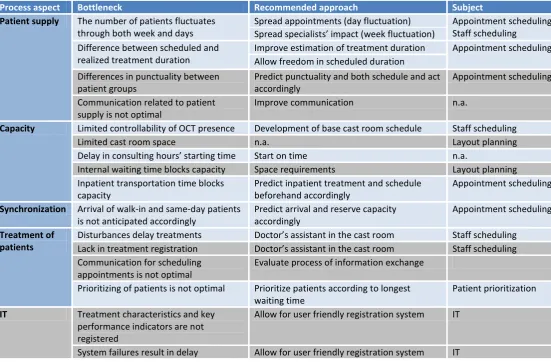
The summary of the data analysis in Section 2.3.4 supports our statement that the cast room has an unbalance in supply and demand that results in an increase of patient waiting times and a decrease of both quality of labor and quality of care. To conclude Chapter 2, we summarize the process bottlenecks and give recommended approaches in order to improve the current performance. In addition, we indicate the related literature subjects for further research. Table 2.12 provides an overview of these aspects.
Process aspect Bottleneck Recommended approach Subject Patient supply The number of patients fluctuates
through both week and days
Spread appointments (day fluctuation) Appointment scheduling Staff scheduling
Spread specialists’ impact (week fluctuation) Difference between scheduled and
realized treatment duration
Improve estimation of treatment duration Appointment scheduling Allow freedom in scheduled duration
Differences in punctuality between patient groups
Predict punctuality and both schedule and act accordingly
Appointment scheduling Communication related to patient
supply is not optimal
Improve communication n.a.
Capacity Limited controllability of OCT presence Development of base cast room schedule Staff scheduling
Limited cast room space n.a. Layout planning
Delay in consulting hours’ starting time Start on time n.a.
Internal waiting time blocks capacity Space requirements Layout planning Inpatient transportation time blocks
capacity
Predict inpatient treatment and schedule beforehand accordingly
Appointment scheduling Synchronization Arrival of walk-in and same-day patients
is not anticipated accordingly
Predict arrival and reserve capacity accordingly
Appointment scheduling Treatment of
patients
Disturbances delay treatments Doctor’s assistant in the cast room Staff scheduling Lack in treatment registration Doctor’s assistant in the cast room Staff scheduling Communication for scheduling
appointments is not optimal
Evaluate process of information exchange Prioritizing of patients is not optimal Prioritize patients according to longest
waiting time
Patient prioritization IT Treatment characteristics and key
performance indicators are not registered
Allow for user friendly registration system IT
[image:29.595.20.572.261.623.2]System failures result in delay Allow for user friendly registration system IT
Table 2.12: Overview of problems and recommended approaches for current cast room process
30
main subjects regarding planning, namely appointment scheduling, patient prioritization, and staff scheduling. Thus, we exclude the grey shaded areas in table 2.12 from our research as a specific implementation project group at AMC performs the research and possible implementation of these recommendations.
31
CHAPTER 3 -
FORMULATION OF SOLUTION APPROACH
Chapter 3 presents the formulation of the solution approach to improve the cast room process. First, we present a framework for hospital planning and control (Section 3.1). Second, we translate the findings of Table 2.12 according to the framework for hospital planning and control into the formal problem description (Section 3.2). Third, we study the literature for the identified subjects for further research in Section 2.4. We combine the literature findings with the results from the process description (Chapter 2) to design organizational interventions (Section 3.3). Finally, we discuss the aspects of our problem and solution approach to find the most suitable tool for evaluation in our research (Section 3.4).
3.1 FRAMEWORK FOR HOSPITAL PLANNING AND CONTROL
Van Houdenhoven (2007) presents a framework for hospital planning and control. Figure 3.1 shows the framework.
Figure 3.1: Framework for hospital planning and control (van Houdenhoven, 2007)
Van Houdenhoven (2007) defines four managerial areas in a hospital: medical planning involves the coordination and planning of medical activities, resource capacity planning involves the planning and control of health care resources, material coordination involves the coordination of hospital materials, and financial planning involves the coordination of financial aspects of the hospital processes.
We find that the content of our problem statement (Section 1.2) and the findings of Chapter 2 match the managerial area of resource capacity planning in the framework. Resource capacity planning deals with efficiently using the scarce resources of a hospital. These resources include people, tools and space requirements. The planning of capacity either involves the acquisition of additional resources or the allocation of existing resources (Smith-Daniels, et al., 1988). The framework provides four hierarchical levels for which we can derive organizational interventions: strategic decisions are made for the long term (1-5 years), tactical decisions are made for the medium term (months-years), and operational decisions are made for the short term (days-weeks). Offline decisions concern proactive scheduling of either staff or patients, whereas online decisions are reactive: how to respond to current events.
32
3.2 FORMAL PROBLEM DESCRIPTION
Chapter 2 shows that the problem at stake in the cast room process relates to different managerial levels. We use the framework for hospital planning and control (Section 3.1) to distinguish the different aspects of the problem. Per managerial level, we specify the parameters and decision variables of the problem. In the remainder of this report, we define and evaluate organizational interventions and scenarios based on the decision variables. We include a glossary for the formal problem description terms in Appendix A.
Strategic problem description Parameters Decision variables Time horizon
Jobs Size of demand - - 5 years
Resources OCTs Specialists Beds
- # OCTs
# beds # specialists Constraints Capacity is feasible to perform OCT tasks.
Objective Minimize # OCTs.
Tactical problem description Parameters Decision variables Time horizon
Jobs Demand per cycle - - 1 year
Resources OCTs Specialists Specialist impact None-specialist impact Specialist schedule OCT schedule Shift duration Agenda schedule Capacity reserving Slot duration
Constraints Specialists have a required number of consulting hours per cycle. This is required to be scheduled. Specialists have various tasks, and thus preferences for when to have their consulting hours. OCT schedule satisfies OCT contractual agreements (Hours per cycle).
# OCTs ≤ # beds
Anticipate OCT unavailability due to illness.
Objective Match the number of OCTs per shift to the expected number of patients per shift.
Operational offline problem description Parameters Decision variables Time horizon Jobs Appointment requests Patient type
Treatment type Specialist requirements Treatment date Appointment scheduling rule Weeks
Resources Agendas Specialists OCTs Agenda schedule Slot duration Shift duration Specialist schedule OCT schedule Appointment time Appointment duration
Constraints Schedule all appointment requests.
Patient appointments only during specialist consulting hours if combination appointment required. Patient appointments only in free agenda slots (see Tactical decision variable).
33
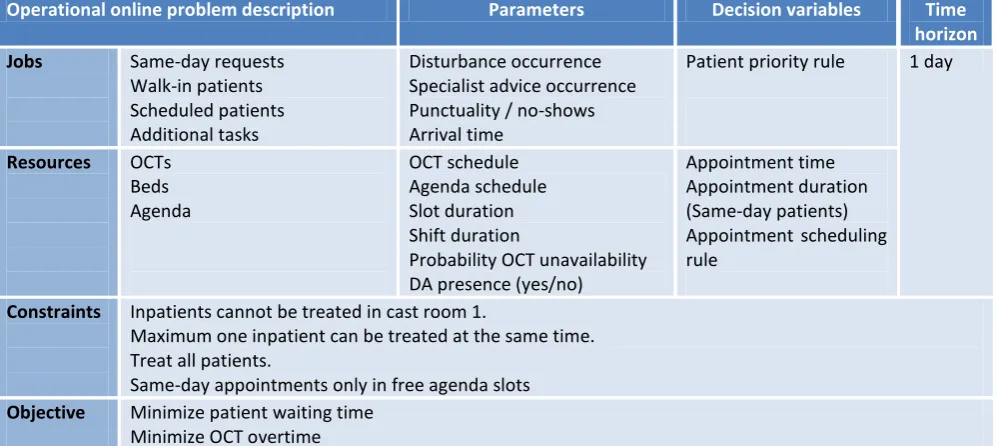
Operational online problem description Parameters Decision variables Time horizon Jobs Same-day requests
Walk-in patients Scheduled patients Additional tasks
Disturbance occurrence Specialist advice occurrence Punctuality / no-shows Arrival time
Patient priority rule 1 day
Resources OCTs Beds Agenda
OCT schedule Agenda schedule Slot duration Shift duration
Probability OCT unavailability DA presence (yes/no)
Appointment time Appointment duration (Same-day patients) Appointment scheduling rule
Constraints Inpatients cannot be treated in cast room 1.
Maximum one inpatient can be treated at the same time. Treat all patients.
Same-day appointments only in free agenda slots Objective Minimize patient waiting time
[image:33.595.50.549.74.297.2]Minimize OCT overtime
Table 3.1: Overview of the formal problem description
The Workplace Management (WPM) makes the decisions on strategic and tactical level together with the related personnel. On operational level, doctors’ assistants make the decisions (scheduling of appoi