The Cochlear Nuclear Complex: MR Location and Abnormalities
StephenS. Gebarski, 1 Debara L. Tucci,2 and Steven A. Telian2
PURPOSE: To determine the usefulness of MR imaging in locating known structural landmarks of the cochlear nuclear complex (CNC), and to determine the frequency of CNC abnormalities, based on these landmarks, in patients referred for MR evaluation of unilateral sensorineural hearing loss. SUBJECTS AND METHODS: We studied 12 consecutive months of temporal bone/posterior fossa MR images retrospectively to find four known structural landmarks of the CNC: the vestibulocochlear nerve root entry zone; the cerebellar flocculus; the curvilinear choroid plexus along and protruding from the foramen of Luschka; and the bulge of the CNC into the lateral recess of the fourth ventricle and the foramen of Luschka. We tabulated the number of landmarks located per CNC and the number and type of CNC MR abnormalities. Medical records were then reviewed to tabulate clinical indication for MR imaging, type of hearing deficit, and etiology of the hearing deficit and clinical-pathologic proof. RESULTS: 175 patients (ages 15-75 years) provided 350 CNCs for study. All 350 CNCs showed at least three of the four landmarks. Thirteen of the 175 patients (7 .4%) had focal CNC MR abnormalities; 136 of these 175 patients had been referred for MR evaluation of unilateral sensorineural hearing loss. In 10 of these 136 patients (7 .4% ), the CNC abnormalities shown on MR proved to be the cause of the sensorineural hearing loss. CONCLUSIONS: MR reliably delineates the CNC. Over 1 year, approximately 7% of patients referred for MR evaluation of unilateral sensorineural hearing loss had MR-determined focal CNC abnormalities that caused the sensorineural hearing loss.
Index terms: Nerves, vestibulocochlear (Vlll); Nerves; magnetic resonance; Nerves, anatomy;
Hearing loss
AJNR 14:1311-1318, Nov/Dec 1993
The cochlear nuclear complex (CNC) is a struc-tural and functional unit of the brain stem with well-defined gross anatomic and surgical land-marks (1-7). General magnetic resonance (MR) studies of the brain stem, reviews of acoustic pathway imaging, and studies of less common causes of sensorineural hearing loss (SNHL) dis-cuss the location of the CNC but do not specifi-cally evaluate the ability of MR imaging to locate CNC landmarks in a large number of patients (8-1 0). Disease frequencies and treatments differ markedly between the CNC and the vestibulo-cochlear nerve, cranial nerve Vlll (CN 8), but CNC lesions can present with unilateral SNHL identical
Received April 7, 1993; accepted June 16.
Departments of 'Radiology and 2
0tolaryngology-Head and Neck S
ur-gery, University of Michigan Medical School, Ann Arbor, Ml48109. Address reprint requests to Stephen S. Gebarski, MD, Department of Radiology, University Hospital B 1 D530G/0030, 1500 E. Medical Center Drive, Ann Arbor, Ml48109-0030.
AJNR 14:1311-1318, Nov/Dec 1993 0195-6108/93/1406-1311
© American Society of Neuroradiology
to that seen with lesions of CN 8 (9-12). We designed a retrospective study to determine the usefulness of MR imaging in locating previously reported structural landmarks of the CNC and the frequency of CNC abnormalities shown on MR images in patients referred for an evaluation of unilateral SNHL.
Materials and Methods
1311
We retrospectively studied all patients referred to our
institution over 12 consecutive months for temporal bone/ posterior fossa MR imaging. MR imaging was performed with a 1.5-T system (Signa, GE Medical Systems, Milwau-kee, Wis) using a quadrature head coil. Spin-echo
se-quences were used to acquire axial images of the temporal bones/posterior fossa at 567/20/2 (repetition time/echo
time/excitations), 256 X 192 matrix, 20-cm field of view, and 3.0-mm section thickness with a 0.5-mm intersection gap. This sequence was acquired before and immediately after the intravenous infusion of gadopentetate dimeglu-mine at 0.1 mmol/kg. Precontrast axial images of the
entire brain were also obtained (2500-3000/30-90, 256 X
1312 GEBARSKI
and a 1-mm intersection gap). Other sequences were ac -quired, depending on the clinical indications. However,
none of these other sequences was formally analyzed for the purposes of our study because they were not uniformly obtained in all of the patients.
Our imaging analysis consisted of subjective examina
-tion of the images to locate four previously reported ana -tomic landmarks of the CNC (1-7): 1) the vestibulocochlear nerve (CN 8) root-entry zone; 2) the cerebellar flocculus; 3) the curvilinear choroid plexus along and protruding from the foramen of Luschka; and 4) the bulge of the dorsal and ventral portions of the CNC into the lateral recess of the
fourth ventricle and the foramen of Luschka. Considering the right and left CNCs separately, each landmark was tabulated as either visible or not visible. All MR abnormal-ities located in and/or distorting each CNC were tabulated.
Medical records of all patients were then reviewed to locate and tabulate the clinical indication for the MR im-aging, the type of hearing deficit, and the cause of the hearing deficit and clinical-pathologic proof of this cause.
Results
One hundred seventy-five patients, ages rang-ing from 15-75 years, were referred for imaging. These 175 patients provided 350 CNCs for analy-sis. None of the patients received more than one posterior fossa/temporal bone MR study over the
12 consecutive months.
When both gadolinium-enhanced and unen-hanced MR images were examined, we found that
296 (85%) of the CNCs had MR delineation of all four anatomic landmarks. The remaining 54 (15%) showed three of four landmarks. The non-visualized landmark differed among these 54
CNCs. Thirty-five CNCs (10%) showed no clearly defined CN 8 root entry zone. Eleven CNCs (3%)
showed discontinuous choroid plexus in the for-amen of Luschka. Eight CNCs (2%) showed no clearly defined cerebrospinal fluid (CSF) in the foramen of Luschka to outline the bulge of the CNC. If gadolinium-enhanced MR imaging was excluded from review, the choroid plexus could not be delineated throughout its length in any of the foramina of Luschka.
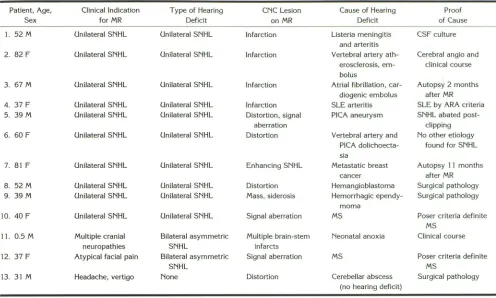
Thirteen of the 175 patients (7 .4%) had focal CNC MR abnormalities. Imaging and clinical in-formation on these patients is summarized in Table 1.
Review of medical records showed that 136 of the 175 patients (78%) had been referred for MR evaluation of unilateral SNHL. In 1 0 of these 136
patients (7 .4% ), the CNC abnormalities shown on MR imaging proved to be the cause of the SNHL. Imaging and clinical information on these 10
patients is summarized in Table 1.
AJNR: 14, November /December 1993
Discussion
Lesions causing unilateral SNHL almost always occur within the sensory organ, the cochlea, or the first-order neural ramifications, the vestibu-locochlear nerve (CN 8), and/ or CNC (11, 12).
Lesions peripheral to the cochlea cause conduc-tive hearing loss, whereas lesions in the central auditory pathways rostral to the CNC often cause no hearing loss or more obscure patterns of bilateral SNHL (12).
Until recently, imaging of cochlear lesions was restricted to abnormalities that altered the com-puted tomographic appearance of the cochlear portion of the bony labyrinth such as congenital anomalies, erosion, fractures, and pathologic mineralization. Various works now exist reporting imaging of abnormalities of the membranous cochlea alone, usually shown by contrast-en-hanced MR imaging (13, 14). In addition, cochlear abnormalities usually can be electrodiagnostically differentiated from lesions of CN 8 or the CNC
(15). Imaging investigations of CN 8 are numer
-ous, both in the CT and MR literature, because of the relative ease of imaging the common neoplastic causes of dysfunction at this level (9-11 ). Although mentioned as part of a report of general brain stem imaging and in reviews of numerous causes of SNHL, CNC imaging has not been specifically studied (8-1 0).
The surface and sectional landmarks of the CNC have been defined anatomically (1-7).
Across its entire length, CN 8 cross-sectional dimensions average 3.0 X 1.3 mm (3). CN 8
AJNR: 14, November/December 1993 COCHLEAR NUCLEAR COMPLEX 1313
TABLE 1: Summary of clinical and imaging information on patients with MR-detectable focal CNC lesions
Patient, Age, Clinical Indication Type of Hearing CNC Lesion Cause of Hearing Proof Sex for MR Deficit on MR Deficit of Cause
1. 52 M Unilateral SNHL Unilateral SNHL Infarction Listeria meningitis CSF culture
and arteritis
2. 82 F Unilateral SNHL Unilateral SNHL Infarction Vertebral artery ath- Cerebral angie and
erosclerosis, em- clinical course bolus
3. 67 M Unilateral SNHL Unilateral SNHL Infarction Atrial fibrillation, car- Autopsy 2 months diogenic embolus after MR 4. 37 F Unilateral SNHL Unilateral SNHL Infarction SLE arteritis SLE by ARA criteria
5. 39M Unilateral SNHL Unilateral SNHL Distortion, signal PICA aneurysm SNHL abated
post-aberration clipping
6. 60 F Unilateral SNHL Unilateral SNHL Distortion Vertebral artery and No other etiology PICA dolichoecta- found for SNHL sia
7. 81 F Unilateral SNHL Unilateral SNHL Enhancing SNHL Metastatic breast Autopsy 11 months
cancer after MR
8. 52 M Unilateral SNHL Unilateral SNHL Distortion Hemangioblastoma Surgical pathology
9. 39M Unilateral SNHL Unilateral SNHL Mass, siderosis Hemorrhagic ependy- Surgical pathology mama
10. 40 F Unilateral SNHL Unilateral SNHL Signal aberration MS Poser criteria definite MS
11. 0.5 M Multiple cranial Bilateral asymmetric Multiple brain-stem Neonatal anoxia Clinical course
neuropathies SNHL infarcts
12. 37 F Atypical facial pain Bilateral asymmetric Signal aberration MS Poser criteria definite
SNHL MS
13. 31M Headache, vertigo None Distortion Cerebellar abscess Surgical pathology (no hearing deficit)
Note.-CNC = cochlear nuclear complex; SNHL = sensorineural hearing loss; angie = angiography; SLE = systemic lupus erythematosus; ARA criteria from Tan et al (17); PICA= posterior-inferior cerebellar artery; MS = multiple sclerosis; Poser criteria from Poser et al (18).
the canthomeatal plane (4). Therefore, in this axial plane, the CNC comprises a curving tubular structure approximately 3 mm thick and 8 mm long.
Surgical landmarks for the CNC have been defined (4, 5). The cisternal portion of CN 8 approaches the pontomedullary junction by first
coming in contact with the cerebellar flocculus,
which is just rostral to CN 8 here. CN 8 then
moves medially and enters the lateral recess of the fourth ventricle forming the CN 8 root-entry
zone. Although CN 8 is usually free in the CSF
until it enters the pontomedullary junction, in
approximately 5% of individuals CN 8 will
coa-lesce with the surface of the pons, and the precise
point of penetration will be lost (4). However,
even if this is the case, CN 8 will still travel
superficially toward the lateral recess of the fourth ventricle covered immediately posteriorly and
su-periorly by protruding choroid plexus from the
lateral recess of the fourth ventricle. Such
protru-sion of choroid plexus is seen in more than 96%
of individuals (16). This choroid plexus extends
lushly into the subarachnoid space at the
cere-bellopontine angle cistern and then thins
some-what as it traverses the lateral recess and the
foramen of Luschka to be contiguous with the
bulk of the choroid plexus of the fourth ventricle
(1). The most reliable surgical landmark
fortran-sition of CN 8 into the ventral cochlear nucleus
is the tenia of the fourth ventricle (4). This thin,
membranous structure is present in slightly less
than half of surgical specimens (4). But, even if
the tenia is not present, the ventral pole of the
CNC forms a discrete bulge into the floor of the lateral recess and distal portion of the foramen of
Luschka (4). The CNC then continues medially
arching over the inferior cerebellar peduncle and
bulging into the floor of the lateral rectus as the
dorsal pole of the CNC (1, 4). Using these
ana-tomic/surgical landmarks, investigators
success-fully marked the CNC in 19 of 20 cadavers (4).
Most importantly for imaging correlation, the
CNC always forms the dorsal and rostral border
of the most rostral portion of the medulla at the
pontomedullary junction along the most rostral
extent of the CSF-containing foramen of Luschka and lateral recess of the fourth ventricle ( 1-7).
Axial sections rostral to this will be in the pons/
[image:3.612.55.551.95.393.2]1314 GEBARSKI
and its favorable topographic features should allow it to be located reliably with MR.
Summarizing the above-described landmarks, the path of CN 8 through to the CNC can be defined on MR as follows. The nerve bundle containing the cisternal portion of CN 8 is re-solved separate from surrounding CSF (Figs 1 and 2A). This nerve bundle descends, in most cases, to approach and blend with the ponto-medullary junction just under the protruding cer-ebellar flocculus. This junction of CN 8 with the brain stem forms the root-entry zone, the first of our four MR landmarks (Figs 1 and 28). The cerebellar flocculus, the second of our MR land-marks, is sharply defined separate from CSF (Figs 1, 28, and 2C). If gadolinium is given, curvilinear contrast-enhancing choroid plexus can be fol-lowed from the roof of the fourth ventricle along the foramen of Luschka and then protruding from the foramen into the rostral portion of the lateral recess (Figs 1, 28, and 2C). This curvilinear choroid plexus forms the third of our four MR landmarks. Moving medially from the root-entry
Fig. 1. Axial section of the brain stem at the pontomedullary
junction through CN 8 and the foramen of Luschka. Canthomeatal plane of section. CN 8 root-entry zone is seen where the cisternal
portion of CN 8 fuses with the brain stem. The vestibular portion of the nerve separates off anteriorly. The cochlear portion of the nerve remains posterior, fusing with the brain stem and forming the ventral portion of the cochlear nuclear complex ( V). This region of fusion of CN 8 and the brain stem provides the first MR landmark for the CNC, the root-entry zone. The cerebellar
floc-culus (F), the second MR landmark, protrudes into CSF at and about the lateral recess (white arrow) of the fourth ventricle. The
third MR landmark is the curvilinear choroid plexus (choroid pix) extending along the posterior aspect of the foramen of Luschka
and protruding into the lateral recess. The fourth MR landmark is
the bulge of the dorsal (D) and ventral ( V) portions of the CNC
into the choroid plexus and/or CSF in the foramen of Luschka.
In the canthomeatal plane, the entire CNC can be included on a single section.
AJNR: 14, November /December 1993
zone, a dorsolateral bulge from the rostral portion of the medulla is seen. This portion of the bulge contains the ventral pole of the CNC, as none of the inferior cerebellar peduncle is immediately contiguous with the surface of the brain stem at this point ( 1, 3-7). Continuing medially along the foramen of Luschka within this bulge, the surface of the brain stem is made up of the dorsal pole of the CNC. The entire CNC bulge forms the fourth of our landmarks (Figs 1, 28, and 2C). In most cases, a small amount of CSF in the fora-men of Luschka will be seen separating the con-trast-enhancing choroid plexus from the CNC bulge (Figs 1 and 2C).
We found that 85% of the CNCs studied dem-onstrated MR delineation of all four landmarks. The remaining 15% showed three of the four
landmarks. No CNC showed fewer than three
landmarks. Thirty-five of the CNCs ( 10%) showed no clearly defined root-entry zone. This is nearly twice the reported incidence of this anatomic variant (4). This is not surprising, because CN 8 could be teased separate from the pia mater in anatomic preparations if CN 8 was simply running along but not penetrating the brain stem. How-ever, MR imaging in such cases would appear to show early fusion of CN 8 with the brain stem. Eleven of the CNCs (3%) showed discontinuous choroid plexus; we could not reliably trace the path of the choroid plexus from the lateral recess all along the foramen of Luschka. This is probably not significant, because all of these CNCs showed CSF intensity outlining the foramen of Luschka.
Eight of the CNCs (2%) showed no CSF intensity
along the foramen of Luschka. All eight of these were found in younger patients (ages less than 20 years). Younger individuals usually have small ventricles and subarachnoid spaces. However, in all eight of these CNCs, a continuous band of enhancing choroid plexus could be followed along the foramen of Luschka.
[image:4.613.56.298.375.549.2]AJNR: 14, November/December 1993 COCHLEAR NUCLEAR COMPLEX 1315
A
8
Fig. 2. A, Axial MR image (1.5 T, 567/20, 3-mm section thickness) after intravenous infusion of 0.1 mmol/kg of gadopentetate dimeglumine. Inferior orbitomeatal plane of section. Canalicular (arrow) and cisternal (arrowhead) portions of CN 8 are shown on the
left. CN 8 descends through the cerebellopontine angle cistern toward the brain stem. No portion of the foramen of Luschka shows on this section.
B, Axial MR image approximately 3 mm caudal to A. Cerebellar flocculus (F). Choroid plexus (arrowheads) extending along the foramen of Luschka and protruding into the lateral recess of the fourth ventricle. Arrow represents CN 8 root-entry zone. D and V represent CNC bulge. When comparing A and B notice the abrupt transition from the pons/middle cerebellar peduncle to the foramen of Luschka, which contains CSF and choroid plexus. This sudden change in shape and signal makes this landmark easily discernable on both T1- and T2-weighted MR.
C, Axial MR image approximately 3 mm caudal to Fig 3. This section, approximately 3 mm caudal to the root-entry zone of CN 8,
shows the most caudal extent of the dorsal (D) portion of the CNC. The CNC bulges into a thin band of CSF in the foramen of Luschka.
This band of CSF separates the CNC bulge from curvilinear contrast-enhancing choroid plexus (arrowheads). The choroid plexus follows the posterior aspect of the foramen of Luschka and bulges into the lateral recess of the fourth ventricle, near the inferior-most aspect of the cerebellar flocculus (F). Two adjacent 3-mm sections (B and C) are needed to include the entire CNC when sectioning in the inferior orbitomeatal plane, which is the most commonly used axial plane for clinical MR imaging.
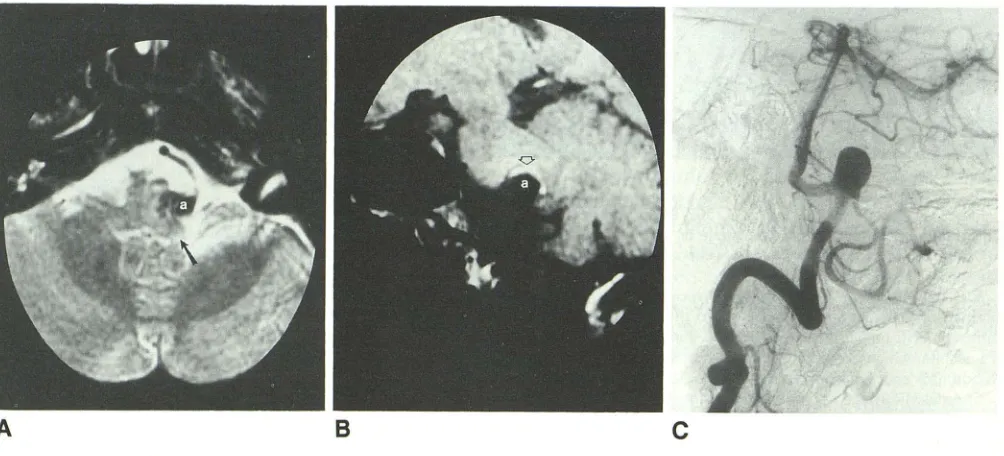
The remaining 10 of the 13 patients with focal MR imaging abnormalities of the CNC were all from the group of 136 patients referred for MR evaluation of unilateral SNHL. Vascular causes predominated, seen in six of the 10 patients (Figs 3, 4, and 5). There were four cases of CNC infarction, two from arteritis and two from throm-boembolism. Vertebral artery and posterior-infe-rior cerebellar artery abnormalities distorted the
CNC in two cases. One of these was dolichoec-tasia, the other a saccular aneurysm. Neoplasms were the next most common with three cases,
one each of metastatic breast cancer (Fig 6),
hemangioblastoma, and ependymoma. There
was one case of multiple sclerosis (Fig 7).
Although we found no other CNC
disease-focused imaging investigations for comparison,
[image:5.612.59.556.77.455.2]1316 GEBARSKI AJNR: 14, November/December 1993
3
4
Fig. 3. Axial MR image (1.5 T, 2500/90, 5-mm section thickness), patient three, subacute infarction. Signal aberration and slight swelling involving the right rostodorsal medulla along the foramen of Luschka, defined by the above landmarks as the region of the CNC. Arrow indicates CSF in the foramen of Luschka, outlining the CNC bulge. Autopsy 2 months after MR imaging showed infarction involving the CNC.
Fig. 4. Axial contrast-enhanced MR image (1.5 T, 567/20, 3-mm section thickness), patient four, subacute infarction (1). Signal
aberration and swelling with subtle pathologic contrast enhancement at the edges of the lesion in the left rostrodorsal medulla. Despite the slightly oblique plane of acquisition, CSF (arrow) and enhancing choroid plexus (arrowhead) in the foramen of Luschka provide
reliable landmarks for the CNC.
A
8
c
Fig. 5. A, Axial MR image (1.5 T, 3000/90, 5-mm section thickness).
B, Sagittal MR image (1.5 T, 500/11, 5-mm section thickness).
C, Detail of subtraction lateral film from left vertebral arteriogram. Patient five, PICA aneurysm (a) with subacute hemorrhage (open arrow) within the intraluminal thrombus. Focal distortion and signal aberration of the rostrodorsal medulla involving the CNC. Despite the distortion, CSF in the foramen of Luschka (black arrow) provides a reliable landmark for the CNC. Although not as useful as the axial plane for delineating the CNC, the sagittal image demonstrates the focal distortion at the pontomedullary junction and affords easy correlation with the arteriogram.
numerous other causes of SNHL (9, 11). If
abnor-malities of the cochlea and CN 8 are excluded
from these previous works, the more recent of
these studies reports disease frequencies very similar to ours (9). This work by Armington et al
studied 176 patients and showed 11 patients (6%)
with vascular disease, five patients (3%) with
neoplasm, and six patients (3%) with
demyeli-nating disease. We studied 136 patients with
[image:6.612.57.539.75.252.2] [image:6.612.56.558.364.592.2]AJNR: 14, November/December 1993 COCHLEAR NUCLEAR COMPLEX 1317
6
7
Fig. 6. Axial contrast-enhanced MR image (1.5 T, 567/20, 3-mm section thickness), patianlt sewern, ~it: ihll1fliflitt <CE~m:a!:lr ..
Contrast-enhancing mass (m) expanding the left rostrodorsal medulla. Despite the local distortion <:oo ~ 51iii£jhltt «llb:l~i!Jiuiitrw df tt!ln:e !OO!iliimn\,
CSF in the foramen of Luschka (arrows) provides a reliable landmark for the C C Autopsy i I ffit.!llilU1!ius iiillfttar ~ i~ill\!l] :fl~lJII
metastatic breast cancer involving the CNC.
Fig. 7. Axial MR image (1.5 T, 3000/90, 5-mm section thickness), patient ten, multiple :sciB'oois_ lesiirnm ((U...)) din iiml!!rlTl'l!le :!i!nJI!Eill aberration in the right rostrodorsal medulla, mainly in the inferior cerebellar peduncle, bult also
m
ollwilrJig k O'!IC. lesls 111!1lalllkl<e.rll :!i!nJntallaberrations in the left dorsal and bilateral ventral medulla. CSF in the foramen of Luschka (a~rows) OllJIIllmnJEs; tt!ln:e lbmlllgje <!!If 1ffhle O'i!C.
vascular disease, three patients (2%) with
neo-plasm, and one patient (1%) with demyelinating
disease.
We reviewed only cases referred for focused
posterior fossa/temporal bone MR imaging
be-cause we wanted to study reasonably
high-reso-lution images of the CNC in a large number of
patients. Clinical selection bias is apparent in our sample, 78% of these patients were referred for an imaging evaluation of unilateral SNHL. Un-doubtedly, this selects for more subtle structural
lesions, likely raising the number of CNCs
show-ing clearly defined landmarks. However, this is
exactly the group of patients where it would seem
most useful to carefully look for MR
imaging-detectable CNC lesions. Larger lesions most likely
would cause other clinical deficits and, because
of their size, would be easier to image. The
technical quality of our MR imaging was limited
by the time constraints of clinical practice and our need for a large number of patients with
comparable MR images. The intersection gap,
relatively coarse matrix per excitation, and thick
sections as well as lack of additional imaging
planes all act to reduce resolution and increase
partial volume artifact. As is common with clinical
MR imaging, our sections were obtained in the
inferior orbitomeatal plane. Because of the topo
-graphic distribution of the CNC, specialized ac
-quisitions in the canthomeatal plane would be
References
e ern CINlC
llllllil:6tt
\7GSCUlllliaur <dlii'5reireue, ~ 1bJ.w
·celfurniiD1tiiJn~ <dlii'5reire;Te .
1. Carpenter iM!B.. lllhre JllllllllfS. lint: /HlQJirmm mmncmul'ltwnw ffil'llliilm:lre: \VAI I-Iiams & ll • , 1~:~371.5)
2. Eydesh~ C, SldirmJEJnlaJtmr lOt~. /fl.. ((JWJJJmudiiml ~· em
Yo ·:~~.11Slli(ID~
3. Lang J. OiirniiolBI ~ <l1ff lihfe 1~. rti$w Wmnlk: 5\jmiilr@jerr-W<arlb@,
1983::33S-35ill
4. ·~ ..JJlr ..Jlr., lillll:lfeli!lal§far ~. lti~ ~. S>un@iolBI m~r.tt~fuiltift!w
of ~ <iJlJJl:JbJiil!illl' lf!lllldlil!illl' ~Je>~< ihn 1111lf11ltl: s~Ullgjrcrall~ .
cOJ1!oiliB-1)7UI@Ili! ~ IT'fk.dk !Sl4n@ TISJW/;~:1!~1!4JOJ
5. IIEJ)\\, h<l'rdE]~ ..JJlr ..Jlr,, ltlfll:lfell!l~ ~ iHtoJurse igE
~lil!S ll'll> ltllr~ I~ <iJlJJl:JbJtGl!lr lf!lllldlt.Jitlr ~- Am J Otol U9a~;;$::~
6. T'il:!Tt 1!.11, ~ f!li.!L !Slunt~ ~~y the cochlear nuclei in
.
~m
~anal ·s. Hear Res 1985;17:• Three-dimensional reconstruction of the eac
h-in humans. Arch Otolaryngo! 1985; 111:
[image:7.612.140.467.74.269.2]1318 GEBARSKI
9. Armington WG, Harnsberger HR. Smoker WRK, Osborn AG. Normal and diseased acoustic pathway: evaluation with MR imaging.
Radiol-ogy 1988;167:509-515
10. Mark AS, Seltzer S, Harnsberger HR. Sensorineural hearing loss: more than meets the eye? AJNR: Am J Neuroradio/1993;14:37-45
11. Kumar A, Maudelonde C, Mafee M. Unilateral sensory neural hearing loss: analysis of 200 consecutive cases. Laryngoscope 1986;96:
14-32
12. Barbour PJ. A neurologist's approach to a patient with hearing impairment. Otolaryngol C/in North Am 1985;18:207-221
13. Mark AS, Seltzer S, Nelson Drake J, Chapman JC, Fitzgerald DC,
Gulya AJ. Labyrinthine enhancement on GD-MRI in patients with
sudden hearing loss and vertigo: correlation with audiologic and electronystagmographic studies. Ann Otol Rhino/ Laryngo/
1992; 101 :459-464
AJNR: 14, November/December 1993
14. Seltzer S, Mark AS. Contrast enhancement of the labyrinth on MR
scans in patients with sudden hearing Joss and vertigo: evidence of
labyrinthine disease. AJNR: Am J Neuroradiol 1991; 12:13-16 15. Kumar A, Mafee M, Torek N. Anatomic specificity of central
vestib-ular signs in posterior fossa lesions. Ann Otol Rhino/ Laryngol
1982;91 :510-515
16. Bradac GB, Simon RS, Fiegler W, Schneider H. A radioanatomic
study of the choroid plexus of the fourth ventricle. Neuroradiology
1976;11:87-91
17. Tan EM, Cohen AS, Fries JE, et al. The 1982 revised criteria for the classification of systemic lupus erythematosus. Arthritis Rheum
1982;25: 1271-1277
18. Poser CM, Paty DW, Scheinberg L, et al. New diagnostic criteria for multiple sclerosis: guidelines for research protocols. Ann Neural