Self-Reflective Sentiment Analysis
Benjamin ShickelUniversity of Florida Gainesville, FL 32611
Martin Heesacker University of Florida Gainesville, FL 32611
Sherry Benton TAO Connect, Inc. Gainesville, FL 32601 [email protected]
Ashkan Ebadi University of Florida Gainesville, FL 32611 [email protected]
Paul Nickerson University of Florida Gainesville, FL 32611
Parisa Rashidi University of Florida Gainesville, FL 32611 [email protected]
Abstract
As self-directed online anxiety treatment and e-mental health programs become more preva-lent and begin to rapidly scale to a large num-ber of users, the need to develop automated techniques for monitoring patient progress and detecting early warning signs is at an all-time high. While current online therapy sys-tems work based on explicit quantitative feed-back from various survey measures, little at-tention has been paid thus far to the large amount of unstructured free text present in the monitoring logs and journals submitted by patients as part of the treatment process. In this paper, we automatically categorize pa-tients’ internal sentiment and emotions using machine learning classifiers based on n-grams, syntactic patterns, sentiment lexicon features, and distributed word embeddings. We report classification metrics on a novel mental health dataset.
1 Introduction
As mental health awareness becomes more widespread, especially among at-risk populations such as young adults and college-aged students, many institutions and universities are beginning to offer online anxiety and depression treatment pro-grams to supplement traditional therapy services. A key component of these largely self-directed pro-grams is the regular completion of journals, in which patients describe how they are feeling. These jour-nals contain a wide variety of information, including a patient’s specific fears, worries, triggers, reactions, or simply status updates on their emotional state. At
current time, these journals are either reviewed by therapists (who are vastly outnumbered by the users) or left unused, with the assumption that simply talk-ing about negative emotions is therapy in and of it-self. We see a large and novel opportunity for ap-plying natural language techniques to these unstruc-tured mental health records. In this paper, we focus on analyzing the sentiment of patient text.
The largest motivator of existing sentiment analy-sis research has arguably been the detection of user sentiment towards entities, such as products, com-panies, or people. We define this type of problem as external sentiment analysis. In contrast, when working in the mental health domain (particularly with self-reflective textual journals), we are trying to gauge a patient’sinternalsentiment towards their own thoughts, feelings, and emotions. The differ-ences in goals, types of sentiment, and distribution of polarity presents unique challenges for applying sentiment analysis to this new domain.
One key aspect that sets our task apart from tra-ditional sentiment analysis is our treatment of polar-ity classes. Traditionally, sentiment is categorized as eitherpositive, negative, orneutral. In contrast, we subdivide theneutralpolarity class into two dis-tinct classes: both positive and negativeandneither positive nor negative. We justify this decision based on several studies showing the independent dimen-sions of positive and negative affect in human emo-tion (Warr et al., 1983; Watson et al., 1988; Di-ener et al., 1985; Bradburn, 1969), and feel that is a more appropriate framework for our domain. This choice represents a novel characterization of senti-ment analysis in senti-mental health, and is one we hope
to see made in future studies in this domain.
Our primary focus in this paper is on the au-tomatic and reliable categorization of patient re-sponses aspositive,negative,both positive and neg-ative, orneither positive nor negative. Such a sys-tem has far-reaching implications for the online ther-apy setting, in which automatic language analysis can be incorporated into existing patient evaluation and progress monitoring, or serve as an early warn-ing indicator for patients with severe cases of de-pression and/or risk of suicide. Additionally, tools based on this type of internal sentiment analysis can provide immediate feedback on mental health and thought processes, which can become distorted and unclear in patients stuck in anxiety or depression. In the future, sentiment-based mental health mod-els can be incorporated into the characterization and treatment of patients with autism, dementia, or other broadly-defined language disorders.
In short, our main contributions are summarized by the following:
• We present a novel sentiment analysis dataset, annotated by psychology experts, specifically targeted towards the mental health domain.
• We introduce the notion of subdividing the tra-ditionalneutral polarity class into both a dual polarity sentiment (both positive and negative) and aneither positive nor negativesentiment.
• We identify the unique challenges faced when applying existing sentiment analysis tech-niques to mental health.
• We present an automatic model for classifying the polarity of patient text, and compare our work to models trained on existing sentiment corpora.
2 Related Work
From a technical point of view, our methods fall squarely in the realm of sentiment analysis, a field of computer science and computational linguistics primarily concerned with analyzing people’s opin-ions, sentiments, attitudes, and emotions from writ-ten language (Liu, 2010). In our paper, we apply sentiment analysis and polarity detection techniques to the largely untapped mental health domain.
In the past decade, sentiment analysis techniques have been applied to a wide variety of areas. Al-though the majority of work has dealt in areas out-side of mental health, we must discuss the bulk of previous sentiment analysis research, from which our techniques are derived.
Given the explosive rise in popularity of social media platforms, a large number of studies have fo-cused on user sentiment in microblogs such as Twit-ter (Barbosa and Feng, 2010; Pak and Paroubek, 2010; Agarwal et al., 2011; Kouloumpis et al., 2011; Nielsen, 2011; Wang et al., 2011; Zhang et al., 2011; Montejo-R´aez et al., 2012; Spencer and Uchyigit, 2012; Montejo-R´aez et al., 2014; Tang et al., 2014). Other studies have explored user sentiment in web forum opinions (Abbasi et al., 2008), movie reviews (Agrawal and Siddiqui, 2009), blogs (Melville et al., 2009), and Yahoo! Answers (Kucuktunc et al., 2012). As we will show, the models proposed in all of these works cannot be directly transferred to po-larity detection in mental health (as sentiment anal-ysis remains a largely domain-specific task), but our initial techniques are largely based on these previous works.
Although the majority of sentiment analysis has focused on user opinions towards entities, there are studies in domains more directly related to our area. One such study analyzed the sentiment of suicide notes (Pestian et al., 2012). Another mined user sentiment in MOOC discussion forums (Wen et al., 2014).
(Glo-rot et al., 2011; Socher et al., 2013). As a starting point for our newinternalsentiment analysis frame-work, in this paper we apply more straightforward approaches based on linear classifiers.
3 Dataset
In this section, we detail the construction of our mental health sentiment dataset. While not yet pub-licly available, we plan to release our data in the near future.
In order to build a dataset of real patient re-sponses, we partnered with TAO Connect, Inc.1, an
online therapy program designed to treat anxiety, de-pression, and stress. This program is being imple-mented in several universities around the country, and as such, the primary demographic is college-aged students.
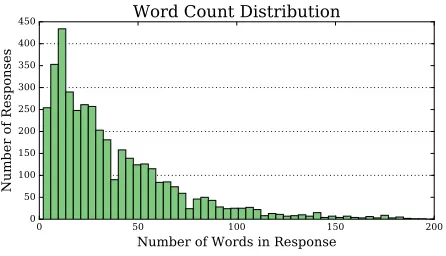
As part of the TAO program, patients complete several self-contained content modules designed to teach awareness and coping strategies for anxiety, depression, and stress. Additionally, patients regu-larly submit several types of journals and logs per-taining to monitoring, anxiety, depression, worries, and relaxation. The free text contained in these logs is the source of our dataset. In total, we collected 4021 textual responses from 342 unique patients, with submission dates ranging from April 2014 to November 2015. Patients were de-identified and the collection process was part of an IRB-approved study. Responses typically range from single sen-tences to a single paragraph, with an average of 39 words per response. We show a complete word count distribution in Figure 1.
To help transform our collection of free text re-sponses into a classification dataset suitable for po-larity prediction, we solicited the expertise of three psychology undergraduates (all female) under the supervision of one psychology professor (male) to provide polarity labels for our response documents. The annotators were tasked with reading each indi-vidual response, and assigning it a label ofpositive, negative,both positive and negative, orneither pos-itive nor negative. The inter-rater agreement relia-bility (Cohen’s kappa) between annotators 1 and 2 was 0.5, between annotators 2 and 3 was 0.67, and between annotators 1 and 3 was 0.48. The overall
1http://www.taoconnect.org/
0 50 100 150 200
Number of Words in Response 0
50 100 150 200 250 300 350 400 450
Number of Responses
Word Count Distribution
Figure 1:Distribution of word counts per response for our col-lected dataset. On average, each response contains 39 words, with a minimum of two words and a maximum of 762 words. 30 responses had more than 200 words, which we do not show.
Annotator POS NEG BOTH NEITHER
Annotator 1 494 2569 556 402
Annotator 2 321 2509 552 638
Annotator 3 531 2152 383 954
[image:3.612.316.539.56.184.2]Final 414 2545 510 548
Table 1: Label counts per annotator, as well as the the final dataset label counts obtained via a majority-voting scheme. For brevity, we denote thepositivelabel as POS,negativeas NEG, both positive and negativeas BOTH, andneither positive nor negativeas NEITHER.
agreement reliability between all annotators (Fleiss’ kappa) was 0.55. We used a majority-vote scheme to assign a single label to each piece of text, where 62% of the documents had full annotator agreement, 35% had a clear label majority, and only 3% had no majority, in which case we picked the label from the annotator with the best aggregate reliability. Table 1 shows label counts for each annotator, as well as the final count after applying the majority-vote process. To provide a clearer picture of the types of re-sponses in our dataset, we present one short concrete example of each polarity class below.
• Positive- I tried to say good things for them
since I know there was a lot of arguments hap-pening.
• Negative- I don’t do well at parties, I’m not
interesting.
• Both Positive and Negative-I shouldn’t have
taken things so seriously.
journal, and read till I was tired enough to fall asleep.
In the above examples, the challenges of applying sentiment analysis and traditional text classification techniques to self-reflective text becomes more ap-parent. For instance, thepositiveexample mentions arguments, typically associated with negative senti-ment, while thenegativeexample mentions parties, a word usually associated with a positive connota-tion. Additionally, theboth positive and negative ex-ample exhibits subtle cues that differentiate it from the other three polarity classes.
4 Method
To predict polarity from patient text, we employ several established machine learning and text classi-fication techniques. We begin by preprocessing the annotated patient responses, which we refer to inter-changeably as documents. We then extract several types of attributes from each response, referred to as features. The extracted features and polarity annota-tions are used to build a logistic regressionclassifier, which is a linear machine learning model we use to predict the final polarity label. In this section, we describe each step in detail.
4.1 Preprocessing
Starting with the raw documents obtained from our data collection process, we apply several tradi-tional preprocessing steps to the text. First, based on experimental feedback, we convert all the text to lowercase and strip all documents of punctua-tion following a standard tokenizapunctua-tion phase. While these are relatively standard steps, it should be ex-plicitly noted that we did not remove stop words from our corpus, which is a common preprocessing technique in other domains, due to lowered classifi-cation performance. This can be partially explained by the nature of our domain; for example, the phrase “what if” tended to be associated with worrying about the future - traditionally, both of these words are considered stop words and filtered out, losing valuable information for our task.
4.2 Feature Extraction
Next, we extract several types of features from the preprocessed documents. In our experiments, we
evaluate classification performance with various fea-ture subsets.
4.2.1 N-Gram Features and POS Tags
As a starting point for our experiments with this new domain, the most numerous of our extracted features are derived from a traditional “bag of n-grams” approach, in which we create document vec-tors comprised of word unigrams, bigrams, and/or trigram counts. As previous works have shown, this allows the capture of important syntactical informa-tion like negainforma-tion, which would otherwise be missed in a standard “bag of words” (i.e., unigrams only) model.
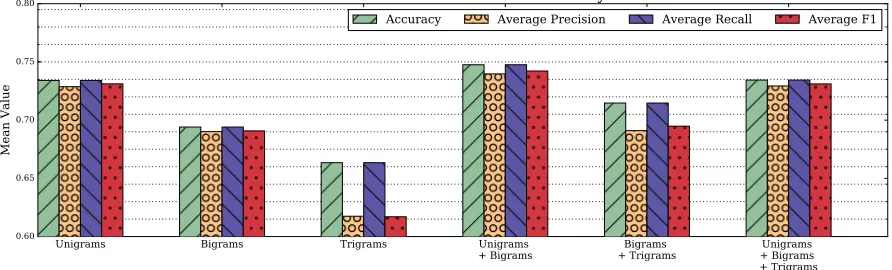
In order to constrain the scope of later feature sub-set experiments, we first obtain the n-gram combina-tion resulting in the best performance for our newly created dataset. We denote this optimal n-gram set-ting as the “n-grams only” model in later experi-ments. In this experiment, we perform a 10-fold cross-validated randomized parameter search using six possible word n-gram combinations: unigrams, bigrams, trigrams, unigrams + bigrams, bigrams + trigrams, and unigrams + bigrams + trigrams. We split cross-validation folds on responses, as we ex-pect patient responses to be independent over time. All extracted n-gram counts are normalized by tf-idf (term frequency-inverse document frequency), a common technique used for describing how impor-tant particular n-grams are to their respective docu-ments. The results of this n-gram comparison exper-iment are shown in Figure 2, where it is clear that us-ing a combination of unigrams and bigrams resulted in the best performance.
In an effort to capture more subtle patterns of grammatical structure, we also experiment with aug-menting each document with each word’s Penn-Treebank part-of-speech (POS) tag. In these exper-iments, we augment our documents by appending these tags, in order, to the end of every sentence, al-lowing for our n-gram extraction methods to capture syntactic language patterns. During the tokenization process, we ignore any n-grams consisting of both words and part-of-speech tags.
4.2.2 Sentiment Lexicon Word Counts
dictio-Unigrams Bigrams Trigrams Unigrams
+ Bigrams + TrigramsBigrams + Bigrams Unigrams + Trigrams
0.60 0.65 0.70 0.75 0.80
Mean Value
N-Gram Feature Subsets for Four-Class Polarity Prediction
[image:5.612.84.530.64.199.2]Accuracy Average Precision Average Recall Average F1
Figure 2:Classification results using only word n-gram features for our 4-class polarity dataset. Results were obtained following a 10-fold cross-validated randomized hyperparameter search. A combination of unigrams and bigrams resulted in the best metrics. As seen by the final cluster, adding trigrams to this subset resulted in a performance decrease. Thus, when we use n-gram features in later experiments, we only consider the combination of unigrams and bigrams.
nary, or lexicon, which is a pre-existing collection of subjective words that are labeled as either posi-tiveornegative. Using the sentiment lexicon from (Liu, 2012)2, we count the number of positive and
negative words occurring in each document and in-corporate the counts as two additional features.
4.2.3 Document Word Count
In our initial analysis, we discovered that often-times the most negative text responses were associ-ated with a larger word count. Although the corre-lation is relatively weak across the entire corpus, we nonetheless include a word count of each document as a feature.
4.2.4 Word Embeddings
Based on the recent successes of distributed word representations like Word2Vec (Mikolov et al., 2013) and GloVe (Pennington et al., 2014), we sought to harness these learned language models for predicting sentiment polarity. Although primarily used in deep learning architectures, we show that these representations can also be useful with linear models. Unlike our other features, the individual features contained in word embeddings are indeci-pherable; however, as we show in the results section, they contribute to the overall success of our classifi-cation.
In our experiments, we utilize a publicly
avail-2https://www.cs.uic.edu/ liub/FBS/sentiment-analysis.html
able Word2Vec model pre-trained on Google News3,
containing 100 billion words. Each unique word in the model is associated with a 300-dimensional vec-tor. For each of our documents, we include the mean word vector derived from each individual word’s embedding as 300 additional features.
5 Four-Class Polarity Prediction
Because our new dataset introduces a clear dis-tinction between text labeled as both positive and negativeandneither positive nor negative (tradition-ally, both of these classes are grouped together as neutral), there are no baselines for which to com-pare our experiments. We offer our results for this scenario as a launching point for future studies on polarity detection in mental health. For this sce-nario, we show the results of each feature extraction method individually, as well as the results for the combination of all features. All results are evaluated via 10-fold cross-validation, with folds split on re-sponses. Results are shown in Figure 3, where it is clear that optimal performance is achieved using the model trained on all features. Our methods gave rise to an overall classification accuracy of 78%.
From Figure 3, it is apparent that of all individual features, n-grams perform the best. The relatively strong performance of n-gram features tends to align with our expectations, given the widespread use of n-gram features across all types of text
N-Grams POS Tags Word Count Sentiment Lexicon Word2Vec All
0.45 0.50 0.55 0.60 0.65 0.70 0.75 0.80 0.85
Mean Value
Feature Subsets for Four-Class Polarity Prediction
[image:6.612.86.532.63.202.2]Accuracy Average Precision Average Recall Average F1
Figure 3:Classification performance for the 4-class polarity prediction task. We show results for each feature set individually, as well as the combination of all features. Using all extracted features results in the highest accuracy, F1, precision, and recall.
tion problems. However, what is more surprising is the relatively weak results for the sentiment lexicon features, given their popularity in modern sentiment analysis. Additionally, the word embedding features also gave rise to better performance than expected, especially considering that we used the Word2Vec embeddings with linear models as opposed to the more traditional deep learning architectures. Finally, we see optimal performance across all metrics when using the combination of all features.
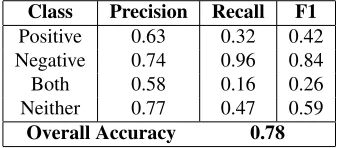
Using the optimal model from Figure 3, we show the individual class metrics for precision, recall, F1, and overall accuracy in Table 2. It is apparent that the both positive and negative class proves espe-cially difficult to classify. This is explained in part by the previously mentioned class imbalance issue - when the majority of the corpus is negative, it comes difficult for the classifier to differentiate be-tween sentiment comprising of mostlypositive po-larity, and sentiment comprising of some positive polarity. The low recall of theboth positive and neg-ativeclass clearly points towards the need for more research in this area.
6 Binary Polarity Prediction
In this section, we experiment with using ex-isting sentiment analysis corpora to perform tradi-tional two-class polarity prediction on our dataset, and compare the results to a cross-validation ap-proach, split on responses, trained on our dataset alone. The primary purpose is to gauge the effective-ness of classifiers trained on existing sentiment cor-pora as applied to the mental health domain. State of
Class Precision Recall F1
Positive 0.63 0.32 0.42
Negative 0.74 0.96 0.84
Both 0.58 0.16 0.26
Neither 0.77 0.47 0.59
Overall Accuracy 0.78
Table 2:Polarity prediction results for the full 4-class version of our dataset. For brevity, the polarity classboth positive and negativeis denoted asBoth, and the classneither positive nor negativeis denoted asNeither.
the art sentence-level binary polarity detection accu-racy is reported as 85.4% (Socher et al., 2013) us-ing deep learnus-ing models and a specialized movie review dataset, and while our models are compu-tationally more simple and use different features, we incorporate such existing corpora in our exper-iments. Since our full dataset consists of four po-larity labels, whereas traditional sentiment analysis only uses two, for these experiments we only con-sider the responses from our dataset belonging to the positiveandnegativeclasses.
We begin by training our model on existing sen-timent datasets only. The first is a large-scale Twit-ter sentiment analysis dataset4 which automatically
assigns polarity labels based on emoticons present in user tweets (we denote this dataset as “Twitter”). The next is a collection of IMDB movie reviews published by (Maas et al., 2011) at Stanford Univer-sity5(we denote this dataset as “Stanford”). We also
use two movie reviews datasets from (Pang et al., 4http://help.sentiment140.com/for-students/
[image:6.612.342.511.255.329.2]Twitter Stanford Cornell Cornell Sentence UMich TAO 2-Class
0.5 0.6 0.7 0.8 0.9 1.0
Mean Value
Binary Polarity Prediction with External Corpora
[image:7.612.85.532.64.202.2]Accuracy Average Precision Average Recall Average F1
Figure 4: Classification results for the positivevs. negativeprediction setting using 5 external sentiment corpora and cross-validated results on our own binary dataset (TAO 2-Class). The precision, recall, and F1 scores are reported using a weighted average incorporating the support of each class label. For all metrics, training on our dataset (TAO 2-Class) yields better results than using models trained on existing sentiment corpora.
Dataset # Positive # Negative
Twitter 797792 798076
Stanford 25000 25000
Cornell 1000 1000
Cornell Sentence 5221 5212
[image:7.612.91.281.282.354.2]UMich 3995 3091
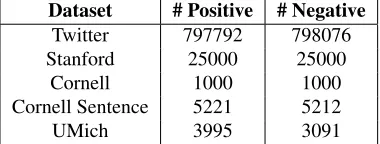
Table 3:Existing sentiment corpora summary.
2002) at Cornell University6, where one is geared
to-wards document-level sentiment classification (de-noted as “Cornell”), and the other towards sentence-level classification (denoted as “Cornell Sentence”). Our final dataset is a collection of web forum opin-ions collected by the University of Michigan as part of a Kaggle competition7(which we denote as
“UMich”). The number of documents of each senti-ment class, per dataset, is given in Table 3.
Using all features from the previously outlined ex-traction process, we train a separate model on each of the five existing sentiment analysis corpora. Op-timal hyperparameters for each experiment were se-lected via a randomized parameter search in con-junction with three-fold cross validation. In each case, the trained models were tested against the bi-nary version of our dataset. Additionally, we per-form the same extraction and fine-tuning process to construct a model trained on our new dataset alone. For this experiment, we report the results after a
10-6
https://www.cs.cornell.edu/people/pabo/movie-review-data/
7https://inclass.kaggle.com/c/si650winter11/data
fold cross-validation process split on responses. A summary of accuracy, precision, recall, and F1 score for the binary prediction setting is shown in Figure 4, where it is apparent that the best performance occurs when using our dataset, pointing towards the need for collecting custom mental health datasets for this new type of internal sentiment analysis. Our binary polarity model resulted in 90% classification accu-racy.
7 Important Features
In this section, we wish to understand which fea-tures are most discriminative in predicting whether a piece of text ispositive,negative,both positive and negative, orneither positive nor negative. These fea-tures (all of which are naturally-interpretable aside from the word embeddings) can serve as useful indi-cators for therapists and future mental health polar-ity studies.
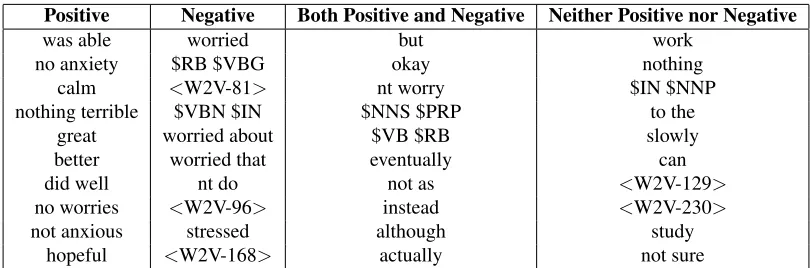
To evaluate our features, we examine the weight matrix of a randomized logistic regression classi-fier trained on our full four-class polarity dataset. The feature weights corresponding to each of the four classes give an idea of the relative importance of each feature, and how discriminative they are as compared to the remaining three classes. We sum-marize the 10 most important features per class in Table 4.
Positive Negative Both Positive and Negative Neither Positive nor Negative
was able worried but work
no anxiety $RB $VBG okay nothing
calm <W2V-81> nt worry $IN $NNP
nothing terrible $VBN $IN $NNS $PRP to the
great worried about $VB $RB slowly
better worried that eventually can
did well nt do not as <W2V-129>
no worries <W2V-96> instead <W2V-230>
not anxious stressed although study
[image:8.612.103.508.53.187.2]hopeful <W2V-168> actually not sure
Table 4: Top 10 features per class from a randomized logistic regression model, trained on our mental health dataset. Features with a $ symbol are part-of-speech tags (using our POS n-gram method). All individual word embedding features, obtained via a pre-trained Word2Vec embedding, are denoted as<W2V-X>, where X is the dimension index of the embedding vector. The POS tags shown are are as follows: $RB = adverb, $VBG = present participle verb, $VBN = past participle verb, $IN = preposition, $JJ = adjective, $NNS = plural noun, $PRP = personal pronoun, $VB = base form verb, $NNP = singular proper noun.
classes are clearly characteristic of their respective labels (with negative words pertaining mostly to worry and stress), the words found in theboth posi-tive and negaposi-tiveclass are more indecisive in nature (‘but’, ‘eventually’, ‘although’, ‘actually’). Words from the neither positive nor negative class carry less surface-level emotional significance. The part-of-speech patterns are more difficult to interpret, but these results point towards the need for future explo-ration.
8 Conclusion
In this paper, we introduced the notion of apply-ing sentiment analysis to the mental health domain, and show that existing techniques and corpora can-not be simply transferred to this new setting. We de-veloped baseline classification techniques grounded in the results from previous works, and show the benefit of spending resources on creating new men-tal health datasets explicitly focused on patient sen-timent. We introduced the notion of splitting the po-larity class traditionally defined asneutralinto two sub-classes, and demonstrated the new challenges that decision brings as it pertains to the automatic classification of patient sentiment in mental health text.
References
Ahmed Abbasi, Hsinchun Chen, and Arab Salem. 2008. Sentiment analysis in multiple languages: Feature
se-lection for opinion classification in web forums. ACM Transactions on Information Systems, 26(3):1–34. Apoorv Agarwal, Boyi Xie, Ilia Vovsha, Owen Rambow,
and Rebecca Passonneau. 2011. Sentiment analysis of Twitter data. In Proceedings of the Workshop on Languages in Social Media, pages 30–38.
Shaishav Agrawal and Tanveer J Siddiqui. 2009. Us-ing syntactic and contextual information for sentiment polarity analysis. InProceedings of the 2nd Interna-tional Conference on Interaction Sciences: Informa-tion Technology, Culture and Human, pages 620–623. Stefano Baccianella, Andrea Esuli, and Fabrizio Sebas-tiani. 2010. SentiWordNet 3.0: An enhanced lexical resource for sentiment analysis and opinion mining. In Proceedings of the Seventh International Conference on Language Resources and Evaluation (LREC’10), pages 2200–2204.
Luciano Barbosa and Junlan Feng. 2010. Robust senti-ment detection on Twitter from biased and noisy data. In Proceedings of the 23rd International Conference on Computational Linguistics: Posters, pages 36–44. Farah Benamara, Carmine Cesarano, Antonio Picariello,
Diego Reforgiato, and V.S. Subrahmanian. 2007. Sen-timent analysis: adjectives and adverbs are better than adjectives alone. InProceedings of the International Conference on Weblogs and Social Media (ICWSM), pages 203–206.
Norman M. Bradburn. 1969. The structure of psycho-logical well-being.
E Diener, R J Larsen, S Levine, and R a Emmons. 1985. Intensity and frequency: dimensions underlying pos-itive and negative affect. Journal of personality and social psychology, 48(5):1253–1265.
X Glorot, A Bordes, and Y Bengio. 2011. Domain adap-tation for large-scale sentiment classification: A deep learning approach. Proceedings of the.
Soo-Min Kim and Eduard Hovy. 2004. Determining the sentiment of opinions. InProceedings of the 20th In-ternational Conference on Computational Linguistics, pages 1367–1373, Morristown, NJ, USA.
Efthymios Kouloumpis, Theresa Wilson, and Johanna Moore. 2011. Twitter sentiment analysis: The good the bad and the omg! InProceedings of the Fifth In-ternational AAAI Conference on Weblogs and Social Media (ICWSM 11), pages 538–541.
Onur Kucuktunc, Ingmar Weber, B. Barla Cambazoglu, and Hakan Ferhatosmanoglu. 2012. A large-scale sentiment analysis for Yahoo! Answers. In Proceed-ings of the 5th ACM International Conference on Web Search and Data Mining, pages 633–642.
Yuming Lin, Jingwei Zhang, Xiaoling Wang, and Aoying Zhou. 2012. An information theoretic approach to sentiment polarity classification. InProceedings of the 2nd Joint WICOW/AIRWeb Workshop on Web Quality, pages 35–40.
Bing Liu. 2010. Sentiment Analysis and Subjectivity. 2 edition.
Bing Liu. 2012. Sentiment analysis and opinion mining. Synthesis Lectures on Human Language Technologies, 5(1):1–167.
Andrew L Maas, Raymond E. Daly, Peter T. Pham, Dan Huang, Andrew Y. Ng, and Christopher Potts. 2011. Learning word vectors for sentiment analysis. In Pro-ceedings of the 49th Annual Meeting of the Associa-tion for ComputaAssocia-tional Linguistics: Human Language Technologies, pages 142–150. Association for Compu-tational Linguistics.
Yelena Mejova and Padmini Srinivasan. 2011. Explor-ing feature definition and selection for sentiment clas-sifiers. InProceedings of the Fifth International AAAI Conference on Weblogs and Social Media, pages 546– 549.
Prem Melville, Wojciech Gryc, and Richard D. Lawrence. 2009. Sentiment analysis of blogs by com-bining lexical knowledge with text classification. In Proceedings of ACM SIGKDD International Confer-ence on Knowledge Discovery and Data Mining, pages 1275–1284, New York, New York, USA. ACM Press. Tomas Mikolov, Kai Chen, Greg Corrado, and Jeffrey
Dean. 2013. Efficient estimation of word repre-sentations in vector space. In Proceedings of In-ternational Conference on Learning Representations (ICLR), pages 1–12.
Arturo Montejo-R´aez, Eugenio Mart´ınez-C´amara, M. Teresa Mart´ın-Valdivia, and L. Alfonso Ure˜na-L´opez. 2012. Random walk weighting over
SentiWordNet for sentiment polarity detection on Twitter. InProceedings of the 3rd Workshop in Com-putational Approaches to Subjectivity and Sentiment Analysis, pages 3–10. Association for Computational Linguistics.
Arturo Montejo-R´aez, Eugenio Mart´ınez-C´amara, M. Teresa Mart´ın-Valdivia, and L. Alfonso Ure˜na-L´opez. 2014. Ranked WordNet graph for sentiment polarity classification in Twitter. Computer Speech & Language, 28(1):93–107.
Tetsuya Nasukawa and Jeonghee Yi. 2003. Senti-ment analysis: Capturing favorability using natural language processing. In Proceedings of the 2nd In-ternational Conference on Knowledge Capture, pages 70–77, New York, New York, USA.
Finn ˚Arup Nielsen. 2011. A new ANEW: Evaluation of a word list for sentiment analysis in microblogs. In ESWC2011 Workshop on Making Sense of Microposts, pages 93–98.
Alexander Pak and Patrick Paroubek. 2010. Twit-ter as a corpus for sentiment analysis and opinion mining. In Proceedings of the Seventh Conference on International Language Resources and Evaluation (LREC’10), pages 19–21.
Bo Pang and Lillian Lee. 2004. A sentimental edu-cation: Sentiment analysis using subjectivity summa-rization based on minimum cuts. In Proceedings of the 42nd Annual Meeting on Association for Compu-tational Linguistics, pages 271–278.
Bo Pang, Lilian Lee, and Shivakumar Vaithyanathan. 2002. Thumbs up? Sentiment classification using ma-chine learning techniques. InProceedings of the Con-ference on Empirical Methods in Natural Language Processing, pages 79–86.
Jeffrey Pennington, Richard Socher, and Christopher D Manning. 2014. GloVe: Global vectors for word rep-resentation. InProceedings of the Empiricial Methods in Natural Language Processing, pages 1532–1543. John Pestian, John Pestian, Pawel Matykiewicz, Brett
South, Ozlem Uzuner, and John Hurdle. 2012. Senti-ment analysis of suicide notes: A shared task. Biomed-ical Informatics Insights, 5(1):3–16.
Richard Socher, Alex Perelygin, Jean Y Wu, Jason Chuang, Christopher D Manning, Andrew Y Ng, and Christopher Potts. 2013. Recursive deep models for semantic compositionality over a sentiment tree-bank. InProceedings of the Conference on Empiri-cal Methods in Natural Language Processing, pages 1631–1642.
Maite Taboada, Julian Brooke, Milan Tofiloski, Kimberly Voll, and Manfred Stede. 2011. Lexicon-based meth-ods for sentiment analysis. Computational Linguis-tics, 37(2):267–307.
Luke Kien Weng Tan, Jin Cheon Na, Yin Leng Theng, and Kuiyu Chang. 2011. Sentence-level sentiment polarity classification using a linguistic approach. In Proceedings of 13th International Conference on Asia-Pacific Digital Libraries, pages 77–87.
Duyu Tang, Furu Wei, Nan Yang, Ming Zhou, Ting Liu, and Bing Qin. 2014. Learning sentiment-specific word embedding for Twitter sentiment classification. InProceedings of the 52nd Annual Meeting of the As-sociation for Computational Linguistics, pages 1555– 1565.
Xiaolong Wang, Furu Wei, Xiaohua Liu, Ming Zhou, and Ming Zhang. 2011. Topic sentiment analysis in Twit-ter: A graph-based hashtag sentiment classification ap-proach. InProceedings of the 20th ACM International Conference on Information and Knowledge Manage-ment, pages 1031–1040, New York, New York, USA. ACM Press.
Peter Warr, Joanna Barter, and Garry Brownbridge. 1983. On the Independence of Positive and Negative Affect. Journal of Personality and Social Psychology, 44(3):644–651.
D Watson, L A Clark, and A Tellegen. 1988. Develop-ment and Validation of Brief Measures of Positive and Negative Affect - the Panas Scales. Journal of Person-ality and Social Psychology, 54(6):1063–1070. Miaomiao Wen, Diyi Yang, and Cp Ros´e. 2014.
Sen-timent analysis in MOOC discussion forums: What does it tell us? In Proceedings of Educational Data Mining, pages 1–8.
Michael Wiegand, Alexandra Balahur, Benjamin Roth, Dietrich Klakow, and Andr´es Montoyo. 2010. A sur-vey on the role of negation in sentiment analysis. In Proceedings of the Workshop on Negation and Specu-lation in Natural Language Processing, pages 60–68. Theresa A. Wilson, Janyce Wiebe, and Paul Hoffmann.
2009. Recognizing contextual polarity: An explo-ration of features for phrase-level sentiment analysis. Computational Linguistics, 35(3):399–433.