Original Article
The mammalian target of rapamycin (mTOR)
inhibitor rapamycin improves postoperative
cognitive dysfunction (POCD)
Ke-Liang Lu1,2, Wen-Zhen Shen1, Ting Luo1, Yun Wang1, Yun Yue1, An-Shi Wu1
1Department of Anesthesiology, Beijing Chaoyang Hospital, Capital Medical University, Beijing 100020, China; 2Department of Anesthesiology, Weifang Medical University, Weifang 261053, Shandong, China
Received September 6, 2015; Accepted January 16, 2016; Epub February 15, 2016; Published February 29, 2016 Abstract: Background: Several lines of evidence have indicated that rapamycinacts as an inhibitor of the mam-malian target of rapamycin (mTOR), and this inhibition has therapeutic benefits as a treatment for postoperative cognitive dysfunction (POCD). Thus, we hypothesized that inhibition of mTOR signaling could affect the occurrence of POCD. Methods and results: Here, 12-14-week-old C57BL/6J mice were randomly divided into four groups. Conditioned fear tests on all mice were carried out on postoperative day 1. The expression levels of mTOR and LC3B proteins in the hippocampus were evaluated by western blotting and immunofluorescence assay. The conditioned fear tests showed that rapamycin could improve the learning and memory of mice. Rapamycin reduced the level of p-mTOR (Ser2448) protein in the hippocampus (P<0.05 vs Sur group) and increased the content of LC3B protein in the hippocampus (P<0.05 vs Sur group). Immunofluorescence assay showed that LC3B was mainly expressed in the cytoplasm. Conclusions: The mTOR inhibitor rapamycin can significantly impede mTOR signaling, up-regulate the expression of LC3B protein in the hippocampus, and improve cognitive dysfunction caused by surgical trauma.
Keywords: Postoperative cognitive dysfunction, mammalian target of rapamycin, autophagy, rapamycin
Introduction
Postoperative cognitive dysfunction (POCD) is a central nervous system complication of anes-thesia and surgery in elderly patients [1]. Its specific pathogenesis is still not clear. Age and surgery are the recognized risk factors [2, 3]. Patients with POCD often exhibit memory decline, cognitive impairment, anxiety, lan-guage comprehension skill loss, social integra-tion ability loss, and other clinical manifesta-tions, and patients with serious forms may fur-ther develop dementia [4].
A previous study has shown that about 25.8% of elderly patients suffer from POCD in the week after non-cardiac surgery, and the propor-tion was higher for cardiac surgery [5]. POCD can affect patient quality of life, lengthen patients’ hospital stay, increase medical expenses, and increase patient mortality, which cause a heavy burden for individuals and families. Therefore, elucidating the mechanism
of POCD and identifying effective prevention and treatment methods are increasingly becom-ing popular medical science issues for society [6].
The mammalian target of rapamycin (mTOR) is the target of rapamycin in mammalian cells, and it plays an important role in the process of neurodegenerative disease [7, 8]. It is hypothe-sized that the pathogenesis of POCD has a simi-lar pathway as neurodegenerative diseases [9]. It is assumed that the mechanism of POCD is that anesthesia induces abnormalities in mTOR signal activation in the brain, and then, protein synthesis becomes abnormal, ultimately dam-aging the functioning of the nervous system [10].
determine whether the role and mechanism of rapamycin in POCD involves influencing mTOR signaling, and the results indicate a theoretical basis and new approach for the prevention and treatment of POCD.
Material and methods
Experimental animals
Male C57BL/6J mice (12-14 weeks old, SPF grade, body weight 20-30 g), were provided by the animal center of Capital Medical University. The mice were randomly divided into four groups: the control group (Ctrl group, n=8), rapamycin group (provided by Shanghai Chenyi Biological Technology Co., LTD) (Ctrl + Rapa group, n=8), surgery group (Sur group, n=8), and surgery + rapamycin group (Sur + Rapa group, n=8). This study was carried out in strict accordance with the recommendations in the Guide for the Care and Use of Laboratory Animals of the National Institutes of Health. The animal use protocol has been reviewed and approved by the Institutional Animal Care and Use Committee of Capital Medical University.
Establishment of the animal model
Sur model (tibial fractures with open reduction and intramedullary nail fixation): The tibia was sheared at the middle position, and open reduction and internal fixation were performed. Sur + Rapa group: 0.5 mg/Kg rapamycin was intraperitoneally injected in the mice for 3 d before the operation. The dose of rapamycin was based on a previous study [11]. Ctrl + Rapa group: 0.5 mg/Kg rapamycin was intraperitone-ally injected in the mice for 3 d. The mice in the control group were placed in the anesthesia induction box with an 80% oxygen concentra-tion for 15 min.
Behavior test
The mice were placed in the training room for 2 h the day before anesthesia to allow them to become familiar with the environment. The mice were placed in the training box for 5 min at first. Then, the mice were exposed to three consecutive 2000-Hz 90-dB sound stimula-tions. The mice were given consecutive 2-sec 0.85-mA electrostimulations at the end of the sound stimulation. The above training sessions
were repeated five times, and the mice were removed from the training box and returned to their cage. After completion of the training, the mice underwent a conditioned fear test. The mice were returned to the original training box for 3 min to become familiar with the environ-ment, and the total freezing time over 3 min was observed without sound stimulation or electrostimulation administration. The mice received the same condition-related fear mem-ory test on postoperative day 1. The freezing time percentage of the mice was measured under the fear condition.
Western blot
Total protein extracts were obtained, and the protein concentrations were determined using a bicinchoninic acid (BCA) protein assay kit. Equal amounts of proteins were fractionated using 12% sodium dodecyl sulfate polyacryl-amide gel electrophoresis (SDS-PAGE) and then transferred to polyvinylidene difluoride (PVDF) membranes. The membranes were incubated with primary antibodies (rabbit poly-clonal, 1:4000, Maxim, China) after blocking with 3% BSA in TBS. The membranes were incu-bated with peroxidase-conjugated goat anti-mouse or anti-rabbit secondary antibody. Actin was used as a loading control.
Immunofluorescence assay
The rat sections were blocked in PBS contain-ing normal goat serum (diluted 1:10, by vol.), 0.5% BSA, 0.2% Tween-20, and 0.05% sodium azide for 4 h at 4°C. The cells were labeled with the respective primary antibodies at a 1:100 dilution followed by incubation with fluorescein-conjugated secondary antibodies at a 1:100 dilution. The nuclei were stained with 4, 6-diamidino-2-phenylindole (DAPI).
Statistical methods
Newman-Keuls post-hoc test was used. P<0.05 indicat-ed statistical significance.
Results
General condition of the mice
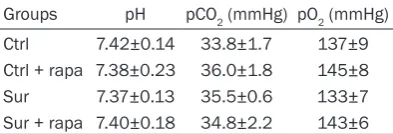
There were no significant differences in body weight between the groups in this experiment (Table 1). The vital signs of the mice in all groups were stable during the surgery. There was no obvious hypoxia, respiratory depres-sion, hypotendepres-sion, or other symptoms. The spe-cific data are shown in Tables 2 and 3.
Cognitive function
In order to investigate whether inhibition of mTOR signaling could improve POCD induced
by surgery, the effect of rapamycin on learning and memory impairment was evaluated using the conditioned fear test. The results showed that the surgical trauma could cause hippo-campus-dependent learning and memory dam-age (*P<0.05 Sur group vs Ctrl group). The mTOR inhibitor rapamycin did not affect the learning and memory function of normal mice, but it did significantly improve the learning and memory impairment in POCD mice (60.0±8.1% vs 43.4±8.0%, #P<0.05) (Figure 1).
mTOR signaling activation
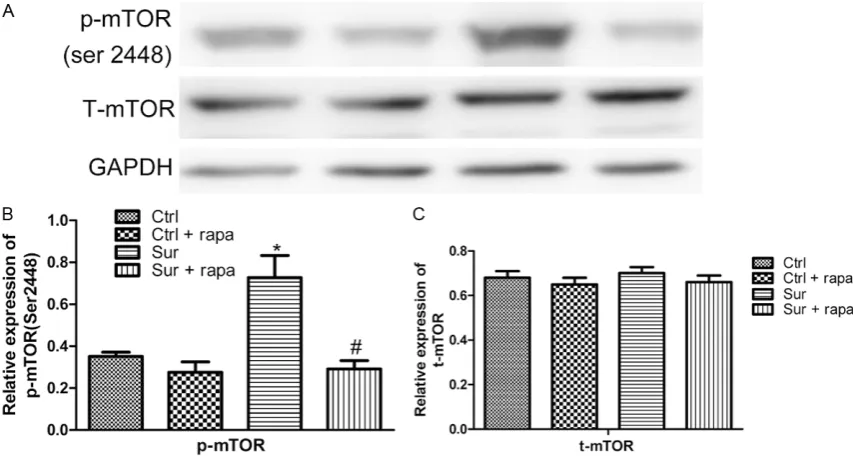
[image:3.629.333.528.81.230.2]Previous results showed that surgery could activate mTOR signaling in the hippocampus. In order to further verify the role of mTOR signal-ing activation in the occurrence of POCD, the mTOR inhibitor rapamycin was administered in this experiment before the surgery, and the changes in postoperative hippocampal mTOR signaling were evaluated. The expression levels of mTOR protein and phosphorylated mTOR pro-tein in the hippocampus were detected by west-ern blotting. The results further confirmed that the phosphorylation level of the mTOR protein was increased by the surgery (*P<0.05 vs Ctrl group) but was significantly decreased in the
Table 1. Body weight comparison between four groups of mice (n=12)
Groups Weight (g) Ctrl 27.2±2.6 Ctrl + rapa 28.2±3.2
Sur 29.5±3.7
Sur + rapa 26.3±2.7
Ctrl: Control group, Ctrl + rapa: rapamycin group, Sur: surgery group, Sur + rapa: surgery + rapamycin group.
Table 2. Comparison of the vital signs moni-toring results between four groups of mice (n=8)
Groups MAP (mmHg) HR (bpm) SpO2 (%) Ctrl 93.16±12.3 539±136 96.6±0.7 Ctrl + rapa 92.87±14.4 508±109 97.1±1.0 Sur 90.22±11.8 562±103 97.5±1.3 Sur + rapa 91.3±10.8 498±118 97.8±1.0
[image:3.629.100.298.104.171.2]Ctrl: Control group, Ctrl + rapa: rapamycin group, Sur: surgery group, Sur + rapa: surgery + rapamycin group.
Table 3. Comparison of blood gas index be-tween four groups (n=4)
Groups pH pCO2 (mmHg) pO2 (mmHg) Ctrl 7.42±0.14 33.8±1.7 137±9 Ctrl + rapa 7.38±0.23 36.0±1.8 145±8 Sur 7.37±0.13 35.5±0.6 133±7 Sur + rapa 7.40±0.18 34.8±2.2 143±6
[image:3.629.100.297.252.322.2]Ctrl: Control group, Ctrl + rapa: rapamycin group, Sur: surgery group, Sur + rapa: surgery + rapamycin group.
Figure 1. Effect of mTOR inhibitor rapamycin on con-ditioned fear memory. The mTOR inhibitor rapamy-cin did not affect the learning and memory function of the normal mice (Ctrl + rapa group vs Ctrl group,
[image:3.629.99.296.390.457.2]surgical group treated with rapamycin (#P<0.05 vs Sur group) (Figure 2). Rapamycin treatment did not affect the expression of total mTOR protein (Figure 2).
Content of LC3B protein
[image:4.629.100.527.81.311.2]Previous studies have shown that the content of autopha-gy protein in the hippocam-pus in surgically treated ani-mals was significantly de- creased along with the acti-vation of mTOR signaling. However, the content of autophagy protein was influ-enced by multiple factors. To further verify the relation-ship between surgical trau-ma, mTOR activation, and autophagy proteins, rapamy-cin was used to inhibit the activity of mTOR protein, and Figure 2. Effect of mTOR inhibitor rapamycin on the expressions of hippocampal total mTOR protein and phosphory-lated mTOR. A. Western Blot result showed the expressions of phosphoryphosphory-lated mTOR and total mTOR protein in the hippocampus of mice in postoperative 1 d. B. Compared with Ctrl group, the expression of p-mTOR (Ser2448) protein in Sur group was significantly increased (*P<0.05 vs Ctrl group, n=8). Compared with Sur group, the expres-sion of p-mTOR (Ser2448) protein in Sur + Rapa group was decreased in postoperative 1 d, which was statistically significant (#P<0.05 vs Sur group, n=8). Compared with Ctrl group, the expression of p-mTOR (Ser2448) protein showed no statistical significance in Ctrl + rapa group (P>0.05, n=8). C. There was no significant difference in the ex-pression of mTOR protein between all groups (P>0.05, n=8). The histogram represented mean ± standard deviation.
Figure 3. Effect of mTOR inhibitor rapamycin on the expression of LC3B pro-tein in hippocampus. The expression of LC3B propro-tein was detected by WB in postoperative 1 d, 3 d and 7 d. Postoperative 1 d, 3 d and 7 d: compared with Ctrl group, the expression of LC3B protein was significantly increased in Sur group and Sur + rapa group (*P<0.05 vs Ctrl group, n=8). Compared with Sur group, the expression of LC3B protein in Sur + Rapa group was significantly higher (#P<0.05 vs Sur group, n=8). At the same time, there was no significant
[image:4.629.101.392.421.614.2]the expression of LC3B protein in hippocampus was evaluated after the surgery. The results showed that the mTOR inhibitor rapamycin could increase the level of the autophagy pro-tein LC3B (#P<0.05 vs Sur group), (Figure 3).
Morphological changes of hippocampal neu-rons and glial cells
In order to investigate the effect of the mTOR inhibitor rapamycin on autophagy, the autopha-gy protein LC3B activity was evaluated using the morphological changes of the hippocampal neurons and glial cells. Multiple bright green fluorescent spots were observed under fluores-cence microscopy. The autophagy activity was evaluated by counting. The fluorescence detec-tion results (Figure 4) showed that LC3B was mainly expressed in the cytoplasm. The expres-sion tendency of LC3B was consistent between the Sur group and the Sur + Rapa group, and LC3B increased at 1 d, 3 d, and 7 d. Compared with the Sur group, the expression of LC3B was stronger in the Sur + Rapa group. The expres-sion intensities showed no significant differ-ences at 1 d, 3 d, and 7 d in the Ctrl + Rapa group.
Discussion
POCD is a common postoperative complication in elderly patients, and it has received increas-ing attention among medical professionals. However, to date, the specific pathogenesis of POCD is still not clear. Recently, advances in POCD research showed that POCD might have a similar or common mechanism as neurode-generative disease, and the abnormal function of mTOR also plays an important role in some neurodegenerative diseases, such as Alzhei- mer’s disease [12-14].
mTOR, as an atypical serine/threonine protein kinase, is involved in controlling protein synthe-sis, cell growth, proliferation and apoptosynthe-sis, and other pathophysiological processes. Pre- vious studies have shown that in addition to mTOR deficiency, excessively activated mTOR could also cause neural functional damage [15, 16]. Puighermanal et al. showed that the excessive activation of mTOR in the hippocam-pus was not beneficial for the formation of learning and memory [17], as it damaged the function of hippocampus-dependent learning and memory. Therefore, we speculated that
abnormal mTOR function might play a role in the occurrence of POCD.
In this experiment, the effects of anesthesia surgery and rapamycin on the activity of mTOR signaling in the hippocampus of mice were investigated. The results showed that the surgi-cal trauma could not only cause cognitive dys-function but also led to the excessive activation of mTOR signaling in hippocampus. The exces-sive activation of mTOR caused cognitive dys-function due to many factors. Surgical trauma could cause an increase in Aβ and Tau protein expression levels as well as the up-regulation of Tau protein phosphorylation [18]. These toxic proteins excessively activate the mTOR/ p70S6K pathway, induce the production of the toxic amyloid β protein (Aβ), and inhibit autoph-agy, forming a vicious cycle and resulting in cognitive dysfunction [19, 20]. Our study con-firmed that rapamycin inhibited the excessive activation of mTOR signaling and improved cog-nitive dysfunction caused by surgical trauma. Autophagy is another important cytobiological phenomenon that follows cell necrosis and apoptosis. Autophagy is ubiquitous in most eukaryotic cells. Autolysosomes function in cel-lular metabolism and in the renewal of organ-elles through the phagocytosis and degrada-tion of cellular structures [21, 22]. The litera-ture suggests that the regulatory pathway of autophagy mainly involves the classicalphos-phatidylinositol-3-kinase/protein kinase B/ rapamycin target protein (PI3K/Akt/mTOR) sig-nal [23, 24]. This interconnected and interde-pendentsignal pathway inhibits the cytotoxic response to agrin in the cell and protects cells from damage and apoptosis. Caccamo et al. showed that increasing the activity of mTOR increased the Tau protein phosphorylation level and inhibited autophagy. The mTOR inhibitor rapamycin can reduce Tau protein expression and enhance its phosphorylation [20]. Rapa- mycin can inhibit the phosphorylation of p70S6K and decrease the activity of microglia [25]. Meanwhile, rapamycin can regulate the expression of Tau protein and its phosphoryla-tion level, which are also involved in the mecha-nism of postoperative cognitive impairment [26].
of operative trauma, which is likely related to the intense stress caused by trauma. In addi-tion, the expression of the autophagy protein LC3B was stronger when rapamycin was admin-istered before the operation. Meanwhile, rapamycin could inhibit the activation of mTOR signaling and enhance the expression of the autophagy protein LC3B. Autophagy had a clear anti-inflammatory effect and removed toxic pro-teins. CCI-779 (a rapamycin analogue) can inhibit the activity of mTOR in an HD mouse model, promote autophagy, reduce the aggre-gation of mtHTT, and inhibit cell apoptosis [27]. Immunofluorescence assays also confirmed that the level of the autophagy protein LC3B in the hippocampus increased following surgical stress. The expression of the LC3B protein in the hippocampus increased significantly when rapamycin was administered before the sur-gery, and autophagy was enhanced, and POCD was alleviated.
In summary, the mTOR inhibitor rapamycin reversed the activation of mTOR signaling and as a result improved POCD, suggesting that rapamycin inhibited the neuro-inflammatory response, reduced the abnormal protein accu-mulation seen in neurodegenerative disease, and alleviated POCD through inducing and pro-moting autophagy. Rapamycin may be a poten-tial drug for use in preventing and treating POCD, and it is also expected to be used to pre-vent and treat neurodegenerative diseases.
Disclosure of conflict of interest
None.
Address correspondence to: An-Shi Wu, Department of Anesthesiology, Beijing Chaoyang Hospital, Capital Medical University, No. 8 Gongtinan Road, Chaoyang District, Beijing 100020, China. Tel: +86 10 8523 1862; Fax: +86 10 8523 1862; E-mail: [email protected]; [email protected] References
[1] Ballard C, Jones E, Gauge N, Aarsland D, Nilsen OB, Saxby BK, Lowery D, Corbett A, Wesnes K, Katsaiti E, Arden J, Amoako D, Prophet N, Purushothaman B and Green D. Optimised an-aesthesia to reduce post operative cognitive decline (POCD) in older patients undergoing elective surgery, a randomised controlled trial. PLoS One 2012; 7: e37410.
[2] Lin R, Zhang F, Xue Q and Yu B. Accuracy of regional cerebral oxygen saturation in predict-ing postoperative cognitive dysfunction after total hip arthroplasty: regional cerebral oxygen saturation predicts POCD. J Arthroplasty 2013; 28: 494-497.
[3] Xu T, Bo L, Wang J, Zhao Z, Xu Z, Deng X and Zhu W. Risk factors for early postoperative cog-nitive dysfunction after non-coronary bypass surgery in Chinese population. J Cardiothorac Surg 2013; 8: 204.
[4] Steinmetz J, Siersma V, Kessing LV and Rasmussen LS. Is postoperative cognitive dys-function a risk factor for dementia? A cohort follow-up study. Br J Anaesth 2013; 110 Suppl 1: i92-97.
[5] Jildenstal PK, Hallen JL, Rawal N, Gupta A and Berggren L. Effect of auditory evoked potential-guided anaesthesia on consumption of anaes-thetics and early postoperative cognitive dys-function: a randomised controlled trial. Eur J Anaesthesiol 2011; 28: 213-219.
[6] Qian XL, Zhang W, Liu MZ, Zhou YB, Zhang JM, Han L, Peng YM, Jiang JH and Wang QD. Dexmedetomidine improves early postopera-tive cognipostopera-tive dysfunction in aged mice. Eur J Pharmacol 2015; 746: 206-212.
[7] Sasazawa Y, Sato N, Umezawa K and Simizu S. Conophylline protects cells in cellular models of neurodegenerative diseases by inducing mammalian target of rapamycin (mTOR)-inde-pendent autophagy. J Biol Chem 2015; 290: 6168-6178.
[8] Sarkar S. Regulation of autophagy by mTOR-dependent and mTOR-inmTOR-dependent pathways: autophagy dysfunction in neurodegenerative diseases and therapeutic application of au-tophagy enhancers. Biochem Soc Trans 2013; 41: 1103-1130.
[9] Menuet C, Borghgraef P, Voituron N, Gestreau C, Gielis L, Devijver H, Dutschmann M, Van Leuven F and Hilaire G. Isoflurane anesthesia precipitates tauopathy and upper airways dys-function in pre-symptomatic Tau.P301L mice: possible implication for neurodegenerative diseases. Neurobiol Dis 2012; 46: 234-243. [10] Yang C, Zhu B, Shen J, Hu T, Li Z and Hong T.
Rapamycin and mTOR inhibitors probably have therapeutic effects for post-operative cognitive dysfunction. Med Hypothes 2013; 81: 487-488.
[11] Irvine EE, Danhiez A, Radwanska K, Nassim C, Lucchesi W, Godaux E, Ris L and Giese KP. Properties of contextual memory formed in the absence of alphaCaMKII autophosphorylation. Mol Brain 2011; 4: 8.
[13] Wang H, Tan MS, Lu RC, Yu JT and Tan L. Heat shock proteins at the crossroads between can-cer and Alzheimer’s disease. Biomed Res Int 2014; 2014: 239164.
[14] Gouras GK. mTOR: at the crossroads of aging, chaperones, and Alzheimer’s disease. J Neuro-chem 2013; 124: 747-748.
[15] Garelick MG and Kennedy BK. TOR on the brain. Experimental Gerontology 2011; 46: 155-163.
[16] Jaworski J, Sheng M. The growing role of mTOR in neuronal development and plasticity. Mol Neurobiol 2006; 34: 205-219.
[17] Puighermanal E, Busquets-Garcia A, Maldona-do R and Ozaita A. Cellular and intracellular mechanisms involved in the cognitive impair-ment of cannabinoids. Philos Trans R Soc Lond B Biol Sci 2012; 367: 3254-3263.
[18] Wan Y, Xu J, Meng F, Bao Y, Ge Y, Lobo N, Vizcaychipi MP, Zhang D, Gentleman SM, Maze M and Ma D. Cognitive decline following major surgery is associated with gliosis, beta-amyloid accumulation, and tau phosphorylation in old mice. Crit Care Med 2010; 38: 2190-2198. [19] Jiang T, Yu JT, Zhu XC, Tan MS, Wang HF, Cao L,
Zhang QQ, Shi JQ, Gao L, Qin H, Zhang YD and Tan L. Temsirolimus promotes autophagic clearance of amyloid-beta and provides protec-tive effects in cellular and animal models of Alzheimer’s disease. Pharmacol Res 2014; 81: 54-63.
[20] Caccamo A, Magri A, Medina DX, Wisely EV, Lopez-Aranda MF, Silva AJ and Oddo S. mTOR regulates tau phosphorylation and degrada-tion: implications for Alzheimer’s disease and other tauopathies. Aging Cell 2013; 12: 370-380.
[21] He C, Wei Y, Sun K, Li B, Dong X, Zou Z, Liu Y, Kinch LN, Khan S, Sinha S, Xavier RJ, Grishin NV, Xiao G, Eskelinen EL, Scherer PE, Whistler JL and Levine B. Beclin 2 functions in autopha-gy, degradation of G protein-coupled receptors, and metabolism. Cell 2013; 154: 1085-1099.
[22] Yefimova MG, Messaddeq N, Harnois T, Meunier AC, Clarhaut J, Noblanc A, Weickert JL, Cantereau A, Philippe M, Bourmeyster N and Benzakour O. A chimerical phagocytosis model reveals the recruitment by Sertoli cells of autophagy for the degradation of ingested illegitimate substrates. Autophagy 2013; 9: 653-666.
[23] Duan J, Yu Y, Li Y, Wang J, Geng W, Jiang L, Li Q, Zhou X and Sun Z. Silica nanoparticles induce autophagy and endothelial dysfunction via the PI3K/Akt/mTOR signaling pathway. Int J Nanomedicine 2014; 9: 5131-5141.
[24] Chang L, Graham PH, Ni J, Hao J, Bucci J, Cozzi PJ and Li Y. Targeting PI3K/Akt/mTOR signal-ing pathway in the treatment of prostate can-cer radioresistance. Crit Rev Oncol Hematol 2015; 96: 507-517.
[25] Xu JT, Zhao X, Yaster M and Tao YX. Expression and distribution of mTOR, p70S6K, 4E-BP1, and their phosphorylated counterparts in rat dorsal root ganglion and spinal cord dorsal horn. Brain Res 2010; 1336: 46-57.
[26] Morita T and Sobue K. Specification of neuro-nal polarity regulated by local translation of CRMP2 and Tau via the mTOR-p70S6K path-way. J Biol Chem 2009; 284: 27734-27745. [27] Obara I, Tochiki KK, Geranton SM, Carr FB,