Finding Good Conversations Online:
The Yahoo News Annotated Comments Corpus
Courtney Napoles,1 Joel Tetreault,2 Enrica Rosato,3 Brian Provenzale,4andAasish Pappu3 1 Johns Hopkins University,[email protected]
2Grammarly,[email protected]
3Yahoo,{aasishkp|enricar}@yahoo-inc.com
4 Accellion,[email protected]
Abstract
This work presents a dataset and annota-tion scheme for the new task of identifying “good” conversations that occur online, which we call ERICs: Engaging, Respect-ful, and/or Informative Conversations. We develop a taxonomy to reflect features of entire threads and individual comments which we believe contribute to identify-ing ERICs; code a novel dataset of
Ya-hoo News comment threads (2.4kthreads
and10k comments) and 1k threads from
the Internet Argument Corpus; and ana-lyze the features characteristic of ERICs. This is one of the largest annotated corpora of online human dialogues, with the most detailed set of annotations. It will be valu-able for identifying ERICs and other as-pects of argumentation, dialogue, and dis-course.
1 Introduction
Automatically curating online comments has been a large focus in recent NLP and social media work, as popular news outlets can receive millions of comments on their articles each month (Warzel, 2012). Comment threads often range from
vacu-ous to hateful, but good discussionsdooccur
on-line, with people expressing different viewpoints and attempting to inform, convince, or better un-derstand the other side, but they can get lost among the multitude of unconstructive comments. We hypothesize that identifying and promoting these types of conversations (ERICs) will cultivate a more civil and constructive atmosphere in online communities and potentially encourage participa-tion from more users.
ERICs are characterized by:
• A respectful exchange of ideas, opinions, and/or
information in response to a given topic(s).
• Opinions expressed as an attempt to elicit a
di-alogue or persuade.
• Comments that seek to contribute some new
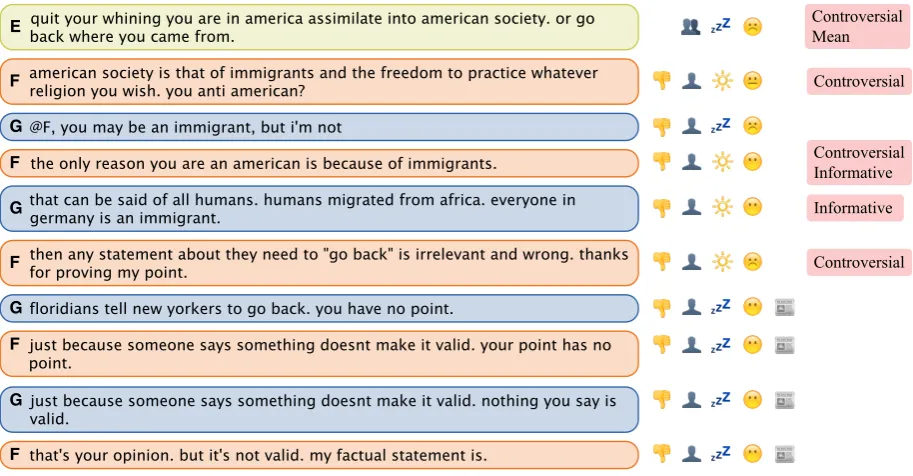
in-formation or perspective on the relevant topic. ERICs have no single identifying attribute: for in-stance, an exchange where communicants are in total agreement throughout can be an ERIC, as can an exchange with heated disagreement. Fig-ures 1 and 2 contain two threads that are charac-terized by continual disagreement, but one is an ERIC and the other is not. We have developed a new coding scheme to label ERICs and identify six dimensions of comments and three dimensions of threads that are frequently seen in the comments section. Many of these labels are for characteris-tics of online conversations not captured by tra-ditional argumentation or dialogue features. Some of the labels we collect have been annotated in
pre-vious work (§2), but this is the first time they are
aggregated in a single corpus at the dialogue level. In this paper, we present the Yahoo News Annotated Comments Corpus (YNACC), which
contains 2.4k threads and 10k comments from
the comments sections of Yahoo News articles.
We additionally collect annotations on1kthreads
from the Internet Argument Corpus (Abbott et al., 2016), representing another domain of online de-bates. We contrast annotations of Yahoo and IAC threads, explore ways in which threads perceived to be ERICs differ in this two venues, and identify some unanticipated characteristics of ERICs.
This is the first exploration of how charac-teristics of individual comments contribute to the dialogue-level classification of an exchange. YNACC will facilitate research to understand ERICS and other aspects of dialogue. The
cor-pus and annotations will be available athttps:
//github.com/cnap/ynacc.
Legend
Agreement: Agree!, Disagree", Adjunct opinion✋ Audience: Broadcast $, Reply%
Persuasiveness: Persuasive&, Not persuasive'
Sentiment: Mixed(, Neutral), Negative☹, Positive+ Topic: Off-topic with article,, off-topic with conv. -Tone: .
Controversial
Controversial
Sarcastic
Sarcastic
$ ' ☹
% ' ☹ "
% & ) ✋
% & ) ✋
% ' ☹☹ "
% & ☹☹
"
when a country has to use force to keep it's businesses behind a wall. . . something is very wrong. will the next step be forcing the talented and wealthy to remain? this strategy did not work well for the soviet union.
A
your solution is?
B
@B, lower the govt imposed costs and businesses will stay voluntarily.
C
just because a company was started in us, given large tax breakes in the us and makes most of its profits in the us does not mean it owes loyalty right? they have to appease the shareholders who want more value so lower your cost of business by lowering taxes while still getting all the perks is one way of doing it.
D
@D - in your world who eventually pays the taxes that our gov't charges business?
C
@C lowering corporate taxes does not equate to more jobs, its only equates to corporations making more money. did you think they take their profits and make high paying jobs with them? lol wake up!
B
[image:2.595.71.527.71.311.2]Headline: Allergan CEO: Feds blindsided us on Pfizer deal
Figure 1: An ERIC that is labeledargumentative,positive/respectful, and havingcontinual disagreement.
Controversial Mean
! " ☹
Controversial
$ % & '
$ " ☹ '
Controversial Informative
$ % (
'
Informative
$ % (
'
Controversial
$ % ☹
'
$ " ( )
'
$ " ( )
'
$ " ( )
'
$ " (
' )
quit your whining you are in america assimilate into american society. or go back where you came from.
E
american society is that of immigrants and the freedom to practice whatever religion you wish. you anti american?
F
@F, you may be an immigrant, but i'm not G
the only reason you are an american is because of immigrants. F
that can be said of all humans. humans migrated from africa. everyone in germany is an immigrant.
G
then any statement about they need to "go back" is irrelevant and wrong. thanks for proving my point.
F
floridians tell new yorkers to go back. you have no point. G
just because someone says something doesnt make it valid. your point has no point.
F
just because someone says something doesnt make it valid. nothing you say is valid.
G
that's your opinion. but it's not valid. my factual statement is. F
Headline: 'The Daily Show' Nailed How Islamophobia Hurts the Sikh Community Too
Figure 2: A non-ERIC that is labeledargumentativeandoff-topicwithcontinual disagreement.
2 Related work
Recent work has focused on the analysis of user-generated text in various online venues, includ-ing labelinclud-ing certain qualities of individual com-ments, comment pairs, or the roles of individual commenters. The largest and most extensively an-notated corpus predating this work is the Internet Argument Corpus (IAC), which contains
approxi-mately480kcomments in16.5kthreads from
on-line forums in which users debate contentious
is-sues. The IAC has been coded for for topic (3k
threads), stance (2kauthors), and agreement,
sar-casm, and hostility (10k comment pairs) (Abbott
et al., 2016; Walker et al., 2012). Comments from online news articles are annotated in the SEN-SEI corpus, which contains human-authored
sum-maries of1.8kcomments posted onGuardian
[image:2.595.70.527.354.592.2]each comment with short, free-form text labels and then wrote a 150–250-word comment sum-mary with these labels. Barker et al. (2016) recog-nized that comments have diverse qualities, many
of which are coded in this work (§3), but did not
explicitly collect labels of them.
Previous works present a survey of how edi-tors and readers perceive the quality of comments posted in online news publications (Diakopoulos and Naaman, 2011) and review the criteria profes-sional editors use to curate comments (Diakopou-los, 2015). The latter identifies 15 criteria for cu-rating user-generated responses, from online and radio comments to letters to the editor. Our anno-tation scheme overlaps with those criteria but also diverges as we wish for the labels to reflect the nature of all comments posted on online articles instead of just the qualities sought in editorially curated comments. ERICs can take many forms and may not reflect the formal tone or intent that editors in traditional news outlets seek.
Our coding scheme intersects with attributes examined in several different areas of research. Some of the most recent and relevant discourse corpora from online sources related to this work
include the following: Concepts related to
persua-sivenesshave been studied, including annotations for “convincing-ness” in debate forums (Habernal and Gurevych, 2016), influencers in discussions from blogs and Wikipedia (Biran et al., 2012),
and user relations as a proxy ofpersuasionin
red-dit (Tan et al., 2016; Wei et al., 2016).
Polite-nesswas labeled and identified in Stack Exchange
and Wikipedia discussions (Danescu-Niculescu-Mizil et al., 2013). Some previous work focused on detecting agreement has considered blog and Wikipedia discussions (Andreas et al., 2012) and
debate forums (Skeppstedt et al., 2016).
Sar-casmhas been identified in a corpus of microblogs
identified with the hashtag #sarcasm on Twitter (Gonz´alez-Ib´anez et al., 2011; Davidov et al., 2010) and in online forums (Oraby et al., 2016).
Sentiment has been studied widely, often in the context of reviews (Pang and Lee, 2005), and in the context of user-generated exchanges, posi-tive and negaposi-tive attitudes have been identified in Usenet discussions (Hassan et al., 2010). Other qualities of user-generated text that are not cov-ered in this work but have been investigated be-fore include metaphor (Jang et al., 2014) and toler-ance (Mukherjee et al., 2013) in online discussion
threads, “dogmatism” of reddit users (Fast and Horvitz, 2016), and argumentation units in discus-sions related to technology (Ghosh et al., 2014). 3 Annotation scheme
This section outlines our coding scheme for identi-fying ERICs, with labels for comment threads and each comment contained therein.
Starting with the annotation categories from the IAC and the curation criteria of Diakopoulos (2015), we have adapted these schemes and iden-tified new characteristics that have broad coverage
over 100 comment threads (§4) that we manually
examined.
Annotations are made at the thread-level and
thecomment-level. Thread-level annotations cap-ture the qualities of a thread on the whole, while comment-level annotations reflect the characteris-tics of each comment. The labels for each dimen-sion are described below. Only one label per di-mension is allowed unless otherwise specified. 3.1 Thread labels
Agreement The overall agreement present in a
thread.
• Agreement throughout
• Continual disagreement
• Agreement → disagreement: Begins with agreement which turns into disagreement. • Disagreement → agreement: Starts with
dis-agreement that converges into dis-agreement.
Constructiveness A binary label indicating
when a conversation is an ERIC, or has a clear exchange of ideas, opinions, and/or information
done so somewhat respectfully.1
• Constructive
• Not constructive
Type The overall type or tone of the
conversa-tion, describing the majority of comments. Two labels can be chosen if conversations exhibit more than one dominant feature.
• Argumentative: Contains a lot of “back and forth” between participants that does not nec-essarily reach a conclusion.
• Flamewar: Contains insults, users “yelling” at each other, and no information exchanged. 1Note that this definition ofconstructivediffers from that
• Off-Topic/digression: Comments are com-pletely irrelevant to the article or each other, or the conversation starts on topic but veers off into another direction.
• Personal stories: Participants exchange per-sonal anecdotes.
• Positive/respectful: Consists primarily of com-ments expressing opinions in a respectful, po-tentially empathetic manner.
• Snarky/humorous: Participants engage with each other using humor rather than argue or sympathize. May be on- or off-topic.
3.2 Comment labels
Agreement Agreement expressed with explicit
phrasing (e.g., I disagree...) or implicitly,
such as in Figure 2. Annotating the target of (dis)agreement is left to future work due to the number of other codes the annotators need to at-tend to. Multiple labels can be chosen per com-ment, since a comment can express agreement with one statement and disagreement with another.
• Agreement with another commenter
• Disagreement with another commenter
• Adjunct opinion: Contains a perspective that has not yet been articulated in the thread.
Audience The target audience of a comment.
• Reply to specific commenter: Can be
ex-plicit (i.e., @HANDLE) or implicit (not
di-rectly naming the commenter). The target of a reply is not coded.
• Broadcast message: Is not directed to a spe-cific person(s).
Persuasiveness A binary label indicating
whether a comment contains persuasive language or an intent to persuade.
• Persuasive
• Not persuasive
Sentiment The overall sentiment of a comment,
considering how the user feels with respect to what information they are trying to convey.
• Negative
• Neutral
• Positive
• Mixed: Contains both positive and negative sentiments.
Tone These qualities describe the overall tone of
a comment, and more than one can apply.
• Controversial: Puts forward a strong opinion that will most likely cause disagreement. • Funny: Expresses or intends to express humor.
• Informative: Contributes new information to the discussion.
• Mean: The purpose of the comment is to be
rude, mean, or hateful.
• Sarcastic: Uses sarcasm with either intent to
humor (overlaps withFunny) or offend.
• Sympathetic: A warm, friendly comment that expresses positive emotion or sympathy.
Topic The topic addressed in a comment, and
more than one label can be chosen. Comments are
on-topic unless eitherOff-topiclabel is selected.
• Off-topic with the article
• Off-topic with the conversation: A digression from the conversation.
• Personal story: Describes the user’s personal experience with the topic.
4 Corpus collection
With the taxonomy described above, we coded comments from two separate domains: online news articles and debate forums.
Threads from online news articles YNACC
contains threads from the “comments section” of
Yahoo News articles from April 2016.2 Yahoo
fil-ters comments containing hate speech (Nobata et al., 2016) and abusive language using a combina-tion of manual review and automatic algorithms, and these comments are not included in our cor-pus. From the remaining comments, we identified threads, which contain an initial comment and at least one comment posted in reply. Yahoo threads have a single-level of embedding, meaning that users can only post replies under a top-level com-ment. In total, we collected 521,608 comments in 137,620 threads on 4,714 articles on topics includ-ing finance, sports, entertainment, and lifestyle. We also collected the following metadata for each comment: unique user ID, time posted, headline,
URL, category, and the number ofthumbs upand
thumbs down received. We included comments posted on a thread regardless of how much time had elapsed since the initial comment because the vast majority of comments were posted in close se-quence: 48% in the first hour after an initial com-ment, 67% within the first three hours, and 92% within the first 24 hours.
We randomly selected 2,300 threads to anno-tate, oversampling longer threads since the aver-2Excluding comments labelednon-Englishby LangID, a
IAC Yahoo
# Threads 1,000 2,400
# Comments 16,555 9,160
Thread length 29±55 4±3
Comment length 568±583 232±538
Trained 0 1,400 threads
9,160 comments
[image:5.595.75.289.61.146.2]Untrained 1,000 threads 1,300 threads
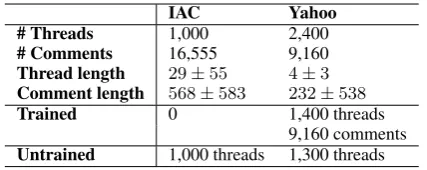
Table 1: Description of the threads and comments annotated in this work and and the number coded by trained and untrained annotators. Thread length is in comments, comment length in characters.
age Yahoo thread has only 3.8 comments. The dis-tribution of thread lengths is 20% with 2–4 com-ments, 60% 5–8, and 20% 9–15. For a held-out test set, we collected an additional 100 threads from Yahoo articles posted in July 2016, with the same length distribution. Those threads are not in-cluded in the analysis performed herein.
Threads from web debate forums To test this
annotation scheme on a different domain, we also code online debates from the IAC 2.0 (Abbott et al., 2016). IAC threads are categorically differ-ent from Yahoo ones in terms of their stated pur-pose (debate on a particular topic) and length. The mean IAC thread has 29 comments and each com-ment has 102 tokens, compared to Yahoo threads which have 4 comments with 51 tokens each. Be-cause significant attention is demanded to code the numerous attributes, we only consider IAC threads with 15 comments or fewer for annotation, but do not limit the comment length. In total, we se-lected 1,000 IAC thread to annotate, specifically: 474 threads from 4forums that were coded in the IAC, all 23 threads from CreateDebate, and 503 randomly selected threads from ConvinceMe.
4.1 Annotation
The corpus was coded by two groups of anno-tators: professional trained editors and untrained crowdsourced workers. Three separate annota-tors coded each thread. The trained ediannota-tors were paid contractors who received two 30–45-minute training sessions, editorial guidelines (2,000-word document), and two sample annotated threads. The training sessions were recorded and available to the annotators during annotation, as were the guidelines. They could communicate their ques-tions to the trainers, who were two authors of this paper, and receive feedback during the training and annotation phases.
Because training is expensive and time consum-ing, we also collected annotations from untrained coders on Amazon Mechanical Turk (AMT). To simplify the task for AMT, we only solicited thread-level labels, paying $0.75 per thread. For quality assurance, only workers located in the United States or Canada with a minimum HIT acceptance rate of 95% could participate, and the annotations were spot-checked by the authors. Trained annotators coded 1,300 Yahoo threads and the 100-thread test set on the comment- and levels; untrained annotators coded thread-level labels of 1,300 Yahoo threads (300 of which overlapped with the trained annotations) and 1,000 IAC threads (Table 1). In total, 26 trained and 495 untrained annotators worked on this task.
4.2 Confidence
To assess the difficulty of the task, we also col-lected a rating for each thread from the trained an-notators describing how confident they were with their judgments of each thread and the comments it comprises. Ratings were made on a 5-level Lik-ert scale, with 1 being not at all confident and 5 fully confident. The levels of confidence were
high (3.9±0.7), indicating that coders were able
to distinguish the thread and comment codes with relative ease.
4.3 Agreement levels
We measure inter-annotator agreement with Krip-pendorff’s alpha (Krippendorff, 2004) and find that, over all labels, there are substantial levels of
agreement within groups of annotators:α = 0.79
for trained annotators andα= 0.71and72for
un-trained annotators on the Yahoo and IAC threads, respectively. However, there is lower agreement on thread labels than comment labels (Table 2).
The agreement of thread typeis 25% higher for
the Yahoo threads than the IAC (0.62–0.64 com-pared to 0.48). The less subjective comment la-bels (i.e., agreement, audience, and topic) have higher agreement than persuasiveness, sentiment, and tone. While some of the labels have only
moderate agreement (0.5 < α < 0.6), we find
these results satisfactory as the agreement levels are higher than those reported for similarly sub-jective discourse annotation tasks (e.g., Walker et al. (2012)).
Yahoo IAC
Thread label Trained Untrained Untrained
Agreement 0.52 0.50 0.53
Constructive 0.48 0.52 0.63
Type 0.62 0.64 0.48
Comment label
Agreement 0.80 – –
Audience 0.74 – –
Persuasiveness 0.48 – –
Sentiment 0.50 – –
Tone 0.63 – –
[image:6.595.73.290.61.188.2]Topic 0.82 – –
Table 2: Agreement levels found for each label category within trained and untrained groups of annotators, measured by Krippendorff’s alpha.
Category Label Matches
Constructive class – 0.61
Agreement – 0.62
Thread type Overall 0.81
Argumentative 0.72
Flamewar 0.80
Off-topic 0.82
Personal stories 0.94 Respectful 0.81 Snarky/humorous 0.85
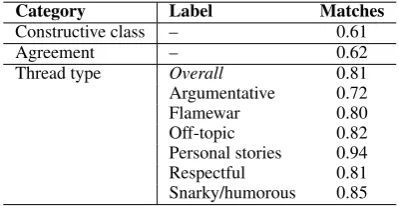
Table 3: Percentage of threads (out of 300) for which the majority label of the trained annotators matched that of the untrained annotators.
by taking the majority label per item from each group of annotators and calculating the percent of exact matches (Table 3). When classifying the thread type, multiple labels are allowed for each thread, so we convert each option into a boolean and analyze them separately. Only 8% of
the threads have no majorityconstructivelabel in
the trained and/or untrained annotations, and 20%
have no majorityagreementlabel. Within both
an-notation groups, there are majority labels on all of thethread typelabels. The category with the
low-est agreement isconstructive classwith only 61%
of the majority labels matching, followed closely byagreement (only 62% matching). A very high percent of the thread type labels (81%). The strong agreement levels between trained and untrained annotators suggest that crowdsourcing is reliable for coding thread-level characteristics.
5 Annotation analysis
To understand what makes a thread constructive, we explore the following research questions:
1. How does the overall thread categorization
differ between ERICs and non-ERICs? (§5.1)
2. What types of comments make up ERICs
compared to non-ERICs? (§5.2)
3. Are social signals related to whether a thread
is an ERIC? (§5.3)
5.1 Thread-level annotations
Before examining what types of threads are ERICs, we first compare the threads coded by different sets of annotators (trained or untrained) and from different sources (IAC or Yahoo). We measure the significance of annotation group for each label with a test of equal proportions for
bi-nary categories (constructivenessand eachthread
type) and a chi-squared test of independence for
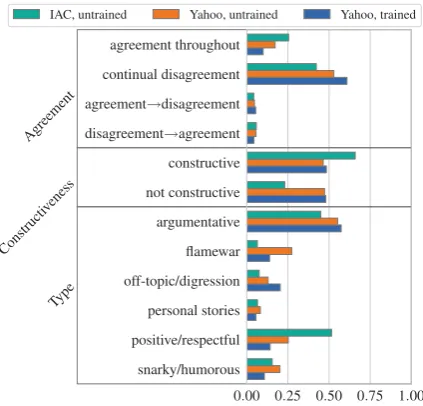
the agreement label. Overall, annotations by the trained and untrained annotators on Yahoo threads are very similar, with significant differences only
between some of the thread type labels
(Fig-ure 3). We posit that the discrepancies between the trained and untrained annotators is due to the for-mer’s training sessions and ability to communicate with the authors, which could have swayed anno-tators to make inferences into the coding scheme that were not overtly stated in the instructions.
The differences between Yahoo and IAC threads are more pronounced. The only label for
which there is no significant difference is
per-sonal stories (p = 0.41, between the IAC and trained Yahoo labels). All other IAC labels are significantly different from both trained and
un-trained Yahoo labels (p <0.001). ERICs are more
prevalent in the IAC, with 70% of threads labeled
constructive, compared to roughly half of Yahoo threads. On the whole, threads from the IAC are more concordant and positive than from Ya-hoo: they have more agreement and less disagree-ment, more than twice as many positive/respectful threads, and fewer than half the flamewars.
For Yahoo threads, there is no significant dif-ference between trained and untrained coders for
constructiveness (p = 0.11) and the
argumenta-tivethread type (p = 0.07; all other thread types
are significant withp <10−5). There is no
signif-icant difference between theagreementlabels,
ei-ther (p = 1.00). Untrained coders are more likely
than trained to classify threads using emotional
la-bels likesnarky,flamewar, andpositive/respectful,
[image:6.595.81.281.247.350.2]0.00 0.25 0.50 0.75 1.00 snarky/humorous
positive/respectful personal stories off-topic/digression flamewar argumentative not constructive constructive disagreement→agreement agreement→disagreement continual disagreement agreement throughout
Agreement
Constructi veness
Type
[image:7.595.77.289.64.267.2]IAC, untrained Yahoo, untrained Yahoo, trained
Figure 3: % threads assigned labels by annotator type (trained, untrained) and source (Yahoo, IAC).
We measure the strength of relationships be-tween labels with the phi coefficient (Figure 4). There is a positive association between ERICs and all agreement labels in both Yahoo (trained) and IAC threads, which indicates that concord is not necessary for threads to be constructive. The
ex-ample in Figure 1 is a constructivethread that is
argumentativeand containsdisagreement. Thread
types associated with non-ERICs are flamewars,
off-topic digressions, and snarky/humorous ex-changes, which is consistent across data sources. The labels from untrained annotators show a
stronger correlation between flamewars and not
constructive compared to the trained annotators,
but the former also identified more flamewars.
Some correlations are expected: across all anno-tating groups, there is a positive correlation
be-tween threads labeled withagreement throughout
andpositive/respectful, anddisagreement
through-out is correlated with argumentative (Figures 1
and 2) and, to a lesser degree,flamewar.
The greatest difference between the IAC and
Yahoo are thethread typesassociated with ERICs.
In the IAC, the positive/respectful label has a
much stronger positive relationship with
construc-tivethan the trained Yahoo labels, but this could
be due to the difference between trained and
un-trained coders. Argumentativehas a positive
cor-relation with constructive in the Yahoo threads,
but a weak negative relationship is found in the
IAC. In both domains, threads characterized as
off-topic, snarky, or flamewarsare more likely to be
non-ERICs. Threads with some level of
agree-mentcharacterized aspositive/respectfulare
com-monly ERICs. A two-tailed z-test shows a
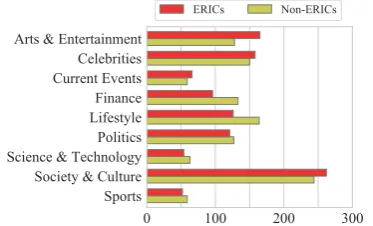
sig-nificant difference between the number of ERICs and non-ERICs in Yahoo articles in the Arts & Entertainment, Finance, and Lifestyle categories (p <0.005; Figure 5).
5.2 Comment annotations
We next consider the codes assigned by trained an-notators to Yahoo comments (Figure 6). The
ma-jority of comments arenot persuasive, reply to a
previous comment, expressdisagreement, or have
negative sentiment. More than three times as many comments express disagreement than agreement,
and comments are labelednegativeseven times as
frequently aspositive. Approximately half of the
comments express disagreement or a negative
sen-timent. Very few comments are funny, positive,
sympathetic, or contain apersonal story(<10%).
Encouragingly, only 6% of comments areoff-topic
with the conversation, suggesting that participants are attuned to and respectful of the topic. Only
20% of comments areinformative, indicating that
participants infrequently introduce new informa-tion to complement the article or discussion.
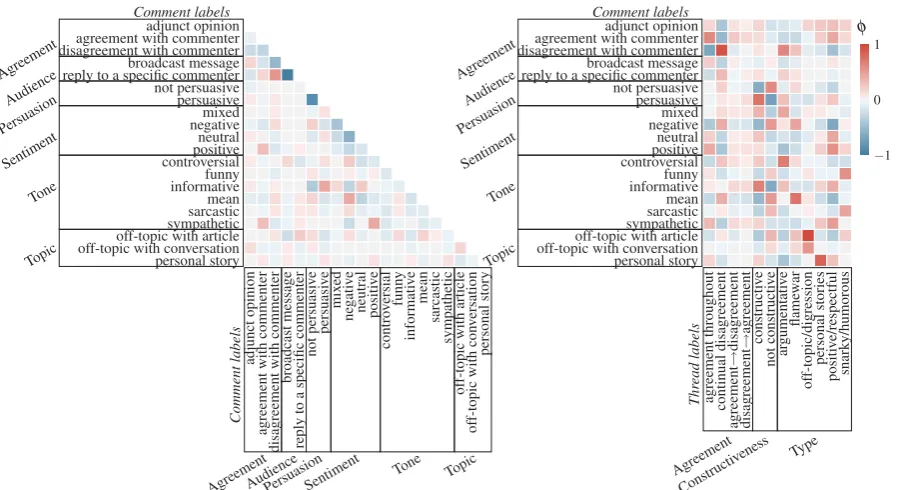
The only strong correlations are between the bi-nary labels, but the moderate correlations provide insight into the Yahoo threads (Figure 7). Some relationships accord with intuition. For instance, participants tend to go off-topic with the article when they are responding to others and not dur-ing broadcast messages; comments expressdur-ing dis-agreement with a commenter are frequently posted in a reply to a commenter; comments express-ing agreement tend to be sympathetic and have positive sentiment; and mean comments correlate with negative sentiment. Commenters in this do-main also express disagreement without partic-ular nastiness, since there is no correlation
be-tween disagreement andmean orsarcastic
com-ments. The informative label is moderately
cor-related withpersuasiveness, suggesting that
com-ments containing facts and new information are more convincing than those without.
The correlation between comment and thread labels is shown in Figure 7. Many of the
rela-tionships are unsurprising, like off-topic threads
tend to have off-topic comments, personal-story
threads have personal-story comments; thread
agreement throughout continual disagreement agreement → disagreement disagreement → agreement constructi ve not constructi ve ar gumentati ve flame w ar of f-topic/digression personal stories positi ve/respectful snark y/humorous snarky/humorous positive/respectfulpersonal stories off-topic/digressionflamewar argumentative not constructiveconstructive disagreement→agreement agreementcontinual disagreement→disagreement agreement throughout Agreement Constructi veness Type Agreement Constructi veness Type Yahoo, trained agreement throughout continual disagreement agreement → disagreement disagreement → agreement constructi ve not constructi ve ar gumentati ve flame w ar of f-topic/digression personal stories positi ve/respectful snark y/humorous Agreement Constructi veness Type Yahoo, untrained agreement throughout continual disagreement agreement → disagreement disagreement → agreement constructi ve not constructi ve ar gumentati ve flame w ar of f-topic/digression personal stories positi ve/respectful snark y/humorous Agreement Constructi veness Type φ IAC, untrained −1 0 1
Figure 4: Correlation between thread labels, measured by the phi coefficient (φ).
0 100 200 300
Sports Society & Culture Science & Technology Politics Lifestyle Finance Current Events Celebrities Arts & Entertainment
[image:8.595.87.274.292.405.2]ERICs Non-ERICs
Figure 5: Number of threads by article category.
0.00 0.25 0.50 0.75 1.00 personal story
off-topic with conversationoff-topic with article sympatheticsarcastic mean informativefunny controversialpositive neutral negativemixed persuasive not persuasive reply to a specific commenterbroadcast message disagreement with commenteragreement with commenter adjunct opinion Topic Tone Sentiment Persuasion Audience Agreement
Figure 6: % Yahoo comments assigned each label.
agreements; and flamewars are correlated with
meancomments.
In accord with our definition of ERICs,
con-structivenessis positively correlated with informa-tiveandpersuasivecomments and negatively
cor-related withnegativeandmean comments. From
these correlations one can infer that
argumenta-tivethreads are generally respectful because, while
they are strongly correlated with comments that are controversial or express disagreement or a
mixedsentiment, there is no correlation withmean
and very little withnegativesentiment. More
sur-prising is the positive correlation between
contro-versialcomments andconstructivethreads. Con-troversial comments are more associated with
ERICs, not non-ERICs, even though the
contro-versiallabel also positively correlates with
flame-wars, which are negatively correlated with
con-structiveness. The examples in Figures 1–2 both have controversial comments expressing disagree-ment, but comments in the second half of the non-ERIC veer off-topic and are not persuasive, where the ERIC stays on-topic and persuasive.
5.3 The relationship with social signals Previous work has taken social signals to be a proxy for thread quality, using some function of the total number of votes received by comments within a thread (e.g., Lee et al. (2014)). Because earlier research has indicated that user votes are not completely independent or objective (Sipos et al., 2014; Danescu-Niculescu-Mizil et al., 2009), we take the use of votes as a proxy for quality skeptically ad perform our own exploration of the relationship between social signals and the pres-ence of ERICs. On Yahoo, users reacted to
com-ments with a thumbs uporthumbs down and we
[image:8.595.72.286.439.630.2]adjunct opinion agreement with commenter disagreement with commenter broadcast message reply to a specific commenter not persuasi ve persuasi ve mix ed ne gati ve neutral positi ve contro versial funn y informati ve mean sarcastic sympathetic of f-topic with article of f-topic with con versation personal story personal story off-topic with conversationoff-topic with article sympatheticsarcastic mean informativefunny controversialpositive neutral negativemixed persuasive not persuasive reply to a specific commenterbroadcast message disagreement with commenteragreement with commenter adjunct opinion
AgreementAudiencePersuasionSentiment Tone Topic
[image:9.595.77.527.62.307.2]Comment labels Topic Tone Sentiment Persuasion Audience Agreement Comment labels agreement throughout continual disagreement agreement → disagreement disagreement → agreement constructi ve not constructi ve ar gumentati ve flame w ar of f-topic/digression personal stories positi ve/respectful snark y/humorous personal story off-topic with conversationoff-topic with article sympatheticsarcastic mean informativefunny controversialpositive neutral negativemixed persuasive not persuasive reply to a specific commenterbroadcast message disagreement with commenteragreement with commenter adjunct opinion Agreement Constructi veness Type Thr ead labels Topic Tone Sentiment Persuasion Audience Agreement Comment labels φ −1 0 1
Figure 7: Correlation between comment labels (left) and comment labels and thread labels (right).
thread to the coded labels to determine whether there are any relationships between social signals and threads qualities. We calculate the relation-ship between labels in each category with TU and TD with Pearson’s coefficient for the binary
la-bels and a one-way ANOVA for theagreement
cat-egory. The strongest correlation is between TD
and untrained annotators’ perception offlamewars
(r = 0.21), and there is a very weak to no
correla-tion (positive or negative) between the other labels
and TU, TD, or TU−TD. There is moderate
cor-relation between TU and TD (r = 0.46),
suggest-ing that threads that elicit reactions tend to receive both thumbs up and down.
The correlation between TU and TD received
by each comment is weaker (r = 0.23).
Com-paring the comment labels to the TU and TD re-ceived by each comment also show little corre-lation. Comments that reply to a specific com-menter are negatively correlated with TU, TD, and
TU−TD (r=0.30, -0.25, and -0.22, respectively).
The only other label with a non-negligible
corre-lation is disagreement with a commenter, which
negatively correlates with TU (r =−0.21). There
is no correlation between social signal and the presence of ERICs or non-ERICs. These results support the findings of previous work and indicate that thumbs up or thumbs down alone (and, pre-sumably, up/down votes) are inappropriate proxies for quality measurements of comments or threads
in this domain.
6 Conclusion
We have developed a coding scheme for label-ing “good” online conversations (ERICs) and cre-ated the Yahoo News Annotcre-ated Comments
Cor-pus, a new corpus of2.4kcoded comment threads
posted in response to Yahoo News articles.
Ad-ditionally, we have annotated 1k debate threads
from the IAC. These annotations reflect several different characteristics of comments and threads, and we have explored their relationships with each other. ERICs are characterized by argumentative, respectful exchanges containing persuasive, infor-mative, and/or sympathetic comments. They tend to stay on topic with the original article and not to contain funny, mean, or sarcastic comments. We found differences between the distribution of annotations made by trained and untrained anno-tators, but high levels of agreement within each group, suggesting that crowdsourcing annotations for this task is reliable. YNACC will be a valu-able resource for researchers in multiple areas of discourse analysis.
Acknowledgments
References
Rob Abbott, Brian Ecker, Pranav Anand, and Marilyn Walker. 2016. Internet Argument Corpus 2.0: An SQL schema for dialogic social media and the cor-pora to go with it. InProceedings of the Tenth In-ternational Conference on Language Resources and Evaluation (LREC 2016), pages 4445–4452, Paris, France, May. European Language Resources Asso-ciation (ELRA).
Jacob Andreas, Sara Rosenthal, and Kathleen McKe-own. 2012. Annotating agreement and disagree-ment in threaded discussion. In Proceedings of the Eight International Conference on Language Resources and Evaluation (LREC’12), pages 818– 822, Istanbul, Turkey, May. European Language Re-sources Association (ELRA).
Emma Barker, Monica Lestari Paramita, Ahmet Aker, Emina Kurtic, Mark Hepple, and Robert Gaizauskas. 2016. The SENSEI annotated corpus: Human summaries of reader comment conversations in on-line news. InProceedings of the 17th Annual Meeting of the Special Interest Group on Discourse and Dialogue, pages 42–52, Los Angeles, Septem-ber. Association for Computational Linguistics. Or Biran, Sara Rosenthal, Jacob Andreas, Kathleen
McKeown, and Owen Rambow. 2012. Detecting influencers in written online conversations. In Pro-ceedings of the Second Workshop on Language in Social Media, pages 37–45, Montr´eal, Canada, June. Association for Computational Linguistics.
Cristian Danescu-Niculescu-Mizil, Gueorgi Kossinets, Jon Kleinberg, and Lillian Lee. 2009. How opinions are received by online communities: A case study on amazon.com helpfulness votes. InProceedings of the 18th International Conference on World Wide Web, WWW ’09, pages 141–150, New York. ACM. Cristian Danescu-Niculescu-Mizil, Moritz Sudhof, Dan Jurafsky, Jure Leskovec, and Christopher Potts. 2013. A computational approach to politeness with application to social factors. InProceedings of the 51st Annual Meeting of the Association for Compu-tational Linguistics (Volume 1: Long Papers), pages 250–259, Sofia, Bulgaria, August. Association for Computational Linguistics.
Dmitry Davidov, Oren Tsur, and Ari Rappoport. 2010. Semi-supervised recognition of sarcasm in Twitter and Amazon. InProceedings of the Fourteenth Con-ference on Computational Natural Language Learn-ing, pages 107–116, Uppsala, Sweden, July. Associ-ation for ComputAssoci-ational Linguistics.
Nicholas Diakopoulos and Mor Naaman. 2011. To-wards quality discourse in online news comments. In Proceedings of the ACM 2011 Conference on Computer Supported Cooperative Work, CSCW ’11, pages 133–142, New York. ACM.
Nicholas Diakopoulos. 2015. Picking the NYT picks: Editorial criteria and automation in the curation of
online news comments. ISOJ Journal, 5(1):147– 166.
Ethan Fast and Eric Horvitz. 2016. Identifying dog-matism in social media: Signals and models. In Proceedings of the 2016 Conference on Empirical Methods in Natural Language Processing, pages 690–699, Austin, Texas, November. Association for Computational Linguistics.
Debanjan Ghosh, Smaranda Muresan, Nina Wacholder, Mark Aakhus, and Matthew Mitsui. 2014. Ana-lyzing argumentative discourse units in online in-teractions. In Proceedings of the First Workshop on Argumentation Mining, pages 39–48, Baltimore, Maryland, June. Association for Computational Lin-guistics.
Roberto Gonz´alez-Ib´anez, Smaranda Muresan, and Nina Wacholder. 2011. Identifying sarcasm in Twit-ter: A closer look. InProceedings of the 49th An-nual Meeting of the Association for Computational Linguistics: Human Language Technologies: Short Papers-Volume 2, pages 581–586. Association for Computational Linguistics.
Ivan Habernal and Iryna Gurevych. 2016. Which ar-gument is more convincing? Analyzing and pre-dicting convincingness of web arguments using bidi-rectional LSTM. In Proceedings of the 54th An-nual Meeting of the Association for Computational Linguistics (Volume 1: Long Papers), pages 1589– 1599, Berlin, Germany, August. Association for Computational Linguistics.
Ahmed Hassan, Vahed Qazvinian, and Dragomir Radev. 2010. What’s with the attitude? Identi-fying sentences with attitude in online discussions. In Proceedings of the 2010 Conference on Empiri-cal Methods in Natural Language Processing, pages 1245–1255, Cambridge, MA, October. Association for Computational Linguistics.
Hyeju Jang, Mario Piergallini, Miaomiao Wen, and Carolyn Rose. 2014. Conversational metaphors in use: Exploring the contrast between technical and everyday notions of metaphor. In Proceedings of the Second Workshop on Metaphor in NLP, pages 1–10, Baltimore, MD, June. Association for Com-putational Linguistics.
Klaus Krippendorff. 2004. Content analysis: An in-troduction to its methodology. Sage Publications, Thousand Oaks, CA, 2nd edition.
Jung-Tae Lee, Min-Chul Yang, and Hae-Chang Rim. 2014. Discovering high-quality threaded discus-sions in online forums. Journal of Computer Sci-ence and Technology, 29(3):519–531.
Marco Lui and Timothy Baldwin. 2012. langid.py: An off-the-shelf language identification tool. In Pro-ceedings of the ACL 2012 System Demonstrations, pages 25–30, Jeju Island, Korea, July. Association for Computational Linguistics.
Arjun Mukherjee, Vivek Venkataraman, Bing Liu, and Sharon Meraz. 2013. Public dialogue: Analy-sis of tolerance in online discussions. In Proceed-ings of the 51st Annual Meeting of the Association for Computational Linguistics (Volume 1: Long Pa-pers), pages 1680–1690, Sofia, Bulgaria, August. Association for Computational Linguistics.
Vlad Niculae and Cristian Danescu-Niculescu-Mizil. 2016. Conversational markers of constructive dis-cussions. In Proceedings of the 2016 Conference of the North American Chapter of the Association for Computational Linguistics: Human Language Technologies, pages 568–578, San Diego, Califor-nia, June. Association for Computational Linguis-tics.
Chikashi Nobata, Joel Tetreault, Achint Thomas, Yashar Mehdad, and Yi Chang. 2016. Abu-sive language detection in online user content. In Proceedings of the 25th International Conference on World Wide Web, pages 145–153. International World Wide Web Conferences Steering Committee. Shereen Oraby, Vrindavan Harrison, Lena Reed, Ernesto Hernandez, Ellen Riloff, and Marilyn Walker. 2016. Creating and characterizing a di-verse corpus of sarcasm in dialogue. In Proceed-ings of the 17th Annual Meeting of the Special Inter-est Group on Discourse and Dialogue, pages 31–41, Los Angeles, September. Association for Computa-tional Linguistics.
Bo Pang and Lillian Lee. 2005. Seeing stars: Ex-ploiting class relationships for sentiment categoriza-tion with respect to rating scales. InProceedings of the 43rd annual meeting on association for compu-tational linguistics, pages 115–124. Association for Computational Linguistics.
Ruben Sipos, Arpita Ghosh, and Thorsten Joachims. 2014. Was this review helpful to you?: It depends! Context and voting patterns in online content. In Proceedings of the 23rd International Conference on World Wide Web, pages 337–348. ACM.
Maria Skeppstedt, Magnus Kerren, Carita Sahlgren, and Andreas Paradis. 2016. Unshared task: (Dis) agreement in online debates. In 3rd Workshop on Argument Mining (ArgMining’16), Berlin, Ger-many, August 7-12, 2016, pages 154–159. Associa-tion for ComputaAssocia-tional Linguistics.
Chenhao Tan, Vlad Niculae, Cristian Danescu-Niculescu-Mizil, and Lillian Lee. 2016. Win-ning arguments: Interaction dynamics and persua-sion strategies in good-faith online discuspersua-sions. In Proceedings of the 25th International Conference on World Wide Web, pages 613–624. International World Wide Web Conferences Steering Committee.
Marilyn Walker, Jean Fox Tree, Pranav Anand, Rob Abbott, and Joseph King. 2012. A corpus for research on deliberation and debate. In Proceed-ings of the Eight International Conference on Lan-guage Resources and Evaluation (LREC’12), Istan-bul, Turkey, May. European Language Resources Association (ELRA).
Charlie Warzel. 2012. Everything in moderation. Adweek, June 18. http://www.adweek.com/ digital/everything-moderation-141163/. Accessed February 20, 2017.