Generative Encoder-Decoder Models for Task-Oriented Spoken Dialog
Systems with Chatting Capability
Tiancheng Zhao, Allen Lu, Kyusong Lee and Maxine Eskenazi
Language Technologies Institute Carnegie Mellon University Pittsburgh, Pennsylvania, USA
{tianchez,arlu,kyusongl,max+}@cs.cmu.edu
Abstract
Generative encoder-decoder models of-fer great promise in developing domain-general dialog systems. However, they have mainly been applied to open-domain conversations. This paper presents a practical and novel framework for building task-oriented dialog systems based on encoder-decoder models. This framework enables encoder-decoder mod-els to accomplish slot-value independent decision-making and interact with external databases. Moreover, this paper shows the flexibility of the proposed method by in-terleaving chatting capability with a slot-filling system for better out-of-domain re-covery. The models were trained on both real-user data from a bus information sys-tem and human-human chat data. Re-sults show that the proposed framework achieves good performance in both offline evaluation metrics and in task success rate with human users.
1 Introduction
Task-oriented spoken dialog systems have trans-formed human-computer interaction by enabling people interact with computers via spoken lan-guage (Raux et al., 2005; Young, 2006; Bohus and Rudnicky, 2003). The task-oriented SDS is usually domain-specific. The system creators first map the user utterances into semantic frames that contain domain-specific slots and intents using spoken language understanding (SLU) (De Mori et al.,2008). Then a set of domain-specific dialog state variables is tracked to retain the context infor-mation over turns (Williams et al.,2013). Lastly, the dialog policy decides the next move from a
list of dialog acts that covers the expected com-municative functions from the system.
Although the above approach has been success-fully applied to many practical systems, it has lim-ited ability to generalize to out-of-domain (OOD) requests and to scale up to new domains. For ex-ample, even within in a simple domain, real users often make requests that are not included in the semantic specifications. Due to this, proper er-ror handling strategies that guide users back to the in-domain conversation are crucial to dialog suc-cess (Bohus and Rudnicky,2005). Past error han-dling strategies were limited to a set of predefined dialog acts, e.g. request repeat, clarification etc., which constrained the system’s capability in keep-ing users engaged. Moreover, there has been an increased interest in extending task-oriented sys-tems to multiple topics (Lee et al., 2009; Gaˇsi´c et al., 2015b) and multiple skills, e.g. grouping heterogeneous types of dialogs into a single sys-tem (Zhao et al., 2016). Both cases require the system to be flexible enough to extend to new slots and actions.
Our goal is to move towards a domain-general task-oriented SDS framework that is flexible enough to expand to new domains and skills by removing domain-specific assumptions on the di-alog state and didi-alog acts (Bordes and Weston,
2016). To achieve this goal, the neural encoder-decoder model(Cho et al.,2014;Sutskever et al.,
2014) is a suitable choice, since it has achieved promising results in modeling open-domain con-versations (Vinyals and Le, 2015;Sordoni et al.,
2015). It encodes the dialog history using deep neural networks and then generates the next sys-tem utterance word-by-word via recurrent neural networks (RNNs). Therefore, unlike the tradi-tional SDS pipeline, the encoder-decoder model is theoretically only limited by its input/output vo-cabulary.
A na`‘ive implementation of an encoder-decoder-based task-oriented system would use RNNs to encode the raw dialog history and gen-erate the next system utterance using a separate RNN decoder. However, while this implementa-tion might achieve good performance in an offline evaluation of a closed dataset, it would certainly fail when used by humans. There are several rea-sons for this: 1) real users can mention new enti-ties that do not appear in the training data, such as a new restaurant name. These entities are, how-ever, essential in delivering the information that matches users’ needs in a task-oriented system. 2) a task-oriented SDS obtains information from a knowledge base (KB) that is constantly updated (“today’s” weather will be different every day), so simply memorizing KB results that occurred in the training data would produce false information. In-stead, an effective model should learn to query the KB constantly to get the most up-to-date informa-tion. 3) users may give OOD requests (e.g. say, “how is your day”, to a slot-filling system), which must be handled gracefully in order to keep the conversation moving in the intended direction.
This paper proposes an effective encoder-decoder framework for building task-oriented SDSs. We propose entity indexing to tackle the challenges of out-of-vocabulary (OOV) entities and to query the KB. Moreover, we show the ex-tensibility of the proposed model by adding chat-ting capability to a task-oriented encoder-decoder SDS for better OOD recovery. This approach was assessed on the Let’s Go Bus Information data from the 1st Dialog State Tracking Chal-lenge (Williams et al., 2013), and we report per-formance on both offline metrics and real human users. Results show that this model attains good performance for both of these metrics.
2 Related Work
Past research in developing domain-general di-alog systems can be broadly divided into three branches. The first one focuses on learning domain-independent dialog state representation while still using hand-crafted dialog act system ac-tions. Researchers proposed the idea of extract-ing slot-value independent statistics as the dia-log state (Wang et al.,2015;Gaˇsi´c et al.,2015a), so that the dialog state representation can be shared across systems serving different knowledge sources. Another approach uses RNNs to
auto-matically learn a distributed vector representation of the dialog state by accumulating the observa-tions at each turn (Williams and Zweig, 2016;
Zhao and Eskenazi, 2016; Dhingra et al., 2016;
Williams et al., 2017). The learned dialog state is then used by the dialog policy to select the next action. The second branch of research de-velops a domain-general action space for dialog policy. Prior work replaced the domain-specific dialog acts with domain-independent natural lan-guage semantic schema as the action space of dia-log managers (Eshghi and Lemon,2014), e.g. Dy-namic Syntax (Kempson et al., 2000). More re-cently, Wen, et al. (2016) have shown the feasibil-ity of using an RNN as the decoder to generate the system utterances word by word, and the dialog policy of the proposed model can be fine tuned us-ing reinforcement learnus-ing (Su et al.,2016). Fur-thermore, to deal with the challenge of develop-ing end-to-end task-oriented dialog models that are able to interface with external KB, prior work has unified the special KB query actions via deep reinforcement learning (Zhao and Eskenazi,2016) and soft attention over the database (Dhingra et al.,
2016). The third branch strives to solve both prob-lems at the same time by building an end-to-end model that maps an observable dialog history di-rectly to the word sequences of the system’s re-sponse. By using an encoder-decoder model, it has been successfully applied to open-domain conver-sational models (Serban et al., 2015; Li et al.,
2015,2016;Zhao et al.,2017), as well as to task oriented systems (Bordes and Weston,2016;Yang et al.,2016;Eric and Manning,2017). In order to better predict the next correct system action, this branch has focused on investigating various neu-ral network architectures to improve the machine’s ability to reason over user input and model long-term dialog context.
3 Proposed Method
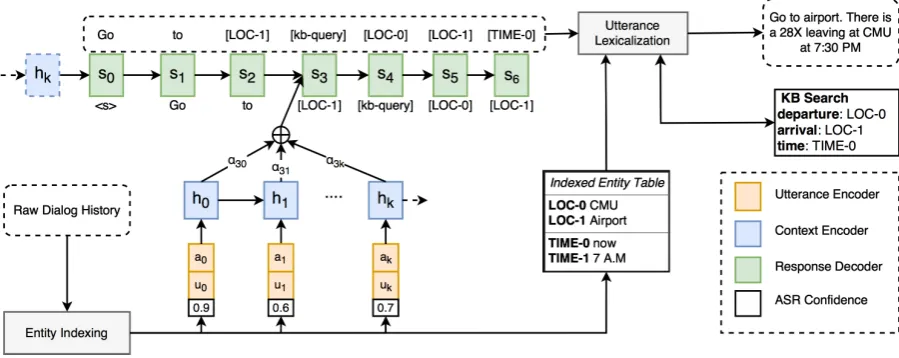
Our proposed framework consists of three steps as shown in Figure 2: a) entity indexing (EI), b) slot-value independent encoder-decoder (SiED), c) system utterance lexicalization (UL). The in-tuition is to leverage domain-general named en-tity recognition (NER) (Tjong Kim Sang and De Meulder, 2003) techniques to extract salient entities in the raw dialog history and convert the lexical values of the entities into entity indexes. The encoder-decoder model is then trained to fo-cus solely on reasoning over the entity indexes in a dialog history and to make decisions about the next utterance to produce (including KB query). In this way, the model can be unaffected by the inclu-sion of new entities and new KB, while maintain-ing its domain-general input/output interface for easy extension to new types of conversation skills. Lastly, the output from the decoder networks are lexicalized by replacing the entity indexes and spe-cial KB tokens with natural language. The follow-ing sections explain each step in detail.
3.1 Entity Indexing and Utterance Lexicalization
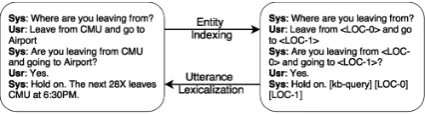
Entity Indexing EI has two parts. First, the EI utilizes an existing domain-general NER to ex-tract entities from both the user and system utter-ances. Note that the entity here is assumed to be a super-set of the slots in the domain. For exam-ple, for a flight-booking system, the system may contain two slots: [from-LOCATION] and [to-LOCATION] for the departure and arrival city, re-spectively. However, EI only extracts every men-tion of [LOCATION] in the utterances and leaves the task of distinguishing between departure and arrival to the encoder-decoder model. Further-more, this step replaces each KB search result with its search query (e.g. the weather is cloudy→ [kb-search]-[DATETIME-0]). The second step of EI involves constructing aindexed entity table. Each entity is indexed by its order of occurrence in the conversation. Figure1shows an example in which there are two [LOCATION] mentions.
[image:3.595.310.523.62.119.2]Properties of Entity Indexing In this section, several properties of EI and their assumptions are addressed. First, each entity is indexed uniquely by its entity type and index. Note that the in-dex is not associated with the entity value, but rather solely by the order of appearance in the dialog. Despite the actual words being hidden,
Figure 1: An example of entity indexing and utter-ance lexicalization.
a human can still easily predict which entity the system should confirm or search for in the KB based on logical reasoning. Therefore, that the EI not only alleviates the OOV problem of deploying the encoder-decoder model in the real world, but also forces the encoder-decoder model’s focus on learning the reasoning process of task-oriented di-alogs instead of leveraging too much information from the language modeling.
Moreover, most slot-filling SDSs, apart from forming the concepts from KBs, usually do not in-troduce novel entities to users. Instead, systems mostly corroborate the entities introduced by the users. With this assumption, every entity mention in the system utterances can always be found in the users’ utterances in the dialog history, and there-fore can also be found in the indexed entity table. This property reduces the grounding behavior of the conventional task-oriented dialog manager into selecting an entity from the indexed entity table and confirming it with the user.
Utterance Lexicalization is the reverse of EI. Since EI is a deterministic process, its effect can always be reversed by finding the corresponding entity in the indexed entity table and replacing the index with its word. For KB search, a simple string matching algorithm can search for the special [kb-search] token and take the following generated en-tities as the argument to the KB. Then the actual KB results can replace the original KB query. Fig-ure 1 shows an example of utterance lexicaliza-tion.
3.2 Encoder-Decoder Models
The encoder-decoder model can then read in the EI-processed dialog history and predict the sys-tem’s next utterance in EI format. Specifically, a dialog history of k turns is represented by
[(a0, u0, c0), ...(ak−1, uk−1, ck−1)], in which ai,
ui andci are, respectively, the system, user
Figure 2: The proposed pipeline for task-oriented dialog systems.
(CNNs) proposed in (Kim, 2014). Specifically, each word in an utterancexis mapped to its word embedding, so that an utterance is represented as a matrixR ∈ R|x|×D, in whichDis the size of the
word embedding. ThenLfilters of size 1,2,3 con-duct convolutions onRto obtain a feature map,c, of n-gram features in window size 1,2,3. Thenc
is passed through a nonlinear ReLu (Glorot et al.,
2011) layer, followed by a max-pooling layer to obtain a compact summary of salient n-gram fea-tures, i.e. et(x) = maxpool(ReLu(c+b)).
Us-ing CNNs to capture word-order information is crucial, because the encoder-decoder has to be able to distinguish between fine-grained differ-ences between entities. For example, a simple bag-of-word embedding approach will fail to dis-tinguish between the two location entities in “leave from [LOCATION-0] and go to [LOCATION-1]”, while a CNN encoder can capture the context in-formation of these two entities.
After obtaining utterance embedding, a turn-level dialog history encoder network similar to the one proposed in (Zhao and Eskenazi, 2016) is used. Turn embedding is a simple concatena-tion of system, user utterance embedding and the confidence score t = [eu(a
i);eu(ui);ci]. Then
an Long Short-Term Memory (LSTM) ( Hochre-iter and Schmidhuber,1997) network reads the se-quence turn embeddings in the dialog history via recursive state updatesi+1 =LSTM(ti+1, hi), in
whichhiis the output of the LSTM hidden state.
Decoding with/without Attention A vanilla decoder takes in the last hidden state of the encoder as its initial state and decodes the next system utterance word by word as shown
in (Sutskever et al., 2014). This assumes that the fixed-size hidden state is expressive enough to encode all important information about the history of a dialog. However, this assump-tion may often be violated for a task that has long-dependency or complex reasoning of the en-tire source sequence. An attention mechanism proposed (Bahdanau et al., 2014) in the ma-chine translation community has helped encoder-decoder models improve state-of-art performance in various tasks (Bahdanau et al.,2014;Xu et al.,
2015). Attention allows the decoder to look over every hidden state in the encoder and dynamically decide the importance of each hidden state at each decoding step, which significantly improves the model’s ability to handle long-term dependency. We experiment decoders both with and without attention. Attention is computed similarly mul-tiplicative attention described in (Luong et al.,
2015). We denote the hidden state of the decoder at time step jby sj, and the hidden state outputs
of the encoder at turnibyhi. We then predict the
next word by
aji=softmax(hTi Wasj+ba) (1)
cj = X
i
ajihi (2)
e
sj =tanh(Ws
sj
cj
) (3)
p(wj|sj, cj) =softmax(Wosej) (4)
The decoder next state is updated by sj+1 =
3.3 Leveraging Chat Data to Improve OOD Recovery
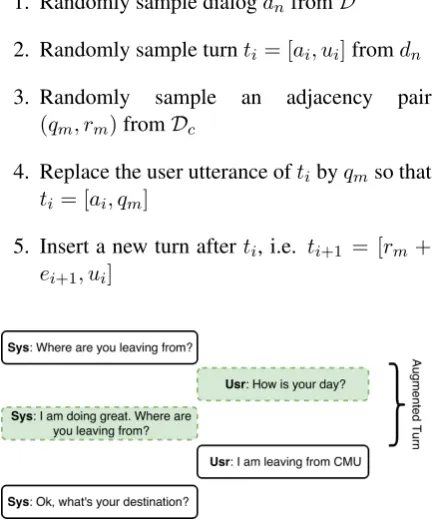
Past work has shown that simple supervised learn-ing is usually inadequate for learnlearn-ing robust se-quential decision-making policy (Williams and Young,2003;Ross et al.,2011). This is because the model is only exposed to the expert demonstra-tion, but not to examples of how to recover from its own mistakes or users’ OOD requests. We present a simple yet effective technique that leverages the extensibility of the encoder-decoder model in or-der to obtain a more robust policy in the setting of supervised learning. Specifically, we artificially augment a task-oriented dialog dataset with chat data from an open-domain conversation corpus. This has been shown to be effective in improv-ing the performance of task-oriented systems (Yu et al.,2017). Let the original dialog dataset with
N dialogs beD= [d0..., dn, ...dN], wherednis a
multi-turn task-oriented dialog of|dn|turns.
Fur-thermore, we assume we have access to a chat dataset Dc = [(q0, r0), ...(qm, rm), ...(qM, rM)],
where qm, rm are common adjacency pairs that
appear in chats, (e.g. q =hello, r =hi, how are you). Then we can create a new datasetD∗ by
re-peating the following process a certain number of times:
1. Randomly sample dialogdnfromD
2. Randomly sample turnti= [ai, ui]fromdn
3. Randomly sample an adjacency pair
(qm, rm)fromDc
4. Replace the user utterance oftibyqmso that
ti= [ai, qm]
5. Insert a new turn afterti, i.e. ti+1 = [rm +
[image:5.595.74.291.450.711.2]ei+1, ui]
Figure 3: Illustration of data augmentation. The turn in the dashed line is inserted in the original dialog.
In Step 5,eiis an error handling system utterance
after the system answers the user’s OOD request,
qm. In this study, we experimented with a simple
case whereei+1 =aiso that the system should
re-peat its previous prompt after responding toqmvia
rm. Figure3shows an example of an augmented
turn. Eventually, we train the model on the union of the two datasetsD+=D ∪ D∗
Discussion: There are several reasons that the above data augmentation process is appealing. First, the model effectively learns an OOD recov-ery strategy from D∗, i.e. it first gives chatting
answers to users’ OOD requests and then tries to pull users back to the main-task conversation. Sec-ond, chat data usually has a larger vocabulary and more diverse natural language expressions, which can reduce the chance of OOVs and enable the model to learn more robust word embeddings and language models.
4 Experiment Setup
4.1 Dataset and Domain
The CMU Let’s Go Bus Information Sys-tem (Raux et al., 2005) is a task-oriented spoken dialog system that contains bus information. We combined the train1a and train1b datasets from DSTC 1 (Williams et al., 2013), which contain 2608 total dialogs. The average dialog length is 9.07 turns. The dialogs were randomly split-ted into 85/5/10 proportions for train/dev/test data. The data was noisy since the dialogs were col-lected from real users via telephone lines. Fur-thermore, this version of Let’s Go used an in-house database containing the Port Authority bus schedule. In the current version, that database was replaced with the Google Directions API, which both reduces the human burden of maintaining a database and opens the possibility of extending Let’s Go to cities other than Pittsburgh. Connect-ing to Google Directions API involves a POST call to their URL, with our given access key as well as the parameters needed: departure place, arrival place and departure time, and the travel mode, which we always set as TRANSIT to obtain rel-evant bus routes. There are 14 distinct dialog acts available to the system, and each system utterance contains one or more dialog acts. Lastly, the sys-tem vocabulary size is 1311 and the user vocabu-lary size is 1232. After the EI process, the sizes become 214 and 936, respectively.
corpus used in (Yu et al., 2015)1. In total, there
are 3793 chatting adjacency pairs. We control the number of data injections to 30% of the number of turns in the original DTSC dataset, which leads to a user vocabulary size of 3537 and system vocab-ulary size of 4047.
4.2 Training Details
For all experiments, the word embedding size was 100. The sizes of the LSTM hidden states for both the encoder and decoder were 500 with 1 layer. The attention context size was also 500. We tied the CNN weights for the encoding system and user utterances. Each CNN has 3 filter windows, 1, 2, and 3, with 100 feature maps each. We trained the model end-to-end using Adam (Kingma and Ba, 2014), with a learning rate of 1e-3 and a batch size of 40. To combat overfitting, we apply dropout (Zaremba et al.,2014) to the LSTM layer outputs and the CNN outputs after the maxpooling layer, with a dropout rate of 40%.
5 Experiments Results
This approach was assessed both offline and on-line evaluations. The offon-line evaluation contains standard metrics to test open-domain encoder-decoder dialog models (Li et al., 2015; Serban et al., 2015). System performance was assessed from three perspectives that are essential for task-oriented systems: dialog acts, slot-values, and KB query. The online evaluation is composed of ob-jective task success rate, the number of turns, and subjective satisfaction with human users.
5.1 Offline Evaluation
Dialog Acts (DA):Each system utterance is made up of one or more dialog acts, e.g. “leaving at [TIME-0], where do you want to go?” →
[implicit-confirm, request(arrival place)]. To eval-uate whether a generated utterance has the same dialog acts as the ground truth, we trained a multi-label dialog tagger using one-vs-rest Support Vec-tor Machines (SVM) (Tsoumakas and Katakis,
2006), with bag-of-bigram features for each dia-log act label. Since the natural language genera-tion module in Let’s Go is handcrafted, the dialog act tagger achieved 99.4% average label accuracy on a held-out dataset. We used this dialog act tag-ger to tag both the ground truth and the generated
1github.com/echoyuzhou/ticktock text api
responses. Then we computed the micro-average precision, recall, and the F-score.
Slots:This metric measures the model’s perfor-mance in generating the correct slot-values. The slot-values mostly occur in grounding utterances (e.g. explicit/implicit confirm) and KB queries. We compute precision, recall, and F-score.
KB Queries:Although the slots metric already covers the KB queries, here the precision/recall/F-score of system utterances that contain KB queries are also explicitly measured, due to their impor-tance. Specifically, this action measures whether the system is able to generate the special [kb-query] symbol to initiate a KB query, as well as how accurate the corresponding KB query argu-ments are.
BLEU(Papineni et al.,2002): compares the n-gram precision with length penalty, and has been a popular score used to evaluate the performance of natural language generation (Wen et al.,2015) and open-domain dialog models (Li et al.,2016). Corpus-level BLEU-4 is reported.
Metrics Vanilla EI EI
+Attn EI+Attn+Chat DA
(p/r/f1) 83.577.9 80.5
79.7 80.1 80.0
80.0 83.1 81.5
81.8 83.5 82.7 Slot
(p/r/f1) 42.030.3 35.2
60.6 63.6 62.1
63.7 64.7 64.2
64.6 69.1 66.8 KB
(p/r/f1) N/A 48.955.3 51.9
55.4 70.8 62.2
[image:6.595.313.521.377.542.2]58.2 71.9 64.4 BLEU 36.9 54.6 59.3 60.5
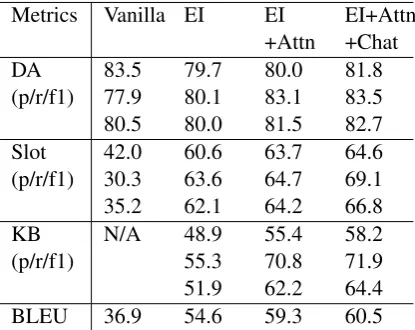
Table 1: Performance of each model on automatic measures.
achieved impressive results in more challenging settings, e.g. modeling open-domain conversa-tions. Furthermore, since the DSTC1 data was collected over several months, there were minor updates made to the dialog manager. Therefore, there are inherent ambiguities in the data (the dia-log manager may take different actions in the same situation). We conjecture that ∼80% is near the upper limit of our data in modeling the system’s next dialog act given the dialog history.
On the other hand, these proposed methods sig-nificantly improved the metrics related to slots and KB queries. The inclusion of EI alone was able to improve the F-score of slots by a relative 76%, which confirms that EI is crucial in develop-ing slot-value independent encoder-decoder mod-els for modeling task-oriented dialogs. Likewise, the inclusion of attention further improved the pre-diction of slots in system utterances. Adding at-tention also improved the performance of predict-ing KB queries, more so than the overall slot accu-racy. This is expected, since KB queries are usu-ally issued near the end of a conversation, which requires global reasoning over the entire dialog history. The use of attention allows the decoder to look over the history and make better decisions rather than simply depending on the context sum-mary in the last hidden layer of the encoder. Be-cause of the good performance achieved by the models with the attentional decoder, the attention weights in Equation1at every step of the decod-ing process in two example dialogs from test data are visualized. For both figures, the vertical axes show the dialog history flowing from the top to the bottom. Each row is a turn in the format of (sys-tem utterance # user utterance). The top horizon-tal axis shows the predicted next system utterance. The darkness of a bar indicates the value of the attention calculated in Equation1.
The first example shows attention for ground-ing the new entity [LOCATION-1] in the previ-ous turn. The attention weights become focus on the previous turn when predicting [LOCATION-1] in the implicit confirm action. The second di-alog example shows a more challenging situation, in which the model is predicting a KB query. We can see that the attention weights when generating each input argument of the KB query clearly fo-cus on the specific mention in the dialog history. The visualization confirms the effectiveness of the attention mechanism in dealing with long-term
[image:7.595.306.524.90.281.2]de-pendency at discourse level.
Figure 4: Visualization of attention weights when generating implicit confirm (top) and KB query (bottom).
Surprisingly, the model trained on the data aug-mented with chat achieved slightly better slot ac-curacy performance, even though the augmented data is not directly related to task-oriented di-alogs. Furthermore, the model trained on chat-augmented data achieved better scores for the KB query metrics. Several reasons may explain this improvement: 1) since chat data exposes the model to a significantly larger vocabulary, the re-sulting model is more robust to words that it had not seen in the original task-oriented-only training data, and 2) the augmented dialog turn can be seen as noise in the dialog history, which adds extra regularization to the model and enables the model to learn more robust long-term reasoning mecha-nisms.
5.2 Human Evaluation
Chrome Speech API2served as the ASR and
text-to-speech (TTS) modules. Turn-taking was done via the built-in Chrome voice activity detection (VAD) plus a finite state machine-based end-of-turn detector (Zhao et al.,2015). Lastly, a hybrid named entity recognizer (NER) was trained using Conditional Random Field (CRF) (McCallum and Li, 2003) and rules to extract 4 types of entities (location, hour, minute, pm/am) for the EI process. The experiment setup is as follows: when a user logs into the website, the system prompts the user with a goal, which is a randomly chosen combina-tion of departure place, arrival place and time (e.g. leave from CMU and go to the airport at 10:30 AM). The system also instructs the user to say goodbye if the he/she thinks the goal is achieved or wants to give up. The user begins a conversa-tion with one of the two evaluated systems, with a 50/50 chance of choosing either system (not vis-ible to the user). After the user’s session is fin-ished, the system asks the him/her to give two scores between 1 and 5 for correctness and nat-uralness of the system respectively. The subjects in this study consist of undergraduate and grad-uate students. However, many subjects did not follow the prompted goal, but rather asked about bus routes of their own. Therefore, the dialog was manually labeled for dialog success. A dia-log is successful if and only if the systems give at least one bus schedule that matches with all three slots expressed by the users. Table 2 shows the
Metrics EI+Attn EI+Attn +Chat # of Dialog 75 74 Slot Precision 73.3% 71.8% KB Precision 88.6% 93.7% Success Rate 73.3% 77.0% Avg Turns 4.88 4.91 Avg Correctness 3.45 (1.32) 3.22 (1.40) Avg Naturalness 3.46 (1.41) 3.53 (1.34)
Table 2: Performance of each model on automatic measures. The standard deviations of subjective scores are in parentheses.
results. Overall, our systems achieved reasonable performance in terms of dialog success rate. The EI+Attn+Chat model achieves slightly higher suc-cess and subjective naturalness metrics (although the difference between EI+Attn+Chat and EI+Attn
2www.google.com/intl/en/chrome/demos/speech.html
was not statistically significant due to the limited number of subjects). The precision of ground-ing the correct slots and predictground-ing the correct KB query was also manually labelled. EI+Attn model performs slightly better than the EI+Attn+Chat model in slot precision, while the latter model per-forms significantly better in KB query precision. In addition, EI+Attn+Chat leads to slightly longer dialogs because sometimes it generates chatting utterances with users when it cannot understand users’ utterances.
At last, we investigated the log files and iden-tified the following major types of sources of dia-log failure: RNN Decoder Invalid Output: Oc-casionally, the RNN decoder outputs system ut-terances as “Okay going to [LOCATION-2]. Did I get that right?”, in which [LOCATION-2] can-not be found in the indexed entity table. Such in-valid output confuses users. This occurred in 149 of the dialogs, where 4.1% of system utterances contain invalid symbols. Imitation of Subopti-mal Dialog Policy: Since our models are only trained to imitate the suboptimal hand-crafted di-alog policy, their limitations show when the orig-inal dialog manager cannot handle the situation, such as failing to understand slots that appeared in compound utterances. Future plans involves im-proving the models to perform better than the sub-optimal teacher policy.
6 Conclusions
References
Dzmitry Bahdanau, Kyunghyun Cho, and Yoshua Ben-gio. 2014. Neural machine translation by jointly
learning to align and translate. arXiv preprint
arXiv:1409.0473.
Dan Bohus and Alexander I Rudnicky. 2003. Raven-claw: Dialog management using hierarchical task decomposition and an expectation agenda .
Dan Bohus and Alexander I Rudnicky. 2005. Er-ror handling in the ravenclaw dialog management
framework. In Proceedings of the conference on
Human Language Technology and Empirical Meth-ods in Natural Language Processing. Association for Computational Linguistics, pages 225–232.
Antoine Bordes and Jason Weston. 2016.
Learn-ing end-to-end goal-oriented dialog. arXiv preprint arXiv:1605.07683.
Kyunghyun Cho, Bart Van Merri¨enboer, Caglar Gul-cehre, Dzmitry Bahdanau, Fethi Bougares, Holger Schwenk, and Yoshua Bengio. 2014. Learning phrase representations using rnn encoder-decoder for statistical machine translation. arXiv preprint arXiv:1406.1078.
Renato De Mori, Fr´ed´eric Bechet, Dilek Hakkani-Tur, Michael McTear, Giuseppe Riccardi, and Gokhan
Tur. 2008. Spoken language understanding. IEEE
Signal Processing Magazine25(3).
Bhuwan Dhingra, Lihong Li, Xiujun Li, Jianfeng Gao, Yun-Nung Chen, Faisal Ahmed, and Li Deng. 2016. End-to-end reinforcement learning of dia-logue agents for information access. arXiv preprint arXiv:1609.00777.
Mihail Eric and Christopher D Manning. 2017. A copy-augmented sequence-to-sequence architecture gives good performance on task-oriented dialogue.
arXiv preprint arXiv:1701.04024.
Arash Eshghi and Oliver Lemon. 2014. How domain-general can we be? learning incremental dialogue
systems without dialogue acts. DialWattSemdial
2014page 53.
M Gaˇsi´c, N Mrkˇsi´c, Pei-hao Su, David Vandyke, Tsung-Hsien Wen, and Steve Young. 2015a. Policy committee for adaptation in multi-domain spoken
dialogue systems. InAutomatic Speech Recognition
and Understanding (ASRU), 2015 IEEE Workshop
on. IEEE, pages 806–812.
Milica Gaˇsi´c, Dongho Kim, Pirros Tsiakoulis, and Steve Young. 2015b. Distributed dialogue poli-cies for multi-domain statistical dialogue
manage-ment. InAcoustics, Speech and Signal Processing
(ICASSP), 2015 IEEE International Conference on. IEEE, pages 5371–5375.
Xavier Glorot, Antoine Bordes, and Yoshua Bengio. 2011. Deep sparse rectifier neural networks. In Ais-tats. volume 15, page 275.
Sepp Hochreiter and J¨urgen Schmidhuber. 1997.
Long short-term memory. Neural computation
9(8):1735–1780.
Ruth Kempson, Wilfried Meyer-Viol, and Dov M
Gab-bay. 2000. Dynamic syntax: The flow of language
understanding. Wiley-Blackwell.
Yoon Kim. 2014. Convolutional neural
net-works for sentence classification. arXiv preprint
arXiv:1408.5882.
Diederik Kingma and Jimmy Ba. 2014. Adam: A
method for stochastic optimization. arXiv preprint
arXiv:1412.6980.
Cheongjae Lee, Sangkeun Jung, Seokhwan Kim, and Gary Geunbae Lee. 2009. Example-based dialog modeling for practical multi-domain dialog system.
Speech Communication51(5):466–484.
Jiwei Li, Michel Galley, Chris Brockett, Jianfeng Gao, and Bill Dolan. 2015. A diversity-promoting objec-tive function for neural conversation models. arXiv preprint arXiv:1510.03055.
Jiwei Li, Will Monroe, Alan Ritter, Michel Galley, Jianfeng Gao, and Dan Jurafsky. 2016. Deep
rein-forcement learning for dialogue generation. arXiv
preprint arXiv:1606.01541.
Minh-Thang Luong, Hieu Pham, and Christopher D Manning. 2015. Effective approaches to
attention-based neural machine translation. arXiv preprint
arXiv:1508.04025.
Andrew McCallum and Wei Li. 2003. Early results for named entity recognition with conditional random fields, feature induction and web-enhanced lexicons. In Proceedings of the seventh conference on Natu-ral language learning at HLT-NAACL 2003-Volume 4. Association for Computational Linguistics, pages 188–191.
Kishore Papineni, Salim Roukos, Todd Ward, and Wei-Jing Zhu. 2002. Bleu: a method for automatic
eval-uation of machine translation. In Proceedings of
the 40th annual meeting on association for compu-tational linguistics. Association for Computational Linguistics, pages 311–318.
Antoine Raux, Brian Langner, Dan Bohus, Alan W Black, and Maxine Eskenazi. 2005. Lets go pub-lic! taking a spoken dialog system to the real world. Inin Proc. of Interspeech 2005. Citeseer.
St´ephane Ross, Geoffrey J Gordon, and Drew Bagnell. 2011. A reduction of imitation learning and struc-tured prediction to no-regret online learning. In AIS-TATS. volume 1, page 6.
Iulian V Serban, Alessandro Sordoni, Yoshua Bengio, Aaron Courville, and Joelle Pineau. 2015. Build-ing end-to-end dialogue systems usBuild-ing generative
hi-erarchical neural network models. arXiv preprint
Alessandro Sordoni, Michel Galley, Michael Auli, Chris Brockett, Yangfeng Ji, Margaret Mitchell, Jian-Yun Nie, Jianfeng Gao, and Bill Dolan. 2015. A neural network approach to context-sensitive gen-eration of conversational responses. arXiv preprint arXiv:1506.06714.
Pei-Hao Su, Milica Gasic, Nikola Mrksic, Lina Rojas-Barahona, Stefan Ultes, David Vandyke,
Tsung-Hsien Wen, and Steve Young. 2016.
Continu-ously learning neural dialogue management. arXiv
preprint arXiv:1606.02689.
Ilya Sutskever, Oriol Vinyals, and Quoc V Le. 2014. Sequence to sequence learning with neural
net-works. InAdvances in neural information
process-ing systems. pages 3104–3112.
Erik F Tjong Kim Sang and Fien De Meulder. 2003. Introduction to the conll-2003 shared task: Language-independent named entity recognition. In
Proceedings of the seventh conference on Natural language learning at HLT-NAACL 2003-Volume 4. Association for Computational Linguistics, pages 142–147.
Grigorios Tsoumakas and Ioannis Katakis. 2006.
Multi-label classification: An overview.
Interna-tional Journal of Data Warehousing and Mining
3(3).
Oriol Vinyals and Quoc Le. 2015. A neural conversa-tional model. arXiv preprint arXiv:1506.05869. Zhuoran Wang, Tsung-Hsien Wen, Pei-Hao Su,
and Yannis Stylianou. 2015. Learning domain-independent dialogue policies via ontology parame-terisation. In16th Annual Meeting of the Special In-terest Group on Discourse and Dialogue. page 412. Tsung-Hsien Wen, Milica Gasic, Nikola Mrksic, Pei-Hao Su, David Vandyke, and Steve Young. 2015. Semantically conditioned lstm-based natural lan-guage generation for spoken dialogue systems.
arXiv preprint arXiv:1508.01745.
Tsung-Hsien Wen, David Vandyke, Nikola Mrksic, Milica Gasic, Lina M Rojas-Barahona, Pei-Hao Su, Stefan Ultes, and Steve Young. 2016. A network-based end-to-end trainable task-oriented dialogue
system. arXiv preprint arXiv:1604.04562.
Jason Williams, Antoine Raux, Deepak Ramachan-dran, and Alan Black. 2013. The dialog state
track-ing challenge. InProceedings of the SIGDIAL 2013
Conference. pages 404–413.
Jason Williams and Steve Young. 2003. Using wizard-of-oz simulations to bootstrap
reinforcement-learning-based dialog management systems. In
Proceedings of the 4th SIGDIAL Workshop on Discourse and Dialogue.
Jason D Williams, Kavosh Asadi, and Geoffrey Zweig. 2017. Hybrid code networks: practical
and efficient end-to-end dialog control with
super-vised and reinforcement learning. arXiv preprint
arXiv:1702.03274.
Jason D Williams and Geoffrey Zweig. 2016. End-to-end lstm-based dialog control optimized with su-pervised and reinforcement learning. arXiv preprint arXiv:1606.01269.
Kelvin Xu, Jimmy Ba, Ryan Kiros, Kyunghyun Cho, Aaron C Courville, Ruslan Salakhutdinov, Richard S Zemel, and Yoshua Bengio. 2015. Show, attend and tell: Neural image caption generation with visual
at-tention. InICML. volume 14, pages 77–81.
Zichao Yang, Phil Blunsom, Chris Dyer, and Wang Ling. 2016. Reference-aware language models.
arXiv preprint arXiv:1611.01628.
Steve J Young. 2006. Using pomdps for dialog
man-agement. InSLT. pages 8–13.
Zhou Yu, Alan W Black, and Alexander I Rudnicky. 2017. Learning conversational systems that
inter-leave task and non-task content. arXiv preprint
arXiv:1703.00099.
Zhou Yu, Alexandros Papangelis, and Alexander Rud-nicky. 2015. Ticktock: A non-goal-oriented mul-timodal dialog system with engagement awareness. InProceedings of the AAAI Spring Symposium. Wojciech Zaremba, Ilya Sutskever, and Oriol Vinyals.
2014. Recurrent neural network regularization.
arXiv preprint arXiv:1409.2329.
Tiancheng Zhao, Alan W Black, and Maxine Eskenazi. 2015. An incremental turn-taking model with ac-tive system barge-in for spoken dialog systems. In
16th Annual Meeting of the Special Interest Group on Discourse and Dialogue. page 42.
Tiancheng Zhao and Maxine Eskenazi. 2016. Towards end-to-end learning for dialog state tracking and management using deep reinforcement learning. In
17th Annual Meeting of the Special Interest Group on Discourse and Dialogue.
Tiancheng Zhao, Maxine Eskenazi, and Kyusong Lee. 2016. Dialport: A general framework for
aggregat-ing dialog systems. EMNLP 2016page 32.