Proceedings of NAACL-HLT 2018, pages 2166–2179
Learning with Latent Language
Jacob Andreas Dan Klein Sergey Levine
Computer Science Division University of California, Berkeley {jda,klein,svlevine}@eecs.berkeley.edu
Abstract
The named concepts and compositional opera-tors present in natural language provide a rich source of information about the abstractions humans use to navigate the world. Can this linguistic background knowledge improve the generality and efficiency of learned classifiers and control policies? This paper aims to show that using the space of natural language strings as a parameter space is an effective way to capture natural task structure. In a pretraining phase, we learn a language interpretation model that transforms inputs (e.g. images) into outputs (e.g. labels) given natural language descriptions. To learn a new concept (e.g. a classifier), we search directly in the space of descriptions to minimize the interpreter’s loss on training examples. Crucially, our models do not require language data to learn these concepts: language is used only in pretraining to impose structure on subsequent learning. Results on image classification, text editing, and reinforcement learning show that, in all settings, models with a linguistic parameterization outperform those without.1
1 Introduction
The structure of natural language reflects the struc-ture of the world. For example, the fact that it is easy for humans to communicate the conceptleft of the circle but comparatively difficult to com-municate mean saturation of the first five pixels in the third column reveals something about the abstractions we find useful for interpreting and navigating our environment (Gopnik and Meltzoff,
1987). In machine learning, efficient automatic discovery of reusable abstract structure remains a major challenge. This paper investigates whether 1Code and data are available at https://github.com/
jacobandreas/l3.
0.0
0.9
0.8 true
true
true
true
concept learning:
evaluation:
there is a green square
a gray square is above a square
a red cross is below a square
0.2
[image:1.595.318.511.226.338.2]a red cross is below a square
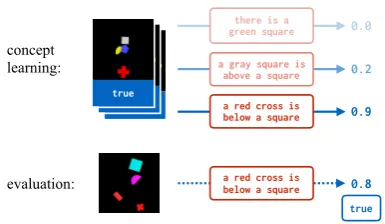
Figure 1: Example of our approach on a binary image classification task. We assume access to a pretrained language interpretation model that outputs the proba-bility that an image matches a given description. To learn a new visual concept, we search in the space of natural language descriptions to maximize the interpre-tation model’s score (top). The chosen description can be used with the interpretation model to classify new images (bottom). Figures best viewed in color.
background knowledge from language can pro-vide a useful scaffold for acquiring it. We specif-ically propose to use language as a latent param-eter space for few-shot learning problems of all kinds, including classification, transduction and policy search. We aim to show that this linguis-tic parameterization produces models that are both more accurate and more interpretable than direct approaches to few-shot learning.
Like many recent frameworks for multitask-and meta-learning, our approach consists of three phases: a pretraining phase, a concept-learning phase, and an evaluation phase. Here, the product of pretraining is a language interpretation model that maps from descriptions to predictors (e.g. im-age classifiers or reinforcement learners). Our the-sis is that language learning is a powerful, general-purpose kind of pretraining, even for tasks that do not directly involve language.
New concepts are learned by searching directly in the space of natural language strings to
?.???
(a) language learning
a white cross is left of a yellow shape
true true
true false
x(i)
y(i)
x(c)
y(c)
x(e)
y(e)
w(i)
true true
true
(b) concept learning (c) evaluation
[image:2.595.77.290.63.148.2]???
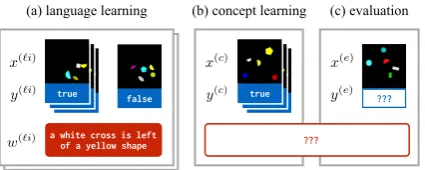
Figure 2: Formulation of the learning problem. Ul-timately, we care about our model’s ability to learn a concept from a small number of training examples (b) and successfully generalize it to held-out data (c). In this paper, concept learning is supported by a language learning phase (a) that makes use of natural language annotations on other learning problems. These annota-tions are not provided for the real target task in (b–c).
mize the loss incurred by the language interpre-tation model (Figure 1). Especially on tasks that require the learner to model high-level composi-tional structure shared by training examples, natu-ral language hypotheses serve a threefold purpose: they make it easier to discover these compositional concepts, harder to overfit to few examples, and easier for humans to understand inferred patterns. Our approach can be implemented using a stan-dard kit of neural components, and is simple and general. In a variety of settings, we find that the structure imposed by a natural-language parameterization is helpful for efficient learning and exploration. The approach outperforms both multitask- and meta-learning approaches that map directly from training examples to outputs by way of a real-valued parameterization, as well as ap-proaches that make use of natural language anno-tations as an additional supervisory signal rather than an explicit latent parameter. The natural lan-guage concept descriptions inferred by our ap-proach often agree with human annotations when they are correct, and provide an interpretable de-bugging signal when incorrect. In short, by equip-ping models with the ability to “think out loud” when learning, they become both more compre-hensible and more accurate.
2 Background
Suppose we wish to solve an image classifica-tion problem like the one shown in Figure 2b–c, mapping from images x to binary labels y. One
straightforward way to do this is to solve a
learn-ing problem of the followlearn-ing form:
arg min η∈H
X
(x, y)
L(f(x;η), y), (1)
where L is a loss function and f is a richly-parameterized class of models (e.g. convolutional networks) indexed byη(e.g. weight matrices) that
map from images to labels. Given a new imagex0,
f(x0;η)can be used to predict its label.
In the present work, we are particularly in-terested in few-shot learning problems where the number of (x, y) pairs is small—on the order of
five or ten examples. Under these conditions, di-rectly solvingEquation 1is a risky proposition— any model class powerful enough to capture the true relation between inputs and outputs is also likely to overfit. For few-shot learning to be suc-cessful, extra structure must be supplied to the learner. Existing approaches obtain this struc-ture by either carefully structuring the hypothe-sis space or providing the learner with alternative training data. The approach we present in this pa-per combines elements of both, so we begin with a review of existing work.
(Inductive) program synthesis approaches (e.g. Gulwani, 2011) reduce the effective size of the hypothesis class Hby moving the
optimiza-tion problem out of the continuous space of weight vectors and into a discrete space of formal pro-gram descriptors (e.g. regular expressions or Pro-log queries). Domain-specific structure like ver-sion space algebras (Lau et al., 2003) or type systems (Kitzelmann and Schmid, 2006) can be brought to bear on the search problem, and the bias inherent in the syntax of the formal language provides a strong prior. But while program syn-thesis techniques are powerful, they are also lim-ited in their application: a human designer must hand-engineer the computational primitives nec-essary to compactly describe every learnable hy-pothesis. While reasonable for some applications (like string editing), this is challenging or impos-sible for others (like computer vision).
1. apretraining(or “meta-training”) phase that makes use of various different datasetsiwith
examples {(x(1`i), y(1`i)), . . . ,(x(n`i), yn(`i))}
(Figure 2a)
2. a concept-learning phase in which the
pretrained model is adapted to fit data
{(x(1c), y1(c)), . . . ,(x(nc), y(nc))} for a specific
new task (Figure 2b)
3. an evaluation phase in which the learned concept is applied to a new inputx(e)to
pre-dicty(e)(Figure 2c)
In these approaches, learning operates over two collections of parameters: shared parameters η
and task-specific parameters θ. In pretraining,
multitask approaches find:
arg min η∈Ra, θ(`i)∈Rb
X
i, j
L f(x(j`i);η, θ(`i)), y(j`i). (2)
At concept learning time, they solve for:
arg min θ(c)∈Rb
X
j
L f(x(jc);η, θ(c)), yj(c) (3)
on the new dataset, then make predictions for new inputs usingf(x(e);η, θ(c)).
Closely relatedmeta-learningapproaches (e.g.
Schmidhuber,1987;Santoro et al.,2016;Vinyals et al., 2016) make use of the same data, but col-lapse the inner optimization overθ(c)and
predic-tion ofy(e)into a single learned model.
3 Learning with Language
In this work, we are interested in developing a learning method that enjoys the benefits of both approaches. In particular, we seek an intermediate language of task representations that, like in pro-gram synthesis, is both expressive and compact, but like in multitask approaches is learnable di-rectly from training data without domain engineer-ing. We propose to use natural language as this intermediate representation. We call our approach
learning with latent language(L3).
Natural language shares many structural advan-tages with the formal languages used in synthesis approaches: it is discrete, has a rich set of com-positional operators, and comes equipped with a natural description length prior. But it also has a considerably more flexible semantics. And cru-cially, plentiful annotated data exists forlearning
this semantics: we cannot hand-write a computer
program to recognize asmall dog, but we can learn how to do it from image captions. More basically, the set of primitive operators available in language provides a strong prior about the kinds of abstrac-tions that are useful for natural learning problems. Concretely, we replace the pretraining phase above with a language-learning phase. We as-sume that at language-learning time we have ac-cess to natural-language descriptionsw(`i) ( Fig-ure 2a, bottom). We use thesewasparameters, in
place of the task-specific parametersθ—that is, we
learn a languageinterpretationmodelf(x;η, w)
that uses shared parametersηto turn a description winto a function from inputs to outputs. For the
example inFigure 2, f might be an image rating
model (Socher et al., 2014) that outputs a scalar judgmentyof how well an imagexmatches a
cap-tionw.
Because these natural language parameters are observed at language-learning time, we need only learn the real-valued shared parametersηused for
their interpretation (e.g. the weights of a neural network that implements the image rating model):
arg min η∈Ra
X
i, j
L f(x(j`i);η, w(`i)), yj(`i). (4)
At concept-learning time, conversely, we solve only the part of the optimization problem over nat-ural language strings:
arg min w(c)∈Σ∗
X
j
L f(x(jc);η, w(c)), yj(c). (5)
This last step presents something of a chal-lenge. When solving the corresponding optimiza-tion problem, synthesis techniques can exploit the algebraic structure of the formal language, while end-to-end learning approaches take advantage of differentiability. Here we can’t do either—the lan-guage of strings is discrete, and any structure in the interpretation function is wrapped up inside the black box off. Inspired by related techniques
aimed at making synthesis more efficient (Devlin et al.,2017), we use learning to help us develop an effective optimization procedure for natural lan-guage parameters.
In particular, we simply use the language-learning datasets, consisting of pairs(x(j`i), yj(`i))
and descriptions wi, to fit a reverse proposal
model, estimating:
arg maxλPilogq(wi|x(1`i), y (`i) 1 , . . . , x
(`i)
true a white shape is
left of a yellow semicircle
true true
[image:4.595.76.292.70.153.2]true true
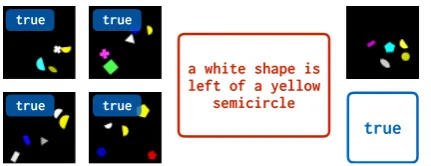
Figure 3: The few-shot image classification task. Learners are shown four positive examples of a visual concept (left) and must determine whether a fifth image matches the pattern (right). Natural language annota-tions are provided during language learning but must be inferred for concept learning.
whereq provides a (suitably normalized)
approx-imation to the distribution of descriptions given task data. In the running example, this pro-posal distribution is essentially an image caption-ing model (Donahue et al., 2015). By sampling fromq, we expect to obtain candidate descriptions
that are likely to obtain small loss. But our ulti-mate inference criterion is still the true modelf:
at evaluation time we perform the minimization in
Equation 5by drawing a fixed number of samples, selecting the hypothesisw(c)that obtains the
low-est loss, and usingf(x(e);η, w(c)) to make
pre-dictions.
What we have described so far is a generic pro-cedure for equipping collections of related learn-ing problems with a natural language hypothesis space. In Sections4and5, we describe how this procedure can be turned into a concrete algorithm for supervised classification and sequence predic-tion. InSection 6, we describe how to extend these techniques to reinforcement learning.
4 Few-shot Classification
We begin by investigating whether natural lan-guage can be used to support high-dimensional few-shot classification. Our focus is on visual reasoning tasks like the one shown in Figure 3. In these problems, the learner is presented with four images, all positive examples of some visual concept likea blue shape near a yellow triangle, and must decide whether a fifth, held-out image matches the same concept. These kinds of rea-soning problems have been well-studied in visual question answering settings (Johnson et al.,2017;
Suhr et al., 2017). Our version of the problem, where the input and output feature no text data, but an explanation must be inferred, is similar to
the visual reasoning problems proposed byRaven
(1936) andBongard(1968).
To apply the recipe in Section 2, we need to specify an implementation of the interpretation model f and the proposal model q. We begin
by computing representations of input images x.
We start with a pre-trained 16-layer VGGNet ( Si-monyan and Zisserman,2014). Because spatial in-formation is important for these tasks, we extract a feature representation from the final convolutional layer of the network. This initial featurization is passed through two fully-connected layers to form a final image representation, as follows:
x VGG-16 FC ReLU FC rep( )x
We define interpretation and proposal models:2
f(x;w) =σ rnn-encode(w)>rep(x)
q(w| {xj}) =rnn-decode w| 1
n P
jrep(xj)
The interpretation model f outputs the
probabil-ity thatx is assigned a positive class label, and is
trained to maximize log-likelihood. Because only positive examples are provided in each language learning set, the proposal modelq can be defined
in terms of inputs alone. Details regarding training hyperparameters, RNN implementations, etc. may be found inAppendix A.
Our evaluation aims to answer two questions. First, does the addition of language to the learning process provide any benefit over ordinary multi-task or meta-learning? Second, is it specifically better to use language as a hypothesis space for concept learning rather than just an additional sig-nal for pretraining? We use several baselines to answer these questions:
1. Multitask: a multitask baseline in which the definition of f above is replaced by σ(θ>i rep(x)) for task-specific parameters θi
that are optimized during both pretraining and concept-learning.
2. Meta: a meta-learning baseline in whichf is
defined byσ([n1Pjrep(xj)]>rep(x)).3
3. Meta+Joint: as inMeta, but the pretraining objective includes an additional term for pre-dictingq(discarded for concept learning).
We report results on a dataset derived from the ShapeWorld corpus ofKuhnle and Copestake
(2017). In this dataset the held-out image matches the target concept 50% of the time. In the val-idation and test folds, half of learning problems feature a concept that also appears in the language learning set (but with different exemplar images), while the other half feature both new images and a new concept. Images contain two or three dis-tractor shapes unrelated to the objects that define the target concept. Captions in this dataset were generated from DMRS representations using an HPS grammar (Copestake et al., 2016). (Our re-maining experiments use human annotators.) The dataset contains a total of 9000 pretraining tasks and 1000 of each validation and test tasks. More dataset statistics are provided inAppendix B.
Results are shown in Table 1. It can be seen that L3 provides consistent improvements over
the baselines, and that these improvements are present both when identifying new instances of previously-learned concepts and when discover-ing new ones. Some example model predictions are shown inFigure 4. The model often succeeds in making correct predictions, even though its in-ferred descriptions rarely match the ground truth. Sometimes this is because of inherent ambiguity in the description language (Figure 4a), and some-times because the model is able to rule out candi-dates on the basis of partial captions alone ( Fig-ure 4b, where it is sufficient to recognize that the
Model Val (old) Val (new) Val Test
Random 50 50 50 50
Multitask 64 49 57 59
Meta 63 62 62 64
Meta+Joint 63 69 66 64
L3(ours) 70 72 71 70
[image:5.595.318.515.541.689.2]L3(oracle) 77 80 79 78
Table 1: Evaluation on image classification. Val (old)andVal (new)denote subsets of the validation set that contain respectively previously-used and novel vi-sual concepts. L3 consistently outperforms alternative learning methods based on multitask learning, meta-learning, and meta-learning jointly trained to predict descriptions (Meta+Joint). The last row shows results when the model is given a ground-truth concept de-scription rather than having to infer it from examples.
target concept involves acircle). More examples are provided inAppendix C.
5 Programming by Demonstration Next we explore whether the same technique can be applied to tasks that involve more than binary similarity judgments. We focus on structured pre-diction: specifically a family of string processing tasks. In these tasks, the model is presented with examples of five strings transformed according to some rule; it must then apply an appropriate trans-formation to a sixth (Figure 5). Learning proceeds as in the previous section, with:
rep(x, y) =rnn-encode([x, y])
f(y |x;w) =
rnn-decode y |[rnn-encode(x),rnn-encode(w)]
q(w| {(xj, yj)}) =
rnn-decode w| 1
n P
jrep(xj, yj)
Baselines are analogous to those for classification. While string editing tasks of the kind shown inFigure 5 are popular in both the programming by demonstration literature (Singh and Gulwani,
2012) and the semantic parsing literature ( Kush-man and Barzilay,2013), we are unaware of any datasets that support both learning paradigms at the same time. We have thus created a new dataset of string editing tasks by (1) sampling random reg-ular transducers, (2) applying these transducers to collections of dictionary words, and (3) showing the collected examples to Mechanical Turk users
a blue cross is above a pentagon a cyan pentagon is to
the right of a magenta shape
false true
(a)
(b)
(c)
examples true description true label
pred. description pred. label
a square is above a red cross a red cross is below
a square
true true
a circle is above a yellow circle a cyan circle is to
the left of a rectangle
false false
[image:5.595.70.293.560.649.2]Model Val Test
Identity 18 18
Multitask 54 50
Meta 66 62
Meta+Joint 63 59
[image:6.595.116.247.62.135.2]L3 80 76
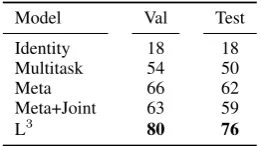
Table 2: Results for string editing. The reported num-ber is the percentage of cases in which the predicted string exactly matches the reference. L3is the best per-forming model; using language data for joint training rather than as a hypothesis space provides little benefit.
and asking them to provide a natural language ex-planation with their best guess about the under-lying rule. The dataset thus features both multi-example learning problems, as well as structured and unstructured annotations for each target con-cept. There are 3000 tasks for language learning and 500 tasks for each of validation and testing (Appendix B). Annotations are included in the code release for this paper.
Results are shown in Table 2. In these experi-ments, all models that use descriptions have been trained on the natural language supplied by human annotators. While we did find that the Meta+Joint model converges considerably faster than all the others, its final performance is somewhat lower than the baseline Meta model. As before, L3
out-performs alternative approaches for learning di-rectly from examples with or without descriptions. Because all of the transduction rules in this dataset were generated from known formal de-scriptors, these tasks provide an opportunity to perform additional analysis comparing natural lan-guage to more structured forms of annotation (since we have access to ground-truth regular ex-pressions) and more conventional synthesis-based methods (since we have access to a ground-truth regular expression execution engine). We addi-tionally investigate the effect of the number of
warding curved uranium pedaled drum warying curved uranium peyaled drum
replace d before a vowel with y
s/d([aeiou])/y\1/g
chided
chiyed
Figure 5: Example string editing task. Learners are presented with five examples of strings transformed ac-cording to some rule (left), and must apply an appropri-ate transformation to a sixth string (right). Language-learning annotations (center) may take the form of ei-ther natural language or regular expressions.
change any n
to a c replace all n s
with c
loocies loocies
replace consonant - vowel pairings with n
replace pairs of letters consisting of a consonant followed by a
vowel with an n
ntnynd ntnnd (a)
(b)
(c)
examples true description true output
pred. description pred. output emboldens kisses loneliness vein dogtrot emboldecs kisses locelicess veic dogtrot loonies mapper concluding excuse effete contracting npnr nncnnng exnn efnn nntncnng betrayed plummest bereaving eddied struggles evils plummesti bereavinti eddieti struggleti evilti
change the last letter of the word
into t i
replace the last letter of the word with t i
mistrialti mistrialti
mistrials
Figure 6: Example predictions for string editing.
samples drawn from the proposal model. These results are shown inTable 3.
A few interesting facts stand out. Under the ordinary evaluation condition (with no ground-truth annotations provided), language-learning with natural language data is actually better than language-learning with regular expressions. This might be because the extra diversity helps the model determine the relevant axes of variation and avoid overfitting to individual strings. Allowing the model to do its own inference is also better than providing ground-truth natural language de-scriptions, suggesting that it is actually better at generalizing from the relevant concepts than our human annotators (who occasionally write things like I have no ideafor the inferred rule). Unsur-prisingly, with ground truth REs (which unlike the human data are always correct) we can do bet-ter than any of the models that require inference. Coupling our inference procedure with an oracle RE evaluator, we essentially recover the synthesis-based approach ofDevlin et al.(2017). Our find-ings are consistent with theirs: when an exact exe-cution engine is available, there is no reason not to use it. But we can get almost 90% of the way there
Annotations Samples1 100 Ann.OracleEval.
None (Meta) 66 – – –
Natural language 66 80 75 –
Regular expressions 60 76 88 90
[image:6.595.307.526.69.197.2] [image:6.595.77.287.631.680.2]with an execution model learned from scratch. Ex-amples of model behavior are shown inFigure 6; more may be found inAppendix D.
6 Policy Search
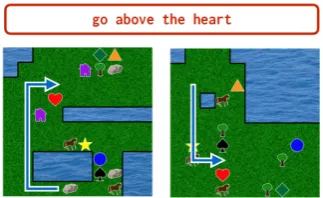
[image:7.595.100.262.553.652.2]The previous two sections examined supervised settings where the learning signal comes from few examples but is readily accessible. In this section, we move to a set of reinforcement learning prob-lems, where the learning signal is instead sparse and time-consuming to obtain. We evaluate on a collection of 2-D treasure hunting tasks. These tasks require the agent to discover a rule that de-termines the location of buried treasure in a large collection of environments of the kind shown in
Figure 7. To recover the treasure, the agent must navigate (while avoiding water) to its goal loca-tion, then perform a DIG action. At this point
the episode ends; if the treasure is located in the agent’s current position, it receives a reward, oth-erwise it does not. In every task, the treasure has consistently been buried at a fixed position relative to some landmark (inFigure 7a heart). Both the offset and the identity of the target landmark are unknown to the agent, and the location of the land-mark varies across maps. Indeed, there is noth-ing about the agent’s observations or action space to suggest that landmarks and offsets are even the relevant axes of variation across tasks: only the language reveals this structure.
The interaction between language and learning in these tasks is rather different from the super-vised settings. In the supersuper-vised case, language serves mostly as a guard against overfitting, and
Figure 7: Example treasure hunting task: the agent is placed in a random environment and must collect a reward that has been hidden at a consistent offset with respect to some landmark. At language-learning time only, natural language instructions and expert policies are provided. The agent must both learn primitive nav-igation skills, like avoiding water, as well as the high-level structure of the reward functions for this domain.
can be generated conditioned on a set of pre-provided concept-learning observations. Here, agents are free to interact with the environment as much as they need, but receive observations only during interaction. Thus our goal here will be to build agents that canadapt quicklyto new environ-ments, rather than requiring them to immediately perform well on held-out data.
Why should we expect L3to help in this setting?
In reinforcement learning, we typically encourage our models to explore by injecting randomness into either the agent’s action space or its under-lying parameterization. But most random policies exhibit nonsensical behaviors; as a result, it is in-efficient both to sample in the space of network weights and to perform policy optimization from a random starting point. Our hope is that when pa-rameters are chosen from within a structured fam-ily, a stochastic search in this structured space will only ever consider behaviors corresponding to a reasonable final policy, and in this way discover good behavior faster than ordinary RL.
Here the interpretation modelfdescribes a
pol-icy that chooses actions conditioned on the cur-rent environment state and a linguistic parameter-ization. As the agent initially has no observations at all, we simply design the proposal model to gen-erate unconditional samples from a prior over de-scriptions. Takingxto be an agent’s current obser-vation of the environment state, we define a state representation network and models:
x FC tanh FC tanh rep( )x
f(a|x;w)∝rnn-encode(w)>Warep(x)
q(w) =rnn-decode(w)
This parameterization assumes a discrete action space, and assigns to each action a probability pro-portional to a bilinear function of the encoded de-scription and world state. f is an instruction
fol-lowing model of a kind well-studied in natural lan-guage processing (Branavan et al.,2009); the pro-posal model allows it to generate its own instruc-tions without external direction. To learn, we sam-ple a fixed number of descriptionswfromq. For
each description, we sample multiple rollouts of the policy it induces to obtain an estimate of its av-erage reward. Finally, we take the highest-scoring description and fine-tune its induced policy.
tar-20 40 60 80 100
Timestep (×1000)
−1.0
−0.5 0.0 0.5 1.0 1.5 2.0 2.5 3.0
A
verage
re
w
ard
L3
Multitask
[image:8.595.85.271.71.192.2]Scratch
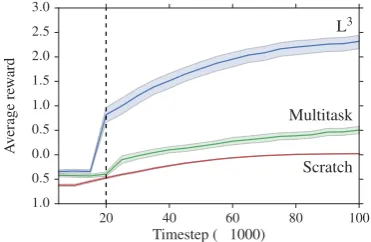
Figure 8: Treasure hunting reward obtained by each learning algorithm across multiple evaluation environ-ments, after language learning has already taken place (bands show 95% confidence intervals for mean per-formance). Multitask learns an embedding for each task, while Scratch trains on every task individually. L3rapidly discovers high-scoring policies in most envi-ronments. Dashed line indicates the end of the concept-learning phase; subsequent performance comes from fine-tuning. The max reward for this task is 3.
get locations provided by human annotators, as well as expert policies for navigating to the lo-cation of the treasure. The multitask model we compare to replaces these descriptions with train-able task embeddings.4 The learner is trained
from task-specific expert policies using DAgger (Ross et al., 2011) during the language-learning phase, and adapts to individual environments us-ing “vanilla” policy gradient (Williams,1992) dur-ing the concept learndur-ing phase.
The environment implementation and linguistic annotations are in this case adapted from a natural language navigation dataset originally introduced byJanner et al.(2017). In our version of the prob-lem (Figure 7), the agent begins each episode in a random position on a randomly-chosen map and must attempt to obtain the treasure. Relational concepts describing target locations are reused between language learning and concept-learning phases, but the environments themselves are dis-tinct. For language learning the agent has access to 250 tasks, and is evaluated on an additional 50. Averaged learning curves for held-out tasks are shown inFigure 8. As expected, reward for the L3
model remains low during the initial exploration period, but once a description is chosen the score
4In RL, the contribution of L3 is orthogonal to that of
meta-learning—one could use a technique like RL2 (Duan et al., 2016) to generate candidate descriptions more effi-ciently, or MAML (Finn et al., 2017) rather than zero-shot
reward as the training criterion for the interpretation model.
improves rapidly. Immediately L3 achieves
bet-ter reward than the multitask baseline, though it is not perfect; this suggests that the interpretation model is somewhat overfit to the pretraining envi-ronments. After fine-tuning even better results are rapidly obtained. Example rollouts are visualized inAppendix E. These results show that the model has used the structure provided by language to
learna better representation space for policies— one that facilitates sampling from a distribution over interesting and meaningful behaviors.
7 Other Related Work
This is the first approach we are aware of to frame a general learning problem as optimization over a space of natural language strings. However, many closely related ideas have been explored in the literature. String-valued latent variables are widely used in language processing tasks rang-ing from morphological analysis (Dreyer and Eis-ner, 2009) to sentence compression (Miao and Blunsom, 2016). Natural language annotations have been used in conjunction with training ex-amples to guide the discovery of logical descrip-tions of concepts (Ling et al., 2017; Srivastava et al., 2017), and used as an auxiliary loss for training (Frome et al., 2013), analogously to the Meta+Joint baseline in this paper. Structured language-like annotations have been used to im-prove learning of generalizable structured poli-cies (Oh et al., 2017;Andreas et al.,2017;Denil et al., 2017). Finally, natural language instruc-tions available at concept-learning time (rather than language-learning time) have been used to provide side information to reinforcement learners about high-level strategy (Branavan et al.,2011), environments (Narasimhan et al.,2017) and explo-ration (Harrison et al.,2017).
8 Conclusion
We have presented an approach for learning in a space parameterized by natural language. Using simple models for representation and search in this space, we demonstrated that our approach outper-forms standard baselines on classification, struc-tured prediction and reinforcement learning tasks. We believe that these results suggest the following general conclusions:
concepts, but not always at generalizing to new ones. By forcing decisions to pass through a lin-guistic bottleneck in which the underlying com-positional structure of concepts is explicitly ex-pressed, stronger generalization becomes possible.
Language simplifies structured exploration. Natural language scaffolding provides dramatic advantages in problems like reinforcement learn-ing that require exploration: models with latent linguistic parameterizations can limit exploration to a class of behaviors that are likelya priorito be goal-directed and interpretable.
And generally, language can help learning. In multitask settings, it can even improve learning on tasks for which no language data is available at training or test time. While some of these advan-tages are also provided by techniques built on top of formal languages, natural language is at once more expressive and easier to obtain than formal supervision. We believe this work hints at broader opportunities for using naturally-occurring lan-guage data to improve machine learning for tasks of all kinds.
Acknowledgments
JA is supported by a Facebook graduate fellow-ship.
References
Jacob Andreas, Dan Klein, and Sergey Levine. 2017. Modular multitask reinforcement learning with pol-icy sketches. In Proceedings of the International Conference on Machine Learning.
Mikhail Moiseevich Bongard. 1968. The recognition problem. Technical report.
S.R.K. Branavan, Harr Chen, Luke S. Zettlemoyer, and Regina Barzilay. 2009. Reinforcement learning for mapping instructions to actions. InProceedings of the Annual Meeting of the Association for Computa-tional Linguistics.
S.R.K. Branavan, David Silver, and Regina Barzilay. 2011. Learning to win by reading manuals in a Monte-Carlo framework. InProceedings of the Hu-man Language Technology Conference of the Asso-ciation for Computational Linguistics.
Rich Caruana. 1998. Multitask learning. InLearning to learn, Springer.
Kyunghyun Cho, Bart van Merri¨enboer, Dzmitry Bah-danau, and Yoshua Bengio. 2014. On the properties of neural machine translation: Encoder-decoder ap-proaches. arXiv preprint arXiv:1409.1259.
Ann A Copestake, Guy Emerson, Michael Wayne Goodman, Matic Horvat, Alexander Kuhnle, and Ewa Muszynska. 2016. Resources for building ap-plications with dependency minimal recursion se-mantics. InLanguage Resources and Computation. Misha Denil, Sergio G´omez Colmenarejo, Serkan
Cabi, David Saxton, and Nando de Freitas. 2017. Programmable agents. arXiv preprint arXiv:1706.06383.
Jacob Devlin, Jonathan Uesato, Surya Bhupatiraju, Rishabh Singh, Abdel-rahman Mohamed, and Push-meet Kohli. 2017. RobustFill: Neural program learning under noisy I/O. InProceedings of the In-ternational Conference on Machine Learning. Jeffrey Donahue, Lisa Anne Hendricks, Sergio
Guadar-rama, Marcus Rohrbach, Subhashini Venugopalan, Kate Saenko, and Trevor Darrell. 2015. Long-term recurrent convolutional networks for visual recogni-tion and descriprecogni-tion. InProceedings of the Confer-ence on Computer Vision and Pattern Recognition. Markus Dreyer and Jason Eisner. 2009. Graphical
models over multiple strings. InProceedings of the Conference on Empirical Methods in Natural Lan-guage Processing.
Yan Duan, John Schulman, Xi Chen, Peter L Bartlett, Ilya Sutskever, and Pieter Abbeel. 2016. RL2: Fast reinforcement learning via slow reinforcement learning.arXiv preprint arXiv:1611.02779. Chelsea Finn, Pieter Abbeel, and Sergey Levine. 2017.
Model-agnostic meta-learning for fast adaptation of deep networks. InProceedings of the International Conference on Machine Learning.
Andrea Frome, Greg Corrado, Jonathon Shlens, Samy Bengio, Jeffrey Dean, MarcAurelio Ranzato, and Tomas Mikolov. 2013. Devise: A deep visual-semantic embedding model. InAdvances in Neural Information Processing Systems.
Alison Gopnik and Andrew Meltzoff. 1987. The de-velopment of categorization in the second year and its relation to other cognitive and linguistic develop-ments. Child Development.
Sumit Gulwani. 2011. Automating string processing in spreadsheets using input-output examples. ACM SIGPLAN Notices46(1).
Brent Harrison, Upol Ehsan, and Mark O Riedl. 2017. Guiding reinforcement learning exploration using natural language. arXiv preprint arXiv:1707.08616 .
Michael Janner, Karthik Narasimhan, and Regina Barzilay. 2017. Representation learning for grounded spatial reasoning. Transactions of the As-sociation for Computational Linguistics.
Justin Johnson, Bharath Hariharan, Laurens van der Maaten, Li Fei-Fei, C Lawrence Zitnick, and Ross Girshick. 2017. CLEVR: A diagnostic dataset for compositional language and elementary visual rea-soning.Proceedings of the Conference on Computer Vision and Pattern Recognition.
Diederik Kingma and Jimmy Ba. 2015. Adam: A method for stochastic optimization. InProceedings of the International Conference on Learning Repre-sentations.
Emanuel Kitzelmann and Ute Schmid. 2006. Induc-tive synthesis of functional programs: An explana-tion based generalizaexplana-tion approach. Journal of Ma-chine Learning Research7.
Alexander Kuhnle and Ann Copestake. 2017. Shapeworld-a new test methodology for multi-modal language understanding. arXiv preprint arXiv:1704.04517.
Nate Kushman and Regina Barzilay. 2013. Using se-mantic unification to generate regular expressions from natural language. In Proceedings of the An-nual Meeting of the North American Chapter of the Association for Computational Linguistics.
Tom Kwiatkowski, Luke Zettlemoyer, Sharon Goldwa-ter, and Mark Steedman. 2011. Lexical generaliza-tion in ccg grammar inducgeneraliza-tion for semantic pars-ing. InProceedings of the Conference on Empirical Methods in Natural Language Processing.
Tessa Lau, Steven A Wolfman, Pedro Domingos, and Daniel S Weld. 2003. Programming by demonstra-tion using version space algebra. Machine Learning 53(1).
Wang Ling, Dani Yogatama, Chris Dyer, and Phil Blun-som. 2017. Program induction by rationale genera-tion: Learning to solve and explain algebraic word problems. InProceedings of the Annual Meeting of the Association for Computational Linguistics. Yishu Miao and Phil Blunsom. 2016. Language as a
latent variable: Discrete generative models for sen-tence compression. In Proceedings of the Confer-ence on Empirical Methods in Natural Language Processing.
Karthik Narasimhan, Regina Barzilay, and Tommi Jaakkola. 2017. Deep transfer in reinforcement learning by language grounding. arXiv preprint arXiv:1708.00133.
Junhyuk Oh, Satinder Singh, Honglak Lee, and Push-meet Kohli. 2017. Zero-shot task generalization with multi-task deep reinforcement learning. In Pro-ceedings of the International Conference on Ma-chine Learning.
John C Raven. 1936. Mental tests used in genetic stud-ies: The performance of related individuals on tests mainly educative and mainly reproductive. Unpub-lished masters thesis, University of London.
St´ephane Ross, Geoffrey J Gordon, and Drew Bagnell. 2011. A reduction of imitation learning and struc-tured prediction to no-regret online learning. In In-ternational Conference on Artificial Intelligence and Statistics.
Adam Santoro, Sergey Bartunov, Matthew Botvinick, Daan Wierstra, and Timothy Lillicrap. 2016. Meta-learning with memory-augmented neural networks. In Proceedings of the International Conference on Machine Learning.
Jurgen Schmidhuber. 1987. Evolutionary principles in self-referential learning. On learning how to learn. Diploma thesis, Institut f. Informatik, Tech. Univ. Munich.
K Simonyan and A Zisserman. 2014. Very deep convo-lutional networks for large-scale image recognition. arXiv preprint arxiv:1409.1556.
Rishabh Singh and Sumit Gulwani. 2012. Learning se-mantic string transformations from examples. In In-ternational Conference on Very Large Databases.
Jake Snell, Kevin Swersky, and Richard S Zemel. 2017. Prototypical networks for few-shot learning. arXiv preprint arXiv:1703.05175.
Richard Socher, Andrej Karpathy, Quoc V Le, Christo-pher D Manning, and Andrew Y Ng. 2014. Grounded compositional semantics for finding and describing images with sentences. Transactions of the Association for Computational Linguistics2.
Shashank Srivastava, Igor Labutov, and Tom Mitchell. 2017. Joint concept learning and semantic parsing from natural language explanations. InProceedings of the Conference on Empirical Methods in Natural Language Processing.
Alane Suhr, Mike Lewis, James Yeh, and Yoav Artzi. 2017. A corpus of natural language for visual rea-soning. In55th Annual Meeting of the Association for Computational Linguistics, ACL.
Oriol Vinyals, Charles Blundell, Tim Lillicrap, Koray Kavukcuoglu, and Daan Wierstra. 2016. Matching networks for one shot learning. InAdvances in Neu-ral Information Processing Systems.
A Model and Training Details
In all models, RNN encoders and decoders use gated recurrent units (Cho et al.,2014).
Few-shot classification Models are trained with theADAMoptimizer (Kingma and Ba,2015) with a step size of 0.0001 and batch size of 100. The number of pretraining iterations is tuned based on subsequent concept-learning performance on the development set. Neural network hidden states, task parameters, and word vectors are all of size 512. 10 hypotheses are sampled during for each evaluation task in the concept-learning phase.
Programming by demonstration Training as
in the classification task, but with a step size of 0.001. Hidden states are of size 512, task param-eters of size 128 and word vectors of size 32. 100 hypotheses are sampled for concept learning.
Policy search DAgger (Ross et al., 2011) is used for pre-training and vanilla policy gradient (Williams,1992) for concept learning. Both learn-ing algorithms useADAMwith a step size of 0.001 and a batch size of 5000 samples. For imitation learning, rollouts are obtained from the expert pol-icy on a schedule with probability0.95t(fortthe
current epoch). For reinforcement learning, a dis-count of 0.9 is used. Because this dataset con-tains no development data, pretraining is run un-til performance on the pretraining tasks reaches a plateau. Hidden states and task embeddings are of size 64. 100 hypotheses are sampled for con-cept learning, and 1000 episodes (divided evenly among samples) are used to estimate hypothesis quality before fine-tuning.
B Dataset Information
ShapeWorld This is the only fully-synthetic
dataset used in our experiments. Each scene fea-tures 4 or 5 non-overlapping entities. Descriptions refer to spatial relationships between pairs of enti-ties identified by shape, color, or both. There are 8 colors and 8 shapes. The total vocabulary size is only 30 words, but the dataset contains 2643 dis-tinct captions. Descriptions are on average 12.0 words long.
Regular expressions Annotations were
col-lected from Mechanical Turk users. Each user was presented with the same task as the learner in this paper: they observed five strings being trans-formed, and had to predict how to transform a
sixth. Only after they correctly generated the held-out word were they asked for a description of the rule. Workers were additionally presented with hints like “look at the beginning of the word” or “look at the vowels”. Descriptions are automati-cally preprocessed to strip punctuation and ensure that every character literal appears as a single to-ken.
The regular expression data has a vocabulary of 1015 rules and a total of 1986 distinct descriptions. Descriptions are on average 12.3 words in length but as long as 46 words in some cases.
Navigation The data used was obtained from
Janner et al.(2017). We created our own variant of the dataset containing collections of related tasks. Beginning with the “local” tasks in the dataset, we generated alternative goal positions at fixed offsets from landmarks as described in the main section of this paper. Natural-language descriptions were selected for each task collection from the human annotations provided with the dataset. The vocab-ulary size is 74 and the number of distinct hints 446. The original action space for the environment is also modified slightly: rather than simply reach-ing the goal cell (achieved with reasonably high frequency by a policy that takes random moves), we require the agent to commit to an individual goal cell and end the episode with a special DIG
action.
C Examples: ShapeWorld
(Examples in this and the following appendices were not cherry-picked.)
Positive examples:
True description:
a red ellipse is to the right of an ellipse
Inferred description:
a red shape is to the right of a red semicircle
Input: True label:
true
Pred. label:
true
a shape is below a white ellipse
a white shape is to the left of a yellow ellipse
false
true
a magenta triangle is to the left of a magenta pentagon
a magenta triangle is to the left of a pentagon
true
true
a green pentagon is to the right of a yellow shape
a green shape is to the right of a red semicircle
false
false
a red circle is above a magenta semicircle
a green triangle is above a red circle
false
true
a white ellipse is to the left of a green cross
a green cross is to the right of a white ellipse
true
D Examples: Regular Expressions Example in: mediaeval paneling wafer conventions handsprings Example out: ilediaeval ilaneling ilafer ilonventions ilandsprings Human description:
leading consonant si replaced with i l
Inferred description:
first consonant of a word is replaced with i l
Input: chaser True out: ilhaser Pred. out: ilhaser uptakes pouching embroidery rebelliousness stoplight uptakes punuching embrunidery rebelliunusness stunplight
replace every o with u n
change all o to u n
regulation regulatiunn regulatinun fluffiest kidnappers matting griping disagreements fluffiest kidnappers eeatting griping disagreeeeents
the leter m is replaced by ee
change every m to ee
chartering chartering chartering clandestine limning homes lifeblood inflates clandqtine limning homq lifqlood inflatq e
where e appears , replace it and the following letter with q
gratuity gratuity gratuity fruitlessly sandier washers revelries dewlaps fruitlessly sandier washemu revelrimu dewlamu
if the word ends with an s , replace the last two letters with m u
change last to m u if consonant
prompters promptemu promptemu ladylike flintlocks student surtaxes bedecks ladylike flintlocknl studennl surtaxenl bedecknl
ending consonant is replaced with n l
drop last two and add n l
initials initialnl initialnl porringer puddling synagog curtseying monsieur porringeer puddlinge synageoge curtseyinge monsieur
add e next to letter g
when a letter is preceded by a g , e is added after that letter
rag rage rage trivializes tried tearfully hospitalize patronizing trivializes tried gxarfully gxspitalize gxtronizing
replace the 1st 2 letters of the word with a g x if the word begins with a consonant then a vowel
if the second letter is a vowel , replace the first two letters with g x
landlords gxndlords gxndlords microseconds antiviral flintlock appreciable stricter microsecnyr antiviral flintloyr appreciabyr stricter
replace consonants with y r
the last two letters are replaced by y r
exertion
exertion
E Examples: Navigation
White breadcrumbs show the path taken by the agent.
Human description:
move to the star
Inferred description:
reach the star cell
reach square one right of triangle
reach cell to the right of the triangle
reach cell on left of triangle
reach square left of triangle
reach spade
go to the spade
left of the circle
go to the cell to the left of the circle
reach cell below the circle