Proceedings of the 7th Joint Conference on Lexical and Computational Semantics (*SEM), pages 113–118
Named Graphs for Semantic Representations
Richard Crouch
A9.com
Aikaterini-Lida Kalouli
University of Konstanz
Abstract
A position paper arguing that purely graphical representations for natural language semantics lack a fundamental degree of expressiveness, and cannot deal with even basic Boolean op-erations like negation or disjunction, let alone intensional phenomena. Moving from graphs to named graphs leads to representations that stand some chance of having sufficient expres-sive power. NamedF L0graphs are of partic-ular interest.
1 Introduction
Graphs are popular for both (semantic web) knowledge representation (Screiber and Raimond,
2014;Dong et al., 2014;Rospocher et al.,2016) and natural language semantics (Banarescu et al.,
2013;Perera et al.,2018;Wities et al.,2017). The casual observer might assume there is substantial overlap between the two activities, but there is less than meets the eye. This paper attempts to make three points:
1. Knowledge graphs, which are designed to represent facts about the world rather than human knowledge, are not well set up to represent nega-tion, disjuncnega-tion, and conditional or hypothetical contexts. Arguably, the world contains no nega-tive, disjuncnega-tive, or hypothetical facts; just posi-tive facts that make them true. Natural language semantics has to deal with more partial assertions, where all that is known are the negations, dis-junctions, or hypotheticals, and not the underlying facts that make them true.
2. Named graphs (Carroll et al., 2005) are an extension of RDF graphs (Screiber and Raimond,
2014), primarily introduced to record provenance information. They are worthy of further study, since they promise a way of bridging between the relentlessly positive world of knowledge represen-tation and the more partial, hypothetical world of natural language. In RDF-OWL graphs (Hitzler et al., 2012), the subject-predicate-object triples
forming the nodes and arcs of the graph corre-spond to atomic propositions. Beyond conjunc-tion, no direct relations between these proposi-tions can be expressed. Named graphs allow sub-graphs (i.e. collections of atomic propositions) to be placed in relationships with other sub-graphs, and thus allow for negative, disjunctive and hypo-thetical relations between complex propositions.
3. Named graphs illustrate a certain way of factoring out complexity, in this case between predicate-argument structure and Boolean / modal structure. As a semantic representation, the predicate-argument structure is correct, but not complete. Adding a named, Boolean layer re-quires no adjustment to the syntax or semantics of the predicate-argument structure; it just embeds it in a broader environment. This often is not the case; e.g. in moving from unquantified predicate logic to first-order quantified logic, to first-oder modal logic, to higher-order intensional logic.
After reviewing RDF graphs and named graphs, we discuss how they could be applied to a (some-what incestuous) family of layered, graphical, se-mantic representations (Boston et al., forthcom-ing;Shen et al., 2018;Bobrow et al., 2007) (see our companion paper (Kalouli and Crouch,2018) for an introduction to these representations). This offers the prospect of a formal semantics that takes graphs to be first class semantic objects, which dif-fers from approaches like AMR (Banarescu et al.,
2013), where the graphs are descriptions of under-lying semantic objects.
2 Graphs and Named Graphs
A graph is a collection of binary relationships between entities. Since any n-ary relationship
can be decomposed into n+ 1 binary
relation-ships through the introduction of an extra entity that serves as a “pivot” (this is the basis of neo-Davidsonian event semantics (Parsons,1990)), all
n-ary relationships can be represented in graphical
form as a collection of entity-relation triples.
2.1 RDF
This graphical approach ton-ary relationships has
seen perhaps its fullest use in the Resource De-scription Framework (RDF) (Screiber and Rai-mond,2014), where subject-relation-object triples can be stored to treat complex ontologies as graphs. But since the triples form a conjunctive set, RDF has to go through some contortions to emulate negation and disjunction.
Unadorned, RDF is lax about what kinds of en-tity can occur in triples, and individuals, relations, and classes can intermingle freely. One can state facts about how classes relate to other classes (e.g. one is a subclass of the other), how relations relate to other relations, and how individual relate to re-lations and classes. Successive restrictions, such as RDFS (Brickley and Guha, 2014) and OWL (Hitzler et al., 2012) tighten up on this freedom of expression, for the resulting gain in inferential tractability.
OWL provides a number of class construction operations that mimic Booleans at a class level: complement (negation), intersection (conjunction) and union (disjunction). One could therefore as-sert that Rosie is not a cat by saying that she is an instance of the cat-complement class, and one could assert that Rosie is a cat or a dog by asserting that she is an instance of the class formed by tak-ing the union of cats and dogs. Additionally, OWL and RDFS allow negative properties as a way of stating that a particular relation does not hold be-tween two entities (i.e. a form of atomic negation). The semantic web is geared toward capturing positive facts about what is known. Two positive facts can establish a negative, e.g. that cats and dogs are disjoint classes and that Rosie is a dog establishes that Rosie is not a cat. But the need to
asserta negative rarely arises: better to wait until the corresponding incompatible positive is known, or as a last resort make up a positive fact that is in-compatible with negative (e.g. that Rosie is a non-cat). Natural language, by contrast, is full of neg-ative, disjunctive, and hypothetical assertions for which the justifying positive facts are not known. And these Boolean and modal assertions express relationships between propositions (i.e. collec-tions of triples), and not between classes.
Moreover, Gardenf¨ors (2014) makes the case for restricting semantics to natural concepts within
a conceptual space. A conceptual space consists of a set of quality dimensions (c.f. dimensions in word vectors). A point in the space is a particular vector along these dimensions. A natural concept is a region (collection of points in the space) that is connected and convex. This essentially means that the shortest path from one sub-region of a natural concept to another does not pass outside of the re-gion defined by the concept: natural concepts are regions that are not gerrymandered. OWL unions of classes can arbitrarily combine disconnected re-gions, whereas complements can tear holes in the middle of regions: they can produce gerrymander-ing that would make the most partisan blush.
2.2 Named Graphs
Named graphs were introduced by Carroll et al.
(2005) as a small extension on top of RDF, primar-ily with the goal of recording provenance meta-data for different parts of a complex graph, such as source, access restrictions, or ontology versions. However, applications to stating propositional at-titudes and capturing logical relationships between graphs were also mentioned in passing. A named graph simply associates an extra identifier with a set of triples. For example, a propositional attitude like Fred believes John does not like Marycould be represented as follows1:
:g1 { :john :like :mary } :g2 :not :g1
:fred :belive :g2
where:g1is the name given to the graph
express-ing the proposition thatJohn likes Mary, and:g2
to the graph expressing its negation. Disjunction likewise can be expressed as a relationship be-tween named graphs:
:g1 { :john :like :mary } :g2 { :fred :like :mary } :g0 :or :g1
:g0 :or :g2
where the graph:g0 expresses the disjunction of :g1and:g2.
The graph semantics for named graphs is a sim-ple extension of the basic semantics (Carroll et al.,
2005). The meaning of a named graph is the mean-ing of the graph, and sub-graph relations between named graphs must reflect the underlying relations between the graphs that are named. But signif-icantly, named graphs are not automatically as-serted — there is no presumption that the triples
Figure 1: GKR forFred believes John likes Mary
occurring in a named graph are true. This is some-what inconvenient if your main goal is to assert positive, true facts. But this looks ideal for deal-ing with negation, disjunction and hypotheticals in natural language. In particular, the named graph above asserts neither that John likes Mary nor that John doesn’t like Mary.
Reification in RDF was an earlier approach to dealing with provenance meta-data (Screiber and Raimond, 2014). This turns every triple into four triples that describe it, so that :john :like :mary becomes :t :type :statement; :t :subj :john; :t :pred :like; :t :obj :mary. The reified graph is graphical description
of the original graph. Naming preserves the underlying graph in a way that reification does not.
3 Layered Graphs and the Graphical Knowledge Representation
A recent proposal for semantic representation has made use of so-called “layered-graphs” (GKR, (Kalouli and Crouch, 2018), see also (Boston et al., forthcoming;Shen et al., 2018)), with the claim that this gives a good way of handling Boolean, hypothetical, and modal relations2. The
proposal is based on earlier work on an Abstract Knowledge Representtions (AKR, (Bobrow et al.,
2007)), which imposes a separation between con-ceptual / predicate-argument structure and contex-tual structure. The GKR representation (simpli-fied) forFred believes John likes Mary is shown in Figure 1. This comprises two sub-graphs: a concept/predicate-argument graph on the left, and a context graph on the right. The concept graph can be read conjunctively as stating the following, but where variables range over (sub)concepts and not over individuals:
∃b,l,f,j,m.
2This section does not attempt to motivate GKR in terms of coverage of phenomena or support of natural language in-ference: see the cited papers for this.
believe(b) & like(l) & fred(f) & sub(b,f) & comp(b,l)
& mary(m) & john(j) & subj(l,j) & obj(l,m)
Thusbdenotes a sub-concept ofbelieve, that is
further constrained to have as a subject role some sub-concept offred, and as a complement some
sub-concept of like. The concept graph makes
no assertions about whether any of these concepts have individuals instantiating them: it asserts nei-ther that Fred has a belief, nor that John likes Mary. It is a level at which semantic similarity can be assessed, but not one at which — on its own — logical entailments can be judged. The concept graph is a correct characterization of the sentence, but an incomplete one.
Entailment requires existential commitments that are introduced by the context graph shown on the right of Figure1. There are two contexts. The top level, “true”, contexttopstates the com-mitments of the sentence’s speaker. The arc con-necting it to the believe node means that the speaker is asserting that there is an instance of the believe concept. The second context,belis lex-ically induced by the word “believes”. The arc from bel to the like node means that in this context there is asserted to be an instance of the like context. However, bel is marked as being averidical with respect to top. This means that we cannot lift the existential commitments ofbel
up intotop. Hence Figure1 does not entail that John likes Mary (nor that he doesn’t).
Other words introduce different context rela-tions. For exampleknowcreates a veridical lower context, which means that the lower existential commitments can be lifted up. Whereas nega-tion creates an anti-veridical lower context, which specifically says that the concept that is instan-tiated in the lower context is uninstaninstan-tiated in the upper one. Following the work of (Nairn et al.,2006), these instantiation raising rules allow complex intensional inference to be drawn (see (Boston et al., forthcoming) for a fuller descrip-tion).
4 Named
F L
0 GraphsC, D⇒A|CuD| ∀R.C
where A∈Atomic concept
R∈Atomic role
[image:4.595.92.204.540.642.2]C, D∈concept
Figure 2: Concept Construction inF L0
are nothing more than concept (sub-)graphs. Sec-ond, that the concept graph corresponds to the
F L0 description logic (Baader and Nutt, 2003),
for which subsumption is decidable in polynomial time. F L0 is a simple logic that is generally
re-garded as too inexpressive to deal with interesting language-related phenomena. But in combination with graph naming it becomes much more expres-sive.
The F L0 description logic allows concepts to
be constructed as shown in Figure 2. Given a stock of atomic concepts, complex concepts can be formed by (i) intersection, e.g. (AdultuMale
uPerson)≡Man; and ii) slot/role restriction, e.g.
Biteu ∀subj.Dogu ∀obj.Man(the class of bitings by dogs of men). The concept graphs of GKR cor-respond to the application of F L0 operations to
atomic lexical concepts. The concept of thelike
node in Figure1is thuslikeu ∀subj.ju ∀obj.m3.
In order to keep the concept graphs of GKR withinF L0, it is important that context nodes are
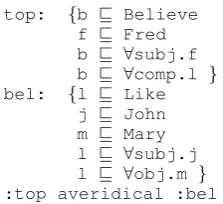
not allowed to participate in role restrictions. This rules out the kind of free intermingling of graph nodes and other nodes that was presented in Sec-tion2.2. The GKR treatment ofFred believes John likes Maryis shown in Figure 1. Expressed as a named graph, this corresponds to:
top: {b v Believe f v Fred b v ∀subj.f b v ∀comp.l } bel: {l v Like
j v John m v Mary l v ∀subj.j l v ∀obj.m } :top averidical :bel
This named-graph formulation of GKR inherits a standard graph semantics, as described byCarroll et al.(2005). The graph semantics is complemen-tary to the kind of truth-conditional semantics set out for AKR (and by analogy, GKR) byBobrow
3GKR extends its concept graph with a property graph that captures the effect of morpho-syntactic features like car-dinality. This corresponds to extending the logic toF LN0
by introducing cardinality restrictions.
et al. (2005). More work, however, is needed to explore the connections between the graph and truth-conditional semantics.
5 Abstract Meaning Representation (AMR)
AMR is best seen as a graphical notation for de-scribing logical forms, which is the view taken by
Bos (2016) and Stabler (2017) in their augmen-tations of AMR to increase its expressive power. This can be seen by considering the AMR forFred believes John likes Mary:
(b / believe
:arg0 (f / Fred) :arg1 (l / like
:arg0 (j / John) :arg1 (m / Mary)))
Expressed as a set of triples, this becomes
b instance believe; l instance like; f instance Fred; j instance John;
b :arg0 f; m instance Mary;
b :arg1 l; l :arg0 j;
l :arg1 m;
Since a graph is a conjunction of triples, and be-cause A ∧ B |= A, all the triples on the left
can be validly eliminated to leave those on the right, which correspond to the graph forJohn likes Mary. The inference fromFred believes John likes Mary to John likes Mary is clearly not semanti-cally valid. Consequently the AMR triples cannot be interpreted as stating semantic-web style facts; rather they state sub-formulas of a logical form.
There is nothing wrong in having a more hab-itable, graphical notation for logical formulas, es-pecially if large amounts of annotation are to be done. But this is different from a goal of having graphs as first class semantic objects.
6 Concluding Observations
This paper attempts to make the case for named graphs as an interesting tool for natural language semantics. The first task in exploring this further would be to provide a truth-conditional, graph-based semantics for GKR. A positive outcome would enable closer links between semantic and knowledge graphs.
By naming graphs, it appears that an inexpres-sive, conjunctive concept logic,F L0, can be
em-ployed to handle a wide variety of more complex phenomena including Booleans and hypotheticals. However, one should not assume that the inferen-tial tractability ofF L0 carries across to a system
We conjecture that the restriction of concept for-mation toF L0will satisfy (Gardenf¨ors,2014)
re-quirements on the connectedness and convexity of concepts. Additionally, the restricted operations may be better for the operations inherent in deal-ing with vector spaces used in distributed seman-tic representation; it is currently unclear what cor-responds to negation in vector spaces, though see (Bowman et al.,2015). The strategy of having a correct but incomplete conceptual structure may make it easier to reconcile logical and distribi-tional accounts of semantics if distribudistribi-tional se-mantics is relieved of the burden of having to ac-count for Boolean structure.
Naming a graph essentially boxes it off, to be evaluated or asserted within a different context. GKR focuses on the analogue between these con-texts and switching assignments to possible worlds in standard Kripke semantics for modal logics. With regard to distributional quantification it ob-serves that assignments to variables in standard first-order logic plays a similar role, and suggests using this to account for quantifier scope via con-texts. This does not exhaust the space of evalua-tive contexts. Named graphs were primarily mo-tivated by the desire to record (provenance) meta-data about triples. They provide an ideal means of associating meta-data with semantic relation-ships, such as the confidence that a particular role restriction is correct. This can be extended to record inter-dependencies between collections of ambiguous relationships, using the packing mech-anism of (Maxwell and Kaplan,1993): choices be-tween alternate interpretations also set up different evaluation contexts.
The embedding of boxes in Discourse Rep-resentation Theory (Kamp and Reyle, 1993) is strongly reminiscent of embedding sub-graphs. We speculate that DRT could be given a graph-based semantics, in which discourse representa-tion structures (DRSs) are seen as first class graph-ical and semantic objects. However, one differ-ence between DRT and GKR is that GKR imposes a strict separation between concepts and contexts. This essentially means that contexts cannot be re-ferred to in conceptual predicate-argument struc-tures. In DRT, this would correspond to not per-mitting DRSs to serve as arguments of predicates. With regard to AMR, naming some of the graphs and expressing context relations between them seems a relatively conservative extension in
terms of notation. But doing so offers the prospect of lifting AMRs out of being graphical descrip-tions of some other semantic object (like a logical form), and becoming much closer to RDF graphs as first-class semantic objects.
Ackowledgements
This paper does not describe any work done by the first author in his role at A9. We are grateful to Tagyoung Chung and Valeria de Paiva for helpful comments on presentation, though they should not be held responsible for the views expressed.
References
Franz Baader and Werner Nutt. 2003. The description logic handbook. chapter Basic Description Log-ics, pages 43–95. Cambridge University Press, New York, NY, USA.
Laura Banarescu, Claire Bonial, Shu Cai, Madalina Georgescu, Kira Griffitt, Ulf Hermjakob, Kevin Knight, Philipp Koehn, Martha Palmer, and Nathan Schneider. 2013. Abstract Meaning Representation for Sembanking. In Proceedings of the Linguistic Annotation Workshop.
Chris Bizer and Richard Cyganiak. 2014. RDF 1.1 TriG, https://www.w3.org/tr/trig/.
Danny G. Bobrow, Cleo Condoravdi, Richard Crouch, Valeria de Paiva, Lauri Karttunen, Tracy Holloway-King, Rowan Nairn, Charlotte Price, and Annie Zaenen. 2007. Precision-focused Textual Infer-ence. In Proceedings of the ACL-PASCAL Work-shop on Textual Entailment and Paraphrasing, RTE ’07, pages 16–21, Stroudsburg, PA, USA. Associa-tion for ComputaAssocia-tional Linguistics.
Danny G. Bobrow, Richard Crouch, Valeria de Paiva, Ron Kaplan, Lauri Karttunen, Tracy King-Holloway, and Annie Zaenen. 2005. A basic logic for textual inference. In Proceedings of the AAAI Workshop on Inference for Textual Question Answering.
Johan Bos. 2016. Expressive Power of Abstract Mean-ing Representations. Computational Linguistics, 42(3):527–535.
Marisa Boston, Richard Crouch, Erdem ¨Ozcan, and Pe-ter Stubley. forthcoming. Natural language infer-ence using an ontology. In Cleo Condoravdi, editor,
Lauri Karttunen Festschrift.
Dan Brickley and R. V. Guha. 2014. RDF Schema 1.1, https://www.w3.org/tr/rdf-schema/.
Jeremy Carroll, Christian Bizer, Pat Hayes, and Patrick Stickler. 2005. Named Graphs. Web Semantics: Sci-ence, Services and Agents on the World Wide Web, 3(4).
Xin Luna Dong, Evgeniy Gabrilovich, Geremy Heitz, Wilko Horn, Ni Lao, Kevin Murphy, Thomas Strohmann, Shaohua Sun, and Wei Zhang. 2014. Knowledge Vault: A Web-Scale Approach to Prob-abilistic Knowledge Fusion. In The 20th ACM SIGKDD International Conference on Knowledge Discovery and Data Mining, KDD ’14, New York, NY, USA - August 24 - 27, 2014, pages 601–610. Peter Gardenf¨ors. 2014. The Geometry of Meaning:
Semantics Based on Conceptual Spaces. MIT Press. Pascal Hitzler, Markus Kr¨otzsch, Bijan Parsia, Pe-ter F. Patel-Schneider, and Sebastian Rudolph. 2012. OWL 2 Web Ontology Language Primer, https://www.w3.org/tr/owl2-primer.
Aikaterini-Lida Kalouli and Richard Crouch. 2018. GKR: the graphical knowledge representation. In
SemBEaR-18.
Hans Kamp and Uwe Reyle. 1993. From Discourse to Logic. Introduction to Modeltheoretic Semantics of Natural Language, Formal Logic and Discourse Representation Theory. Kluwer, Dordrecht. John T. Maxwell and Ronald M. Kaplan. 1993. The
interface between phrasal and functional constraints.
Computational Linguistics, 19(4).
Rowan Nairn, Cleo Condoravdi, and Lauri Karttunen. 2006. Computing relative polarity for textual infer-ence. Inference in Computational Semantics (ICoS-5), pages 20–41.
Terence Parsons. 1990. Events in the semantics of En-glish. MIT Press.
Vittorio Perera, Tagyoung Chung, Thomas Kollar, and Emma Strubell. 2018. Multi-Task Learning for parsing the Alexa Meaning Representation Lan-guage. InProc AAAI.
Marco Rospocher, Marieke van Erp, Piek Vossen, Antske Fokkens, Itziar Aldabe, German Rigau, Aitor Soroa, Thomas Ploeger, and Tessel Bogaard. 2016. Building event-centric knowledge graphs from news. 37.
Guus Screiber and Yves Raimond. 2014. RDF 1.1 primer, https://www.w3.org/tr/rdf-primer/.
Jiaying Shen, Henk Harkema, Richard Crouch, Cia-ran O’Reilly, and Peng Yu. 2018. Layered semantic graphs for dialogue management. InSigDial. Ed Stabler. 2017. ReformingAMR. InFormal
Gram-mar 2017. Lecture Notes in Computer Science, vol-ume 10686. Springer.