• No results found

Vol. 6, Issue 8, August 2016 ISSN: (

N/A
N/A
Protected

Academic year: 2020

Share "Vol. 6, Issue 8, August 2016 ISSN: ("

Copied!
8
0
0

Loading.... (view fulltext now)

Full text

(1)

ROLE OF COMMERCIAL BANKS IN NON-PERFORMING ASSETS (NPAs)AND GDP GROWTH

Mohd Mubeen Siddiqui

1

, Dr. Hari Om

2

Department of Commerce

1,2

OPJS University, Churu (Rajasthan) – India Abstract

The expectation of normal downpours, help in private and government expenditure alongside green shoots emerging in investment spending have provoked India Ratings and Research to modify its FY19 GDP growth gauge to 7.4% from 7.1% prior. Nonetheless, the Fitch Group company advised that headwinds from the higher bank NPAs, lifted security yields and exchange protectionism may cause disturbance. Fixing global financial markets in combination with the NPA-laden domestic banking sector could influence international capital inflows, it advised.

"From the expenditure side, the lift is relied upon to come from both private and government expenditure coupled with green shoots emerging in investment spending," the rating firm said.

According to the report, FY19 growth will continue to be driven by consumption and related sectors, for example, vehicles; load took care of at major ports, railroad cargo, domestic air travellers and consumption of petroleum products.

1. INTRODUCTION

India's economic growth had slipped to a three year low of 5.7% in April-June quarter of the current fiscal; however it recovered in the consequent quarters. The economy is required to develop at 6.6 % in 2017-18, according to the second propelled estimates of the Central Statistics Office (CSO), compared to 7.1% out of 2016-17. India's gross domestic product (GDP) is required to grow 7.2 percent in 2017-18, World Bank showed in its semiannual economic India Development Update that was discharged on

Monday. In 2016-17, India's GDP is relied upon to be 6.8 percent. This is because of the effect

of demonetisation. Notwithstanding, the organization additionally featured the low and falling

support of women in the work advertise that is negative to the country's growth. Higher female

work drive interest is vital to moving India towards twofold digit growth, the report said. India

needs to make protected, adaptable and well-paying occupations for a substantial number of

women who are currently not in the work market to accomplish higher growth [1].

(2)

Figure 1: Bank specifics and Macroeconomic Factors 2. INDIA’S FINANCIAL SECTOR AND COMMERCIAL BANKS

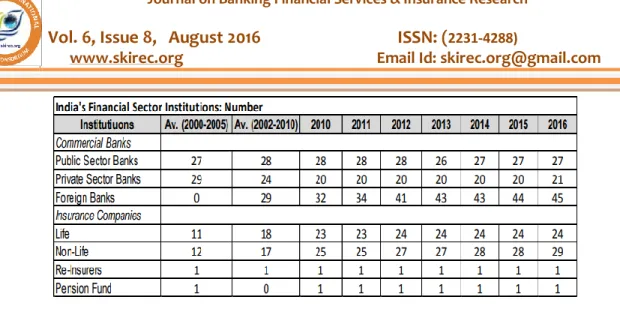
Commercial banks, engaged to make cash under the partial reserve system by lending, normally overwhelm the system; and this research, thusly, takes a gander at them all the more intently. In comparison, the non-banking financial institutions (NBFI) sector operates under three systematized classes of All-India Financial Institutions (AIFIs), Non-Banking Financial Companies (NBFC) and Stand-Alone essential merchants (PDs) are managed and directed by Reserve Bank of India (RBI). The NBFIs address the gap in credit financing not met by the scheduled commercial banks, for example, physical resource financing, framework loans and government securities showcase creators in essential and secondary market [2].

India's insurance sector is considered as one of the biggest on the planet in terms of populace

socioeconomics. The foundation of Insurance Regulatory and Development Authority Act

(1999) guaranteed the insurance showcase wound up competitive and expel the sole restraining

infrastructure delighted in by Life Insurance Corporation of India (LIC). Currently, LICI rules in

excess of seventy percent of the insurance showcase (Indian Brand Equity Foundation, 2017),

trailed by 24 life insurance companies, 28 general insurance companies and one re-back up plan

in the private sector. The growth effect of the commercial banks amid the 15-year time of study

is very much reflected in fast growth of deposits and credit dispensed. Their deposits expanded

from 41.3 percent in 1999-2000 to 69.5 percent of GDP in 2015-16; though the advances have

developed from 20.5 to 54.4 percent of GDP amid the corresponding time frame [3].

(3)

Table 1: India's Financial Sector Institutions

As of 2015, PSBs’ aggregate deposits stood at Rs. 65,025.01 billion (47.9 percent of GDP)

dominating 72.9 percent of market share. The PSBs hold Rs. 49,283.11 billion of total credit

(36.3 percent of GDP) with 71.6 percent of market share. The private sector banks’ aggregate

deposits amounted to Rs. 17,573.15 billion (12.9 percent of GDP) controlling 19.7 percent of

market share and holding Rs. 14,334.22 billion of total credit (10.6 percent of GDP) with 20.8

percent of market share, while; foreign banks’ deposits were Rs. 2,678.91 billion (2.9 percent of

GDP) with a narrow market share of 4.4 percent and total credit outstanding at Rs. 3,355.09

billion (2.5 percent of GDP), which amounted to 4.9 percent of market share. On the other hand,

regional rural banks, also in the public sector, held a limited market share of 3 percent of deposit

market constituting of Rs. 2,678.91 billion (2.0 percent of GDP) and with a modest credit share

of 2.6 percent or Rs. 1,812.31 billion (1.3 percent of GDP) [4].

(4)

Assets of commercial banks have grown from 50.9 percent in 2000 to 88.6 percent of GDP in 2015. The deposits growth reflected the increase in number of branches across the country. A total number of 125,672 branches were in operation in 2015, compared to 65,919 in 2000 increasing by 91 percent which indicates spread of banking operations across rural, semi-urban, urban and metropolitan centres in the country. The PSBs had 89,711 branches (68.8 percent); the private sector banks had 20,434 (15.7 percent); foreign banks had 332 (0.3 percent) and regional rural banks had 20,005 (15.3 percent) number of offices operation in 2015. However, the total number of banks (including regional rural banks) has decreased to 149 in 2015 compared to 296 in 2000 as failures led to liquidation and amalgamation of banks [5].

Figure 2: Commercial Banks: Deposits and Advances (Rs. Billions): 2000-2015 3. ECONOMIC GROWTH AND BANKING CREDIT IN INDIA

An inquiry into the significance of credit in an economy and the role it plays in driving growth

has been regularly sought after. The individuals who declare that credit impacts growth stretch

that the financial system, particularly banking, encourages proficient distribution of resources

from savers to borrowers with productive investment opportunity, in this way advancing

economic growth. Likewise, by giving financial intermediation, tolerating and conveying a lot of

public funds, and making cash supply, banks go about as an important channel of monetary

approach transmission. The development of economic exercises, nonetheless, may generate

credit and impact it. Several methodologies have so far been utilized to examine the relationship,

using an assortment of econometric systems to think about this complex relationship amongst

credit and economic growth.

(5)

Banks in India have generally been the principle wellspring of credit for different sectors of the economy, and their lending operations have advanced in light of necessities of the economy. In India, the savings rate has been in the scope of 30-35 percent and banks assemble such resources.

The financial savings, which can improve growth, is encouraged. The current plans of Financial Inclusion, for example, go for tapping savings of rural and suburban regions and converting unproductive physical savings into financial savings. Banking credit has likewise advanced after some time, with the rise of credit cards and securitization which positively affect credit growth.

The relationship between bank credit and economic growth has been a broad subject of exact research in both creating and under creating countries since the development of the advancement hypothesis [6].

4. BANKING SECTOR DEVELOPMENT AND ECONOMIC GROWTH IN DEVELOPING ECONOMIES

As of late the government of India has been making endeavours to encourage the development of rural banking through approach reforms. Lately, the structure of business and income generation in the Indian economy has experienced some important changes. India, which was prevalently an agrarian economy, is currently encountering a lift in its service sector. The current reforms in the banking sector say a different story, in any case. In spite of the fact that the provincial rural banks (RRB) began their operation since the foundation of the banking sector in India, it was just amid the latest banking sector reforms in India where the government made endeavours to encourage the extension of RRBs.

This change is gone for advancing rural development and development in the agrarian and united sector. We consider this as a fascinating blend of realities for a quickly developing emerging economy like India, which is the reason we discover the analysis of neighbourhood economic growth impacts of banking sector development in India as an important economic issue. In rundown, our fundamental inspiration is researching the two inquiries, which are [7]

(a) If the recent banking sector reform in India is aimed at promoting and expanding rural banking, what impact it is likely to have on the state level growth in per capita domestic product and its components?;

(b) Which dimension of banking sector development (demand side or supply side) has a significant marginal impact on state level growth in per capita domestic product and its components?

5. STATE DOMESTIC PRODUCT (SDP), ITS COMPONENTS AND GROWTH

For this study, mainly for data reasons (availability, continuity and completeness) we have

(6)

component of SDP, relatively more urban union territories such as Chandigarh and Delhi are not included in the total sample. The states Sikkim, Mizoram and Arunachal Pradesh are excluded because of partial unavailability and discontinuity of data. On an average over the period 1995- 2009, the states in the south region have the highest growth, although for the current period there is low growth in SDP in Tamil Nadu.

There is also a large drop in the SDP growth rates of Andhra Pradesh and Karnataka. There is significant progress in SDP growth in Uttar Pradesh (one of the largest states of India).

Improvement in SDP growth is also observed in Meghalaya, Bihar and Goa. States in the northern region show consistent growth performance. The economies of most of these states (e.g.

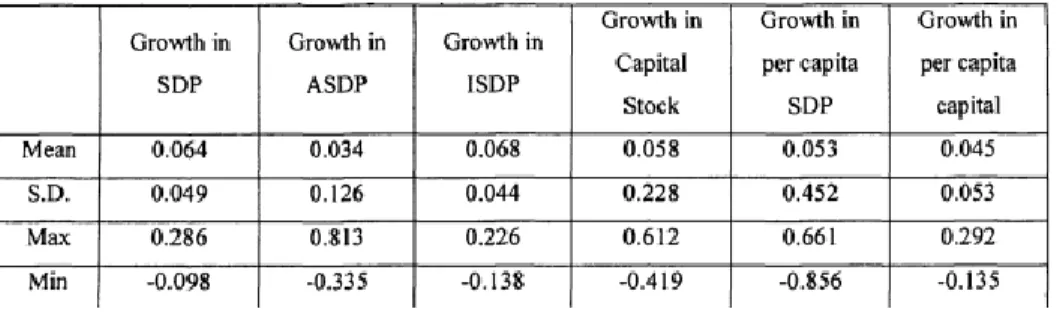
Haryana, Punjab) are primarily based on either industry or agriculture. The summary statistics for growth in SDP, growth in the agricultural component of SDP (ASDP), growth in the industrial component of SDP (ISDP), growth in capital stock, growth in per capita SDP and growth in per capita capital stock for the 26 states and UTs for the full sample period (1999- 2008).

These growth rates are computed using the SDP, ASDP, ISDP, Gross capital data (all in 2000 prices). The ASDP includes the gross state domestic product from all agricultural and allied activities, while the ISDP includes the gross state • o domestic product from all manufacturing and service activities. The data are collected from the National Data Warehouse of the Ministry of Statistics and Programme Implementation (MOSPI) of the Government of India [8].

Table 4: Summary Statistics of Real Growth Rates ofthe 26 States and Union Territories

Table 3.4 presents the cross sectional mean of SDP, mean of the agricultural component of SDP,

mean of the manufacturing component of SDP and mean of the service component of SDP, all in

2000 prices, for the full sample period 1999-2008 (the table are in INR. Crore, where 1 crore =10

millions). The trend in agricultural component of SDP and the manufacturing component of SDP

is relatively flatter over the period 1999-2008, while that of SDP shows sustained increase. This

is also evident in table 3.4. Compared to the average growth rate of SDP for 1995-2009, the

average growth rate of SDP for 2003-2009 is higher for all states in the sample except Nagaland

and Madhya Pradesh.

(7)

Table 3.4 presents the mean of the growth rate in real per capita SDP, the growth rate in real per capita ASDP, and the mean of the growth rate in real per capita ISDP for the 26 states and UTs of India for the sample period 1999-2008, where the values are in numbers. For the full sample period, there is considerable variation in the mean growth rate of per capita ASDP, while the mean growth rate of per capita ISDP almost mimics the mean growth rate of per capita SDP. The probable reason behind this correlation (of SDP growth and ISDP growth) is that a large proportion of ISDP growth is the growth in the service component of SDP. Following the liberalization of markets in the nineties, the service sector in India has grown rapidly both in terms of output and employment.

6. CONCLUSION

It is concluded that bank credit may invigorate the capital amassing and rate of saving that further instigate the economic growth. It is pertinent to say that the Banks should monitor Risk- Weighted Assets (RWA) while extending its credit activities. Something else, more risk capital will influence all that matters of Banking Sector and Banks will be demotivated. Conversely, economic growth may fuel credit development through its interest for additionally banking activities. In this background, the present examination explored the causal nexus between bank credit and economic growth for extensive board information of 21 Indian states (barring Northeast states) for the period of 2000-01 to 2014-15. Further, the investigators analysed the long run affiliation and a causal nexus between bank credit and economic growth through Kao's remaining based cointegration test and pairwise DumitrescuHurlin board causality test separately. Likewise, we additionally evaluated the impact of bank credit on economic growth utilizing Arellano-Bond (AB) GMM dynamic board estimation technique.

REFERENCES

[1]. IMF (2009). Global Financial Stability Report- Responding to the Financial Crisis and Measuring Systemic Risks’, World Economic and Financial Surveys, International Monetary Fund, Washington DC, April 2009.

[2]. Allan, F., and Gale, R., (2007). Understanding Financial Crisis, Oxford University Press, Oxford, United Kingdom.

[3]. Sprayregen, J., Friedland, J., Miller, N., and Li, C., (2004). Non-performing loans in China: a potential win-win opportunity for foreign investors and China’s economy, Global Restructuring & Insolvency Review, pp. 38-9.

[4]. Ernst & Young (2001). Non-Performing Loan Report: Asia 2002, Ernst & Young, New York.

[5]. Barseghyan, L., (2004). Non-performing Loans, Prospective Bailouts, and Japan’s Slowdown, Cornell University, New York, NY, USA.

[6]. Kang, Moon-Soo (2001). Financial Restructuring in Korea, Korea Development

(8)

[7]. Bhattacharya, H., (2001). Banking Strategy, Credit Appraisal & Lending Decisions, Oxford University Press, New Delhi.

[8]. Das A., and Ghosh S., (2003). Determinants of Credit Risk, Paper presented at the

Conference on Money, Role and Investment held at Nottingham Treat University in

Nov 2003.

Figure

Figure 1: Bank specifics and Macroeconomic Factors  2. INDIA’S FINANCIAL SECTOR AND COMMERCIAL BANKS
Table 1: India's Financial Sector Institutions
Figure 2: Commercial Banks: Deposits and Advances (Rs. Billions): 2000-2015  3. ECONOMIC GROWTH AND BANKING CREDIT IN INDIA
Table 4: Summary Statistics of Real Growth Rates ofthe 26 States and Union Territories   Table 3.4 presents the cross sectional mean of SDP, mean of the agricultural component of SDP,  mean of the manufacturing component of SDP and mean of the service comp

References

Related documents

The objective of this paper is to study and estimate origin-destination (O-D) city-pair passenger air traffic based on DGCA (Director General of Civil Aviation) airport statistics

Because binary masking is conservative (any invalid constituent fine pixel results in an invalid coarse pixel) it is guaranteed that the correlation is based on only data known to

Positions held: Argonne National Laboratory: resident student associate, 1973; research associate, 1974; assistant computer scientist 1975–1980; senior computer scientist 1980–

– Primary Latch Reinforcement (PLR) feature (optional) ensures no accidental terminal back- out of crimped contacts during vibrations of up to 10G – MX150 CE TM connectors accept

This elite 2 + 2 programme offers H.I.T.’s high achieving students the opportunity to obtain the BEng (Hons) Mechanical Engineering degree from the University of Bath, UK.. After

Eight morpho-anatomical properties of two-year-old needles of Pinus heldreichii (Bosnian pine) from the Scardo-Pindic mountain massif in Serbia (Kosovo, Mt. Ošljak)

18 Experience and Team Building 0.35 Positive relationship 19 Experience and Loyalty 0.67 StrongPositive. relationship 20 Experience and

The differently processed soybean had higher crude protein content than the control diet (38%CP) with sprouted soybean (42.00%) having the highest value, this reaffirmed the