ISSN Online: 2333-9721 ISSN Print: 2333-9705
DOI: 10.4236/oalib.1105334 Oct. 23, 2019 1 Open Access Library Journal
Assessing DASS-42 Models among
Polytechnic Staff
A. A. Adetunji
*, J. A. Ademuyiwa
Department of Statistics, Federal Polytechnic, Ile-Oluji, Nigeria
Abstract
The DASS-42 is examined among randomly selected staff of the Federal Po-lytechnic, Ile-Oluji, Nigeria with each respondent (based on their experience in the last one week) choosing between each score (0, 1, 2, 3) for depression, anxiety and stress. Results revealed that junior administrative staff are the most depressed, most stressed and most anxious; senior administrative staff are the least stressed and least anxious while academic staff are the least de-pressed. Results also show that there is a significant difference in the depres-sions and anxiety levels of staff in the various categories while the disparities observed in the stress level are not significant. Staff with lowest educational qualification are ranked first in depressions, anxiety and stress level. There is no significant difference between genders, although male staff are marginally more depressed and stressed than female staff while female staff are more an-xious than male staff. Results also reveal that depressions, anxiety and stress decrease as age increases; this may be due to satisfaction deriving in life as one gets older and the need to accept fate as one experiences more about life.
Subject Areas
Sociology
Keywords
Anxiety, DASS-42, Depression, Scale, Stress, Polytechnic, Staff
1. Introduction
Anxiety and depression are psychiatric disorders that usually affect about 1 in every 15 people each year world over and about 13% of people during a lifetime
[1]. Depression among many other mental disorders is ranked among first 20 leading causes of disability worldwide and around one-fifth of children across How to cite this paper: Adetunji, A.A. and
Ademuyiwa, J.A. (2019) Assessing DASS-42 Models among Polytechnic Staff. Open Access Library Journal, 6: e5334.
https://doi.org/10.4236/oalib.1105334
Received: March 13, 2019 Accepted: October 20, 2019 Published: October 23, 2019
Copyright © 2019 by author(s) and Open Access Library Inc.
This work is licensed under the Creative Commons Attribution International License (CC BY 4.0).
DOI: 10.4236/oalib.1105334 2 Open Access Library Journal the world suffer from one form of mental disorder or another [2]. Many authors have defined stress various ways; with all the definition expressing different views and understanding based on individual perception of the events, or condi-tion causing the stress. According to [3] events and circumstances must be in-terpreted as threat to the wellbeing of an individual before stress manifest; they defined stress as “a process involving a person’s interpretation and response to threatening events and circumstances”. Hence, stress is appropriately related to events and conditions that are interpreted by individuals as producers of dis-comforts which affect the attainment of their stated objectives, duties and re-sponsibilities. Also, [4] sees stress as “a form of hardship, strain, adversity or af-fliction characterized by force and pressure on person’s organ or mental pow-ers”. This presupposes that an event which is hard to execute and which also ex-erts much pressure on an individual is stressful.
The tripartite of stress, anxiety and depression are the number one diagnosed psychology disorder in working people [5] [6]. These disorders may ultimately incapacitate the affected populace in discharging expected responsibilities.
Job stress is the harmful physical and emotional responses that occur when the requirements of the job do not match the capabilities, resources, or needs of the worker. When an individual is stressed out, the body responds by raising the concentration of stress hormones in the blood and when the body continues to respond to constant demands or threats, coping mechanisms stay in overdrive, which can be damaging to health over time. Excessive job stress can lead to many long-term health problems, including cardiovascular disease, diabetes, weakened immune function, high blood pressure, musculoskeletal disorders, substance abuse, depression and anxiety.
Stressful working conditions can impact health indirectly by limiting the abil-ity or motivation to participate in other health promoting behaviors such as eat-ing well and exerciseat-ing [7]. Stress at job varies based on the job set-up and re-sponsibilities of the workers, usually; people at the lower level of management in official settings tend to be more stress physically while the mental stress is usually felt by those at the upper management position.
Work-related stress causes negative emotional state which can lead to both physical and mental illness if it persists. On the basis on gender, age, type of or-ganization and other socio-demographic variables, the amount of anxiety can differ from an individual to the other [8]. When exposed to the same conditions,
[9] revealed that females are more likely to report symptomology associated with fatigue, pain, digestive problems and several psychomotor agitations and confu-sions compared to their male counterparts. Also, [10] [11] reported a significant difference between female and male police officers with female officers having higher level of depression, anxiety, and stress. Other researchers [12] [13] [14]
have shown that women are more anxious and suffer more stress than men when exposed to the same conditions.
DOI: 10.4236/oalib.1105334 3 Open Access Library Journal had been assessed along with various variables, there no reported literature as-sessing differences among classes of workforce in higher institution. Among these three categories of workers, it is assumed that physical stress will be felt more among junior staff while senior staff are expected to suffer more metal stress.
Depression, anxiety and stress have been opined to progress as one gets older. Older workers in Britain have consistently shown unwillingness to remain in la-bour force [15] largely due to associated old-age illness.
Ideally, a stress free working condition for staff of any organization is a “sine qua non” for an improved job performance on the job. This is because such conditions are characterized by availability of job resources capable of fulfilling the basic human needs for psychological competence that in-turn enhances the overall wellbeing and increased motivation. To this end, job re-sources, namely: institutional support (including relationship with superiors, role clarity, information, communication and participation); growth oppor-tunities (including variety, opportunity to learn and autonomy); social support and advancement are positively related to a free stress working condition for staff. This study is aimed at gaining an accurate and subjective assessment of the severity of depression, anxiety, and/or stress levels among polytechnic staff using the depression, anxiety, and stress scale (DASS 42) along with some so-cio-demographic variables (Sex, Educational qualifications, Unit, and Age). The output of the research is expected to help management to appropriately develop and assist in resolving depressive, anxiety, and/or stress-related symp-toms among the staff.
2. Materials and Methodology
In this paper, the DASS-42 is examined among randomly selected staff of the Federal Polytechnic, Ile-Oluji, Nigeria with each respondent (based on their ex-perience in the last one week) choosing between each score (0, 1, 2, 3) for de-pression, anxiety and stress. The respondents include 126 males and 74 females staff with age distribution (20 - 29 years = 34, 30 - 39 years = 113, 40 - 49 years = 40, and 50 years and above = 13). 47 of them are Academic staff, 113 are Senior Administrative staff while 40 are junior administrative staff.
Measures
The depression anxiety stress scales (DASS) is a respondent self-reporting tool for assessing severity of the negative emotional states of depression, anxiety, or stress symptoms [16]. The scale from the creation of two subscales is designed by
[17] to measure depression and anxiety. The original items were uniquely de-signed to differentiate between symptoms of anxiety and depression, where items that are not related to neither depression nor anxiety were used as control
DOI: 10.4236/oalib.1105334 4 Open Access Library Journal DASS is a measuring tool (not a diagnosing tool) and it is developed not to serve as a comprehensive bio-psychosocial assessment instrument. The depression subscale appraises hopelessness, life devaluation, lack of involvement/interest, self-deprecation and inactiveness while the stress subscale scale measures relax-ing difficulty, easiness of upsettrelax-ing, levels of inveterate non-specific stimulation and impatient. The anxiety subscale evaluates situational anxiety, arousal, effects of skeletal muscle, and immanent experience.
The instrument generally assesses for depression, anxiety, and stress with the use of a subscale for each of the three categories, each containing 14 items. On each subscale, the DASS score ranges from 0 - 42 and the total score is obtained by summing the scores for each subscale.
The items for each subscale and the standard indications for interpretations are given in Table 1.
Items on the depression subscale are 3, 5, 10, 13, 16, 17, 21, 24, 26, 31, 34, 37, 38, and 42. The anxiety subscale has items 2, 4, 7, 9, 15, 19, 20, 23, 25, 28, 30, 36, 40, and 41 while the stress subscale has items 1, 6, 8, 11, 12, 14, 18, 22, 27, 29, 32, 33, 35, and 39.
[16] reported that people with at least moderate depression are at increased risk for suicide and require immediate referral to a mental health professional for prompt assessment and treatment.
The DASS provides information on respondent’s report on low mood, self-esteem, irritability, panic, motivation, and fear [16]. Based on the score ob-tained from DASS assessment, respondents with signs and symptoms of depres-sion may be referred to further psychometric evaluation.
Total score for each subscale is obtained for all the respondents and the scores obtained were analyzed using the IBM Statistical Package for Social Sciences (version 23). At 5% significant level, t-test is applied to measure the differences in the levels of depression, anxiety and stress between female and male staff while ANOVA was used to test or significant difference among staff in the dif-ferent 1) Units (Academic, Senior and Junior Administrative); 2) Educational level and 3) Age group.
3. Results
Reliability
DOI: 10.4236/oalib.1105334 5 Open Access Library Journal Table 1. DASS indicators.
Normal Mild Moderate Severe Very Severe Depression 0 - 9 10 - 13 14 - 20 21 - 27 ≥28
Anxiety 0 - 7 8 - 9 10 - 14 15 - 19 ≥20
Stress 0 - 14 15 - 18 19 - 25 26 - 33 ≥34
[image:5.595.210.537.202.426.2]Source: [17].
Table 2. Descriptive statistics and ANOVA values of DASS among the units.
Mean Standard Std. Dev. F-critical P-value
Depressions Sum
Academic 7.02 Normal 6.595
5.773 0.004 Senior Admin 7.76 Normal 7.561
Junior Admin 11.98 Mild 8.207 Total 8.43 Normal 7.660
Anxiety Sum
Academic 8.38 Mild 6.964
4.372 0.014 Senior Admin 7.53 Mild 6.684
Junior Admin 11.23 Moderate 6.900
Total 8.47 Mild 6.908
Stress Sum
Academic 10.40 Normal 7.450
2.257 0.079 Senior Admin 9.37 Normal 7.338
Junior Admin 12.40 Normal 6.964 Total 10.22 Normal 7.349 Source: [17].
With the average score of 7.53 and 9.37, Table 3 reveals that the senior ad-ministrative staff are the least anxious and stressed respectively while the aca-demic staff are the least depressed. Junior administrative staff are consistently most depressed, anxious and stressed, though the levels are not severe.
While there is no significant difference in the stress level of staff in the various categories, both depressions and anxiety levels are significantly difference. Using Tukey’s HSD Post Hoc test for homogeneous subsets, it is revealed that both Academic and Senior administrative staff have no significant difference in the depressions and anxiety levels.
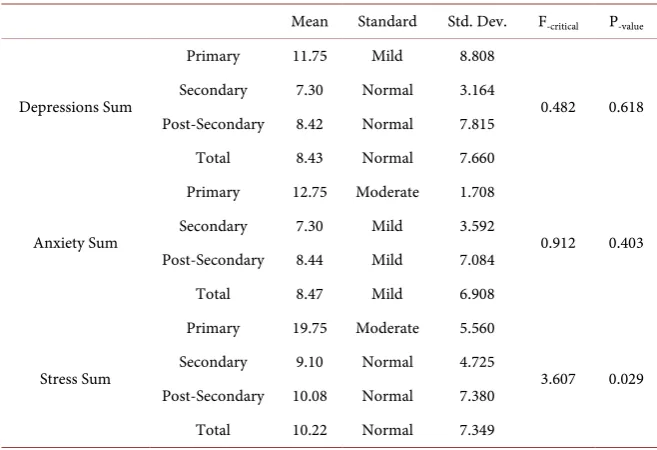
Though, depressions, anxiety and stress level is highest for staff with only primary education, there is no significant difference for depression and anxiety among various educational qualifications. There is however a significant differ-ence in the stress level of the staff with post hoc test revealing differdiffer-ence in the stress level of staff with only Primary school education and staff with other qua-lifications.
DOI: 10.4236/oalib.1105334 6 Open Access Library Journal Table 3. Descriptive statistics and ANOVA of DASS for different educational qualifica-tions.
Mean Standard Std. Dev. F-critical P-value
Depressions Sum
Primary 11.75 Mild 8.808
0.482 0.618 Secondary 7.30 Normal 3.164
Post-Secondary 8.42 Normal 7.815 Total 8.43 Normal 7.660
Anxiety Sum
Primary 12.75 Moderate 1.708
0.912 0.403 Secondary 7.30 Mild 3.592
Post-Secondary 8.44 Mild 7.084
Total 8.47 Mild 6.908
Stress Sum
Primary 19.75 Moderate 5.560
3.607 0.029 Secondary 9.10 Normal 4.725
[image:6.595.213.538.356.526.2]Post-Secondary 10.08 Normal 7.380 Total 10.22 Normal 7.349
Table 4. Descriptive statistics and t-test values of DASS for genders.
Mean Standard Std. Dev. t-critical P-value
Depressions Sum
Male 8.67 Normal 7.921
0.569 0.570 Female 8.03 Normal 7.230
Total 8.43 Normal 7.660
Anxiety Sum
Male 8.82 Mild 7.292
0.928 0.355 Female 7.88 Mild 6.202
Total 8.47 Mild 6.908
Stress Sum
Male 10.41 Normal 7.757
0.483 0.630 Female 9.89 Normal 6.636
Total 10.22 Normal 7.349
gender and age, the result opposes views of police samples [10] [11] [23] [24]
where female officers are reported to suffer higher level of stress, anxiety and depression in comparison with their male counterparts. Assessing stress among university workers, [25] also found that male teachers stress in comparison to the opposite gender. In support of the finding by [26], independent sample t-test however shows that there is no significant difference in the three subscales (de-pression, anxiety and stress) between male and female staff.
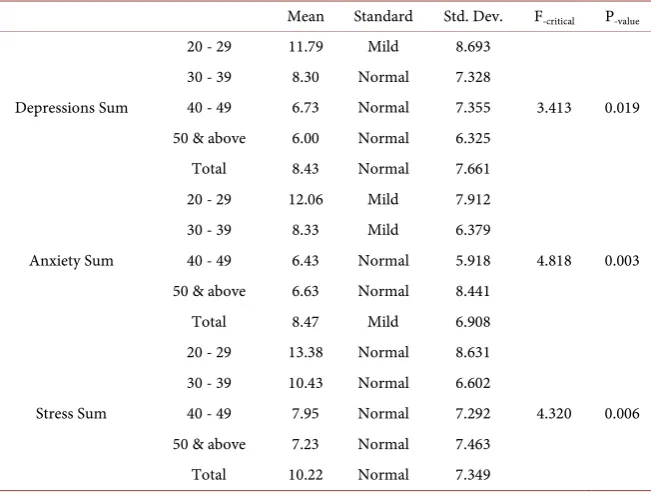
DOI: 10.4236/oalib.1105334 7 Open Access Library Journal Table 5. Descriptive statistics and ANOVA values of DASS for different age groups.
Mean Standard Std. Dev. F-critical P-value
Depressions Sum
20 - 29 11.79 Mild 8.693
3.413 0.019 30 - 39 8.30 Normal 7.328
40 - 49 6.73 Normal 7.355 50 & above 6.00 Normal 6.325 Total 8.43 Normal 7.661
Anxiety Sum
20 - 29 12.06 Mild 7.912
4.818 0.003 30 - 39 8.33 Mild 6.379
40 - 49 6.43 Normal 5.918 50 & above 6.63 Normal 8.441
Total 8.47 Mild 6.908
Stress Sum
20 - 29 13.38 Normal 8.631
4.320 0.006 30 - 39 10.43 Normal 6.602
40 - 49 7.95 Normal 7.292 50 & above 7.23 Normal 7.463 Total 10.22 Normal 7.349
4. Conclusions
A stress-free working condition for the staff of any organization is a “sine qua non” for an improved job performance which will lead to a better productivity. Consequently, from the analysis and interpretation of the collected data, results revealed that junior administrative staff are the most depressed, most stressed and most anxious when compared with other categories of staff working in the polytechnic. Senior administrative staff are the least stressed and least anxious while academic staff are the least depressed.
Results also show that there is a significant difference in the depressions and anxiety levels of staff in the various categories while the disparities observed in the stress level are not significant.
Staff with lowest educational qualification are ranked first in depressions, an-xiety and stress level, though the difference is not statistically significant for de-pression and anxiety, there is a significant difference in the stress level of the staff with post hoc test revealing difference in the stress level of staff with only Primary school education and staff with other qualifications.
Although, there is no significant difference between genders, male staff are marginally more depressed and stressed than female staff while female staff are more anxious than male staff.
Results also reveal that depressions, anxiety and stress decrease as age in-creases; this may be due to satisfaction derive in life as one gets older and the need to accept fate as one experiences more about life.
Conflicts of Interest
DOI: 10.4236/oalib.1105334 8 Open Access Library Journal
References
[1] Steel, Z., Marnane, C., Iranpour, C., Chey, T., Jackson, J.W., Patel, V. and Silove, D. (2014) The Global Prevalence of Common Mental Disorders: A Systematic Review and Meta-Analysis 1980-2013. International Journal of Epidemiology, 43, 476-493.
https://doi.org/10.1093/ije/dyu038
[2] World Health Organisation (2008) The Global Burden of Disease 2004 Update. [3] Aureback, S. and Gramling, K. (2009) Psychology, Encarta Encyclopedia. Microsoft
Corporation, New York.
[4] Cooper, C. and Marshall, J. (2007) The Experience of Work Related Stress across Occupation. Journal of Managerial Psychology,20, 56-82.
[5] Brown, T., Chorpita, B., Korotitsch, W. and Barlow, D. (1997) Psychometric Prop-erties of the Depression Anxiety Stress Scales (DASS) in Clinical Samples. Behavior Research and Therapy, 35, 79-89. https://doi.org/10.1016/S0005-7967(96)00068-X
[6] Farmer, R. (1998) Depressive Symptoms as a Function of Trait Anxiety and Impul-sivity. Journal of Clinical Psychology, 54, 129-135.
https://doi.org/10.1002/(SICI)1097-4679(199802)54:2<129::AID-JCLP1>3.0.CO;2-N
[7] World Health Organisation (2014) Mental Disorders.
[8] Morteza, A. and Morteza, S.P.V. (2014) International Conference on Current Trends in ELT an Investigation of Teaching Anxiety among Novice and Experienced Ira-nian EFL Teachers across Gender.
[9] Bitsika, V., Sharpley, C.F. and Melhem, T.C. (2010) Gender Differences in Factor Scores of Anxiety and Depression among Australian University Students: Implica-tions for Counselling IntervenImplica-tions. Canadian Journal of Counselling,44, 51-64. [10] Husain, W., Sajjad, R. and Rehman, A. (2014) Depression, Anxiety and Stress
among Female and Male Police Officers. Pakistan Journal of Clinical Psychology, 13, 3-14.
[11] He, N., Zhao, J. and Ren, L. (2005) Do Race and Gender Matter in Police Stress? A Preliminary Assessment of the Interactive Effects. Journal of Criminal Justice, 33, 535-547. https://doi.org/10.1016/j.jcrimjus.2005.08.003
[12] Matud, M.P. (2004) Gender Differences in Stress and Coping Styles. Personality and Individual Differences, 37, 1401-1415. https://doi.org/10.1016/j.paid.2004.01.010
[13] Baruch, G.K., Biener, L. and Barnett, R.C. (1987) Women and Gender in Research on Work and Family Stress. American Psychologist, 42, 130-136.
https://doi.org/10.1037/0003-066X.42.2.130
[14] Mirowsky, J. and Ross, C.E. (1995) Sex Differences in Distress: Real or Artifact? American Sociological Review, 60, 449-468. https://doi.org/10.2307/2096424
[15] Griffiths, A., Knight, A. and Mahudin, A.M. (2009) Ageing, Work-Related Stress and Health: Reviewing the Evidence. A Report for Age Concern and Help the Aged and TAEN (The Age and Employment Network).
[16] Gale, L. (2015) Anxiety and Depression Assessment: Using the Depression Anxiety Stress Scales, Cinahl Information Systems, a Division of EBSCO Information Ser-vices.
[17] Lovibond, S.H. and Lovibond, P.F. (1995) Manual for the Depression Anxiety and Stress Scale. Second Edition, Psychology Foundation, Sydney.
DOI: 10.4236/oalib.1105334 9 Open Access Library Journal
https://doi.org/10.1348/014466503321903544
[19] Cronbach, L.J. (1951) Coefficient Alpha and the Internal Structure of Tests. Psy-chometrika, 16, 297-334. https://doi.org/10.1007/BF02310555
[20] Sijtsma, K. (2008) On the Use, the Misuse, and the Very Limited Usefulness of Cronbach’s Alpha. Psychometrika, 74, 107-120.
https://doi.org/10.1007/s11336-008-9101-0
[21] McDonald, R.P. (1999) Test Theory: A Unified Treatment. Erlbaum, Hillsdale. [22] Revelle, W. (2008) Psych: Procedures for Personality and Psychological Research (R
Package Version 1.0-51).
[23] Daniela, V. (2011) Stress and Job Satisfaction among University Teachers. Interna-tional Conference of Scientific Paper AFASES, Brasov, 26-28 May 2011, 320-325. [24] Violanti, J.M., Desta, F., Luenda, E., Charles, M.E., Andrew, T.A., Anna, M. and
Ce-cil, M. (2008) Suicide in Police Work: Exploring Potential Contributing Influences. American Journal of Criminal Justice, 34, 41-53.
https://doi.org/10.1007/s12103-008-9049-8
[25] Varda, P. and Akhtar, S. (1989) A Study of Extra Organizational Stress. National Seminar on Anxiety, Stress and Depression in Modern Life, Patiala, November 1989. [26] Putter, L. (2003) Stress Factors among Teachers in Schools of Industry.
Unpub-lished M.A. Thesis, University of Zululand, Zululand.