1
Managing learning trajectories: the case of mathematics
Abstract
In this paper we explore how mathematics department leaders manage curriculum (what is taught), teaching (how it is taught) and learner progression (what results) for 14-19 year olds. The background to the study is a range of national, and international, concerns about participation rates in university entrance level mathematics. Given the recommendation of the Smith Report (2004) that new pathways models be
developed for 14-19 mathematics, this paper explores some of the strategies employed, and issues faced, by schools as they seek to maximise attainment and participation in mathematics. Following a thematic
analysis of data from interviews with heads of department in fifteen schools we look in more depth at one school to see how it manages the mathematics learning trajectories of young people. The theme of performativity is all pervasive.
Key Words
Mathematics, pathways, 14-19, performativity
Introduction
In 2004 the Smith Report on post-14 mathematics education recommended that the Qualifications and Curriculum Authority (QCA ) should oversee the remodelling of mathematics learning pathways through 14-19 education. The report was predicated upon a concern that the supply of STEM (science, technology, engineering and mathematics) academics, professionals and technicians should be maintained and increased in order to assure the nation’s future economic prosperity. This concern has been expressed more generally in the UK (Roberts, 2002), Europe (Gago, 2004) and elsewhere in the developed world (e.g. in the US, National Academies, 2007). This was one of a wide ranging set of recommendations on 14-19 mathematics education made in the Smith Report, several of which have led to significant changes in schools since 2004. In recent years there has been an upturn in take up of advanced level mathematics which, although
welcomed by policymakers and interest groups, is not well understood.
One of the shortcomings of any such report on a single curriculum area is that it fails to take into account how the wider educational landscape (Noyes, 2004) influences any single curriculum or assessment initiative. The team evaluating the QCA’s Mathematics Pathways project have noted that the strongly performative culture of schooling tends to interact with both existing and pilot mathematics qualifications in unintended ways (Noyes, Murphy, Wake, & Drake, 2008). This can mean that implemented changes have a quite different effect from that which they were intended to achieve. This is something that some
stakeholders have not always fully appreciated.
2
routes . The report sets out the hope for “a highly flexible set of interlinking pathways that provide motivation, challenge and worthwhile attainment across the whole spectrum of abilities and motivations” (p. 8) although it is unclear whether the structural constraints of the education system in England make this impossible to achieve, in reality. A particular challenge is the transition for all students at age 16. Students might remain in the same school (as in all of the schools involved in this study) but need to manage the shift to post-compulsory education, negotiate a bewildering set of choices and contribute, willingly or under protest, to maximising school results. This transition gateway is a boundary crossing where different students travel into different educational sites with new rules, cultures and histories (e.g. A levels, Diplomas). So what is critical in the pathways are such gateways which allow or deny passage to these futures. The vision of “highly flexible” and “interlinking” pathways remains unrealised. However, if the metaphor were allowed to do its generative work (Schön, 1993) by leading to clear thinking about the pathway experiences, there is a possibility for developing new ways of thinking about learner trajectories through 14-19 mathematics education. Having said that it is still limited by the root metaphor (Lakoff, 1993) of movement (Noyes, 2006; Parks, 2010). This metaphor has similarities to the ‘pipeline’ metaphor – popular in the US (e.g. Jacobs & Simpkins, 2006) – used for describing the supply of suitably qualified STEM graduates and technicians.
Smith’s recommendation assumes that there is not a range of appropriate pathways already in existence. However, our research shows that schools have for some time been developing their own pathways for learners of mathematics, and would no doubt continue to do so even if there were new officially mandated curriculum pathways in place. These existing pathways are arguably more complex than those envisaged by Smith, but what schools are doing is employing a range of qualifications, organisation structures and curriculum designs to make the best of what is currently available to them, all framed by the pressure to perform. What we want to do in this paper is to explore these existing learner pathways that schools have developed to meet the intertwined challenges of a) meeting the needs of learners whilst b) seeking to maximise their performance in high stakes public examinations. Admittedly, the learning pathways in these schools are not that different in terms of the qualifications offered. However there are small but significant differences in the organisation of curriculum and recruitment to advanced level mathematics. The place and power of the so called ‘league table’ in this performative work is now well documented (Brown, 1998; Goldstein & Woodhouse, 2000; Leckie & Goldstein, 2009) and the culture of management by numbers (Ozga, 2009) is deeply embedded in school culture and teacher identity. Ball’s (2001, 2003) analysis of how the neo-liberal technologies of markets, managerialism and performativity frame current educational practice is particularly pertinent as we shall show in our analysis.
In England, young people complete their compuslory schooling at age 16 (Year 11) with the General
3
might complete only half of one of these two-year, modular A level courses and receive an Advanced Supplementary (AS) award. Advanced level Mathematics is a prerequisite for most Science, Technology, Engineering and Mathematics (STEM) courses in higher education and has been shown to increase future earning potential (Wolf, 2002).
We proceed here by considering a few key issues reported by heads of department in relation to mathematical attainment and participation and will then proceed to consider one school in more detail: Breston Meadow. This particular school is interesting because of the advanced state of development of its pathway model and also because of the clear rationale articulated by the head of department. Although all of the participating schools are unique in many ways, Breston Meadow is typical in that the staff are working hard to make the most of the situation given the particular catchment, resources available and
internal/external expectations and pressures.
The Study
The data used herein was collected in 2008 through semi-structured interviews with mathematics
department leaders in fifteen 11-18, state-funded, co-educational comprehensive schools in the Midlands of England, as part of a multi-scale/mixed- method ESRC-funded study of attainment and participation in post-14 mathematics. The larger study integrated three levels of data collection and analysis. Descriptive statistical analysis and multilevel modelling was conducted using data from the National Pupil Database. This enabled us to make some general statements regarding patterns in learner performance and progression as well as quantify some differences in learner progress made in schools across the region (Noyes, 2009a). We were then able to identify sixteen different 11-18 schools for further investigation (one of these withdrew prior to the interview stage). These represented different school types and we surveyed students in years 7, 11 and 12 as well as the teachers of mathematics in order to explore school and
classroom cultures, attitudes to mathematics, future aspirations, etc. Both of the above processes indicated some important differences between schools (Noyes, 2009b; Noyes & Sealey, 2010). The following
interviews with teachers and subsequent tracking of small groups of students in eight of the sixteen schools enabled us to explore more closely the kinds of processes and structures that might contribute to any differences between the schools. The interviews were transcribed and, together with the other qualitative data, incorporated into an Nvivo database where they were coded using an initial, partial coding framework which was further developed through iterations of data analysis. The broad context for the interviews was to explore patterns and trends in both the performance and participation of students in mathematics.
School School Type Ability
grouping
A level entry requirement
% achieving 5 or more A*-C grades including English and Maths Addlington* Village, largely white
British,
1-4, 1-4 C 70
Breston Meadow* Suburban comp, ethnically diverse
4 catchment
Chattingham Suburban comp, ethnically diverse
1-4,1-4 B 45
Deneswood Suburban, ethnically diverse
1-5,1-4 B (prefer A) 75
Edward Taylor Medium town,
Voluntary aided, white British
1-4,1-4 B (and teacher recommendation)
70
Florence Boot Small town, ex-mining, white British
1-4, 1-4 C (prefer B) 40
George Green* Small town, agricultural, white British
1-5,1-5 B 65
Harbury Vale Suburban, white British
1-5, 1-5 B (with interview) 75
Jack Linton Small town, industrial, white British,
1-4, 1-4 B 45
Kelsley Court Commuter village, predominantly white British
1-4, 1-4 C (normally B, prefer A)
70
Larkstone Village, ex-mining, white British
1-3, 1-4 C 45
Moorsway Village, white British 1-4, 1-4 C 40
Nelson High City, voluntary aided, ethnically diverse
1-3, 1-3 B 60
Queensbury Park* Suburban, ethnically diverse
1-4, 1-4 B 50
Rempstone Rural, ex-mining, white British
[image:4.595.54.511.70.493.2]1-6, 1-6 B 45
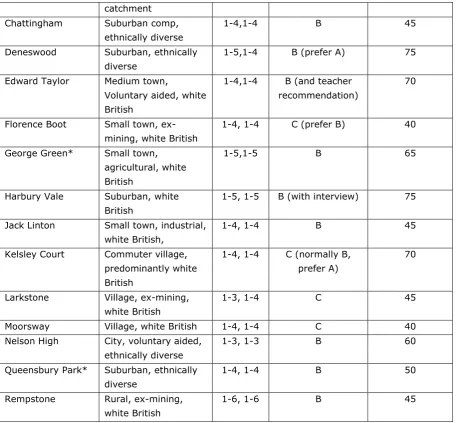
Table 1: overview of the fifteen 11-18 schools [NB. All schools are co-educational and have a broadly comprehensive intake. The figures in the final column are to the nearest 5% and from summer 2008, the year of the interviews.]
The schools served a range of communities (see Table 1), some very localised and homogenous and others dispersed, but being 11-18 schools, most were not in the most disadvantaged areas of the region and this is reflected in the generally high levels of attainment in the schools. Breston Meadow has all of the GCSE classes in a single ‘ability group’ hierarchy but the remainder of the schools have mathematics classes grouped by ability in two half-year groups (e.g. 1-4, 1-4 denotes sets 1-4 in each half year group)
5
learners. The following sections focus on a number of key themes that emerge from the analysis: choosing GCSE specifications, A level recruitment and curriculum, transition at age 16 and the notion of ‘mathematics as different’ ). Following this we consider Breston Meadow in greater detail.
Choosing specifications
When students begin their GCSE study there are a number of different possible course specifications that they might be following. The simplest division is between unitised (modular) and linear specifications. Four of the heads of department (marked with an * in Table 1) referred to the introduction of new modular qualifications as a catalyst for greater learner self-confidence, improved progress and increased likelihood of future participation in mathematics beyond 16. For example at Addlington School:
With the modular, that was instrumental in getting more success at Key Stage 4 [i.e. GCSE, aged 16] and then because the pupils felt good about what they had achieved at KS4 they wanted to take it further. ... I think because they know how well they are doing from the outset.
(Addlington)
This school’s original motivation was to increase attainment at age 16 but there seems to have been a positive side effect: increased post-16 participation. Many other modularised subjects allow students to get high grades on limited content early in the two year Key Stage 4 period. The traditional hierarchical, linear view of mathematical knowledge suggests that students can only reach the highest levels at the end of the Key Stage aged 16. Those departments using modular courses acknowledged the power of students achieving the highest grades early in their course. The regular, high stakes module examinations help to ‘keep them motivated’, or perhaps this might be understood more as keeping up the pressure. In contrast there are those that think a linear specification offers better preparation for further study:
I’ve taught both (linear and modular) and I think the kids are better and ready more for A level if you’ve done a linear because … you can make more connections I think and they can see things connecting more. (Rempstone)
This tension between the performativity of increasing grades at GCSE (using modular specification) and a more connected preparation for further mathematical study (using linear specification) is repeated in kind elsewhere in these interviews. The irony is that the modular course, with its apparent increases in
6
below) so complement the curriculum with GCSE Statistics or one of a range of available Free Standing Mathematics Qualifications which act as a bridge form GCSE to A level mathematics.
Making the gradefor entry to A level
Several of the heads of department acknowledge that the increased success in GCSE mathematics, relative to other subjects, is one of the main factors driving increased uptake. This supports results from modelling of student data (Noyes, 2009b) which show that students’ performance in mathematics, relative to other GCSE subjects, is a significant predictor of the likelihood of further participation in mathematics. Heads of
department talk competitively about student attainment and performativity as much within as between schools;they are competing for post-16 student numbers with other departments in the school. Increasing attainment at the top end of the GCSE range is critical as more students can hit the threshold for entry to A level mathematics. The schools are split between a GCSE B and C grade being a minimum requirement for entry to A level (see Table 1), although there is sometimes a difference between the published school and department policies and what they would ideally like.
We would like them to have an A or A*. We do take anyone with a higher C now, but we don’t get many Cs, just Bs, As and A*s. (Kelsley Court)
This is also illustrated by the head of mathematics at Edward Taylor school where they expect a grade B: But we said it’s not just that, it is with the teacher’s advice as well. Because you know there are children that get grade Bs that wouldn’t cope with A level. And the little worriers - I advise them not to do it because I know they’ll worry from day one. Whereas you have those students that have got a B but it should have been an A and you know they can cope with A level. So it is teacher advice as well. (Edward Taylor)
There is considerable room for subjective judgement here and we are not really able to say how this notion of ‘worrying’ is recognised, whether it is at all valid and the extent to which it is a strategy for filtering out the perceived ‘weak’ student. Matthews and Pepper’s (2007)analysis of the attainment profile across A level subjects makes it clear that schools filter out the lower attaining students to leave a heavily skewed ‘clever core’ of student completing A level mathematics (see also Mendick, 2008).
There is a general feeling across these schools that the ability range of AS mathematics groups has widened, perhaps due to the increased success at GCSE: with better test preparation students who would not have made the grade are now admitted. There are quite different views on whether C grade students should be allowed entry:
I’m adamant and I have to dig my heels in sometimes, taking kids that got a C…in the past I’ve seen probably only two or three kids be very successful. And I feel duty bound to give them the opportunity. (Larkstone)
7
Entry to advanced level mathematics courses, particularly for those in a school’s admissions grey area, is often managed through a careful interview process. For example at George Green:
I think the reason we don’t have a massive fall out rate is we interview students to go into the 6th form [i.e. years 12/13, age 16-18] in this school at this stage of the year…We also interview them on the day when they get their GCSE results. We try to get a balance…of looking at their work ethic and their ability to study independently from what the teacher says because if they can study independently and they’ve got a low B, they’ll probably be alright. But if they can’t and they got a low B by really not doing a lot they probably won’t so they’ll drop out by half term. So we tend to, you know the interviews help us to weed out. (George Green)
The notion of weeding out happens at different points in the cycle for different schools. Here it is pre-course and is associated with the interview and informed by prior knowledge of the student. For some of the other schools the first A level module is used as a filter five months into the course.
A level mathematics options
When students have been accepted to the AS programme in these fifteen schools the content of their year 12 programme can look quite different, depending upon which school they attend. More of these schools opt for statistics module options in the first year of A level, partly because they consider mechanics to be more challenging, which might mean that students leave the programme after one year of study. This issue of module choice has been explored in depth by Matthews and Pepper (2007) but in our data, whatever modules are taken, there is a concern to fit student interests to maximise engagement and, therefore, performance. There is a gender effect linked to certain application modules. In a linked paper we highlight the impact that a mechanics module had on some of the girls’ attitudes to A level mathematics at
Queensbury Park school (Noyes & Sealey, 2009). At Nelson High the students are divided into single sex groups and the boys study the optional mechanics module whilst the girls complete the statistics option. Such a gendered division is not planned into the curriculum in any of the other schools .
As part of their recruitment strategies some schools are making use of research, well reported in the press (e.g. Judd, 1999) and now more widely known, regarding the exchange value of mathematics and the economic return to mathematics A level (Wolf, 2002) in their recruitment (Wolf, 2002):
We make a big thing of maths having currency as a qualification…we tell them that A level maths looks good on UCAS forms because people are still impressed if you are going to get an A level maths qualification. A decent ... well even a poorer grade is not as bad as a poorer grade in something else. (Rempstone)
The headline - people with A level maths earn more money – that’s what it says and I think it’s true. (Florence Boot)
8
disposition of students to the further study of mathematics. Some of these schools have enjoyed good teacher recruitment over many years and there is confidence that their teacher allocation makes only a minor difference. In a small number of these schools staffing is a serious concern and the impact on learners is understandable (Noyes, 2010).
Supporting Transition: mathematics is different
The schools in this study have a particular advantage when it comes to curricular progression: the majority of their students are known to them at the start of A levels. This also means that they can support the
transition from GCSE to A level study in quite focused ways. At Kelsey Court students have an induction lesson at the end of Year 11 and are given bridging work to do during the long summer holiday between Year 11 and 12. Much of this is developing algebraic confidence. At Breston Meadow (below) this notion of bridging is built into the Key Stage 4 curriculum so that, in a sense, preparation for A level starts several years earlier. This need for supporting progression, which is, of course, very difficult for the large proportion of the national cohort who move schools at 16, is in acknowledgement of a widely held belief amongst teachers of mathematics that there remains a considerable gap between GCSE and A level mathematics. As the head of mathematics from Jack Linton explains “there is no gentle way to A level maths. It’s just in your face sort of stuff”. This is not only in terms of cognitive demand but also in the type of study practices required for success.
There is a general view in these schools that a particular work ethic is necessary for success in A level mathematics. This is considered to be demanding and peculiar to mathematics, for example
AN: Do you think this matter of work ethic is important for all A level subjects?
HoD: No I think it’s specific to maths…We always say from the outset that we expect that for every 4 to 5 hours teaching they get we expect them to be doing 4-6 hours of homework. And a lot of them find that very hard to deal with. (Addlington School)
At George Green School the head of department, who is also a form tutor for A level students, makes the comparison with other subjects:
If you ask them…as a form tutor ‘what’s the hardest subject you are doing currently?’ or ‘what’s the one you are doing most work in?’ they say maths. They always say that, in the first term, it’s that jump. They feel that it’s so much harder than the others and they are doing more work. (George Green)
There is an enduring sense that mathematics is different from other subjects (e.g. work ethic required) and maths is harder than other subjects, something which Mendick (2008) has also highlighted. The few schools that are fiercely committed to inclusive approaches to recruitment to A level (typically those with smaller numbers) also offer structured ways of accessing extra support, sometimes providing departmental work spaces and ‘on call’ teachers that support students.
9
which commit students to courses for the full year and, at Breston Meadow, they structure their course so that students need to continue into the second year. There are quite different beliefs about learner development that underpin these different strategies but, suffice to say, opportunities for access to the full course are not equal between schools. As we see below, they argue that this is for pedagogic reasons but it does have the added benefit of maximising retention.
So, what do we learn from this brief overview? Mathematics department approaches to curriculum,
recruitment and support are subtly, but sometimes significantly, different. The same student in the different schools might have a very different experience, which makes sense in terms of the teaching and learning experience, but is less acceptable in terms of the opportunities and support made available. There is a sense throughout of the distinction of mathematics which is sometimes expressed as intrinsic to the subject but is also realised through forms of internal competition and selection, in ‘weeding out’ or identifying ‘worriers’ as potentially weak students. The culture of performativity appears with varying prominence in these departmental leaders’ accounts.
We turn now to Breston Meadow in order to look far more closely at the ways in which one of these schools manages learning trajectories. This close analysis allows us to see how these issues of distinction,
competition and performativity are managed in one site.
Breston Meadow
Breston Meadow is a large comprehensive school in the suburbs of a city in the Midlands of England. It is sited in a large area of predominantly private housing, the catchment is largely professional and the attainment at GCSE and A level is significantly higher than the local and national averages. That said the published Key Stage 2-4 contextual value added measures suggest that students do not quite make the progress that might be expected of them by age 16. The department boasts a full complement of well qualified mathematics teachers, nearly all of whom teach some A level mathematics. There is a long history of curriculum innovation in the school. Compared to the other schools in the study, year 11 students’ intentions to study mathematics at A level are fairly typical, as are the attrition rates during year 12 and the proportion of students progressing to A2.
A ‘can do’ department
The mathematics department at Breston Meadow is described by Ian, the head of department, as a “can do” department and, repeatedly, he refers to the hard work of the teachers.
We work really hard. We are very, very fortunate that we have got, erm, very good A level teachers who work really hard with the kids. The kids work hard…
No doubt most school departments would consider themselves to work hard, though other Heads of
10
before, it was very much “do it if you like”. If you were like very, very good at maths you can do A level. So we have gone down into group 2…and we run transition groups. We used a lot of university students to do extra sessions for them to look at some of the higher level material… We looked at them being able to achieve a grade B on their mock [GCSE] at Christmas… and had an interest in doing it, and then we started looking basically at some of the manipulative algebra with them, taking them out of a lesson and working through that.
This level of ‘can do’ is not typical. We have already noted the increased algebraic demand when moving to A level but here, rather than complaining about it, they have developed a partial solution: transition groups with focused content using human resources made available through their long-term involvement in teacher education partnerships. Such interventions are not accidental but reflect a careful strategising process and ability to mobilise social capital.
Ian also recognises that real challenges exist for learners at all stages of their mathematics education. Whereas an example like that above is a target intervention, built into the programme, elsewhere the department is flexible and learning is contingent upon progress. There seems to be a willingness to depart from structural constraints (e.g. scheme of work) where appropriate, and this is possible because of the expertise of the staff in the department.
we are quite good at tracking through the concepts of maths…so it’s not unusual that in a top year 8 class we’ll talk about complex numbers and you know what is the square root of minus 1 and you know the staff feel comfortable in their maths to be able to do that… we would teach them Pythagoras but half of them know all about it anyway because they’re the type of kids who mess about on the internet and their dads’ve told them about it and what have you. So it’s being able to work with them at that sort of level and not be frightened to pop off the
curriculum… that only comes when you have got confident staff who are confident in their own mathematics.
Often, when Ian talks about these strategies and practices he is referring to the more able or higher attaining students. The gender reference is notable as is this access to resource capital, here seen in the
qualifications of parents, and in the view that young people might use the internet to check out mathematics, which is not a typical practice for 13 year old boys.
Expectations, elitism and inclusion
As in the overwhelming majority of secondary schools in England, students learn mathematics in ability groups (‘setting’, see Table 1). The rationale for doing this from the beginning of secondary school is to increase attainment of the ‘top end’ in year 9, as Ian explains
11
This discourse that describes students as numbers/levels is deeply ingrained in the imagination of teachers. Such scales enabled Ian to have increased attainment in year 9 as one of his early goals as a head of
department and this was partly intended to raise teacher expectations of what is possible for students. So, although this sounds very much like performativity, there does appear to be an underlying belief in the potential of the students to do better. However, distinguishing between the undercurrent of performativity and higher expectations for learners is not straightforward. This raising of the bar in year 9 was a
prerequisite for tackling another of Ian’s departmental issues, namely the number of A* grades at GCSE. …the big issue we’ve had with the attainment in the department has been with the As and the A*s. We have always done very, very well/we’re significantly good at getting grade Cs. We can get a lot of kids who would have got Ds and Es through to a grade C. What we haven’t been able to do, which is really the massive generator for going onto full grouping, was the As and A*s out of these top groups.
What Ian means by full grouping is that all of Year 10 is timetabled together and is set, apparently by ability, in groups 1-10. Each group has a narrow range of target grades and teachers are told, in no uncertain terms when they start with a group, what these classes should get.
So kids come into group 6 and 7 and 8 out of ten and they’re coming in expecting to get a grade C and they come into a group 1 and they expect to get an A* and that expectation is shared with them all of the time and I share it with the staff, so when I give the class lists out I say your target is to get these children A*s. But, of course, they work harder because the person last year managed to get them A* and it just, sort of like, feeds itself…and the expectation of the kids is very high.
So, in that sense, Ian explains that every group has become a “target”, or “vulnerable”. The high expectations, upon both staff and students, are built from the outset by Ian and are also structurally embedded in the history of the team. Ian talks about such aspirations in the context of the higher attainers:
…and the expectation of the kids is very high. We start off, purposely, as soon as they come into year 7, talking about their journey in maths, certainly in terms of top groups, as ending when they leave having done A level maths or you’re off to university to do your degree in maths
Having said that, Ian thinks that the ‘feel good factor’ that is cultivated in a successful department has an effect upon all learners. Many of the students who just attain a grade C at GCSE and who have enjoyed the experience wish to try their hand at A level and are gently deterred from doing so.
Structures and strategies
12
across the mathematics curriculum to develop the more networked understanding of mathematics which is typical of effective teaching (Askew, Brown, Rhodes, Wiliam, & Johnson, 1997).
The GCSE programme of study is not considered to be sufficiently demanding for the top group, from which will come the hoped for clutch of A* grades. However, Ian explains that “I don’t want to enter them early and lose my A*s”. That he refers to them as his A*s is not accidental – after all, he has carefully engineered these students’ results and so would not want to risk this success. They are the results of his department and his leadership will be judged by them. Therefore, as he is not willing to accelerate the group through to complete their GCSE early they have opted for a course of curricular enrichment.
But there is a problem with this finely differentiated provision further down the line as the mixed ability A level groups in the following year contain those that have experienced this extension work as part of their mathematics curriculum and those that have not. Here again, the provision for the elite creates problems for the next group of students as they are now playing ‘catch up’.
We saw earlier how the department sought to smooth the transition to A level for middle attainers through the provision of extra teaching of manipulative algebra. But this interest in supporting an inclusive approach (“we really do try and throw the net as wide as we can”) is counterpointed by a reluctance to make
admission to A level mathematics too easy. For example, when asked about the experiences of students with prior attainment of grade B at GCSE Ian explains that “they stuck the course and got a grade, because they were committed to doing it. It was a bit of a struggle for them. We hadn’t made it easy for them to cope.” This sense of commitment is akin to the ‘work ethic’ discussed earlier and those without this required attitude
… don’t tend to get on in the first place. I just think that, again it’s very subliminal isn’t it…I think for kids like that there’s more comfortable places for them to be than in a maths classroom if that makes any sense to you. Because we are quite demanding…It’s not really a home for wasters really.
He does not elaborate on who the ‘wasters’ are, or, indeed, what subjects would be a good home for them. Yet, despite this underlying selectivism, Ian is keen to see more students engaged in some A level
mathematics.
Parents and mathematical currency
Mathematics is a core subject in the curriculum and so is well placed in the school hierarchy of knowledge. Ian believes that this is a view which is increasingly held by parents, at least the kinds of parents that are typical at Breston Meadow.
13
I’m going to mess about in geography cause I’m not bothered but I’ve got to sort of vaguely pay a bit of attention in maths
Of course it is not clear from this excerpt whether this is the view of a particular parent, parents in general, or simply a reflection of Ian’s own prejudice. And, although he chooses to contrast mathematics with geography, the impact of mathematics being high currency hardly has a dramatic effect on this imagined, vaguely attentive student. What is interesting is his sense that this view on mathematics is changing. It is common for commentators on mathematics education to note the social acceptability of professing one’s mathematical incompetence (Gates, 2001) in contrast to admitting one’s illiteracy.
Maths has always been quite high currency hasn’t it but I think it is very, very much so. I think you are getting fewer parents who are saying “oh I was hopeless at maths”. That is
going…down the bottom end you do get it but it is less and less. On a parents’ evening at least half of parents would tell you how hopeless they were at maths and how so and so never understood anything.
This sense of the shifting parental/public discourse on mathematics learning is still imbued with notions of hierarchy, something which mathematics is prone to so that Ian can say “We’re above everybody else” when describing the performance of his department with the rest of the school
Concluding comments
In this paper we have sought to briefly explore some of the complex and interacting ways in which the learning of mathematics is managed for 14-19 year olds, particularly the route into A level mathematics which is a prerequisite for higher level STEM studies. The rationale for the analysis is partly to understand current changes that seem to be happening in terms of engagement in post-compulsory mathematics education. Of particular interest to us is how performativity, which is stamped across all school experience nowadays, plays out in shaping the curriculum and organisational pattern for mathematics learning. Decisions are made for pragmatic reasons, dominant among which is the need to maximise pupil progress and attainment in high stakes national tests. It is clear from our data that each case study site is exactly that – a case. Nonetheless, the dynamic of performativity, of compliance to the overarching goal of meeting targets, becomes powerful in determining the shape of learner experiences, albeit inflected uniquely in each setting
14
prioritising of either GCSE performance and A level recruitment or better transitions to A level. The second of these is probably more appealing if a larger proportion of your students are expected to proceed to A level. On the other hand, for 11-16 schools, which are not the focus of this study, concerns about recruitment to, or experiences on, A level are of little concern.
The ways in which GCSE grouping is organised differs very little between schools. All students are ability grouped before they reach the age of 14 and to a large degree the expectations for their attainment at GCSE and likely progression to A level are set. More interestingly, the espoused and enacted A level entry policies differ considerably between schools. As a result, similar students in different schools might have quite different opportunities presented to them. These distinctions reflect different beliefs about inclusion and about mathematics and raise serious equity issues regarding access to what is a high stakes qualification. At Breston Meadow Ian indicates how the students’ results are not theirs alone but are also his. It has no doubt always been the case that teachers talk of their classes’ results as if they were their own but in recent years this ownership has taken on new meanings under the gaze of Ofsted and the over-scrutinised ‘league tables’ of school performance. He is particularly concerned for those with the potential to continue to A level.
For Ian all students need to have the best possible grade squeezed out of them and the grouping of students is expressly designed to do this (at least for the top half of students). In the interviews at Breston Meadow, and in the fifteen schools more generally, there is little reflection on whether or not the students are getting worthwhile learning experiences in mathematics. The worth in their study is increasingly in the exchange value of the qualification.
Acknowledgements
This research was funded by the Economic and Social Research Council (RES-061-25-0035).
References
Askew, M., Brown, M., Rhodes, V., Wiliam, D., & Johnson, D. (1997). Effective Teachers of Numeracy: report of a study carried out for the Teacher Training Agency. London: King's College, University of London. Ball, S. (2001). Performativities and fabrications in the education economy: towards the performative
society. In D. Gleeson & C. Husbands (Eds.), The performing school: managing, teaching and learning in a performance culture. London: Routledge Falmer.
Ball, S. (2003). The teacher's soul and the terrors of performativity. Journal of Education Policy, 18(2), 215-228.
Brown, M. (1998). The Tyranny of the International Horse Race. In R. Slee, G. Weiner & S. Tomlinson (Eds.), School Effectiveness for Whom? Challenges to the School Effectiveness and School Improvement Movements (pp. 33-47). London: Falmer Press.
Gago, J. M. (2004). Increasing human resources for science and technology in Europe. Brussels: European Commission.
15
Goldstein, H., & Woodhouse, G. (2000). School Effectiveness Research and Educational Policy. Oxford Review of Education, 26(3&4), 353-363.
Jacobs, J., & Simpkins, S. (Eds.). (2006). Leaks in the Pipeline to Math, Science and Technology Careers: Jossey Bass.
Judd, J. (1999, 20th February 1999). A-level in maths is key to high pay. The Independent. Retrieved 14th September 2010, from http://www.independent.co.uk/news/alevel-in-maths-is-key-to-high-pay-1071914.html.
Lakoff, G. (1993). The contemporary theory of metaphor. In A. Ortony (Ed.), Metaphor and Thought (2nd ed., pp. 202-251). Cambridge: Cambridge University Press.
Leckie, G., & Goldstein, H. (2009). The limitations of using school league tables to inform school choice. Journal of the Royal Statistical Society: Series A.
Matthews, A., & Pepper, D. (2007). Evaluation of Participation in A level Mathematics: final report. London: Qualifications and Curriculum Authority.
Mendick, H. (2008). Subtracting difference: troubling transitions from GCSE to AS-level mathematics. British Educational Research Journal, 34(6), 711-732.
National Academies (2007). Rising above the gathering storm: energizing and employing America for a brighter future. Washington, DC: The National Academies Press.
Noyes, A. (2004). Learning Landscapes. British Educational Research Journal, 30(1), 27-41.
Noyes, A. (2006). Using Metaphor in Mathematics Teacher Preparation. Teaching and Teacher Education, 22(7), 898-909.
Noyes, A. (2009a). Exploring social patterns of participation in university-entrance level mathematics in England Research in Mathematics Education, 11(2), 167-183.
Noyes, A. (2009b). Modelling participation in pre-college mathematics education. Paper presented at the 33rd Conference of the International Group for the Psychology of Mathematics Education, Thessaloniki, Greece.
Noyes, A. (2010). Choosing mathematics and classroom culture. Paper presented at the 34th Conference of the International Group for the Psychology of Mathematics Education, Belo Horizonte, Brazil. Noyes, A., Murphy, R., Wake, G., & Drake, P. (2008). Evaluating Mathematics Pathways: Stage 4 report,
December 2008 (confidential report to QCDA). Nottingham: University of Nottingham.
Noyes, A., & Sealey, P. (2009). Investigating participation in Advanced level mathematics: a study of student drop out Research Papers in Education (in press).
Noyes, A., & Sealey, P. (2010). Investigating participation in Advanced level mathematics: a study of student drop out Research Papers in Education (in press).
Noyes, A., Wake, G., Drake, P., & Murphy, R. (2009). Evaluating Mathematics Pathways: Stage 6 report, December 2009 (confidential report to QCDA). Nottingham: University of Nottingham.
Ozga, J. (2009). Governing education through data in England: from regulation to self-evaluation. Journal of Education Policy, 24(2), 149-162.
16
Roberts, G. (2002). SET for success: The supply of people with science, technology, engineering and mathematics skills. London: Department for Education and Science.
Schön, D. (1993). Generative metaphor: A perspective on problem-setting in social policy. In A. Ortony (Ed.), Metaphor and Thought (2nd ed., pp. 137-163). Cambridge: Cambridge University Press.
Smith, A. (2004). Making Mathematics Count. London: The Stationery Office.