A Financial Accelerator through
Coordination Failure
A Financial Accelerator through
Coordination Failure
∗
Oliver de Groot
†University of St Andrews & European Central Bank
31 January 2019
Abstract
This paper studies the effect of liquidity crises in short-term debt markets in a
dy-namic general equilibrium framework. Creditors (retail banks) receive imperfect signals
regarding the profitability of borrowers (wholesale banks) and, based on these signals
and their beliefs about other creditors actions, choose whether to rollover funding, or
not. The uncoordinated actions of creditors cause a suboptimal incidence of rollover,
generating an illiquidity premium. Leverage magnifies the coordination inefficiency.
Illiquidity shocks in credit markets result in sharp contractions in output. Policy
re-sponses are analyzed.
Keywords: Financial frictions, DSGE models, Global games, Bank runs,
Unconven-tional monetary policy, Financial crises.
JEL Classification: D82, E32, E44, G12
∗I would like to thank Chryssi Giannitsarou for her help and support throughout the writing of this paper.
I am also grateful for helpful comments and discussions from Dean Corbae, Giancarlo Corsetti, Emily de Groot, Wouter den Haan, Stephen Morris, Matthias Paustian, Hashem Pesaran, Sergejs Saksonovs, Flavio Toxvaerd, TengTeng Xu, and the participants at many conferences, central banks and universities. First version: August 2010. Disclaimer: The views expressed in this paper are those of the author and do not necessarily reflect the views of the ECB, the Eurosystem, or its staff.
1
Introduction
Creditors financing a project face a coordination problem. Fear of other creditors not rolling
over funding may lead to preemptive action, undermining the project, and the chance of
repayment to those creditors as well. Coordination problems impact the functioning of many
types of the credit market but often the most visible manifestation of coordination failure
is a bank run.1 At least since Bagehot (1873)’s description of the 1866 financial panic,
economists have acknowledged the inherent fragility of financial intermediaries. Table 1 lists
notable bank runs during the 2007-08 financial crisis. The demise of Northern Rock (UK)
and Lehman Brothers (US), for example, have been interpreted (see Brunnermeier (2009)
and Shin (2009)) as events in which short-term interbank market creditors were unwilling to continue lending to these institutions, for fear that other creditors were doing likewise.2
This paper makes three contributions. First, it builds a rigorously micro-founded
coor-dination problem in credit markets in a dynamic, general equilibrium macroeconomic model.
Second, the model highlights the role that maturity- and liquidity-mismatch play in the
prop-agation of shocks through the economy. Third, it provides a laboratory to study the effect of
unconventional policy responses to a large scale liquidity dry up, as seen during the 2007-08
financial crisis.
To the best of my knowledge, this paper was the first to model liquidity and bank runs
within a dynamic general equilibrium framework.3 Recently, Gertler and Kiyotaki (2015) and Gertler et al. (2016) also studied the macroeconomic implications of bank runs. My
contribution distinguishes itself from these in two important respects. First, in the
afore-mentioned papers bank runs are themselves aggregate shocks to the economy in which the
entire financial sector experiences a run. In reality, as Table 1 suggests, even during a major
financial crisis, only a subset of all financial institutions experience a run. My model
cap-tures this feature. In particular, in any given period the proportion of borrowers in danger
1Coordination problems also impact the market for bank loans, commercial paper, and corporate bonds.
For example, Hertzberg et al. (2011) exploited a natural experiment, which compelled banks to make public negative private assessments about their borrowers, to quantify the effect of coordination problems. Even the commercial paper market, primarily for low-default-risk firms, experienced liquidity dry ups, following the Penn Central bankruptcy (1970), the Russia/LTCM crisis (1998), and the Enron/WorldCom episode (2002). In 2008, the Fed introduced the Commercial Paper Funding Facility (CPFF) to prevent a market freeze. No issuers who used the CPFF defaulted on their debt obligations, suggesting the liquidity dry up was driven by coordination problems rather than increased insolvency risk. Disorderly liquidation of assets is economically inefficient. In the US, chapter 11 bankruptcy provision is designed to address the coordination problem among creditors (Jackson (1986)), giving legal protection to a firm to remain in business while being restructured.
2In practice, it is difficult to disentangle whether the unwillingness of creditors to continue lending hastened
the bankruptcy of an insolvent bank or whether the run scuppered a sound institution. Morris and Shin (2016) disentangle the two in theory.
of experiencing a run is determined by the aggregate state, with the proportion of borrowers
experiencing a run being endogenously countercyclical. Second, runs in the model are
deter-mined by a rigorously microfounded global game. In contrast, Gertler and Kiyotaki (2015) and Gertler et al. (2016) use an ad hoc threshold rule (based on the insights from the global
games literature).
Table 1: Notable bank runs during the 2007-08 financial crisis
2007 Aug Countrywide Financial US Wholesale funding run followed by a retail-deposit run.
2007 Sep Northern Rock UK Wholesale funding run followed by a retail-deposit run.
2008 Mar Bear Stearns US Wholesale funding run.
2008 Jul IndyMac US Wholesale funding and brokered-deposit run.
2008 Sep Lehman Brothers US Wholesale funding run.
2008 Sep Washington Mutual US Retail deposit run.
2008 Sep Wachovia US Retail- and brokered-deposit bank run.
In my model, wholesale banks (the borrowers) finance themselves with short-term debt from a multitude of retail banks (the creditors). I show that coordination problems generate an equilibrium trade off between the leverage of a borrower and the illiquidity premium paid
on external finance, resulting from a suboptimal incidence of debt rollover. The coordination
problems among creditors amplify business cycle dynamics and illiquidity shocks in credit
markets generate a novel channel for additional volatility in economic activity. I study two
potential policy instruments to dampen the effect of an illiquidity crisis: direct lending to and equity injections into wholesale banks. I show, for a given dollar amount committed, that equity injections dampen the contemporaneous effect on economic activity more than direct
lending, but causes output to remain subdued for longer. This is because a dollar of debt
intermediated by the policymaker improves the solvency of a wholesale bank (which largely
determines the extent of the coordination problem) by less than a dollar of additional
eq-uity. However, equity injections disincentivize balance sheet adjustment, slowing the output
recovery following the shock.
Coordination failure arises from two assumptions. One, borrowers have a balance sheet
maturity mismatch with longer maturity (more illiquid) assets and shorter maturity (more
liquid) liabilities. Two, multiple creditors per borrower who cannot coordinate their actions. When a borrower’s debt matures, each creditor must decide whether to rollover, taking
ac-count of fundamentals and the actions of other creditors. Diamond and Dybvig (1983) study
equilibria, one of which is a bank run.4 Such multiple equilibria, however, are problematic for
a general equilibrium framework where the endogenous pricing of a debt contract requires
ex ante knowledge about the probability distribution of ex post outcomes. Global games offer a solution.5 Multiple equilibria in Diamond and Dybvig (1983) is a consequence of the
assumption that creditors’ information sets are perfectly symmetric. By introducing
idiosyn-cratic noise into creditors’ signal of a borrower’s solvency, the global games literature shows
that a unique set of self-fulfilling beliefs prevail in equilibrium. I thus model the coordination
problem in credit markets as a sequence of micro-founded static global games, building on
Morris and Shin (2004), Rochet and Vives (2004), and Goldstein and Pauzner (2005). The
resulting dynamic general equilibrium model allows the study of the macroeconomic effects
of illiquidity shocks and the efficacy of alternative policy interventions.6
Liquidity hoarding and interbank lending during the crisis has been studied Heider et al. (2015). However, theories of coordination problems in credit markets have received
rela-tively little attention in the macroeconomics literature. The majority of the financial friction
literature has broadly followed two paths which find their roots in the work of Bernanke and
Gertler (1989) (building on the costly state verification (CSV) assumption from Townsend
(1979), in which there is an informational asymmetry in a single borrower-creditor
relation-ship) and Kiyotaki and Moore (1997) (building on the hold-up assumption of Hart and Moore
(1994), introducing a binding collateral constraint on lending).7 The distortion created by
coordination problems among creditors is a distinct and important feature of credit
mar-kets, especially during the 2007-08 financial crisis. This paper therefore is an important complementary framework to analyze credit market interventions. Related papers modeling
the policy response of the Fed, Treasury, and other central banks and governments to the
financial crisis in the context of alternative financial frictions include Gertler and Kiyotaki
(2010) and Gertler and Karadi (2011).8
The rest of the paper: Section 2 presents the model. Section 3 analyzes partial
equi-librium comparative statics of the global game and the dynamic response of the model to
illiquidity shocks. Section 4 analyzes direct lending and equity injections. Section 5
con-cludes.
4See Gorton and Winton (2003) for a review of the literature Diamond and Dybvig (1983) spawned.
5The seminal contribution is Carlsson and van Damme (1993). For an overview, see Morris and Shin
(2003). Corsetti et al. (2004) apply global games to currency crises.
6Kurlat (2013) and Dang et al. (2012) explain why the market for some assets freeze during crises.
7Seminal contributions include Carlstrom and Fuerst (1997) and Bernanke et al. (1999); Iacoviello (2005)
applied financial frictions to the housing market; Christiano et al. (2014) estimated the importance of financial risk shocks; Carlstrom et al. (2010), Fiore and Tristani (2013), and C´urdia and Woodford (2016) analyze optimal monetary policy with financial frictions; Angeloni and Faia (2013) model macroprudential policy. de Groot (2016) reviews the financial accelerator literature.
2
The model
The model is a canonical real business cycle model in which I embed a coordination problem
facing retail banks in financing wholesale banks.
2.1
Households
A representative household consumes, Ct, supplies labor, Lt, and has preferences given by
E0 ∞
X
t=0
βt
C1−σC
t
1−σC
−χL
1+ρ t
1 +ρ
. (1)
The household maximizes (1) subject to its budget constraint given by
Ct ≤WtLt+Rt−1Dt−1−Dt+ Πt, (2)
where Wt is the real wage, Rt is a predetermined risk-free rate on deposits held with retail
banks, Πt are profits (from owning goods producing firms and capital producers). The
household’s first-order conditions are given by
Wt=χL ρ tC
σC
t , (3)
1 =βEt(Ct+1/Ct) −σCR
t. (4)
2.2
Capital producers
The production of new capital is subject to adjustment costs. A representative capital
producer takes It consumption goods and transforms them into Ψ (It/I)I units of capital
that it sells at priceQt(whereI is the steady state level of investment). I assume the function
Ψ is concave and Ψ(1) = Ψ0(1) = 1 and Ψ00(1) =−ψ. Profits are given by QtΨ (It/I)I−It.
The producer’s first-order condition is given by
Qt = (Ψ0(It/I)) −1
. (5)
The aggregate capital stock at the end of period t is given by
Kt = (1−δ)Kt∗ + Ψ (It/I)I, (6)
2.3
Goods producers
Goods producing firms hire labor and rent capital as inputs to a constant returns to scale
technology to produce output, Yt, given by
Yt =At(Kt∗) α
L1−t α, (7)
where At is the stochastic level of technology. Output is sold in a perfectly competitive
market at a unit price. The firm’s first-order conditions are given by
M P Kt=αYt/Kt∗, (8)
Wt= (1−α)Yt/Lt, (9)
where M P Kt is the marginal product of capital. In the absence of coordination failure,
arbitrage ensures that the discounted expected return on capital equals the risk-free rate
Et (Ct+1/Ct) −σCR
K,t+1
=Et (Ct+1/Ct)
−σCR
t, (10)
where RK,t ≡(M P Kt+ (1−δ)Qt)/Qt−1.
2.4
Retail and wholesale banks
The financial sector transforms household savings into financing for firms to rent capital.
Two types of intermediary exist: retail and wholesale banks. Retail banks accept household
savings and lend to wholesale banks who finance firms. By assumption, wholesale banks rely
on short-term debt funding from a large number of retail banks. As a result, retail banks
face a coordination problem in deciding whether to rollover maturing debt.
Wholesale banks Think of them as capital managers. They invest in firms’ capital with the intention of augmenting the capital with their idiosyncratic productivity and earning
a return from the augmented capital. Formally, there is a continuum of wholesale banks
indexed by w with preferences linear in consumption. At the end of t − 1, a wholesale bank purchases capital, Kwt−1, at price Qt−1 financed with net worth, Nwt−1, and external
financing from the full continuum of retail banks. This external finance takes the form of
a two-stage intertemporal loan: 1) At an intra-period stage of time t retail banks decide whether to rollover the loan. 2) Rolled over loans are scheduled for repayment at the end of
a return at the end of t but its liabilities (the debt) must be rolled intra-period.9
At the end oft−1 wholesale banks are homogeneous in all respects except net worth. Thus, wholesale bank leverage, `t = QtKwt/Nwt, and the terms of the debt contract (such
as the loan rate) will be common across banks. At the beginning of t, wholesale bank w
observes its idiosyncratic productivity that will transform its capital to ωwtKwt−1, where ωwt
is iid across time and space, E(ωwt) = 1, with cdf F, pdf f, and support on [0,∞). The
distribution is assumed to be log-normal and common knowledge. The aggregate return per
unit of productive capital, ωwtKwt−1, is given by RK,t. The contract specifies a non-default
loan rate, RL,t.10 If a retail bank does not rollover at the intra-period stage, the loan must
be repaid immediately with loan rate ˜RL,t =RL,t/RK,t.11
Table 2: Timing in a given period
1. The aggregate state,{At, λt}, is realized and ¯ωtis determined from a state-contingent menu.
2. The idiosyncratic productivity,ωwt, of each wholesale bank is realized.
3. Retail banks receive signalsωrwt and decide whether to rollover funding.
4. Banks with capital use their idiosyncratic productivity,ωwt or γ, to augment their capital.
5. The augmented capital is rented to goods producers at rental rateM P Kt.
6. After production, capital is sold to the capital producers at priceQt.
7. Wholesale banks repay retail banks and retail banks repay households.
8. A measure, 1−υ, of wholesale banks exit, consume their profits and a new measure, 1−υ, enter. 9. Wholesale banks buy capital,Kwt, at priceQtusing net worth,Nwt, and new external financing.
Suppose all retail banks rollover. It is then possible to define a wholesale bank’s solvency
condition in terms of a cutoff value of idiosyncratic productivity, denoted ¯ωt, such that the
9The maturity mismatch is not beneficial per se, as in, Diamond and Dybvig (1983) where some
depos-itors have liquidity needs at the intra-period stage. Instead, the assumed market structure is motivated by Brunnermeier and Oehmke (2013)’s maturity rat race in which a negative externality induces borrowers to use excessively short-term financing. The externality arises because short maturity claims dilute the value of long maturity claims, causing a borrower to successively move towards short-term financing, with complete short-term financing the only stable equilibrium.
10Following Bernanke et al. (1999), the debt contract will have wholesale banks absorb the aggregate risk.
Retail banks hold a portfolio of wholesale bank debt which perfectly diversifies idiosyncratic risk. Thus, retail banks hold perfectly safe portfolios with a predetermined return that can be passed on to depositors. Carlstrom et al. (2016) and Dmitriev and Hoddenbagh (2017) study the consequences of (optimal) state contingent deposit contracts.
11This assumption reduces the complexity of the debt contract and sinceR
L,t>R˜L,t does not materially
wholesale bank has just enough resources to repay the loan, given by
¯
ωtRK,t`t−1 =RL,t(`t−1−1). (11)
However, retail banks need not rollover. If a retail bank does not rollover, the wholesale
bank pays ˜RL,t(Qt−1Kwt−1−Nwt−1) in units of capital (since the wholesale bank has no
other assets at the intra-period stage), which is equivalent to ¯ωtQt−1Kwt−1. Transferring
capital, however, incurs a cost: For every unit of capital transferred at the intra-period
stage, the wholesale bank loses 1−λt units of capital, where λt ∈ (0,1) is an exogenous
stochastic measure of the liquidity of wholesale banks’ assets.
When one is forced to sell an asset quickly in an illiquid market, one must content oneself
with a price for the asset below its fundamental value. It is this feature of credit markets
which is captured by λt. Thus, wholesale banks’ balance sheets not only exhibit a maturity
mismatch, but also a liquidity mismatch. The intra-period value of a wholesale bank’s capital
isλtKwt−1while the claims on the wholesale bank if no retail banks rollover is ¯ωtKwt−1. When
the loan rate is such that ¯ωt > λt, the wholesale bank is illiquid and vulnerable to a credit
run. Appendix A.2 provides conditions under which ¯ωt(which is endogenous) is greater than
λt in equilibrium. Thus, the coordination problem is an endogenous phenomenon.
Retail banks Retail banks are perfectly competitive, accept deposits from households
(paying a risk-free return) and hold a fully diversified portfolio of wholesale banks’ short-term
debt. As described above, retail banks choose whether to rollover loans at an intra-period
stage. By not rolling over, a retail bank receives a fraction of the wholesale bank’s capital and
earns a return by taking over the capital management process (i.e. augmenting the capital
itself and renting the augmented capital to firms).
This section solves the retail banks’ rollover decision rule, conditional on a given debt
contract specified by{`t−1,ω¯t}. At the beginning oft, each retail bank, indexed byr, observes
a noisy signal of each wholesale bank’s idiosyncratic productivity, ωrwt = ωwt +εrwt. The
noise term, εrwt ∼ U(−ε,¯ ε¯), is iid across time and space. Given the signals, retail banks
decide individually for each wholesale bank, whether to rollover funding.
A retail bank’s payoff (to rolling over or not) depends on a wholesale bank’s realized
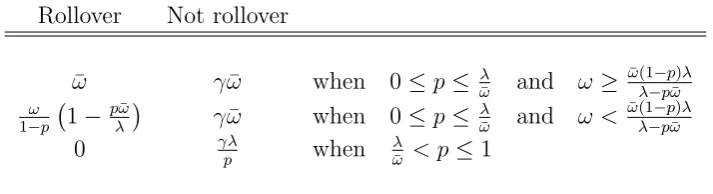
idiosyncratic productivity and on the actions of other retail banks. These payoffs are derived
in Appendix A.2 and given in Table 3, where 1−pt is the proportion of retail banks that
rollover. γ is the productivity of the retail bank (i.e. the retail banks’ equivalent of ωwt)
and measures the retail banks’ ability to do a wholesale bank’s job. When γ = 0, retail and wholesale banks are complements in the financial sector—neither can do the others’ job.
return from capital management.12
Table 3: Payoffs to retail banks
Rollover Not rollover
¯
ω γω¯ when 0≤p≤ λ ¯
ω and ω ≥
¯ ω(1−p)λ
λ−pω¯ ω
1−p 1− pω¯
λ
γω¯ when 0≤p≤ λ ¯
ω and ω < ¯ ω(1−p)λ
λ−pω¯
0 γλp when ωλ¯ < p≤1
Note: Payoffs are normalized byRK,tQt−1Kwt−1, and are for a given retail bank’s
action regarding a given wholesale bank. Since the problem is a static, symmetric game, all time and bank indexes have been dropped.
Table 3, top-left: When the fraction of retail banks not rolling over, pt, is low and the
wholesale bank’s productivity, ωwt, is high, a retail bank that rolls over receives the
non-default return ¯ωt. Bottom-left: If however, the retail bank rolls over when a large fraction of
retail banks do not, such that the wholesale bank runs out of capital, the rolled over retail
bank gets zero. Middle-left: This is the intermediate outcome in which the wholesale bank
survives the intra-period stage but cannot fully repay its debt obligation at the end of t. The right column gives the payoffs from not rolling over. If a retail bank does not
rollover, but few other retail banks do likewise so the wholesale bank does not lose all its
capital, the retail bank receives ¯ωt, applies its own productivity, γ, and earns γω¯t.
Right-bottom: If the fraction of retail banks that do not rollover is high, the wholesale bank has
insufficient liquid capital and the liquid capital, λt, is divided equally among the retail banks
that do not roll over, earning γλt/pt.
The payoff structure exhibitsstrategic complementarities. Up to the criticalptat which
the wholesale bank fails (i.e. runs out of capital), thenetpayoff from rolling over (i.e. rollover minus not rolling over) decreases as the fraction of retail banks that do not rollover, pt, rises.
Thus, retail banks face a strategic environment in which higher-order beliefs regarding the
actions of other retail banks are important.
Proposition 1 states that, under certain technical assumptions, a retail bank’s action is
uniquely determined by its signal: It only rolls over if its signal, ωrwt, is above a threshold,
denoted ω∗t.
Proposition 1 There is a unique (symmetric) equilibrium in which a retail banks does not rollover if it observes a signal ωrwt below threshold ωt∗, and rolls over otherwise.
12Whenγ is sufficiently high, retail banks will have no incentive to lend to wholesale banks since they will
The proof is given in Appendix A.2.13 In computing the threshold, ωt∗, observe that a retail bank with signalωrwt =ωt∗, must be indifferent between rolling over and not. The retail
bank’s posterior distribution of ωwt is uniform over the interval [ωt∗−ε, ωt∗+ε]. Moreover,
the retail bank believes that the fraction of retail banks not rolling over, pt, is given by
p(ωw, ω∗) =
1 ω∗−εrw > ωw 1
2 + ω∗−ω
w
2εrw if ω ∗−ε
rw ≤ ωw ≤ ω∗+εrw
0 ωw < ω∗+εrw
.
Thus, the posterior distribution of pt is uniform over [0,1]. In the limit when ¯ε → 0 the
resulting indifference condition is given by14
Z 1
p=λ¯ω
−γλ
p dp+
Z λ¯ω
p=0
ω∗
1−p
1− pω¯
λ
−γω¯
dp= 0. (12)
where solving for ωt∗ leads to Proposition 2.
Proposition 2 In equilibrium, with the noise component of retail banks’ signals arbitrarily close to zero, the rollover threshold, ω∗t, is given by
ωt∗ =γλtxt(1−ln (xt)) (xt+ (1−xt) ln (1−xt)) −1
, (13)
where xt≡λt/ω¯t. It is a striking result of Proposition 1 that there exists a unique switching
equilibrium, even when the noise term in retail banks’ signals is arbitrarily close to zero. Thus,
in equilibrium, wholesale banks never experience a partial run but experience a complete run
and full rollover with probability F (ωt∗) and 1−F(ωt∗), respectively.
To see the inefficiency created by the coordination problem, consider the decision of a
retail bank when it is the sole holder of a wholesale bank’s debt (or, equivalently, a scenario in which retail banks can costlessly and credibly coordinate their actions).15 If it does not
13The proof requires that there exist lower and upper dominance regions,
0, ωLand ωH,∞
, in which a retail bank would not rollover and rollover, respectively, regardless the actions of other retail banks. This requirement is discussed in Appendix A.2. When retail banks receive a noiseless signal on the interval
ωL, ωH, there are multiple equilibria. But, a grain of doubt for retail banks (i.e. ¯εarbitrarily close to zero) leads to the starkly different (and very useful) result given in Proposition 1.
14This condition specifiesω∗forω∗<ω¯. The complete indifference condition is given in Appendix A.2.
15There are two benchmarks against which to gauge the inefficiency. The first, applied in the text, is to
assume that creditors can perfectly coordinate their actions. The second is to assume long-term debt. This eliminates the rollover decision and thus eliminates the coordination problem. A standard RBC model is akin to this second benchmark. Under the first benchmark, it is efficient to coordinate and not rollover for wholesale banks with extremely low values of ωwt (i.e. ωeff∗ >0). Even after accounting for the liquidation
rollover it gets γλt and if it rolls over it gets the lesser of ¯ωt and ωwt. The optimal action
is to rollover when ωwt > γλt and not rollover otherwise. The efficient, full coordination,
threshold is given by ωeff∗ =γλt and is lower thanωt∗, implying that, because of coordination
problems, the probability of a run is higher than is optimal. This leads to Propositions 3.
Proposition 3 i) The inefficiency wedge, ω∗/ωeff∗ , is increasing in the illiquidity, x= λ/ω¯, of the wholesale bank: ∂(ω∗/ωeff∗ )/∂x < 0. ii) In the limit, when the wholesale bank is not illiquid, there is no inefficiency: limx→1(ω∗/ω∗eff) = 1.
To get a sense of the dynamic implications, suppose the loan rate (and thus ¯ωt) moves
countercyclically. This implies that in a recession, for a given λt, the distortionary effects of
coordination problems in the credit market are magnified, generating a financial accelerator.
The contracting problem A debt contract can be characterized by the pair {`t,ω¯t+1}.
Since retail banks are perfectly competitive and pay a predetermined return to depositors,
Rt, the debt contract must satisfy a zero profit break-even condition for the retail banks.
And since retail banks hold fully diversified portfolios of loans, a retail bank’s expected
(normalized) payoff is given by
¯
ω
Z ∞
¯ ω
f(ω)dω
| {z }
i. Rolled over and pay in full
+ Z ω¯
ω∗
ωf (ω)dω
| {z }
ii. Rolled over and default
+γλt
Z ω∗
0
f(ω)dω
| {z }
iii. Not rolled over
, (14)
which is an integral over three possible outcomes:16 The wholesale bank i) survives the
intra-period stage and repays its loan in full; ii) survives the intra-intra-period stage but is insolvent
resulting in partial payment; or iii) does not survive and the the retail banks earn a return
managing the capital themselves. We can rewrite (14) as Γt−Gt where
Γ≡ω¯ Z ∞
¯ ω
f(ω)dω+ Z ω¯
0
ωf(ω)dω and G≡
Z ω∗ 0
(ω−γλt)f(ω)dω. (15)
Thus, 1−Γt and Γt−Gt are the fraction of gross returns accruing to wholesale and retail
banks, respectively, whereGtcaptures the deadweight loss resulting from coordination failure.
The contracting problem maximizes the wholesale banks’ return subject to the retail
banks’ break even condition, given by
max
`t,ω¯t+1
Et(1−Γt+1)St+1`t s.t. (Γt+1−Gt+1)St+1`t ≥(`t−1), (16)
contracts, but long-term contracts are preferred to short-term contracts without coordination.
16This assumesω∗
where St ≡ RK,t/Rt−1. The constraint holds for all realizations of RK,t+1 because the retail
banks’ return, Rt, is assumed to be predetermined. The combined first-order condition
(substituting out the Lagrange multiplier) is given by
Et
dΓt+1
dΓt+1−dGt+1
=Et
St+1
1 + Γt+1dGt+1−dΓt+1Gt+1
dΓt+1−dGt+1
, (17)
wheredΓt ≡∂Γt/∂ω¯t anddGt ≡∂Gt/∂ω¯t. The break-even condition from (16) and equation
(17) combine to implicitly define a loan supply schedule that has the following form
EtSt+1 =θ `t (+)
, λt −
!
, (18)
where EtSt+1 is denoted the illiquidity premium. The illiquidity premium is increasing in
wholesale banks’ leverage and decreasing in the intra-period liquidity of capital. Endogenous
fluctuations in leverage and exogenous fluctuations in liquidity generate a time-varying wedge
between the expected return on capital and the risk-free rate in the economy.
2.5
Closing the model
Aggregation is straightforward since, at the end of a period, wholesale banks are only
het-erogenous in net worth but choose a common leverage ratio and face the same interest rate
on loans. Net worth of wholesale banks are its end-of-period profits. A fraction 1−υ of wholesale banks are the forced to exit the market and consume their profits while a measure
1−υ of new wholesale banks enter. In addition, all wholesale banks receive a positive but arbitrarily small lump-sum tranfer from households. These two assumptions ensure that i)
wholesale banks do not accumulate sufficient net worth to no longer need external finance
and ii) the net worth of every wholesale bank is positive and the contracting problem is well
defined. It follows that the evolution of aggregate net worth, Nt, is given by
Nt=υ((1−Gt)St`t−1−(`t−1−1))Rt−1Nt−1. (19)
The deadweight cost of coordination failure is in units of capital. Thus, while the aggregate
stock of capital purchased in t−1 for use in t is Kt−1, only Kt∗ = (1−Gt)Kt−1 is put to
productive use. Aggregate wholesale bank consumption of exiting bankers is given byCW,t= 1−υ
3
Results
3.1
Comparative statics
This section analyzes the comparative static properties of the static coordination failure
model. In particular, it shows the interplay between liquidity, coordination problems, leverage
and the illiquidity premium before the full dynamic properties of the model are explored.
In the next subsection, the full model is carefully parameterized to capture moments
in US aggregate data. For the present comparative static exercises, the following stylized
parameterization is used: γ =λ= 0.4, ¯ω = 0.5, andσ2 = 0.35, where ln (ω)∼N −1 2σ
2, σ2 .
These parameter values aid graphical illustration without altering the qualitative properties
[image:14.595.80.546.318.457.2]of the quantitatively parameterized model presented in the next section.
Figure 1: Net payoff function
0 0.5 1
-0.2 0 0.2
0 0.5 1
-0.2 0 0.2
0 0.5 1
-0.2 0 0.2
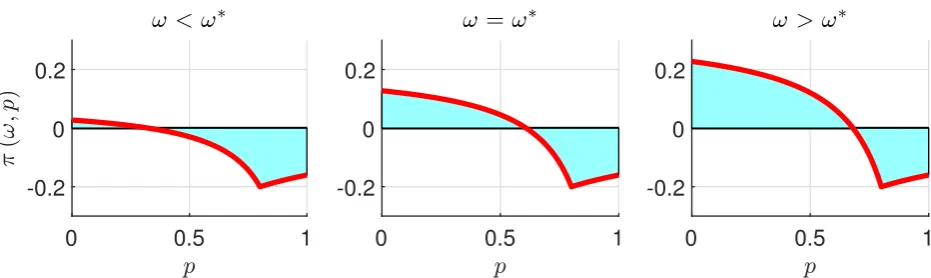
Note: Setγ=λ= 0.4 and ¯ω= 0.5. This givesω∗ = 0.3275. The left and right panels setω=ω∗±0.1. ω∗ is the value of ωthat equalized the shaded area above and below the line.
The red line in Figure 1 plots the net payoff function to rolling over for variousωvalues. The payoff function exhibits two important features: A single crossing where the net payoff
to rolling over is zero, and a negative slope, which implies strategic complementarities. In the
left-panel (low ω), the equilibrium action is to not rollover whereas in the right-panel (high
ω), the equilibrium action is to rollover. The middle panel defines the threshold ω∗ (solving the indifference condition in (12)), which is when the sum of the blue areas equals zero.
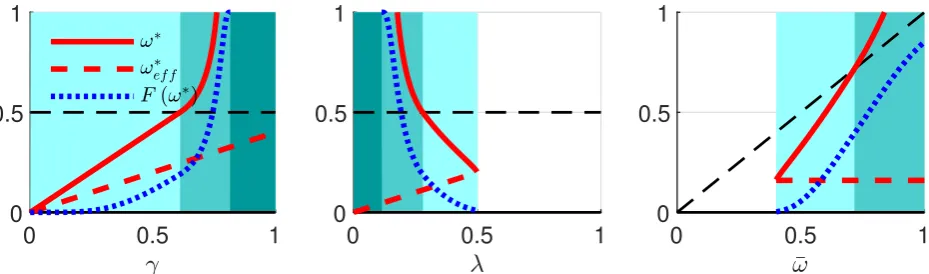
Figure 2 plots the behaviour of ω∗ and ω∗eff as γ, λ, and ¯ω are altered, respectively. In Section 2, I focused the model’s derivation on a specific region of the parameter space,
which I term the mild fragility scenario. However, as Appendix A.2 describes in detail, the model generates four scenarios: 1) No fragility, 2) Mild fragility, 3) Acute fragility, and 4)
No rollover. These are represented in Figure 2 by the shaded areas from white to dark green,
Figure 2: Comparative statics for ω∗
0 0.5 1
0 0.5 1
0 0.5 1
0 0.5 1
0 0.5 1
0 0.5 1
Note: Set γ =λ= 0.4 and ¯ω = 0.5. The shaded areas from white to dark-green represent Scenario 1) No fragility; 2) Mild fragility; 3) Acute fragility; and 4) No rollover.
coordination problem: Retail banks base their rollover decision on their private signal alone
and not on higher order beliefs about other retail banks’ actions. The pale green region is
the mild fragility scenario that is the focus of this paper. In this scenario, ω∗ <ω¯. A fall in liquidity, (i.e. a lowering of λ) raises the rollover threshold and lowers the efficient rollover threshold, thus increasing the inefficiency generated by the coordination problem. When λ
falls further, the economy enters the acute fragility scenario in which ω∗ > ω¯. Notice the curvature of the red line. In this scenario, the rollover threshold becomes very sensitive to
small changes in liquidity. And, as a result, the proportion of wholesale banks that experience
a run, F (ω∗), also increases dramatically (blue-dot line). Finally, when the liquidity of the capital stock is extremely low, there is a no rollover scenario, in which case rollover never
occurs and the market effectively fails to exist. Clearly, there are interesting nonlinearities
in this model, but which are beyond the scope of the current paper to explore further. This paper focuses on perturbations of the model in the light-green (mild fragility) region. One
can think of the model of Gertler and Kiyotaki (2015) and Gertler et al. (2016) as studying
large jumps from the white (no fragility) region to the dark-green (no rollover) region.
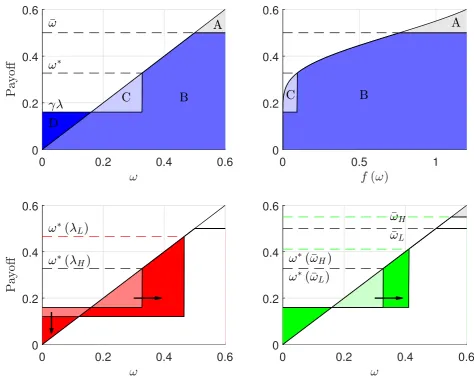
Figure 3 plots the debt contract, showing how the return on capital is split between
the borrower and creditor for different realizations of the wholesale bank’s idiosyncratic ω. Top-left panel: A textbook debt contract has the creditor receiving the area Γ (·) = B +C
Figure 3: Debt contract
0 0.2 0.4 0.6
0 0.2 0.4 0.6
0 0.5 1
0 0.2 0.4 0.6
0 0.2 0.4 0.6
0 0.2 0.4 0.6
0 0.2 0.4 0.6
0 0.2 0.4 0.6
Note: Top-left: Γ (·) =B+Cand 1−Γ (·) =A. Deadweight cost given byG(·) =C−D. Top-right panel is probability-weighted. Bottom-left: Comparative static of a rise in illiquidity (i.e. fall in λfrom λH to λL).
The deadweight cost rises (i.e. areaC−D expands). Bottom-right: Comparative static of a rise in ¯ω from ¯
ωLto ¯ωH. The deadweight cost again increases.
long-term. The top-right panel shows the same panel but probability-weighted and shows that, given the distributional assumptions, area Dis negligible. The bottom-left panel shows the effect of a rise in illiquidity caused by a fall in λ from 0.4 to 0.3. As a result, ω∗ rises and the deadweight cost rises (i.e. the area C−D expands). The bottom-right panel shows the effect of an exogenous rise in the lending rate, with ¯ω rising from 0.5 to 0.55. This also increases ω∗ and the deadweight cost of coordination failure.
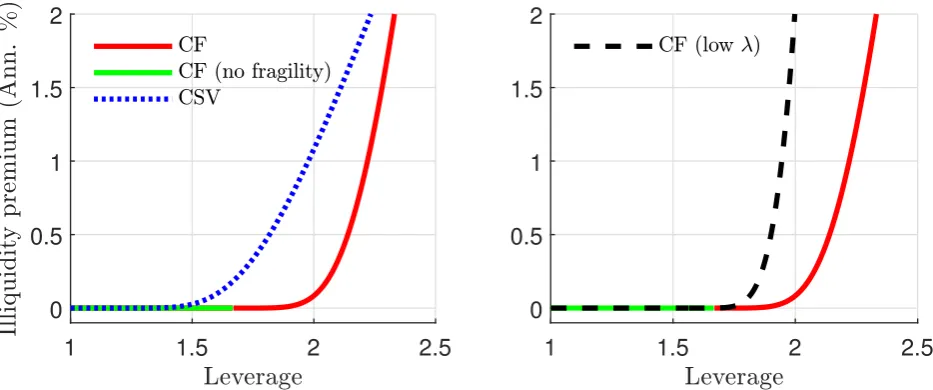
Figure 4 plots the supply curve of loanable funds by translating the deadweight costs
of coordination failure studied above into a tradeoff between wholesale banks’ leverage and
Figure 4: Illiquidity premium and leverage
1 1.5 2 2.5
0 0.5 1 1.5 2
1 1.5 2 2.5
0 0.5 1 1.5 2
Note: Set γ =λ= 0.4, ¯ω = 0.5 and σ= 0.35. CF denoted coordination failure model. CSV denotes the costly state verification model of Bernanke et al. (1999) with monitoring cost parameterµ= 0.166.
left panel shows that if wholesale banks have low leverage (green line), then there is no
coordination problem for retail banks and as a result the illiquidity premium is zero. However,
as leverage rises above a critical value then the coordination problem appears (red line),
generating an illiquidity premium which is increasing in leverage. An interesting comparison
is with an alternative model of financial frictions, the costly state verification (CSV) model
of Townsend (1979). In this model, costly state verification generates a risk premium even for low levels of leverage but grows more gradually (blue-dot line). The implication of this
comparison is that the CSV-type risk premium is larger during normal times (when leverage
is relatively low) than the CF-type illiquidity premium, but in periods of financial stress when borrower net worth falls and leverage sharply rises, then illiquidity premium rise rapidly and
can even become larger than typical risk premia.
The right panel shows the effect of a fall in liquidity. When λ falls, the loanable funds supply schedule shifts inward and steepens, resulting in a higher illiquidity premium for a
given leverage ratio. The next section studies the dynamic effect of such an illiquidity shock.
3.2
Parameterization
Table 4 list the calibrated and estimated parameters. The model parameters are partitioned
into three groups. The first group of parameters are results from previous studies. The
second group are calibrated using steady state relationships.
Table 4: Structural parameters
α 0.33 χ 5.02‡ σa 0.0055† υ 0.981‡
β 0.99 ρ 3 ρa 0.868† σ2 0.048‡
δ 0.025 ϕ 0.273† σλ 0.0041† γ 0.589‡
σC 2.0 ρλ 0.893† λ 0.703‡
Note: Parameters with‡are calibrated to match steady state moments. Parameters with†
are estimated using simulated method of moments to match US aggregate data moments.
parameters are chosen to minimize the distance between the model moments and moments
in US aggregate data. Formerly, the estimator is the solution of the following problem
J = min
θ M
D−
M(θ)0W−1 MD−M(θ), (20)
where MD denotes a vector that comprises the unconditional variances and autocorrelations
of output, consumption, investment, hours worked and the illiquidity premium in the data
and M(θ) denotes its model counterpart and θ={ϕ, σa, ρa, σλ, ρλ}. W is a diagonal matrix
that contains the standard errors of the data moment estimates.
Based on standard values in the literature at a quarterly frequency, the subjective
discount factor is β = 0.99, the intertemporal elasticity of substitution, 1/σC = 2.0, the
inverse of the Frisch elasticity of labor supply is ρ= 3 and the depreciation rate of capital is 0.025. The weight on leisure in the utility function, χ is chosen such that steady state labor supply is normalized to 1.
The financial sector is governed by four structural parameters: The capital
manage-ment productivity of retail banks,γ, the steady-state intra-period liquidity of capital,λ, the variance of the distribution of idiosyncratic shocks,σ2, and the proportion of wholesale banks
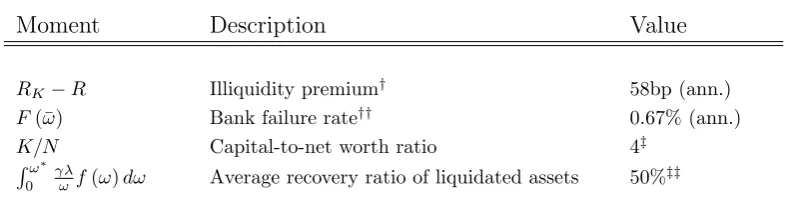
that survive each period, υ. The values are pinned down by four steady state moments of the model that approximately match long-run averages in US data, given in Table 5.
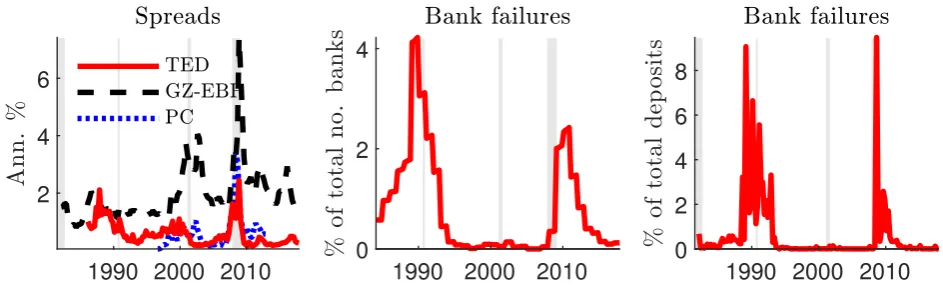
One, I use the TED spread, which is the spread between the 3-month LIBOR and the
3-month Treasury bill, as a proxy for the illiquidity premium. LIBOR is the rate banks charge each other for lending. Since the coordination problem in the lending relationship between
retail and wholesale banks is the only wedge between the return on deposits and the return
on capital in this model, the TED spread is a good proxy for the illiquidity premium. For
comparison, Figure 5 plots the TED spread alongside the Gilchrist and Zakrajsek (2012a)
Figure 5: Illiquidity premium and bank failure
1990 2000 2010 2
4 6
1990 2000 2010
0 2 4
1990 2000 2010 0
2 4 6 8
Note: TED is the spread between 3-month LIBOR and the 3-month Treasury bill. GZ-EBP is the excess bond premium from Gilchrist and Zakrajsek (2012a). PC is a liquidity premium calculated from 7 spread series using principal components analysis following Bredemeier et al. (2018). Bank failure source: FDIC. Shaded areas denote NBER recession dates.
of credit spreads/risk premiums. The figure also plots an alternative measure of the
liquid-ity premium, which takes the principal component of seven spreads between the return on
Treasuries and illiquid assets of similar safety and maturity. This follows the methodology
of Bredemeier et al. (2018) (see Appendix C for details).17 Thus, I match the steady state
illiquidity premium to the mean of the TED spread from 1986-2017, which is 58bp.
Two, Figure 5 also plots a time-series of bank failures, which I constructed from FDIC
data. The series goes back to 1934 but for consistency with the other time-series, I use
only the period 1986-2017. In the model, the fraction of banks that fail and the fraction of
failures weighted by balance sheet size are equivalent. In the data, however, these series are quite different. In particular, at the peak of the 2007-08 financial crisis, 2% of banks covered
by the FDIC failed but this accounted for 9% of total deposits. In addition, there were a
large number of bank failures in the aftermath of the crisis in 2010-12 but these were mainly
small banks. Thus, the series for bank failures in terms of total deposits appears much less
persistent. For the empirical exercise, I use the measure of bank failures and as a share of
deposits. The mean annualized failure rate from 1986-2017 was 0.67%.
Three, leverage in the wholesale bank sector varies widely across financial institutions,
with some banks with leverage in excess of 10. I take a conservative estimate and calibrate
the steady state leverage of the wholesale bank sector to be 4 following Gertler et al. (2012).18
17Robustness exercises using this series are available on request.
18While the deterministic steady state is, by definition, independent of uncertainty, it is likely that wholesale
Finally, the average recovery ratio of liquidated assets is set at 50% following estimates from
[image:20.595.107.501.163.271.2]Berger et al. (1996).
Table 5: Targeted steady state moments
Moment Description Value
RK−R Illiquidity premium† 58bp (ann.)
F(¯ω) Bank failure rate†† 0.67% (ann.)
K/N Capital-to-net worth ratio 4‡
Rω∗
0
γλ
ωf(ω)dω Average recovery ratio of liquidated assets 50%
‡‡
Note: †TED spread;††source: FDIC;‡Gertler et al. (2012). ‡‡Berger et al. (1996).
The remaining five parameters are estimated using simulated method of moments. The
following 10 moments are included: The standard deviation and autocorrelation of output,
consumption, investment, hours, and the TED spread. Four of the five parameters are the
persistence and standard deviation of the two exogenous shock series: Technology, At, and
liquidity, λt. The final parameter, ϕ, controls investment-adjustments costs. This is a key
parameter for determining the strength of the financial accelerator. When ϕ is zero, the financial accelerator is generally weak because investment demand adjusts rapidly to changes
in financial conditions.19 The success of the model in matching the business cycle moments is reported in Table 6. Given the parsimony of the model, it does a reasonable job of matching
business cycle moments. Most notably, hours worked are too volatilite and consumption is
too persistent. However, the model captures well the properties of the TED spread.
3.3
Impulse responses and crisis scenario
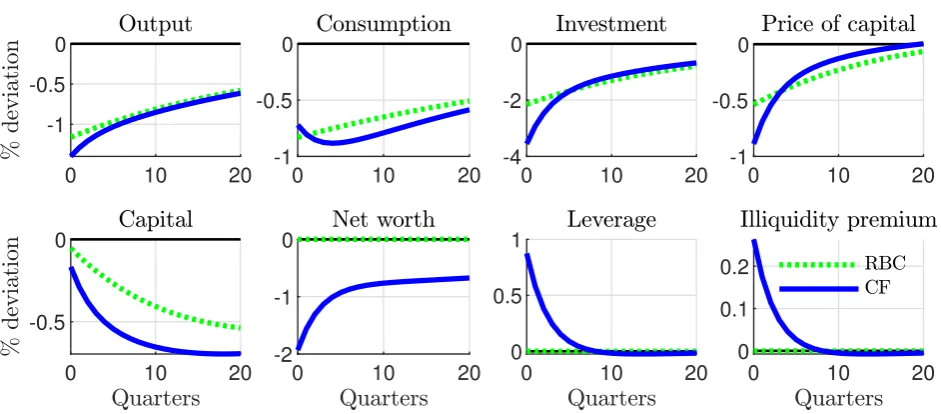
Technology shocks Figure 6 shows the reaction to a 1% negative technology shock.20 The
blue-solid and green-dot lines show the reaction of the model with and without coordination
failure, respectively. Coordination failure does not significantly alter the qualitative shapes
of the responses, but does alter the magnitude of the responses. Notably, the drops in
investment, asset prices and the capital stock are magnified.
19The model is solved to first-order in the neighborhood of the deterministic steady state. The model,
however, admits interesting non-linearities as shown in Section 3. Although it would be a fruitful avenue for future research to solve the model using global methods, it is beyond the scope of the current paper.
20Supplementary material on other shocks (e.g. capital quality and net worth shocks) and the behaviour
Table 6: Business cycle moments
Moment Data Model Moment Data Model
std(GDP) 1.060 1.051 ac(GDP) 0.862 0.786
std(C) 0.864 0.686 ac(C) 0.820 0.965
std(I) 4.418 4.154 ac(I) 0.931 0.714
std(Hours) 0.478 0.794 ac(Hours) 0.792 0.676
std(TED) 0.410 0.359 ac(TED) 0.796 0.651
Note: Construction of data moments given in Appendix C.
Figure 6: Technology shock
0 10 20
-1 -0.5 0
0 10 20
-1 -0.5 0
0 10 20
-4 -2 0
0 10 20
-1 -0.5 0
0 10 20
-0.5 0
0 10 20
-2 -1 0
0 10 20
0 0.5 1
0 10 20
0 0.1 0.2
Note: 1% negative technology shock
Coordination failure introduces three new aggregate variables of interest: Wholesale bank net worth and leverage and the illiquidity premium. The negative technology shock
causes a drop in wholesale bank net worth and an increase in wholesale bank leverage. The
risk-free (deposit) rate falls while the expected return on capital rises, leading to a sharp rise
in the illiquidity premium.21 These responses are the result of three features of coordination
21The countercyclical leverage ratio is a feature of most financial accelerator models. Adrian et al. (2013)
[image:21.595.78.549.298.505.2]failure. First, the loan rate paid by wholesale banks is a function of the expected return
on capital, which means that the wholesale banks absorb the aggregate risk. When the
negative technology shock hits, the realized return on capital is below its expected return, which drives down the aggregate wholesale bank profits and hence their net worth. Second,
wholesale bank net worth decreases faster than the demand for capital, implicitly causing
leverage to rise. Third, higher leverage increases the severity of the coordination problem
among retail banks, causing the illiquidity premium to rise. As a result, retail banks demand
a higher loan rate (i.e. an increase in ¯ωt) following a negative productivity shock, which
increases the illiquidity of wholesale banks yet further. This causes investment and the price
of capital to fall further in response to a negative technology shock. Investment falls 3.8%
on impact following a 1% technology shock in the coordination failure model, relative to a
2.0% in the frictionless case.
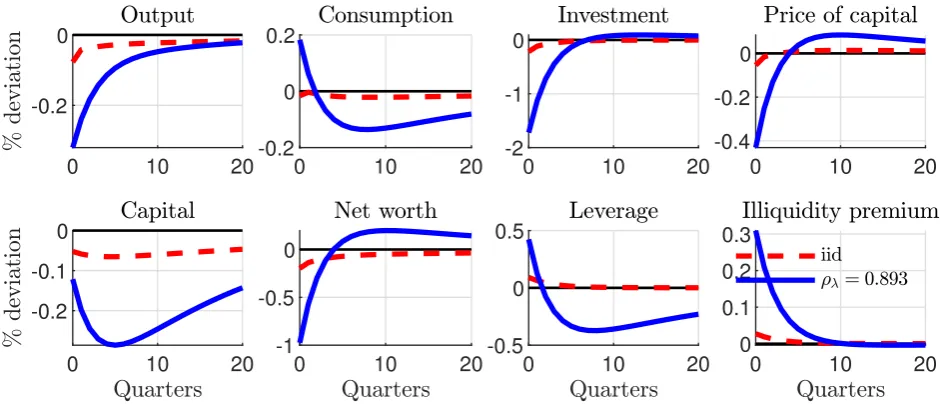
Illiquidity shock A novel feature of the model is the ability to generate an exogenous
rise in illiquidity in credit markets. Figure 7 shows the response to a 1% rise in intra-period
[image:22.595.77.549.398.600.2]capital illiquidity with an iid (red-dash) and a persistent shock (blue-solid line), respectively.
Figure 7: Illiquidity shock
0 10 20
-0.2 0
0 10 20
-0.2 0 0.2
0 10 20
-2 -1 0
0 10 20
-0.4 -0.2 0
0 10 20
-0.2 -0.1 0
0 10 20
-1 -0.5 0
0 10 20
-0.5 0 0.5
0 10 20
0 0.1 0.2 0.3
Note: 1% illiquidity shock
A rise in the illiquidity of capital leads to a rise in the rollover threshold,ω∗, implying a higher incidence of bank runs. This causes a sharp rise in the illiquidity premium paid by
wholesale banks on external finance. The rise in the illiquidity premium is the result of both
a rise in the expected return on capital as well as a fall in the risk-free deposit rate. The
capital is insufficient to offset the fall in wholesale bank net worth. In order to break even,
the retail banks lower the return paid on deposits. Households, facing a lower return on
savings, generates a temporary consumption boom.22 In the transition back to steady state, the fall in the demand for investment causes a decline in the capital stock. As the impact of
the illiquidity shocks recedes, households cut consumption order to restore their steady state
savings ratio. This requires a long period of deleveraging by wholesale banks.
The size and persistence in the response of capital (and hence output) is sensitive to
the persistence of the exogenous rise in illiquidity. The evolution of capital is relatively
gradual. A less persistent shock therefore gives less opportunity for capital to fall and do
serious damage to potential output. Thus, the length and severity of a recession depends on
how long the credit market remains illiquid.
This model has several features unique to coordination failure. First, retail banks’ are most likely to run when liquidity is most needed. Second, as the constraints on wholesale
banks tighten countercyclically, the share of capital held by retail banks will move
counter-cyclically. This occurred during the financial crisis with dealer banks in the shadow banking
sector shrinking and commercial banks expanding their market share.
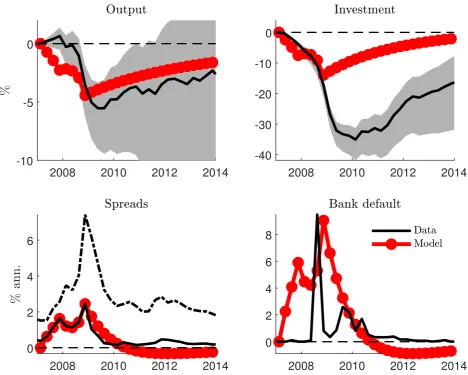
Illiquidity during the 2007-08 financial crisis In this section, I provide an illiquidity
shock narrative of the 2007-08 financial crisis as an external validation exercise for the model.
Since the model is a parsimonous RBC model, chosen for clarity rather than quantitative
accuracy, it is unlikely to provide a close fit to the data. However, the exercise provides a
good way of assessing its strengths and weaknesses.
In this exercise, I suppose the economy was hit by a sequence of illiquidity shocks from
2007q2–2008q4 that match the evolution of the illiquidity premium (TED spread) in the
data. Using simple projection methods, I estimate a distribution of counterfactual paths
for output, investment, the illiquidity premium and bank failure had the financial crisis not
occurred. The black line in Figure 8 represents the deviation between the actual path for these
variables and the median of the counterfactual path. The methodology follows Christiano et
al. (2015) and is described in Appendix C. The grey area captures the uncertainty in these
counterfactual paths. The counterfactual evolution of output is most uncertain while the
bank failure rate is estimated very precisely (i.e. without the financial crisis, the bank failure rate would have almost certainly remained at zero).
22The implication is that when an illiquidity shocks hits, consumption rises temporarily while output and
Figure 8: Illiquidity shocks during the 2007-08 crisis
2008 2010 2012 2014
-10 -5 0
2008 2010 2012 2014
-40 -30 -20 -10 0
2008 2010 2012 2014
0 2 4 6
2008 2010 2012 2014
0 2 4 6 8
Note: Black lines represent the data relative to an uncertain trend using following Christiano et al. (2015). Black-dash line is the Gilchrist and Zakrajsek (2012b) EBP. Red line is the model prediction with illiquidity shocks chosen to match exactly the TED spread from 2007q2–2008q4.
The model’s illiquidity shocks captures well the fall in output during the financial crisis although only around a third of the drop in investment, suggesting that investment specific
shocks also played an important role. The model captures well the peak bank failure rate of
9%. However, the model predicts that bank failures would have appeared as early as 2007
and would have persisted into 2010. Thus, when integrating over the total number of bank
failures for the 2007-2010 period, the model overpredicts the number of bank failures.
Of course, there is a clear rationale for policymakers (monetary or fiscal) to offset the
4
Policy responses
The coordination failure model facilitates the analysis of two unconventional credit market policies adopted by the US Federal Reserve during the 2007-08 financial crisis: 1) Direct
lending (or liquidity injections) in credit markets and 2) equity injections.23
4.1
Direct lending (DL)
In this scenario, the policymaker supplements private lending in credit markets with
addi-tional lending directly to wholesale banks with abnormal excess returns. Since wholesale
banks in the model are funded by a continuum of retail banks, the retail banks cannot
coor-dinate actions. The policymaker instead behaves as a single, large market participant with
deep pockets. By committing to rollover, it is able to reduce the coordination problem.24
Let nt denote the proportion of total lending to wholesale bank w provided by retail
banks. Funding provided by the policymaker is therefore given by (1−nt) (QtKwt−Nwt).
Retail banks can still choose not to rollover while the policymaker is assumed to always
rollover.25 The policymaker lends at the prevailing market rateR
L,t. However, by expanding
the supply of run-free funds available in the market, it reduces the loan rate endogenously.
The new rollover threshold, augmented by direct lending, is given by
ω∗ =γλnx(1−ln (x))/(nx+ (1−nx) ln (1−nx)), (21)
wherex≡λ/(nω¯) is the new measure of endogenous illiquidity. The efficient rollover thresh-old becomes ωeff∗ = γλ/n. It is straightforward to show that, all else equal, direct lending increases the efficient threshold while ω∗ falls, thus reducing the market distortion.26 Retail
banks’ break-even condition is unchanged except for the deadweight cost, Gt, given by
G= Z ω∗
0
(ω−γλ/n)f(ω)dω. (22)
23C´urdia and Woodford (2010), Reis (2009a) and Gertler and Kiyotaki (2010) also model the effect of
credit market policies.
24In other respects, the government is likely less efficient at intermediating funds. Thus, think of this as
only a crisis measure.
25In the crisis, the Fed implicitly lengthened the maturity structure of banks’ borrowing by directly
lending at longer maturities than private agents were willing to lend. See the Fed’s press release: http://www.federalreserve.gov/newsevents/press/monetary/20081007c.htm
26In fact, a sufficiently large intervention will push the economy into the “no fragility” region described in
4.2
Equity injections (EI)
In this scenario, the policymaker acquires part ownership of wholesale banks.27 I assume that
government equity and private equity has the same characteristics. Let ct be the proportion
of total equity that is privately held by wholesale bankers, such that the funds injected by the
government are given by (1−ct)Nt. The retail banks’ break-even condition is unchanged
but wholesale bank profits are split between the wholesale bankers and the government in
proportion to ct. The augment net worth equation is given by
Nt =
ct−1
ct
υ((1−Gt)St`t−1−(`t−1−1))Rt−1Nt−1.
Since equity injections expand wholesale bank net worth, this will expand credit creation,
reduce leverage ratios, and lower the illiquidity premium.
4.3
The policy rule
The policymaker obtains funds by levying lump sum taxes on households.28 Returns from
direct lending and equity are also transferred lump sum to households. The aim is to assess
the relative power of the two alternative instruments and so this simplification facilitates a
clean comparison. The government flow budget constraint is given by
Tt= (1−nt−1)
Γt−
Z ωt∗
0
ωf(ω)dω
RK,tQt−1Kt−1
| {z }
Return on direct lending
+ (1−ct−1) (1−Γt)RK,tQt−1Kt−1
| {z }
Return on equity injections
−(1−nt) (QtKt−Nt)
| {z }
Direct lending
− (1−ct)Nt
| {z }
Equity injections
, (23)
where Tt are lump-sum transfers net of taxes. Note the policymaker does not receive the
same return on direct lending as retail banks. Since the policymaker commits to always
rollover, it loses γλt to banks that still experience a run.
The policymaker has two policy instruments available, ct and nt. I consider a simple
and implementable reaction function that governs the use of these instruments given by
nt= 1−aDL(EtSt+1/S−1) and ct= 1−aEI(EtSt+1/S−1), (24)
27I abstract from efficiency costs associated with government acquisition of equity
28The lump sum taxes/transfers should more realistically be modelled as central bank reserves when
where aDL, aEI ≥0. Thus, the size of the policy intervention depends positively on the
illiq-uidity premium. The rule is reasonable since the magnitude of the distortion the policymaker
is trying to offset is proxied by the illiquidity premium. The rule is also practically imple-mentable since credit spreads are observable (although disentangling illiquidity risk from
credit risk may not be so easy). After all, it was the sharp rise in spreads during the financial
crisis that pushed the Fed into introducing unconventional credit policies, even before the
conventional tool of monetary policy, the nominal interest rate, reached the zero lower bound.
4.4
Illiquidity shock with policy responses
Figure 9 shows a 1% fall in the intra-period liquidity of the capital stock. To provide a clear
comparison between policy instruments, the experiment ensures that both policies deliver
the same initial cost to the government in term of GDP. This requires the parameters of the policy rules to be set at aDL = 3.00 andaEI = 14.02.29
Figure 9 shows that equity injections mitigate the effects of the initial shock to liquidity
better than direct lending. The initial fall in output with no policy intervention was 0.35%.
Equity injections and direct lending reduced this to 0.11% and 0.27%, respectively. The
reason is that equity injections directly offset the fall in net worth, actually causing leverage
to fall. However, while equity injections reduce the initial impact of the illiquidity shock, they
also cause the effects of the shock to persist for longer. The reason is as follows: Without
coordination problems, the Modigliani-Miller theorem states the irrelevance between debt
or equity financing. But, with coordination problems, the shadow price of equity is lower, exactly because equity avoids the coordination problem. Wholesale banks build up equity
so that they don’t require debt finance. Direct lending, even though it reduces the maturity
mismatch, does not materially improve the solvency of the wholesale banks. Equity injections
are therefore powerful in mitigating the problem in credit markets (because it lowers the need
to access them). However, as the illiquidity premium recedes, the policymaker’s withdrawal
of equity offsets the recovery in net worth that the wholesale bank would have experienced
in the counterfactual scenario without policy intervention.
5
Conclusion
This paper incorporates short-term uncoordinated creditors in credit markets in a dynamic,
general equilibrium setting. The coordination problem generates a time-varying incidence of
bank runs, rising during downturns and especially during periods of illiquidity. The resulting
29In terms of quantities, the size of the initial intervention in these experiments is 0.6% of annual GDP, or
Figure 9: Illiquidity shock and policy response
0 10 20
-0.2 0
0 10 20
-0.2 0 0.2
0 10 20
-2 -1 0
0 10 20
-0.4 -0.2 0
0 10 20
-0.2 -0.1 0
0 10 20
-1 -0.5 0
0 10 20
-0.5 0 0.5
0 10 20
0 0.1 0.2 0.3
Note: 1% illiquidity shock with policy intervention
illiquidity premium provides a new lense through which to study the financial accelerator
and the role of credit market interventions during financial crises. In particular, the model
shows that equity injections are more powerful policies than direct lending.
Moreover, the microfounded coordination problem at the heart of this model provides
rich nonlinearities that this current research has not yet fully explored and will likely be a
References
Adrian, Tobias, Paolo Colla, and Hyun Song Shin (2013) ‘Which financial frictions? Parsing
the evidence from the financial crisis of 2007 to 2009.’ NBER Macroeconomics Annual 27(1), 159–214
Angeloni, Ignazio, and Ester Faia (2013) ‘Capital regulation and monetary policy with fragile
banks.’ Journal of Monetary Economics60(3), 311–324
Bagehot, Walter (1873) Lombard Street: A description of the money market(London: Henry S. King & Co.)
Basu, Susanto, and Brent Bundick (2017) ‘Uncertainty shocks in a model of effective demand.’
Econometrica 85(3), 937–958
Berger, Philip G., Eli Ofek, and Itzhak Swary (1996) ‘Investor valuation of the abandonment
option.’Journal of Financial Economics 42(2), 257–287
Bernanke, Ben S., and Mark Gertler (1989) ‘Agency costs, net worth, and business
fluctua-tions.’ American Economic Review 79(1), 14–31
Bernanke, Ben S., Mark Gertler, and Simon Gilchrist (1999) ‘The financial accelerator in a
quantitative business cycle framework.’ vol. 1C of Handbook of Macroeconomics (Amster-dam: Elsevier) chapter 21, pp. 1341–1393
Bredemeier, Christian, Christoph Kaufmann, and Andreas Schabert (2018) ‘Interest rate
spreads and forward guidance’
Brunnermeier, Markus K. (2009) ‘Deciphering the liquidity and credit crunch 2007-2008.’
Journal of Economic Perspectives23(1), 77–100
Brunnermeier, Markus K., and Martin Oehmke (2013) ‘The maturity rat race.’ Journal of Finance68(2), 483–521
Carlsson, Hans, and Eric van Damme (1993) ‘Global games and equilibrium selection.’ Econo-metrica 61(5), 989–1018
Carlstrom, Charles T., and Timothy S. Fuerst (1997) ‘Agency costs, net worth, and
busi-ness fluctuations: A computable general equilibrium analysis.’American Economic Review 87(5), 893–910
Carlstrom, Charles T., Timothy S. Fuerst, and Matthias Paustian (2010) ‘Optimal monetary
(2016) ‘Optimal contracts, aggregate risk, and the financial accelerator.’ American Eco-nomic Journal: MacroecoEco-nomics 8(1), 119–47
Christiano, Lawrence J., Martin S. Eichenbaum, and Mathias Trabandt (2015)
‘Understand-ing the great recession.’American Economic Journal: Macroeconomics 7(1), 110–67
Christiano, Lawrence J., Roberto Motto, and Massimo Rostagno (2014) ‘Risk shocks.’ Amer-ican Economic Review104(1), 27–65
Corsetti, Giancarlo, Amil Dasgupta, Stephen Morris, and Hyun Song Shin (2004) ‘Does one
Soros make a difference? A theory of currency crises with large and small traders.’ Review of Economic Studies 71(1), 87–113
C´urdia, Vasco, and Michael Woodford (2010) ‘Conventional and unconventional monetary
policy.’ Federal Reserve Bank of St. Louis Review92(4), 229–64
(2016) ‘Credit frictions and optimal monetary policy.’ Journal of Monetary Economics 84, 30–65
Dang, Tri Vi, Gary Gorton, and Bengt Holmstr¨om (2012) ‘Ignorance, debt and financial
crises.’ Unpublished manuscript
de Groot, Oliver (2014) ‘The risk channel of monetary policy.’ International Journal of Cen-tral Banking10(2), 115–160
(2016) ‘The financial accelerator.’ In The New Palgrave Dictionary of Economics, ed. Steven N. Durlauf and Lawrence E. Blume (Basingstoke: Palgrave Macmillan)
Del Negro, Marco, Gauti Eggertsson, Andrea Ferrero, and Nobuhiro Kiyotaki (2017) ‘The
great escape? a quantitative evaluation of the fed’s liquidity facilities.’American Economic Review 107(3), 824–57
Diamond, Douglas W., and Philip H. Dybvig (1983) ‘Bank runs, deposit insurance, and
liquidity.’Journal of Political Economy 91(3), 401–419
Dmitriev, Mikhail, and Jonathan Hoddenbagh (2017) ‘The financial accelerator and the
optimal state-dependent contract.’ Review of Economic Dynamics24, 43–65
Fiore, Fiorella D., and Oreste Tristani (2013) ‘Optimal monetary policy in a model of the
credit channel.’The Economic Journal 123(571), 906–931
Gertler, Mark (2013) ‘Comment on “Which financial frictions? Parsing the evidence from
Gertler, Mark, and Nobuhiro Kiyotaki (2010) ‘Financial intermediation and credit policy in
business cycle analysis.’ vol. 3 ofHandbook of Monetary Economics(Amsterdam: Elsevier) chapter 11, pp. 547–599
(2015) ‘Banking, liquidity, and bank runs in an infinite horizon economy.’ American Eco-nomic Review 105(7), 2011–43
Gertler, Mark, and Peter Karadi (2011) ‘A model of unconventional monetary policy.’Journal of Monetary Economics 58(1), 17–34
Gertler, Mark, Nobuhiro Kiyotaki, and Albert Queralto (2012) ‘Financial crises, bank risk
exposure and government financial policy.’ Journal of Monetary Economics 59, Supple-ment, 17–34
Gertler, Mark, Nobuhiro Kiyotaki, and Andrea Prestipino (2016) ‘Wholesale banking and
bank runs in macroeconomic modeling of financial crises.’ vol. 2 of Handbook of Macroeco-nomics (Amsterdam: Elsevier) chapter 11, pp. 1345–1425
Gilchrist, Simon, and Egon Zakrajsek (2012a) ‘Credit spreads and business cycle
fluctua-tions.’ American Economic Review 102(4), 1692–1720
(2012b) ‘Credit spreads and business cycle fluctuations.’ The American Economic Review 102(4), 1692–1720
Goldstein, Itay, and Ady Pauzner (2005) ‘Demand–deposit contracts and the probability of bank runs.’ Journal of Finance 60(3), 1293–1327
Gorton, Gary, and Andrew Winton (2003) ‘Financial intermediation.’ vol. 1A of Handbook of the Economics of Finance: Corporate Finance(Amsterdam: Elsevier) chapter 8, pp. 431– 552
Hart, Oliver, and John Moore (1994) ‘A theory of debt based on the inalienability of human
capital.’ Quarterly Journal of Economics 109(4), 841–79
Heider, Florian, Marie Hoerova, and Cornelia Holthausen (2015) ‘Liquidity hoarding and interbank market rates: The role of counterparty risk.’ Journal of Financial Economics 118(2), 336 – 354
Hertzberg, Andrew, Jos´e M. Liberti, and Daniel Paravisini (2011) ‘Public information and
Iacoviello, Matteo (2005) ‘House prices, borrowing constraints, and monetary policy in the
business cycle.’ The American Economic Review95(3), 739–764
Jackson, Thomas H. (1986)The logic and limits of bankruptcy law(Boston: Harvard Univer-sity Press)
Kiyotaki, Nobuhiro, and John Moore (1997) ‘Credit cycles.’ Journal of Political Economy 105(2), 211–248
Krishnamurthy, Arvind, and Annette Vissing-Jorgensen (2012) ‘The aggregate demand for
treasury debt.’Journal of Political Economy 120(2), 233–267
Kurlat, Pablo (2013) ‘Lemons markets and the transmission of aggregate shocks.’ American Economic Review 103(4), 1463–1489
Morris, Stephen, and Hyun Song Shin (2003) ‘Global games: Theory and applications.’
vol. 1 of Advances in economics and econometrics: Theory and applications, Eighth world congress (Cambridge: Cambridge University Press) pp. 56–114
(2004) ‘Coordination risk and the price of debt.’ European Economic Review 48, 133–153
(2016) ‘Illiquidity component of credit risk.’ International Economic Review 57(4), 1135– 1148
Reis, Ricardo (2009a) ‘Interpreting the unconventional US monetary policy of 2007-09.’ Brookings Papers on Economic Activity pp. 119–165
(2009b) ‘Where should liquidity be injected during a financial crisis?’ Unpublished manuscript
Rochet, Jean-Charles, and Xavier Vives (2004) ‘Coordination failures and the lender of last
resort: Was Bagehot right after all?’ Journal of the European Economic Association 2(6), 1116–1147
Sargent, Thomas J., and Neil Wallace (1982) ‘The real-bills doctrine versus the quantity
theory: A reconsideration.’ Journal of Political Economy90(6), 1212–1236
Shin, Hyun Song (2009) ‘Reflections on Northern Rock: The bank run that heralded the
global financial crisis.’ Journal of Economic Perspectives23(1), 101–119
Townsend, Robert M. (1979) ‘Optimal contracts and competitive markets with costly state