1 FULL TITLE
Using Needs Assessments to Understand Continuing Disability in Patients with Enduring Mental Illness. Implications for Considerations of Service Development.
SHORT TITLE
Continuing Disability in Enduring Mental Illness
Hugh Middleton, Richard Adeniran, Chris R. Brewin, Carol Brady, Connor Duggan, Nigel Hopkins, Kay Raleigh & Mark Walton.
Address
Dr. Hugh Middleton Division of Psychiatry Duncan MacMillan House Porchester Road
2 ABSTRACT
Particular strengths of the MRC Needs for Care Assessment Schedule have been used to investigate the treatment status of patients with persistent psychiatric disability in ways that other needs assessment tools are unable to. 179 such patients from 3 settings; a private sector psychiatric hospital, two public sector day hospitals situated in the same town and a high security hospital, were found to have a high level of need. Although there were differences between settings, overall these needs were well met in all three. The high level of persistent disability found amongst these patients could not be attributed to failure on the part of those treating them to use the best available methods, or to failures to comply or engage with treatment on the patient’s part. In some two thirds of instances persistent disability was best explained by the fact that even the most suitable available treatments have to be considered only partially effective.
INTRODUCTION
3
Department of Health 1999), even though there is doubt in some circles that it will improve outcomes beyond those already achieved in British NHS settings (Tyrer 2000). This doubt stems in large part from the results of two relevant UK trials.
The first was the PRiSM Study. This was a comparison between patients treated in a catchment area served by a standard community mental health team (Standard Sector) and patients treated in a catchment area served by two teams with extended opening hours; a psychiatric acute care and emergency team and a psychiatric assertive continuing care team (Intensive Sector). The main findings were that both groups of patients fared well and achieved outcomes that were comparable if not better than a hospital based service but that there were very limited additional advantages and some disadvantages associated with management in the Intensive Sector (Thornicroft et al 1998a). The main criticicisms of this have been that it was not a formally conducted randomised controlled clinical trial, and because the intensified treatment it investigated was not sufficiently “faithful” to the ACT model (Marshall et al 1999).
The first of these criticisms was met by the UK 700 trial (Burns et al 1999). This also failed to find differences in bed occupancy, social or clinical functioning between patients managed as part of a small (10-15) case load and those managed as part of a standard (30-35) case load, despite clear evidence of an enhanced rate of patient contact amongst the experimental group (Burns et al 2000). It would seem fairly clear that improving outcome in this context is going to require more than simply increasing the intensity of provision.
4
treatment settings, frequency of contact and other factors (Teague et al 1998, Thornicroft et al 1998b, Burns et al 1999). Although appropriate enough for a study investigating service management issues, this approach does not address the nature or choice of interventions that might be provided under the framework in question. Issues of team management and organisation are an important background to the way in which care is delivered but effectiveness can only be judged if measure is also made of what that care comprises. The PRiSM study found a dilution effect in that the outcome after intensive community care in realistic settings was not as good as that obtained in more experimental settings. Was this because care was organised less intensively than in the experimental settings, (Marshall et al 1999), or because it contained fewer “therapeutic ingredients”? Such a question can only be answered by a methodology that not only investigates the intensity of care but also its content.
Investigating the content of a care package is a challenging prospect and there are few instruments that have been developed that even attempt this. One is the MRC Needs for Care Assessment Schedule; NFCAS (Brewin et al 1987). Another is the Camberwell Assessment of Need; CAN (Phelan et al 1995). This establishes whether or not provision is being made for identified problems or needs but unlike the NFCAS it does not inquire in any structured way into the nature of that provision.
5
behaviour problems are noted to be present, or there is evidence of a failure or threatened failure to exercise one of the specified skills and activities of daily living, enquiries are then made about the provision of each of the specified items of care A rating is made for each item of care that reflects whether or not it would be appropriate. If an item of care is considered appropriate in any particular instance enquiries are then made to determine whether or not it is being provided. If it is being provided further enquiries establish whether it is deemed to be wholly effective or potentially so, or only partly effective but worth continuing. If an item of care is considered appropriate but it is not being provided, a judgement is made that reflects whether or not this is thought to be because it has been offered but refused or not engaged with, tried in the past and found to be ineffective, or contra-indicated for recognised reasons. Thus the NFCAS provides a structured review of the nature and propriety of service provision and its efficacy in any one of the twenty classes of disability where an intervention might be helpful. Distinctions can be drawn between circumstances in which the problems are present because treatments that might be effective have yet to be tried, circumstances in which all appropriate treatments are only partially effective, or circumstances in which the use of treatments that might be effective is being hindered for some reasons.
6
provision and engagement with specified treatments has been used in a hitherto unexplored manner. In particular the question has been addressed; “Is the presence of continuing disability due to the failure to provide treatments of known efficacy, because the use of such treatments is being hindered in some way or because treatments that are available are of only limited efficacy?”. This addresses the question of whether or not disability could be reduced by more intensive input. If continuing disability is associated with inadequate treatment or poor compliance then more intensive input or more skilled engagement might improve outcome. If on the other hand continuing disability is associated with only partially effective treatments then no improvement in outcome can be expected until more effective treatments are devised, however assiduously those currently available are being provided.
SUBJECTS
Needs Assessments
7 Private Sector Inpatients
These were selected from general adult psychiatry patients accommodated in two admission wards, one long-term care ward and one open rehabilitation ward. They were men and women who had been inpatients in one or other of those settings for a minimum of 6 months. The selected sixty were chosen by reference to an alphabetical list of names. These were thirty five men and twenty five women. The overall age range was 19 – 59 with a mean of 33.4 (sd 9.4).
Public Sector Day Patients
These were chosen using a random selection generator applied to the databases listing the names of those attending each of two day centres situated in the same town. One was run by Social Services and included a ‘pool’ of seventy six people, the other was run by the NHS and included a ‘pool’ of fifty six. Thirty patients were selected from those attending each of the two facilities. The sample comprised thirty eight males with a mean age of 41.5 (sd 9.6) and twenty two women with a mean age of 51.6 (sd 11.6). All were attending their day centre at least twice a week and had been doing so for at least 6 months.
High Security Hospital Patients
8
and could not be replaced. The 30 men had a mean age of 34.2 (sd 6.1) and the 29 women had a mean age of 32.2 (sd 7.5). All had been an inpatient in that high security hospital for at least 6 months.
Local Research Ethics Committee agreement was obtained for each of the three sites.
METHODS
9
In addition to these conventional assessments of needs status the assessments were further analysed to addressed the core research question; “Is the presence of continuing disability due to the failure to provide treatments of known efficacy, because patients do not comply with treatments that are provided or because treatments that are available are of only limited efficacy?”. This was achieved by an analysis of Current Significant Problems rated as Met Need. The identification of a Current Significant Problem reflects the presence of explicit symptomatology or a behavioural problem, or the failure to be self-sufficient in one of the eleven activities of daily living. A rating of Met Need reflects the fact that the presence of such a problem has led to the provision of at least one appropriate item of care. The items of care being provided might or might not include one or more deemed to be potentially wholly effective and amongst the available and appropriate items of care there may be one or more that could be productive but are not being provided because they have been refused or prematurely turned down. Thus, for each Current Significant Problem that has been rated as a Met Need it has been possible to clarify whether or not this is one for which a potentially wholly effective item of care is being provided, and therefore the current significant problem can be expected to respond to a treatment that is available and is being provided, one for which only partially effective items of care are being provided and there exist potentially more effective items of care but their use is being hindered in some way, or one for which only partially effective items of care are available.
10
the gender and ward of origin of the Private Sector In-patient group, the gender and day centre of the Public Sector Day Patients and the gender and legal classification of the High Security Hospital In-patients. It did not, however, allow raters to be blind to the setting. Once ratings had been completed and collated they were entered into SPSS for tabulation and statistical analysis, which employed non-parametric methods.
RESULTS
Distribution of Problems and Needs
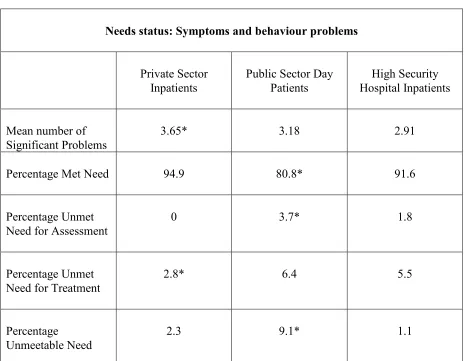
The mean number of Symptoms and Behaviour problems was significantly higher (Kruskal-Wallis one-way ANOVA adjusted for ties followed by post-hoc Mann-Whitney U test comparisons) amongst the Private Sector Inpatients, although the data on needs status reveal that their problems were dealt with very effectively, with high levels of Met Need and low levels of Unmet Need. In contrast, Public Sector Day Patients had proportionately fewer Met Needs, and higher levels of Unmet and Unmeetable Needs. High Security Hospital Inpatients had high levels of Met Need and a level of Unmet Need for Treatment that was similar to the Public Sector Day Patients. These comparisons are outlined in Table 1.
11
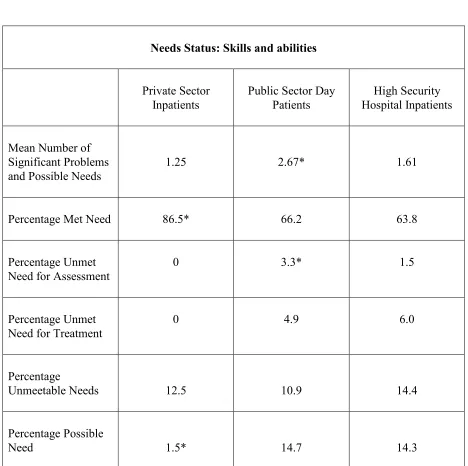
much higher levels of Possible Need than the Private Sector Inpatients. These comparisons are outlined in Table 2.
Analysis of Current Significant Problems Rated as Met Needs
There were 633 instances of a Current Significant Problem across the three groups. Of these 30 were rated as Unmet Needs for Treatment, 9 as Unmet Needs for Assessment, 57 as Unmeetable Needs and 58 as Possible Need. Thus 76% (479) instances of a Current Significant Problem were rated as Met Need. Kruskal-Wallis one-way ANOVA with post-hoc Mann-Whitney U tests indicated that there were significantly fewer Current Significant Problems rated as Met Need amongst the High Security Inpatients (mean 2.1) than amongst the Public Sector Day Patients and the Private Sector Inpatients, who did not differ from each other (mean in both cases was 2.9).
Tables 3 & 4 present details of the treatment status of these Current Significant Problems rated as Met Needs. Across the three groups it is evident that in a small minority of cases effective treatment is being precluded by patients refusing or prematurely terminating interventions that have been offered. There are more instances where potentially wholly effective interventions are being offered, but it is striking that in the majority of instances only partially effective items of care are available. These figures are shown in the right hand column of Tables 3 & 4. Across the nine areas of symptoms and behaviour problems this column accounts for 169 of 281 instances of persistent disability (60%), and across the eleven areas of skills and abilities 136 of 198 instances (69%).
12
there were a total of 43 patients suffering from a Current Significant Problem that was being addressed in an appropriate manner. More than half (25) were receiving at least one item of care that was felt to be potentially wholly effective, and only 14 were receiving treatment that was acknowledged as less than wholly effective and unlikely to become more so. In the area of Skills and Abilities Education provided a similar exception, but the number of patients involved was very small.
DISCUSSION
As previously reported by Brewin et al. (1988), it appears that the MRC Needs for Care Assessment Schedule is capable of detecting meaningful differences between the needs of patients in different settings. This investigation has used such data to further investigate the background of instances of disability that persist despite provision of an apparently appropriate intervention.
There are some methodological reservations. Although the process of assessment and rating was the same across the three sites it was clearly unrealistic to arrange for the raters to be blind to the site from which patients had been drawn, and the identities of the research assistant and clinical psychologist involved in carrying out the ratings differed from site to site. Nevertheless there are a number of differences between the three groups of patients that carry face validity and support the view that the assessments accurately reflect the nature of clinical problems and related treatments in each of the three sites.
13
being treated in an institution which has an established and well deserved reputation for managing people with resistant and persistent mental health problems and behavioural difficulties. It is well resourced and staffed and as a result it is hardly surprising that in comparison with the other groups of patients these have a higher rate of Significant Problems and a lower rate of Unmet Needs for treatment. The Public Sector Day Patients are less intensively supervised and so it is not surprising that these had a lower rate of Met Needs and higher rates of Needs for Assessment and Unmeetable Needs. Furthermore they were older than the other two groups and might therefore be expected to have more complex difficulties. Finally, it is perhaps not surprising that the High Security Hospital Inpatients had the lowest mean number of Current Significant Problems. These patients are accommodated where they are not so much because of the complexity of their mental health problems, but because of the dangers they have presented in the past or are considered to continue to present.
Analysis of Current Significant Problems Rated as Met Needs
These differences in needs status between sites notwithstanding the main purpose of this investigation was to use the NFCAS to explore the background to persistent disability despite appropriate treatment wherever it was present. Not surprisingly, reflecting the sources of these assessments, there was a high rate of such instances. Nearly half the Private Sector Inpatients had a Current Significant Problem with Positive Psychotic Symptoms that was rated as a Met Need; there was a high rate of such problems with Physical Symptoms amongst both the Public Sector
14
Destructive Behaviour amongst both the Private Sector Inpatients and the High Security Hospital Inpatients.
15 available are only partly effective if at all?”.
Although any instance of Unmet Need is unsatisfactory and should not arise, those that did were few in number, amounting to combined ratings of “Unmet Need for Treatment” and “Unmet Need for Assessment” in under 5% of rated problems. In contrast the proportion of Current Significant Problems rated as Met Need was considerably higher (75%). Across the range of Symptoms and Behaviour Problems 34% of these Met Needs were receiving potentially effective interventions whereas 60% were instances in which all items of care that were considered appropriate were rated as only partially effective. Similarly across the range of Skills and Abilities 29% of Met Needs were receiving potentially effective interventions whereas fully 68% were instances in which only partially effective treatments were available.
16
Although this is quite possibly true in areas where more can clearly equate to better, such as the supervision of medication or carers’ respite, it is not automatically the case that more necessarily equals better under all circumstances. There is growing evidence for the value of specific therapeutic interventions that are appropriate for different types of patient and problem over and above the value of merely providing a greater quantity of “eclectic” treatment. Examples include the use of a systemic approach to understand and influence domestic and other relationships that can play a part in maintaining abnormal or unnecessary illness behaviour (Kuipers, 1993), specific cognitive/behavioural approaches to psychotic (Tarrier et al 1993) and neurotic symptoms (Clark et al 1999) and continuing critical review of any psychopharmacological strategies that might be available (Sharma and Kerwin 1996). Our review of needs assessment data suggests that outcomes for those with persistent psychiatric disability are more likely to be improved by attention to genuine therapeutic advances in these areas than by simply providing current interventions more intensively. Such conclusions suggest the need for a somewhat different approach to service improvement than is currently being advocated by service planners.
17
improvement in outcome has to await genuine therapeutic advance, or the incorporation of specific therapeutic skills such as specific, relevant psycho-social interventions into the repertoire of those treating them. In contrast the treatment of patients broadly described as “neurotic” does suggest room for improvement in response to organisational changes that could sharpen case detection, improve compliance and engagement, and widen the use of treatments already established to be effective. Perhaps this is where the injection of additional resources might actually reap greater rewards. Unfortunately these patients tend to be less conspicuous than their chronically psychotic but unfortunately frequently less treatable counterparts.
Acknowledgements:
18 REFERENCES
Bebbington P., Brewin, C.R., Marsden, L., Lesage, A. (1996) Measuring the need for psychiatric treatment in the general population: The community version of the MRC Needs for Care Assessment. Psychological Medicine 26, 229-236.
Bebbington, P., Marsden, L., & Brewin, C.R. (1997) The need for psychiatric treatment in the general population: The Camberwell Needs for Care Survey. Psychological Medicine 27, 821-834.
Bebbington, P., Marsden, L., Brewin, C.R. (1999) The treatment of psychiatric disorder in the community: Report from the Camberwell Needs for Care Survey. Journal of Mental Health 8, 1, 7-17.
Brewin, C.R., Wing, J.K., Mangen, S.P., Brugha, T.S. & MacCarthy, B. (1987) Principles and practice of measuring needs in the long-term mentally ill: the MRC Needs for Care
Assessment. Psychological Medicine 17, 971-981.
Brewin, C.R., Wing, J.K., Mangen, S.P., Brugha, T.S., MacCarthy, B., & Lesage, A. (1988) Needs for care among the long-term mentally ill, a report from the Camberwell High Contact Survey. Psychological Medicine, 18, 457-468.
Brugha, T.S., Wing, J.K., Brewin, C.R., MacCarthy, B., Mangen, S., Lesage, A. & Mumford, J. (1988) The problems of people in long-term psychiatric day care. An introduction to the Camberwell High Contact Survey. Psychological Medicine 18, 443-456.
Burns T., Good F., Fahy T., Thompson S., Tyrer P., White I. (1999) Intensive versus standard case management for severe psychotic illness. A randomised trial. Lancet 353, 2185-2189.
Burns T., Fiander M., Kent A., Ukoumunne O.C., Byford S., Fahy T., Kumar R. (2000) Effects of case-load size on the process of care of patients with severe psychotic illness. Report from the UK 700 trial. British Journal of Psychiatry 177, 427-433.
Clark D.M., Salkovskis P.M., Hackmann A., Wells A., Ludgate J., Gelder M. (1999) Brief cognitive therapy for panic disorder: A randomized controlled trial. Journal of Consulting and Clinical Psychology 67, 583-589.
Department of Health (1999) National Service Framework for Mental Health. Modern Standards and Service Models.
19
Lesage, A.D., Cope, S.J., & Pezeshgi, S. (1991) Assessing the needs for care of non-psychotic patients. A trial with a new standardized procedure. Social Psychiatry and Psychiatric Epidemiology 26, 281-286.
Marshall, M., Bond, G., Stein, L.I., Shepher, G., McGrew, J., Hoult, J., Rosen, A., Huxley, P., Diamond, R.J., Warner, R., Olsen, M., Latimer, E., Goering, P., Craig, T.K.J., Meisler, N., Test M. (1999) PRiSM psychosis study. Design limitations, questionable conclusions. British Journal of Psychiatry 175, 501-503.
Middleton, H.C., Regueira, M.F., & Bramley, M. (1996) Formal needs assessment in practice: An application of the MRC Needs for Psychiatric Care Assessent Schedule. Journal of Mental Health 5, 1, 65-75.
Phelan, M., Slade, M., Thornicroft, G., Dunn, G., Holloway, F., Wykes, T., Strathdee, G., Loftus, L., McCrone, P., & Hayward, P. (1995) The Camberwell Assessment of Need: The Validity and Reliability of an Instrument to Assess the Needs of People with Severe Mental Illness. British Journal of Psychiatry 167, 589-595.
Stein L.I., Test M.A. Alternative to mental hospital treatment. 1. Conceptual model,
treatment programme and clinical evaluation. Archives of General Psychiatry 37, 392-397. Sharma T., Kerwin R. (1996) Biological determinants of difficult to treat patients with schizophrenia. British Journal of Psychiatry 169, Suppl 31 5 – 9.
Tarrier N., Beckett R., Harwood S., Baker A., Yusupoff L., Ugaretebum I. (1993) A trial of two cognitive behavioural methods of treating drug resistant psychotic symptoms in
Schizophrenia patients. 1. Outcome. British Journal of Psychiatry 162, 524-532.
Teague, G.B., Bond, G.R., & Drake, R.E. (1998) Program fidelity in assertive community treatment: development and use of a measure. American Journal of Orthopsychiatry, 68, 216-232.
Thornicroft, G., Wykes, T., Holloway, F., Johnson, S., & Szmukler, G. (1998a) From efficacy to effectiveness in community mental health services. British Journal of Psychiatry 173, 423-427.
Thornicroft, G., Strathdee, G., Phelan, M., Holloway, F., Wykes, T., Dunn, G., McCrone, P., Leese, M., Johnson, S., Szmukler, G. (1998b) Rationale and design. PRiSM Psychosis Study 1. British Journal of Psychiatry 173, 363-370.
20 Table 1
Needs status: Symptoms and behaviour problems
Private Sector Inpatients
Public Sector Day Patients
High Security Hospital Inpatients
Mean number of Significant Problems
3.65* 3.18 2.91
Percentage Met Need 94.9 80.8* 91.6
Percentage Unmet Need for Assessment
0 3.7* 1.8
Percentage Unmet Need for Treatment
2.8* 6.4 5.5
Percentage
Unmeetable Need
2.3 9.1* 1.1
21 Table 2
Needs Status: Skills and abilities
Private Sector Inpatients
Public Sector Day Patients
High Security Hospital Inpatients
Mean Number of Significant Problems and Possible Needs
1.25 2.67* 1.61
Percentage Met Need 86.5* 66.2 63.8
Percentage Unmet Need for Assessment
0 3.3* 1.5
Percentage Unmet Need for Treatment
0 4.9 6.0
Percentage
Unmeetable Needs 12.5 10.9 14.4
Percentage Possible
Need 1.5* 14.7 14.3
2