Original citation:
Farihi, J., Parsons, S. G. and Gaensicke, B. T. (Boris T.). (2017) A circumbinary debris disk in a polluted white dwarf system. Nature Astronomy, 1 (3). 0032.
Permanent WRAP URL:
http://wrap.warwick.ac.uk/86779
Copyright and reuse:
The Warwick Research Archive Portal (WRAP) makes this work by researchers of the University of Warwick available open access under the following conditions. Copyright © and all moral rights to the version of the paper presented here belong to the individual author(s) and/or other copyright owners. To the extent reasonable and practicable the material made available in WRAP has been checked for eligibility before being made available.
Copies of full items can be used for personal research or study, educational, or not-for-profit purposes without prior permission or charge. Provided that the authors, title and full
bibliographic details are credited, a hyperlink and/or URL is given for the original metadata page and the content is not changed in any way.
Publisher’s statement:
Published version: http://dx.doi.org/10.1038/s41550-016-0032
A note on versions:
The version presented here may differ from the published version or, version of record, if you wish to cite this item you are advised to consult the publisher’s version. Please see the ‘permanent WRAP URL’ above for details on accessing the published version and note that access may require a subscription.
arXiv:1612.05259v1 [astro-ph.EP] 15 Dec 2016
A circumbinary debris disk
in a polluted white dwarf system
J. Farihi
1,5∗, S. G. Parsons
2,3, B. T. G¨ansicke
41Department of Physics and Astronomy, University College London, London WC1E 6BT, UK
2Departamento de F´ısica y Astronom´ıa, Universidad de Valpara´ıso, Valpara´ıso 2360102, Chile
3Department of Physics and Astronomy, University of Sheffield, Sheffield S3 7RH, UK
4Department of Physics, University of Warwick, Coventry CV5 7AL, UK
5STFC Ernest Rutherford Fellow
∗
To whom correspondence should be addressed; E-mail: [email protected]
Planetary systems commonly survive the evolution of single stars, as evidenced
by terrestrial-like planetesimal debris observed orbiting and polluting the
sur-faces of white dwarfs (1, 2). This letter reports the identification of a
circumbi-nary dust disk surrounding a white dwarf with a substellar companion in a
2.27 hr orbit. The system bears the dual hallmarks of atmospheric metal
pol-lution and infrared excess (3, 4), however the standard (flat and opaque) disk
configuration is dynamically precluded by the binary. Instead, the detected
reservoir of debris must lie well beyond the Roche limit in an optically thin
configuration, where erosion by stellar irradiation is relatively rapid. This
finding demonstrates that rocky planetesimal formation is robust around close
The formation and evolution of planetary systems around close binary stars is a challenging
problem, yet provides insight into the growth of planetesimals within evolving protoplanetary
disks and planet formation in general. The small but increasing number of transiting
circumbi-nary planets detected with Kepler (5, 6) are providing the first tests of theoretical formation
models. To date, it has been shown that in situ formation is unfavorable for most of these
Neptune- to Jupiter-sized bodies due to the destructive, dynamical effects of the central binary
on planetesimal agglomeration in the regions where the planets currently orbit (7, 8, 9).
How-ever, for a range of masses including small planets, recent models predict favorable conditions
for planetesimal growth within the snow line, and thus promoting efficient terrestrial planet
formation around binaries (10, 11, 12).
Atmospheric pollution in white dwarf stars offers a unique and powerful window into the
assembly and chemistry of terrestrial exoplanets. There are now more than three dozen
plan-etary system remnants made evident based on thermal and line emission from circumstellar
disks (2), and several hundred where photospheric metals indicate ongoing or recent accretion
of planetary debris (13). The current paradigm of disrupted and accreted asteroids has been
unequivocally confirmed by numerous studies, including the recent detection of complex and
rapidly evolving photometric transits from debris fragments orbiting near the Roche limit of one
star (14, 15, 16). To date, all polluted white dwarfs with detailed analyses indicate the sources
are rocky planetesimals comparable in both mass and composition to large Solar System
aster-oids (17, 18, 1), and thus objects that formed within a snow line. These findings unambiguously
demonstrate that large planetesimal formation in the terrestrial zone of stars is robust and
com-mon.
Until now, over 90% of such dusty and polluted white dwarf systems have been discovered
among single stars, with a small fraction belonging to sufficiently wide binaries (a ≫100AU)
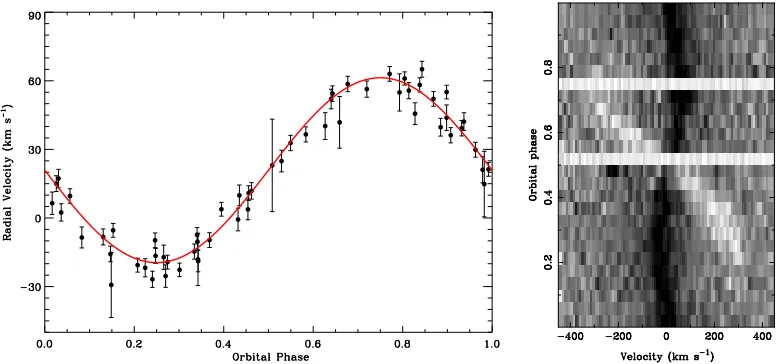
Figure 1: Phased radial velocity diagrams. The left panel plots the phased radial velocities for SDSS 1557 based
on measurements of the MgIIabsorption line and their associated errors (see Methods), with the resulting
parame-ters given in Table 1. The right panel shows a trailed spectrum for the Hαcomponent of SDSS 1557, where darker
features represent lower fluxes and lighter features indicate higher fluxes. The absorption component follows iden-tically that of MgII, and thus both features are intrinsic to the white dwarf photosphere. The emission component
is observed in anti-phase with the primary, and therefore originates from the irradiatively heated companion. The
two horizontal blank lines represent phase bins without coverage.
The white dwarf SDSS J155720.77+091624.6 (hereafter SDSS 1557) exhibits strong infrared
excess fromT ≈1100K dust, and possesses one of the highest known metal abundances (3, 4),
but has a distinctive low mass (M . 0.45M⊙) that indicates a helium core. Such white dwarf
masses are too low for single stars to attain within the age of the Galaxy, implying SDSS 1557
belongs to a class of remnants whose evolution was truncated prior to helium ignition (20, 19).
These low-mass, helium core white dwarfs are often found to be short-period, spectroscopic
binaries (21), consistent with efficient (common) envelope ejection during the first ascent giant
branch.
SDSS 1557 was observed on multiple occasions with the GMOS and X-Shooter
spectro-graphs at Gemini Observatory South and the Very Large Telescope respectively. The lower
resolution GMOS data hinted at radial velocity changes in the MgII 4482 ˚A absorption
semi-White Dwarf Primary Binary
p(h) 2.273153±0.000002
SpT DAZ t0(HJD) 2457201.0551±0.0004
g(AB mag) 18.43 K1(km s−1) 40.42±0.69
Teff (K) 21 800±800 K2(km s−1) 288.3±3.0
log g(cm s−2) 7.63±0.11 γ
1 (km s−1) 20.91±0.51
M1(M⊙) 0.447±0.043 γ2 (km s−1) 6.2±1.4
log(L/L⊙) −1.25±0.08 z(km s
−1) 14.7±1.5
Cooling Age (Myr) 33±5 M2(M⊙) 0.063±0.002
d(pc) 520±35 i(◦
) 62±3
a(R⊙) 0.70±0.02
Table 1: Stellar and binary parameters. White dwarf parameters Teff andlog g were derived from fitting atmospheric models to the higher Balmer lines for individual X-shooter spectra, and the adopted errors are the
standard deviation from all 60 measurements. Errors in derived stellar parameters were calculated by propagating the uncertainties in the adoptedTeff,logg, and published photometry through white dwarf evolutionary models
(19). The binary and companion parameters, including errors, were calculated from analysis of the radial velocity
measurements of the MgIIline in all X-shooter spectra (see Methods), and Kepler’s laws. Notet0is defined as the inferior conjunction of the white dwarf, andK2is calculated assuming the observed emission is uniformly spread
across the inner hemisphere of the companion.
amplitudeK1 = 40.4km s
−1(Figure 1). A close examination of the Hαregion reveals an
emis-sion feature arising from the irradiated companion, seen in anti-phase and with semi-amplitude
of 267.6 km s−1. Assuming the emission is uniformly spread across the inner hemisphere of
the companion, this implies a binary mass ratioM2/M1 = 0.14. Both the radial velocity data
and the spectral energy distribution are consistent with a substellar companion of 0.063M⊙
(66MJup) seen at an orbital inclination near 63◦. Table 1 lists all system parameters with
un-certainties.
Figure 2 shows the expected infrared emission from a mid-L type substellar companion at
the white dwarf distance based on the derived stellar parameters. Ultracool dwarfs earlier than
L3 can be firmly ruled out, as the expected fluxes blueward of 2µm would be significantly
brighter than those observed. At the same time, the substellar companion cannot account for
the total excess emission in the system over the2−5µm region, as the 4.5µm flux is 5 to 6
Figure 2: Spectral energy distribution. Previously reported multi-wavelength photometric data for SDSS 1557
are plotted as blue error bars (4), with the stellar flux from a pure hydrogen atmospheric model is shown as a
dotted line. Overplotted as a dashed line is an 1100 K blackbody fitted to the strong, infrared dust emission, and an L5-type brown dwarf is shown as red circles; any companion earlier than L3 is ruled out by the photometry below
2µm. The measured 4.5µm flux from the system is between 5 and 6 times brighter than any allowed companion,
and hence must be due to circumbinary dust. There is a notable deficit in ultraviolet flux relative to the stellar model, but a metal-rich atmosphere cannot account for the mismatch; neither the photospheric opacity nor the
emergent flux are strongly affected by the presence of trace metals in a hydrogen-rich star of this temperature. The
presence of a vertically extended dust shell may account for additional extinction at these shortest wavelengths.
the predicted 4.5µm flux from a mid-L type companion is nearly doubled – mimicking the
peak-to-peak changes seen in related systems due to irradiation from the primary (23) – the
observed flux remains significantly higher. SDSS 1557 thus has both a strong infrared excess
and atmospheric metal pollution at high abundance. It is therefore similar to more than three
dozen known white dwarfs that are accreting planetary debris from circumstellar reservoirs that
are consistent with tidally disrupted minor planets.
The identification of orbiting dust and atmospheric pollution within a close binary presents
a fundamental challenge to the disk modeling, as the canonical flat and opaque ring geometry is
dynamically prohibited. This standard disk would nominally be completely contained between
M2 = 0.063M⊙, and a semimajor axis a = 0.70R⊙, stable circumstellar orbits are allowed
within0.4a≈0.3R⊙of the primary, and stable circumbinary orbits are allowed beyond2.0a≈
1.4R⊙ (24). The emitting dust cannot lie interior to0.3R⊙, where even shielded grains would
attainT > 1700K and thus be inconsistent with the observed thermal emission. Therefore the
solid material must lie exterior to1.4R⊙, but at this distance a flat, opaque disk would be no
warmer than 500 K, and by itself inconsistent with the infrared data. Blackbody grains with
T = 1100K will have an orbital radius of3.3R⊙in this system; this is the only configuration
consistent with both the observed emission and the dynamical effects of the binary. Figure 3
provides an illustration of the system.
This Teff = 21 800K hydrogen-rich white dwarf has a heavy element sinking timescale
of only a few weeks (25), and observations of the MgII feature include detections in 2010
April, 2012 May, 2014 May, and 2016 July, with no observed change in line strength. Thus
SDSS 1557 is in a steady state of accretion from the circumbinary disk; the inferred accretion
rate is M˙ ≃ 6×10⁸g s−1 assuming a bulk Earth abundance for Mg. Captured material from
the companion – with solar abundance Mg – can be dismissed as the source of atmospheric
enrichment, since this would require the brown dwarf to either 1) have a wind rate higher than
the solar value (26), or 2) be twice its normal size to overfill its Roche lobe. It is noteworthy
that the similar and even closer binary WD 0137–349 neither exhibits atmospheric metals nor
an infrared excess above that expected for its components (27).
This is the first case of dusty debris inferred to be exterior to the Roche limit of a
metal-accreting white dwarf (28, 29). The surrounding reservoir was likely created via binary driving
of debris generated during a catastrophic fragmentation interior to the Roche limit. Material
must flow onto the stellar surface via stable streaming from the inner edge of the circumbinary
disk, where solids will gradually sublimate as they spiral inward from 3.3R⊙. This process is
Figure 3: Circumbinary system geometry. Diagrams illustrating SDSS 1557 in the primary reference frame,
where the entire system is drawn within a single plane as viewed from above, with the stable and unstable orbital
regions (24) labelled on the left. The sizes of the binary components are accurately portrayed in both diagrams, and the companion is surrounded by a dashed boundary delineating a circular approximation of its Roche lobe.
The lifetime of an optically thin dust reservoir is determined by Poynting-Robertson (PR)
drag, scaling linearly with particle size and yielding 9 yr for micron-sized grains orbiting SDSS 1557
at3.3R⊙. Therefore, the circumbinary dust disk surrounding – and polluting – the white dwarf
is either 1) in a transient phase of rapid erosion, 2) being replenished by additional dust sources,
or 3) contains a significant mass of particles larger than 10-30µm. In the second case, the
observed 1100 K dust shell could be fed by an exterior, flat and cold disk that is beyond the
gravitational influence of the binary.
Models of optically thin disk accretion onto single white dwarfs predict rates two orders
of magnitude lower than that inferred to be ongoing in this system (32), where those
calcula-tions were made for vertically narrow (i.e. flat) disks, as expected from rapid dynamical
relax-ation around single stars. The accretion rate in this system therefore suggests the disk must
will eventually experience gravitational encounters with the binary, and this could produce and
maintain a vertically thick yet optically thin, disk configuration. Comparing the current,
esti-mated rate of accretion with the theoretical maximum for PR drag on optically thin dust, implies
the disk intercepts a fractionτ = 0.0025of the total starlight. However, this is only about half
of LIR/L∗ = 0.0055obtained from fitting the spectral energy distribution, and may imply the
accretion rate is actually more than twice the estimate based on models.
A cylindrical dust shell with radius3.3R⊙and height1.1×109cm (1.0 white dwarf radius)
would cover a fractional area of 0.0025. Such a shell might account for the observed ultraviolet
fluxes shown in Figure 2, which sit below the atmospheric model and cannot be adequately
explained by interstellar reddening, as this would result in a significantly lower effective
tem-perature than derived here and by other authors (3). If correct, ultraviolet spectroscopy has the
potential to detect gas absorption along the line of sight through the shell.
The progenitors of extant white dwarfs are typically A- and F-type stars with masses in the
range1.2−3.0M⊙, a stellar population that is not readily probed for inner planetary systems
using conventional techniques. The SDSS 1557 binary was thus born with a low mass ratio in
the range M2/M1 = 0.02−0.05, and likely with a semimajor axis less than an AU or so, in
order to form a common envelope on the first ascent giant branch. Excepting the low mass ratio,
the progenitor binary would have been similar to the eclipsing binaries with planets detected
by Kepler (33). However, the surviving planetary bodies in the SDSS 1557 system likely had
primordial orbits beyond a few AU to escape engulfment.
At the current steady-state accretion rate, over1017g of planetary debris has been deposited
onto the white dwarf since its discovery in 2010. This is the bare minimum mass of the reservoir,
yielding a parent body with diameter greater than 4 km for typical asteroid densities. This
implies that the formation of large planetesimals in the SDSS 1557 system was not inhibited
planetesimals were avoided.
If this polluted and dusty white dwarf is similar to the well-studied larger population, then
the parent body of the debris was likely formed within the snow line of the progenitor system,
and thus implying that rocky planet formation was robust in this circumbinary environment.
These observations therefore support a picture where additional mechanisms can promote
plan-etesimal growth in the terrestrial zones of close binary stars, which are predicted to be
sub-stantially wider than in planet forming disks around single stars (34). This interpretation can
be confirmed with ultraviolet spectroscopy of key carbon and oxygen transitions, as these will
easily distinguish between rocky and icy parent bodies.
References and Notes
1. Jura, M., Young, E. D. Extrasolar cosmochemistry, Annu. Rev. Earth Planet. Sci., 42, 45–67
(2014)
2. Farihi, J. Circumstellar debris and pollution at white dwarf stars, New Astron. Rev., 71, 9–34
(2016)
3. Girven, J., G¨ansicke, B. T., Steeghs, D., Koester, D. DA white dwarfs in Sloan Digital Sky
Survey Data Release 7 and a search for infrared excess emission, Mon. Not. R. Astron. Soc.,
417, 1210–1235 (2011)
4. Farihi, J., G¨ansicke, B. T., Steele, P. R., Girven, J., Burleigh, M. R., Breedt, E., Koester, D.
A trio of metal-rich dust and gas discs found orbiting candidate white dwarfs with K-band
excess, Mon. Not. R. Astron. Soc., 421, 1635 (2012)
6. Welsh, W. F., et al. Transiting circumbinary planets Kepler-34b and Kepler-35b, Nat., 481,
475–479 (2012)
7. Paardekooper, S., Leinhardt, Z. M., Th´ebault, P., Baruteau, C. How not to build Tatooine:
the difficulty of in situ formation of circumbinary planets Kepler 16b, Kepler 34b, and Kepler
35b, Astrophys. J., 754, L16–L20 (2012)
8. Pelupessy, F. I., Portegies Zwart, S. The formation of planets in circumbinary discs, Mon.
Not. R. Astron. Soc., 429, 895–902 (2013)
9. Lines, S., Leinhardt, Z. M., Paardekooper, S., Baruteau, C., Thebault, P. Forming
circumbi-nary planets: N-body simulations of Kepler-34, Astrophys. J., 782, L11–L16 (2014)
10. Rafikov, R. R. Building Tatooine: suppression of the direct secular excitation in Kepler
circumbinary planet formation, Astrophys. J., 764, L16–L21 (2013)
11. Martin, R. G., Armitage, P. J., Alexander, R. D. Formation of circumbinary planets in a
dead zone, Astrophys. J., 773, 74–80 (2013)
12. Bromley, B. C., Kenyon, S. J., Planet formation around binary stars: Tatooine made easy,
Astrophys. J., 806, 98–118 (2015)
13. Koester, D., G¨ansicke, B. T., Farihi, J. The frequency of planetary debris around young
white dwarfs, Astron. Astrophys., , 566, A34–A53 (2014)
14. Vanderburg, A., et al. A disintegrating minor planet transiting a white dwarf, Nat., 526,
546–549 (2015)
15. Xu, S., Jura, M., Dufour, P., Zuckerman, B. Evidence for gas from a disintegrating
16. G¨ansicke, B. T., et al. High-speed photometry of the disintegrating planetesimals at
WD 1145+017, Astrophys. J., 818, L7–L12 (2016)
17. G¨ansicke, B. T., Koester, D., Farihi, J., Girven, J., Parsons, S. G., Breedt, E. The chemical
diversity of exo-terrestrial planetary debris around white dwarfs, Mon. Not. R. Astron. Soc.,
424, 333–347 (2012)
18. Farihi, J., G¨ansicke, B. T., Koester, D. Evidence for water in the rocky debris of a disrupted
extrasolar minor planet, Sci., 342, 218–220 (2013)
19. Fontaine, G., Brassard, P., Bergeron, P. The potential of white dwarf cosmochronology,
Publ. Astron. Soc. Pacific, 113, 409–435 (2001)
20. Sweigart, A. V. The determination of the core mass at the helium flash in globular cluster
stars, Astrophys. J., 426, 612–620 (1994)
21. Marsh, T. R., Dhillon, V. S., Duck, S. R. Low-mass white dwarfs need friends ? five new
double-degenerate close binary stars, Mon. Not. R. Astron. Soc., 275, 828–840 (1995)
22. Patten, B. M. et al. Spitzer IRAC photometry of M, L, and T dwarfs, Astrophys. J., 651,
502–516 (2006)
23. Casewell, S. L., et al. Multiwaveband photometry of the irradiated brown dwarf WD 0137–
349B, Mon. Not. R. Astron. Soc., 447, 3218–3226 (2015)
24. Holman, M. J., Wiegert, P. A. Long-term stability of planets in binary systems, Astrophys.
J., 117, 621–628 (1999)
25. Koester, D. Accretion and diffusion in white dwarfs, Astron. Astrophys., , 498, 517–525
26. Debes, J. H. Measuring M dwarf winds with DAZ white dwarfs, Astrophys. J., 652, 636–
642 (2006)
27. Maxted, P. F. L., Napiwotzki, R., Dobbie, P. D., Burleigh, M. R. Survival of a brown dwarf
after engulfment by a red giant star, Nat., 442, 543–545 (2006)
28. Jura, M., Farihi, J., Zuckerman, B. Externally polluted white dwarfs with dust disks,
Astro-phys. J., 663, 1285–1290 (2007)
29. Farihi, J., Jura, M., Zuckerman, B. Infrared signatures of disrupted minor planets at white
dwarfs, Astrophys. J., 694, 805–819 (2009)
30. Artymowicz, P., Lubow, S. H. Mass flow through gaps in circumbinary disks, Astrophys.
J., 467, L77–L80 (1996)
31. Terquem, C., Sørensen-Clark, P. M., Bouvier, J. A circumbinary disc model for the
vari-ability of the eclipsing binary CoRoT 223992193, Mon. Not. R. Astron. Soc., 454, 3472–3479
(2015)
32. Bochkarev, K. V., Rafikov, R. R. Global modeling of radiatively driven accretion of metals
from compact debris disks onto white dwarfs, Astrophys. J., 741, 36–44 (2011)
33. Kirk, B., et al. Kepler eclipsing binary stars. VII. the catalog of eclipsing binaries found in
the entire Kepler data se, Astron. J., 151, 68–88 (2016)
34. Vartanyan, D., Garmilla, J. A., Rafikov, R. R. Tatooine nurseries: structure and evolution
Acknowledgments The authors acknowledge Gemini Observatory for the award of
Direc-tor’s Discretionary Time for program GS-2012A-DD-3. The X-shooter observations were
ob-tained under ESO programs 093.D-0030 and 097.C-0386. J. Farihi thanks R. Rafikov and
D. Veras for useful discussions, and acknowledges support from the United Kingdom
Sci-ence and Technology Facilities Council in the form of an Ernest Rutherford Fellowship
(ST/J003344/1). S. G. Parsons and B. T. G¨ansicke received financial support from the
Eu-ropean Research Council under the EuEu-ropean Union’s7thFramework Programmes n. 340040
(HiPERCAM) and n. 320964 (WDTracer), respectively.
Author contributions J. Farihi was the primary author, organized the observations,
ana-lyzed multi-wavelength data, implemented infrared models, and interpreted the overall data.
S. G. Parsons reduced optical spectra, performed radial velocity and time-series analysis,
and calculated all binary parameters. B. T. G¨ansicke analyzed optical spectra and performed
model atmosphere fitting to determine the primary stellar parameters. All authors contributed
to and commented on the manuscript. Correspondence and requests for materials should be
Methods
Observations and white dwarf parameters. The white dwarf SDSS 1557 was observed with
three optical spectrographs covering the higher Balmer lines, and thus enabling as many
in-dependent determinations ofTeff andlog g. In addition to the ISIS spectrum previously
pub-lished (4), new observations were obtained at Gemini South and the VLT. Director’s
Dis-cretionary Time was awarded to obtain spectra covering important metal features as well as
the higher Balmer lines using the GMOS spectrograph (35) on Gemini South in 2012 May,
with the B600 grating and a0.′′
75slit. Data were taken on two non-consecutive nights, with
three individual exposures of 900 s obtained each night. Each of the six spectra were analyzed
separately by fitting the temperature- and gravity-sensitive Balmer lines with white dwarf
at-mospheric models. This yields a statistical, weighted average ofTeff = 21 800±600K and
log g = 7.50±0.10, corresponding toM = 0.40±0.04M⊙. The combined data are shown
in Supplementary Figure 1 and reveal CaIIK absorption, whereas only MgII was detected in
the ISIS data. Analysis of individual GMOS spectra revealed0.2−0.4A shifts in the Mg˚ II
line, but no firm conclusion could be reached due to the low spectral resolution and the small
number of spectra.
Medium-resolution spectra covering the entire optical wavelength range were obtained with
X-Shooter (36) on the VLT during two observing periods. In 2014 May, data were taken over
two consecutive half nights, in below average weather conditions and without the benefit of
the atmospheric dispersion corrector. The instrument was used in staring mode as the target
is too faint to yield usable signal in the NIR arm of the spectrograph. A total of 18 usable
spectra were acquired, each with roughly 1200 s exposure in both the UVB and VIS arms
using the0.′′
8and0.′′
7slits respectively. With a similar instrument setup in 2016, SDSS 1557
spectra. All spectra were fitted individually with atmospheric models, resulting in Teff =
21 810±790K and log g = 7.63±0.11, corresponding toM = 0.45±0.04M⊙. As this
data set contains the largest number of exposures, the highest resolution, and S/N≈ 20per
spectrum, the derived X-shooter parameters were adopted for SDSS 1557. A summary of all
spectroscopic observations are given in Supplementary Table 1.
Radial velocity analysis. Using the MgII 4482 ˚A line in each of the individual X-Shooter
spectra, the radial velocity of the white dwarf was measured for each of the 60 observations.
Each spectrum was fitted with a combination of a straight line and a Gaussian around the
absorption line, with the central position of the Gaussian allowed to vary, and the errors
deter-mined using the method of damped least-squares. The resulting velocity measurements and
uncertainties are given in Supplementary Table 2, and were fitted with a sine wave of the form:
v(t) =γ1+K1sin
2π(t−t0)
p
, (1)
where p is the orbital period and t0 is the time of inferior conjunction of the white dwarf.
The results of this fit are detailed in Table 1 of the main paper, including the 2.273 hr binary
period.
The only spectral features visible from the companion in the X-shooter data are emission
lines arising from its heated inner hemisphere, with the Hαline strongest. The radial velocity
of the Hα emission was measured using the same method as the white dwarf MgII velocity
measurements, but with one Gaussian for the white dwarf absorption component and another
Gaussian for the emission feature. The latter was allowed to vary in position and strength,
semi-amplitude of the Hα emission line was Kem = 267.6±2.6km s−1, where the radial
velocities of the observed emission and the companion center-of-mass are related by (38):
K2 =
Kem
1−[f(1 +q)R2/a], (2)
whereq = M2/M1 is the binary mass ratio,R2 is the radius of the secondary, and a is the
orbital separation. Here,f is a constant bound by the two extreme cases: all emission is from
the substellar point andf = 1; the emission is spread uniformly over the surface, thus tracking
the center-of-mass andf = 0. These extremes place limits on the actual radial velocity of the
brown dwarf, yielding 0.056M⊙(59MJup)< M2 <0.068M⊙(71MJup), confirming a
sub-stellar nature. However, it is highly probable that the emission originates only from the heated
hemisphere of the companion, and a more accurate estimate of the physical and binary
param-eters can be made by assuming the companion emission is uniformly spread across the inner
hemisphere. This approach has been substantiated by observations of spectroscopic binaries
where the secondary exhibits both heated emission and intrinsic absorption components (38).
In this casef = 0.42and the estimate of the true radial velocity isK2 = 288.3±3.0km s−1,
with a secondary mass of0.063M⊙(66MJup) as given in the main paper.
Modeling of companion, dust, and accretion. The infrared properties of SDSS 1557 were
modeled in the context of previously published multi-wavelength photometry (4), including
Spitzer IRAC data, but now as a binary system with well-constrained parameters. Previous
modeling of the strong infrared excess detected in the 2−5µm range employed only the
standard, flat and opaque dust disk geometry, whose temperature-radius relationship is given
r≈
2 3π
1/3
Teff
T
4/3
R∗ (3)
whereT is the dust temperature andR∗is the stellar radius. Based on the photometric spectral
energy distribution shown in Figure 2, this model predicts a disk that extends from0.4R⊙and
T = 1400K, to0.8R⊙ andT = 800K (4). However, in light of the binary properties, there
are no stable orbits within this entire region (24) and hence the canonical disk model can be
ruled out.
Next the companion was modeled using published absolute magnitudes and infrared
photom-etry for L-type dwarfs (40, 22). Four models for the companion were constructed by adopting
typical absolute magnitudes for L0, L3, L5, and L8 dwarfs in theJHK and IRAC bands, then
adjusting their flux to the 520 pc distance of the SDSS 1557 system. The best fit was found
for an L5-type companion, as this is most consistent with the1−2µm photometry, but an L3
dwarf is just allowed within the errors. Spectral types later than L5 are also possible, as 100%
of the observed infrared excess could be due to dust emission.
No cool dwarf emission can account for the strong excess at IRAC wavelengths, and a
blackbody dust model was successfully fitted to the infrared photometry. This model has a
temperature-radius dependence of (41):
r≈ 1
2
Teff
T
2
R∗ (4)
For theT = 1100K dust model shown in Figure 2, blackbody grains have an orbital radius of
3.3R⊙ and lie in the stable circumbinary region.
Three models were tested to account for the ongoing accretion in SDSS 1557, as evidenced
rate of accretion is based on a steady-state balance that is highly likely given the diffusion
timescale of only a few weeks (25), and based on the published magnesium abundance [Mg/H]
=−4.5(4). In a steady state, the total mass accretion rate onto the primary can be calculated
as follows (2):
˙
M1 ≈
1
A
XMgMmix
τMg
≈6×10⁸g s−1
(5)
whereMmixis the stellar mass above Rosseland optical depth 2/3 where the accreted material
is fully mixed, XMg is the mass fraction of Mg within this atmospheric layer, τMg is the
sinking timescale for Mg, andArepresents the mass fraction of Mg within the source material.
Only one accretion model can account both for the circumbinary dust and the atmospheric
pollution in the star simultaneously, and that is direct deposition of material originating from
the dust reservoir. Such a flow would be driven by Poynting-Robertson drag at a rate near
6.0×10⁸g s−1for a bulk Earth abundance of Mg [A= 0.16(45)], which compares well with
predictions based on the fractional infrared luminosity of the dust disk (32).
For completeness, two additional models assume that Mg is carried in solar abundance [A=
0.00069 (47)], via binary mass transfer as Roche lobe overflow or in a captured, wind-like
outflow from the substellar companion. In these cases the total mass accretion rate would
be at least 1.4× 10¹¹g s−1 (2.3×10⁻¹⁵M
⊙yr
−1). For this system, the Roche lobe of the
companion is well approximated by a circular radius (37):
RL
a = 0.462
q
1 +q
1/3
(6)
This givesRL = 0.16R⊙ and is twice as large as models predict for substellar objects of
and hot Jupiter exoplanets, where inflated radii have been directly observed (43), and the
incident flux received by the companion of SDSS 1557 is comparable at7×109erg s−1cm−2.
However, hot Jupiters can be 100 times less massive than the brown dwarf in this system,
and hence the energy requirement to inflate such an object would be commensurately greater.
The system NN Ser has a 57 000 K white dwarf irradiating a 0.1M⊙ M dwarf with incident
flux3×1011erg s−1cm−2, but precise measurements of the secondary radius reveal it to be
only 10% larger than model predictions (44). It is therefore unlikely that the companion to
SDSS 1557 is filling its Roche lobe.
If the white dwarf were instead accreting wind from the substellar companion, it would be an
unexpected find; all known or suspected wind-accreting white dwarfs are in polars or detached
binaries with stellar (M-type) companions (38). In the case that such material is optimally
captured in a Bondi-Hoyle flow onto SDSS 1557, the required mass-loss from the companion
can be expressed as (26):
˙
M2 = ˙M1
a2v4
G2M2 1
(7)
Here, v is taken as the wind velocity with orbital velocity ignored; this would only serve
to increase M˙2. For an escape velocity of 600 km s−1 the required mass-loss rate from the
companion is 1.5 × 10⁻¹⁴M
⊙yr
−1 and nearly equal to the solar value. However, a more
realistic, gravitational capture would be described as (46):
˙
M2 = ˙M1
a2v2
GM1R1
For the same parameters as above, this results in a companion wind rate of 4.3 ×
10−13M
⊙yr
−1. Either case would require the brown dwarf to have a wind comparable to
or higher than that of the Sun, and can hence be dismissed.
Therefore the best model for the ongoing accretion is due to radiatively driven infall from the
circumbinary dust disk.
Data availability The spectroscopic data analyzed for radial velocity variations are available
via the ESO and Gemini archives, while photometric data are previously published.
References
35. Hook, I., Jørgensen, I., Allington-Smith, J. R., Davies, R. L., Metcalfe, N., Murowinski,
R. G., Crampton, D. The Gemini-North Multi-Object Spectrograph: performance in imaging,
long-slit, and multi-object spectroscopic modes, Publ. Astron. Soc. Pacific, 116, 425–440
(2004)
36. Vernet, J., et al. X-shooter, the new wide band intermediate resolution spectrograph at the
ESO Very Large Telescope, Astron. Astrophys., 536, A105–A119 (2011)
37. Eggleton, P. P. Approximations to the radii of Roche lobes, Astrophys. J., 268, 368–369
(1983)
38. Parsons, S. G., et al. A precision study of two eclipsing white dwarf plus M dwarf binaries,
Mon. Not. R. Astron. Soc., 420, 3281–3297 (2012)
39. Jura, M. A tidally disrupted asteroid around the white dwarf G29-38, Astrophys. J., 584,
L91–L94 (2003)
40. Dahn, C. C., et al. Astrometry and photometry for cool dwarfs and brown dwarfs, Astron.
41. Wyatt, M. C. Evolution of debris disks, Annu Rev. Astron. Astrophys., 46, 339–383 (2008)
42. Baraffe, I., Chabrier, G., Barman, T. S., Allard, F., Hauschildt, P. H. Evolutionary models
for cool brown dwarfs and extrasolar giant planets, Astron. Astrophys., 402, 701–712 (2003)
43. Fortney, J. J., et al. Discovery and atmospheric characterization of giant planet Kepler-12b:
an inflated radius outlier, Astrophys. J. Supp., 197, 9–20 (2011)
44. Parsons, S. G., Marsh, T. R., Copperwheat, C. M., Dhillon, V. S., Littlefair, S. P., G¨ansicke,
B. T., Hickman, R. Precise mass and radius values for the white dwarf and low mass M dwarf
in the pre-cataclysmic binary NN Serpentis, Mon. Not. R. Astron. Soc., 402, 2591–2608 (2010)
45. All`egre, C., Manh`es, G., Lewin, ´E. Chemical composition of the Earth and the volatility
control on planetary genetics, Earth Planet. Sci. Let., 185, 49–69 (2001)
46. Farihi, J., Barstow, M. A., Redfield, S., Dufour, P., Hambly, N. C. Rocky planetesimals as
the origin of metals in DZ stars, Mon. Not. R. Astron. Soc., 404, 2123–2135 (2010)
47. Lodders, K. Solar system abundances and condensation temperatures of the elements,
Supplementary Figure 1: Spectroscopic data plots. The top panel shows the combined GMOS data set in blue.
In addition to the MgII4482 ˚A feature detected previously in the ISIS spectrum, the CaIIK line is also clearly detected; this is unprecedented at low-resolution for aTeff >20 000K, hydrogen atmosphere white dwarf. In green
is the velocity-shifted and combined, X-Shooter spectrum over the same wavelength range. The lower four figures
focus on individual line regions within the X-shooter data, where notable features include emission components in both Hαand CaIIK. Because these data are co-added in the rest frame of the white dwarf, the weak Hαemission
from the irradiated companion is smeared over a wide velocity range, resulting in the small amount of structure
Epoch 2010.4 2012.4 2014.4, 2016.3–2016.6
Facility WHT Gemini South VLT
Spectrograph ISIS GMOS X-shooter
λ/∆λ 2300 1600 6000
λ( ˚A) 3650–5120 3610–6450 3000–10 2000
# Spectra 3 6 60
Detected Metals MgII MgII, CaII MgII, SiII, CaII
Teff (K) 22 250±1190 21 800±600 21 810±790
logg(cm s−2) 7.61±0.36 7.50±0.10 7.63±0.11
M (M⊙) 0.43±0.14 0.40±0.04 0.45±0.04
Supplementary Table 1: Summary of spectroscopic observations. In addition to the spectrum available from
the SDSS,there were three follow up, spectroscopic data sets obtained for SDSS 1557, whose details are listed
in the table. Within each data set, the higher Balmer lines for individual spectra were fitted with atmospheric models to obtainTeffandlogg, where the listed values and errors in the table are the resulting means and standard
deviations, respectively. Stellar masses are derived from evolutionary models, with errors propagated from the
HJD Radial Velocity Error HJD Radial Velocity Error
(km s−1) (km s−1) (km s−1) (km s−1)
56 798.602714 43.85 5.62 57 488.821731 −16.57 3.27
56 798.620193 −8.53 4.58 57 488.830599 −10.38 3.54
56 798.637932 −25.42 4.92 57 488.839467 9.88 4.54
56 798.655365 3.76 4.54 57 512.721651 36.55 3.31
56 798.672982 52.03 4.29 57 512.730518 58.61 3.37
56 798.690741 45.63 4.77 57 512.739384 63.01 3.21
56 798.708633 6.45 4.90 57 512.748670 52.09 3.19
56 798.739539 −18.84 4.71 57 512.757559 29.85 3.25
56 798.757188 24.90 4.73 57 512.766426 9.63 3.17
56 798.769488 41.84 11.32 57 512.775554 −5.40 3.02
56 799.679388 −17.17 5.31 57 512.784445 −9.75 3.21
56 799.695131 −0.67 4.96 57 512.793335 −7.41 3.20
56 799.713580 40.20 5.87 57 566.532498 56.37 3.55
56 799.729323 54.91 8.13 57 566.541386 55.72 3.56
56 799.747266 14.84 14.33 57 566.550262 36.20 3.34
56 799.763003 −29.29 14.22 57 569.571379 61.02 2.89
56 799.781362 −18.10 11.44 57 569.580259 55.07 2.99
56 799.797089 23.01 20.21 57 569.589125 21.26 3.02
57 486.793931 58.20 3.12 57 569.609550 −20.62 3.06
57 486.802812 39.27 3.39 57 569.618431 −22.69 2.97
57 486.811696 15.03 3.46 57 569.627298 3.82 3.02
57 486.823164 −15.73 3.42 57 597.534207 2.43 3.79
57 486.832047 −26.81 3.55 57 597.543096 −8.28 3.51
57 486.840931 −14.69 3.32 57 597.551991 −21.79 3.97
57 486.852416 10.89 3.22 57 601.534731 −19.29 3.03
57 486.861294 32.82 3.35 57 601.543618 −9.66 3.23
57 486.870173 54.40 3.40 57 601.552518 11.86 3.61
57 488.783416 65.05 3.48 57 603.486847 39.71 3.89
57 488.792296 42.14 3.90 57 603.495741 21.08 5.72
57 488.801179 17.24 4.05 57 603.504640 7.37 4.11
Supplementary Table 2: MgII4482 ˚A velocity measurements from the X-shooter data. The velocities were