© 2019, IRJET | Impact Factor value: 7.211 | ISO 9001:2008 Certified Journal
| Page 4578
Behavior of Beam Column Joint in RCC Frames Subjected to Lateral
Loading
Deepika Singh
1, Asst. Prof. Shiwani Bharti², B.S. Tyagi³
1
M. Tech. Student of Structural Engineering, Department of Civil Engineering, RGEC, Meerut-250004,U.P., INDIA
2Assistant Professor, Department of Civil Engineering, ABSS Institute of Engineering & Technology, Meerut , INDIA
³
HOD Department of Civil Engineering, RGEC, MEERUT, U.P., INDIA
---***---Abstract –
Beam column joint is a point or location wherebeam and column intersect each other. Joint can be basically classified in three types i.e. interior joint, exterior joint, and corner joint. Using SAP software displacement, stress, stiffness variation can be analyzed. In the past many experimental research has been conducted on Beam Column Joint Behavior subjected to lateral loads. Different research studies considered different parameters i.e. poor anchorage of bars, weak columns and insufficient transverse reinforcement.
Key Words: Beam column joint analysis, Stiffness, Ductility, displacement, shear, moment, axial force SAP2000v20.2.0.
1. INTRODUCTION
1.1 Objectives
Crucial zone in an RCC frame or steel structure is Beam Column Joint. When Beam column joint is subjected to lateral loading, there is great influence on the response of whole structure of the behavior of beam column joint. Portion of the RCC frame building where beam column joint intersect is known as Beam column joint. When higher shear forces are developed due to lateral loading, joint becomes fail to resist the failure. It means it is the weakest portion of the structure. Due to higher shear forces, shear failure will takes place which is brittle in nature and Joints are not capable to withstand against this because of limited strength of constituent materials. It is not an easy task to repair the joints. Hence joints should be enough strong to bear the lateral load effect. In our design provision joint is considered to be rigid. But If joint is rigid brittle failure will take place. On the other hand it is not possible to become joint ad ductile because it will cause more deformation. So, the objective of the project is
a)To find out optimum value of rigidity i.e. Rigid Zone Factor in SAP for a joint at which the joint is neither fully rigid nor fully ductile using SAP2000v20.2.0.
b)To study the results obtained after the analysis of building different no. of storeys using SAP2000v20.2.0.
c)The various parameters such as lateral displacement/storey displacement, axial force, stress, shear force and bending moment will be compared when joint is ductile and when joint is semi rigid ( i.e. will give same value of deflection and other parameter as when joint is fully rigid).
1.2 Methodology
The process involved in this study is:
a) Modelling of RCC frame with different no. of storeys.
b) Then, provide optimum value of rigidity. c) comparison of the result .
d) Presentation of results in the form of graphs and tables.
e) Coclusion .
2. LITERATURE REVIEW
Vladmir Guilherne Haach, Ana Lucia Home De Cresce El Debs, Mounir Khalil El Debs- Effect of column axial load is studied on joint shear strength through numerical simulation. Numerical study is based on FINITE ELEMENT METHOD done by ABAQUS software. A comparison is given between numerical and experimental result . It is observed that the column axial load made the joint more stiff but also introduced stresses in the beam longitudinal reinforcement. It also represents the effect of stirrup ratio on the joint. Conclusion of the research is that Tension stress is absorbed by stirrups provided in the joint portion.
Hegger Josef Sherif Alaa and Roeser Wolfgang – The author for this study used ANTENA software. He studied the behavior of exterior and interior joints by nonlinear analysis of RCC structure. Shear strength is influenced by different parameters for exterior and interior joints. Comparison between experimental and numerical value is done and significant result is shown
.
© 2019, IRJET | Impact Factor value: 7.211 | ISO 9001:2008 Certified Journal
| Page 4579
reversed cyclic loading. Main concentration was on theanchorage and lap location when it is subjected to earthquake like loading. Beam column joint’s shear strength is highly dependent on axial load on column. Kuang J.S. and Wong H. F. Beam column joint affects seriously due to lack of ductility. High strength concrete beam column joints were designed by providing anchored type intermediate bars and doubly closed stirrups are provided near the joints. This approach minimized the damage of failure of joint and improved the performance of beam column joint under cyclic loading i.e. structure will safe when it will be subjected to lateral loading.
3. MODEL CONFIGURATION
Three building models of 10, 20, 30 storey are created. The data related to models is as follows:
Plan Area = 625m² No. of Bays in X & Y direction = 5@5mc/c Height of storey = 3m
Beam M25 = 450mmx350mm, 450mmx400mm, 500mmx450mm Column M30 &M35 = 400mmx400mm, 600mmx600mm 450mmx450mm Slab M25 = 125mm thick Grade of steel = Fe415 & Fe500 Live Load = 3KN/m² Floor Finish Load = 2KN/m²
Earthquake Load = As per IS 1893:2016 (Part-I)
Software used = SAP2000v20.2.0
Table1: Various Parameters
Frame Type Special Moment Resisting Frame
Ecc, Ratio .05
Seismic Zone Factor .24 (IV)
Importance Factor 1
Response Reduction Factor
R 5
Soil Type 2 (Medium)
Time Period User Defined (.075h^.75)
10 STOREY
© 2019, IRJET | Impact Factor value: 7.211 | ISO 9001:2008 Certified Journal
| Page 4580
30STOREY
4. COMPARISON OF RESULTS
COMPARISON OF 10 STOREY BUILDING Table 2:
Storey DISPLACEMENT STRESS
RZF=0 RZF=1 RZF=.78 RZF=0 RZF=1 RZF=.78
10 0.028 0.021 0.022 3056.46 3727.76 3667.09
9 0.027 0.02 0.02 4195.8 5024.41 4929.49
8 0.025 0.019 0.019 3936.56 4655.7 4601.57
7 0.023 0.017 0.018 3866.88 4578.45 4492.3
6 0.02 0.015 0.015 3739.63 4413.96 4396.72
5 0.017 0.012 0.013 3584.69 4220.26 4172.42
4 0.013 0.01 0.01 3399.85 3989.36 3901.53
3 0.009 0.007 0.007 3181.53 3712.8 3690.03
2 0.006 0.004 0.005 2941.26 3414.37 3305.65
1 0.002 0.002 0.002 2798.04 2965.56 2932.05
Table3:
Storey SHEAR FORCE MOMENT
RZF=0 RZF=1 RZF=.78 RZF=0 RZF=1 RZF=.78
10 -39.243 -40.855 -40.457 -36.213 -43.542 -41.825
9 -43.195 -45.707 -45.095 -49.113 -58.628 -58.403
8 -42.349 -44.49 -43.971 -46.41 -54.84 -53.874
7 -41.977 -44.057 -43.563 -45.59 -53.974 -52.956
6 -41.388 -43.328 -42.854 -44.103 -52.062 -51.207
5 -40.611 -42.42 -41.99 -42.295 -49.8 -48.954
4 -39.783 -41.32 -40.943 -40.11 -47.051 -46.941
3 -38.744 -40.07 -39.697 -37.508 -43.739 -42.939
2 -37.588 -38.573 -38.33 -34.707 -40.286 -39.505
1 -37.013 -36.565 -38.678 -32.013 -34.71 -34.351
COMPARISON OF 20 STOREY BUILDING
Table 4:
Storey DISPLACEMENT STRESS
RZF=0 RZF=1 RZF=.81 RZF=0 RZF=1 RZF=.81
20 0.055 0.039 0.04 4072.11 4889.69 4799.52
19 0.054 0.039 0.041 5490.24 6529.05 6463.17
18 0.052 0.037 0.038 5206.33 6124.81 6082.02
17 0.051 0.036 0.036 5164.7 6083.68 5989.08
16 0.048 0.034 0.035 5075.17 5973.65 5892.32
15 0.046 0.032 0.032 4968.07 5845.78 5794.75
14 0.043 0.03 0.032 4838.86 5690.66 5601.23
13 0.04 0.028 0.029 4686.94 5508.05 5489.02
12 0.036 0.025 0.026 4517.4 5305.07 5299.46
11 0.033 0.023 0.024 4270.63 5021.07 4969.36
10 0.029 0.02 0.02 4485.61 5451.45 5402.6
9 0.026 0.018 0.018 4581.67 5544.65 5396.41
8 0.023 0.016 0.017 4386.13 5297.37 5213.14
7 0.019 0.014 0.014 4202.34 5055.93 4981.62
© 2019, IRJET | Impact Factor value: 7.211 | ISO 9001:2008 Certified Journal
| Page 4581
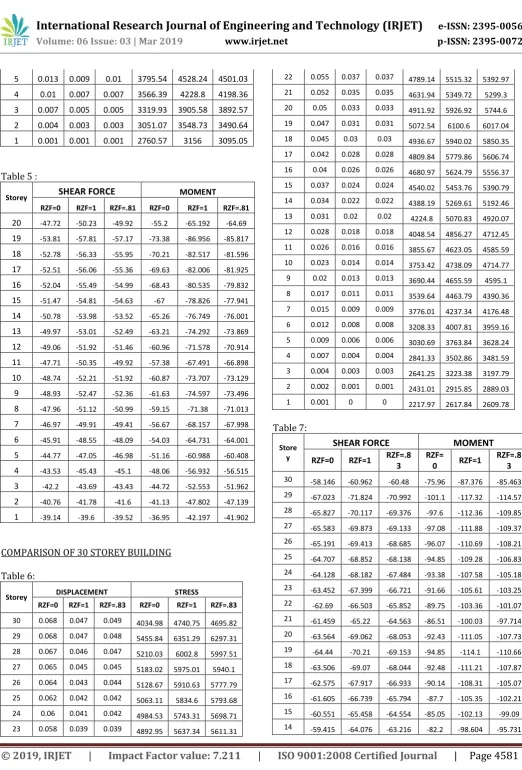
5 0.013 0.009 0.01 3795.54 4528.24 4501.03
4 0.01 0.007 0.007 3566.39 4228.8 4198.36
3 0.007 0.005 0.005 3319.93 3905.58 3892.57
2 0.004 0.003 0.003 3051.07 3548.73 3490.64
[image:4.595.35.558.30.801.2]1 0.001 0.001 0.001 2760.57 3156 3095.05
Table 5 :
Storey SHEAR FORCE MOMENT
RZF=0 RZF=1 RZF=.81 RZF=0 RZF=1 RZF=.81
20 -47.72 -50.23 -49.92 -55.2 -65.192 -64.69
19 -53.81 -57.81 -57.17 -73.38 -86.956 -85.817
18 -52.78 -56.33 -55.95 -70.21 -82.517 -81.596
17 -52.51 -56.06 -55.36 -69.63 -82.006 -81.925
16 -52.04 -55.49 -54.99 -68.43 -80.535 -79.832
15 -51.47 -54.81 -54.63 -67 -78.826 -77.941
14 -50.78 -53.98 -53.52 -65.26 -76.749 -76.001
13 -49.97 -53.01 -52.49 -63.21 -74.292 -73.869
12 -49.06 -51.92 -51.46 -60.96 -71.578 -70.914
11 -47.71 -50.35 -49.92 -57.38 -67.491 -66.898
10 -48.74 -52.21 -51.92 -60.87 -73.707 -73.129
9 -48.93 -52.47 -52.36 -61.63 -74.597 -73.496
8 -47.96 -51.12 -50.99 -59.15 -71.38 -71.013
7 -46.97 -49.91 -49.41 -56.67 -68.157 -67.998
6 -45.91 -48.55 -48.09 -54.03 -64.731 -64.001
5 -44.77 -47.05 -46.98 -51.16 -60.988 -60.408
4 -43.53 -45.43 -45.1 -48.06 -56.932 -56.515
3 -42.2 -43.69 -43.43 -44.72 -52.553 -51.962
2 -40.76 -41.78 -41.6 -41.13 -47.802 -47.139
1 -39.14 -39.6 -39.52 -36.95 -42.197 -41.902
COMPARISON OF 30 STOREY BUILDING
Table 6:
Storey DISPLACEMENT STRESS
RZF=0 RZF=1 RZF=.83 RZF=0 RZF=1 RZF=.83
30 0.068 0.047 0.049 4034.98 4740.75 4695.82
29 0.068 0.047 0.048 5455.84 6351.29 6297.31
28 0.067 0.046 0.047 5210.03 6002.8 5997.51
27 0.065 0.045 0.045 5183.02 5975.01 5940.1
26 0.064 0.043 0.044 5128.67 5910.63 5777.79
25 0.062 0.042 0.042 5063.11 5834.6 5793.68
24 0.06 0.041 0.042 4984.53 5743.31 5698.71
23 0.058 0.039 0.039 4892.95 5637.34 5611.31
22 0.055 0.037 0.037 4789.14 5515.32 5392.97
21 0.052 0.035 0.035 4631.94 5349.72 5299.3
20 0.05 0.033 0.033 4911.92 5926.92 5744.6
19 0.047 0.031 0.031 5072.54 6100.6 6017.04
18 0.045 0.03 0.03 4936.67 5940.02 5850.35
17 0.042 0.028 0.028 4809.84 5779.86 5606.74
16 0.04 0.026 0.026 4680.97 5624.79 5556.37
15 0.037 0.024 0.024 4540.02 5453.76 5390.79
14 0.034 0.022 0.022 4388.19 5269.61 5192.46
13 0.031 0.02 0.02 4224.8 5070.83 4920.07
12 0.028 0.018 0.018 4048.54 4856.27 4712.45
11 0.026 0.016 0.016 3855.67 4623.05 4585.59
10 0.023 0.014 0.014 3753.42 4738.09 4714.77
9 0.02 0.013 0.013 3690.44 4655.59 4595.1
8 0.017 0.011 0.011 3539.64 4463.79 4390.36
7 0.015 0.009 0.009 3776.01 4237.34 4176.48
6 0.012 0.008 0.008 3208.33 4007.81 3959.16
5 0.009 0.006 0.006 3030.69 3763.84 3628.24
4 0.007 0.004 0.004 2841.33 3502.86 3481.59
3 0.004 0.003 0.003 2641.25 3223.38 3197.79
2 0.002 0.001 0.001 2431.01 2915.85 2889.03
1 0.001 0 0 2217.97 2617.84 2609.78
Table 7:
Store y
SHEAR FORCE MOMENT
RZF=0 RZF=1 RZF=.8
3
RZF=
0 RZF=1
RZF=.8 3
30 -58.146 -60.962 -60.48 -75.96 -87.376 -85.463
29 -67.023 -71.824 -70.992 -101.1 -117.32 -114.57
28 -65.827 -70.117 -69.376 -97.6 -112.36 -109.85
27 -65.583 -69.873 -69.133 -97.08 -111.88 -109.37
26 -65.191 -69.413 -68.685 -96.07 -110.69 -108.21
25 -64.707 -68.852 -68.138 -94.85 -109.28 -106.83
24 -64.128 -68.182 -67.484 -93.38 -107.58 -105.18
23 -63.452 -67.399 -66.721 -91.66 -105.61 -103.25
22 -62.69 -66.503 -65.852 -89.75 -103.36 -101.07
21 -61.459 -65.22 -64.563 -86.51 -100.03 -97.714
20 -63.564 -69.062 -68.053 -92.43 -111.05 -107.73
19 -64.44 -70.21 -69.153 -94.85 -114.1 -110.66
18 -63.506 -69.07 -68.044 -92.48 -111.21 -107.87
17 -62.575 -67.917 -66.933 -90.14 -108.31 -105.07
16 -61.605 -66.739 -65.794 -87.7 -105.35 -102.21
15 -60.551 -65.458 -64.554 -85.05 -102.13 -99.09
© 2019, IRJET | Impact Factor value: 7.211 | ISO 9001:2008 Certified Journal
| Page 4582
13 -58.196 -62.59 -61.778 -79.13 -94.843 -92.1212 -56.865 -60.962 -60.204 -75.79 -90.843 -88.166
11 -55.403 -59.251 -58.531 -72.09 -86.531 -83.945
10 -54.684 -59.78 -58.769 -70.49 -88.979 -85.526
9 -54.043 -58.981 -57.996 -68.98 -87.051 -83.668
8 -52.949 -57.518 -56.604 -66.24 -83.393 -80.185
7 -51.743 -55.867 -55.04 -63.21 -79.252 -76.264
6 -50.484 -54.142 -53.407 -60.06 -74.931 -72.174
5 -49.151 -52.367 -51.672 -56.72 -70.336 -67.827
4 -47.736 -50.35 -49.822 -53.17 -65.437 -63.197
3 -46.237 -48.26 -47.85 -49.42 -60.202 -58.257
2 -44.633 -45.996 -45.719 -45.4 -54.536 -52.924
1 -42.96 -43.638 -43.498 -41.17 -48.567 -47.3
(i)
(ii)
(iii)
Chart (i),(ii),(iii) showing displacement for all the models for different Rigidity Factor (RZF).
NOTE: Displacement values are taken @ U1 translation in Direction 1.
(a)
(b)
0 0.005 0.01 0.015 0.02 0.025 0.03
10 9 8 7 6 5 4 3 2 1
D
IS
PL
A
CE
M
EN
T
IN
m
No. of Storey
DISPLACEMENT
RZF=0
RZF=1
RZF=.78
0 0.01 0.02 0.03 0.04 0.05 0.06
20 18 16 14 12 10 8 6 4 2
D
IS
PL
A
CE
M
EN
T
IN
M
No. of storey
DISPLACEMENT
RZF=0
RZF=1
RZF=0.81
0 0.02 0.04 0.06 0.08
30 28 26 24 22 20 18 16 14 12 10 8 6 4 2
D
IS
PL
A
CE
M
EN
T
IN
m
No. of storey
DISPLACEMENT
RZF=0
RZF=1
0.00 5.00 10.00 15.00 20.00 25.00
Percentage Change
PARAMETER
0 5 10 15 20 25 30
Percentage Change
© 2019, IRJET | Impact Factor value: 7.211 | ISO 9001:2008 Certified Journal
| Page 4583
(c)Chart (a), (b), (c) showing percentage change in various parameters for different storey building.
5. RESULT
Percentage change between RZF as zero to optimum value of RZF keeping RZF=0 as initial value the changes for different storeys are as follows-
Table-8: Percentage comparison
Storey 10 20 30
Percentage in displacement in
top storey
21.43 29.09 27.94
Percentage change in stress
in top storey
19.98 20.08
17.49
Percentage change in shear in
top storey
3.09 16.38 4.8
Percentage change in
moment
15.5
18.10
15.02
6. CONCLUSION
1. Study shows that there is different value of Rigidity Zone Factor for different storeys i.e. 0.78 for 10 storey building, 0.81 for 20 storey building, and 0.83 for 30 storey building.
2. At these values displacement is almost equal to the displacement obtained at full rigidity.
3. Hence it shows that at these values building is not fully rigid and the displacement is same as that in case of full rigidity but stiffness is low i. e. less chances of brittle failure.
7. ACKNOWLEDGEMENT
First of all, I would like to thank God for his blessings Then I would like to express my deepest gratitude to
our H.O.D, Mr. B.S. Tyagi Sir (Department of Civil Engineering, Radha Govind Group of Institution, Meerut) for his excellent guidance and information.I would like to express my sincere respect to my project guide Ms. Shiwani Bharti (Assistant Professor, Civil Engineering) for her expert guidance, moral support and continuous encouragement throughout the project work. This work would not have been possible without her invaluable support. I would also like to thank all those who are mentioned in reference section and all those unknown people who upload useful educational content and videos YouTube from where I learnt so many things. And apart from these things.
8. REFERENCES
[1] ACI committee 352:1991 Recommendations for design of beam column joints in monolithic reinforced concrete structures. ACI report 352R-91.
[2] Andre et.al., " Seismic performance of code designed fiber reinforced concrete joints" ACI structural journal vol:91(5), pp 564-571,1994.
[3] Pradip Sarkar, Rajesh Agrawal and DevdasMenon, ―Design of RC beam-column joints under seismic loading- A review‖, Journal of Structural Engg., Vol. 33, No.6, pp. 449-457, February 2007.
[4]Siva Chidambaram. K.R and Thirugnanam.G.S, ―Comparative Studies on Behaviour of Reinforced Beam-Column Joints with
Reference to Anchorage Detailing‖, Journal of Civil Engineering Research, Vol.2, pp. 12-17, 2012.
[5]Indian Standard (IS-13920-1993), ‗Ductile Detailing of Reinforced Concrete Structures Subjected to Seismic Forces — Code of
Practice‘, Bureau of Indian Standards, New Delhi, 2002.
[6] IS 1893 (Part 1):2002 Criteria for Earthquake Resistant Design of Structures Part1 General Provision and Buildings (Fifth Revision).
[7] IS 456: 2000 Indian Standard PLAIN AND
REINFORCED CONCRETE CODE OF PRACTICE (Fourth Revision) .
[8] NILSON, I.H.E., LOSBERG, R. Reinforced concrete corners and joints subjected to bending moment, Journal of Structural Division, ASCE, June 1976, Vol.102, No.ST6, pp.1229-1253.
0 5 10 15 20 25 30