DOI 10.1007/s11222-016-9660-3
Improved bridge constructs for stochastic differential equations
Gavin A. Whitaker1 · Andrew Golightly1 · Richard J. Boys1 · Chris Sherlock2
Received: 30 September 2015 / Accepted: 21 April 2016
© The Author(s) 2016. This article is published with open access at Springerlink.com
Abstract We consider the task of generating discrete-time realisations of a nonlinear multivariate diffusion process sat-isfying an Itô stochastic differential equation conditional on an observation taken at a fixed future time-point. Such realisa-tions are typically termed diffusion bridges. Since, in general, no closed form expression exists for the transition densities of the process of interest, a widely adopted solution works with the Euler–Maruyama approximation, by replacing the intractable transition densities with Gaussian approxima-tions. However, the density of the conditioned discrete-time process remains intractable, necessitating the use of compu-tationally intensive methods such as Markov chain Monte Carlo. Designing an efficient proposal mechanism which can be applied to a noisy and partially observed system that exhibits nonlinear dynamics is a challenging problem, and is the focus of this paper. By partitioning the process into two parts, one that accounts for nonlinear dynamics in a deter-ministic way, and another as a residual stochastic process, we develop a class of novel constructs that bridge the resid-ual process via a linear approximation. In addition, we adapt a recently proposed construct to a partial and noisy obser-vation regime. We compare the performance of each new construct with a number of existing approaches, using three applications.
Keywords Stochastic differential equation·Multivariate
diffusion bridge·Guided proposal·Markov chain Monte
Carlo·Linear noise approximation
B
Andrew Golightly1 School of Mathematics & Statistics, Newcastle University, Newcastle upon Tyne NE1 7RU, UK
2 Department of Mathematics and Statistics, Lancaster University, Lancaster LA1 4YF, UK
1 Introduction
Diffusion processes satisfying stochastic differential equa-tions (SDEs) provide a flexible class of models for describing many continuous-time physical processes. Some applica-tion areas and indicative references include finance, e.g. Kalogeropoulos et al. (2010), Stramer et al. (2010),
reac-tion networks, e.g.Fuchs(2013),Golightly et al.(2015) and
population dynamics, e.g.Heydari et al.(2014). Fitting such
models to data observed at discrete-times can be problem-atic since the transition densities of the diffusion process are likely to be intractable. A review of inferential
meth-ods for diffusions can be found inFuchs(2013). A widely
adopted solution is to approximate the unavailable
transi-tion densities either analytically (Aït-Sahalia 2002, 2008)
or numerically (Pedersen 1995;Elerian et al. 2001;Eraker
2001; Roberts and Stramer 2001). Within the Bayesian paradigm, the numerical approach can be seen as a data aug-mentation problem. The simplest impleaug-mentation augments low-frequency data by introducing intermediate time-points between observation times. An Euler–Maruyama scheme is then applied by approximating the transition densities over the induced discretisation as Gaussian. Computation-ally intensive algorithms such as Markov chain Monte Carlo (MCMC) are then used to integrate over the uncertainty asso-ciated with the missing data. The key challenges of designing such an MCMC scheme include overcoming dependence between the parameters and missing data (first highlighted as
a problem byRoberts and Stramer(2001)) and overcoming
dependence between successive values of the missing data. Dealing with the latter requires repeatedly generating
real-isations known asdiffusion bridgesfrom an approximation
byBeskos et al.(2006) (see alsoBeskos et al. 2009). How-ever, these exact methods are limited to diffusions which can be transformed to have unit diffusion coefficient, known as reducible diffusions.
Designing bridge constructs for irreducible, multivariate diffusions is a challenging problem and has received much attention in recent literature. The simplest approach (see e.g. Pedersen 1995) is based on the forward dynamics of the diffu-sion process and generates a bridge by sampling iteratively from the Euler–Maruyama approximation of the uncondi-tioned SDE. This myopic approach induces a discontinuity at the observation time (as the discretisation gets finer) and is well known to lead to low Metropolis–Hastings accep-tance rates. The modified diffusion bridge (MDB) construct ofDurham and Gallant(2002) (see also extensions to the
par-tial and noisy observation case inGolightly and Wilkinson
2008) pushes the bridge process towards the observation in a
linear way and provides the optimal sampling method when the drift and diffusion coefficients of the SDE are constant (Stramer and Yan 2006). However, this construct is less effec-tive when the process exhibits nonlinear dynamics. Several approaches have been proposed to overcome this problem.
For example, Lindström (2012) (see alsoFearnhead 2008
for a similar approach) combines the Pedersen and MDB approaches, with a tuning parameter governing the precise
dynamics of the resulting sampler.Del Moral and Murray
(2014) (see also Lin et al. 2010) use a sequential Monte
Carlo scheme to generate realisations according to the for-ward dynamics, pushing the resulting trajectories tofor-wards the
observation using a sequence of reweighting steps.Schauer
et al.(2016) combine the ideas ofDelyon and Hu(2006) and Clark(1990) to obtain a bridge based on the addition of a guiding term to the drift of the process under consideration. The guiding term is derived using a tractable approximation of the target process.
1.1 Contributions and organisation of the paper
Our contribution is the development of a novel class of bridge constructs that are computationally and statistically efficient, simple to implement, and can be applied in scenarios where only partial and noisy measurements of the system are avail-able. Essentially, the process is partitioned into two parts, one that accounts for nonlinear dynamics in a deterministic way, and another as a residual stochastic process. A bridge con-struct is obtained for the target process by applying the MDB
sampler ofDurham and Gallant(2002) to the end-point
con-ditioned residual process. We consider two implementations of this approach. Firstly, we use the bridge introduced by Whitaker et al.(2015) that constructs the residual process by subtracting the solution of an ordinary differential equation (ODE) system based on the drift, from the target process. Sec-ondly, we recognise that the intractable SDE governing the
residual process can be approximated by a tractable process. We therefore extend the first approach by additionally sub-tracting the expectation of the approximate residual process and bridging the remainder with the MDB sampler. In
addi-tion, we adapt the guided proposal proposed bySchauer et al.
(2016) to a partial and noisy observation regime.
We evaluate the performance of each bridge construct
(as well as the constructs proposed byDurham and Gallant
(2002) andLindström(2012)) using three examples: a
sim-ple birth–death model, a Lotka–Volterra system and a model of aphid growth.
The remainder of this article is organised as follows.
Section 2 provides a brief introduction to the problem of
sampling conditioned SDEs and examines two previously
proposed approaches. In Sect.3we describe a novel class of
bridge constructs and adapt an existing approach to a more general observation regime. Applications are considered in
Sect.4and a discussion is provided in Sect.5.
2 Sampling conditioned SDEs
Consider a continuous-time d-dimensional Itô process
{Xt,t ≥ 0}governed by the SDE paramaterised by θ =
(θ1, . . . , θp)of the form
d Xt =α(Xt, θ)dt+
β(Xt, θ)d Wt, X0=x0. (1)
Here,αis ad-vector of drift functions, the diffusion matrix
β is ad×dpositive definite matrix with a square root
rep-resentation√β such that√β√β=βandWtis ad-vector
of (uncorrelated) standard Brownian motion processes. We
assume thatαandβ are sufficiently regular so that the SDE
has a weak non-explosive solution (Øksendal 2003).
For tractability, we make the same assumption asGolightly
and Wilkinson(2008),Golightly and Wilkinson(2011), Pic-chini (2014) and Lu et al. (2015) among others, that the
process is observed att =T according to
YT =FXT +T, T|Σ∼N(0, Σ). (2)
Here,YT is ado-vector, F is a constantd ×domatrix and
T is a random do-vector for some do ≤ d. This flexible
setup allows for only observing a subset of components. For simplicity we also assume that the process is known
exactly att =0. This is the case when a diffusion process is
observed completely and without error. In the case of partial and/or noisy observations, typically the initial position is an unknown parameter in an MCMC scheme and a new bridge is created at each iteration conditional on the current para-meter values, so in terms of the bridge, the initial position is effectively known. The complication of multiple partial
Our aim is to generate discrete-time realisations of Xt
conditional onx0andyT. To this end, we partition[0,T]as
0=τ0< τ1< τ2<· · ·< τm−1< τm =T,
givingm intervals of equal length τ = T/m. Since, in
general, the form of the SDE in (1) will not permit an analytic
solution, we work with the Euler–Maruyama approximation which gives the change in the process over a small interval
of lengthτ as a Gaussian random vector. Specifically, we
have that
Xτk+1 −Xτk =α(Xτk, θ) τ+
β(Xτk, θ) Wτk
where Wτk ∼ N(0, τId) and Id is the d ×d
iden-tity matrix. The continuous-time conditioned process is then approximated by the discrete-time skeleton bridge, with the
latent valuesx(0,T]=(xτ1, . . . ,xτm =xT)having the
(pos-terior) density
π(x(0,T]|x0,yT, θ, Σ)∝π(yT|xT, Σ) m−1
k=0
π(xτk+1|xτk, θ)
(3)
where
π(xτk+1|xτk, θ)=N
xτk+1;xτk+α(xτk, θ)τ, β(xτk, θ)τ
is the transition density under the Euler–Maruyama
approx-imation,π(yT|xT, Σ)= N(yT; FxT, Σ)andN(·;m,V)
denotes the multivariate Gaussian density with mean vector
m and variance matrix V. In the special case wherexT is
known (so that yT = xT and F = Id), the latent values
x(0,T)=(xτ1, . . . ,xτm−1)have the density
π(x(0,T)|x0,xT, θ)∝ m−1
k=0
π(xτk+1|xτk, θ). (4)
For nonlinear forms of the drift and diffusion coefficients, the
products in (3) and (4) will be intractable and samples can
be generated via computationally intensive algorithms such as Markov chain Monte Carlo or importance sampling. We focus on the former but note that in either case, the efficiency of the algorithm will depend on the proposal mechanism used to generate the bridge. A common approach to constructing
an efficient proposal is to factorise the target in (3) as
π(x(0,T]|x0,yT, θ, Σ)∝ m−1
k=0
π(xτk+1|xτk,yT, θ, Σ). (5)
The density in (4) can be factorised in a similar
man-ner. This suggests seeking proposal densities of the form
q(xτk+1|xτk,yT, θ, Σ) which aim to approximate the
intractable constituent densities in (5). In what follows, we
consider some existing approaches for generating bridges via
approximation ofπ(xτk+1|xτk,yT, θ, Σ)before outlining our
contribution. For each bridge, the proposal densities take the form
q(xτk+1|xτk,yT, θ, Σ)=N
xτk+1; xτk
+μ(xτk)τ , Ψ (xτk)τ
(6)
and our focus is on the choice ofμ(·)andΨ (·). For simplicity
and where possible, we drop the parametersθandΣfrom
the notation as they remain fixed throughout.
2.1 Myopic simulation
Ignoring the information in the observation yT and
sim-ply apsim-plying the Euler–Maruyama approximation over each
interval of lengthτ leads to a proposal density of the form
given by (6) withμEM(xτk)=α(xτk)andΨEM(xτk)=β(xτk).
Sampling iteratively according to (6) fork=0,1, . . . ,m−1
gives a proposed bridge which we denote byx(∗0,T]. The
Met-ropolis-Hastings (MH) acceptance probability for a move
fromx(0,T]tox(∗0,T]is
min
1, π(yT|x
∗
T)
π(yT|xT)
.
This strategy is likely to work well provided that the
obser-vation yT is not particularly informative, that is, when the
measurement error dominates the intrinsic stochasticity of
the process. However, asΣis reduced, the MH acceptance
rate decreases. A related approach can be found inPedersen
(1995), where it is assumed thatxT is known. In this case, a
move fromx(0,T)tox∗(0,T)is accepted with probability
min
1, π(xT|x
∗
τm−1)
π(xT|xτm−1)
which tends to 0 asm→ ∞(or equivalently,τ →0).
2.2 Modified diffusion bridge
For known xT, Durham and Gallant (2002) derive a
lin-ear Gaussian approximation ofπ(xτk+1|xτk,xT), leading to
a sampler known as the modified diffusion bridge (MDB). Extensions to the partial and noisy observation regime are
considered inGolightly and Wilkinson(2008). In brief, the
joint distribution of Xτk+1 and YT (conditional on xτk) is
Xτk+1
YT
xτk
∼N
xτk +αkτ F(xτk+αkk)
,
βkτ βkFτ
Fβkτ FβkFk+Σ
whereαk=α(xτk),βk =β(xτk)andk =T −τk.
Condi-tioning onYT =yT gives
μMDB(xτk)=αk+βkF
FβkFk+Σ
−1
×yT −F(xτk +αkk)
(7)
and
ΨMDB(xτk)=βk−βkF
FβkFk+Σ
−1
Fβkτ. (8)
In the case of no measurement error and observation of all
components (so thatxT is known), (7) and (8) become
μ∗MDB(xτk)=
xT −xτk T−τk
and ΨMDB∗ (xτk)= T−τk+1
T−τk β(
xτk).
2.2.1 Connection with continuous-time conditioned processes
Consider the case of no measurement error and full observa-tion of all components. The SDE satisfied by the condiobserva-tioned
process{Xt,t ∈ [0,T]}, takes the form
d Xt = ˜α(Xt)dt+
β(Xt)d Wt, X0=x0 (9)
where the drift is
˜
α(Xt)=α(Xt)+β(Xt)∇xtlogp(xT|xt). (10)
See for example chap. IV.39 ofRogers and Williams(2000)
for a derivation. Note thatp(xT|xt)denotes the (intractable)
transition density of the unconditioned process defined in
(1). Approximatingα(Xt)andβ(Xt)in (1) by the constants
α(xT) and β(xT) yields a process for which p(xT|xt) is
tractable. The corresponding conditioned process satisfies
d Xt =
XT −Xt
T −t dt+
β(Xt)d Wt. (11)
Use of (11) as a proposal process has been justified by
Delyon and Hu(2006) (see alsoStramer and Yan (2006), Marchand(2011) andPapaspiliopoulos et al.(2013)), who show that the distribution of the target process (conditional
onxT) is absolutely continuous with respect to the
distribu-tion of the soludistribu-tion to (11). As discussed byPapaspiliopoulos
et al. (2013), it is impossible to simulate exact
(discrete-time) realisations of (11) unlessβ(·)is constant. They also
note that performing a local linearisation of (11) according to
Shoji and Ozaki(1998) (see alsoShoji 2011) gives a tractable process with transition density
q(xτk+1|xτk,xT)
=N
xτk+1; xτk +
xT −xτk T −τk
τ , T −τk+1 T −τk
β(xτk)τ ,
that is, the transition density of the modified diffusion bridge discussed in the previous section. Plainly, taking the Euler–
Maruyama approximation of (11) yields the MDB construct,
albeit without the time dependent multiplier of β(xτk) in
the variance. As observed by Durham and Gallant (2002)
and discussed inPapaspiliopoulos and Roberts(2012) and
Papaspiliopoulos et al. (2013), the inclusion of the time dependent multiplier can lead to improved empirical perfor-mance.
Unfortunately, the MDB is only efficient when the drift
of (1) is approximately constant. When this is not the
case, so that realisations of the SDE started from the same point exhibit strong and similar non-linearity over the inter-observation time, the modified diffusion bridge is likely to be unsatisfactory.
2.3 Lindström bridge
A bridge construct that combines the myopic sampler with
the MDB is proposed inLindström(2012), for the special
case of knownxT. Extending the sampler to the observation
scenario in (2) is straightforward. Whereas the MDB
approx-imates the variance ofYT|xτkbyFβkFk+Σ, the simplest
version of the Lindström bridge (LB) has that
Var(YT|xτk)F
βkk+C(k+1)2
F+Σ,
whereC(k+1)2is the squared bias ofXT|xτk+1using a
sin-gle Euler–Maruyama time-step andCis an unknown matrix.
By assuming that the squared bias is a fractionγof the
vari-ance over an interval of lengthτ, a heuristic choice ofCis
given by
CHeur= γβk τ ,
with γ > 0. This particular choice of CHeur ensures that
Var(YT|xτk) is a positive definite matrix. The joint
dis-tribution of Xτk+1 and YT (conditional on xτk) is then
approximated by
Xτk+1 YT
xτk
∼N
xτk+αkτ F(xτk+αkk) ,
βkτ βkFτ
whereγk =k+γ (k+1)2/τ. Conditioning onYT =yT gives
μLB(xτk)=αk+βkF
FβkFγk +Σ
−1
×yT −F(xτk+αkk)
(12)
and
ΨLB(xτk)=βk−βkF
FβkFγk +Σ
−1
Fβkτ. (13)
In the case of no measurement error and observation of all
components, (12) and (13) become
μ∗
LB(xτk)=w
γ
kμ∗MDB(xτk)+(1−w
γ k)α(xτk)
and
Ψ∗LB(xτk)=w
γ
kΨMDB∗ (xτk)+(1−w
γ k)β(xτk)
where
wγk =
(τk+1−τk)(T −τk)
(τk+1−τk)(T −τk)+γ (T −τk+1)2.
The Lindström bridge can therefore be seen as a convex
com-bination of the MDB and myopic samplers, withγ = 0
giving the MDB andγ = ∞giving the myopic approach.
In practice,Lindström (2012) suggests thatγ ∈ [0.01,1],
given that these values have proved successful in simulation
experiments. Note also that for a fixedγ, ifT−τk+1τ
thenwkγ 0 and the myopic sampler dominates. However,
asτk+1approachesT,wkγapproaches 1 and the LB is
dom-inated by the MDB.
Whilst the LB attempts to account for nonlinear dynam-ics by combining the MDB with the myopic approach, having to specify a model-dependent tuning parameter is
unsatisfactory, since different choices ofγ will lead to
dif-ferent properties of the proposed bridges. Moreover, the link between the regularised sampler and the continuous-time conditioned process is unclear.
3 Improved bridge constructs
In this section we describe a novel class of bridge constructs that require no tuning parameters, are simple to implement (even when only a subset of components are observed with Gaussian noise) and can account for nonlinear dynamics driven by the drift. In addition, we discuss the recently
pro-posed bridging strategy ofSchauer et al.(2016) and describe
an implementation method in the case of partial observation with additive Gaussian measurement error.
3.1 Bridges based on residual processes
Suppose that Xt is partitioned as Xt = ζt + Rt where
{ζt,t ≥ 0}is a deterministic process and{Rt,t ≥ 0}is a
residual stochastic process, satisfying
dζt = f(ζt)dt, ζ0=x0,
d Rt = {α(Xt)− f(ζt)}dt+
β(Xt)d Wt, R0=0. (14)
We then aim to chooseζt (and therefore f(·)) to adequately
account for nonlinear dynamics (so that the drift in (14) is
approximately constant), and construct the MDB of Sect.2.2
for the residual stochastic process rather than the target
process itself. Suitable choices ofζtand f(·)can be found in
Sects.3.1.1and3.1.2. It should be clear from the discussion
in Sect.2.2that for knownxT, the MDB approximates the
density of Rτk+1|rτk,rT by
q(rτk+1|rτk,rT)
=N
rτk+1;rτk+
rT −rτk T −τk τ ,
T−τk+1
T −τk β(xτk)τ . (15)
In this case, the connection between (15) and the intractable
continuous-time conditioned residual process can be
estab-lished by following the arguments of Sect.2.2.1. By
approx-imating the drift and diffusion matrix in (14) by the constants
α(xT)− f(ζT)andβ(xT)gives a process with a tractable
transition density. The corresponding conditioned process then satisfies
d Rt =
RT −Rt
T−t dt+
β(Xt)d Wt. (16)
The density in (15) is then obtained by a local linearisation
of (16).
It remains for us to choose ζt to balance the accuracy
and computational efficiency of the resulting construct. We explore two possible choices in the remainder of this section.
3.1.1 Subtracting the drift
In the simplest approach to account for dynamics based on
the drift, we takeζt =ηt and f(·)=α(·)where
dηt =α(ηt)dt, η0=x0, (17)
so that
d Rt = {α(Xt)−α(ηt)}dt+
β(Xt)d Wt, R0=0. (18)
The MDB can be constructed for the residual process by
(conditional onrτk), whereYT−FηTcan be seen as a partial
and noisy observation ofRT since
YT −FηT =FRT +T, T|Σ∼N(0, Σ).
As in Sect.2.2, we obtain the (approximate) joint distribution
Rτk+1 YT−FηT
rτk
∼N
rτk+(αk−αkη)τ F(rτk+(αk−αηk)k) ,
βkτ βkFτ
Fβkτ FβkFk+Σ
(19)
where αkη = α(ητk)and αk,βk andk are as defined in
Sect.2.2. Note that the mean in (19) uses the tangentαkηat
(τk, ητk)to approximatedηt/dtover time intervals of length
τandk. Sinceητk+1 will be available either exactly from
the solution of (17) or from the output of a (stiff) ODE solver,
we propose to approximatedηt/dt via the chord between
(τk, ητk)and(τk+1, ητk+1), that is, by
δkη=
ητk+1 −ητk
τ .
Replacingαkηin (19) withδkη, conditioning onyT−FηTand
using the partitionXt =ηt+RtgivesΨRB(xτk)=ΨMDB(xτk)
and
μRB(xτk)=αk+βkF
FβkFk+Σ
−1
×yT −F(ηT +rτk+(αk−δ
η k)k)
. (20)
Note that in the case of knownxT,ΨRB∗(xτk) = ΨMDB∗ (xτk)
and (20) becomes
μ∗RB(xτk)=δ
η
k +
(xT −xτk)−(ηT −ητk)
T −τk .
3.1.2 Further subtraction using the linear noise approximation
Whilst the solution of the SDE governing the residual
sto-chastic process in (18) is unavailable in closed form, a
tractable approximation can be obtained. Therefore, in
situ-ations whereηtfails to adequately capture the target process
dynamics, we propose to further subtract an approximation
of the conditional expectation ρt = E(Rt|r0,yT), which
we denote by ρˆt = E(Rˆt|r0,yT). Here, { ˆRt,t ∈ [0,T]}
is obtained through the linear noise approximation (LNA) of
(18). The LNA can be derived in a number of more or less
formal ways (see e.g.Kurtz(1970),van Kampen(2001) and
Fearnhead et al.(2014)). Here, we give a brief exposition of
the LNA and refer the reader toFearnhead et al.(2014) and
the references therein for a complete derivation.
By Taylor expandingα(Xt)andβ(Xt)aboutηt(the
solu-tion of (17)), truncating the expansion of αat the first two
terms and taking only the first term of the expansion ofβ,
we obtain
dRˆt =H(ηt)Rˆtdt+
β(ηt)d Wt,
where H(ηt) is the Jacobian matrix with(i,j)th element
(H(ηt))i,j =∂αi(ηt)/∂ηj,t. It should be clear from the
trun-cations used in the Taylor expansions of the drift and diffusion coefficients that the key assumption underpinning the LNA
is that the stochastic termβ(Xt)is “small”. Now, for a fixed
initial conditionRˆ0= ˆr0, it is straightforward to show that
ˆ
Rt| ˆR0= ˆr0∼N
Ptrˆ0, PtψtPt
(21)
where Pt andψt satisfy the ODE system
d Pt
dt =H(ηt)Pt, P0=Id, (22)
dψt
dt =P −1
t β(ηt)(Pt−1), ψ0=0. (23)
The joint distribution of Rˆt andYT −FηT (conditional on
ˆ r0) is
ˆ
Rt
YT −FηT
rˆ0
∼N
Ptrˆ0 FPTrˆ0 ,
PtψtPt PtψtPTF
FPTψtPt FPTψTPTF+Σ
.
(24)
Conditioning further on yT −FηT and noting that rˆ0 =
r0= 0 gives
ˆ
ρt =E(Rˆt|r0,yT)
= PtψtPTF(FPTψTPTF+Σ)−
1(y
T −FηT).
Having obtained an explicit, closed-form (subject to the
solution of (17), (22) and (23)) approximation of the expected
conditioned residual process, we adopt the partition Xt =
ηt+ ˆρt+Rt−where{R−t ,t ∈ [0,T]}is the residual stochastic
process resulting from the additional decomposition of Xt.
Although the SDE satisfied by R−t will be intractable, the
joint distribution of Rτ−k+1 andYT − F(ηT + ˆρT)can be
Rτ−k+1 YT −F(ηT + ˆρT)
rτ−k
∼N
rτ−k+(αk−δkη−δkρ)τ
F(rτ−k +(αk−δηk −δkρ)k) ,
βkτ βkFτ
Fβkτ FβkFk+Σ
where again we use the chord
δkρ= ˆ
ρτk+1− ˆρτk τ
in preference to the tangent. Hence we obtainΨRB−(xτk)=
ΨMDB(xτk)and
μRB−(xτk)=αk+βkF
FβkFk+Σ
−1
×yT −F(ηT + ˆρT +rτ−k +(αk−δkη−δkρ)k)
. (25)
Note that in the case of knownxT,ΨRB∗−(xτk)=ΨMDB∗ (xτk)
and (25) becomes
μ∗RB−(xτk)=δ
η k +δkρ
+(xT −xτk)−(ηT −ητk)−(ρˆT − ˆρτk)
T −τk .
3.2 Guided proposals
For knownxT,van der Meulen and Schauer(2015) (see also
Schauer et al. 2016) derive a bridge construct which they
term aguided proposal(GP). They take the SDE satisfied by
the conditioned process{Xt,t ∈ [0,T]}in (9) and (10) but
replace the intractable p(xT|xt)with the transition density
associated with a class of linear processes{ ˆXt,t ∈ [0,T]}
satisfying
dXˆt =B(t)Xˆtdt+b(t)dt+
σ(t)d Wt, Xˆ0=x. (26)
Here, B(t) andσ(t) are d ×d matrices and b(t) is ad
-vector. Note that the LNA (see Sect.3.1.2) satisfies (26) with
B(t)=H(ηt),b(t)=α(ηt)−H(ηt)ηtandσ(t)=β(ηt). The guided proposal can be extended to the Gaussian
addi-tive noise regime in (2) by noting that in this case, the drift
in (10) becomes
˜
α(Xt)=α(Xt)+β(Xt)∇xtlogp(yT|xt). (27)
Given a tractable approximation of p(yT|xt), the Euler–
Maruyama approximation of (9) can be applied over the
discretisation of[0,T]to give a proposal density of the form
(6) withμGP(xτk)= ˜α(xτk)andΨGP(xτk)=β(xτk).
We will approximate p(yT|xt)using the LNA. Using the
partitionXˆt =ηt+ ˆRt and combining the transition density
ofRˆtin (21) with the observation regime defined in (2) gives
ˆ
p(yT|xt)=N
yT ; F{ηT +PT|t(xt−ηt)},
FPT|tψT|tPT|tF+Σ
wherePT|tandψT|tare found by integrating the ODE system
in (22) and (23) fromt toT with Pt|t = Id andψt|t =0.
Hence the drift (27) becomes
˜
α(Xt)=α(Xt)+β(Xt)PT|tF(FPT|tψT|tPT|tF+Σ)−
1
×yT −F(ηT +PT|t[xt−ηt])
. (28)
Note that a computationally efficient implementation of this
approach is obtained by using the identitiesPT|t =PTPt−1
andψT|t = Pt(ψT −ψt)Pt. Hence, the LNA ODEs in (17),
(22) and (23) need only be integrated onceover the
inter-val [0,T]. Unfortunately, we find that this approach does not work well in practice, unless the total measurement error
tr(Σ)is large relative to the infinitesimal varianceβ(·). Note
that the variance ofYT|xtunder the LNA is a function of the
deterministic processηt. Ifηtandxtdiverge astis increased,
the guiding term in (28) will result in an over or under
dis-persed proposal mechanism (relative to the target conditioned
process) at times close toT. The problem is exacerbated in
the case of no measurement error, where the discrepancy
between xt andηt can result in a singularity in the
guid-ing term in (28) at timeT. This naive approach (henceforth
referred to as GP-N) can be alleviated by integrating the ODE
system given by (17), (22) and (23)for each interval[τk,T],
k =0,1, . . . ,m−1, withητk =xτk. In this case, the drift
(27) is given by
˜
α(Xt)=α(Xt)+β(Xt)PT|tF(FPT|tψT|tPT|tF+Σ)−1 ×yT −FηT
.
In the special case that xT is known, we have that
Ψ∗
GP-N(xτk)=ΨGP∗(xτk)=β(xτk), μ∗
GP-N(xτk)=α(xτk)+β(xτk)PT|τk(PT|τkψT|τkPT|τk) −1
×xT − [ηT +PT|τk(xτk−ητk)]
and
μ∗GP(xτk)=α(xτk)+β(xτk)PT|τk(PT|τkψT|τkPT|τk) −1
×(xT −ηT) .
The limiting form of the acceptance rate in this case can be
found inSchauer et al.(2016), who also remark that a key
requirement for absolute continuity of the target and
σ (t)=β(ηt). Again, we note that the naive implementation of the guided proposal (GP-N) will not meet this condition
in general (whenxT is known). Ensuring thatσ (t)→β(xT)
ast → T by integrating (17), (22) and (23) for eachτk is
likely to be time consuming, unless the LNA ODE system is tractable. In the case of exact observations, a
computation-ally less demanding approach is obtained invan der Meulen
and Schauer(2015) by taking the transition density of (26)
withB(t) = 0 and σ (t) = β(xT)to construct the guided
proposal. Settingb(t) =α(ηt)leads to a proposal density
for the simplified guided proposal (GP-S) of the form (6)
withΨGP-S∗ (xτk)=β(xτk)and
μ∗
GP-S(xτk)=α(xτk)+β(xτk)β(xT)− 1
×
xT −xτk −(ηT −ητk) T −τk
.
Further (example-dependent) methods for constructing
guided proposals in the case of knownxT can be found in
van der Meulen and Schauer(2015).
3.2.1 Use of the MDB variance
Using the Euler–Maruyama approximation of (9) gives the
variance ofXτk+1|xτk,yT in the guided proposal process as
ΨGP(xτk)τ =β(xτk)τ. In Sect.4we investigate the effect
of using the variance (8) of the modified diffusion bridge
con-struct by takingΨGP(xτk)=ΨMDB(xτk). Although in this case,
deriving the limiting form of the acceptance rate under the resulting proposal is problematic, we observe a worthwhile
increase in empirical performance. In the case of knownxT,
use of the MDB variance in place of β(xτk)τ comes at
almost no additional computational cost. We denote this con-struct GP-MDB.
3.3 Computational considerations
For the observation regime in (2), all bridge constructs (with
the exception of the myopic approach) require the
inver-sion of a do ×do matrix at each intermediate time τk,
k=1,2. . . ,m−1 and for each skeleton bridge required.
For knownxT, the proposal densities associated with each
construct simplify. In this case, only the LNA-based residual
bridge and guided proposal require the inversion of ad×d
matrix at each intermediate time.
The Lindström bridge and modified diffusion bridge have roughly the same computational cost. The bridges based on residual processes incur an additional computational cost of
having to solve a system of eitherd(when subtractingηt) or
orderd2(when further subtractingρt) coupled ODEs.
How-ever, we note that for knownx0, the ODE system need only be
solved once, irrespective of the number of skeleton bridges required. This is also true of the naive and simplified guided
proposals. However, we note that in the case of known xT,
the guided proposal requires solving order d2 ODEs over
each interval[τk,T],k=0,1, . . . ,m−1 for each simulated
skeleton bridge, in order to maintain reasonable statistical efficiency (as measured by, for example, estimated accep-tance rate of a Metropolis–Hastings independence sampler).
4 Applications
We now compare the accuracy and efficiency of the bridging methods discussed in the previous sections, by using them to make proposals inside a Metropolis–Hastings independence sampler. We consider three examples: a simple birth–death model in which the ODEs governing the LNA are tractable, a Lotka–Volterra system in which the use of numerical solvers are required, and a model of aphid growth inspired by real
data taken from Matis et al. (2008). Generating
discrete-time realisations from the SDE model of aphid growth is particularly challenging due to nonlinear dynamics, and an observation regime in which only one component is observed and is subject to additive Gaussian noise.
In what follows, all results are based on 100 K iterations of a Metropolis–Hastings independence sampler targeting
either (3) or (4), depending on the observation regime. We
measure the statistical efficiency of each bridge via their
empirical acceptance probability.Rcode for the
implemen-tation of the M-H scheme can be found athttps://github.com/
gawhitaker/bridges-apps. The bridge constructs used in each example, together with their relative computational cost can
be found in Table1. Note that in contrast toLindström(2012),
we found thatγ ∈ [0.001,0.3]was required in order to find
a near-optimalγ. Where LB is used, we only present results
for the value ofγ that maximised empirical performance.
4.1 Birth–death
We consider a simple birth–death process with birth rateθ1
and death rateθ2, characterised by the SDE
d Xt =(θ1−θ2)Xtdt+
(θ1+θ2)Xtd Wt, X0=x0 (29)
which can be seen as a degenerate case of a Feller
square-root diffusion (Feller 1952). The ODE system ((17), (22)
and (23)) governing the linear noise approximation of (29) is
tractable, and we obtainηt =x0e(θ1−θ2)t,Pt =e(θ1−θ2)tand
ψt =θ
1+θ2 θ1−θ2
1−e−(θ1−θ2)t
x0.
In this example we assume thatxT is known and, to
ade-quately assess the performance of each bridge construct, we
takexT to be either the 5, 50 or 95 % quantile (denoted by
Table 1 Example and bridge specific relative CPU cost for 100 K iterations of a Metropolis–Hastings independence sampler. Due to well known poor performance in the case of knownxT, EM is not implemented for the first two examples. Likewise, due to poor performance, we omit results based on GP-N and GP-S in the second example, and results based on MDB and LB in the final example
Birth–Death Lotka–Volterra Aphid
Myopic Euler–Maruyama (EM) – – 1.0
Modified diffusion bridge (MDB) 1.0 1.0 –
Lindström bridge (LB) 1.1 1.1 –
Residual bridge, subtractηt(RB) 1.0 1.0 7.3
RB, further subtractρt(RB−) 1.0 1.0 7.9
Guided proposal (GP) 1.2 30.7 7.1
GP with MDB variance (GP-MDB) 1.3 31.0 7.9
Naive GP (GP-N) 1.2 – –
Simplified GP (GP-S) 1.1 – –
xT=xT,(5)
0.0
0.2
0.4
0.6
0.8
1.0
Acceptance Probability
m
20 50 100 500 1000
xT =xT,(50)
0.0
0.2
0.4
0.6
0.8
1.0
Acceptance Probability
m
20 50 100 500 1000
xT=xT,(95)
0.0
0.2
0.4
0.6
0.8
1.0
Acceptance Probability
m
20 50 100 500 1000
0.0
0
.2
0.4
0
.6
0.8
1
.0
Acceptance Probability
m
20 50 100 500 1000
0.0
0
.2
0.4
0
.6
0.8
1
.0
Acceptance Probability
m
20 50 100 500 1000
0.0
0
.2
0.4
0
.6
0.8
1
.0
Acceptance Probability
m
20 50 100 500 1000
Fig. 1 Birth–death model. Empirical acceptance probability againstmwithT=1 (1st row) andT=2 (2nd row). The results are based on 100 K iterations of a Metropolis–Hastings independence sampler.BlackMDB,brownLB,redRB,blueRB−,greyGP-N,greenGP-S,purpleGP,pink
GP-MDB
found by repeatedly applying the Euler–Maruyama
approx-imation to (29) with a small time-step. To allow for different
inter-observation intervals, we take T ∈ {1,2}. An initial
condition ofx0 =50 and parameter valuesθ =(0.1,0.8)
gives (x1,(5),x1,(50),x1,(95)) = (18.49,24.62,31.68) and
(x2,(5),x2,(50),x2,(95))=(6.97,12.00,18.35).
Since the ODE system governing the LNA is tractable for this example, there is little difference in CPU cost between the
bridges (see Table1). Therefore, we use statistical efficiency
(as measured by empirical Metropolis–Hastings acceptance probablity) as a proxy for overall efficiency of each bridge, with higher probabilities preferred.
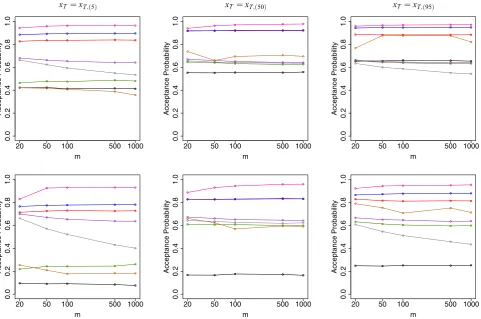
Figure1shows empirical acceptance probabilities against
the number of sub-intervals m for each bridge and each
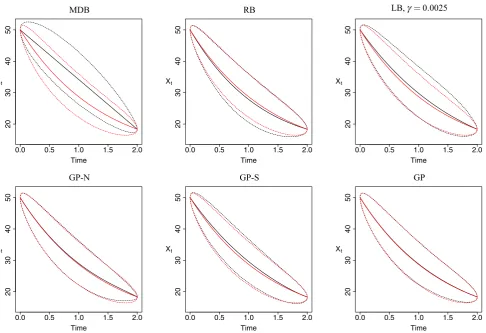
xT. Figures2and3 compare 95 % credible regions of the
[image:9.595.60.542.247.566.2]con-MDB
0.0 0.2 0.4 0.6 0.8 1.0
25
30
35
40
45
50
Xt
Time
RB
0.0 0.2 0.4 0.6 0.8 1.0
25
30
35
40
45
50
Xt
Time
LB,γ=0.0025
0.0 0.2 0.4 0.6 0.8 1.0
25
30
35
40
45
50
Xt
Time
GP-N
0.0 0.2 0.4 0.6 0.8 1.0
25
30
35
40
45
50
Xt
Time
GP-S
0.0 0.2 0.4 0.6 0.8 1.0
25
30
35
40
45
50
Xt
Time
GP
0.0 0.2 0.4 0.6 0.8 1.0
25
30
35
40
45
50
Xt
Time
Fig. 2 Birth–death model. 95 % credible region (dashed line) and mean (solid line) of the true conditioned process (red) and various bridge constructs (black) usingxT =x1,(50)
ditioned process (obtained from the output of the Metropolis– Hastings independence sampler). It is clear from the figures
that asTis increased, the MDB fails to adequately account for
the nonlinear behaviour of the conditioned process. Indeed, in terms of empirical acceptance rate, MDB is outperformed
by all other bridges forT = 2. Asm is increased so that
the discretisation gets finer, the acceptance rates under all bridges (with the exception of GP-N) stay roughly constant.
For GP-N, the acceptance rates decrease withmwhenxT is
either the 5 or 95 % quantile ofXT|X0=50. In this case, the
variance associated with the approximate transition density
either overestimates (whenxT is the 5 % quantile) or
under-estimates (whenxT is the 95 % quantile) the true variance at
the end-point. For example, whenxTis the 95 % quantile, this
results (see Fig.3) in a ‘tapering in’ of the proposal relative to
the true conditioned process. GP-S, GP and LB give similar performance, although we note that GP-S and LB perform
particularly poorly whenxT is the 5 % quantile. Moreover,
LB requires the specification of a tuning parameterγ and
we found that the acceptance rate was fairly sensitive to the
choice ofγ. In all scenarios, RB, RB−and GP-MDB
compre-hensively outperform all other bridge constructs. WhenxT is
the median ofXT|X0=50, we see that RB and RB−(red and
blue lines in Fig.1) give near identical performance, withηt
adequately accounting for the observed nonlinear dynamics. In terms of statistical efficiency, GP-MDB outperforms both
RB and RB−in all scenarios, although the relative difference
is small.
4.2 Lotka–Volterra
In this example we consider a Lotka–Volterra model of
pred-ator-prey dynamics. We denote the system state at time t
byXt =(X1,t,X2,t), ordered as prey, predators. The
mass-action SDE representation of system dynamics takes the form
d Xt =
θ1X1,t−θ2X1,tX2,t
θ2X1,tX2,t−θ3X2,t dt
+
θ1X1,t+θ2X1,tX2,t −θ2X1,tX2,t −θ2X1,tX2,t θ3X2,t+θ2X1,tX2,t
1 2
d Wt.
[image:10.595.59.545.56.388.2]MDB
0.0 0.5 1.0 1.5 2.0
20
30
40
50
Xt
Time
RB
0.0 0.5 1.0 1.5 2.0
20
30
40
50
Xt
Time
LB,γ=0.0025
0.0 0.5 1.0 1.5 2.0
20
30
40
50
Xt
Time
GP-N
0.0 0.5 1.0 1.5 2.0
20
30
40
50
Xt
Time
GP-S
0.0 0.5 1.0 1.5 2.0
20
30
40
50
Xt
Time
GP
0.0 0.5 1.0 1.5 2.0
20
30
40
50
Xt
Time
[image:11.595.58.545.54.387.2]Fig. 3 Birth–death model. 95 % credible region (dashed line) and mean (solid line) of the true conditioned process (red) and various bridge constructs (black) usingxT =x2,(95)
Table 2 Lotka–Volterra model. Quantiles ofXT|X0=(71,79) found by repeatedly simulating from the Euler–Maruyama approximation of (30) with θ=(0.5,0.0025,0.3)
T=1 T=2 T=3 T =4
xT,(5) (82.47, 62.78) (107.35, 57.95) (142.00, 60.02) (185.04, 71.23)
xT,(50) (96.82, 71.93) (133.35, 70.75) (182.64, 77.36) (242.08, 97.23)
xT,(95) (112.13, 81.58) (162.28, 84.63) (228.82, 97.12) (308.58, 128.76)
The components ofθ = (θ1, θ2, θ3)can be interpreted as
prey reproduction rate, prey death and predator reproduc-tion rate, and predator death. Note that the ODE system
((17), (22) and (23)) governing the linear noise
approxi-mation of (30) is intractable and we therefore use the R
packagelsodato numerically solve the system when
nec-essary.
Following Boys et al. (2008) we impose the
parame-ter valuesθ = (θ1, θ2, θ3) = (0.5,0.0025,0.3) and let
x0=(71,79). We assume thatxT is known and generate a
number of challenging scenarios by takingxT as either the
5, 50 or 95 % marginal quantiles ofXT|X0 =(71,79)for
T ∈ {1,2,3,4}. These quantiles are shown in Table2. Note
that for this parameter choice, the expectation of Xt|X0 =
(71,79) is approximately periodic with a period around
17.
We fixed the discretisation by takingm = 50, but note
no appreciable difference in results for finer discretisations
(e.g.m=1000). As in the previous example, GP-N and GP-S
perform relatively poorly, therefore in what follows we omit these bridges from the results. Note that we include MDB for
reference. Figure4shows empirical acceptance probabilities
against T for each bridge and eachxT. Figure5compares
95 % credible regions of the proposal under various bridging strategies with the true conditioned process (obtained from the output of the Metropolis–Hastings independence sam-pler).
Unsurprisingly, asTis increased, MDB fails to adequately
account for the nonlinear behaviour of the conditioned process. LB offers a modest improvement (except when
xT = xT,(5)) but is generally outperformed by the other
[image:11.595.176.544.431.494.2]xT=xT,(5)
0.0
0.2
0.4
0
.6
0.8
1.0
Acceptance Probability
Time
1 2 3 4
xT=xT,(50)
0.0
0.2
0.4
0
.6
0.8
1.0
Acceptance Probability
Time
1 2 3 4
xT=xT,(95)
0.0
0.2
0.4
0
.6
0.8
1.0
Acceptance Probability
Time
1 2 3 4
Fig. 4 Lotka–Volterra model. Empirical acceptance probabilities againstT. The results are based on 100 K iterations of a Metropolis–Hastings independence sampler.BlackMDB,brownLB,redRB,blueRB−,purpleGP,pinkGP-MDB
RB
0.0 0.2 0.4 0.6 0.8 1.0
70
75
80
85
X2
Time
RB−
0.0 0.2 0.4 0.6 0.8 1.0
70
75
80
85
X2
Time
LB,γ=0.01
0.0 0.2 0.4 0.6 0.8 1.0
70
75
80
85
X2
Time
0 1 2 3 4
60
80
100
120
X2
Time
0 1 2 3 4
60
80
100
120
X2
Time
γ=0.1
0 1 2 3 4
60
80
100
120
X2
Time
Fig. 5 Lotka–Volterra model. 95 % credible region (dashed line) and mean (solid line) of the true conditioned predator componentX2,t|x0,xT (red) and various bridge constructs (black) usingxT =xT,(95)withT=1 (1st row) andT =4 (2nd row)
required larger values of γ, reflecting the need for more
weight to be placed on the myopic component of the
con-struct. As for the previous example, unlessxT is the median
ofXT|x0, RB is comprehensively outperformed by RB−(see
Fig.5for the effect of increasingT on RB and RB−).
How-ever, we see that the acceptance probabilities are decreasing
inTfor both constructs. As noted byFearnhead et al.(2014),
the LNA can become poor as T increases, with the
impli-cation here being that the approximation of the expected
[image:12.595.62.542.55.220.2] [image:12.595.65.544.262.594.2]We note that the estimated acceptance probabilities are roughly constant for GP and (to a lesser extent) GP-MDB, and in terms of statistical efficiency for a fixed number of iterations, GP-MDB should be preferred over all other algo-rithms considered in this article. However, the difference in estimated acceptance probabilities between GP-MDB and
RB−is fairly small, even whenT =4 (e.g. 0.857 vs 0.577
whenxT =xT,(5)and 0.834 vs 0.606 whenxT =xT,(50)).
We also note that a Metropolis–Hastings scheme that uses
RB or RB− is some 30 times faster than a scheme with
GP or GP-MDB, since the latter require solving the LNA
ODE system for each sub-interval[τk,T]to maintain
rea-sonable statistical efficiency for a givenm. Therefore, we
further compare RB, RB−, GP and GP-MDB by computing
the minimum effective sample size (ESS) at timeT/2 (where
the minimum is over each component of XT/2) divided by
CPU cost (in seconds). We denote this measure of overall
efficiency by ESS/s. WhenxT = xT,(5) andT =1, ESS/s
scales roughly as 1:3 : 56: 83 for GP : GP-MDB : RB :
RB−. WhenT =4, ESS/s scales roughly as 1: 3:1 :17.
Hence, for this example, RB−is to be preferred in terms of
overall efficiency, although the relative difference between
RB− and GP-MDB appears to decrease as T is increased,
consistent with the behaviour of the empirical acceptance
rates observed in Fig.4.
4.3 Aphid growth
Matis et al. (2008) describe a stochastic model for aphid
dynamics in terms of population size (Nt) and cumulative
population size (Ct). The diffusion approximation of their
model is given by
d Nt
dCt =
θ1Nt−θ2NtCt
θ1Nt dt
+
θ1Nt+θ2NtCt θ1Nt
θ1Nt θ1Nt
1/2
d Wt (31)
where the components ofθ =(θ1, θ2)characterise the birth
and death rate respectively.Matis et al.(2008) also provide
a dataset consisting of cotton aphid counts recorded at times
t=0,1.14,2.29,3.57 and 4.57 weeks, and collected for 27
different treatment block combinations. The analysis of these data via a stochastic differential mixed-effects model driven
by (31) is the focus ofWhitaker et al.(2015).
Driven by the real data of Matis et al. (2008) and to
illustrate the proposed methodology in a challenging partial
observation scenario, we assume thatXTcannot be measured
exactly. Rather, we observe
YT =FXT +T, T|Σ∼N(0, Σ),
Table 3 Aphid growth model. Quantiles of Y3.57|X2.29 = (347.55,398.94) found by repeatedly simulating from the Euler– Maruyama approximation of (31) with θ = (1.45,0.0009), and corruptingN3.57with additiveN(0, σ2)noise
σ=5 σ=10 σ=50
y3.57,(5) 726.75 724.57 762.36
y3.57,(50) 786.09 815.51 774.41
y3.57,(95) 841.82 856.36 910.86
where Σ = σ2 andF = (1,0) so that only noisy
obser-vation of NT is possible, and CT is not observed at all.
We consider a single treatment-block combination and con-sider the dynamics of the process over an observation time
interval [2.29,3.57], over which nonlinear dynamics are
typically observed. We fix θ and x2.29 at their marginal
posterior means found by Whitaker et al. (2015), that is,
atθ = (1.45,0.0009) andx2.29 = (347.55,398.94). We
generate various end-point conditioned scenarios by taking
y3.57to be either the 5, 50 or 95 % quantile ofY3.57|X2.29 =
(347.55,398.94), σ. To investigate the effect of
measure-ment error, we further takeσ ∈ {5,10,50}. The resulting
quantiles are shown in Table3. As with the previous example,
the ODE system governing the linear noise approximation of
(31) is intractable and we again use thelsodapackage to
numerically solve the system when necessary.
Figure6shows empirical acceptance probabilities against
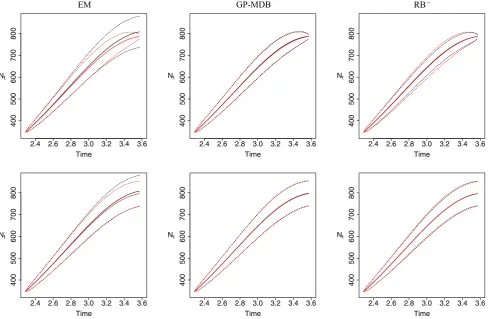
σ for EM, RB, RB−, GP and GP-MDB. Figure7compares
95 % credible regions for a selection of bridges with the true conditioned process (obtained from the output of the
inde-pendence sampler). All results are based on m = 50 (but
note that no discernible difference in output was obtained for finer discretisations). As illustrated by both figures, the myopic sampler (EM) performs poorly (in terms of statistical efficiency, as measured by empirical acceptance probability)
when the measurement error variance is relatively small (σ =
5). Forσ =50, the performance of EM is comparable with
the other bridge constructs. In fact, asσincreases, the bridge
constructs coincide with the Euler–Maruyama approxima-tion of the target process. The gain in statistical performance
of RB− over RB is clear. Likewise, GP-MDB outperforms
GP, although the difference is very small forσ = 50 and
again we note that asσ increases, the variance under
GP-MDB,ΨMDB(xτk), approaches the Euler–Maruyama variance,
as used in GP.
The relative computational cost of each scheme can
be found in Table 1. EM is particularly cheap to
imple-ment, given the simple form of the construct and the M-H acceptance probability. However, this approach cannot be
recommended in this example forσ <10, due to its dire
sta-tistical efficiency. The computational cost of RB, RB−, GP
propos-y3.57=y3.57,(5)
0.0
0.2
0.4
0.6
0.8
1.0
Acceptance Probability
σ
0 5 0
1 5
y3.57=y3.57,(50)
0.0
0.2
0.4
0.6
0.8
1.0
Acceptance Probability
σ
0 5 0
1 5
y3.57=y3.57,(95)
0.0
0.2
0.4
0.6
0.8
1.0
Acceptance Probability
σ
0 5 0
1 5
Fig. 6 Aphid growth model. Empirical acceptance probabilities againstσ. The results are based on 100 K iterations of a Metropolis–Hastings independence sampler.TurquoiseEM,redRB,blueRB−,purpleGP,pinkGP-MDB
EM
2.4 2.6 2.8 3.0 3.2 3.4 3.6
400
500
600
700
800
Nt
Time
GP-MDB
2.4 2.6 2.8 3.0 3.2 3.4 3.6
400
500
600
700
800
Nt
Time
RB−
2.4 2.6 2.8 3.0 3.2 3.4 3.6
400
500
600
700
800
Nt
Time
2.4 2.6 2.8 3.0 3.2 3.4 3.6
400
500
6
00
700
8
00
Nt
Time
2.4 2.6 2.8 3.0 3.2 3.4 3.6
400
500
6
00
700
8
00
Nt
Time
2.4 2.6 2.8 3.0 3.2 3.4 3.6
400
500
6
00
700
8
00
Nt
Time
Fig. 7 Aphid growth model. 95 % credible region (dashed line) and mean (solid line) of the true conditioned aphid population component
Nt|x2.29,y3.57(red) and various bridge constructs (black) usingy3.57=y3.57,(50)withσ=5 (1st row) andσ=50 (2nd row)
als, we found that a naive implementation that only solves the LNA ODEs once, gave no appreciable difference in empirical acceptance probability as obtained when repeatedly solving
the ODE system for each sub-interval[τk,T](as is required
in the case of no measurement error). Consequently, in this
example, GP-MDB outperforms RB−in terms of overall
effi-ciency.
5 Discussion
[image:14.595.56.544.55.221.2] [image:14.595.55.544.257.576.2]the process into a deterministic part that accounts for forward dynamics, and a residual stochastic process. The intractable end-point conditioned residual SDE is approximated using
the modified diffusion bridge ofDurham and Gallant(2002).
Using three examples, we have investigated the empirical performance of two variants of the residual bridge. The first constructs the residual SDE by subtraction of a determinis-tic process based on the drift governing the target process (denoted RB). The second variant further subtracts the lin-ear noise approximation (LNA) of the expected conditioned
residual process (denoted RB−). Our examples included a
scenario in which the LNA system is tractable, and another where the system must be solved numerically. An example that considers partial and noisy observation of the process at a future time was also presented.
5.1 Choice of residual bridge
We find that for all examples considered, the residual bridge that further subtracts the LNA mean results in improved sta-tistical efficiency (over the simple implementation based on the drift subtraction only) at the expense of having to solve
a larger ODE system consisting of orderd2 equations (as
opposed to just d when using the simpler variant). For a
known initial time-pointx0, the ODE system need only be
solved once, irrespective of the number of skeleton bridges required. Taking the Lotka–Volterra diffusion (described in
Sect.4.2) as an example, overall efficiency (as measured by
minimum effective sample size per second, ESS/s, at time
T/2) of RB− is 1.5 times that of RB when T = 1 and
xT is either the 5 or 95 % quantile of XT|x0. This factor
increases to 17 when T = 4. However, for unknown x0,
as would typically be the case when performing parameter inference, the ODE solution will be required for each skele-ton bridge, and the difference in computational cost between the two approaches is likely to be important, especially as the dimension of the state space increases. For the Lotka– Volterra example, the computational cost for solving the ODE
systemfor each bridgescales as 1:2.8 for RB : RB−.
There-fore, the relative difference in ESS/s would reduce to a factor
of roughly 0.5 whenT =1 (so that RB would be preferred)
and 6 when T = 4. We therefore anticipate that in
prob-lems wherex0is unknown, the simple residual bridge is to
be preferred, unless the ODE system governing the LNA is
tractable, or the dimensiond of Xt is relatively small, say
d<5.
5.2 Residual bridge or guided proposal?
We have compared the performance of our approach to sev-eral existing bridge constructs (adapting where necessary to the case of noisy and partial observation). These include the
modified diffusion bridge (Durham and Gallant 2002),
Lind-ström bridge (Lindström 2012) and guided proposal (Schauer
et al. 2016). Our implementation of the latter uses the LNA to guide the proposal. We find that a further modification that replaces the Euler–Maruyama variance with the MDB variance gives a particularly effective bridge, outperforming all others considered here, in terms of statistical efficiency.
We find that for fixed x0 and noisy observation of xT, an
efficient implementation of the guided proposal is possi-ble, where the ODE system governing the LNA need only be solved once. In this case, the guided proposal outper-forms both implementations of the residual bridge in terms of overall efficiency. However, we found that in the case
of no measurement error (so thatxT is known exactly), the
guided proposal required that the ODEs governing the LNA be re-integrated for each intermediate time-point and for each skeleton bridge required. Unless the ODE system can be solved analytically, we find that when combining statistical and computational efficiency, the guided proposal is outper-formed by both implementations of the residual bridge.
5.3 Extensions
Our work can be extended in a number of ways. For exam-ple, it may be possible to improve the statistical performance of the residual bridges by replacing the Euler–Maruyama
approximation of the variance ofYT|X0with that obtained
under the LNA. This approach could also be combined with the Lindström sampler to avoid specification of a tuning
parameter. Deriving the limiting (as τ → 0) forms of
the Metropolis–Hastings acceptance rates associated with the residual bridges would be problematic due to the time dependent terms entering the variance of the constructs. Nev-ertheless, this merits further research. Interest also lies in the comparison of the bridge constructs for SDEs that exhibit multimodal behaviour, although we anticipate that further modification of the constructs will be required to efficiently deal with such a scenario.
Acknowledgments The authors would like to thank the associate edi-tor and three anonymous referees for their suggestions for improving this paper.
Open Access This article is distributed under the terms of the Creative Commons Attribution 4.0 International License (http://creativecomm ons.org/licenses/by/4.0/), which permits unrestricted use, distribution, and reproduction in any medium, provided you give appropriate credit to the original author(s) and the source, provide a link to the Creative Commons license, and indicate if changes were made.