Available Online at www.ijpret.com 43
INTERNATIONAL JOURNAL OF PURE AND
APPLIED RESEARCH IN ENGINEERING AND
TECHNOLOGY
A PATH FOR HORIZING YOUR INNOVATIVE WORK
A REVIEW: DIGITAL IMAGE WATERMARKING USING QR CODE
MAYURI G. KHANDALKAR, DR. C.M. JADHAO
Department of Electronics and Telecommunication, MGI-COET Shegaon, India
Accepted Date: 17/01/2016; Published Date: 01/02/2016
\
Abstract: - Digital watermarking is the act of hiding a message related to a digital signal in different forms like an image, song, video within the signal itself. In this paper, we discuss the various factors used in watermarking, properties and application area where water making technique need to be used. Also a survey on some new work is done in image watermarking field.
Keywords:Watermarking, Image Transforms, QR code
Corresponding Author: DR. C. M. JADHAO
Access Online On:
www.ijpret.com
How to Cite This Article:
Available Online at www.ijpret.com 44
1. INTRODUCTION
A Digital image watermarking systems have been proposed as an efficient means for copyright protection and authentication of digital image content against unintended manipulation (spatial chromatic) [1]. Watermarking techniques tries to hide a message related to the actual content of the digital signal, watermarking is used for providing a kind of security for various type of data (it may be image, audio, video, etc.) Currently, two-dimensional barcodes are used to increase encoding space. Such two-dimensional barcodes as QR code, GS1 Data Bar, Data Matrix, PDF417, and Maxi Code are widely implemented in daily life. The QR code has a number of features, such as large encoding data capacity, small printout size, dirt and damage resistance, readable from any angle, and structural flexibility of application. QR code can be decoded by a small program on a camera-equipped mobile device. Therefore, QR code is applied in mobile value-added services, such as business cards, production information, commercial advertisement, bus or train tickets, passenger management, and patient identification.
2. BACKGROUND 2.1 QR Code:
Available Online at www.ijpret.com 45
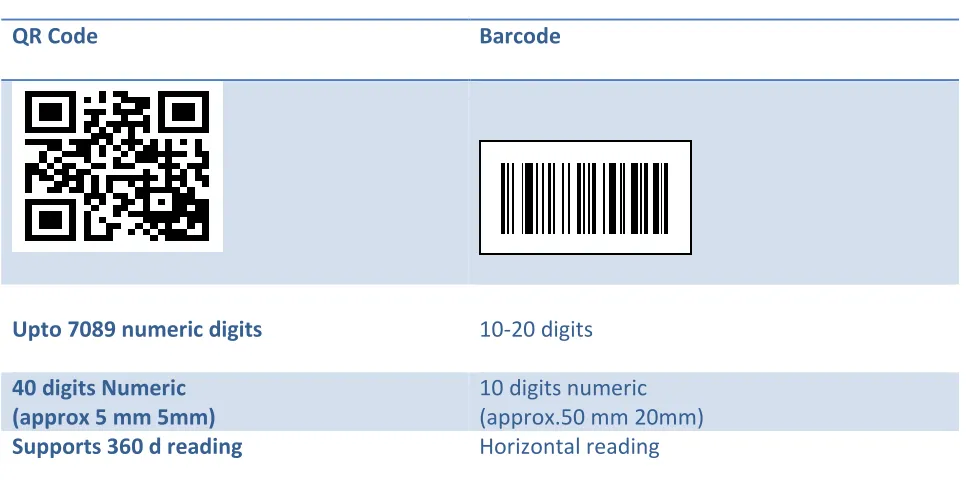
Table 1: Comparison of QR code and Barcode
QR Code Barcode
Upto 7089 numeric digits 10-20 digits
40 digits Numeric (approx 5 mm 5mm)
10 digits numeric (approx.50 mm 20mm)
Supports 360 d reading Horizontal reading
2.2 Watermark:
Watermarks are identification marks produced during the paper making process. A digital watermark is a kind of marker covertly embedded in a noise-tolerant signal such as an audio, video or image data. It is typically used to identify ownership of the copyright of such signal. "Watermarking" is the process of hiding digital information in a carrier signal; thehidden information should, but does not need to, contain a relation to the carrier signal.
1. PROCESS OF IMAGE WATERMARKING
The process of watermarking is divided into two parts:
3.1 Image Embedding:
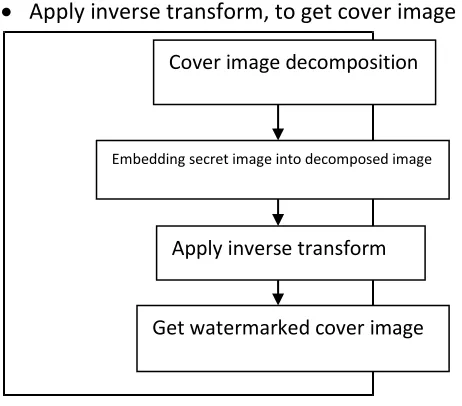
The cover image is decomposed into different sub images.
The cover image can be decomposed with any of the transform such as DCT, DFT, DWT.
Select one sub image for secret image embedding.
Available Online at www.ijpret.com 46 Apply inverse transform, to get cover image
Fig 1.: watermark embedding flowchart
3.2 Image Extraction:
Watermarked cover image is decomposed into sub images.
Extract secret image with reverse algorithm that is used for combining secret image.
Fig 2.: watermark Extraction flowchart 2. DIGITAL IMAGE WATERMARKING TYPES
Watermarking techniques can be divided into various categories in various ways. Watermarking techniques can be divided into three categories according to the type of document to be watermarked as follows:
Cover image decomposition
Embedding secret image into decomposed image
Apply inverse transform
Get watermarked cover image
Watermarked cover image is decomposed
Available Online at www.ijpret.com 47
4.1 Digital Image Watermarking: In present scenario most of the research in digital watermarking is focused on image
watermarking. There might be many reasons behind it such that as these days many images are available on the internet
at free of cost without any copyright protection mechanisms.
Fig 3.: Image Watermarking
4.2 Digital Audio Watermarking: In case of audio Signals, “watermarking” can be defined as follows “Robust and inaudible transmission of additional data along with audio signals”. Audio watermarking is based on the Psychoacoustic
approach of perceptual audio coding techniques.
Fig 4.: Audio Watermarking
4.3 Digital Video Watermarking: A video sequence consists of still images therefore all the watermarking, Methods applied on image could also be applied on video sequences.
Available Online at www.ijpret.com 48
5. DIGITAL WATERMARKING TYPES a. Visible watermarking:
In visible watermarking the imageis partially visible in other image.Visible watermarks are generally used for the copyright protection.
b. Invisible watermarking:
Invisible watermarks cannot be seen, but can be detected with some algorithm.
c. Dual watermarking:
Dual watermark is a combination of a visible and an invisible watermark. An undetectable watermark can be used as a backup for the visible watermark. It is used to verify ownership.
6. DIGITAL WATERMARKING DOMAIN 6.1 In spatial domain:
The least significant bits of original contents is modified.
6.2 In Frequency domain:
First the host or main data is transformed and then modifications are applied to transformed coefficients. Watermark is embedded transform coefficients. Hence it is more secure than spatial domain watermarking.
6.2.1 Discrete Cosine Transform (DCT):
DCT watermarking is more robust as compared to spatial
domain watermarking. But they are difficult to implement and computationally more costly.
Available Online at www.ijpret.com 49
6.2.2 Discrete Fourier Transform (DFT):
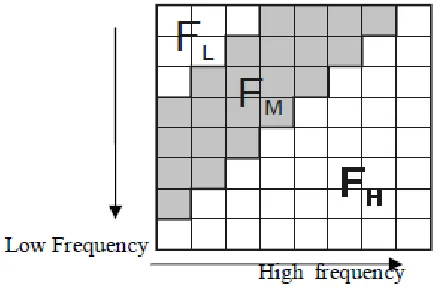
In DFT, low frequency coefficients modification can cause visible artifacts in the spatial domain, so low frequency coefficients should be avoided. High frequency coefficients are removed during JPEG compression. The best way to avoid the both lower and higher frequencies weakness is to embed the watermark in the mid-level frequency.
6.2.3 Discrete Wavelet Transform (DWT):
Discrete Wavelet transform (DWT) is a mathematical tool for hierarchically decomposing an image [10]. It is useful for processing of non-stationary signals. The transform is based on small waves, called wavelets, of varying frequency and limited duration. Wavelet transform provides both frequency and spatial description of an image. Unlike conventional. Fourier transform, temporal information is retained in this transformation process. The basic idea of discrete wavelet transform (DWT) in image process is to multi-differentiated decompose the image into sub-image of different spatial domain and independent frequency district,
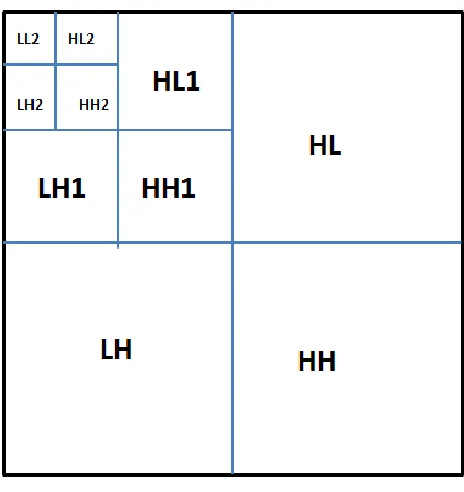
Then transform the coefficient of sub-image. After the original image has been DWT transformed, it is decomposed into 4 frequency districts which is one low-frequency district(LL) and three high-frequency districts (LH,HL,HH). If the information of low-frequency district is DWT transformed, the sub-level frequency district information will be obtained. A two-dimensional image after three-times DWT decomposed can be shown as Fig 7.
Available Online at www.ijpret.com 50
Fig 7.: Discrete Wavelet Transform
7. PROPERTIES OF DIGITAL WATERMARKING
There are three main Properties of digital watermarking technique:
7.1Transparency or Fidelity:
The digital watermark should not affect the quality of the original image after it is watermarked. Watermarking should not introduce visible distortions because if such distortions are introduced it reduces the commercial value of the image.
7.2 Robustness:
Watermarks could be removed intentionally or unintentionally by simple image processing operations like contrast or brightness enhancement, gamma correction etc. Hence watermarks should be robust against variety of such attack
7.3 Capacity or Data Payload:
Available Online at www.ijpret.com 51
8. APPLICATIONS 8.1 Content Labeling:
Watermarks can be used to give more information about the cover object. This process is named as content labeling.
8.2 Tamper Detection:
Fragile watermarks can be used to detect tampering in an image. If the fragile watermark degrades in any way, then we can say that the image or document in question has been tampered.
8.3 Digital Fingerprinting:
This is a process used to detect the owner of the content. Every fingerprint will be unique to the owner.
8.4 Content protection:
In this process the content stamped with a visible watermark that is very difficult to remove so that it can be publicly and freely distributed.
9. PERFORMANCE EVALUATION
Performance evaluation is very important part in the any algorithmic design in watermarking. The main task of this is to evaluate the quality matrices of algorithm or method to find out, how much he is effective? Some of the quality matrices an image watermarking method or algorithm.
9.1 Mean square error (MSE):
The mean squared error (MSE) in an image watermarking is to estimate or measures the average of the squares of the "errors", between host image and watermark image
MSE= 𝑀𝑥𝑁 ∑ ∑ (Wij−Hij)𝑁1 2 𝑗
𝑀 𝑖
Available Online at www.ijpret.com 52
9.2 Peak signal to noise ratio (PSNR):
PSNR (Peak Signal to Noise Ratio) is used to determine the Efficiency of Watermarking with respect to the noise. The noise will degrade the quality of image. The visual quality of watermarked and attacked images is measured using the Peak Signal to Noise Ratio [5]. It is given by
PSNR = 10 *log (P2/MSE)
Where p= maximum value in host image,
Imperceptibility of image is determined by this factor. More the PSNR shows that Watermarked image is perceptible or watermark is not recognized by naked eyes.
10. CONCLUSION
In the proposed Digital watermarking technique, a binary image is watermarked into a QR Code image. The embedding process is in LH, HL and HH sub bands based on wavelet transform. The algorithm states that the watermark with an acceptable visual quality can be recover easily. In future we try to find more efficient ways for more severe attacks such as stronger noise, high compression and geometric distortion etc.
In future work we focus on extending the proposed method for more embedding capacity and also for embedding secret data in audio or video file. In future there is a scope to develop a better technique for QR Code image based on the above theoretical knowledge and the current technology available and also reduce the degradation of image quality.
REFERENCES
1. QR Code Watermarking Algorithm based on Wavelet Transform. ISCIT 2013.
2. F. Hartung, and M. Kutter, “Multimedia watermarking techniques”, Proc. IEEE, vol. 87, no. 3, 1999, pp.1079–1107.
Available Online at www.ijpret.com 53
4. Sushma Yalamanchili, M. Kameswara Rao, “Copyright Protection of Gray Scale Images by Watermarking Technique using (N, N) Secret Sharing Scheme,” Journal of Emerging Technologies in Web Intelligence, Vol 2, No 2, pp.101-105, May 2010.
5. Y. Rangsanseri, J. Panyaveraporn and P. Thitimajshima, “PCA/Wavelet Based Watermarking of Multispectral Images,” 2005 International Symposium on Remote Sensing (ISRS2005), Korea, 12-14 Oct. 2005
6. Nagaraj V. Dharwadkar and B. B. Amberker, “Watermarking Scheme for Color Images using Wavelet Transform based Texture Properties and Secret Sharing,” International Journal of Information and Communication Engineering, Vol 6, No 2, pp 94-101, 2010.