Original citation:
Lekfuangfu, Warn N., Powdthavee, Nattavudh, Warrinnier, Nele and Cornaglia, Francesca. (2016) Locus of control and its intergenerational implications for early childhood skill formation. The Economic Journal.
Permanent WRAP URL:
http://wrap.warwick.ac.uk/81473
Copyright and reuse:
The Warwick Research Archive Portal (WRAP) makes this work by researchers of the University of Warwick available open access under the following conditions. Copyright © and all moral rights to the version of the paper presented here belong to the individual author(s) and/or other copyright owners. To the extent reasonable and practicable the material made available in WRAP has been checked for eligibility before being made available.
Copies of full items can be used for personal research or study, educational, or not-for profit purposes without prior permission or charge. Provided that the authors, title and full bibliographic details are credited, a hyperlink and/or URL is given for the original metadata page and the content is not changed in any way.
Publisher’s statement:
"This is the peer reviewed version of the following article: Lekfuangfu, Warn N.,
Powdthavee, Nattavudh, Warrinnier, Nele and Cornaglia, Francesca. (2016) Locus of control and its intergenerational implications for early childhood skill formation. The Economic Journal. which has been published in final form at http://dx.doi.org/10.1111/ecoj.12414. This article may be used for non-commercial purposes in accordance with Wiley Terms and Conditions for Self-Archiving."
A note on versions:
The version presented here may differ from the published version or, version of record, if you wish to cite this item you are advised to consult the publisher’s version. Please see the ‘permanent WRAP URL’ above for details on accessing the published version and note that access may require a subscription.
Locus of Control and Its Intergenerational Implications for
Early Childhood Skill Formation
Warn N. Lekfuangfu
Chulalongkorn University and CEP, London School of Economics
Nattavudh Powdthavee1
CEP, London School of Economics
Nele Warrinnier
CEP, London School of Economics and University of Leuven
Francesca Cornaglia
Abstract
This paper builds upon Cunha’s (2015) subjective rationality model in which parents have a subjective belief about the impact of their investment on the early skill formation of their children. We propose that this subjective belief is determined in part by locus of control (LOC), i.e., the extent to which individuals believe that their actions can influence future outcomes. Consistent with the theory, we show that maternal LOC measured at the 12th week of gestation strongly predicts maternal attitudes towards parenting style, maternal time investments, as well as early and late cognitive outcomes. We also utilize the variation in inputs and outputs by maternal LOC to help improve the specification typically used in the estimation of skill production function parameters.
Keywords: locus of control; parental investment; human capital accumulation; early skill formation; ALSPAC
Standard economic theories assume that a significant part of an individual’s decision
to invest in human capital is driven not only by the expected returns to investment and
their innate cognitive abilities, but also by the current access to financial resources
(e.g. Mincer, 1958, 1994; Becker, 1962, 1964; Ben-Porath, 1967; Grossman, 1972;
Heckman, 1976). The idea that economic resources matter per se to human capital
investment decisions has provided researchers with a useful framework for analysing
inequalities regarding earnings, health, and social mobility among individuals from
various socio-economic backgrounds (e.g. Flug et al., 1998; Neal and Rosen, 2000;
Deaton, 2001).
Yet, until recently, economists have made few attempts to understand why
investment decisions can – and often do – vary significantly among individuals with
similar levels of incomes and cognitive abilities (e.g. Phillips et al., 1998; Feinstein,
2003; Cunha et al., 2010). According to a study by Cobb-Clark (2014), one potential
explanation for this is that individuals with comparable socio-economic backgrounds
and cognitive abilities may nevertheless possess different subjective beliefs about the
impact of their investments on the rate of return, which can in turn determine how
much each individual is willing to invest in the human capital for him or herself.
These subjective beliefs depend in part on the individual’s locus of control
(LOC), which is a generalised expectancy regarding the nature of the causal
relationship between the individual’s behaviour and the consequences of the
behaviour (Rotter, 1966). The formation of LOC as a trait happens early in life and
remains relatively stable over time (Cobb-Clark and Schurer, 2013). Individuals with
an external LOC believe that events in their life are outcomes of external factors (e.g.
from their own actions and thus tend to expect higher rates of return to their own
behaviour than individuals with an external LOC.
This premise – that an individual’s LOC drives each person’s subjective
expectation about the rate of return to investment – implies that, for efficiency
reasons, people with an internal LOC will also naturally be driven to invest more of
their current resources for the purpose of enjoying future returns compared with
people with an external LOC. With perhaps one exception,2 the notion that an internal
LOC person will invest more than an external LOC person on a range of individual
self-improvement decisions is typically supported by the data. For example, Coleman
and DeLeire (2003) were among the first economists to find that individuals with an
internal LOC are ceteris paribus less likely to drop out from high school primarily
because they tend to have higher expectations regarding the returns to human capital
investments than do people with an external LOC. Cobb-Clark et al. (2014) find that
individuals with an internal LOC are more likely to eat more healthily and exercise
more regularly than people with an external LOC, when individuals’ income, future
orientation, and the value they place on their health remain constant. People with an
internal LOC also tend to search for a job more intensively when unemployed
(Caliendo et al., 2015; McGee, 2015), save more for ‘rainier days’ (Cobb-Clark et al.,
2013), and appear to possess higher levels of psychological resources from which
they could draw upon to help them cope with negative life shocks compared to people
with an external LOC (Schurer, 2014; Buddelmeyer and Powdthavee, 2016).
Our study advances from previous research in this area and focuses on the
potential implications of the individual’s LOC on investment decisions in children
(rather than the implications of LOC on the individual’s own human capital
investments). The contribution of this study is twofold. First, recent research in the
child development literature has concluded that parents do not have full knowledge of
the technology of human capital formation and that there are uncertainties in
achieving the desired outcomes (e.g. Cunha et al., 2013; Cunha, 2015). This implies
that parents’ optimal investment decisions will depend not only on the resources that
are available to them at the time, but also on their subjective expectations about the
rate of return to early childhood investment (e.g. Cunha et al., 2013; Cunha, 2015).
While empirical studies have found that parents’ subjective expectations about
the returns influence the actual investment levels and subsequent child outcomes
(Attanasio and Kaufmann, 2009; Cunha et al., 2013), little is known about the sources
of individual differences in subjective beliefs in the expected returns to early life
investments. Thus, our first contribution is to fill this missing link in the early
childhood investment model by proposing that a significant proportion of variation in
parents’ subjective expectations about the returns to investment may be explained by
individual differences in LOC among mothers.3 More specifically, using rich cohort
data of British children born in the 1990s, we show that maternal LOC measured
during pregnancy is an important predictor of beliefs in parental approaches to active
child rearing (e.g. the beliefs that parents should be more active in rearing the child
rather than leaving it to chance), which we believe to be a reasonably good proxy for
parents’ subjective expectations about the returns to their investments. Additionally,
maternal LOC is strongly related to indicators of maternal time inputs and early
cognitive outcomes – all measured during 1 to 3 years of age.
Our second and perhaps more novel contribution to the literature is in the
methodology. In child development literature, researchers attempt to understand the
role of parental characteristics and early home environments in the production of both
cognitive skills and non-cognitive skills (see e.g. Belsky and Eggebeen, 1991;
Vandell and Ramanan, 1992; Parcel and Menaghan, 1994; Gregg et al., 2005; Bernal,
2008). However, according to Todd and Wolpin (2003), many empirical studies suffer
from several data limitations that prevent many empirical exercises, which use
observational data sets, from making causal interpretations of their findings. The main
reason for this is that most – if not all – early childhood input decisions are subject to
choices made by parents. This would not necessarily pose a problem for researchers
who want to estimate a production function for child development if data on all
relevant inputs as well as child endowments were observed. However, it does pose a
problem when data on relevant inputs and endowments are omitted.
With longitudinal data, researchers can apply a first-difference (FD) model to
correct for any permanent unobserved factors that normally bias the estimation of
skill production function parameters, such as endowed mental capacity in children
that does not change over time (Todd and Wolpin, 2003). However, the application of
FD models is likely to result in estimates that are biased towards zero because of the
attenuation bias normally associated with the differencing of data (McKinnish, 2008).
We aim to correct for part of this problem by proposing that a significant share
of the within-child variation in the optimal investment level among mothers from the
same socio-economic status (SES) is determined by individual differences in maternal
LOC measured during pregnancy. At one extreme, the subjective belief that all
maternal inputs are used efficiently to achieve the desired outcomes held by the
children at each step of child development. At the other extreme, the subjective belief
that active parenting is completely inefficient in achieving the desired outcomes held
by the absolutely external LOC mothers implies that they are likely to invest less – if
at all – in active parenting. Our empirical strategy will exploit this additional
difference in the investment levels between mothers of internal LOC and those of
external LOC who otherwise share similar backgrounds, to estimate the returns to
early childhood investments. We advocate that our estimation technique, when
applied to observational data, can correct for parts of the attenuation bias. Moreover,
by pairing the comparable mothers, our method can account for some of the omitted
time-varying variables, in particular the natural developmental trends of children.
Therefore, the method helps to tackle some of the time-varying biases normally
associated with the estimation of FD models.
The remainder of this paper is organised as follows. Section 1 is a background
to the literature and discusses in more detail the motivation of our study. Section 2
outlines the empirical framework for estimating the production function parameters.
Section 3 describes the data, and Section 4 discusses the econometric models. Section
5 presents and discusses the main results. Section 6 concludes.
1. Background
1.1. What Drives Human Capital Investments in Children?
Traditional economic models typically view the availability of financial resources as
one of the key determinants of human capital investment in children (e.g. Becker,
1962; Ben-Porath, 1967; Becker and Tomes, 1986). According to these models, in
their children will depend almost exclusively on the objective net benefits of their
investments. However, despite all parents wanting to invest optimally in their
children, a presence of liquidity and borrowing constraints in the early years would
imply that early childhood investments will be lower for low-income parents than for
high-income parents (e.g. Lochner and Monge-Naranjo, 2011; Caucutt and Lochner,
2012), thus leading to the formation of a ‘skill’ gap early in a child’s life and that may
persist throughout adolescence and adulthood (Carneiro and Heckman, 2003).
Considerable empirical evidence shows that family income strongly predicts
parents’ human capital investment decisions in children and their cognitive outcomes
at early stages. For example, Kaushal et al. (2011) use two nationally representative
expenditure surveys to show that American families in the bottom family expenditure
quintile spend 3% of their total expenditure on education enrichment items (e.g.
preschool, drama lessons, music lessons) whereas families in the top income quintile
spend 9%. Regarding early child outcomes, Duncan et al. (2008) find that differences
in family income account for many of the observed differences between the early life
IQs of children, even after controlling for differences in family structure and maternal
schooling. Yeung et al. (2002) find family income to be an important predictor of
preschool children’s cognitive and behavioural developmental outcomes. They also
find that much of the association between income and child outcomes is mediated by
the family’s ability to invest in a stimulating learning environment for children at
early stages. Using a range of data sets, other studies have also shown that family
income at early stages has a greater impact on later educational attainments than
family income at late stages (e.g. Duncan and Brooks-Gunn, 1997; Duncan et al.,
Despite numerous studies showing that early access to capital in a child’s life
does influence early childhood investments and developments, recent empirical
evidence indicates that differences in income alone cannot explain the observed gap
in school readiness between low- and high-income children in the US (e.g. Phillips et
al., 1998; Cunha et al., 2010) and in the UK (e.g. Feinstein, 2003). For example,
Duncan et al. (2013) show that the widening income gap between families accounts
for only three-quarters of the increasing schooling gap. Similarly, Reardon (2011),
using data from 19 nationally representative studies, finds that only half of the rising
income gap in test scores is attributed to rising income inequality.
One explanation is that other types of human capital inputs also matter. For
example, growing evidence points towards radical differences in parenting behaviours
between low- and high-income families. Guryan et al. (2008) find that mothers with a
college education spend approximately 4.5 hours per week more in childcare than
mothers with a high-school degree or less. High-SES mothers are also found to be
significantly more verbally engaging to their children; according to a qualitative study
by Hart and Risley (1995), there are large differences in language stimulation
environments measured by word count among mothers from different social classes.
Not only do high-SES parents invest more time in cognitively stimulating their
children, they also do so more efficiently. Using data from the 2003–2007 American
Time Use Surveys, Kalil et al. (2012) show that high-SES mothers not only spend
more time in childcare, but they are also more likely to alter the composition of their
time use to meet the age-specific developmental needs of their children. According to
a qualitative study by Lareau (2003), high-SES parents tend to prefer the ‘concerted
development of skills), which is more common among parents from lower SES
backgrounds.
Evidence that parenting behaviours among parents from different SES
backgrounds influence early childhood developments gives rise to two important
questions. First, what drives the differences in parenting style between low- and
high-SES families? And second, for any given parenting style, do parents with similar
endowments of wealth and educational backgrounds invest the same amount of time
inputs in their children?
1.2. Uncertainty and the Subjective Rationality Model of Parental Investment
To understand better the source of heterogeneity in parenting behaviours between-
and within-SES classes, some updating of the human capital theory is required. Recall
that traditional economic models tend to assume that human capital investment
decisions in children are driven purely by the objective costs and benefits of
investments (e.g. Ben-Porath, 1967; Becker and Tomes, 1986). In fact, many
uncertainties associated with the returns to investment in early childhood human
capital will be realised by parents only years after the investments have taken place
(e.g. Cunha et al., 2013; Cunha, 2015). Because parents are unlikely to have the full
information regarding the production technology of early life skills, their decision of
whether to adopt an active parenting style will be driven in part by their subjective
beliefs in future returns to their investments.
Psychology studies suggest that income level or family SES is associated with
an active parenting style (e.g. Hess et al., 1980; Ninio and Rinott, 1988; Mansbach
and Greenbaum, 1999). However, recent studies show that some knowledge-based
parenting behaviours among low-income families without necessarily changing their
incomes (e.g. Attanasio and Kaufmann, 2009; Fitzsimons et al., 2012; Suskind and
Leffel, 2013).
In other words, although subjective beliefs in the future returns to a concerted
cultivating parenting style tend to be higher among high-income parents than among
low-income parents, income itself is not a prerequisite for improving an individual’s
subjective beliefs in those returns. Moreover, Cunha et al. (2013) show that one of the
main reasons why parents from socio-economically disadvantaged backgrounds tend
to underinvest their time in cognitively stimulating their children at early stages is that
they tend to underestimate the future returns from investing in such an active
parenting style, regardless of potential liquidity constraints.
The importance of parents’ subjective beliefs in future returns provides the
central tenet to Flavio Cunha’s (2015) seminal work on the subjective rationality
model of parental investment. Under his framework, parents are assumed to have
altruistic preferences for their children (e.g. Becker and Tomes, 1986) and to be
rational agents who want to maximise their utility over the lifespan. However, parents
lack information on the human capital process and therefore must rely on their own
subjective assessment of the potential outcomes of the human capital production.
Human capital accumulation is determined by the interaction between investments
(e.g. number of books at home) and institutions (e.g. quality of school).
Similar to a classical framework of human capital investment, each parent
faces budget constraints when attempting to optimise the desired outcomes. A point of
children’s human capital in two stages.4 In the first stage, each parent chooses their
optimal type of parenting style (Lareau’s (2003) ‘concerted cultivation’ versus
‘natural growth’), which is essentially a production technology that governs how
efficiently each type of input, i.e. own investment and institutional factor, is
transformed. Each parent knows that if he or she chooses the ‘concerted cultivation’
style, the parent incurs a cost (in utility unit), whereas choosing the ‘natural growth’
style is costless. When an optimal parenting style is chosen, each parent then chooses
the optimal level of own investment at each time period, subject to budget constraints.
Because income is less constrained and the utility cost of utilising the superior
technology is lower for high-SES parents than for low-SES parents, the model
predicts that high-SES parents are more likely than low-SES parents to adopt the
concerted cultivation parenting style. More importantly, the model also implies that,
for a given parenting style, the optimal level of investment will be higher when
parents’ subjective expectations about the input efficiency are higher (simply because
having higher subjective expectations about the input efficiency increases the belief
that each unit of investment will, with certainty, be converted into the desired output).
However, despite the theoretical importance of this subjective element in the
human capital accumulation process, little is known about how parents acquire this
subjective belief or its formation. Moreover, assuming that the differences in parents’
subjective beliefs are not perfectly captured by differences in family SES, the main
driver of input choices among parents from the same SES background is still poorly
understood.
We propose that, conditional on their SES background, parents’ subjective
expectations regarding the input efficiency of a particular parenting style are mainly
driven by LOC.
1.3. LOC and Human Capital Investment Decisions
Recall that
A. LOC is a generalised expectancy regarding the nature of the causal
relationship between an individual’s behaviour and the consequences of the
behaviour (Rotter, 1966);
B. LOC forms in childhood and remains relatively stable throughout life
(Cobb-Clark and Schurer, 2013); and
C. LOC has important implications across a variety of investment decisions,
including human capital (Coleman and DeLeire, 2003), health (Cobb-Clark et
al., 2014), and job search (Caliendo et al., 2015; McGee, 2015).
Although LOC can affect people’s willingness to invest in human capital through
several potential mechanisms, e.g. productivity, preferences, self-efficacy, risk
perception, and self-control (see e.g. Cobb-Clark, 2014), recent empirical studies in
economics show that LOC is likely to affect human capital investment decisions
mainly through its effect on the individual’s subjective beliefs in returns to
investments. For example, Coleman and DeLeire (2003) were the first to link the
individual’s LOC to expected wage outcomes by empirically showing that subjective
beliefs in wage returns to education are higher for young people with internal LOC
than for otherwise similar young people with external LOC. Both McGee (2015) and
studies attribute their observed effects to the impacts of LOC on the individual’s
beliefs in the returns to search rather than to productivity, because internal LOC
jobseekers are no more successful at finding jobs than their external LOC
counterparts. Finally, McGee and McGee (2011) provide experimental evidence
showing that the link between LOC and search efforts disappears when it is made
clear to people that there is no uncertainty associated with the returns to investment.
In other words, they find virtually no difference in search efforts between high- and
low-LOC individuals in the laboratory when subjects know the true relationship
between efforts and job offers.
Regarding the intergenerational implications of LOC on child outcomes, we
hypothesise that parents’ LOC can influence – independently of their SES background
– the human capital development of their children through (i) its impact on subjective
expectations regarding returns to investments and, in turn, parenting style, and (ii) the
genetic and behavioural heritability of LOC that affects the child’s own human capital
investment decisions (see e.g. Anger, 2012). However, by limiting ourselves to
analysing the first few years of a child’s life, it is possible to minimise the
confounding influences that item (ii) has on the association between parents’ LOC
and the human capital accumulation in their children.
1.4. Estimation of the Returns to Parental Investments
Empirical evidence on the effects of parental time inputs on human capital
accumulation in children at early stages is scarce.5 Todd and Wolpin (2003, 2007)
report that home inputs (e.g. parental involvement and the availability of learning
materials) are strong predictors of cognitive development and that heterogeneity in
these inputs explain approximately 10–20% of the racial attainment gaps. Fiorini and
Keane (2014) use unique time-use diaries from the Longitudinal Study of Australian
Children to establish the links between time allocation of children 1–9 years of age
and human capital accumulation. They find that educational activities together with
parents are the most productive time inputs for the development of cognitive skills,
but not for non-cognitive skills. Similarly, Del Bono et al. (2014) find large effects of
maternal time inputs, both educational and recreational, on cognitive and emotional
skill development in children 3–7 years of age.
According to Todd and Wolpin (2003), the main empirical challenge in the
estimation of the effects of parental time inputs on child outcomes is that parenting
style is endogenous, and it is often unclear what type of variables could serve as a
valid instrumental variable for parental time allocation. With longitudinal data, we
can correct for part of this bias by eliminating unobserved individual fixed effects
altogether from simultaneously affecting both parents’ human capital investment
decisions and child outcomes. However, by doing so we risk exacerbating the extent
of attenuation bias that could result in a severe underestimation of the production
parameters (e.g. McKinnish, 2008).
By assuming that LOC is primarily linked to human capital investment
decisions in children through the individual’s beliefs in investment returns, we can
introduce a source of meaningful variation regarding parental time inputs in our early
child outcomes regression equations that, in turn, helps to correct for some – if not all
– of the attenuation bias caused by the application of the FD model. The following
2. Empirical Framework
Let us assume the following early skills production function, which can be written in
a non-parameterised format as
𝑌𝑖𝑎 = 𝑌(𝑋𝑖𝑎, 𝑁𝑖𝑎, 𝜙𝑖0, 𝜖𝑖𝑎), (1)
where 𝑌𝑖𝑎 is an early skill outcome of child i at age a; 𝑋𝑖𝑎 is vector of parental
investments in the child’s early skill at age a; 𝑁𝑖𝑎 represents all other inputs that
influence the child’s skill development that are independent from parents’
investments at the child’s age a; 𝜙𝑖0 is a set of pre-birth family characteristics
including parents’ highest completed education levels (as a proxy for family SES) and
the child’s endowments at age zero; and 𝜖𝑖𝑎 is the error term.
A linear approximation of Equation (1) is then given by
𝑌𝑖𝑎 = 𝜙𝑖0𝛾𝑎 + 𝑋𝑖𝑎𝛽1+ 𝑋𝑖𝑎−1𝛽2+ ⋯ + 𝑋𝑖1𝛽𝑎+ 𝑁𝑖𝑎𝛼1+ 𝑁𝑖𝑎−1𝛼2+
… + 𝑁𝑖1𝛼𝑎+ 𝜖𝑖𝑎. (2)
Todd and Wolpin (2003, 2007) discuss various ways for researchers to
empirically estimate Equation (3), including (a) cumulative specification in which
data of contemporaneous and historical family and school inputs are used in the
estimation, (b) value-added specification in which missing data of historical inputs
are replaced by the baseline achievement measure (or the lagged dependent variable),
and (c) within-child specification in which multiple observations on child outcomes
and on inputs are used to difference out any unobserved time-invariant factors from
the estimation process.6
Focusing on the within-child specification, we attempt to estimate the child’s
production function up to 2 years of age. For simplification, let us rewrite Equation
(2) for age 1 and age 2 as
𝑌𝑖1 = 𝜙𝑖0𝛾1+ 𝑋𝑖1𝛽1+ 𝑁𝑖1𝛼1+ 𝜖𝑖1, (2a)
and
𝑌𝑖2 = 𝜙𝑖0𝛾2+ 𝑋𝑖2𝛽1+ 𝑋𝑖1𝛽2+ 𝑁𝑖2𝛼1+ 𝑁𝑖1𝛼2+ 𝜖𝑖2. (2b)
Subtracting Equation (2a) from Equation (2b), we obtain the within-child FD
specification
𝑌𝑖2− 𝑌𝑖1 = 𝜙𝑖0(𝛾2− 𝛾1) + (𝑋𝑖2− 𝑋𝑖1)𝛽1+ 𝑋𝑖1𝛽2+ (𝑁𝑖2− 𝑁𝑖1)𝛼1+
𝑁𝑖1𝛼2+ (𝜖𝑖2− 𝜖𝑖1). (3)
Generally, neither 𝜙𝑖0 nor 𝑁𝑖2− 𝑁𝑖1 is observed. The parameters 𝛽1 and 𝛽2
can be consistently estimated under the following assumptions:
(i) The effect of endowment is age-invariant. Here, 𝛾2= 𝛾1= 𝛾𝑎, in which case
the differencing eliminates the endowment from Equation (3), i.e. 𝜙𝑖0(𝛾2− 𝛾1) = 0.
(ii) The omitted inputs are uncorrelated with observed inputs, i.e. 𝑐𝑜𝑟𝑟(𝑁𝑖2− 𝑁𝑖1; 𝑋𝑖2− 𝑋𝑖1) = 0.
(iii) There is no feedback effect of parental input choice from previous outcome, i.e. 𝑐𝑜𝑟𝑟(𝑋𝑖𝑎, 𝑌𝑖𝑎−𝑡) = 0.
(iv) The unobserved inputs are age-invariant: 𝑁𝑖2= 𝑁𝑖1= 𝑁𝑖𝑎, in which case the
differencing eliminates the unobserved inputs from Equation 3), i.e. (𝑁𝑖2− 𝑁𝑖1)𝛼1= 0.
Given the above assumptions, the within-child FD regression can be written as
where 𝑒𝑖 = 𝑁𝑖1𝛼2+ (𝜖𝑖2− 𝜖𝑖1). We now consider a way of relaxing the strong
assumptions (iii) and (iv) that maintained that the omitted inputs are age-invariant and
that later parental input choices are invariant to prior developmental child outcomes.
To account for the unobserved time-variant natural inputs and the endogeneity
of parental inputs, we refer back to our earlier conceptual framework and assume that,
within the same SES background, input choices are mainly driven by parents’
subjective expectations about the returns to investments, and that the main source of
these subjective beliefs is their predetermined LOC. More formally, we propose that
parents can be further distinguished into two groups of individuals who possess
different subjective beliefs about the returns to investments, but who otherwise share,
on average, statistically the same family characteristics and omitted inputs across the
child’s developmental path. It is this between-group difference in parents’ subjective
beliefs – which is partly predetermined by their LOC – that drives the between-group
difference in optimal parental input choice. Given this assumption, we can extend the
fixed effects equation, i.e., Equation (4), for (i) individuals who believe that their
actions are efficient in producing the desired outcomes, i.e. the internal LOC
individuals (IN), and (ii) individuals who believe that their actions are inefficient in
producing the desired outcomes, i.e. the external LOC individuals (EX) as
𝑌𝑖2,𝐼𝑁− 𝑌𝑖1,𝐼𝑁 = 𝜙𝑖0,𝐼𝑁(𝛾2,𝐼𝑁− 𝛾1,𝐼𝑁) + (𝑋𝑖2,𝐼𝑁− 𝑋𝑖1,𝐼𝑁)𝛽1,𝐼𝑁+ 𝑋𝑖1,𝐼𝑁𝛽2,𝐼𝑁
+(𝑁𝑖2,𝐼𝑁− 𝑁𝑖1,𝐼𝑁)𝛼1,𝐼𝑁+ 𝑁𝑖1,𝐼𝑁𝛼2,𝐼𝑁+ (𝜖𝑖2,𝐼𝑁− 𝜖𝑖1,𝐼𝑁), (5)
and
𝑌𝑖2,𝐸𝑋− 𝑌𝑖1,𝐸𝑋 = 𝜙𝑖0,𝐸𝑋(𝛾2,𝐸𝑋− 𝛾1,𝐸𝑋) + (𝑋𝑖2,𝐸𝑋− 𝑋𝑖1,𝐸𝑋)𝛽1,𝐸𝑋+ 𝑋𝑖1,𝐸𝑋𝛽2,𝐸𝑋
+(𝑁𝑖2,𝐸𝑋 − 𝑁𝑖1,𝐸𝑋)𝛼1,𝐸𝑋+ 𝑁𝑖1,𝐸𝑋𝛼2,𝐸𝑋+ (𝜖𝑖2,𝐸𝑋− 𝜖𝑖1,𝐸𝑋). (6)
Because the subjective efficiency of parents’ own investment is higher for the
𝑋𝑖𝑎,𝐼𝑁 > 𝑋𝑖𝑎,𝐸𝑋 for any given age a. Subtracting Equation (6) from Equation (5) gives
a specification similar to a difference-in-differences (DD).
[Δ𝑌𝑖,𝐼𝑁− Δ𝑌𝑖,𝐸𝑋] = 𝛽1(Δ𝑋𝑖,𝐼𝑁− Δ𝑋𝑖,𝐸𝑋) +
𝛽2 (𝑋𝑖1,𝐼𝑁− 𝑋𝑖1,𝐸𝑋) + 𝛼1(Δ𝑁𝑖,𝐼𝑁− Δ𝑁𝑖,𝐸𝑋) +
𝛼2 (𝑁𝑖1,𝐼𝑁− 𝑁𝑖1,𝐸𝑋) + (Δ𝜖𝑖,𝐼𝑁− Δ𝜖𝑖,𝐸𝑋), (7)
where Δ denotes a FD within-child and LOC group 1–2 years of age. For this DD
specification to be appropriate, we need to account for the variables of the change of
omitted inputs or what we refer to as the unobserved developmental trend, Δ𝑁𝑖, which
is the counterfactual developmental trend in the absence of parental inputs. To do this,
we require in lieu of (iii) and (iv):
(v) On average, the unobserved developmental trends are identical across LOC groups, i.e. 𝑁𝑖2,𝐿𝑂𝐶− 𝑁𝑖1,𝐿𝑂𝐶 = 𝑁𝑖2− 𝑁𝑖1.
Assumption (v) implies that the omitted variables of natural trend can be cancelled
out by using the DD specification. However, it is possible that the quality of omitted
inputs faced by parents of different LOC types, 𝑁𝑖𝑎,𝐿𝑂𝐶, will also be driven in part by
the difference in their SES backgrounds, thus making assumption (v) invalid. To
account for the potential confounding influences on input choices from differences in
parents’ SES, a third difference – high-SES (H) and low-SES (L) – is introduced into
the DD equation as follows:
[(Δ𝑌𝑖,𝐼𝑁,𝐻− Δ𝑌𝑖,𝐸𝑋,𝐻) − (Δ𝑌𝑖,𝐼𝑁,𝐿− Δ𝑌𝑖,𝐸𝑋,𝐿)] =
𝛽1[(Δ𝑋𝑖,𝐼𝑁,𝐻− Δ𝑋𝑖,𝐸𝑋,𝐻) − (Δ𝑋𝑖,𝐼𝑁,𝐿− Δ𝑋𝑖,𝐸𝑋,𝐿)] +
𝛽2 [(𝑋𝑖1,𝐼𝑁,𝐻− 𝑋𝑖1,𝐸𝑋,𝐻) − (𝑋𝑖1,𝐼𝑁,𝐿− 𝑋𝑖1,𝐸𝑋,𝐿)] +
[(Δ𝜖𝑖,𝐼𝑁,𝐻− Δ𝜖𝑖,𝐸𝑋,𝐻) − (Δ𝜖𝑖,𝐼𝑁,𝐿− Δ𝜖𝑖,𝐸𝑋,𝐿)], (8)
the parameters 𝛽1 and 𝛽2 can be consistently estimated using this
difference-in-difference-in-difference (DDD) approach.
3. Data
3.1. The Avon Longitudinal Study of Parents and Children
The Avon Longitudinal Study of Parents and Children (ALSPAC)7 is a near-census
English cohort survey designed to study the effect of environmental, genetic, and
socio-economic influences on health and development outcomes of children.
ALSPAC recruited pregnant women residing in the Avon area of England with
expected delivery dates between 1 April 1991 and 31 December 1992. In total, 14,541
pregnancies (80–90% of all pregnancies in the catchment area) resulted in a sample of
13,971 children at 12 months of age. The sample is representative of the national
population of mothers with infants less than 12 months old (Boyd et al., 2013) and
contains multiple high-frequency reported measures on cognitive and socio-emotional
skills in infancy as well as a rich set of parental investment measures and parental
characteristics collected from the prenatal period onwards.
At 7, 8, and 9 years of age, the ALSPAC cohort underwent physical,
psychometric, and psychological tests administered in a clinical setting.
Administrative data from the National Pupil Database has been matched to the
ALSPAC children, containing school identifiers and results of national Key Stage test
scores for all children attending public schools in the four Local Educational
Authorities8 that cover the Avon area. As with any large cohort survey, the usual
attrition due to loss in follow-up applies in the later waves. Moreover, the
participating mothers did not always answer every question in every part of the
questionnaires, and therefore the sample size may vary across different regression
equations and outcome variables. Our strategy is to conduct all our analyses by using
complete cases.
We consider a number of subsamples for our analysis. The first subsample
includes all mothers who were interviewed during pregnancy and responded to the
selected baseline questions examined in our study, including self-reported questions
on LOC and mental health. This initial subsample consists of 9,368 individuals.
Depending on the outcome variable, this initial subsample drops to approximately
5,700 at 2 and 3 years of age and to approximately 3,100 at 16 years of age.
3.2. Measures of Early Childhood and Adolescent Outcomes
We based our main measures of early childhood outcomes on language skill
development. Language development is a key part of early cognitive development and
facilitates all other dimensions of early skill formation. Moreover, language skills at
school-entry age predict educational attainment at later ages (Duncan et al., 2007).
We measured both receptive and expressive language development by using the
MacArthur Communicative Development Inventory, which is a mother-assessed
questionnaire on early language development. Mothers were asked to report whether
their child could understand (receptive) and use (expressive) listed vocabulary items
(Law and Roy, 2008).
As part of our broader analysis, we also focus on adolescent outcomes based
on the child’s educational attainments at 16 years of age. We used the average total
point score of the General Certificate of Secondary Education (GCSE) test, which is a
national test generally taken in the UK in various subjects at 14–16 years of age as a
measure of educational attainment.
3.3. Measures of Locus of Control
Parents’ LOC were derived from the Adult Nowicki and Strickland Internal–External
questionnaire (Nowicki and Duke, 1974a), which had been reported by parents at the
12th week of gestation of the ALSPAC children.9 Responses to the 12 self-completed
questions were then aggregated to create maternal LOC scores, with higher values
representing more external LOC. We also constructed a measure of child’s LOC at 9
years of age based on a shortened version of the Nowicki and Strickland scale for
preschool and primary children (Nowicki and Duke, 1974b).10 Our focus in the
current study is on the maternal LOC variable, which is asked during the prenatal
stage. For our analysis, we grouped mothers by their relative percentile ranking of
their LOC scores. Within each group, we classified those in the top quartile as
External LOC and those in the bottom quartile as Internal LOC. The Neutral LOC
then consists of those whose ranks were between 25th and 75th percentiles.11
3.4. Measures of Maternal Attitudes Towards Parenting and Parental Investments
Information on parental investment originates from (i) self-reported attitudes towards
parenting and (ii) self-reported parental time-use data. Both during the 32th week of
9 For the list of questions, see Appendix A. 10 For the list of questions, see Appendix B.
gestation and when the cohort child was 8 months old, parents were asked questions
about their attitudes towards parenting. To construct measures of time inputs, we
relied on the self-reported parental activities with the child. The data contain
information on the number of times in a given period that mothers and their partners
individually engage in an activity with their child. First, we performed iterated
exploratory factor analysis to determine the dimensionality of these parental time
investment inputs. For parental time input – mother’s and partner’s – across all time
periods, factor analysis produces three dimensions: (i) basic care, (ii) play time, and
(iii) structured activities. For outdoor activities in which children engage with their
either or both parents, factor analysis produces two dimensions: (i) structured outside
activities and (ii) outside activities.
After conducting the exploratory factor analysis, we obtained statistical
guidelines for how each of these parental investment variables should be aggregated.
Instead of extracting the factors, we decided to reduce the dimensionalities of our
inputs while keeping our new index variables tractable by calculating an average
index for each type of parental activity. For each input dimension, we aggregated all
comprising variables by calculating an unweighted index. In total, we obtained the
maximum of eight indices of parental time investment in each period: (i) maternal
basic care activities, (ii) maternal play time activities, (iii) maternal structured
activities, (iv) paternal basic care activities, (v) paternal play time activities, (vi)
paternal structured activities, (vii) structured outside activities, and (viii) outside
activities.12 Although both maternal and paternal time inputs are available, we focus
on estimating the effects of maternal time inputs on child outcomes while holding
3.5. Accounting for Sample Attrition
As suggested by the referees, we acknowledge that survey completion rates – and the
likelihood that researchers can retain participants in a study – may depend on the
participants’ measures of non-cognitive skills (see e.g. O’Leary et al., 1979; Hitt et
al., 2014). One hypothesis is that external LOC mothers are more likely than internal
LOC mothers to attrit in the next period13 and that this could lead to an imprecise
estimate of the production technology parameters simply because of a reduced
variance in investments and child outcomes between internal and external LOC
mothers.
As a check, we estimate in Appendix D a probit regression on the likelihood
of dropping out of the sample when the child was 3 years old. This attrition equation
(attrit = 1 versus non-attrit = 0) is estimated as a function of a set of characteristics
that are measured for all individuals during the prenatal period, 𝑧𝑖0. This includes
dummy variables representing maternal LOC, whether the mother has completed at
least A-level,14 gender of the child, whether partner lived with mother at child’s birth,
whether mother was breastfed when she was a baby, whether mother had her father
around when she was 0–5 years old, whether mother left home before 18 years old,
whether the pregnancy was intended, and whether mother owned a house during the
pregnancy, as well as age and age-squared of mother at child’s birth, number of
children, mother’s physical health during pregnancy, maternal life event score during
the prenatal period, and duration of mother living in the Avon area by the first
trimester. Under this specification, we found that mothers with an internal LOC have
13 For example, it is possible that mothers with the least developed child (in part because of underinvestment caused by their external LOC) may not want to be re-interviewed in the next period.
a statistically significantly lower probability of dropping out when the child was 3
years old when other prenatal characteristics are held constant. Conditioning on
maternal LOC, we also found that mothers with at least A-level are statistically
significantly less likely to attrit in the future.
In an attempt to allow for selective attrition by maternal LOC and SES in
ALSPAC, we computed the inverse probability weighting (IPW) based on Appendix
E’s probit attrition specification. This method relies on ‘selection on observables’ and
implies that attrition can be treated as ignorable non-response, conditional on 𝑧𝑖0
(Fitzgerald et al., 1998; Wooldridge, 2002). The probits of attrit/non-attrit are
estimated at each ALSPAC wave in our sample, using the full sample of mothers
whose characteristics, 𝑧𝑖0, are observed at the prenatal stage. The inverse of the
residual probabilities from this model, 1 1 − 𝑝̂ 𝑖𝑡
⁄ , are then used to weight observations
in all our regression equations. Thus, this process of re-weighting using IPW allows
us to give more weights to individuals who have similar prenatal characteristics to
those of individuals who are likely to subsequently attrit in the study.
4. Econometric Models
By adopting the empirical framework to the ALSPAC survey and focusing primarily
on mothers and the impacts of their inputs on child development, we can write the
econometric counterpart to the DD equation (7), which is estimated in this paper, as
𝑌𝑖,𝑎,𝑙 = 𝑋𝑖,𝑎,𝑙𝛽𝑎,𝑙 + 𝛿1𝐿𝑖,𝑙 + 𝛿2𝐴𝑖,𝑎+ 𝑍𝑖,𝑎,𝑙𝜌𝑎,𝑙 + 𝜖𝑖,𝑎,𝑙, (9)
where 𝑌 𝑖,𝑎,𝑙 is a level of early childhood skill, measured at age a, of a child i whose
mother has L-type LOC; 𝑋𝑖,𝑎,𝑙 is a vector of parental investments; 𝐿𝑖,𝑙 is a set of
characteristics, including child’s gender, maternal mental health (measured by
Crown–Crisp Experiential Index), maternal smoking (number of cigarettes smoked),
maternal physical health (self-assessed rating), maternal alcohol consumption,
maternal employment status, hours of family member childcare and hours of
non-family member childcare, and the log of non-family income during 0–5 years of age; and
𝜖𝑖,𝑎,𝑙 is the error term, where we assume that E(𝜖𝑖,𝑎,𝑙|a, L) = 0.15
As mentioned above, one concern with Equation (9) is that the unobserved
developmental trends are, on average, not identical among children from different
maternal LOC types. The estimates of 𝛽 would be biased if the unobserved trends are
correlated with within-child changes in parental inputs. In an attempt to mitigate this
issue, we introduce a proxy of maternal SES (High-School Graduates and
High-School Dropouts) as a third variation. The DDD specification, which is the empirical
counterpart to Equation (8), can be written as follows:
𝑌𝑖,𝑎,𝑙,𝑒 = 𝑋𝑖,𝑎,𝑙,𝑒𝛽𝑎,𝑙,𝑒 + 𝜏1(𝐿𝑖,𝑙𝐴𝑖,𝑎) + 𝜏2(𝐴𝑖,𝑎𝐸𝑖,𝑒 ) + 𝜏3(𝐿𝑖,𝑙𝐸𝑖,𝑒 ) +
𝜋1𝐿𝑖,𝑙 + 𝜋2𝐴𝑖,𝑎+ 𝜋3𝐸𝑖,𝑒+ 𝑍𝑖,𝑎,𝑙,𝑒 𝜌𝑎,𝑙,𝑒+ 𝜗𝑖,𝑎,𝑙,𝑒, (10)
where 𝑋𝑖,𝑎,𝑙,𝑒 is a vector of parental investments of child i of age a with maternal
education e and LOC type l; 𝐸𝑖,𝑒 is a dummy variable representing whether the
mother has completed at least a high-school qualification (A-level). All of our
regression models are estimated using ordinary least squares with robust standard
errors and IPW. Recall that we based our FD, DD, and DDD models only on early
child outcomes. This is because the production of child development during these
early ages is most likely to have been influenced entirely by the parents and less so by
the school and peers. Additionally, it is less likely that the child’s own LOC, which
may be correlated with parents’ LOC through heritability, will have a direct impact on
the child’s human capital accumulation at these early ages.
5. Results
5.1. Maternal LOC as Predictors of Maternal Inputs and Child Outcomes
Before we use LOC to estimate the production parameters of maternal inputs in child
development, it is useful to begin our empirical analysis by asking: To what extent
can we use maternal LOC measured at the 12th week of gestation to predict the
mother’s subjective beliefs about the rates of return to investments? Although we
cannot find an outcome variable that perfectly captures the mother’s subjective beliefs
about the efficiency of her inputs, we can find a set of variables that closely
approximate her preferences for the more active ‘concerted cultivation’ parenting
style, which is assumed to be positively correlated with maternal subjective
expectations about the returns to investments. This includes, for example, mother’s
preference towards cognitively stimulating her child and her attitude towards the
‘natural growth’ parenting style.
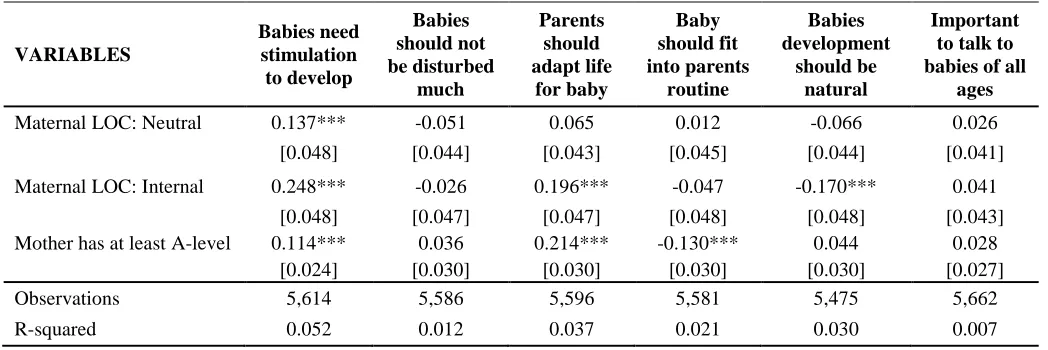
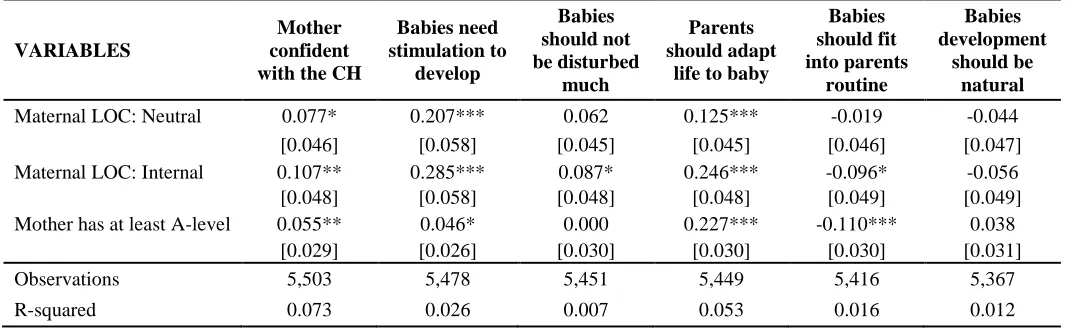
To make a first pass at the above question, Tables 1A and 1B respectively
present the reduced-form ordinary least-squares estimates with maternal attitudes
towards parenting variables as outcomes at 32nd week of gestation and when the child
was 8 months old. The responses to these maternal attitudes questions range from ‘1.
Disagree with the statement’ to ‘4. Agree with the statement’, which we standardised
to have a mean of 0 and a standard deviation of 1. Here, the explanatory variables of
interest are maternal LOC dummies (Neutral and Internal) and, as a proxy for
(mother’s age at birth, number of siblings, and child’s gender), child’s birth outcomes
(birth weight, heel–crown length, gestation weeks, and head circumference), mother’s
personality traits (measures of interpersonal skills, self-esteem, religiosity, belief in
divinity, maternal neuroticism (Crown–Crisp Experiential Index and Edinburgh
postnatal depression scale), and log of household income at 0–5 years of age.
Table 1A shows that the coefficients of the Neutral and Internal dummies of
maternal LOC are ceteris paribus positive, monotonically increasing, and statistically
significant in the equation where the belief that ‘babies need stimulation to develop’
measured at 32nd week of gestation is the outcome. Additionally, the top 25%
internal LOC mothers are significantly more likely to believe that ‘parents should
adapt life for baby’ and significantly less likely to believe that ‘babies development
should be natural’ at the prenatal stage than the baseline, i.e. the External LOC
mothers. Moreover, high-SES mothers are more likely to believe in a more active
(‘concerted cultivation’) parenting style: The coefficient on ‘mother has at least
A-level’ is positive and statistically well-determined in the ‘babies need stimulation to
develop’ and ‘parents should adapt life for baby’ regressions, but negative and
statistically significant in the ‘baby should fit into parents routine’ regression.
Table 1B shows qualitatively similar results. When questioned when their
child was 8 months old, internal LOC mothers tend to be the most confident in their
own child-rearing skills. They are also the most likely to believe that ‘babies need
stimulation to develop’ and ‘parents should adapt life to baby’.16 In other words, our
statistical results indicate that maternal internal LOC correlates well with variables
that proxy for maternal preferences towards a ‘concerted cultivation’ parenting style
measured during the prenatal period and the first year of a child’s life.
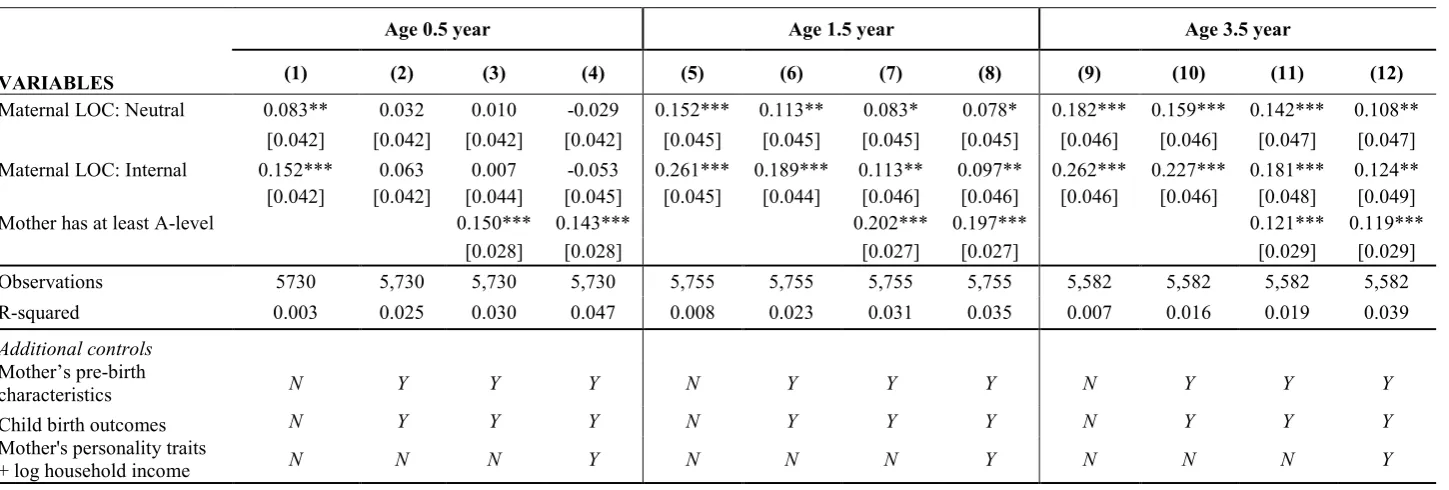
Table 2A establishes whether internal LOC mothers are also more likely to act
on those beliefs. Specifically, the table tests whether internal LOC mothers are more
likely than external LOC mothers to spend their time cognitively stimulating their
child and how their estimates vary with the inclusion of various groups of controls.
The dependent variable is the standardised index of maternal time spent on structured
activities (e.g. read to the child, talk to the child) measured at 0.5, 1.5, and 3.5 years
of age.
Without any controls, maternal internal LOC strongly predicts more maternal
structured activities across all ages. This positive association observed at 0.5 years of
age disappears when we control for mother’s pre-birth characteristics – mother’s age
at child’s birth, number of child’s siblings, and gender of child (Column 2 of Table
2A).17 However, the positive and statistically significant relationship between internal
LOC mothers and maternal structured activities at 1.5 and 3.5 years of age persist
even when we control for mother having completed at least A-level, mother’s
pre-birth characteristics, child pre-birth outcomes, mother’s personality traits, and log
household income at 0–5 years of age. These results imply that, holding all other
factors constant, all mothers – regardless of LOC type – tend to engage their child in
structured activities during the first year of the child’s life. However, it is internal
LOC mothers who either continue to stimulate their child cognitively or increase their
levels of engagement with their child as the child grows older.
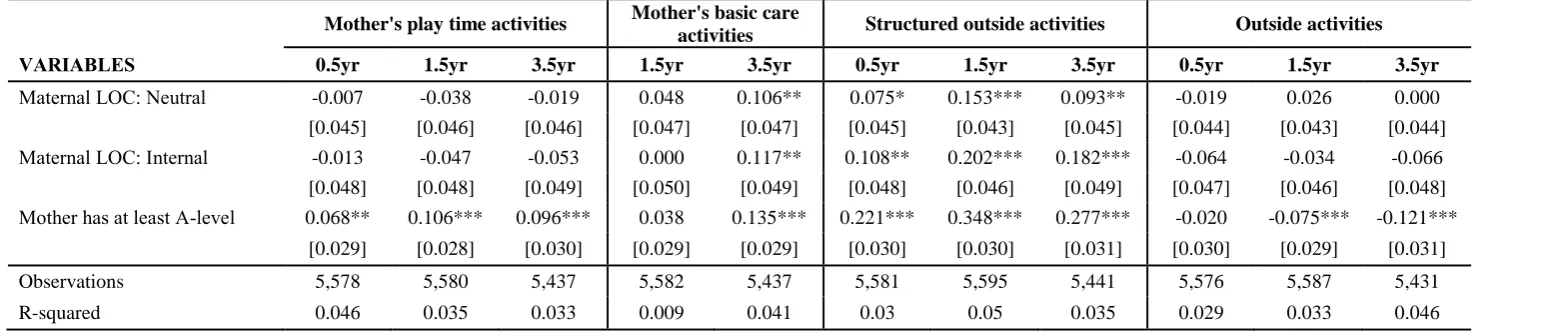
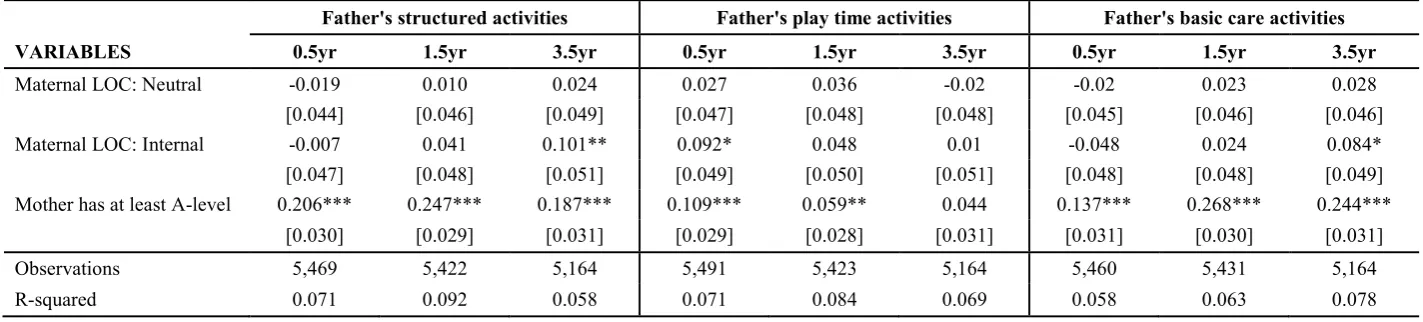
Tables 2B and 2C report estimates of maternal LOC with other types of
maternal and paternal time investments as outcomes. Internal LOC mothers tend to
invest more in structured outside activities (e.g. take child to park, take child to
friends/family, take child to places of interest) and in caring activities (e.g. bath child,
put child to bed). We also find evidence of a significantly higher level of paternal
time investments in cognitively stimulating activities at 3.5 years of age among
internal LOC mothers.
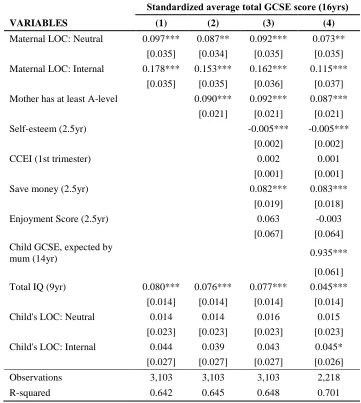
As a further check, in Tables 3A and 3B, respectively, we show whether the
evidence that internal LOC mothers tend to invest more in structured activities is also
reflected in early childhood cognitive outcomes – i.e. standardised MacArthur
receptive scores and MacArthur expressive scores at 2 and 3 years of age – and later
educational attainments – i.e. standardised average total GCSE scores at 16 years of
age.
Table 3A shows that maternal internal LOCs are good predictors of both
MacArthur receptive scores and MacArthur expressive scores at 2 and 3 years of age.
The results on early childhood language skills are robust to a specification that allows
for a dummy variable representing mother with at least A-level.
Table 3B shows that children of internal LOC mothers also tend to perform
better academically in their late teens. The positive association between internal LOC
mothers and standardised average total GCSE scores does not disappear even when
we control for mother with A-level; mother’s self-esteem score (at 2.5 years of age);
maternal depression during prenatal; a proxy for maternal time preference, i.e. a
dummy for whether mother saves money (at 2.5 years of age); a proxy for mother’s
intrinsic preferences in child rearing, i.e. mother’s enjoyment score (at 2.5 years of
qualification (at 14 years of age); child’s IQ (at 9 years of age); and child’s own LOC
(at 9 years of age). The estimated relationship is both quantitatively important and
statistically significant. In the full specification, children with internal LOC mothers
score approximately 12% higher in the standardised average GCSE score than
children with external LOC mothers, and children with neutral LOC mothers score
approximately 7% higher, on average.18
In summary, internal LOC mothers clearly tend to believe in a more active
parenting style and, consequently, invest more of their time engaging their child in
structured activities. Additionally, children with internal LOC mothers are more likely
to have better cognitive outcomes in early childhood and perform better in their
GCSE at 16 years of age. These findings are robust to controlling for maternal
education, early years household incomes, and other observable differences in
prenatal and early years characteristics.
5.2. Estimating the Production Parameters
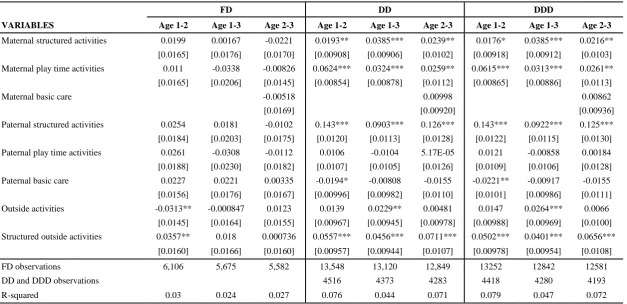
To illustrate how input parameters in a child production function can be estimated, the
first three columns of Tables 4A and 4B follow Todd and Wolpin’s (2003, 2007)
empirical strategy by estimating, for various development periods, FD regression
equations in which changes in early language skills (MacArthur: Receptive and
Expressive) are the outcome variables and changes in different parental time inputs
are included on the right-hand side as parental investment variables.
The associations between within-child changes in the standardised maternal
structured activities and changes in both measures of early language skills in the
child’s first three years, although positive, are mostly statistically insignificantly
different from zero. The magnitudes of the estimated relationships are small: For
example, an increase of 1 standard deviation in the maternal structured activities
index predicts a standard deviation increase of approximately 0.01–0.02 in child
language skills at 1–2 years of age.
We also find evidence that ‘structured outside activities’ are positively and
statistically significantly correlated with early development of expressive language
skills at 1–2 years of age. Nevertheless, the estimated magnitude of this statistically
significant association is small: The estimated standardised coefficient on the
structured outside activities index is 0.04 (or 4% of the standard deviation).
Other FD estimates also produce results that are more difficult to predict. For
example, we find both maternal and paternal play time activities with the child to be
mostly negatively, albeit statistically insignificantly, related to changes in early
language skills in the first three years, when other factors are held constant.
The next three columns of Tables 4A and 4B report estimates obtained from
running Equation (9). The DD specification generally produces coefficients of the
maternal structured activities index that are more positive and statistically robust than
those obtained in the FD model. For example, the estimated DD coefficient of the
maternal structured activities index in receptive language skill at 1–2 years of age is
approximately six times larger than the FD estimates: An increase of 1 standard
deviation in the maternal structured activities index is now associated with a 7%
increase in the standardised receptive language skill. Moreover, we find that the
estimated DD coefficients of maternal play time with the child, paternal structured
activities, and structured outside activities index are noticeably larger – and now
both sets of receptive and expressive language skills regression equations. This
indicates that there may have been a significant attenuation bias in the FD regression
model that biased most – if not all – FD estimates on the maternal (and paternal)
cognitively stimulating activities index towards zero.19
Almost the same estimates as for the DD specification are obtained in the
DDD regression equations, presented in the final three columns of Tables 4A and 4B.
This indicates that it makes virtually no difference whether or not we allow for the
additional third between-group differences by maternal SES in the estimation process.
The overall conclusion is the same: FD models appear to underestimate the effects of
time spent on structured activities for development of the child, perhaps because of
the severe attenuation bias that tends to be exacerbated following the FD process.
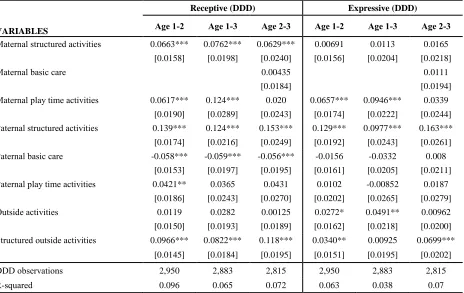
As a robustness check, in Table 5 we estimate the DDD specification by using
only the firstborn sample as a way to control for the ‘learning’ effect among more
experienced mothers. Maternal investment in structured activities continues to be
associated positively and statistically significantly with receptive language skills
throughout the early years. The estimated effects are also similar in magnitude to
those observed in the final three columns of Table 4A. Moreover, although statistical
significance appears to have been lost for some of the estimated coefficients in the
expressive language score regressions, their coefficients continue to be larger than the
FD estimates obtained from using this smaller, firstborn, sample.
5.3. Discussion
One concern is that there may be more than one channel – other than the individual’s
subjective beliefs about the returns to investments – through which maternal LOC
influences the mother’s human capital investment decisions. According to Deborah
Cobb-Clark and colleagues (Cobb-Clark, 2014; Cobb-Clark et al., 2014), there are
four channels through which an individual’s LOC affects his or her investment
decisions:
(i) Time preferences: Internal LOC individuals may discount the
future less than an average person, i.e. they are more
forward-looking (Chiteji, 2010).
(ii) Procedural utility: Internal LOC individuals may derive more
utility (or satisfaction) from carrying out the act of investment than
an average person.
(iii) Superior production function: Internal LOC individuals may
simply be better than an average person at converting each unit of
investment into a desired outcome.
(iv) Subjective expectations about the returns: Internal LOC
individuals ‘believe’ in the efficiency of their inputs more than an
average person, thus leading them to invest more.
We carried out robustness checks on these three other potential mechanisms and
report our results in Appendixes F–I. Our findings are summarised as follows:
Conditioning on maternal LOC, we observe a statistically insignificant
relationship between a proxy variable for being future-oriented (i.e. mother’s
propensity to save money reported when the child was almost 3 years old) and
5.5 years of age; see Appendix F. Thus, being future-oriented is unlikely to be
one of the main drivers of maternal input choices.
By regressing the maternal enjoyment index (i.e. how much the mother enjoys
looking after the baby) and the maternal postnatal depression scale on
maternal LOC and its interaction with investment, we find no evidence that
internal LOC mothers enjoy spending time actively engaging with their child
more than neutral or external LOC mothers do, i.e. the interaction coefficients
between maternal LOC and time investments are largely statistically
insignificantly different from zero; see Appendix G. Thus, it is unlikely that
internal LOC mothers invest more in children simply because they derive
more enjoyment from doing so.
By regressing early language skill on its lagged, maternal LOC and its
interaction with investment, we find no evidence that children with internal
LOC mothers develop faster per given unit of input, i.e. the interaction
coefficients between maternal LOC and time investments are largely
statistically insignificantly different from zero; see Appendix H. Thus, it is
unlikely that internal LOC mothers are simply better than an average person at
converting each unit of investment into a desired outcome.
By regressing the mother’s predicted probability of her child achieving good
grades at GCSE (asked at 11 years of age) on maternal LOC, we observe that
internal LOC mothers are significantly more likely than others to expect that
their child will receive at least five GCSEs at grades A*–C; see Appendix I.
These results are robust to controlling for maternal education and early