Original citation:
Alpern, Steve and Chen, Bo. (2016) The importance of voting order for decisions by sequential majority voting. European Journal of Operational Research.
Permanent WRAP URL:
http://wrap.warwick.ac.uk/76488
Copyright and reuse:
The Warwick Research Archive Portal (WRAP) makes this work by researchers of the University of Warwick available open access under the following conditions. Copyright © and all moral rights to the version of the paper presented here belong to the individual author(s) and/or other copyright owners. To the extent reasonable and practicable the material made available in WRAP has been checked for eligibility before being made available.
Copies of full items can be used for personal research or study, educational, or not-for-profit purposes without prior permission or charge. Provided that the authors, title and full bibliographic details are credited, a hyperlink and/or URL is given for the original metadata page and the content is not changed in any way.
Publisher’s statement:
© 2016, Elsevier. Licensed under the Creative Commons Attribution-NonCommercial-NoDerivatives 4.0 International http://creativecommons.org/licenses/by-nc-nd/4.0/
A note on versions:
The version presented here may differ from the published version or, version of record, if you wish to cite this item you are advised to consult the publisher’s version. Please see the ‘permanent WRAP URL’ above for details on accessing the published version and note that access may require a subscription.
The Importance of Voting Order
for Jury Decisions by Sequential Majority Voting
∗Steve Alpern Bo Chen†
Warwick Business School, University of Warwick Coventry, CV4 7AL, United Kingdom
February 26, 2016
Abstract
A jury of experts is often convened to decide between two states of Nature relevant to a managerial decision. For example, a legal jury de-cides between “innocent” and “guilty”, while an economic jury dede-cides between “high” and “low” growth when there is an investment decision. Usually the jurors vary in their abilities to determine the actual state. When the jurors make their collective decision by sequential majority voting, the order of voting in terms of juror ability can affect the op-timal probabilityQof reaching a correct verdict. We show that when the jury has size three,Q is maximized if the juror of median ability votes first. When voting in this order, sequential voting can close more than 50% of the gap (in terms ofQ) between simultaneous voting and the verdict that would be reached without voting if the jurors’ private information were made public. Our results have implications for larger juries, where we answer an age-old question by showing that voting by seniority (decreasing ability order) is significantly better than by anti-seniority (increasing ability order).
To obtain our new results we introduce a richer notion of private in-formation. Instead of the binary information assumed since Condorcet (for “innocent” or “guilty”), we give each juror a number in interval [−1,+1] with larger values indicating stronger signals for “innocent”. Keywords: jury of experts, sequential voting, voting order, group decision
1
Introduction
A firm or organization has to make an important decision. The best decision
depends on whether Nature is in one of two possible states: A or B. To
∗
It appears in: European Journal of Operational Research (2016), http://dx.doi.org/10.1016/j.ejor.2016.09.053
†
determine which is the actual state, as well as possible, the firm convenes a jury of experts. For example if the decision of the State is whether to send someone to jail, it convenes a legal jury to decide whether the defendant
is guilty A or innocent B. The organization running Wimbledon forms an
umpiring team to determine whether a ball is In or Out, and awards the point accordingly. More often, the jury may consist of economists who aim to determine the future state of the economy in order to decide whether to make an investment. In all these cases, the experts (jurors) will in general have
different abilities (or expertise, judgement, eyesight, economic knowledge)
to determine the actual state of Nature. In this paper we assume that
the jurors obtain their verdict by majority rule in an open sequential vote,
also known as roll call voting, and their common aim is to maximize the
probability that their verdict is correct (called strategic voting). We call
such votersjurors because they arevoting for the truth rather than for their
preferred outcomes. It is often assumed in the literature that voting order does not matter, as each voter can assume he is making the pivotal vote. However, for heterogeneous juries, the voting order assuredly does matter,
as voters need to know not onlyhow many of the others voted each way but
also which jurors voted each way. This observation is the starting point of our investigations.
The main interest of this paper is to determine the optimal voting order in terms of the set of abilities of the jurors, the one that maximizes the
probabilityQ of a correct verdict. Aside from the important work of Dekel
& Piccione (2000), this question has received little attention. For reasons of a combinatorial nature, our techniques (integer programming and dynamic programming) are restricted mainly to small juries and our main findings relate to a jury of size three. We show that it is best (i.e., the afore-definedQ
is maximized) to have the juror of median-level expertise vote first, and that the order of the last two voters does not matter. When voting in such an optimal order, sequential voting can close more than 50% of the gap (in terms
of Q) between simultaneous voting and the verdict that would be reached
without voting if the jurors’ private information were made public and the more likely state of Nature is chosen. Even with such an optimal order of
voting, the jurors in general must vote strategically, rather thanhonestly(for
the alternative that each deems most likely at the time of voting, given his
private information and prior voting). However, when the alternativesAand
B are equally likely, and the voting sequence is the median ability followed
by highest ability and finally lowest ability (one of the optimal orders), all the jurors can afford to vote honestly without diminishing their chances of getting a correct verdict. These results apply as well to the last three jurors
to vote in a larger jury. In tennis or badminton, the A/B call of “In” or
“blind” (zero ability) linesman who votes second. Another result concerns the “wrong conviction rate”, the probability that an innocent defendant is convicted. A classic result of Feddersen & Pesendorfer (1998) established for simultaneous voting of homogeneous jurors that the wrong conviction rate increases when a unanimous rather than majority voting is required for
conviction (and voting in both cases is optimized for Q). We show that,
for sequential voting of homogeneous jurors, their result holds only for the highest level of juror ability, and that the reverse is true otherwise.
Our model assumes that the abilities of the jurors are common knowl-edge, or at least known to the team leader (foreman) who assigns voting strategies to the jurors. In the tennis/badminton example, the ability of a juror (linesman or umpire) might be related in general to his or her physical position on the court, and in particular to the individual’s eyesight, which could be measured. Baharad et al. (2012) show how prior voting records can lead to common knowledge of abilities.
As we have said, our main findings mentioned earlier apply to juries of size three. Due to the combinatorial nature of our techniques that results in computational intractability, in general we cannot analyze larger juries. However, we have spent considerable amount of computer time to determine an optimal ordering for the single case of a five-member jury with distinct abilities from 0 to 4 (the full range in our model) and found that it is (2,3,1,0,4). Thus our result on “median-ability juror votes first”, which holds for all juries of size three, also holds for the single distinct-ability jury
of size five, though it still holds for all juries of size five if, as is common
in the literature, there are only two signals (instead of ten signals in our model). Furthermore, we show our results have general implications for larger juries.
For honest voting, where each juror votes for the alternative he believes is more likely, given his private signal and prior voting, we are able to settle an age old question: Is it better to vote by seniority (more senior, or able, jurors vote earlier) or by anti-seniority? We use a simulation approach to show that seniority order is better. For example, when the jury consists of 13 jurors of random and independent abilities, seniority voting gives the correct verdict 83% of the time, whereas anti-seniority is correct only 76% of the time.
restriction may be due to the large number of voters. In still other cases, such as postal voting, the voters may simply have no easy means of direct communication. So our problem in strategic voters is one of optimizing the joint strategies of the players to obtain the highest reliability of the verdict, which may be viewed as a mechanism design problem. On the other hand, in honest voting each agent can be viewed as wanting his own vote to be correct (perhaps he is an “expert” and the true state of Nature is soon to be revealed, as in Ottaviani & Sorensen (2001). In this case our solution may be viewed as a Nash equilibrium of the game where each players payoff is 1 if his vote is correct and otherwise 0. Our solution is in fact more stable than a Nash equilibrium: a player would not wish to change his strategy if none of the prior voters change theirs (but even if later voters do).
The methodology adopted in some parts of this paper is neither experi-mental nor deductive. Rather we use computer based programming (integer programming or dynamic programming) to determine the set of optimal
threshold profiles for eacha priori probability of stateAand each (ordered)
sequence of juror abilities, and then apply exhaustive search to obtain com-parative general results which hold for all or specified parameters. We use
exact calculations (with fractional probability values) based on
Mathemat-ica. Hence these general results, which we call Propositions, have no proofs.
The data on which the propositions are based are provided in the compan-ion file to this paper. The results with true deductive proofs are called Theorems.
The rest of our paper is organized as follows. Any “voting” is to be taken as strategic unless honest voting is explicitly specified. After literature review in the next section, we set up our problem model in Section 3 with details of its three components: juror abilities together with their signals, voting dynamics, and the common jury objective. In Sections 4 and 5 we
establish the need for strategic voting (where a player may vote B when
he believesAis more likely) and then study such voting with homogeneous
juries. Our more general results on strategic voting are presented in Section 6 for three-member juries and in Section 7 for larger juries. Finally, before making some concluding remarks in Section 9, we address in Section 8 the issue of which ordering is better under honest voting: seniority order or anti-seniority order.
2
Literature
quality called ability, which describes how well they can guess the truth. Obviously jurors in a trial are more complicated. Zufryden (1984) presents a model for attorneys to evaluate and select jurors in order to minimize the likelihood of large jury awards. In his model, jurors have 14 qualities (such as Ethnic, Risk avoidance, Dominance, etc.).
Sequential voting in a common-value (jury) environment has received little attention. In fact the only comparable analysis to ours, admittedly with a simpler signal and ability structure, is that of Dekel & Piccione (2000). The main findings of that important paper lie elsewhere, but their findings on voting order are nicely summarized in the following remarks from their Conclusions (p. 48):
“. . . if voters are endowed ex ante with differential
informa-tion (some voters can be better informed than other) knowing which voters voted in favor and which against can affect the choice of a later voter. It can be shown that, in a common-value and two signal environment (as in Sec. IIIC above), if the player’s signals are completely ordered (in the sense of Black-well), then it is optimal to have the better informed vote earlier. This provides an interesting contrast to the findings of Ottaviani & Sorensen (2001). They obtain the opposite optimal order in an environment in which information providers care not about the outcome but about appearing to be well informed. It is not dif-ficult, however, to construct examples in which having the best-informed voter vote first is not optimal. Hence in seems unlikely that general insights into this question can be obtained.”
As noted in this quotation, the voters in the model of Ottaviani & Sorensen (2001) do not have a common interest (in a correct verdict), but rather are experts who wish to enhance their reputations by voting which turns out to be informed. The optimality issue for these two voting orders will be studied in detail in Section 8 for our richer model.
A discussion of the optimal order of experts is given in Ali et al. (2008), where examples are cited in which courts follow either anti-seniority (in-creasing “ability” in our terminology) or seniority orders, respectively, in the ancient Sanhedrin and the contemporary American Supreme Court. The question of the optimal ordering of state primaries is analyzed in Morton & Williams (2000) from various perspectives. In our context a “more able” state is one whose party electorate is closer to the national mean and hence is a better predictor of the candidate most likely to succeed in the national election. The order of voting in selection committees is analyzed in Alpern, Gal & Solan (2010), but common interest only holds there at the firm level, not for committee members.
statement about the true state of Nature (innocent or guilty in a criminal trial), but also entails a decision and hence a choice is involved (for example, whether to send the defendant to jail). The 1951 book of Kenneth Arrow, now revised as Arrow (2012), provides the foundations of the subject. Chap-ter 10 of Sen (2014) is devoted to majority choice and gives a discussion of Condorcets work on voting. Social choice is concerned with the amalgama-tion of individual preferences and individual informaamalgama-tion. Our work here fits mainly into the latter, although in our analysis of honest voting there are individual preferences as each juror is concerned with being right, instead of with arriving at a correct majority verdict. More specifically, our work is set within the context of what is known as Condorcet Theory, stemming from his original work (Condorcet, 1785). Important recent papers in this area are Grofman, Owen & Feld (1983); Austen-Smith & Banks (1996) and Kanazawa (1998). However, the two closest papers on Condorcet Theory with sequential voting are Dekel & Piccione (2000) and Ottaviani & Sorensen (2001), which we have discussed earlier.
We finally note that juries, as opposed to general electorates, are usually small. Three judges often decide a case (as in boxing and weight-lifting matches, X-Factor competitions) and sometimes only two (as in tennis or badminton line calls with overrule). Many legal decisions are determined by a three-judge panel, and appellate courts are often three tiered. Three-member juries are analyzed theoretically and experimentally in Ali et al. (2008) and Battaglini, Morton & Palfrey (2007), though their models are different from ours.
3
The linear-signal model
Given two states of Nature, A and B, denote by θthe a priori probability
of A. The symmetric case θ = 1/2 is referred to as of neutral alternatives.
A group ofnagents (jurors) attempts to decide the true state of Nature by
amalgamating their private information through sequential majority voting
towards a verdict V of A or B. Their common aim is to maximize the
probabilityQ that their collective verdict is the actual state of Nature.
We model the voting problem Γ = Γm,nin terms of the minimum number
of votesm(out ofn) required for a verdict ofA. We are primarily concerned
with majority voting, where n is odd and a majority of m = (n+ 1)/2 is sufficient for either alternative. We shall also sometimes relate our problem
to one of unanimous voting Γn,n (for sayA), where one of the alternatives
requires a unanimous vote. The agents will make their votes strategically
(depending onθ, previous voting, and their private information). The jurors
differ in theirability to discern the state of Nature, so the voting order may
3.1 Signals, juror abilities and their distributions
We model the private information of each juror as a signal drawn from a
fixed signal set S = {−9,−7, . . . ,+7,+9} consisting of ten odd numbers.
Positive (res. negative) signals will tend to indicate thatA (res.B) is true.
A higher positive signal gives a higher conditional probability of A, so is
considered stronger. Similarly for negative signals.
Given the state of Nature A or B, how can the ability of a juror be
properly reflected in the distribution of signals he receives from the signal
setS? Since we want positive signals to indicateA and negative signals to
indicate B, the simplest assumption, which we adopt here, is to take the
conditional probability Pr[s|A] = fa(s) of signal s to be a linear function
ofsonS, with a positive slope proportional to abilitya. Similarly, we want
conditional probability Pr[s|B] = ga(s) to be linear with negative slope.
That is, high signals are more common than low signals when Nature isA,
and the amount by which they are more common is increasing ina. When
the ability a is 0, we want the slopes of both of these lines to be zero, so
that the signal contains no information. For each juror, a signal near 0 is of little use in determining the state of Nature, but one with high absolute value is very useful. Jurors of high ability are more likely to obtain signals with high absolute values. We choose a discrete set of five equally spaced abilitiesain Ω ={0,1,2,3,4}for our discrete model.
Hence a juror of high ability is more likely to guess the correct state of Nature, as calculated below in Table 1 at the end of this subsection. Given our linearity assumption and our division of abilities into five levels, with
level 0 no ability at all, the slope of the line for a= 4 is taken so that the
line hits the s-axis at the end point −9 (for f4) or the end point +9 (for
g4), so we do not have negative probabilities. These assumptions completely
determine the distribution functions fa(s) and ga(s) as follows (illustrated
in Figure 1):
fa(s) = Pr[s|Nature is A]≡ 101 + 360a
s;
ga(s) = Pr[s|Nature is B]≡fa(−s).
Many of our important calculations will involve the cumulative
distribu-tions of the signals. These are given for even thresholds 2j, with parameter
a indicating ability, by the quadratic functions Fa(2j) (when Nature is A)
and Ga(2j) (when Nature is B) as follows:
Pr[s <2j|Nature isA] =Fa(2j) = (5 +j)
1
10−
a(5−j) 360
; (1)
Pr[s <2j|Nature isB] =Ga(2j) = (5 +j)
1
10+
a(5−j) 360
. (2)
To illustrate how the abilityaof a juror affects his probability of obtain-ing a correct vote, we consider he is a jury of one facobtain-ing neutral
æ æ
æ æ
æ æ
æ æ
æ æ
à à
à à
à à
à à
à à
-5 5 j
[image:9.595.169.426.123.291.2]0.05 0.10 0.15 0.20
Figure 1: Signal distributions f4(s) and g2(s)
is (say) B given that he receives a negative signal s, is the same as the
probabilityQ of a correct verdict when he is a jury of one, namely
Q(a) = Ga(0)
Fa(0) +Ga(0) .
Table 1 shows that a juror of ability 0 is just guessing, while a juror of top
ability a= 4 gets it right 78% of the time.
a 0 1 2 3 4
Q(a) .50 .57 .64 .71 .78
Table 1: Impact of abilities
3.2 Voting thresholds
When jurork comes up to vote, he votesA if his odd signal sk is above an
even threshold τk = τk(v1, v2, . . . , vk−1), where vj ∈ {A, B} is the vote of
thejth earlier juror,j= 1, . . . , k−1. That is
vk=A if and only if sk> τk.
When there aren= 3 jurors, the threshold vectorτ has five coordinates for
majority voting:
τ = (τ1, τ2(B), τ2(A), τ3(AB), τ3(BA))
as τ(AA) and τ(BB) can be ignored since a majority has already been
reached. Since signal indices are odd, we index the thresholds T by even
numbers: T = {−10,−8, . . . ,+10}. Note that threshold −10 is a certain
vote for A and +10 is a certain vote for B. For example, given signal
vector s = (s1, s2, s3) = (1,−3,5) and threshold vector (strategy profile)
τ = (2,−4,6,−8,10), the voting sequence is v1 = B (because s1 = 1 < 2 = τ1), v2 =A (because s2 =−3 > τ2(v1) = τ2(B) = −4), and v3 =B
(because juror 3 always votes B after BA as that threshold is +10). The
voting sequenceBAB determined by sand τ thus gives a majority verdict
V =V(BAB) ofB.
3.3 Probability of correct verdict
Suppose we have three jurors of abilities a, b, c in order of voting. If we
know their thresholds τ = (v, w, x, y, z), then for each state of Nature we
can evaluate the probability of all voting sequences and consequently the
probability Q that the verdict is the actual state of Nature, that is, the
probability it is correct. If Nature is in state A, then the three voting
sequencesAA,ABAandBAAlead to a correct verdict; if Nature is in state
B, then this holds for BB, BAB and ABB. For example, the probability
that Nature is in stateAand the voting sequence isABAis given byθ(1−
Fa(v))Fb(x) (1−Fc(y)). More generally, we can writeQas the sum of the
six possible ways of getting a correct verdict as follows:
Q(θ;a, b, c;v, w, x, y, z) =
θ((1−Fa(v))(1−Fb(x)) + (1−Fa(v))Fb(x)(1−Fc(y))
+Fa(v)(1−Fb(w))(1−Fc(z))) + (1−θ)(Ga(v)Gb(w)
+Ga(v)(1−Gb(w))Gc(z) + (1−Ga(v))Gb(x)Gc(y)).
For a fixed order in which jurors of different abilities may vote, we jointly optimize their thresholds and call the optimal probability of correct verdict
¯
Q= ¯Q(θ;a, b, c). We solve the following integer program:
¯
Q(θ;a, b, c) = max
v,w,z,y,z∈T Q(θ;a, b, c;v, w, x, y, z).
Denote by ¯τ = ¯τ(θ;a, b, c) = (¯v,w,¯ x,¯ y,¯ z¯) any optimal (strategic) threshold
profile. The evaluation of ¯Q for the case of three jurors may also be carried
out via dynamic programming. For large juries, our discrete approach is not
feasible, but some observations extended from the casen= 3 are mentioned
later. Corresponding to our discrete signals, thresholds and juror abilities, we consider thea priori probabilityθ∈ {0.1, . . . ,0.9}.
In contrast to the optimal (strategic) threshold profile ¯τ, it is useful
recursively. The first juror votesA if his subjective probability of A, given
a priori probability θ and his private information s1, is at least 1/2. For
θ = 1/2, this means that his honest threshold is 0. Suppose that the first
k−1 jurors have chosen honest thresholds and the voting has gone in some
sequence (v1, v2, . . . , vk−1). Then the kth juror votes honestly if he votes for the more likely state of Nature, given all this information and his signal
sk. His honest threshold ˜τk(v1, v2, . . . , vk−1) is the even number between
the lowest (odd-numbered) signal for which he votes A and the highest for
which he votes B. Thus ˜τ can be computed recursively (for any number
of voters n). An interesting question is when (if ever) is ˜τ = ¯τ and hence
˜
Q= ¯Q. That is, when is honest voting optimal? This will be addressed in
Propositions 6 and 7.
We note that instead of optimizing the probabilityQof a correct verdict,
we could specify positive costsC1 andC2 for verdictV =Awhen Nature is
Bor verdictV =Bwhen Nature isA, and then minimize the expected cost.
Our methods apply equally well to the general case by suitably adapting the definition ofQ.
4
Optimal thresholds and need for strategic voting
This explanatory section gives some examples that demonstrate the neces-sity of strategic voting and motivate our results on optimal voting orders presented in the Section 6. For simplicity we assume neutral alternatives in this section,θ= 1/2.
We have listed in Table 2 an optimal threshold profile for each voting order of abilities of a jury. Of particular interest (to be discussed below)
are the zero threshold profiles for homogeneous abilities (a, a, a) for a∈Ω,
the skewed (asymmetric) profile for ability order (1,2,4), and the extreme
(±10) thresholds for the second voter in the bold profiles.
4.1 Two yokels and a boffin
Some special combinations of abilities{a, b, c} lead to particularly intuitive
results. Suppose the jurors have abilities a, b < c, where two of the jurors
have low abilities compared with the third. With no offense intended we
call the situationtwo yokels and a boffin (2Y1B), when an optimal strategy
(threshold profile) has the second yokel always vote opposite to the first one, thus canceling out his vote. Such situations are highlighted in bold in
Table 2 with the second yokel’s thresholds (−10,10). (Recall that these are
Note that the 2Y1B phenomena demonstrated in Table 2 depend on voting orders, whose optimality we will address in Section 6. To get some
intuition for our main results, let us consider voting order (1,0,4) in the
2Y1B context. We compare honest voting with strategic (optimal) voting.
In honest voting, the first juror (smart yokel) believes thatA is more likely
if and only if he gets a positive signal, so his threshold is 0. The second juror has a meaningless signal, as his ability is 0. Therefore, whatever the first yokel votes for will be copied by the second yokel, creating a majority for the first yokel’s choice. Thus with honest voting, juror 1 (with low ability) is the sole determinant of the verdict. The boffin is never even consulted (assuming voting ceases after a majority is reached)! This is a miniature example of an information cascade, which is avoided by strategic voting as seen below.
With strategic voting, the optimal thresholds of −10 (always vote A)
and +10 (always voteB) for voter 2 (after first voteB andA, respectively),
as indicated in the second row and first column of the last block of Table 2, require him to always vote the opposite of voter 1. This leaves the verdict up to the boffin, juror 3, of ability 4. Clearly it is better for the boffin of ability 4 to make the decision than the yokel of ability 1, an improvement
from Q(1) = 0.57 to Q(4) = 0.78 (as calculated in Table 1). Of course in
some cases (where he gets a weak signal), the boffin may improve further by taking into account the vote of the first voter.
When we are in the 2Y1B situation, the vote of the second yokel carries no information; but the vote of the first yokel does (if his ability is not 0). If
the boffin votesafter the first yokel, he can go with the first yokel’s vote if
his own signal is very small, say±1. (This argument would be even cleaner
if we allowed a neutral signal of 0). So in order for the boffin to obtain useful information from the smart yokel, we need two conditions:
• The smart yokel must vote before the complete yokel, and
• The smart yokel must vote before the boffin.
Hence the only ordering in which the boffin can make use of the infor-mation contained in the smart yokel’s vote is:
• The smart yokel votes first.
Note that in our example this means that the juror of median ability votes first in the optimal ordering. This turns out to be true generally.
4.2 One or two complete yokels
results show that, regardless of the valueθfor thea priori probability ofA
and of the voting order, the optimalQ-value is determined by the ability of
the boffin.
We conclude this section with the analysis of another special case that
will have applications later. Let θ be arbitrary and the three abilities of
the jurors, in voting order, are a,0, b, where a, b > 0. That is, the second
voter is a complete yokel. Suppose that juror 1 votesA. If juror 2 votesA,
the verdict is A and the last juror never gets to vote. Clearly the jury can
do at least as well if juror 2 votes B and leaves the voting up to the last
juror, because the last juror can always vote A and do the same as in the
previous case. (Of course if the subjective probability ofAfor the last juror
is less than 1/2 he can voteB and do better.) The same reasoning applies if
juror 1 votesB. We can also check this argument by establishing via integer
programming that
¯
Q(θ, a,0, b) = max
−5≤v,y,z≤+5Q(θ;a,0, b; 2v,−10,10,2y,2z),
or equivalently ( ¯w,x¯) = (−10,10). Summarizing this last argument, we have shown the following lemma.
Lemma 1. For anyθ and positive abilitiesaand b, the voting ability order
(a,0, b) has optimal thresholds for the second juror of ( ¯w,x¯) = (−10,10). That is, he always votes against the fist juror.
5
Homogeneous jurors and symmetric profiles
In this section we present some results on optimal voting strategies for a fixed voting order, leaving comparison of voting orders to the next section. First we consider sequential voting of homogeneous ability jurors and then we consider the optimality of voting strategies which are in some sense
sym-metric with respect to the alternatives A and B, which we assume to be
equiprobable in this section.
5.1 Juries of homogeneous abilities
Apart from sequential voting, our model includes two elements not ordi-narily found in the literature: multiple (rather than binary) signals and heterogeneous jurors (of differing abilities). It is the latter assumption that creates the rich and counterintuitive flavor of our model. This can be easily demonstrated by simply calculating the five homogeneous optimal thresh-olds uniquely as ¯τ(1/2, a, a, a) = (0,0,0,0,0) for all abilities a∈ Ω (except
that the uniqueness does not hold for abilitya= 0 for an obvious reason),
as shown in Table 2. That is, each juror votes A exactly when he receives
Ability Pm Pu Em Eu Fm Fu
1 .5 .398 .397 .311 .397 .514
2 .5 .417 .297 .242 .297 .407
3 .5 .449 .206 .184 .206 .285
[image:15.595.180.413.127.206.2]4 .5 .494 .126 .136 .126 .148
Table 3: Comparison of voting rules for homogeneous jurors
Proposition 2. Facing neutral alternatives, homogeneous jurors can vote
optimally by voting myopically without observing previous votes, as if they were voting in a secret (or simultaneous) ballot.
Thus when jurors are homogeneous, each can indeed vote as if they are the pivotal voter, and ignore any prior voting that they witness. Further-more, we have the following simple results concerning conviction rate and
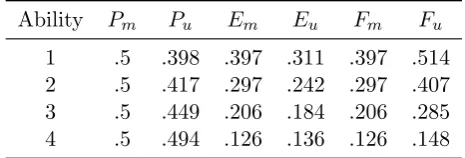
verdict errors when compared with unanimous voting system Γ3,3, which are
further detailed in Table 3, wherePmdenotes conviction rate under majority
rule,Em rate of conviction error under majority rule, andFm rate of
acquit-tal error under majority rule, with the corresponding rates for unanimous
voting having subscriptu.
Proposition 3. For homogeneous jurors with optimal voting strategies,
ma-jority rule leads to a higher conviction rate but lower rate of wrong acquittals when compared with unanimous voting rule. On the other hand, majority rule has a lower rate of wrong conviction for the highest-ability jury (a= 4), but otherwise a higher rate (for anya <4).
A celebrated result of Feddersen & Pesendorfer (1998) showed that for simultaneous voting, the rate of wrong conviction (conviction error) was lower for majority rule than with a unanimous requirement for conviction. For sequential voting, however, our above result shows that their finding
holds only for the highest ability (a= 4) jury, and the comparison goes the
other way for all other juries.
5.2 Optimality of symmetric strategic profiles
Table 2 gives some optimal profiles for the neutral alternative caseθ= 1/2,
where there is an obvious symmetry between the two states of Nature, A
andB. To exploit this symmetry, we define the transposition function given
by ˆA = B and ˆB = A. We can extend this to partial voting histories
v = (v1, v2, . . . , vk−1), where vi ∈ {A, B}, 1 ≤i ≤k−1 and k = 1, . . . , n,
by defining ˆv = (ˆv1,ˆv2, . . . ,vˆk−1) and to thresholds by ˆτ(v) =−τ(ˆv). For
example, if profile τ votes A after previous voting B with signal s2 > 4,
θ= 1/2 the profilesτ and ˆτ yield the same correctness probabilityQ. Thus ifτ is optimal for some ability parameters, so is ˆτ. Thus optimal (threshold) strategies come in pairs (just like conjugate pairs for quadratic equations). We call a profile τ symmetric ifτ = ˆτ, or equivalently if τ(v) = −τ(ˆv) for
all voting historiesv. In particular, for symmetric thresholdsτ we haveτ1 =
0. One question we may naturally ask is whether for neutral alternatives
θ= 1/2 there is always an optimal threshold ¯τ that is symmetric.
To answer this question, look at the entry in Table 2 for the optimal threshold for ability voting order (1,2,4): (2,−8,10,−2,0). The transposed threshold is of course also optimal, but it can be shown by exhaustive search that these are the only two. So in particular there is no optimal threshold profile for (1,2,4) with first coordinateτ1 = 0, no symmetric optimal thresh-old. Thus, despite the symmetric nature of the optimization problem, the
first juror must skew his vote to eitherB (by requiring a signal more than
2 to voteA) or toA (requiring a signal less than−2 to voteB). Given this
example, it is perhaps surprising to note the following general result, which says that such skewing is not necessary for particular voting orders.
Proposition 4. If θ= 1/2, the jurors’ abilities are labeled a < b < c and
the juror of median abilitybvotes first, then there is an optimal threshold τ¯
that is symmetric.
In fact, Table 2, in which we have listed a symmetric threshold profile whenever one of these is optimal, shows more than what is stated in the
above proposition. Note that for the ability ordering (2,1,4) where the
median ability juror votes first, there is indeed a symmetric threshold. We will see later that voting orders with median-ability jurors first are of more special interest.
6
Main results on strategic voting
In this section we present our main results on the optimal voting orders for jurors of differing abilities.
Given a set of abilities {a, b, c} (technically a multi-set, as repetitions
are allowed) for three jurors, with a ≤ b ≤ c, what voting order achieves
the maximum probability ¯Q of the correct verdict optimized in terms of
threshold strategy profiles? How much is this optimal probability? Our
approach is to calculate ¯Q for various orderings of the jurors and attempt
to spot patterns of optimality. We then check these patterns by exhaustive
search over all voting orders and values of θto see where they hold.
6.1 Optimal ordering for strategic voting
a priori probability θ = 4/5 of A and ability set {1,2,3} and with (right side) the neutral alternative caseθ= 1/2 and ability set{1,2,4}. For each case, the six rows correspond to the six voting orders. For each voting order,
we give the optimal probability ¯Qof correct verdict. For a later discussion
in Section 6.3, we also give the probability of a correct verdict ˜Q attained
when voting honestly. Note that in both (left and right) cases, the highest
value of ¯Q (in bold) is attained when the juror of median ability, in these
cases this is ability 2, votes first. Also note that in all cases, the order of
the last two to vote does not affect ¯Q(see Theorem 11). These observations
from Table 4 in fact hold generally.
θ Ability Order Q¯ Q˜ θ Ability Order Q¯ Q˜
4/5 (2,1,3) .827 .800 1/2 (2,1,4) .794 .639
4/5 (2,3,1) .827 .815 1/2 (2,4,1) .794 .794
4/5 (1,2,3) .825 .800 1/2 (1,2,4) .781 .718
4/5 (1,3,2) .825 .8169 1/2 (1,4,2) .781 .781
4/5 (3,1,2) .825 .815 1/2 (4,1,2) .780 .778
[image:17.595.121.474.275.380.2]4/5 (3,2,1) .825 .8172 1/2 (4,2,1) .780 .778
Table 4: BestQ-value comparison of ability orders under strategic and
hon-est voting
Proposition 5. For any three-member jury and any probability θ of
alter-native A, the probability Q¯ of a correct verdict under sequential majority voting is maximized when a juror of median-level ability votes first. For neutral alternatives (θ = 1/2) it is always suboptimal if a juror who does not have median ability votes first. The order of the last two jurors does not affect Q.¯
So if we label the abilities of the jurors asa≤b≤c, then the two optimal voting orders are (b, a, c) and (b, c, a). While the last statement of the above proposition is part of Theorem 11, supporting computational results for the optimality of median-ability-first order can be found in the companion file, from which we also note that if the alternatives are not neutral, then there may be situations where all six voting orders of three abilities give the same
Q.
6.2 Efficiency of sequential voting
Up to this point we have been comparing the relative effectiveness of different voting orders in attaining a correct verdict for sequential voting. We now fix the optimal voting order, and compare the effectiveness of sequential voting
to myopic simultaneous voting and the Full Information Solution (FIS),
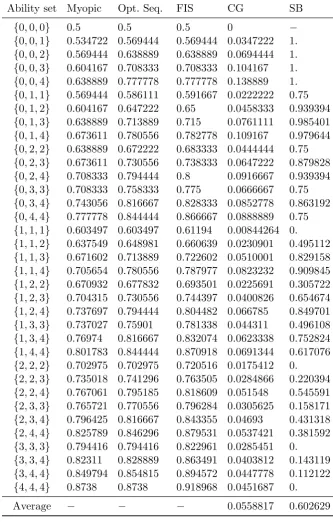
given the signal and the ability of each juror. Note that here there is no voting involved. In general, the FIS is not always achievable through voting. Myopic simultaneous voting, also known as Condorcet voting, leaves a gap with respect to the FIS in terms of the probability of a correct verdict. How much of this gap can be closed by allowing sequential voting in the optimal ordering? This depends on the ability set of the jurors. For example, when the abilities of the jurors are{1,2,3}, then Condorcet voting gives a correct verdict with probability 0.704, sequential voting (in optimal order (2,1,3) or (2,3,1)) gives 0.731, and the FIS gives 0.744. Thus there is what we call the Condorcet Gap (CG) of 0.744−0.704 = 0.04 with respect to the FIS. Sequential voting in the optimal order closes about (0.730−0.704)/(0.744−
0.704) = 0.026/0.04 = 65% of this gap. We call this ratio the Sequential
Bonus(SB). Thus combining one’s own private information with the votes of prior voters goes a long way towards the solution where private information is public (the FIS). The first three columns of Table 5 gives the probabilities
of a correct verdict for myopic simultaneous voting qM, sequential voting
(with optimal voting order)qS, and with full informationqF (the FIS). The
last two columns give the Condorcet GapCG=qF−qM and the fraction SB
of this gap that is closed by sequential voting. The SB is 0 for homogeneous jurors, which is probably why it has not been studied before. The SB is 1 when the jury has two complete yokels (ability 0) on it, who can vote against each other to achieve the FIS. For the remaining ability sets, the sequential
bonus varies between 11% (for the nearly homogeneous abilities {3,4,4})
and 99% (for abilities {0,1,3}), with an average value (taking all ability sets equally) of 60%. The probability of a correct verdict will also depend, a posteriori, on the decisiveness of the vote (whether it was 2-1 or 3-0), as analyzed by Klausner & Pollak (2001) in a different but related context.
6.3 Optimality conditions for honest voting
We now consider two questions of optimality for honest voting, a simple form of voting which we defined and discussed in Section 3.3. The first is the same as that we asked for strategic voting as to which voting order is best when voting honestly. The second asks when honest voting is optimal, that is, when are the honest (threshold) strategies the same as optimal ones
that maximizeQ?
To deal with the first question, we look at Table 4 again, this time
concentrating on the ˜Qcolumns on the left and the right. Note that on the
left side ˜Qis maximized for ordering (3,2,1) = (c, b, a); on the right side, it is maximized for ordering (2,4,1) = (b, c, a). So the orderings are not the
same, but they both end with the juror of least ability (a) voting last. This
is true in general.
Proposition 6. When the jurors vote honestly, the highest correctness
Ability set Myopic Opt. Seq. FIS CG SB
{0,0,0} 0.5 0.5 0.5 0 −
{0,0,1} 0.534722 0.569444 0.569444 0.0347222 1.
{0,0,2} 0.569444 0.638889 0.638889 0.0694444 1.
{0,0,3} 0.604167 0.708333 0.708333 0.104167 1.
{0,0,4} 0.638889 0.777778 0.777778 0.138889 1.
{0,1,1} 0.569444 0.586111 0.591667 0.0222222 0.75
{0,1,2} 0.604167 0.647222 0.65 0.0458333 0.939394
{0,1,3} 0.638889 0.713889 0.715 0.0761111 0.985401
{0,1,4} 0.673611 0.780556 0.782778 0.109167 0.979644
{0,2,2} 0.638889 0.672222 0.683333 0.0444444 0.75
{0,2,3} 0.673611 0.730556 0.738333 0.0647222 0.879828
{0,2,4} 0.708333 0.794444 0.8 0.0916667 0.939394
{0,3,3} 0.708333 0.758333 0.775 0.0666667 0.75
{0,3,4} 0.743056 0.816667 0.828333 0.0852778 0.863192
{0,4,4} 0.777778 0.844444 0.866667 0.0888889 0.75
{1,1,1} 0.603497 0.603497 0.61194 0.00844264 0.
{1,1,2} 0.637549 0.648981 0.660639 0.0230901 0.495112
{1,1,3} 0.671602 0.713889 0.722602 0.0510001 0.829158
{1,1,4} 0.705654 0.780556 0.787977 0.0823232 0.909845
{1,2,2} 0.670932 0.677832 0.693501 0.0225691 0.305722
{1,2,3} 0.704315 0.730556 0.744397 0.0400826 0.654674
{1,2,4} 0.737697 0.794444 0.804482 0.066785 0.849701
{1,3,3} 0.737027 0.75901 0.781338 0.044311 0.496108
{1,3,4} 0.76974 0.816667 0.832074 0.0623338 0.752824
{1,4,4} 0.801783 0.844444 0.870918 0.0691344 0.617076
{2,2,2} 0.702975 0.702975 0.720516 0.0175412 0.
{2,2,3} 0.735018 0.741296 0.763505 0.0284866 0.220394
{2,2,4} 0.767061 0.795185 0.818609 0.051548 0.545591
{2,3,3} 0.765721 0.770556 0.796284 0.0305625 0.158171
{2,3,4} 0.796425 0.816667 0.843355 0.04693 0.431318
{2,4,4} 0.825789 0.846296 0.879531 0.0537421 0.381592
{3,3,3} 0.794416 0.794416 0.822961 0.0285451 0.
{3,3,4} 0.82311 0.828889 0.863491 0.0403812 0.143119
{3,4,4} 0.849794 0.854815 0.894572 0.0447778 0.112122
{4,4,4} 0.8738 0.8738 0.918968 0.0451687 0.
Average − − − 0.0558817 0.602629
[image:19.595.128.462.156.680.2]votes last.
We now consider our second question mentioned above. From Table 4, we see that this is not possible when θ = 4/5 with ability set is {1,2,3}. For every fixed voting order, honest voting does worse than strategic voting,
˜
Q <Q¯. In fact, the best correctness probability attained honestly, 0.8172,
is less than the worst that can be obtained strategically, 0.825. On the
other hand, the right side of Table 4 shows that for neutral alternatives with abilities{1,2,4}, voting honestly in the order (2,4,1) = (b, c, a) achieves the
same correctness probability 0.794 as strategic voting in an optimal order.
This observation holds more generally as follows.
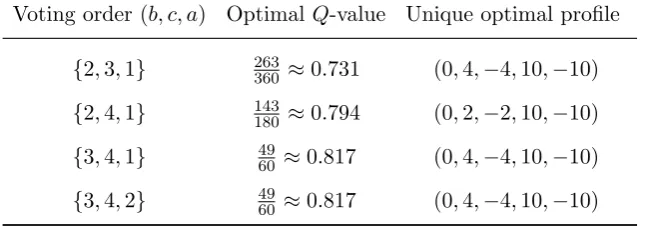
Proposition 7. For neutral alternatives θ = 1/2 and completely
hetero-geneous abilities a < b < c, honest voting in ability order (b, c, a) (which is one of the optimal orderings for strategic voting) gives the best possible correctness probability that can be attained for strategic voting in any order.
This result means that when a completely heterogeneous jury faces neu-tral alternatives, it can afford to vote honestly if it chooses the voting order (b, c, a). Some further information for the above proposition can be found in Table 6. Note that in each case the optimal strategy profile is identical to the honest strategy profile. In particular the profiles are symmetric, as we expect from honest profiles with neutral alternatives.
Voting order (b, c, a) Optimal Q-value Unique optimal profile
{2,3,1} 263
360 ≈0.731 (0,4,−4,10,−10)
{2,4,1} 143180 ≈0.794 (0,2,−2,10,−10)
{3,4,1} 4960 ≈0.817 (0,4,−4,10,−10)
[image:20.595.137.460.445.558.2]{3,4,2} 4960 ≈0.817 (0,4,−4,10,−10)
Table 6: When honest voting is optimal
7
On larger juries
7.1 Juries of size n = 5
Due to the combinatorial nature of our techniques, it is computationally
prohibitive to carry out the same calculations for a jury of sizen= 5 as we
did earlier forn= 3. The number of (threshold) strategy variables (having
an exponential effect on computing time) goes from 5 (with the variables
{x, y, z, v, w} in the definition of Q) to 19 for n = 5. For n = 3 we had to consider 5 prior voting sequences which did not already determine the
majority verdict, namely ∅ (faced by the first juror), A, B (faced by the
second), and AB, BA (faced by the third). When there are five jurors, we
have ∅; A, B; AA, AB, BA, BB; AAB, ABA, BAA and BBA, BAB, ABB;
AABB, ABAB, ABBAandBBAA, BABA, BAAB(19 in all, as we exclude prior voting with three votes for some alternative, where a majority has already been achieved). We can overcome this computational difficulty in
two ways to find optimal orderings for the problem Γ = Γ3,5 with linear
signals.
First we retain our original model, but consider only the single ability
set of completely heterogeneous abilities, namely {0,1,2,3,4}. In this way we establish the following result by finding (with complete enumeration) optimal strategy profiles for each of the possible voting orders.
Proposition 8. For a five-member jury of completely heterogenous abilities
{0,1,2,3,4}, the orderings (2,3,1,0,4)and (2,3,1,4,0) are optimal for se-quential majority voting with neutral alternatives θ = 1/2. Moreover, the first two voters (of abilities2 and 3) can afford to vote honestly.
Note in particular that when there are five jurors to vote, the one of median ability should vote first. Then, when there are again an odd number three left to vote, again the one of median ability should vote first. Also, when there are an even number four left to vote, one of the two median ability voters should vote first.
What we have not been able to show is that the median ability juror should vote first for juries that have more than one juror of the same ability. To establish this more general result, we need to reduce the size of our signal space to make our computation tractable.
To this end, we now convert our 10-signal model to the more traditional one of two signals. We do this by continuing to have Nature send (with the same distribution as before) one of the signals{−9,−7, . . . ,+9}. However, a juror is only able to discern the sign of the signal: a minus sign (indicating
B) or a plus sign (indicating A). That is, he gets signal A (a plus sign
signal) with probability 1−Fa(0) when Nature is A and with probability
1−Ga(0) when Nature is B. Similarly, he gets signal B (or a minus sign
signal) with probabilityFa(0) when Nature isAand with probabilityGa(0)
when Nature is B. (So a juror of ability a gets the correct signal with
space reduces the number of (threshold) strategies for a given prior voting
sequence to three: always voteA; voteB for negative signals (signalB) and
voteAfor positive signals (signalA); and always voteB. (The corresponding
thresholds are −10, 0 and +10 in our earlier notation.) Consequently, we
are able to establish the following result by complete enumeration.
Proposition 9. Suppose the jurors get binary signals, as described above,
with neutral alternatives θ= 1/2. Then for a five-member jury of arbitrary abilities0≤a≤b≤c≤d≤e≤4, the voting ability sequences (c, d, b, a, e)
and (c, d, b, e, a) are optimal. Moreover, the first two voters (of abilities c and d) can afford to vote honestly.
Again, we note that the ordering of the last three agrees with Theorem 11 and that it is optimal for the juror of median ability to vote first. But now we have this result even for juries with repeated abilities, at the cost of a reduced signal structure.
7.2 Larger juries
Up to this point we have mainly been concerned with majority verdicts. It turns out that to obtain certain results on such verdicts we need first
consider verdicts that require a unanimous vote for one outcome (say A).
We will call this unanimous sequential voting. Note that in this case each
jurori(of abilityai) has a single threshold strategyτi =τi(A, . . . , A) as for
the other voting sequences the verdict is already decided. In this subsection
we use the notation Γm,n for a voting scheme where there aren voters and
m votes forAare required for a verdict of A(otherwise the verdict is B).
Unlike our results for majority voting, we can show that for unanimous voting the voting order does not affect the reliability of the verdict.
Theorem 10. In sequential unanimous voting, the voting order of the jurors
does not affect the correctness probabilityQ.
Proof. The probability Q of getting the correct verdict (with a priori
probabilityθ of A) with unanimous voting is given by
Q=θQn
i=1(1−Fai(τi)) + (1−θ) (1−Qni=1(1−Gai(τi))).
Observe that this is the same formula as for the case ofsimultaneous
unan-imous voting for A, when each juror simply compares their private signal
si to their thresholdτi (regardless of other jurors’ votes). Therefore, voting order does not matter.
Note that the above result does not depend on the particular form of
the cumulative distribution functionsFaandGa, so it is quite general. Now
consider sequential majority voting whenn= 3. After the first vote by juror
forA(if juror 1 choseB) or Γ1,2 on unanimous voting forB (if juror 1 chose
A). So in either case Theorem 10 demonstrates that the voting order of the
last two jurors does not matter. This “explains” the similar observation for linear signals demonstrated computationally in Proposition 5. We will state this result more generally in the first part of Theorem 11.
Next consider the majority voting problem Γm,n = Γk+1,2k+1when
num-ber of jurorsn= 2k+1 is odd and greater than 3. We establish the following.
Theorem 11. In sequential majority voting by an odd-size jury with any
signal distribution, the order of the last two voters does not affect the proba-bility of a correct verdict. For signal distributions where the voter of median ability should vote first in a jury of three, the third last to vote should have median ability of the last three to vote.
Proof. Suppose the firstn−3 = 2(k−1) jurors have voted, with a difference
d (necessarily even) between the number of votes for A and B. Consider
the subproblem faced by the last three jurors. If|d| ≥4 then the verdict is
already settled. Ifd= 0, then each alternative has receivedk−1 votes, so
the remaining subproblem is Γ2,3, the same as the majority voting problem
for three jurors. Finally, if |d| = 2 then, depending on the sign of d, the
subproblem is a unanimous voting problem for one of the alternatives, and by Theorem 10, the voting order does not matter. So the ordering is either irrelevant or the optimal ordering is the same as if the last three voters are
the only voters in a three-person sequential majority voting.
Based on our empirical explorations for juries of five as discussed in Section 7.1, we would like to make the following conjecture.
Conjecture: For any jury of any odd sizenwith linear signals, it is optimal
for maximizing the probability of a correct verdict in sequential majority
strategic voting that the k-th juror to vote has median ability among the
remainingn−k+1 jurors, for anyk= 1, . . . , n, where median for a sequence
of even cardinalityx is understood as the element in positionx/2 + 1 of the
sequence.
8
Seniority vs. anti-seniority order with honest
voting
Jury Sizen Rinc(n) Rran(n) Rdec(n)
3 67.4 68.8 70.1
5 70.7 73.2 75.0
7 72.2 74.9 77.5
9 73.3 77.7 80.0
11 74.8 79.2 81.7
[image:24.595.196.397.127.233.2]13 75.7 80.7 82.7
Table 7: Reliability given as percentage of correct verdicts
In this section, we use simulation to compare these two orderings together with a random ordering for honest voting in our richer signal model.
Given a jury of ordered abilities a = (a1, a2, . . . , an) and their signals s= (s1, s2, . . . , sn), there is a generically unique majority verdict v(a, s) ∈ {A, B} with honest voting. For each jury size n = 3,5,7,9,11,13, we de-termine the mean reliability for a jury of sizen, whose abilities{a1, . . . , an}
are randomly generated with random voting order, in seniority order and in anti-seniority order, respectively. We denote these respective mean reliabil-ities by Rran(n), Rdec(n) and Rinc(n). We now outline the calculation for
Rdec(n) for any given n, as the other two are similar. We assume Aand B
are equiprobable.
1. GenerateN independent juries each of random abilities {a1, . . . , an},
which are taken independently and uniformly from interval [0,1].
Ar-range thesenabilities in non-increasing order to obtain vector ¯a, with ¯
a1 ≥¯a2 ≥ · · · ≥¯an.
2. For each vector ¯aobtained in Step 1, generate M independent signal
vectorss= (s1, . . . , sn), where si is drawn from the distribution with
cumulative distribution functionF¯ai(x) = (x+1)(¯aix−a¯i+2)/4, which
is the continuous analog of the distribution given in formula (1), with
assumption that Nature is in stateA.
3. For each of theN×M jury-signal pairs (a, s) generated in Steps 1 and
2, calculate the (deterministic) majority verdict v(¯a, s). The percent-age of these verdicts that are forAis denoted byRdec(n), which gives an estimate of the reliability of the verdict. Obviously we would get
the same answer if we assumed thatB was the state of Nature.
Our simulation withN = 200 andM = 200 has resulted in the numerical
results as shown in Table 7, from which we observe that
The interpretation of inequalities is as follows. If one has to set up a
voting order (e.g., by legislation or otherwise) before a jury is randomly
selected, it is best to agree that they will vote in order of seniority (i.e., decreasing order of ability). This means that, assuming abilities will be observable after the jury is chosen (see for example Baharad et al., 2012), the most able juror should vote first.
We also note from Table 7 that for each type of ordering, reliability increases with jury size, as in the Condorcet model with binary signals. This is not surprising, and in fact we can analytically establish a stronger result.
Theorem 12. Given any honest voting order and two juries of respective
abilities a = (a1, . . . , an) and ˜a = (a1, . . . , an, an+1, an+2) with n odd, the
reliability of the larger jury of abilitiesa˜is not less than the reliability of the smaller jury of abilities a.
Proof. We only need to consider the scenario where the two juries have
different verdicts for a given signal vector ˜s = (s1, . . . , sn, sn+1, sn+2) ≡ (s, sn+1, sn+2). Letv(a, s) =Aandv(˜a,s˜) =B. We show that theposterior
probability ofB is not smaller than that ofA. Given the verdicts of the two
juries, it is clear that the smaller jury votes forA by a single-vote majority
(i.e., (n+ 1)/2 vs. (n−1)/2) and the last two jurors of the larger jury both
vote for B, which implies, in particular, that when it comes for the last
(n+ 2)nd juror to vote honestly, theposterior probability ofB is no smaller
than that ofA, as otherwise he would have voted for A.
9
Concluding remarks
We have analyzed a simple model of sequential majority jury voting, where voting is between two states of Nature. We show that when the jurors differ in their abilities (to discern the true state), the order in which they vote can affect the optimal probability of a correct verdict. We have shown in some cases (any juries of three and completely heterogeneous juries of five with neutral alternatives) that the probability of a correct verdict is maximized when the median-ability juror votes first. The order of the last two voters does not affect the correctness probability. When the voting order is fixed, honest voting (for the alternative that is more likely to be correct at the time) is generally suboptimal — jurors need to vote strategically. However there is always some voting order where honest voting produces the highest correctness probability achievable by strategic voting.
References
Ali, S., Goeree, J., Kartik, N., and Palfrey, T.R. (2008). Information
amal-gamation by voting. American Economic Review: Papers & Proceedings
98(2): 181–186.
Alpern, S., Gal, S., and Solan, E. (2010). A sequential selection game with
vetoes.Games and Economic Behavior 68(1): 1–14.
Austen-Smith, D., and Banks, J.S. (1996). Information aggregation,
ratio-nality, and the Condorcet Jury Theorem.American Political Science
Re-view 90(1): 34–45.
Arrow, K.J. (2012).Social Choice and Individual Values. Vol. 12. Yale
Uni-versity Press.
Baharad, E., Goldberger, J., Koppel, M., and Nitzan, S. (2012). Beyond
Condorcet: optimal aggregation rules using voting records. Theory and
decision 72(1): 113–130.
Battaglini, M., Morton, R. and Palfrey, T.R. (2007). Efficiency, equity, and
timing of voting mechanisms.American Political Science Review 101 (3):
409–424.
Brams, S.J. and Fishburn, P.C. (2002). Voting procedures. In: Handbook of
Social Choice and Welfare, Chapter 4. (Eds. Kenneth Arrow, Amartya Sen, and Kotaro Suzumura). Volume 1, 173–236.
Condorcet, M.J.A.N.C. (1785). Essai sur l’Application de l’Analyse `a la
Prababilit´e des Decisions Rendues `a la Pluralit´e des Voix (Impr. Royale, Paris); reprinted (1972) (Chelsea, New York).
Dekel, E. and Piccione, M. (2000). Sequential voting procedures in
symmet-ric binary elections.Journal of Political Economy 108(1): 34–55.
Easley, D. and Kleinberg, J. (2010).Networks, Crowds and Markets.
Cam-bridge University Press.
Feddersen, T.J. and Pesendorfer, W. (1998). Convicting the innocent: The
inferiority of unanimous jury verdicts under strategic voting. American
Political Science Review 92(1): 23–35.
Kanazawa, S. (1998). A brief note on a further refinement of the Condorcet
Jury Theorem for heterogeneous groups. Mathematical Social Sciences
35(1): 69–73.
Klausner, A. and Pollak, M. (2001). Comparative reliability of verdicts.
Grofman, B., Owen, G., and Feld, S.L. (1983). Thirteen theorems in search
of the truth.Theory and Decision 15(3): 261–278.
Morton, R. B. and Williams, K.C. (2000). Learning by Voting:
Sequen-tial Choices in PresidenSequen-tial Primaries and Other Elections. University of Michigan Press.
Sen, A.K. (2014).Collective Choice and Social Welfare. Elsevier.
Ottaviani, M. and Sorensen, P. (2001). Information aggregation in debate:
who should speak first? Journal of Public Economics 81(3): 393–421.
Zufryden, F.S. (1984). A model for the prediction of juror decisions.Decision