the Design and Development of
Shape-Changing Interfaces
Miriam Sturdee
Highwire Doctoral Training Centre
Lancaster University
This dissertation is submitted for the degree of
Doctor of Philosophy
I hereby declare that except where specific reference is made to the work of others, the contents of this thesis are original and have not been submitted in whole or in part for consideration for any other degree or qualification in this, or any other university. This thesis is my own work and contains nothing which is the outcome of work done in collaboration with others, except as specified in the text and Acknowledgements. This thesis contains fewer than 59,000 words including appendices, footnotes, tables and equations, and has fewer than 103 figures.
The work contained within this thesis was supported by HighWire Doctoral Training Centre at Lancaster University, funded by the RCUK Digital Economy Programme through the EPSRC (Grant EP/G037582/1). It was also partially supported by GHOST, a project funded by the European Commission’s 7th Framework Programme, FET-Open scheme (Grant #309191), and also partially supported by MORPHED, a project funded by the EPSRC (Grant #EP/M016528/1).
Shape-changing interfaces are a novel computational technology which incorporate physical, tangible, and dynamic surfaces to create a true 3-Dimensional experience. As is often the case with other novel hardware, the current research focus is on iterative hardware design, with devices taking many years to reach potential markets. Whilst the drive to develop novel hardware is vital, this usually occurs without consultation of end-users.
Due to the prototypical nature of shape-change, there is no specific current practice of User-Centred Design (UCD). If this is not addressed, the resulting field may consist of undirected, research-focused hardware with little real world value to users. Therefore, the goal of this thesis is to develop an approach to inform the direction of shape-change research, which uses simple, accessible tools and techniques to connect researcher and user. I propose the development of an anticipatory, pre-UCD methodology to frame the field.
Sketching is an established methodology. It is also accessible, universal, and provides us with a low-fidelity tool-kit. I therefore propose an exploration of how sketching can support the design and development of shape-changing interfaces.
List of figures xvii
List of tables xxi
1 Introduction 1
1.1 Research Agenda . . . 3
1.2 Research Objectives . . . 5
1.3 Chapter Outlines, Methodologies & Contributions . . . 6
1.4 Contributing Publications & Outputs . . . 11
2 Analysis & Classification of Shape-Changing Interfaces 13 2.1 Chapter Summary . . . 13
2.2 The Value of Reviews in HCI . . . 14
2.3 Introduction to Shape-Change . . . 14
2.4 Previous Reviews & Analysis . . . 16
2.5 Consolidation of Shape-Change Themes . . . 18
2.6 Application to Existing Prototypes . . . 20
2.6.1 Inclusion Criteria . . . 20
2.6.2 Dimensions of Shape-Change . . . 21
2.6.3 Hardware . . . 21
2.6.4 Interactive . . . 23
2.6.5 Temporal . . . 25
2.6.6 Physical . . . 25
2.7 Categorisation and Analysis of Prototypes . . . 27
2.7.1 Categorisation Summary . . . 35
2.8 Discussion . . . 39
2.8.1 Supporting Application Design . . . 40
2.8.3 Future Use Cases . . . 43
2.8.4 User-Experience and Emotionality . . . 43
2.8.5 Perception . . . 44
2.8.6 Ethical Considerations . . . 44
2.8.7 Next Steps . . . 45
2.9 Conclusion . . . 46
3 SketcHCI: A Short History of Sketching in Human Computer Interaction 47 3.1 Chapter Summary . . . 47
3.2 Introduction to Sketching in HCI . . . 47
3.3 On defining the ‘Sketch’ . . . 49
3.4 Background . . . 49
3.5 Search Strategy, Review, & Analysis . . . 51
3.6 A Timeline & History of Sketching in HCI . . . 55
3.6.1 The Birth of Sketching in HCI (1964–1989) . . . 56
3.6.2 The Middle Years (1990–2010) . . . 57
3.6.3 The Future? (2011–present) . . . 59
3.7 A Categorisation of Sketching in HCI . . . 60
3.7.1 Ideation . . . 61
3.7.2 Input . . . 61
3.7.3 Output . . . 61
3.7.4 Tool . . . 62
3.7.5 Iteration . . . 62
3.7.6 Evidence . . . 62
3.7.7 Elaboration . . . 63
3.7.8 Dialogue . . . 63
3.7.9 Process vs Application Based Sketching . . . 63
3.7.10 Other forms of sketching in HCI . . . 64
3.8 Discussion . . . 64
3.8.1 Methodological Reflection . . . 65
3.8.2 Reflection on Categorisation . . . 65
3.8.3 Sketching Education in HCI . . . 66
3.9 Next Steps . . . 66
4 A Public Ideation of Shape-Changing Applications 69
4.1 Chapter Summary . . . 69
4.2 Introduction . . . 70
4.3 Related Work . . . 70
4.3.1 Existing Shape-changing Prototypes . . . 70
4.3.2 User-studies & Prototype Evaluation . . . 71
4.3.3 Brainstorming and Ideation . . . 72
4.3.4 Methodology . . . 72
4.3.5 Experimental Setup and Location . . . 73
4.3.6 Process . . . 73
4.3.7 Data Analysis . . . 74
4.4 Dataset Analysis . . . 74
4.4.1 Participant Demographic . . . 74
4.4.2 Gender Differences . . . 75
4.4.3 Idea Themes . . . 75
4.4.4 Idea Properties . . . 77
4.5 Discussion . . . 79
4.6 Methodological Reflection . . . 83
4.6.1 Interpersonal factors . . . 84
4.6.2 Prototype effects . . . 84
4.6.3 Using public spaces for research . . . 84
4.6.4 Qualitative data . . . 84
4.6.5 Related methodologies . . . 85
4.6.6 Reflection Summary . . . 86
4.7 Next Steps . . . 86
4.8 Conclusion . . . 87
5 Sketching as Dialogue, Sketching as Elaboration 89 5.1 Chapter Summary . . . 89
5.2 Dialogue & Elaboration with User-Generated Sketches . . . 91
5.2.1 Bridging the Gap between Idea and Prototype . . . 92
5.2.2 Physical Telepresence . . . 92
5.2.3 Shape-Keys . . . 95
5.2.4 Wearables for the Blind . . . 97
5.2.5 Shape-Gaming . . . 99
5.2.6 Section Discussion . . . 102
5.3 Dialogue & Elaboration with Scenarios . . . 104
5.3.1 Sketching User-Scenarios for Shape-Change . . . 106
5.3.2 Method . . . 107
5.3.3 Scenario 1: Xpaaand . . . 108
5.3.4 Scenario 2: JamSheets . . . 110
5.3.5 Scenario 3: Hairlytop Interface . . . 110
5.3.6 Plausible Futures . . . 111
5.3.7 Questionnaires . . . 111
5.3.8 Analysis . . . 111
5.3.9 Section Discussion . . . 116
5.3.10 Section Summary . . . 119
5.4 Extending Elaboration with Design Fiction . . . 120
5.4.1 Design Fiction in HCI, Shape-Change & Games . . . 121
5.4.2 First Hand . . . 122
5.4.3 Analysis . . . 124
5.4.4 Section Discussion . . . 127
5.4.5 Next Steps . . . 130
5.4.6 Section Summary . . . 131
5.5 Conclusion . . . 131
6 A Novel Approach for Requirements Generation in Shape-Changing Interfaces133 6.1 Chapter Summary . . . 133
6.2 Introduction . . . 135
6.3 Related Work . . . 136
6.3.1 User-Centered Design & Future Use-Cases . . . 136
6.3.2 Requirements for Shape-Change . . . 137
6.3.3 Video as a Communication Strategy . . . 137
6.3.4 Exploring Low Fidelity Prototypes . . . 138
6.3.5 Sketching and Storyboards . . . 138
6.4 The ‘Videos, Boxes & Sketches’ Approach . . . 139
6.5 Testing ‘Videos, Boxes & Sketches’ . . . 140
6.5.1 Study Overview . . . 141
6.5.2 Participants . . . 141
6.5.3 Video Material . . . 141
6.5.4 White Box Prototypes . . . 142
6.5.5 Ideation, Elaboration and Storyboarding . . . 142
6.6.1 Requirements Generation . . . 143
6.6.2 Coding . . . 143
6.6.3 Results Presentation . . . 143
6.7 Frequently Occurring Requirements . . . 144
6.8 Toward a Requirements Model . . . 151
6.8.1 Applications & Context . . . 152
6.8.2 Interactions & Behaviour . . . 154
6.8.3 Control Systems . . . 154
6.8.4 Construction & Assembly . . . 155
6.8.5 Input & Output . . . 155
6.8.6 Implications . . . 156
6.8.7 Using the Requirements Model . . . 156
6.8.8 Applying the Requirements Model to Our Dataset . . . 157
6.8.9 Applying the Requirements Model to Existing Prototypes . . . 157
6.8.10 Limitations and Additions to the Requirements Model . . . 158
6.9 Discussion . . . 158
6.9.1 Methodological Reflection . . . 159
6.9.2 Implications for Adoption? . . . 161
6.9.3 One Device to Rule Them All . . . 161
6.10 Conclusion . . . 161
7 Discussion & Conclusion 163 7.1 Chapter Summary . . . 163
7.2 Revisiting Aims & Objectives . . . 163
7.2.1 Applicability of Sketched Research Output to Advancing the Field of Shape-Change . . . 165
7.2.2 Sketching Creates Engagement Opportunities for Researchers and Potential End-Users . . . 165
7.3 Academic Contributions . . . 167
7.4 Other Contributions . . . 168
7.5 Major Insights & Themes . . . 169
7.5.1 Toward a Formal Practice of UCD for Shape-Change . . . 171
7.5.2 Integrating Sketching & Shape-Change . . . 173
7.5.3 Sustainability, Safety, & Implications for Adoption . . . 174
7.6 Next Steps . . . 175
References 177
Appendix A Publications & Outputs 205
A.1 Contributing Publications & Outputs . . . 205
A.2 Additional Publications and Outputs . . . 205
A.3 Community Engagement . . . 206
Appendix B Supplementary Materials 207 B.1 Demographic / Basic Data Collection Form . . . 207
B.2 Exit Questionnaire — Chapter 4 . . . 207
B.3 Scenario Questionnaire — Chapter 5 . . . 209
B.4 Design Fiction Manual – First Hand, Quick Start Guide . . . 209
1.1 Thesis Roadmap . . . 8
2.1 Meta-analysis of shape-change . . . 19
2.2 Overview of shape-changing prototype categories . . . 23
2.3 Possible development of Shape-Pixel states . . . 45
3.1 Overview of search results for sketching terms . . . 50
3.2 Returned search results for “sketching HCI” . . . 51
3.3 Title search for sketching . . . 52
3.4 Direct comparison of relevant returned search results . . . 54
3.5 Timeline of research themes . . . 56
4.1 Study set-up . . . 71
4.2 Levels of scale . . . 74
4.3 Categories mapped by gender . . . 76
4.4 Mapping ideas onto existing research . . . 78
4.5 Novelty and duplication in idea generation . . . 81
4.6 Shape-changing kettle . . . 83
5.1 Phyical telepresence, user . . . 93
5.2 Physical telepresence . . . 94
5.3 Security & Safety, user sketches . . . 95
5.4 Shape-changing keys . . . 96
5.5 Wearable shape-change, user sketches . . . 98
5.6 Wearable shape-changing safety suit for the blind . . . 99
5.7 Shape-changing gaming user sketches . . . 100
5.8 Physical gaming . . . 101
5.9 Prototypes chosen for scenarios . . . 107
5.11 Scenario 2 . . . 112
5.12 Scenario 3 . . . 113
5.13 Cover forFirst Handmanual . . . 124
5.14 Page examples from manual . . . 125
5.15 Magazine article fiction . . . 129
6.1 Study overview . . . 134
6.2 White-box prototypes . . . 139
6.3 Example data . . . 141
6.4 Physical photo album . . . 145
6.5 Shape-changing data map . . . 145
6.6 Shape-changing travel guitar . . . 146
6.7 Remote massage . . . 146
6.8 Shape-changing floor . . . 147
6.9 Boulder moving app . . . 147
6.10 Block toy . . . 148
6.11 Reconfigurable book . . . 148
6.12 Armour . . . 149
6.13 Shape-changing tablet . . . 149
6.14 Drinkable tablet computer . . . 150
6.15 Terrain simulator . . . 150
6.16 Prosthetics . . . 151
6.17 Fake flowers . . . 151
6.18 Fake flowers . . . 152
6.19 Office cubicle . . . 152
6.20 A stacked model of implementation for shape-change . . . 153
7.1 Road-map of thesis . . . 166
7.2 Shape-change sketchnote . . . 170
7.3 Novel UCD approach . . . 173
B.1 Cover . . . 210
B.2 Contents . . . 210
B.3 Introduction . . . 211
B.4 Choosing player type . . . 211
B.5 Terrain play . . . 212
B.6 Presets . . . 212
B.8 Terrain basics . . . 213
B.9 Landmass . . . 214
B.10 Liquid . . . 214
B.11 Colour . . . 215
B.12 Features . . . 215
B.13 Advanced . . . 216
B.14 Life play . . . 216
B.15 Presets . . . 217
B.16 Editing your lifeform . . . 217
B.17 Life basics . . . 218
B.18 Physical characteristics . . . 218
B.19 Biology . . . 219
B.20 Colour . . . 219
B.21 Features . . . 220
B.22 Advanced . . . 220
B.23 Game play . . . 221
B.24 First steps . . . 221
B.25 Basic interactions . . . 222
B.26 Earning interventions . . . 222
B.27 Using interventions . . . 223
B.28 Tips and tricks . . . 223
B.29 Collaborative play . . . 224
B.30 Open universe . . . 224
B.31 Space flight . . . 225
B.32 Attack and defence . . . 225
B.33 Alliances . . . 226
B.34 Colonisation . . . 226
B.35 Participant 6 ideation . . . 227
B.36 Participant 9 ideation . . . 228
B.37 Participant 25 ideation . . . 229
B.38 Participant 7 diagram . . . 230
B.39 Participant 7 scenario . . . 230
B.40 Participant 9 diagram . . . 231
B.41 Participant 9 scenario . . . 232
B.42 Participant 13 diagram . . . 233
B.44 Participant 17 diagram . . . 235
B.45 Participant 17 scenario . . . 236
B.46 Participant 31 diagram . . . 237
B.47 Participant 31 scenario . . . 238
B.48 Participant 38 diagram . . . 239
2.1 Enhanced 2D prototypes comparison table . . . 26
2.2 Bendable prototypes comparison table . . . 28
2.3 Cloth & Paper prototypes comparison table . . . 30
2.4 Elastic & Inflatable prototypes comparison table . . . 32
2.5 Actuated prototypes comparison table . . . 34
2.6 Liquid prototypes comparison table . . . 36
2.7 Malleable prototypes comparison table . . . 37
2.8 Hybrid prototypes comparison table . . . 38
2.9 Category summary of Prototypical Shape-Changing Interfaces . . . 42
2.10 Summary of features, limitations and current use cases . . . 44
3.1 Total number of search entries per database/search engine . . . 48
3.2 Overview of some key concepts of sketching in HCI literature . . . 59
4.1 Descriptive characteristics of sampled participants . . . 75
4.2 Idea themes, descriptions, and examples . . . 80
6.1 Stack model applied toMorpho-Tower . . . 155
Introduction
The study of shape-changing interfaces, displays, and objects is an emerging area of research. Shape-change allows objects to physically re-configure their external geometry to convey in-formation [4], enhance output by exploiting the users’ rich tactile sense [31], influence social behaviours [91], exploit perceived affordances in physical form [155], and re-appropriate objects through dynamic affordances [67]. Ishii et al. succinctly define these mechanisms as “embodying digital information in physical space” [123]. Shape-changing interfaces have the potential to transform how we perceive and use computers, against the “one size fits all” approach adopted by personal computing [218].
be alive [228] — yet there is a divide between shape-change and robotics or AI where the goal is to produce validly human outputs: shape-change remains a computational interface. An additional complication arises when we consider merging screen based design with temporal, 3D form. The standards of Interaction Design cannot currently plan for the extra dimension of shape and animation, as 2D outputs overlaid onto 3D surfaces without adaptation can quickly create distorted viewpoints. By adding dynamic, physical, movement we then further complicate the users’ perception of data and imagery. When user interaction with that surface is added as well, then the current guidelines fall short as theory currently cannot be applied to the demands of the device. Therefore, there is a significant gap between the hardware-driven research that is currently in progress, and the eventual adoption of these technologies in the domestic or industrial setting.
Currently, shape-change research is driven by technology explorations or prototypes with a specific application focus — diverse user-led or applications-driven research has not yet occurred. Instead, we see a trend in the literature of documenting (for example):cartography
[4, 234],wearable technology[16, 202], ormobile phone notifications[48, 83, 109] amongst others. This trend advances the practical hardware and obvious use cases for shape-change, but we need to also considerwho will be using these devices,why and what impactthey will have [185] – these questions remain unanswered. To explore the full-potential and range of shape-change, and to focus technical development work, we therefore need to better understand potential use-cases and applications [242] that drive future design (and therefore, adoption), as well as examining the practical requirements for this exciting technology.
To address the needs of the research, it is therefore essential to develop practices that enable the exploration of this novel technologybefore it is commercially viable, meaning that traditional (meaning established practice for 2D UIs) User Centred Design (UCD) methods and its relations to the current practice of Interaction Design cannot adequately support the field in its current state — UCD works well within the bounds of well established interactions (e.g. touch, mouse clicking), but falls down when the underlying technology is not familiar to the designers or users.
a system’s development”. Rogers et al. can be seen to simplify further, by stating that interfaces that are enjoyable and easy to use have been “designed primarily with the user in mind” [249]. For the purposes of this thesis, I assume the stance that UCD can be abroad
term, and is therefore open to interpretation, and development — with the caveat that the user is key to the procedures of design and development for shape-changing interfaces.
User studies for functional shape-changing prototypes exist only as proof of concept for a device or iteration of technology that is almost never going to be taken to a commercially viable state [159]. We cannot directly utilise these existing methodologies due to the lack of currently working hardware, but we can adapt or borrow. By approaching shape-change from an alternative perspective — hybridising UCD with other methodologies — we can complement the hardware and theory driven development by developing an alternative, future-focused mixed-methods approach, providing an end-user perspective on shape-changing interfaces, and also providing current researchers with additional tools to explore and create these devices.
1.1
Research Agenda
If we approach shape-change from a user-centred perspective we must answer the following questions: What is shape-change good for? Further, in what situations might weneedor
wantthis technology? How do we start building the hardware and developing interaction design for technology that works on multiple, often multi-sensory, dimensions?
These questions cannot be answered purely by iterative academic research, where work is often not directly relatable to practical real-world applications. Conversely, this question can also not be answered by the end-user, as shape-changing technology is not available commercially, nor is it possible to present the current state-of-the-art to those not situated within academic research laboratories. The answer to this challenge is to develop an easily utilised methodology or technique to bring these two groups together, in order to explore and design the next generation of shape-changing interfaces.
is currently used in UCD (and HCI as a whole), and to subsequently adapt it in order to apply it to the investigation of shape-changing interfaces.
Sketching is a universal construct bound to human development, in similar ways to language [35]. According to Buxton [23], a sketch can explore, question, propose and provoke and more. Sketching is a tool long used by designers in multiple domains [51], to suggest, edit and present ideas to different groups of people. Some sketches are private ruminations, others, the start of a seminal work (e.g. Starck’sJuicy Salif lemon squeezer [3]). Sketching is a valuable part of the UCD process in HCI and beyond (e.g. software design and engineering [23, 167]) and has a firm place in the exploration and communication of user-interface design, making it ideal to adapt for the purposes of exploring shape-changing technology.
Within HCI in particular, Fleury et al. examined user-generated storyboards to exam-ine this practice, and discovered that drawings break down perceived boundaries between researcher and user, then get swiftly to the heart of the problem or product, in comparison to focus groups and written information [64]. Truong et al. [315] also champion the use of storyboarding technique in HCI and subsequently formed five guidelines with which to guide novice designers or others wishing to make use of this technique. Indeed, Reeder [245] stated that storyboards help users to “better understand the complexity of a product’s use, and visualise areas for improvement”. This is mirrored by Scott McCloud’s demonstration as to how comics can be used to communicate technical concepts with his visualisation of how to useGoogle Chrome[199]. That sketching can enable end users to understand highly technical information speaks volumes for its use in computing. Sketching has also been linked to how designers might approach shape-change, so there is existing support for the technique alongside its technical focus [243].
1.2
Research Objectives
Based on the research gap and proposed solution identified in the section above, this work addresses the following research objectives:
1. To understand the current state-of-the art in shape-changing interface research
Shape-change is a relatively new field within HCI, but has already amassed a substantial body of work in the past fifteen years. Prototypes are rarely similar, and there are a range of materials and interaction styles currently under investigation. In order to begin to design new processes for the field, a comprehensive understanding of functioning shape-changing interfaces prototypes is essential.
Success Criteria: Conducting a comprehensive review of the field, and identifying all functioning prototypes available during the timeline of this thesis. Investigation, classification
and discussion of overlapping themes and hardware types to identify similarities and make
recommendations for research directions.
2. To understand how sketching is currently used as a methodology in HCI research, and therefore how it can be applied to shape-changing interfaces
Sketching is a universally accessible methodology, and can be applied across all disciplines as part of the research process. Therefore, it is likely that sketching can also be applied to the design and development of shape-changing interfaces, despite their advanced technology and complex outputs. As sketching is such a broadly used term, a structured approach must be undertaken to identify the ways in which sketching is currently used in HCI research practice.
Success Criteria: Using systematic review techniques and identifiable search strategies in or-der to produce an overview of sketching practice in the context of HCI research. Identification
and classification of research into process and application oriented roles for sketching.
3. To use selected methods to discover how sketching can form part of a “Pre-UCD” process for shape-change research
Success Criteria: Identification of sketching methods and techniques for eliciting output already used in HCI for design processes, and application of these methods to the design
and running of user studies and subjective research practice.
4. To use sketching to form a bridge between researchers and potential end-users in order to create dialogue, directions and guidelines to advance research in shape-change
As part of the process to show how sketching can be a viable methodology for the design and development for shape-change sketching will be used to form a bridging methodology between users and researchers. Sketching is used in many different ways in HCI already, but must be focused for the purpose of this thesis, and at present potential end-users also have no prior knowledge of shape-change and are difficult to engage in user studies.
Success Criteria: The sketching techniques utilised create engagement opportunities for both researchers and potential end-users — users are able to understand and sketch ideas
for shape-changing applications, and elaborate upon these to create detailed diagrams
and scenarios; Researchers are able to utilise user-generated sketching to elaborate on
application ideas, and conduct thematic analysis, to subsequently generate requirements for
shape-change.
5. To use sketching in the design and development of shape-changing interfaces to pro-duce tangible outputs for the field (e.g. requirements, models for development)
Sketching for shape-change research can be used as a bridging methodology between re-searcher and user, and produce detailed visual outputs. In order to produce useful results for the field, the sketching dialogue, and subsequent elaboration via user studies and researcher-led sketching practice should lead to tangible outputs.
Success Criteria: The resulting sketched output can be thematically coded to identify re-quirements for a variety of shape-changing hardware and applications. Coded items can be
classifed in order to produce both application level data, but also functional requirements
and models for the design and development of shape-change.
1.3
Chapter Outlines, Methodologies & Contributions
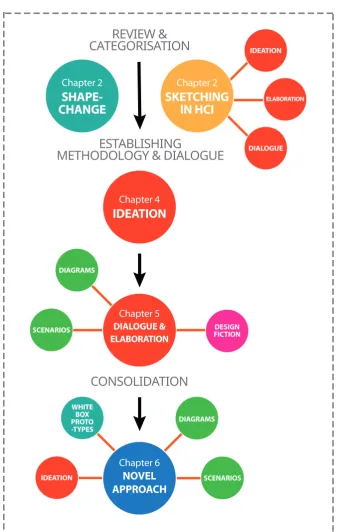
and is subsequently self-contained in respect to methodology and discussion. The final chapter takes the form of ameta-discussion, pulling together the themes from each chapter, and consolidating the work contained within this thesis.The following provides summaries, methodologies, and contribution — an overview of the work can be seen in Figure 1.1.
What is Shape-Change?
Chapter 2contains a detailed review of the field of shape-changing interfaces, examining both existing prototypes and previous papers outlining the major themes and goals in this area and consolidating existing research into themes and subsequently categorizing prototypes by shared materiality and interaction. This categorisation allows us to not only place existing work, but also gives a focus for prospective prototypes and ideas.
Methodology: Here, I conduct a literature review and classification of shape-changing interface prototypes and outline associated theory to set the scene and provide background for the novice reader.
Contributions: The first comprehensive overview, analysis and classification of shape-changing prototypes.
How has sketching historically been used in HCI research?
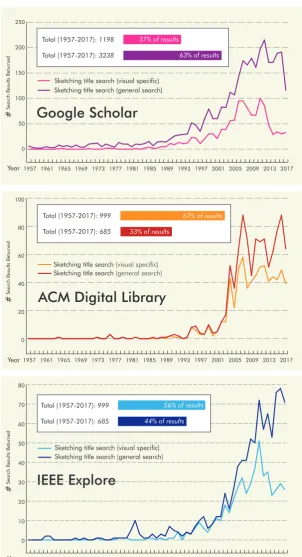
Chapter 3is a systematic review of sketching in HCI over the past 60 years, validating its use in this technology-centred field of study, and considers its value as a medium moving forward into the future. The review proposes 8 categories of sketching currently seen in HCI, and explores their contexts and themes in relation to UCD and other methodologies.
Methodology: Due to the large number of sketching-related papers in HCI (in comparison to shape-change), a systematic review technique is employed across HCI related works, year by year, using keyword searches across the two most comprehensive research databases for HCI (ACM, IEEE) and one academic search engine (Google Scholar).
Contributions: The first systematic overview and history of sketching in HCI, including generation of categories for sketching.
How can we use sketching with potential end users to inform the design and development of shape-changing interfaces?
IDEATION WHITE
BOX PROTO -TYPES
Chapter 2
SKETCHING IN HCI
Chapter 2
SHAPE-CHANGE
REVIEW & CATEGORISATION
ESTABLISHING
METHODOLOGY & DIALOGUE
CONSOLIDATION
Chapter 4
IDEATION
IDEATION
ELABORATION
DIALOGUE
Chapter 5
DIALOGUE & ELABORATION
Chapter 6
NOVEL APPROACH
SCENARIOS FICTIONDESIGN
DIAGRAMS
[image:30.595.122.461.137.670.2]SCENARIOS DIAGRAMS
Methodology: In order to communicate the complex nature of shape-change to non-expert participants, a boundary object (bridging method) is created using a portable, modular shape-changing interface which demonstrates actuation. In addition to this, posters which show other potential parameters of shape-change are shown to participants, to communicate the further opportunities for actuation. I then ask participants to use unstructured brainstorming to create sketched application ideas for shape-change. The qualitative nature of these outputs means that thematic analysis of ideas is necessary, so a grounded theory approach is used. The coding subsequently generates application categories for shape-change so an overview of potential uses can be created.
Contributions: An unstructured brainstorming methodology involving non-expert potential end-users; Categorisation of applications for shape-change; A database of the generated ideas available online at www.shape-change.org/brainstorm/
How can we use the information gathered from potential end-users to inform researcher-led inquiry in sketching and shape-change? How does this inquiry fit in with existing research in shape-change?
Chapter 5 is a subjective exploration of sketching as a tool for addressing the design of shape-changing interfaces from a researcher perspective, in both the ideation and design process (with reference to the body of work from Chapter 4), and also in exploring possible scenarios in storyboard form, based on existing publications. Finally, the theme of gaming in shape-change is elaborated upon in the form of a mixed sketched/text design fiction game manual.
Methodology: This chapter is comprised of three main sections which form a progression through methods of user dialogue, and subjective, researcher-led sketching. The three-part process allows us to see the potential outputs that are feasible for different levels of sketching practice, and therefore ensure that further work bases itself in the most viable methodology to create tangible research outputs.
The second section identifies future work prospects relating to the application ideas in the first section, using existing published material as a resource. The elaboration via sketching is then taken further to create detailed scenarios (a common UCD process) which are then used to form a new dialogue with non-expert users and other HCI researchers. This dialogue produces themes and implications for shape-change that reinforce the findings from the first section, and also within the previous chapters. This provides justification for the earlier methodologies, and suggests that more detailed elaboration methods may generate further insights.
The third section merges sketching as an investigative technique with design fiction, which is commonly used to explore unknown future scenarios and prospective technologies, and therefore is a good match for shape-change research. This work produces a design artefact which allows for the subjective generation of complex requirements for both hardware and interaction.
Contributions: A dialogue and elaboration based sketching methodology for communication between user and researcher; A methodology for generating requirements from researcher-sketched imagery; Using case studies to demonstrate the potential of sketching and analysis in order to identify applications or implications for shape-change; Thematic evaluation of sketched user-scenarios for existing shape-changing interfaces from information generated by HCI practitioners and non-expert participants; Demonstration of subjective sketching and design fiction as a further method for elaboration and requirements generation.
How can we use the insights gathered from subjective sketching to generate more detailed responses from potential end-users? Can we use this information to generate require-ments for shape-change?
Chapter 6 expands on the success of the previous work by utilising the combined ideas from chapters 2–5 to provide a study which not only provides a comprehensive overview of the field to non-expert users, but elicits diagrams and scenarios from which we are able to generate requirements and a stack model of development for shape-change.
Methodology: In order to connect the subjective practice from the previous chapter with user-based research, the methodologies from the ideation study and the subjective practice study are combined. Potential, non-expert end-users are asked to ideate, elaborate on one idea, and produce a scenario for that idea, set in the future where shape-change is commercialised. The produced outputs are thematically coded by in order to produce applications, requirements and implications for shape-change. These outputs are further coded and consolidated to produce a stack model for shape-change.
to address the challenges of involving users in the requirements generation stage of shape-changing interfaces; A 50 participant study that aims to demonstrate the validity of this approach to generate requirements for this novel technology; A thematic analysis of the generated user requirements; A shape-changing requirements stack model
What does this body of work mean for the field of shape-change?
The discussion contained inChapter 7provides justification for the use of sketching within both groups, for the eventual propagation and elucidation of this research area, and suggests steps for future work which encompass developing these techniques, and also application to novel research areas.
1.4
Contributing Publications & Outputs
The following works contain published material from this thesis. Contributions from co-authors are stated in line with the reference. Further works published during this thesis can be found in Appendix 1.
• Sturdee, M., & Alexander, A., 2018. Analysis and Classification of Shape-Changing Interfaces for Design and Application-based Research. InACM Computing Surveys
(CSUR). Vol. 51, Issue 1. ACM.All work by M. Sturdee with the exception of editing and commentary by J. Alexander
• Sturdee, M., Coulton, P. and Alexander, J., 2017. Using Design Fiction to Inform Shape-Changing Interface Design and Use. The Design Journal, 20 (sup1), pp.S4146-S4157.All work by M. Sturdee, with the exception of minor editing and commentary
by J. Alexander, P. Coulton included in supervisory capacity
• Sturdee, M., 2017, June. Drawing Design Futures for Shape-Changing Interfaces.
InProceedings of the 2016 ACM Conference Companion Publication on Designing
Interactive Systems(pp. 399-401). ACM.All work by M. Sturdee
• Sturdee, M., Hardy, J., Dunn, N. and Alexander, J., 2015, November. A public ideation of shape-changing applications. InProceedings of the 2015 International Conference on Interactive Tabletops & Surfaces(pp. 219-228). ACM.All work by M. Sturdee, with the exception of joint thematic analysis and coding, and some editing and commentary
Analysis & Classification of
Shape-Changing Interfaces
2.1
Chapter Summary
Shape-changing interfaces are tangible, physically dynamic and often multi-modal devices, surfaces or spaces that allow users to experience real physical 3D computing. The complexity of the materials and the design of these devices is not standardised, and each example covers new ground, and often new hardware and programming.
Here, I examine the current state-of-the-art for shape-changing interfaces in a systematic manner in order to provide an overview of the field from which I can base my investigation. Over the last fifteen years, research in shape-change has produced functional prototypes over many use-applications, and reviews have identified themes and possible future directions — but have not yet looked at possible design or application based research. This literature review suggests that there are underlying themes in materiality and approach which can be capitalised upon for future design and application.
By conducting a meta-review of existing theory papers, I have been able to synthesise research into an overarching view of shape-change which is broken down into Physical,
Interactive,TemporalandHardwarethemes. A further analysis of 84 functional prototypes in relation to this overview produced distinct material and interactive properties, which then allowed me to categorise shape-changing interfaces for use in design and application based research. Eight categories of prototype are identified, followed by discussion and ideas for subsequent work.
built with a single use case in mind and do not follow formal methodologies or use common materials. Although this variety is encouraging, it also means that there is no clear goal for the field. The foundations laid by this chapter allow us to ground the work that follows, and utilise the theory and categories to create dialogue with potential end users.
2.2
The Value of Reviews in HCI
Science and medicine have a long history of meta-analysis and systematic review, with computer science valuing reviews in the publication of high impact journals such asACM Computing Surveys amongst others. HCI is no exception, and through reviewing existing reviews we can gather requirements for a successful and thorough analysis. Reviews in HCI appear to fall into one of two categories: either providing a critical overview or analysis without outlining the process of gathering papers for review [205, 44, 246]; or, providing an overview via conducting quantitative analysis and resulting categorisation or discussion around a subject area [141, 153]. The latter may, or may not include a visible search strategy, though those that do allow for provenance of data and replication of the work, which is often overlooked in HCI [116]. Despite an often rigorous process, there are still limits to many reviews in HCI, such as limited corpus (“we survey some influential textbooks and handbooks” [115]), only using top-ranking journals [152], or reviewing limited venues [141, 49].
The reasons for conducting reviews vary, for example, Hornbaek et al. [115] suggest that if no other reviews exist of an area then a review fulfils a role in expanding knowledge. Kjeldskov et al. compare and contrast two reviews to form opinion on mobile HCI [153] – the purpose being to produce an “empirically grounded characterization of state-of-the-art and current practices”, whereas Kamppuri et al [141] regards the benefit of review process as allowing others to see the emergence of a field, categorise existing work, see emerging trends, as well as pinpointing pitfalls and promising directions. Finally, DiSalvo proposes reviews as allowing for a subject (e.g. sustainability) to position itself as a research field within HCI [49]. By conducting comprehensive reviews in this context, I firmly establish the groundwork and theory for the work contained within this thesis.
2.3
Introduction to Shape-Change
as advances are made in Shape Changing Materials/Alloys (SCM/SMAs), flexible displays and actuation techniques, thus supporting increasingly more detailed and interactive user experiences. It is feasible to imagine that within the next 50 years, such devices will augment or replace the pervasive 2D screens with which we currently navigate digital space.
Now that the field is maturing quickly, with highly interactive, dynamic and usable prototypes in abundance, we must think beyond the initial test-phase and toward designing meaningful applications (alongside the already identified interactions) for tangible future input and output. Although several research teams have begun to explore and discuss this exciting future, e.g. Roudaut [250] and Jansen [128], at present many applications are either pre-existing program types (such as music players or book readers) [164] or designed for one specific iteration of a device as a demonstration of its capabilities [173]. However, it is because of these explicit investigations, that we have a solid starting point for the evolution of these interfaces. The difficulty lies in creating content for such diverse and multi-dimensional devices.
Poupyrev [236] suggested in 2007 that future research might systematically investigate applications of actuated devices for various uses, outlining how our notion of pixels might further develop as dimensionality is added to graphical information (See Figure 2.1). Ad-ditionally, whilst researchers have started to try and make sense of the design space of shape-changing interfaces, where multiple dimensions must be considered at the same time [34, 161, 323] thus far it appears that there has been little consideration for designing generic applications for shape-changing devices, as we might do for standard 2D UIs. Speculative work relating to solving current hardware problems, or the qualities of future materials [123], leaves a space in between the prototypical present, and the near future of marketable shape-changing products.
The basis for this work is the significant body of research on gestures and interactions with shape-changing displays [83, 313] (for example), but the results of these studies have not yet been channelled into a consolidated, cross-paper set of guidelines for designers. There are even prototypes designed specifically for the act of prototyping itself [102, 111] to help designers make the first step, but there appears to be no united front on where that first step falls.
In order to assist researchers and designers in continuing to examine the current state of the field and the potential applications, this review collates some of the existing theoretical work on designing for shape-change — taken from several reviews [34, 161, 217, 242], interaction studies [111, 215], prototyping tools for shape-change [102] and general prototype papers — to create a comprehensive overview of dimensionality within shape-changing interfaces.
temporality, interaction, and hardware) is then applied directly to existing work on these prototypes, so that categories of device are formed. These categories are discussed in relation to the design space, existing research, and limitations. The discussion looks at supporting application design, hybridisation, limitation in design, future use cases, emotionality and user experience, future use cases, perception theory, the notion of temporal design and ethics, whilst considering how speculation might inform future work.
Tangible User Interfaces (TUIs) are swiftly making inroads into retail reality (wit-ness Nokia’sKinetic Device[149]), merging with changing displays to create shape-changing user Interfaces. Holman and Vertegaal [112] comment on the complexity of designing for this new generation of shape-changing interface/display, stating that all physics acting upon displays, including their shape, will be used to manipulate information. So we must look not only to the manipulation of physical form to design our applications, but also to the other senses and beyond. The following work is the first consolidated review of shape-changing interface theory, and also the first to provide a comprehensive analysis and categorisation of existing prototypes. The latter is necessary in order to begin to formalise design for the field and should be used to inform detailed application design for current shape-changing interfaces in the research context.
This chapter contributes a contemporary meta-analysis of shape-changing design theory, a detailed database of changing prototypes, and a categorisation of types of shape-changing interface (Enhanced 2D, Bendable, Paper & Cloth, Elastic & Inflatable, Actuated,
Liquid, Malleable and Hybrid). The aim of the chapter is to assist researchers interested in contributing novel prototypes and their applications to the field, and designers who wish to gain knowledge of current hardware to begin to create meaningful deformable applications for real world iterations of these devices. The main goal of this review is to set the stage for application design for shape-changing interfaces by providing a reference guide for each interface type and their associated interactions, with which we can inspire real use cases for existing prototypes and look beyond this, to the commercial future of shape-changing interfaces.
2.4
Previous Reviews & Analysis
sub-sequent categorisation of prototypes within this context. This is the first time the field of shape-change has been looked at in as much breadth and depth, and builds upon the valuable contributions made by the researchers discussed below.
Rasmussen’s review of shape-changing interfaces [242] suggests that there is a great deal of research into hardware, but that the design possibility of this space is an underexplored direction. If, as Vallgårda [323] states, a “new expectation of the computer is already being formed” we therefore need to rise to the challenge of meeting this expectation with tangible shape-changing interfaces that will appeal to the next generation of users. Vallgårda creates a baseline for the new type of interaction design necessary for shape-changing interfaces, where temporality meets the physical and the interactive possibilities of such devices. This “trinity” should form the cornerstone for any designer wishing to make a start in this area.
Kwak [161], held boot-camps for industrial designers to create platforms for prototyping design for shape-change, meaning that future designers can explore basic transitions and actions which then form the basis for the nascent application of shape-changing interfaces and displays. Six prototyping tools were identified from an initial selection of ten which cover a range of deformations and actions (Piega, Gato, Yeti, Fantom, Squeezy & Bulge). These prototyping devices mirror the most common deformation styles found in shape-changing interfaces (bar those that make use of 2D flexible computers), and thus provide a neat overview of deformation styles, which can be aptly applied to the overview of shape-changing interfaces.
From a point of view based on the theory ofNon-Uniform Rational B-Splines, Roudaut et al. propose a framework for shape-resolution – aimed at assisting engineers in creating high resolution displays [250]. This framework is only as good as the technology allows though, and its advanced features will need to be applied gradually. It also only applies to those mechanisms which can be thought of as having nodes/loci of control (as seen in a mesh overlay), and thus only applies in part to shape-changing materials, which also require thinking in other dimensions which may not be so constrained.
Coelho et al’s review [34] focuses on all possible realities for shape-change in a specula-tive manner, and further provides an overview of the field as it was in 2011. By combining the multiple dimensionality of shape-changing interfaces, they attempt to begin construction of a “soft” mechanical alphabet for HCI (after 18th century engineer Polhem) with which designers can orientate themselves for this conceptually complex research area. This notion supports this review in regards to the need for a modular design theory for those wishing to engage in application design for shape-changing interfaces [102].
[342]), but any advances in programming will still need to be relatable to designers. At present, researchers must have a firm grounding in programming, electronics, and mechanical engineering to engage with shape-changing interfaces, although this might change in the wake of the recent surge in interest toward interdisciplinary study.
2.5
Consolidation of Shape-Change Themes
A meta-analysis of papers from Coelho [34], Roudaut [250], Taher [299], Rasmussen [242] and Kwak [161] was conducted, alongside complimentary information from Nørgaard [217], Schmid [263] and Hardy [102] in order to create a comprehensive overview of the state of shape-change as it stands at present. These papers were chosen as they covered the breadth of the area in terms of interfaces, although SCM papers were consulted alongside to ensure that all dimensions of change were covered. The categorisations provided by each researcher are mapped alongside one another in Figure 2.1. Following analysis of these papers, it was also found that the types of change which one needs to consider when thinking around the topic of design followed closely to Vallgårda’s [323] “Trinity of Forms”. A separate area for back-end, hardware considerations was created, in order to relate back to the hardware and mechanism of shape-changing interfaces, rather than the pure theory.
To summarise the sections in Figure 2.1, theSpatialsection relates to topology, expansion, height and spread of the interface display area;Orientation/Pathtoward folding and turning abilities of devices;Resolutiontoward textural and pixel quality (which may go hand-in-hand according to Nørgaard [217] – a high enough shape resolution means that the generation of texture is a given); Materialityconcerns the pliability and strength of the surface; and
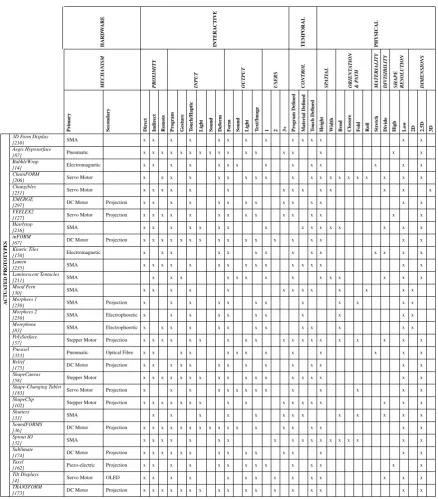
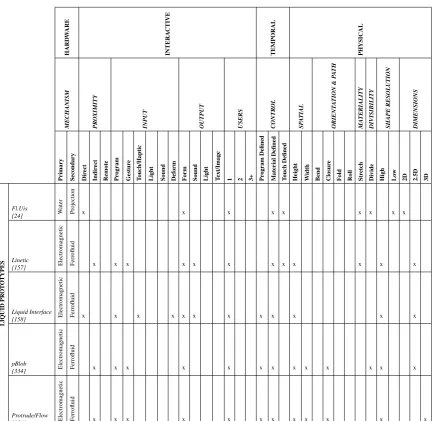
Divisibility, the separation of component parts or ability of a material to let through matter. The interactive qualities of a shape-changing interface are not expanded in this diagram, as interaction is a multi-faceted aspect of a shape-changing interface and requires a more detailed overview (see [242]). Rasmussen et al. suggest three types of interaction in shape-change: direct, indirect and remote. These types are used in applying classification to the existing prototypes in Tables 2.1–2.8, as well as including types of input/output. These are discussed in the next section.
By examining the ways in which these dimensions map alongside each other and interact, we have ensured that we have an easily accessible summary from which we can begin to formalise the nature of this area — all these categories are discussed in more detail in section 2.7. The information in Tables 2.1–2.8 is based on this summary, and the nature of existing devices in relation to the wider theory-based dimensions is discussed later in the chapter.
2.6
Application to Existing Prototypes
Having condensed current theory into a meaningful summary (Figure 2.1), the next stage was to apply this method of analysis to existing prototypes in order to gain an overview of the current state of the art with regards to design and applications. The category descriptions in the previous section are changed to reflect existing deformation types (rather than future possibilities), and the interactive aspect constructed during analyses of the literature. It also proved of further use to add fields to the following tables which give additional information (such as 2D/2.5D/3D).
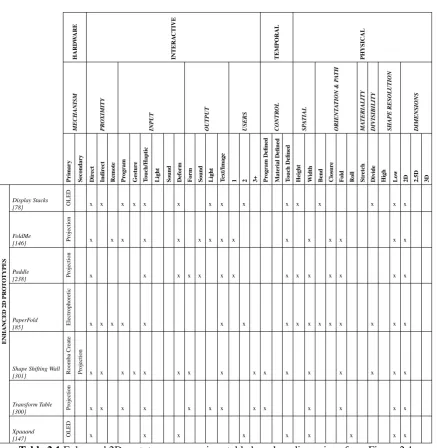
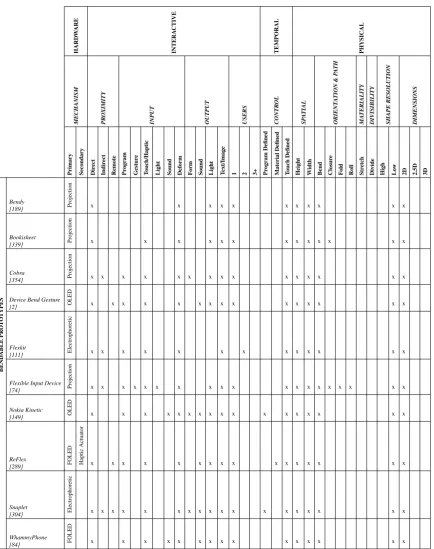
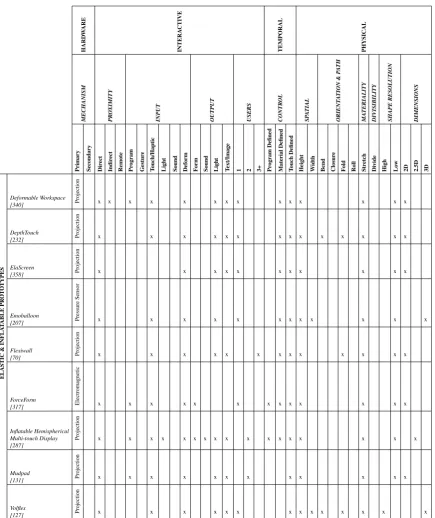
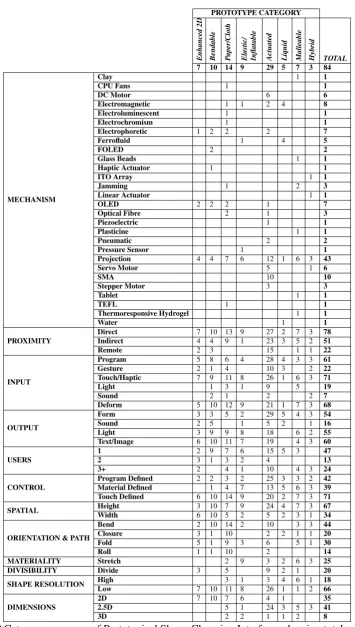
Tables 2.1–2.8 provide a comprehensive overview of 84 existing shape-changing pro-totype interfaces from the past 16 years, as they were at time of writing. This builds upon Rasmussen’s review of 44 papers on shape-changing interfaces [242], but with a more re-fined criteria for inclusion and an tabulated analysis which compares the field. Figure 2.2 provides a graphical overview of this categorisation in order to compare between groups at a glance. Further to this, a summary table (Table 2.9) outlines the main features of the display categories.
2.6.1
Inclusion Criteria
its current iteration. The user in this case is passive, and unable to dictate or influence the output.
Another type of shape-changing prototype that is excluded is Guo et al’sGarden Agua
[94] — despite being described as shape-changing display in the literature — as it deals only with moveable solid objects and not surface deformation. The same premise also applies toAriel Tunes [5] due to the modular and limited nature of its current form-based output. Despite the pixel-like nature of the floating balls inAriel Tunes, the display supports only one type of interaction and one type of output. This is not to say that future iterations of such mechanisms may not fulfil the criteria outlined here. Finally, where there is more than one iteration of the same prototype, the most recent is included, unless a significant change to the usage has been implemented — such asFuSA 2[207].
The reasoning behind setting strict inclusion criteria is that tangible input devices require design only for existing 2D output, which is a well established field, hence the same surface must be utilised in order to establish something novel. The same also applies to non-deformable surfaces — there is no need to establish a new framework of analysis or design. It is also worth noting that definitions of “interface” within shape-change differ between researchers, the criterion here are not intended to exclude without reason, merely to draw a line around what a shape-changing interface is for the purpose of analysis. Future work may expand on this analysis to look at the wider field of tangible TUIs and shape-displays within the overview provided here.
2.6.2
Dimensions of Shape-Change
In applying existing prototypes to category headers, I further condensed the dimensions from within Figure 1, and also identified types of prototype hardware currently used in the literature. The resulting fields of classification are discussed below in order to clarify their use.
2.6.3
Hardware
Some of the dimensions of shape-changing interfaces were identified at the consolidation stage, but either do not apply to existing prototypes in a quantifiable manner (i.e. power requirement is something to be considered at the commercialisation phase) or would require additional levels of detail and discussion for each individual prototype which are not possible within the scope of this chapter.
Bi-Directionality
Whereas Coelho stated that bi-directionality is specifically important for designers [34] it is not an exclusive construct within shape-changing prototypes, and thus has not been applied to the list. Bi-directionality refers to the properties of a material/device to physically change shape in the same way when deformed by a user, and when self-actuating. This is important during the design process as it has an effect on other material properties of the interaction surface, and the interactions a user will have with the interface (i.e. Non-bi-directionality might be seen in the case of clay-based interfaces where the user can deform the surface, but the surface itself is passive, in which case it must be manually “re-set”).
Most examples have varying inputs and outputs but they are not always linked, for example, form-input is not always directly related to form-output by the mechanism, such as withPaddle[238] which utilises purely user-controlled deformation. ForPaddleto exhibit bi-directionality, it would have to be able to deform itself in response to some other form of input, such as a telephone call activating a form-state.
Some examples do exhibit bi-directionality in limited ways however:ShapeClip[102] is bi-directional in respect to the input/output of tangible form and light, but can only react to image-based light input, not produce it (this limitation is addressed byShapeCanvas[58] however, which uses the same base mechanism). The same applies toLightCloth [105] which accepts/projects light as input/output, but deformation is an input only (the user can manipulate the cloths’ form, but the cloth cannot manipulate itself programmatically). Therefore it can be considered that bi-directionality is not a given, and as such not essential in the design of shape-changing applications as meaningful interactions can be had across modalities.
Environmental compatibility/power requirement
BENDABL
E
ELAS
TIC & INFLATA
BLE
ACTUATED
ENHANCED
2D
PAPER & CL
OTH
MALLEAB
LE
HYBRID LIQUID
Fig. 2.2Overview of shape-changing prototype categories
immaturity of the field, these are future considerations. The application of shape-change in real world scenarios must come before situational problem-solving at this stage.
Reversibility, transition quality & accuracy
Of the remaining aspects of the hardware, reversibility is a given for shape-change in this case, as otherwise there would be no form-based interaction past the initial deformation. Transition quality and accuracy are difficult to assume from the literature alone: without analysis of these aspects in particular for each prototype, I cannot begin to attribute these qualities to the mechanics of each device. The remaining dimensions (accuracy, trainability and complexity of actuation) are rooted firmly in the material/actuation type, and can be related directly back to the primary hardware categories.
2.6.4
Interactive
The proximal considerations for the user are based on Rasmussen’s classification of interaction (see previous paragraph), omitting only “none” as a type of interaction, for the reason given above.Directproximity infers that the user can touch the surface of, or interact with the prototype directly (as withClaytricSurface[259]), without the need for an additional item such as a ring or wand (as is the case withLinetic[157]). Indirectproximity requires an additional construct for the user to interact (such as a connected laptop as withFlexkit
[111]) or the user can use mid-air gestures as a form of input – but this can exist in tandem withDirectproximity. This is also the case forRemoteoperation, which suggests that the interface can be controlled via infrared, wireless or Bluetooth technology, and therefore, in the case of wireless internet communication, from almost any distance.
Almost any kind of input or output could be designed for shape-changing interfaces, but the tables record only current iterations. Smell, for example, has been used inclayodor[142] as an output, but this prototype is not included due to the separate nature of the input/output components. Future types of input might include those that are non-visible, such as radiation or air quality. Of the research surveyed, it can be seen that there is currently a greater variety of input than output. Inputs thus include: program (a program is used to control some aspect of the interface, such as the bend of the SMA [83], or visual imagery [221]); gesture [102] [157]; touch/haptic [216, 317]; light [284]; sound [87]; and deform (separate from simple touch sensitivity, this implies some force or movement is applied to change the shape of the available surface, whether it is bending [305], pushing [67] or more advanced deformation [259]).
Output is currently limited to: form (as discussed in relation to bi-directionality) e.g. [251, 334]; sound (deliberately generated, as opposed to an incidental sound generated by the mechanism) [158]; light (often as an artefact of projection [174], or internally generated [235]); and text/image [4, 193].
Number of users was also found to be relevant to interactions with prototypes — because it changes the way designers think about their interface — although it was not always explicitly written how many each device was designed for.Xpaaand [147] is a mobile device prototype based around one user perspective, but the discussion highlighted the possibility that a large change in width supports multiple user interaction. In comparison,inFORM/TRANSFORM’s
2.6.5
Temporal
The notion of temporality in design is in its infancy, but is inextricably linked to both the physical and interactive dimensions of interaction for shape-changing interfaces [323] (see Figure 2.1). Understanding the limitations of time and speed for each prototype is essential for implementing successful design strategies. Whilst categorizing existing work for Tables 2.1–2.8, the origin of control for speed was found to be important as it affects how interaction occurs and how the user experiences the prototype. Interfaces were found to support three types of control: program defined— the speed of change is defined by programming, as in
Aegis Hyposurface[87] which can move up to 100km an hour;material defined— limitations are placed on the speed with which a change can take place due to material constraints, such as with SMAs [250] or actuators [216]; anduser defined— the user controls the speed of deformation via direct deformation at a chosen speed (but within the limits of the device) [157]; or all three [102].
Designing for temporality is at its most difficult when the potential exists on all three dimensions. The desire for speed from the user may not always match the intentions of the application — i.e. an educational application might move with deliberate sluggishness so the child cannot skip parts, or by increasing the speed of a transformation, essential information might be lost. The opposite is also true — when browsing a shape-library, you may need to skip ahead or traverse options swiftly. These aspects and more must be designed for, or against: the application must be able to control the pace that is most conducive for its purpose.
2.6.6
Physical
The physical characteristics of shape-change emerge as quite distinct from the consolidated dimensions seen in Figure 2.1. Application of these dimensions to existing interface examples allows specific deformations to be noted and discussed. The physical changes of a surface range from the basic (height/width/bend) to the complex (closure/divide).
Heightis the most commonly found change in actuated and material based deformations. It implies that the prototype experiences a change in height of the surface relative to its baseline (non-deformed starting point). This is always limited by the hardware making up the device. Height is also applied as a change to those prototypes which make use of one axis, in one direction [87] as the same idea applies despite the change in orientation.
HARD W ARE INTERA CTIVE TEMPORAL PHYSICAL MECHANISM PR O XIMITY
INPUT OUTPUT USERS CONTR
OL SP A TIAL ORIENT A TION & P A TH MA TERIALITY DIVISIBILITY SHAPE RESOLUTION DIMENSIONS
Primary Secondary Dir
ect Indir ect Remote Pr ogram Gestur e T ouch/Haptic
Light Sound Def
orm
F
orm
Sound Light Text/Image 1 2 3+ Pr
ogram Defined Material Defined T ouch Defined Height W idth Bend Closur e F old Roll Str etch Di vide High Lo w
2D 2.5D 3D
ENHANCED 2D PR O T O TYPES Display Stacks
[78] OLED x x x x x x x x x x x x x x x
FoldMe
[146] Projection x x x x x x x x x x x x x x x
Paddle
[238] Projection x x x x x x x x x x x x x x
PaperFold
[85] Electrophoretic x x x x x x x x x x x x x x x x
Shape Shifting Wall [301] Roomba
Create
Projection x x x x x x x x x x x x x x x x
Transform Table
[300] Projection x x x x x x x x x x x x x
Xpaaand
[image:48.595.74.512.183.632.2][147] OLED x x x x x x x x x
instance [224], or due to a device having the capability to be unfolded, such as withPaddle
[238].
Bend, is most common with flexible displays such asMorphees[250] where the thickness of the OLED display or constraints of the SMA wires means that only a slight deformation of an otherwise 2D item is permissible.
Fold is closely related to closure –– but the distinction lies between surface merely creasing and the surface folding entirely in on itself. Reabsorption happens in the cases where a ferrofluid is used (pBlob[334]) or edges meeting with a static surface (PaperFold
[85]).
Rollalso often goes hand in hand with highly flexible static surfaces — the best example beingXpaaandwhich is encased in rolls at either end [147].
Stretchis distinct fromwidth, as it implies an area expansion from baseline based on materiality rather than simply displaying more of the same substrate. Stretchable materials are usually incidental hardware (like latex) and used over actuators [104] or in jamming [259].
Dividesuggests either a modularity in actuators or components as seen in Hairlytop
[216],PaperFold[85] andShapeClip[102] or where a solution can be split into parts and reunited as inpBlob[334].Shutters[33] is an interesting hybrid, using folds and splitting simultaneously to allow for a divided (or permeable) surface.
Resolutionrefers to shape-resolution as coined by Roudaut et al. [250] and incorporates the textural element as discussed earlier in section 2.5 [217]. A high shape resolution is the same as a high pixel resolution in that a 2 dimensional representation of a sphere on a low resolution screen would show “squaring off” oraliasingaround the edges, whereas a low shape resolution sphere would have angular blocks making up its surface. Liquid interfaces have high shape resolution due to fact they do not rely on set sized nodes as actuators do.
Dimensionfalls between 2D and 3D, referring to 2.5D as either a limited 3D display (i.e. one plane of deformation only with projection as a separate construct) or as one where there is sufficient deformation possibility that the design-surface would need to allow for form if the display was to have an application design for it. 2D shape-changing interfaces in this case are typically changing their area (width) but the design space is resolutely flat.
2.7
Categorisation and Analysis of Prototypes
HARD W ARE INTERA CTIVE TEMPORAL PHYSICAL MECHANISM PR O XIMITY
INPUT OUTPUT USERS CONTR
OL SP A TIAL ORIENT A TION & P A TH MA TERIALITY DIVISIBILITY SHAPE RESOLUTION DIMENSIONS
Primary Secondary Dir
ect Indir ect Remote Pr ogram Gestur e T ouch/Haptic
Light Sound Def
orm
F
orm
Sound Light Text/Image 1 2 3+ Pr
ogram Defined Material Defined T ouch Defined Height W idth Bend Closur e F old Roll Str etch Di vide High Lo w
2D 2.5D 3D
BEND ABLE PR O T O TYPES Bendy
[189] Projection x x x x x x x x x x x
Bookisheet
[339] Projection x x x x x x x x x x x x x
Cobra
[354] Projection x x x x x x x x x x x x x x x
Device Bend Gesture
[2] OLED x x x x x x x x x x x x x x x
Flexkit
[111] Electrophoretic x x x x x x x x x x x x x
Flexible Input Device
[74] Projection x x x x x x x x x x x x x x x x x x x
Nokia Kinetic
[149] OLED x x x x x x x x x x x x x x x x x
ReFlex
[289] FOLED Haptic
Actuator
x x x x x x x x x x x x x x x x
Snaplet
[304] Electrophoretic x x x x x x x x x x x x x x x x x x
WhammyPhone
[image:50.595.77.512.133.683.2][84] FOLED x x x x x x x x x x x x x x x
the vital factor in assigning these categories as it had the most influence on user-interaction and shape-input/output. For example, a user interacts with an elastic interface in a very different way to an actuated interface (i.e. it is impossible to stretch a solid-state pneumatic pin).
The 8 categories are:Enhanced 2D(Table 2.1),Bendables(Table 2.2),Cloths & Papers
(Table 2.3), Elastics & Inflatables (Table 2.4), Actuated (Table 2.5), Liquids (Table 2.6),
Malleables(Table 2.7) andHybrids(Table 2.8). These categories are clear groupings which stand out from a combined analysis, as they often share common themes not only within their hardware, but across the interactive, temporal and physical dimensions. A comparison between these categories can be seen in Tables 2.9 and 2.10. Each category is discussed in detail below.
Enhanced 2D
Prototypes make use of multiple incidences of 2D screens which flex along either axis (see Table 2.1). Prototypes must have one or more screen or extra surface available which operates independently from its primary interface surface (see Table 2.1). The primary method of shape-change is touch defined (with the exception of TransformTable [300]). Shape resolution is low.
These types of devices account for nearly 10% of the surveyed literature (7/84). Design forEnhanced 2Dinterfaces should exploit multi-screen interactions or applications and either exploit or avoid the ensuing perceptual angles allowed by such prototypes (such as when a geometric shape such as a boat is constructed [83]). With regards to this, designers should also be a focus on user perception over more than 2 screens, as well as number of users and how they communicate about differing screen-states during multiple use interactions. Single user scenarios fit more commonly into existing device designs and therefore there are existing precedents (e.g. Nintendo DSTM).
Bendables
HARD W ARE INTERA CTIVE TEMPORAL PHYSICAL MECHANISM PR O XIMITY
INPUT OUTPUT USERS CONTR
OL SP A TIAL ORIENT A TION & P A TH MA TERIALITY
DIVISIBILITY SHAPE RESOLUTION DIMENSIONS
Primary Secondary Dir
ect Indir ect Remote Pr ogram Gestur e T ouch/Haptic
Light Sound Def
orm
F
orm
Sound Light Text/Image 1 2 3+ Pr
ogram Defined Material Defined T ouch Defined Height W idth Bend Closur e F old Roll Str etch Di vide High Lo w
2D 2.5D 3D
P APER & CLO TH PR O T O TYPES Cloth Displays
[177] Projection x x x x x x x x x x x x x x x x x x x
Flexpad
[284] Projection x x x x x x x x x x x x x x
FluxPaper
[220] Electromagnetic x x x x x x x x x x x x x x x x x x x
FuSA 2 [208] Optical
Fibre
Projection x x x x x x x x x x x x x x
IllumiPaper
[154] Electrochromism Electroluminescence x x x x x x x x x x x x x x
jamSheets
[224] Jamming Projection x x x x x x x x x x x x x x x x x x x x
LightCloth [105] Optical
Fibre
x x x x x x x x x x x x x x x
Metamorphic Light
[193] Projection x x x x x x x x x x x x x x x
Murmur [254] CPU
F
ans
x x x x x x x x x x x x
PaperPhone
[164] OLED Electrophoretic x x x x x x x x x x x x
PaperTab
[305] Electrophoretic x x x x x x x x x x x
PaperWindows
[113] Projection x x x x x x x x x x x x x x x x
PrintScreen
[221] OLED TEFL x x x x x x x x x x x x x x
Projectagami
[302] Projection x x x x x x x x x x x x x x