£Tt~6 ~J ~sor
NVS
April, 1967
LOZIN*
OGNV
~3~VS
+
13~~VW+JOTO
"'WT
'
•
11*7L*7
£9
J3S
Sl'!fJIOOI~3d'7?
0"y
CD
1
Mirror
t
{PI"
by
~
I
~
l
-because The Kelly-Springfield TI "
Com pa ny gets the right ti re to t;;
right place at the right time, with:-, modern communications and d2:;1
processing system, that's why nt,;
And they sell over
2600
differesizes and types of tires in the U.'
Canada and
66
other countries.Here's how the system works: each warehouse Bell System Te
type® machines use master ta~
to enter standard information ,i
customers and their purchasls, while the variable sale informatit n is typed in manually. The machines make printed orders and by-product
Why
not?
" ~.. p ~ ! n c h~; d P -J ' ,r:: ',_ 'f) f:; . ; t
" i"inittea
c,.
;2: : :."~:,: ""~(..i:; a minu~e. i-,';
.t,,,;, ..
-" L, fJU L 110 U I -::1',"::: :::.' n~,;' ': 1:_; '(' ,:::~
,;;:-;1lUed in E; ;i':!"l:
Wc~(;kly (C:-:Y)rl~; (", !. '~. t
;:;; JC :: ('Hr~;'lt~i.:"l. ,., ',"'is,
sa,·:, ',-, nei ordc rs ' '';'',.'. hC\!:~'2 in thc~-
(;'C'imr.-y. '" ','
'me;!'\,' :';(:, ,tel from each of the
26
warehousesi>: rnepared for factory production
~' : ,: juling.
TI ~ resu It: I nformation flow is
f0~: r, more accurate. Customers
e':, ;
1e best possible service,every-,,'1';':' e in the Kelly-Springfield
mar-h_ i ' g world.
; " i ' more information, call your
l'~':;\l Telephone Business Office and
()~;I( for a talk with one of our Com-rnu'.ications Consultants. And don't
Il';~;' :ate to call us early-because if. :; way we can serve you best.
\' ,len you work with data commu-ni:'""tions, work with the Bell System.
... ---::-l
"peed
I
:;;,1.
-.-.
-
..:..:. .. ~ ....
_--... r.l..' .,:. : :.~.'
,
~.
,>Ietn·r':'~~:~ ,I I, S
--.. "0';'"
. '\TS Wide A I<-':Jilone SE
. , ... 't } 1 ' ..
Introducing
the
DATA 620-1
new systems computer
The DATA/620-1 integrated circuit computer is the newest
member of the DATA/620 family of system computers. DATA/620-1 fills the gap
between general purpose and special purpose computers. It belongs in a
system, and solves problems previously considered too difficult or
expensive for computer solution.
Designed for faster problem solution the DATA/620-1 has a bigger
instruction set, integrated circuit reliability, is
smaller, has one-half the components, and
costs less than any computer in its class.
DATA/620-1 comes complete with
software, field-proven and refined on
the DATA/620.
Extremely compact, the DATA/620-1
requires only 10" of 19" rack space.
It's available with memory modules from
1024 to 32,768 words of 16 or 18 bits,
and with a selection of control, arithmetic
and I/O facilities, including D.M.I.'s
unique Micro-Exec.
Price: $13,900 with 4096 words of 16 bit
memory, including ASR 33 teletype.
We are very proud of our new DATA/620-1, and
would like to tell you more in a fact filled brochure.
Please write for one.
DATA MACHINES
1590 Monrovia Avenue, Newport Beach, California
Tel. (714) 646-9371 TWX (910) 596-1358
Division of DECISION Control, Inc. Designate No. lOon Reader Service Card
The Data 620-1 and the Data/620 will be on
display at booths HS-HIO
The 20-minute education break.
For busy people who need to know.
Maybe you have a programmer who needs to brush up on COBOL, or a tab operator who needs to know about the IBM
85
Collator. Or you may know a junior executive who just wants to learn a little bit about data processing. IBM has an easy way to teach them.It's called programmed instruction - P.1. for short. P.1. is an approach to self-study that guides a stu-dent through the required material at the stustu-dent's own pace, a step at a time. He can breeze through five or ten pages whenever there's some time to spare-at home or on the job.
Last year, some 100,000 students took IBM pro-grammed instruction courses. And the results were gratifying. Students learned faster- 27% faster on the average-and scored higher than did those in conven-tional lecture-discussion classes.
Right now there are 29 P.1. courses available to IBM customers covering punched card systems, computer fundamentals and computer programming. More are being developed.
But programmed instruction won't replace your local IBM Education Center. Some subjects are just too complex or too specialized to be taught by P.
I.
So we'll continue to operate our school system-providing a comprehensive curriculum for everyone from key punch operators to board chairmen.Either way-sending the student to school or the school to the student-IBM education helps you and your people learn how to get the most productive work from your IBM system.
©CQ)[Flfl)CQ)(1)T~~~~
S[nHo'l
alUJ~Oll'il'ls'tCaIOJfn
Mirror by Computer
The front cover shows a famous Japanese wood-block print, as reproduced by a plotter guided by
a digital computer.
APRIL, 1967 Vol. 16, No.4
13 c&a problem corner
by Walter Penney, C.D.P.
37 calendar of coming events 39 across the editor's desk
Computing and Data Process-ing Newsletter
54 computer census
56 books and other publications
59 new patents
by Raymond R. Skolnick
60 ad~ertising index
editor and publisher
Edmund C. Berkeley
assistant editors
Moses M. Berlin, Charlene J. Hofer, Linda Ladd Lovett, Neil D. MacDonald
market research director
Patrick J. McGovern
contributing editors
John Bennett, Andrew D. Booth, Dick H. Brandon, John W. Carr, III, Ned Chapin, Alston S. Householder, Peter Kugel, Rod E. Packer
advisory committee
T. E. Cheatham, Jr., James J. Cryan, Richard W, Hamming, Alston S. Householder, Victor Paschkis
art director
Ray W, Hass
fulfilment manager
William J. McMillan, 815 Washington St., Newtonville, Mass. 02160, 617 DE 2-5453
advertising representatives
NEW YORK 10018, Bernard Lane, 37 West 39 St., 212-BRyant 9-7281 CHICAGO 60611, Cole, Mason and Deming, 737 N. Michigan Ave., 312-SU 7-6558 LOS ANGELES 90005, Wentworth F. Green, 300 S. Kenmore Ave., 213-DUnkirk 7-8135 ELSEWHERE, The Publisher, 815 Washington St., 617-DEcatur 2-5453 Newtonville, Mus, 02160
For more in/ormation, see page 60.
Special Feature,'
Performance Comparisons of Computing and Data Processing
Systems
16 REAL-TIME PROCESSING POWER: A STANDARDIZED EVALUATION, by J. Burt Totaro How to obtain valid measurements of the power of a computer to. do real-time processing. .22 COMPUTER PERFORMANCE PROJECTED THROUGH SIMULATION, by Fred C. Ihrer
A specific evaluation technique predicts the performance of various hardware and software designs in terms of cost and response_
29 RECOVERY FROM ERROR, by Jan B. Hext
The emphasis should be on the prevention of error, as hardware becomes more complicated and more reliable. But software failures seem destined to survive longer.
34 LANGUAGE ENGINEERING, from Hughes Aircraft Company
To date no one has assembled a complete, integrated, automatic machine that listens and speaks. But as such devices become more and more needed, advances in making and pro_ gramming them should culminate in a satisfactory, working system.
editm'ial
Time Sharing, Batch Processing, and Direct Access
market report
The top 100 computer users (among industrial firms) with over $2 billion worth of computers workinq in 1966 - and who they are
world report -
Great Britain,
Kosygin praises British computers; sales to East Europe rise; British universities purchase U.S_-made machines; British European Airways to purchase integrated management system.
capital report,
The Defense Department seeks bids for a management information system; the National Data Center controversy continues; in an experiment, computer systems successfully match unem-ployed workers with jobs.
multi-access forum
8 Time-Sharing: A View from New Zealand, by B. A. M. Moon
Perhaps the benefits of time-sharing may be available without time-sharing. 9 Library Service for Blind Computer Programmers Seeks Type-Composing Tapes 9 Addresses of Computer Organizations
9 Modern Indian Story: Electronic Firms Locate on Reservations
Aid from the Department of the Interior and an abundant, easily-trained labor supply leads to industrial growth on Indian reservations.
10 Cybernetics in the U.S.S.R., by Robert W. Brainard and William D. Hitt
Computers in Soviet law, medicine, education, public health, and economics may result in fundamental changes in Soviet economic theory and practice.
11 Computers Checking All United States Taxpayers for First Time, by Norman Teich The Internal Revenue Ser.vice's nationwide computer system.
11 IFIP Admits Hungary as 26th Member Country
12 "Individual Privacy and Central Computerized Files" - Comments 12 "Bootstrapping a Career in the Computer Field" - Comments 12 ECPI Program Write-Ups Available
13 Jovial Bulletin Established - Papers Sought
*0 ON YOUR ADDRESS IMPRINT MEANS THAT YOUR SUBSCRIPTION INCLUDES THE COMPUTER DIRECTORY. *N MEANS THAT YOUR PRESENT SUBSCRIPTION DOES NOT INCLUDE THE COMPUTER DIREC-TORY. SEE NOTICE ON PAGE 20.
53 Revived "Annual Review in Automatic Programming" - Papers Sought 53 Correction
58 Articles for "Computers and Automation" and how to write them
.. ~\ COMPUTERS AND AUTOMATION IS PUBLISHED MONTHLY AT 815 WASHINGTON ST., NEWTONVILLE, MASS. 02160, BY BERKELEY ENTERPRISES, INC. PRINTED IN U.S.A. SUBSCRIPTION RATES: UNITED
: '~~~r. STATES, $15.00 FOR 1 YEAR, $29.00 FOR 2 YEARS, INCLUDING THE JUNE DIRECTORV ISSUE; CANADA, ADD SOc A YEAR FOR POSTAGE; FOREIGN, ADD $3.50 A YEAR FOR POSTAGE. ADDRESS ALL " . , / EDITORIAL AND SUBSCRIPTION MAIL TO BERKelEY ENTERPRISES, INC., 815 WASHINGTON ST., NEWTONVILLE, MASS., 02160. SECOND CLASS POSTAGE PAID AT BOSTON, MASS.
POSTMASTER: PLEASE SEND ALL FORMS 3579 TO BERKELEY ENTERPRISES, INC., 815 WASHINGTON ST., NEWTONVILLE, MASS. 02160. © COPYRIGHT, 1967, BY BERKelEY ENTERPRISES, INC. CHANGE OF ADDRESS: IF YOUR ADDRESS CHANGeS, PLEASE SEND US BOTH YOUR NEW ADDRESS AND YOUR OLD ADDRESS (AS IT APPEARS ON THE MAGAZINE ADDRESS IMPRINT), AND ALLOW THREE WEEKS
c&a
EDITORIAL
Time Sharing
lBatch Processing
land Direct Access
In this issue in Multi-Access Forum we publish an impor-tant and interesting letter from B. A. M. Moon, Director of the Computer Centre, University of Canterbury, Christchurch, New Zealand. Among other questions that he raises are:
1. If immediate man-machine interaction in scientific and technical research and design problems is so· impor-tant, why has there not been more of it in the past?
2. If small computers are going to be needed at the terminals of large time-shared machines anyway, would not the greatest economy in many cases be simply to dispose of the central machine and leave each user in intimate contact with his own smaller computer?
3. Can we get the benefits of time sharing without time sharing?
These questions have points of resemblance to the follow-ing questions:
"Are apples or oranges better"?
(Answer: It depends on many factors.)
"Is it better to have a pain in your head or a pain in your foot?"
(Answer: The answer depends on two factors essen-tially: if the pains are equally intense and equally serious, certainly the foot pain is preferable.) "Is it better to have the right equipment or the wrong equipment to do a job?"
(Answer: Of course, the right equipment is better -though in this case, the issue has been avoided by in-serting answer-begging words in the question.) Most of the answer to Question 1 is that as long as com-puters were very expensive, it cost too much to give the per-sons working on problems in design and research direct access to computers. However, as c;osts have gone down - due to both time sharing and the arrival of small computers-direct access (man-machine interaction) became economically feasible and was immediately desirable, because of latent but ineffective demand.
The answer to Question 2 is clear. If most of time sharing reaches the point where a small computer is needed in the console, then clearly we should get rid of the big computer, the intricate software for control, and the long communica-tion lines for access, and we should in nearly all cases settle either for single-console access to a single computer, or for two or three nearby consoles, short communication lines, and simple supervising software in the computer.
I am convinced that the answer to Question 3 .is:
In a great number of places, we can get the benefits of time sharing without time sharing; the pendulum of that fashion has swung too far.
In fact, we could rename much of "time sharing" as "direct access" and have the substance of it. We should translate a great many of the arguments for time sharing into arguments for direct access.
Nevertheless we should remember that:
• Batch processing is almost certainly the right proce-dure for a great many jobs, such as production runs of large computations according to established needs and fully reliable programs.
• Time sharing of a powerful computer and a large file of information, centrally located, and with long com-munication lines, is vitally necessary for some prob-lems - probably not many - such as the airlines reser-vations problem.
• Direct access is a desirable, and economically feasible, facility for the programmer who is troubleshooting a program, the engineer who is experimenting with dif-ferent ways of solving a problem, and some other people.
In fact, we can foresee not a cleavage between time shar-ing, batch processshar-ing, and direct access to single computers, but a mingling. The time is coming when normally the big computer will have a load of batch processing jobs for back-ground, and direct access in the foreback-ground, not only for the operator, but for one, two, three, or even a dozen input lines from various nearby consoles and small computers. The resi-.dent software supervisor in the big computer will find this
hardly any more trouble than to meet the requirements of twenty input lines from magnetic tape units or similar peripheral input/output devices.
There is a phrase I like to remember from the book Silas
Marner by George Eliot, which was said by the landlord of a tavern, who used it to settle arguments among his conten-tious patrons:
"Ye're both right and ye're both wrong, as I allus say, - the truth lies atwixt and atween you."
The right solution to a particular problem of a computing facility consists of considering all the important factors, and making a sensible well-reasoned choice, with little regard to fashion.
c&a
MULTI-ACCESS FORUM
riME-SHARING: A VIEW FROM NEW ZEALAND
I. From B.A.M. Moon, Director University of Canterbury Christchurch, 1, New Zealand
Somewhat detached here from the principal centres of investigation, we have watched with interest the growing activity in the use of time-shared computer systems, help-fully reviewed in recent issues of Computers and Automa-tion.
In using computers in a scientific or technical environ-ment, the main reason advanced in support of the time-shared system seems to be the opportunity for man-machine interaction in the solution of design or research problems which it offers. In some situations there are further ad-vantages, such as the opportunity for dynamic interaction through the computer between research workers with com-mon problems.
At present the remote console is usually a typewriter, con-sidered to be a limiting factor in many cases, though per-haps more apparent than real because we have become ac-customed to the sorts of high-speed input/output devices needed with batch-processing systems. Nevertheless, in writ-ing of the next step, Hal Becker (Computers and Automa-tion for Oct., 1966) suggests the provision of card readers,
line printers, and even small computers at the remote ter-'minals.
All this raises the cost, an important point noted by Hans Jeans (also Computers and Automation for Oct., 1966), who
observes further that so far in time-shared systems "cost is seldom emphasized as a design criterion."
While the well-known "Grosch's Law" indicates that there are economies in the use of large-scale central processors, the increased cost of terminal devices and terminal servicing complexity, which may increase exponentially with the number of terminals, indicate that overall the cost advantage may not lie with the large system.
Jeans, arguing further, suggests that the modest system may be no more than most subscribers will need (at least perhaps for those kinds of situation where intimate man-machine rapport is important), a case advanced further by both Rudy Stiefel and George Zimmerman (Compute.rs and Automation for Nov., 1966).
If this be true and if small computers are going to be needed at the terminals of large time-shared machines any-way, perhaps the greatest economy in many cases would be simply to dispose of the central machine and leave each user in intimate contact with his own smaller computer. The really big computational tasks would continue to be run on really big computers by bat~h processing methods.
8
An interesting question at this point then, is: If immedi-ate man-machine interaction in scientific and technical re-search and design problems is so important, why has there not been more of it in the past? T.he opportunity has exist-ed for a number of years; in fact the IBM 1620 and some other machines were designed expressly for this purpose. The cost has not been prohibitive (and may decrease), com-pared with the cost of a share in a large time-shared system.
Yet our experience, at least, with a 1620 has been that users do not desire to use it in this way. Even when given every opportunity for "open-shop" use, they appear much to prefer to enter source statements on prepunched cards, rather than at the console typewriter and to design produc-tion runs for lengthy calculaproduc-tions with a minimum of op-erator intervention. For this reason, we intend to install shortly an IBM 360/44, a fast batch-processing system with even less operator intervention.
Does this mean that the attractiveness of a time-shared system in which each user has his own console typewriter is a psychological rather than a technical one, or did com-puter users simply fail to appreciate what the 1620, say, had to offer?
When our 360/44 is installed and the 1620 enters a merit-ed semi-retirement we intend to investigate this point - to initiate a project in whi~h we approach its console typewriter as if it were one of the fifty such typewriters attached to a time-shared system fifty times as fast. In this way we may get the benefits of time-sharing without time-sharing, or else discover that time-sharing has something else to offer which is fundamental and important.
Do we seem naive or does the distance of our view give it at least a little perspective?
II. From the Editor
Thank you for your letter, which I was very glad to read. I think you have raised some important questions, which have served as the basis for our editorial in this issue.
Personally, I think "time sharing" expresses the wrong emphasis," and that "direct access" expresses the right em-. phasisem-. I have found in a year's personal use of a time-shared console to a big computer much frustration, and in several years' use of "direct access" to a small computer much satisfaction and only a small amount of frustration.
TECHNICAL LIBRARY SERVICE FOR BLIND COMPUTER PROGRAMMERS
SEEKS TYPE-COMPOSING TAPES
I. From David L. Neblett Proiect Director
Computer Training for the Blind Washington University
724 South Euclid Ave. St. Louis, Missouri 63110
Weare organizing a technical library service for blind computer programmers. This service will eventually provide technical articles from various sources in Braille to enable these individuals to keep abreast of this dynamic field. We are using the IBM 360 computer to make the translation into Grade II Braille. (Grade I is letter for letter and Grade II is similar to shorthand notation.)
I would like to know if you use composing tapes or any similar method in printing that could be used for computer input. Would you make them available to us?
In any event we are interested in subscribing to "Com-puters and Automation." Please enter a subscription and bill us.
II. From the Editor
Thank you for your subscription and for your letter tell-ing us about your service for blind computer programmers. We are sending you some of the punched paper tape pro-duced at our typesetter's, Wellesley Press, One Crest Road, Wellesley, Mass., 02192, for typesetting. They and we will gladly arrange that tape like this be sent to you each time our magazine is set, if this kind of tape actually meets your requirements. Please let us know.
ADDRESSES OF COMPUTER ORGANIZATIONS
I. From Hans Lutke, Engineer 117 Berlin
German Democratic Republic
Your editorial on "The Thirst for Computer Knowledge" in the outstanding Computers and Automation for July 1966
encourages me to ask the address of the International Fed-eration of Information Processing Societies. I am interested in their glossary related to computers. This glossary would be of considerable value in my work, in either the English or German language.
Please be so kind as to' deliver my wish to said Federation or let me know their address. In either case, I ani much obliged to you.
II. From the Editor
Thank you for your letter. The address you wish is: In-ternational Federation for Information Processing, 345 East
47th St., New York, N.V. 10017. We believe they will be able to help you if you write directly to them.
III. To our Readers
As a regular service to readers of Computers and Auto-m.ation anywhere in the world, we are glad to provide the
address of a computer-related organization, if we know it. Any request should be addressed to the editor.
If you are a part of a computer-related organization, and you are not sure that Computers and, Automation knows the
address, please send it to us. In this way we can help in-crease communication and cooperation in the field of com-puters and data processing.
MODERN INDIAN STORY: ELECTRONIC FIRMS LOCATE ON RESERVATIONS
(Based on a report in the Feb. 27, 1967 issue of
Electronic News, published at 7 East 12th St., New York, N.Y. 10003)
It is a safe prediction that more electronics firms will be springing up on Indian reservations. One reason for this is that the Department of the Interior has been nudging these firms a little with one hand, and offering them sweeteners with another. Social factors are also a consideration. The most important fact, however, is that electronics companies which have pioneered in employing Indians have already demonstrated that they can produce and deliver. Other types of firms are als() showing interest.
Interior Secretary Stewart L. Udall has briefed industry representatives on the advantages of operating in Indian areas and of cooperating with the Bureau of Indian Affairs
Indus-trial Development program. He has shown that Indians are easily trained for skilled operations, and represent an abun-dant labor supply. The Bureau provides on-the-job training programs under which the Bureau contracts to pay up to 50 percent of trainee wages in plants on or near reservations. Indian trainees are recruited and screened by specialists ip
the Bureau in cooperation with local offices of the State Em-ployment Service. The Bureau also offers services in getting firm and tribe together.
A typical experimental plant on a reservation is the Fair-child Camera & Instrument Semiconductor Division located on a Navajo reservation at Shiprock, New Mexico. The firm "employs about 450 assemblers and mechanics, and has a $700,000 contract with the Bureau of Indian Affairs to provide , on-the-job training. The firm is negotiating with the Navajo to build a $1 ~ million permanent facility there, which how-ever is contingent on the provision of proper housing by the Government. Dr. Robert Noyce, group vice-president of Fairchild, said the company regards the experiment as suc-cessful bcause "in the Indian culture there is an emphasis on producing when you work!" He admitted labor cost was a factor in the decision to employ Indians, but declared social benefit was also a consideration. "Probably nobody would ever admit it, but I feel sure the Indians are the most under-privileged ethnic group in the United States," he said.
A major problem is educating large groups of people on the reservation. The people are so widely dispersed, with cities mere crossroads and without centralized housing, that it is difficult for a large industrial enterprise to employ a great number of people in one location.
In another experiment, a group of Seminoles are devoting their talents to assembling components at a $500,000 Am-phenol Connector division plant near Hollywood, Florida. The plant is expected to ship approximately $7 million worth of computer, instrument, and communications equipment con-nectors this year, with an expected increase to $10 million in 1968.
CYBERNETICS IN THE U.S.S.R.
Robert W. Brainard and William D. HiH Battelle Memorial Institute
Columbus, Ohio 43201
The Soviet Union is making a considerable effort to inte-grate cybernetics with the beliefs and institutions of Soviet society. In the Soviet Union cybernetics has kept a solid scientific meaning as the science of control and communica-tion in man, machines, and organizacommunica-tions with emphasis on the use of automatic computers; and the subject is being applied to a very broad range of activities, including factory produc-tion control, economics, law, medicine, and educaproduc-tion.
The Soviets consider that cybernetics is relevant to con-temporary scientific and technological problems, and rein-forces certain statements of dialectical materialism, a' philos-ophy of development of societies and similar complex phenomena.
Official recognition, and acceptance of cybernetics in the Soviet Union began in 1958 with the establishment of the Scientific Council on Cybernetics by the USSR Academy of Sciences.
The most ambitious application is in the field of economics, where a national program aimed at establishing a cybernetic system for controlling the entire economy is being vigorously developed.
At the heart of this proposal is a dynamic mathematical model of the entire Societ economy. Planning and control would be implemented through an integrated nation-wide network of computer centers. Soviet experts predict that this program, when introduced, will raise the national economic output by one-third, and will double the present rate of economic growth.
Introduction of cybernetic methods could result in funda-mental changes in Soviet economic theory and practice. The use of such methods raises the possibility that the Communist party might eventually lose its control over the economy-that the formulation of economic objectives will be taken over by technicians.
10
As an outgrowth of these successes, an Employment Train-ing Center for Indians will open this month in Madera, Cali-fornia. It will be directed by Philco-Ford Corp. under a contract with the Bureau of Indian Affairs. This Center is aimed at alleviating chronic unemployment and hard-core poverty among Indians, and is a major departure from other programs to increase opportunities for the unemployed. The concept involves comprehensive family training. The center will provide education, training, urban adjustment orienta-tion, and job-placement for all family members of employable age. Family and vocational counseling, pre-vocational and ~ocational training, and health services, will be provided for trainees and their families, at no cost to them.
Specialized training for jobs, job placement, and follow-up, are included. Philco-Ford is committed to place all trainees who complete the program. It is expected that more than one job will be generated for each family.
The center will initially enroll 30 Indian families from all parts of the country. An additional 200 single trainees will be added by July 1.
Theodore S. Hoffman, president of Hoffman Info'rmation Systems, Inc., has been appointed a consultant on economic development with the Bureau of Indian Affairs. He will advise the Bureau on development and use of Indian talents and resources; promotion of locations on Indian reservations for industrial plants, commercial endeavors, and tourist enter-prises; encouragement of Indian-owned-and-operated com-mercial ventures; and mobilization of credit and financing for such activities.
Some specific economic applications of cybernetics in the Soviet Union are:
• Systematic control of planning and administration of large construction enterprises.
• Selection by computer of the optimum method of transporting a raw material between its producers and its consumers.
• Simulation of production processes in machine and tool design.
• Development of a city master plan which even speci-fies the optimum time period for urban renewal. In fact, the control of the total national development is con-sidered a part of cybernetics.
In the legal field, the Soviet objective is to use cybernetics to provide a scientific basis for law and law enforcement. Numerous Soviet writers have suggested that cybernetics can be used to codify the laws and to analyze their internal con-sistency. Although the application of cybernetics to legal problems looks promising, few, if any, cybernetic techniques have yet been used in ~ctual practice. The major impediment is the technical problem of converting legal information into computer language.
Some work has started recently on collecting and analyzing legal statistical data in an effort to identify conditions that produce crime. The aim is to find means for detecting criminal tendencies at an early stage. Considerable effort is also being made to automate the analysis of fingerprints, handwriting, facial features, and of substances such as metal shot, glass, and paint.
general laws of control and communication as inanimate systems.
A great deal of effort has been directed toward automating medical diagnosis. Several medical centers are reported to be using diagnostic machines. No remarkable results have yet been reported in literature on these developments, nor on the
development of automatic selection of treatment.
Cybernetics is also being applied in the field of public health, with emphasis on the collection and analysis of medi-cal data. Some interesting work is being done in establishing optimum diets and hygienic norms of work and rest.
In the field of education, particularly in the area of
pro-grammed instruction, the Soviets have borrowed extensively from Western methodology and textbooks. Interest in pro-grammed instruction is high, and a rapid increase in its use- is anticipated. Teaching machines are under active develop-ment, particularly in the military and higher academic insti-tutions.
In general, there are fundamental differences between the U.S. and U.S.S.R. in the development and application of cybernetics. The environment in the U.S. appears to be more conducive to creative breakthroughs in cybernetic theory, while the Soviet environment appears to be more conducive to large-scale application of cybernetics.
COMPUTERS CHECKING ALL UNITED STATES TAXPAYERS FOR FIRST TIME
Norman P. Teich
Honeywell Electronic Data Processing Wellesley Hills, Mass. 02181
Computers are checking all Federal income tax· returns for the first time this year; not some
at
them, but allat
them.By mid-April, filing deadline for most taxpayers, seventeen Honeywell 200 computers in the seven Internal Revenue Ser-vice (IRS) regional serSer-vice centers will have received for processing more than 100 million tax returns representing more than $130 billion in collections.
According to IRS Commissioner' Sheldon S. Cohen, all returns are processed in the service centers before being sent to the National IRS Computer Center in Martinsburg, West Virginia. At the National Center, the returns are matched against the master files, which include a record for every single tax paying entity in the country. The files bring -together in one place for thorough scrutiny all tax
trans-actions of all taxpayers - no matter where they live or when they filed their returns. Every taxpayer has only one account and all information affecting his tax status is matched against that account and no other.
This nationwide system was developed during the past five years. Its need became obvious when IRS projected its work-load and realized it would become virtually impossible to collect and account for tax revenues - while effectively en-forcing tax laws - unless a significantly different approach for administering the system was developed.
The magnitude of the job to be accomplished can be realized from a few simple statistics: in 1930, only six million tax returns representing $3 billion in revenue were filed; this year, more than 100 million returns will be filed and $130 billion collected.
Tax returns are "perfected" at each of the seven regional centers by tax examiners whose job it is to make sure all in-formation asked for is entered on the form in the correct places. The information
IS
then transcribed onto punched cards and fed into the Honeywell 200's, which verify the returns' mathematical accuracy and make some preliminarycalculations on deductions, exemptions, etc.
Magnetic tape records of the returns are then prepared and sent to the National Computer Center, where they are matched against the national master files. Each taxpayer's account in-cludes the taxpayer's permanent tax number, a continuously up-dated multiple-year digest of tax data about the tax account, data on all returns for which the taxpayer is liable, when and where returns have been filed, the amount and status of each liability and any audit results.
The National Computer Center, when it has completed its job, produces a number of magnetic tape reports which dis-close who failed to file returns, owes taxes for previous years, has refunds coming or filed duplicate claims for refunds. Also revealed are any discrepancies or unusual characteristics of a return that would suggest a need to examine it further. Refund tapes listing amounts to be returned to taxpayers are sent to U.S. Treasury Department disbursing offices where refund checks are printed and mailed. Other tapes are sent to the regional service centers, where they are used to prepare tax bills, delinquency notices and other communications to taxpayers, and identify returns that are to be considered for audit.
IRS' nationwide system - now complete - provides for the first time a comprehensive, uniform, nationwide check on failures of individuals or businesses to file returns. It also improves mathematical verification of returns, increases the ability to detect improper refurid claims, and enables more complete checking of data reported on information docu-ments - such as dividend and interest payments - against information on tax returns.
In addition it will insure proper application of credits and reduce processing errors. The capacity and memory of the system benefits taxpayers who may have overlooked prior year's credits or advantages provided by law and enables credit of undelivered refund checks to tax accounts.
IFIP ADMITS HUNGARY AS 26th MEMBER COUNTRY
International Federation for Information Processing IFIP Congress Office
23 Dorset Square London, N.W.I., England
The total membership of the International Federation for Information Processing was brought to 26 nations with the formal admission of Hungary at the eleventh General Assem-bly of IFIP. Hungary is the fifth eastern European country to join the Federation. The other four are U.S.S.R., Poland, Czechoslovakia, and Bulgaria.
COMPUTERS and AUTOMATION for April, 1967
At the meeting, both Yugoslavia, whose admission is under consideration, and Mexico issued invitations for IFIP Con-gress 71 to be held in their respective countries.
As previously announced, IFIP Congress 68 will be -held in Edinburgh, Scotland, August 5-10, 1968.
"INDIVIDUAL PRIVACY AND CENTRAL
COMPUTERIZED FILES" -
COMMENTS
I. From Sherman C. Blumenthal Sr. Systems Planner
Union Carbide Corp. New York, N.Y. 10017
The following letter was sent to Senator R. F. Kennedy, Senator J. Javits, and Congressman Leonard Farbstein, relat-ing to your editorial in the October 1966 issue of Computers and Automation:
The invasion of privacy of the individual citizen by vari-ous government agencies is' an increasingly disturbing phe-nomenon to many thoughtful people. Deliberate and wide-spread patterns of government snooping of questiomible legality have come to light. This includes such reprehensi-ble practices as the monitoring of first class mail in the Post Office, unauthorized wiretaps by the Federal Bureau of Investigation and the Internal Revenue Service, and a suspicion of ubiquitous, rampant and virtually undetectable electronic eavesdropping.
Most disturbing of all, perhaps, are recent proposals to establish a 'centralized computer data bank, collecting all the information about each individual available throughout the government in a single file. The existence of this ca-pability will whip imaginative bureaucrats into a frenzy of unrestrained abuse. The temptations are simply too great for us to believe that the desire for information will not outpace the ability to restrict its use.
I have enclosed what I believe to be an excellent edi-torial on this subject from a recent issue of Computers and Automation. As a practicing professional in the computer sciences I can vouch for the reality of this threat to'individ-ual freedom. This development should be stamped out now, firmly and forever, by enacting legislation along the lines suggested in the ed~torial.
II. From the Editor
Thank you for the copy of your letter to the Senators and Congressman. Weare pleased that you thought the editorial worth sending on to them.'
"BOOTSTRAPPING A CAREER IN THE
COMPUTER FlELD" -
COMMENTS
I. Fred V. Rubenstein Los Angeles, Calif.
As an avid reader of Computers and Automation I have been active in promoting many of the philosophies you touch upon in your C&A editorials. If possible, I would very much appreciate receiving ten copies of your September 1966 edi-torial entitled "Bootstrapping a Career in the Computer Field." I have shown my copy (still intact in my personal file) to several of my associates who enjoyed your message. How nice it would be to circulate copies among some of our high school and college students.
Some of us are interested in contributing articles to your magazine. Please indicate what the appropriate steps would be to submit an article to Computers and Automation.
12
II. From the Editor
We appreciate your kind remarks, and we are happy to provide several copies of the September 1966 editorial. If you want still more, we suggest you make arrangements with some local copying service.
We would like to have an article from you; some
informa-tion for prospective authors is enclosed (see the notice "Arti-cles Jor Computers and Automation in this issue).
ECPI PROGRAM WRITE-UPS AVAILABLE
A. Estipona, Technical Director
Electronic Computer Programming Institute, Inc. Empire State Bldg.
New York, N.Y. 10001
In order to facilitate testing of 1401 and 360 programs . written by our students, Electronic Computer Programming Institute (ECPI) has developed two resident core dump pro-grams for its IBM 360 16K model 30. It has occurred to us that these programs may have a wider appeal and we are there-fore willing to supply a write-up and an object deck to all requestors. Both programs reset themselves each time they are executed and need only be loaded once. In addition, both programs permit periodic dumps to be taken by insert-ing the codinsert-ing given in the write-up at the appropriate point in the user's source program. When this option is used, all registers are restored and control is returned to the user's program.
Our 1401 dump program is designed to overcome the problem of obtaining the contents of the read area when taking a storage dump in the Compatibility mode. The pro-gram solves this problem by being loaded prior to testing and remaining resident in high core. A storage print, starting at the read area and continuing to 14,999, may then be obtained whenever needed simply by altering to the starting address of the dump program (15,000). The primary restriction on the use of the program is that any programs to be tested must not have a CTL card greater than 55 (12K). This is to pre~ vent the dump program from being cleared when the user's program is loaded.
For testing of 360 programs, ECPI uses a supervisor gen-erated by the BPS 8K tape System. To obtain a storage print after a student's program caused a program check in-terruption, we .used IBM's storage print program. However, since this program included its own supervisor, it was neces-,sary to re-Ioad our supervisor before we could resume testing. To avoid this extra step, we developed a resident storage print program which is placed immediat~y behind the super7 visor and loaded with it. The program modifies the instruc-tion address in the new Program Check PSW so that linkage is automatically provided to the storage print program in the event oJ a program check. The contents of the sixteen regis-ters, the interruption code, the address of the next sequential instruction, and -the contents of main storage are printed in hexadecimal format on SYSLST. Control is then returned to the program loader in the supervisor .. The two restrictions on the use of the program loader in the supervisor must not go beyond address 2999 and programs to be tested must not begin before address 4000. The program as assembled, will print the contents of storage beginning at address 0000 and ending at address 16,000.
As an additional feature, both prognims can be modified to print fewer positions of storage by modifying the beginning and ending address constants. Additional information on this aspect is provided in the program write-ups.
The write-ups and object decks rilay be obtained by writing to me.
JOVIAL BULLETIN ESTABLISHED
- PAPERS SOUGHT
David K. Oppenheim Abacus Programming 3507 Barry Ave.
Los Angeles, Calif. 90066
A new information bulletin has been established to deal with the Jovial programming language. The new Jovial In-formation Bulletin (JIB) will be published under the auspices of the Special Interest Committee on Programming Lan-guages of the Association for Computing Machinery, and will be distributed (along with the Algol Bulletin, the
PL/I
Bul-letin, and the Cobol Information Bulletin) as a supplement to SICPLAN Notices, the Committee's informal monthly newsletter.As editor of "The JIB," I am seeking contributions con-cerning Jovial that may be of interest to Jovial users and implementers, as well as to computer programmers in general. Suggested topics include:
• Comparisons of Jovial with other programming lan-guages, outlining advantages, disadvantages, etc. • Interesting applications of Jovial, including real-time and
non-real-time applications.
• Language features that are compiler or machine depen-dent and are not generally available in Jovial systems. • Information about Jovial processors, including machines involved, current status, language restrictions or exten-sions, interesting processing techniques or outputs, and error checking capabilities or incapabilities.
c&a
PROBLEM CORNER
Walter Penney, C.D.P. Problem Editor,
Computers and Automation
Readers are invited to submit problems (and their solu-tions) for this column to: Problem Editor, Computers and Automation, 815 Washington St., Newtonville, Mass. 02160.
This month's problem:
Claude Liffey picked up a piece of paper from one of the desks and was studying it when John Lawthorne came in.
"Did you forget we were going to have lunch together today?," his fellow-professor asked.
"Oh, I'm sorry. One of the students in my programming class left this behind and I was trying to figure it out. Must have gotten a little too engrossed." He handed the sheet to John (see Figure 1 ) .
"I was going to punch up a few cards and run the program just to see what would come out," said Claude. He watched as his companion hit a few keys on the desk calculator, then wrote a number at the bottom of the sheet.
"No need to do that. Here's the value of z that would have been printed out," he announced.
What did he write?
• Algorithms for processing Jovial source-language pro-grams, as well as algorithms in Jovial for which the language is especially applicable.
• Philosophy and techniques of Jovial programming, in-cluding coding, debugging, and operation, machine-indep~ndent programming methods, use of and exten-sions to the com pool, etc. . • Improvements, extensions, and deletions that would be
desirable in Jovial.
In addition to contributions on these and other topics, I would like information from: those in charge of programming groups or computing facilities that use Jovial as a pro-gramming or documentation language; those with develop-ment or primary maintenance responsibility for an existing, developmental, or planned Jovial compiler or processor; those interested in receiving copies of "The Jovial Information Bulletin."
Please address all comments and contributions to me at the above address.
(Please turn to'
FORUM,.
page 53 )
Solution to last month's problem:
TOP 100 COMPUTER USERS AMONG INDUSlRIAL FIRMS HAD OVER $ 2 BILLION WORTH OF COl\1PUTERS AT WORK BY MID-1966
Over a third of the market for computers among industrial firms consists of the one hundred top accounts.
These hundred (the "EDP 100") have over $ 2 billion worth of computers installed, and they ac-count for 34.~/o of the total value of computers used by industrial corporations. Indeed, these hundred companies use nearly 16% of the $13 bil-li'on worth of computers currently installed in the world (not counting military applications which are classified) •
These figures are derived from a study of the value of computer and related data processing equipment in use by the 500 largest industrial cor-porations in the U.S. and the 200 largest foreign-based industrial concerns, as compiled by Fortune magazine, July and August, 1966. The study was conducted by International Data Corporation. The top 100 computer customers -- the "EDP 100" -- are listed lJelow.
Preparing the Base
To qualify as "industrial corporations", and thus be included in this study, firms must have received at least 50% of their revenues from manu-facturing or mining during the most recent fiscal year. American Telephone and Telegraph, a utility, would therefore not qualify, even though it is probably the largest computer user outside the Federal Government. However, Western Electric, its manufacturing affiliate, is included in the EDP 100.
Also, companies whose primary digital computer systems -- such as Data -- were not considered for the
products are IBM and Control EDP 100. There
c&a
MARKET REPORT
is virtually no way to separate computers used for computer product development, programming, a~d
sales support, from those actually used for lnter-nal business in such firms.
Interpretation
The world's largest manufacturing corpora-tion, General Motors, heads the list as the world's largest computer user among manufacturers. It was using $175 million of computers as of June 30, 1966, the cutoff date for the study. Next down the list was General Electric, with $85 million of com-puters, followed by Boeing with $80 million, Lock-heed with $75 million, and Ford with $72 million.
Other firms tend to line up by size-within their industry classifications, but there are quite distinct characteristics of computer usage among different industry groups. As Table I indi-cates, 12 aerospace firms on the EDP 100 list ac-count for 21.8% of the computers included in this study.
Foreign Use
Although 35 of the EDP 100 are foreign-based, they use only 18.~/o of the computers. To some extent, this indicates relative immaturity of the foreign marketj one of the reasons for the higher growth rate currently being achieved 'in this mar-ket is that foreign firms are catching up with their U.S.-based firms in the value of computers used to support their business activities.
For more information about complete IDC sur-vey results, designate 4 on the Readers Service Card.
TABLE 1
EDP 100
DISTRIBUTION OF VALUE OF COMPUTERS
Aerospace
Automotive
Chemicals
Electrical
Food
&
Beverage
Petroleum
Primary Metals
Rubber
Miscellaneous
14
WITHIN INDUSTRY GROUP ($ Million)
$450
''Alii know
is one evening in our
living room, my wife
and I decided it was
a good idea to jOin
the Peace Corps.
So we
did:'
What the David Kadanes did puzzled and puz-zles a lot
of
people. Maybe because tho Ka-danes weren't anywhere near twenty years old anymore. Maybe because they gave up two years' worth of a lot of salary, two years' worth of a big job as General Counsel for the Long Island Lighting Company, two years' worth of a life they had spent their whole lives building ... just to join the Peace Corps.But what a lot
of
people don't realize is that the Peace Corps isn't just a place for just-out-of-college kids with strong arms and heads and good-size hearts. The Peace Corps is a place for p·eople who want to do something and can do something. It's a. place for people who want to see things and do things firsthand and closeup. People who want to give other people a chance to get to know and under· stand their country and themselves as they really are. People who care about the world and other people maybe even as much as they care about themselves.And, maybe more than anything, the Peace Corps is a place for people who, for some reason, are willing to give up whatever they have to give up to do something they.feel they have to do. And the David Kadanes are two of those people.
Write: The Peace Corps, Washington, D.C.
:\\
...
~20525. f~'i PUBLISHED AS A PUBLIC SERVICE IN
1-~; COOPERATION WITH THE ADVERTISING COUNCIL
REAL-TIME PROCESSING POWER:
A STANDARDIZED EVALUATION
J.
Burt
Totaro~Associate Editor
Auerbach Standard EDP Reports
Auerbach Corporation
Philadelphia~
Pa. 19107
((Most current computer systems offer several different types of
random-access storage devices, with speed and storage capacities (and prices)
that vary by several orders of magnitude. H ow can the user determine
what computer system can best serve his growing real-time needs?"
A clear trend in the computer industry today is toward the use of computer systems that employ large-capacity random-access storage devices and perform "real-time" processing in a wide variety of application areas. Real-time processing in its broadest sense can include any type of processing that for practical purposes is instantly responsive to external events and is capable of influencing the further course of these events. Thus, both missile guidance and simple on-line file inquiry systems can be considered rcal-time activities.
Applications
Random-access devices and the real-time processing they permit have become so important that many current com-puter systems require some kind of mass storage· device in every equipment configuration that is sold. These devices can aid considerably in improving the performance efficiency of a system's hardware and software. Fast-access storage devices· make possible efficient real-time processing in such diverse applications as:
• Inventory control • Airline reservations • On-line savings • Process control • Credit checking
• On-demand management reporting • Conversational programming.
-The performance advantages and application flexibility gained with real-time processing in random-access-oriented systems have forced almost every current or prospective com-puter user to come to grips with questions such as "Are we ready for real-time processing?," or "What computer system can best serve our growing real-time needs?" The user con-templating installation of real-time hardware or addition of another real-time application to his -system cannot easily find
answers to his questions because the subject matter is com-plex and the consequences of any decisions are far-reaching. Evaluating, selecting, and utilizing real-time equipment is especially difficult because up to this time there has been no effective method - short of full-scale (and expensive) simu-lation - of measuring the performance of planned real-time "ystems.
New Estimating Technique
This article discusses a new standardized estimating proce-dure for measuring the ability of computer systems to locate and update randomly addressed records in real-time applica-tions. It is based on a standard random-access benchmark problem, which is similar in concept to the standard sequen-tial benchmarks.1 Using a detailed programming technique
that is standard, objective, and yet flexible, the new estimat-ing procedure measures computer systems in their perfor-mance of the random-access benchmark problem. The result-ing performance times serve as a valuable guide to the overall performance of those systems which are oriented toward the use of random-access devices. They also serve as a useful tool in comparative system evaluations, since all systems can and will be measured in basically the same standard manner.
Real-Time Benchmark Approach
One of the most common real-time jobs in commercial data processing installations is the processing of randomly (and often remotely) entered detail transactions against a master file stored in random-access storage devices. The detail trans-actions supply the information used to update the master file by inserting new records, deleting old records, and modifying
1 "Standardized Benchmark Problems Measure Computer Performance,"
•
the contents of existing records. Usually an activity report is prepared concurrently to reflect the modifications made to the on-line master file. Figure 1 illustrates this type of applica-tion. An on-line savings system is a typical exarriple of this for.m of real-time processing.
Computer
F'igure 1. Rllil Diagram of Random-Access Benchmark Problem
The application parameters that ~ave the greatest effect on throughput ,times in real-time processing are: organization of the master file in random-access storage, source and frequency 'of real-time detail transactions, amount of computation
re-quired to update each master-file record, and method of handling the activity report. With regard to these parameters, the random-access benchmark problem (like any standard benchmark problem) includes certain necessary assumptions and parameter specifications. The following paragraphs ex-plain these basic assumptions and general parameters.
Master File Organization
The master file is assumed to be stored on one or more random-access storage devices in sequential order by item number. It is further assumed that the master records will be accessed through use of the indexed s2quential access tech-riique, with a complete cylinder index permanently resident in core storage and a track index stored on the first track of every logical cylinder. 2
Thus, when a detail transaction enters the system, the cylinder index in core storage is searched to find the number of the cylinder that contains the desired master-file record.
Seek Operation
A seek operation is then performed on the random-access device to locate the desired cylinder. Next, the first track of the cylinder is read to obtain the track index, which reveals the exact track and block number within which the desired 'record is stored. Using this information, the desired master
record is read into core storage for updating.
As mentioned;' the master file is assumed to be distributed in strict sequential order through the random-access storage medium. One reason for this assumption is to make the stor-age of the master file as application-independent as possible and thereby extend the general applicability of the results. It is fu'rther assumed that there are no known differences in the activity (i.e., frequency of access) of individual master-file records, so that no performance advantage can be gained by organizing all highly active records in the same or consecu-tive cylinders. Experience has shown that the master files in
2 A "cylinder" is that group of tracks or data storage locations that can be
accessed when the movable access mechanism of a random-access storage device is positionecl at one discrete position. A fixed-head drum unit or disc file would, therefore, consist of only one actual cylinder since all of the data it holds can be accessed without repositioning of the access mechanism. In practice, however, the cylinder concept. can be - and usually is - applied to fixed-head devices by subdividing the total body of data tracks into a number of logical "cylinders" so that the. two-level index-ing scheme, as used in this benchmark problem, can conveniently be applied.
many application areas are organized in just this straightfor-ward fashion, especially in their earliest versions of imple-mentation.
Detail Transactions
-The random-access benchmark problem primarily measures the speed at which a given system can locate, read, update, and write randomly speG,ified master records on random-access storage devices. In order to ensure that the benchmark will accurately measure the throughput capabilities of ran-dom-access devices engaged in file-updating activities (and . to ensure that the times for this primary activity will not be muddled by extraneous and widely varying considerations), no attempt' has been made to include timing considerations involved in obtaining the Detail Transadions. Instead, the Detail Transactions are assumed to be arriving in random sequence and at a continuous rate from either local or remote input devices.
Wh-en the transactions enter the central computer system, they are stored in a transaction queue in a communication area of core storage by a r~al-time program or simple data input routine resident in a "foreground" portion of core s'torage. The random-access benchmark problem, then, obtains its Detail Transactions by accessing the common communi-cation area of core storage. It is assumed that the Detail Transactions arrive at a sufficiently high rate so that one or more transactions are always waiting to be processed; i.e., the transaction arrival rate is nev~r allowed to be a limiting factor upon the computer system's throughput.
Through this assumption, the applicability of the results of the standard benchmark test is again kept broad. To the random-access benchmark problem, it makes no difference whether the Detail Trqnsactions enter the system via a local card reader, via a simple remote inquiry device, or via a complex data communications network. Detail Transactions are considered to be device-independent. The random-access benchmark problem primarily measures a system's ability to locate and update randomly addressed master records. It does not attempt to measure the efficiency of the system's data communications network.
Required Computation
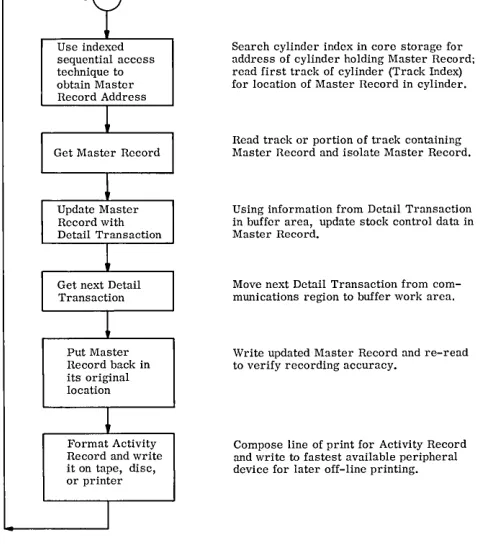
The amount of computation required to update each master-file record is determined by the number of computa-tiRnal steps required to perform the program functions speci-fied in' a series of detailed flowcharts. The general flowchart in Figure 2 summarizes these detailed flowcharts and indi-cates the basic computational processes that must be per-formed. Because of the imbalance between computational speeds and the access times for most current random-access devices, the central processor time required to perform the
spe~ified computations will generally be a small portion of the total time required to update one randomly addressed master-file record. The amount of computational time can, however, affect the number of disc or drum revolutions re-quired to complete the processing cycle for a single master record.
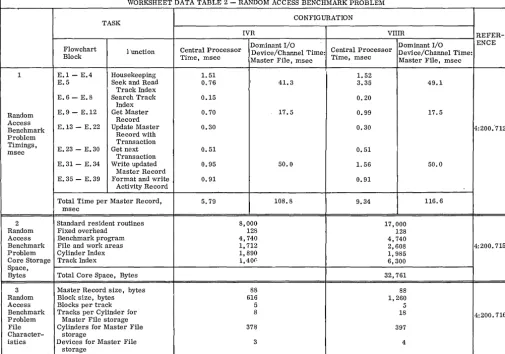
The central processing time for each system is clearly indi-cated in a Worksheet Data Table that lists both processor and input-output times required to perform each logical function of the standard problem. Standard throughput per-tormance graphs show both the elapsed job time and the total amount of central processor time used in processing the mas-ter records. Comparing elapsed and central processor time will show the amount of central processor time available for use by other jobs. This information is of vital interest when measuring computer systems that are ~capable of multipro-grammed operation~. These graphs and worksheets form part