
A Fixed-Phase Quantum Search Algorithm with More
Flexible Behavior
Xin Li*, Panchi Li
School of Computer & Information Technology, Northeast Petroleum University, Daqing, China Email: *[email protected]
Received February 6, 2012; revised March 18, 2012; accepted April 20, 2012
ABSTRACT
When the Grover’s algorithm is applied to search an unordered database, the probability of success usually decreases with the increase of marked items. To address this phenomenon, a fixed-phase quantum search algorithm with more flexible behavior is proposed. In proposed algorithm, the phase shifts can be fixed at the different values to meet the needs of different practical problems. If research requires a relatively rapid speed, the value of the phase shifts should be appropriately increased, if search requires a higher success probability, the value of the phase shifts should be appro- priately decreased. When the phase shifts are fixed at , the success probability of at least 99.38% can be obtained in
0.1π
O N M
iterations.Keywords: Quantum Computing; Quantum Searching; Grover Algorithm; Fixed Phase Shifting
1. Introduction
Grover’s quantum search algorithm [1] is one of the most important developments in quantum computation. For searching a marked state in an unordered database, it achieves quadratic speed up over classical search algo- rithms. At present, Grover’s quantum search algorithm has been greatly noticed and has become a challenging research field. However, the Grover’s algorithm also has some limitations. When the fraction of marked items is greater than a quarter of the total items in the database, the success probability will rapidly decrease, and when the fraction of marked items is greater than half of the total items in the database, the algorithm will be disabled. Up to now, many efforts in improving Grover’s origin- nal algorithm have been done. The Grover’s original al-gorithm consists of inversion of the amplitude in the de-sired state and inversion-about-average operation [1]. In [2], Grover presented a general algorithm: Q I U I U , where U is any unitary operation, is the adjoint of
U,
U
2
I I , I I 2 , is an initial state and is a desired state. When U1 U W ,
where W is the Walsh-Hadamard transformation, and
0
, the general algorithm becomes the original algo-rithm. Long extended Grover’s algorithm [3]. In Long’s algorithm, I and I are expressed as
1
I I ei and I I
1 ei
,respectively. Long further studied two-phase matching
conditions [4]. When π, Long’s algorithm be-comes Grover’s original algorithm. In [5], Grover pre-sented the new algorithm by replacing the selective in-versions by selective phase shifts of π3. Just like clas-sical search algorithms the algorithm has a fixed point in state-space toward which it preferentially converges. Li
et al. studied the changes of the approximation error in the fixed-point search algorithm obtained by replacing equal phase shifts of π3 by different phase shifts [6]. In [7], by applying Partial Diffusion Operator, Younes et al. proposed a quantum search algorithm and showed that the performance of the algorithm is more reliable than other quantum search algorithms especially for multiple matches within the search space. The minimum success probability of this algorithm is 84.72% when
0.3084
M N . In [8], by regarding the searching
en-gine as a three-dimensional rotation in the SO(3) picture, Long presented a modified version of Grover’s algorithm that searches a marked state with full successful prob-ability. However, two phase shifts in Long’s algorithm are determined by the number of iterations and the num-ber of marked items, not a fixed value. Building quantum devices using fixed operators is a must to simplify the hardware construction. Quantum search engine is not an exception [9]. Therefore, this algorithm is not conducive to the quantum computer hardware implementation. Yonues presented a fixed phase quantum search algo-rithm in [9]. By selecting phase shifts of in the standard amplitude amplification, the success probability
1.825π
of at least 98% is obtained in O N M , which is better than other fixed operator quantum search algorithms. In [10], a novel information geometric cha- racterization of Grover’s quantum search algorithm is presented, and the possible deviations from Grover’s algorithm within this quantum information geometric setting are discussed. In [11], a method for implementing the Grover search algo-rithm based on multi-level systems is proposed.
The methods mentioned above cannot solve the pro- blem that the algorithm efficiencies decrease as the marked items increase. In this paper, we study the phase matching in Grover’s algorithm, and propose an adaptive matching, namely, f
, where λ is the frac-tion of marked items, and f
is the polynomial for λ. With application of the new phase matching, when λis a rational number in range
3 5
8 to 1/4, the proba- bility of getting correct results is equal to 1 with two Grover iterations, and when λ is greater than 1/4, the probability of getting correct results is equal to 1 with only one Grover iteration.In this letter, with application of two operators with arbitrary phase rotations in [3] and the phase matching conditions in [4], we will present a general Grover algo- rithm with fixed-phased shifts. The different algorithms can be derived from this algorithm according to the dif- ferent phase shifts. When the phase shifts are fixed at , the success probability of at least 99.38% can be obtained in
0.1π
O N M
iterations.2. Grover’s Algorithm and Its Problem
2.1. Grover’s Algorithm Summary
Suppose we wish to search through a search space of N
elements. Rather than search the elements directly, we concentrate on the index to those elements, which is just a number in range 0 to N – 1. For convenience we as- sume N = 2n, so the index can be stored in n qubits, and
that the search problem has exactly M solutions, with
1M N. The algorithm begins with the state 0n. The Walsh-hadamard transform is used to put the state
0n in the equal superposition state,
1
0 1 N
x
x N
. (1)The Grover quantum search algorithm then consists of repeated application of a quantum subroutine, know as the Grover iteration or Grover operator, which we denote
G. The Grover iteration may be broken up into four steps. 1) Apply the oracle O. The oracle is a unitary operator defined by its action on the computational basis
O x q x qf x , (2) where x is the index register, denotes addition modulo 2, and the oracle qubit
q is a single qubit
which is flipped if f x
1, and is unchanged other- wise.2) Applying the Walsh-Hadamard transform Hn. 3) Perform a conditional phase shift, with every com-putational basis state except 0 receiving a phase shift of –1, x
1x0 x .4) Applying the Walsh-Hadamard transform Hn. It is useful to note that the combined effect of steps 2), 3), and 4) is
2 0 0 I
2 In n
H H , (3)
where is the equally weighted superposition of
states, (1). Thus the Grover iteration, G, may be written as G
2 I
O.Let M N, and CI(x) denote the integer closest to the real number x, where by convention we round halves down. Then repeating the Grover iteration
arccos CI
2arcsin
R
(4)
times rotates to within an angle arcsin π 4
of a superposition of marked states [12]. Observation of the state in the computational basis then yields a solution to the search problem with probability at least one-half.
2.2. Grover’s Algorithm Success Probability
In fact, the Grover iteration can be regarded as a rotation in the two-dimensional space spanned by the starting vector and the state consisting of a uniform super- position of solutions to the search problem. Let represent a normalized states of a sum over all which are not solutions to the search problem, and represent a normalized states of a sum over all which are solutions to the search problem. Simple algebra shows that the initial state may be re-expresses as
cos t sin t
, (5)
where tarcsin . After R Grover iterations, the initial state is taken to
cos 2 1 arcsin sin 2 1 arcsin
R
G R
R
. (6)
Hence, the success probability is
sin 2 2 1 arcsin
P R . (7)
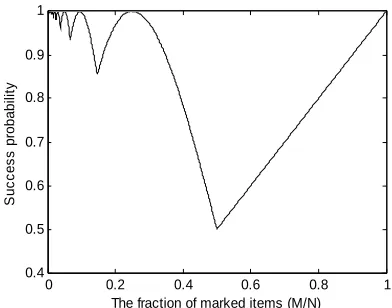
The curve of P is shown in Figure 1.
2.3. The Drawback of Grover’s Algorithm
It is easy to deduce from Equations (4) and (7) that when
3 5 8
0.14645, P decreases rapidly. When0 0.2 0.4 0.6 0.8 1 0.4 0.5 0.6 0.7 0.8 0.9 1
The fraction of marked items (M/N)
[image:3.595.67.263.86.240.2]S u c c e s s pr ob ab ili ty
Figure 1. The success probability of Grover’s algorithm.
1 4 1 2, P decreases rapidly. When 1 2, there is R0, P, and the algorithm is disabled. Hence, the Grover’s algorithm is no longer useful when
1 4 .
The reason for the problem is that the two phase rota-tions in Grover iteration are fully equivalent in both am-plitude and direction, namely π. According to [12], the result of such phase rotations is that, for the one Grover iteration, the phase of the increases 2 arcsin
radians, and that rotating through at least arccos
radians takes the to . When 3 5 8,1
, there are only 11 4 and 2 3 5 8 make R aninteger, namely, 1 1 1 arccos 1 2 arcsin R
, 2
2 2 arccos 2 2 arcsin R .
3. The Grover Algorithm with Fixed-Phase
Shifts
3.1. The Searching Engine Description
Assume that s1 , s2 , , sM denote the marked
states, and that t1 , t2 , , tN M denote the non- marked states. Let
1 1
1 , 1 ,
sin ,
M N
i i
i i
M
s s t t
M N M
M N
and 0 π 2, then the initial system can be written as follows, 1 (0) 0 1 1 1 cos sin cos sin N i
N M M
i i
i i
i N
t s
N M M
t s
. (8)Two phase shifting operator in Grover’s algorithm may be generally expressed as follows,
1 i
s
I I e s s , (9)
0 1 i 0
I I e 0 . (10) Hence, the searching engine is described as follows,
0 2
2 1 cos 1 1 sin cos
1 sin cos 1 sin 1
s
i i i
i i i
G HI H I
e e e
e e e
, (11)
where H denotes Walsh-Hadamard operator.
3.2. The Searching Process Description
Quantum search is such a process of repeatedly applying the search engine G to the initial state (0) , which in- crease the probability amplitude of the marked state. Af-ter diagonalization, the successive operations of search-ing engine G can be written as follows [8],
11 12 21 22 1
n n a a
G Q Q
a a
C
, (12) where
( /2) ( /2) cos 2 sin cos cos 1cos cos 2 sin cos
i i e Q C e ,(13)
( 2 )
( 2 )
0 0 i i e e
, (14)
22
cos cos 2 sin cos
C , (15)
arcsin sin 2 sin
, (16)
2 ( 2 ) 11
2 ( 2 ) cos
cos 2 sin cos
i n n
i n n
a e e
, (17)
12
( /2 2 ) ( /2 2 ) cos cos 2 sin cos
i n n i n n
a
e e
, (18)
21
( /2 2 ) ( /2 2 ) cos cos 2 sin cos
i n n i n n
a
e e
, (19)
2 ( 2 ) 22
2 ( 2 ) cos
cos 2 sin cos
i n n
i n n
a e e
. (20)
After n applications of G on (0) we get,
( )n Gn (0) a tn bn
such that,
2 2 3 ( 2 )
2 2
1 cos sin cos
2
sin 2 sin 2
cos ( )
cos cos sin cos
2
n
i n
i n n
i n n
a C n e e e
, (22)
π
2 2 2
2 2
2 2
1
2 cos sin cos 2
cos sin 2
sin cos sin cos 2
sin cos
n
i n
i n n
i n n
b C n e e e
. (23)
3.3. The Success Probability of the Proposed Algorithm
From Equations (21)-(23), after n iterations, the success probability Ps and the failure probability can be
respectively written as follows, t
P
2 2 4 2 2 4 2 4 3 2 41 4 cos cos sin cos sin 2 2
sin cos cos sin cos 2
4 cos sin cos sin cos 2
sin 2 sin 2 2
4 cos sin cos sin cos 2 n s P b n C n n
2 2 2sin 2 sin 2 2
2sin cos cos sin cos cos 4 2 n n n
2 22 2 2
2 4 2 4 4 2 1
4sin cos cos sin cos sin 2 2
cos cos cos sin cos 2
4 cos sin cos sin cos 2
sin 2 sin 2 2
4 cos sin cos sin cos 2 n t P a n C n n
3 2 4sin 2 sin 2 2
2 cos cos sin cos cos 4 2 n n n (25) and meet the following relationship Ps Pt 1.
3.4. The Required Number of Iterations of the Proposed Algorithm
According to [4], the searching engine G can be thought as a rotation in a 3-dimensional space, and the
polariza-tion vector of marked state is . For the initial
state, the polarization vector is about (0 (0, 0,1)
, 0, 1) , each searching iteration is a rotation of the polarization vector through angle 4arcsin sin( 2
)sin
. Therefore, the required number of iterations to get a match with the highest possible probability can be calculated as follows,
π
4 arcsin sin 2 sin
R
, (26)
where is the floor operation. When M N,
π
O
4sin 2 R N M N
M
. (27)
(24) 3.5. The Relation between the Proposed
Algorithm and the Other Algorithms
According to the different values of α in Equation (26), the proposed algorithm can be transformed into the dif-ferent algorithms. For instance, when π,
π
π44 arcsin sin 2 sin
N R M
, (28)
When π 2 or 3π 2,
π π
4 arcsin(sin 2 sin ) 2 2
N R
M
, (29)
in this case, the proposed algorithm is equivalent to the algorithm in [7].
When 1.825π or 0.175π,
π 1.825π
4 arcsin(sin 2 sin ) 2sin
R
, (30)
in this case, the proposed algorithm is equivalent to the algorithm in [9].
It can be seen from above depiction that the different algorithms can be achieved from the proposed algorithm according the different values of α. The above result shows that the proposed algorithm is the promotion of other search algorithms, it is the more flexible algorithm, and other algorithms can be seen as a special case of this algorithm.
In the proposed algorithm, if two phase shifts are fixed at 0.1π, then the required number of iterations is
π
54 arcsin sin 2 sin
N R
M
. (31)
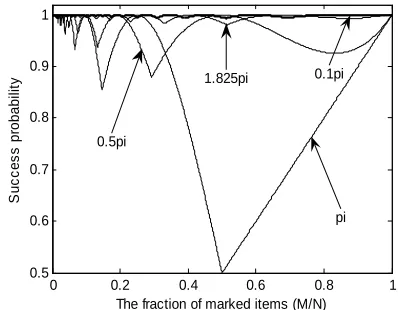
In this case, examine the system after R 5 M N, the success probability will be at least 99.38% compared with 98% for Younes [9], 84.72% for Younes et al. [7], and 50% for the Grover’s original algorithm, which is better than any know fixed operator quantum search al-gorithms.
When 0.01π or 1.99π,
π
504 arcsin sin 2 sin
N R
M
[image:5.595.322.521.84.239.2] , (32)
Figure 2 shows the success probability as a function
of the ratio M N for the proposed algorithm after in-serting the calculated number of iterations R shown in Equation (26) in Ps shown in Equation (24), where the
phase shifts are set to π, π/2, , and , respec-tively.
1.825π 0.1π
4. Performance Comparison
When N10 , 10 , 10 , 10 , 102 3 4 5 6 and 0M N1 , the performance comparison of the proposed algorithm with Younes algorithm [9], Younes algorithm [7] and the Grover’s original algorithm is shown in Tables 1-5.
From Tables 1-5, we can see that the success
prob-ability of proposed algorithm is the highest among four algorithms; however, the inquired number of iterations is the greatest. Despite this, from Equation (27), it can still achieve quadratic speed up over classical search
algo-0 0.2 0.4 0.6 0.8 1
0.5 0.6 0.7 0.8 0.9 1
The fraction of marked items (M/N)
Su
cce
ss p
ro
b
a
b
il
it
y 1.825pi 0.1pi
0.5pi
pi
[image:5.595.308.538.319.402.2]Figure 2. The success probability curves of the proposed algorithm with the different fixed-phases after the required number of iterations.
Table 1. The performance comparison of four algorithms (N = 102, α = 0.1π).
Prop.Alg Younes [9] Younes [7] Grover’s Alg
min
P 0.9942 0.9819 0.8645 0.5000
M NP Pmin 0.5100 0.5200 0.3000 0.5000
max
[image:5.595.309.538.446.519.2]R 50 28 11 7
Table 2 The performance comparison of four algorithms (N = 103, α = 0.1π).
Prop.Alg Younes [9] Younes [7] Grover’s Alg
min
P 0.9939 0.9801 0.8481 0.5000
M NP Pmin 0.5120 0.5140 0.3080 0.5000
max
[image:5.595.308.539.558.624.2]R 158 90 35 24
Table 3. The performance comparison of four algorithms (N = 104, α = 0.1π).
Prop.Alg Younes [9] Younes [7] Grover’s Alg
min
P 0.9938 0.9800 0.8473 0.5000
M NP Pmin 0.5123 0.5137 0.3084 0.5000
max
[image:5.595.307.540.663.735.2]R 502 286 111 78
Table 4. The performance comparison of four algorithms (N = 105, α = 0.01π).
Prop.Alg Younes [9] Younes [7] Grover’s Alg
min
P 0.9999 0.9799 0.8472 0.5000
M NP Pmin 0.4960 0.5136 0.3084 0.5000
max
Table 5. The performance comparison of four algorithms (N = 106, α = 0.01π).
Prop.Alg Younes [9] Younes [7] Grover’s Alg
min
P 0.9999 0.9799 0.8472 0.5000
M NP P min 0.4960 0.5136 0.3084 0.5000
max
R 50002 2866 1110 785
rithms. When N102 and 0.1π, from Equation (31), Rmax 5 N N 2 50 , this algorithm does not seem to have achieved the quadratic speed up of Grover’s original algorithm. However, when
and
6 10
N
0.01π
, max , this al-
gorithm has demonstrated good acceleration role, and with the increase of N, this kind of speed up will be in-creasingly significant.
50 20 50,002
R N N
These results can be analyzed as follows. As the say-ing goes, there is no free lunch. The proposed scheme obtains high successful probability at the expense of the number of iterations. When the phase shifts are fixed at , the success probability of at least 99.38% can be obtained, and when the phase shifts are fixed at , the success probability of at least 99.99% can be ob-tained after more iteration. Since the phase shifts αis set to a adjustable parameter in Equation (11), the proposed scheme is more flexible, and it can obtain a balance be-tween speed and accuracy.
0.1π
0.01π
When , the probability curves of four search
algorithms are shown in Figure 3, and the inquired itera-
tions number curves are shown in Figure 4. 2
10
N
5. Conclusion
In the future quantum computers, the search engine should be constructed from fixed operators that can handle the whole possible range of the search problem, i.e. whether a single match or multiple matches exist in the search space. Based on this consideration, in this letter, we pre-
0 0.2 0.4 0.6 0.8 1
0.5 0.6 0.7 0.8 0.9 1
The fraction of marked items (M/N)
S
uc
c
es
s
pr
obab
ilit
y Prop.Alg
(0.1pi)
Younes[9]
Younes et al[7]
[image:6.595.323.509.85.228.2]Grover's original algorithm
Figure 3. The success probability distribution of four quan- tum search algorithms after the required number of itera- tions.
0 0.2 0.4 0.6 0.8 1
0 10 20 30 40 50
The fraction of marked items (M/N)
N
o.
of
i
ter
at
ions
Prop.Alg(0.1pi) Younes[9] Younes et al[7] Grover's original algorithm
Figure 4. The required number of iterations for the pro-posed algorithm, Younes algorithm [9], Younes et al. algo-rithm [7] and Grover’s original algoalgo-rithm.
sent a fixed-phase quantum search algorithm with more flexible behavior. The phase shifts can be fixed at the different values to meet the needs of different practical problems. If research requires a relatively rapid speed, the value of the phase shifts should be appropriately in-creased, if search requires a higher success probability, the value of the phase shifts should be appropriately de-creased. When the phases shifts are fixed at , the proposed algorithm can get a solution with probability at least 99.38% in
0.1π
5 N M
iterations.
6. Acknowledgements
This paper was supported by Scientific Research Foun-dations of Heilongjiang Provincial Education Department (Grant No. 12511009).
REFERENCES
[1] L. K. Grover, “A Fast Quantum Mechanical Algorithm for Database Search,” Proceedings of the 28th Annual ACM Symposium on the Theory of Computing, Philadel-phia, 22-24 May 1996, pp. 212-221.
[2] L. K. Grover, “Quantum Computers Can Search Rapidly by Using Any Transformation,” Physical Review Letters, Vol. 80, No. 19, 1998, pp. 4329-4332.
doi:10.1103/PhysRevLett.80.4329
[3] G. L. Long, Y. S. Li and W. L. Zhang, “Phase Matching in Quantum Searching,” Physics Letters A, Vol. 262, No. 1, 1999, pp. 27-34. doi:10.1016/S0375-9601(99)00631-3 [4] G. L. Long, X. Li and Y. Sun, “Phase Matching
Condi-tion for Quantum Search with a Generalized Initial State,” Physics Letters A, Vol. 294, No. 3-4, 2002, pp. 143-152. doi:10.1016/S0375-9601(02)00055-5
[5] L. K. Grover, “Fixed-Point Quantum Search,” Physical Review Letters, Vol. 95, 2005, Article ID: 150501. [6] D. F. Li, X. X. Li and H. T. Huang, “Phase Condition for
the Grover Algorithm,” Theoretical and Mathematical Physics, Vol. 144, No. 3, 2005, pp. 1279-1287.
[image:6.595.72.262.559.698.2][7] A. Younes, et al., “Quantum Search Algorithm with More Reliable Behavior Using Partial Diffusion,” Quantum Communication, Vol. 734, 2006, pp. 171-174.
[8] G. L. Long, “Grover Algorithm with Zero Theoretical Failure Rate,” Physical Review A, Vol. 64, No. 2, 2001, Article ID: 022307. doi:10.1103/PhysRevA.64.022307 [9] A. Younes, “Fixed Phase Quantum Search Algorithm,”
2007.http://arxiv.org/pdf/0704.1585.pdf
[10] C. Cafaro and S. Mancini, “On Grover’s Search Algo-rithm from a Quantum Information Geometry Viewpoint”. Physica A, Vol. 391, No. 4, 2012, pp. 1610-1625.
doi:10.1016/j.physa.2011.09.018
[11] H. Y. Li, C. W. Wu, W. T. Liu, et al., “Fast Quantum Search Algorithm for Databases of Arbitrary Size and Its Implementation in a Cavity QED System,” Physics Let-ters A, Vol. 375, No. 48, 2011, pp. 4249-4254.
doi:10.1016/j.physleta.2011.10.016
![Figure 4. The required number of iterations for the pro-posed algorithm, Younes algorithm [9], Younes rithm [7] and Grover’s original algorithm.et al](https://thumb-us.123doks.com/thumbv2/123dok_us/9285597.423080/6.595.323.509.85.228/required-iterations-algorithm-algorithm-younes-grover-original-algorithm.webp)
