AN EFFICIENT CROSS-LAYER COOPERATIVE DIVERSITY OPTIMIZATION SCHEME
TOGETHER WITH DEL-CMAC FOR LIFETIME MAXIMIZATION AND ENERGY
EFFICIENCY IN MANETs
M. Lakshmi Priya, K. Saravanan
1
Department of Computer Science, PRIST University, Vallam, Thanjavur, 613 403, Tamil Nadu, India
2
Centre for Research and Development, PRIST University, Vallam, Thanjavur, 613 403, Tamil Nadu, India
---***---
ABSTRACT:- Cooperative Communication (CC) is a promising technique for conserving the energy consumption in MANETs. CC inherited a cross-layer problem, while communication resources such as bandwidth, energy have to be carefully allotted among different nodes in the network. Thus, the incorporation and interaction with higher layers has become an active and major research area in recent years. In resource constraint networks, the benefits of cooperation can be further exploited by optimally allocating the energy and bandwidth resources among users in a cross-layer way. In the proposed work, we analyze the problem of transmission power minimization and network lifetime maximization using cross layer cooperative diversity for Mobile Ad-hoc Networks (MANETs), under the condition of a target end-to-end transmission reliability and a given transmission rate. By exploiting a cross-layer cooperative diversity optimization system, distributive algorithms which mutually consider relay selection, routing, and power allocation strategies are proposed for the reliability constraint MANETs. Hence, with the objective of prolonging the network lifetime and increasing the energy efficiency, we present an efficient cross-layer cooperative diversity-aware routing algorithm together with DEL-CMAC, namely CCDRA+DEL-CMAC for MANETs. Through simulation results, we prove that the proposed cross-layer cooperative strategies prolong the network lifetime and achieve significant energy savings considerably.
Key words: Cooperative MAC, DEL-CMAC, Network Lifespan, throughput, Cross Layer.
INTRODUCTION
Portable Ad Hoc Networks (MANETs) comprise of a growth of adaptable hubs which are not restricted in any framework. Hubs in MANETs can speak with each other and can be transfer wherever not concerning to limitation. This non confined portability and simple sending qualities of MANETs make them extremely famous and very appropriate for emergency and characteristic failure. Mobile terminals, PDAs, convenient gaming gadgets, individual advanced associates, (PDAs) and tablets are all have remote networks administration capacities. By taking an interest in MANETs, these terminals may achieve the internet when they are not in the scope Wi-Fi access focuses or cell base stations, or speak with each other, when no network administration base is accessible. MANETs can be used in the mishap keep and period of recovery. One necessary subject with persistent cooperation in MANETs is the network lifespan, on the basis that the previously stated remote terminals are battery fuelled and energy is an unusual benefit [1]. Helpful correspondence (CC) is a capable method for preserving the energy utilization in MANETs. It shows that the remote medium is harmed in cooperative design. The remote transmission between a pair of terminal can be gotten and handled at different terminals for execution pick up, instead to be considered as a difficulty normally. CC can give picks up as far as the necessary transmitting power because of the spatial mixed qualities by means of client cooperation [2].
Related work
The network lifetime of MANET has been expanded from various perspectives that utilizing a few protocols as CMAC, DELCMAC and furthermore ways like energy efficient power allocation strategy, optimal grouping strategy. In terms of energy consumption cooperative communication is taken into consideration to be an honest technique, however whenever direct transmission happens it offers poor performance in terms of energy. With the help of cooperation among the nodes spacial diversity may be achieved mistreatment cooperative communication that provides gains concerning the sending power. However, whenever further process and receiving energy is taken into account, it's not necessary that cooperative transmission can continuously be energy efficient in comparison to direct transmission. A CMAC is introduced to deal with the decreasing output, and increase it. A responsive network writing aware CMAC protocol has been proposed inside which, that in the meantime will the work of conveying its own particular data and boost up the information through the hand-off node for the supply node. A distributed CMAC protocol was proposed to upgrade the period of wireless device networks, but it is supported the belief that every node will attach up with the base station inside one hop, that is illogical for many applications. The prevailing CMAC protocols principally concentrate on the output upgradement whereas failed to research the energy potency whereas the works on energy efficiency and network period can be mounted on physical layer or network layer. CMAC is extended to DEL-CMAC provided with location based services to upgrade network period. The major objective is to extend the network period and energy efficiency. Therefore two new management frames were cooped up within the MAC layer named ETH and II. However these management frames hyperbolic the overhead of MAC because it is other to the MAC header. A Lyapunov change is utilized to make ideal utilization of system assets that are out there. The conception of celebrated channel and obscure measures and the other ways around model are employed. During this it's difficult to achieve 95th responsibility with direct transmission alone.
Considering output a cross layer theme is presented inside which an ideal gathering system is utilized for efficient aide node decision and an eager equation for MAC convention to extend the system output.
Frame Work
Cross-Layer Optimization Problem in cooperative MANETs
This section examine and formulate the min-power problem and the max-lifetime problem of cooperative MANETs in the context of reliability constrained and derives applicable solutions, leading to our algorithms which will be described in the section 4.
Problem Formulation
Let us assume that a MANET contains multiple arbitrarily distributed nodes and each node can dynamically adjust its transmitted power. A graph (𝑉, 𝐸) is used to represent the network, where 𝑉 is the vertex set and 𝐸 is the edge set. The total number of nodes is |𝑉| = 𝑁 and the total number of edges is |𝐸| = 𝑀. Then the proposed work considers two related optimization objectives. The first one is min-power problem and the second is max-lifetime problem. In min-power problem, given any source node 𝑠, the target is to find the 𝑠 to 𝑑 route that minimizes the total transmission power, while fulfilling a transmission rate and required end to-end transmission success probability which is denoted as 𝑅𝑜 and Qs. In
max-lifetime problem, given a set of source nodes 𝑆, the target is to give a data transferring scheme that maximizes the network lifetime whose battery drains out first [5], mean time fulfilling the same conditions as the min-power problem. For (𝑠, 𝑑), indicate Ω as the set of every possible routes. For a route 𝜔 ∈ Ω, symbolize 𝜔𝑖 as the ith hop of this route.
Therefore, the problem is formulated into a standard linear programming problem (LPP) [6].
Min-Power Solution
Min-power problem is a convex problem and it is solved using Lagrangian multiplier techniques. For direct transmission mode there is [7].
𝑃𝐷𝑖= (2𝑅𝑜 − 1) N0 ⋅ (log𝑄−1𝑠)−1 ⋅ 𝑑𝛼/2𝑖 ⋅ (𝑑𝛼/2𝑖). (1)
and for the direct transmission mode, the total transmission power is
For cooperative transmission,
𝑃C𝑖= (2𝑅c − 1) N0 ⋅ (log𝑄−1𝑠)−1/2 ⋅ [ 𝑑1/3eq,i]1/2⋅ (𝑑1/3eq,i). (3)
For the multi relay cooperation mode,
𝑃C𝑖= (2𝑅c − 1) N0 ⋅ (log𝑄−1𝑠)−1/(K+1) ⋅ [ 𝑑1/(K+2)eq,i]1/(K+1)⋅ (𝑑1/(K+2)eq,i). (4)
Max-Lifetime Solution
For direct transmission mode, the optimization problem is
𝑃𝑖=[𝜆𝑖𝐸𝑖𝑚𝑑/log𝑄−1𝑠] [𝑑𝛼i/𝜆𝑖𝐸𝑖]. (5)
For cooperative mode, the optimization problem is
𝑃𝑖=[𝜆𝑖𝐸𝑖𝑚c/(log𝑄−1𝑠)1/2] [𝑑eq,i/𝜆2𝑖𝐸2𝑖]. (6)
CCDRA+ DEL- CMAC Protocol Description
In this section, with the objective of prolonging the network lifetime and increasing the energy efficiency, we present an efficient cross-layer cooperative diversity-aware routing algorithm together with DEL-CMAC, namely CCDRA+DEL-CMAC, for multihop MANETs. Our algorithms are composed of two parts: routing (and relay selection) algorithm and power allocation algorithm. This work proposed a detailed minimum-power and maximize-lifetime cooperative cross-layer algorithms for an efficient routing and power allocation, based on the condition of end-to-end success probability and data rate, in direct mode and cooperative mode.
The proposed cross-layer Cooperative Diversity aware DEL-CMAC is depended on the IEEE 802.11 Distributed Coordination Functions. CCDRA+DEL-CMAC deal with relay and dynamic transmitting power based on five control frames RTS , CTS , ACK (Acknowledgement), Eager-To-Help or Willing- to- help (ETH/WTH) and Interference- Indicator (II) [8] are used. ETH mainly used to identify the winning relay. The II is used to reconfirm the interference range of allocated transmitting power at the winning relay. The Frame exchanging process of the proposed model is shown in Figure: 1.
When a source wants to initiate the data transmission, it first senses the channel to check whether it is idle or not. If the channel is in idle state, the source picks a random back off timer between 0 and CW (Contention Window). When the back off counter reaches zero, the source sends a RTS for reserving the channel. Upon receiving the RTS, the destination sends CTS back after SIFS which contains the location information of the destination. Any terminal that receives both RTS and CTS and does not interfere with other transmissions in its range can be regarded as a relay candidate. The Winning Relay is the one which has maximum residual energy and minimum transmitting power.
Similar to the IEEE 802.11 DCF protocol, the purpose of the RTS/CTS handshake is to reserve the channel at first. In general, the cooperative transmission is not need in the case that the transmitting power is small [9], because the extra overhead for coordinating the relaying outstrips the energy saving from diversity gain. Those ineffective cases are avoided by initiating a transmitting power threshold Λp. In CCDRA+DEL-CMAC, upon receiving the RTS frame, the destination calculates the required transmitting power for the direct transmission PDs (given in Section 4.1).
Optimal power allocation
Optimal power allocation is essential for a cross-layer CMAC protocol, because it aims at increasing energy efficiency. In this subsection, we deal with the power allocation for CC and direct transmission under the given outage probability. We begin with deriving the transmitting power at source in the direct transmission mode, which is computed by the destination after it receives the RTS. After that, the optimal transmitting power at source and relay in the cooperative transmission mode is computed by individual relay candidates after the RTS/CTS handshake under the same outage probability and end-to-end data rate.
Min-Power Cross-layer System with Direct Transmission
1. Initiate the cost of every node for routing as ∞ excluding Cost (0) = 0.
2. Evaluate the effective distance d𝛼i,j of every node according to (2), for its outgoing links.
3. Compute the cost of every node for its outgoing links as d𝛼/2i,j.
4. Update the cost of every node to the destination as d𝛼i,j Cost(𝑖) = min𝑗∈𝑁(𝑖)( d𝛼/2i,j + Cost(𝑗)), and pick node 𝑗 as the
successive hop node.
5. If 𝑄𝑠 is a priori to the entire network, every node in the route will adjust the transmitting power according to (1).
6. If source will not deliver a message, informing all nodes about the 𝑄𝑠 along the path. Then every node in the route will adjust the transmitting power according to (1).
7. Go to step 2.
Min-Power Cross-layer System Cooperative Transmission (for single-relay situation)
1. Initiate the cost of every node for routing as ∞ excluding Cost (0) = 0.
2. Evaluate the effective distance d𝛼i,j of every node according to (2), for its outgoing links.
3.Compute the cost of every node for its outgoing links as 𝑑eq,ij= min𝑘∈𝑁(𝑖,𝑗) d𝛼i,j (d𝛼i,k + d𝛼k,j), where 𝑁(𝑖, 𝑗) indicates the set of
neighbouring node of 𝑖 and 𝑗 and then select node 𝑘 as the relay of this link.
(4) Update the cost of every node to the destination as Cost𝑖= min𝑗∈N(𝑖)(𝑑1/3eq,𝑖𝑗+ Cost𝑗) and pick node 𝑗 as the successive hop
node.
5. If 𝑄𝑠 is a priori to the entire network, every node in the route will adjust the transmitting power according to (3).
6. If source will not deliver a message, informing all nodes about the 𝑄𝑠 along the path. Then every node in the route will adjust the transmitting power according to (3).
(7) Go to step 2.
Min-Power Cross-Layer System Cooperative Transmission (for opportunistic relaying multi relay situation)
1. Initiate the cost of every node for routing as ∞ excluding Cost (0) = 0.
2. Evaluate the effective distance d𝛼i,j of every node according to (2), for its outgoing links.
3. Sort the neighbouring nodes in ascending of every node according to the value of 𝑑𝛼𝑖,rk+ 𝑑𝛼rk,j, and picks the first 𝐾 nodes
4. Compute the cost of every node for its outgoing links as 𝑑eq,ij= min𝑟𝑘∈(𝑖,𝑗)𝑑𝛼𝑖𝑗Π𝐾𝑘=1(𝑑𝛼𝑖,rk+ 𝑑𝛼rk,j), where 𝑁(𝑖, 𝑗) indicates
the set of neighbouring node of both 𝑖 and 𝑗.
5. Update the cost of every node to the destination as Cost𝑖= min𝑗∈(𝑖)(𝑑1/(K+2)eq,𝑖𝑗+ Cost𝑗), and pick node 𝑗 as the successive hop
node.
6. If 𝑄𝑠 is a priori to the entire network, every node in the route will adjust the transmitting power according to (4).
7. If source will not deliver a message, informing all nodes about the 𝑄𝑠 along the path. Then every node in the route will adjust the transmitting power according to (4).
8. Go to step 2.
Max-Lifetime Cross-Layer System with Direct Transmission
1. Initiate the cost of every node for routing as ∞ excluding Cost (0) = 0.
2. Evaluate the effective distance d𝛼i,j of every node according to (2), for its outgoing links.
3. Measure the residual energy 𝐸𝑖 and total power 𝑃𝑖0 of every node for the ongoing flows.
4. Calculate the cost of outgoing links as 𝑑𝛼𝑖,/𝜆𝑖𝐸𝑖.
5. Update the cost of every node to the destination as Cost𝑖= min𝑗∈N(𝑖)( 𝑑𝛼𝑖,/𝜆𝑖𝐸𝑖 + Cost𝑗), and pick node 𝑗 as the successive hop
node. 6. If 𝑄𝑠 is a priori to the entire network, every node in the route will adjust the transmitting power according to (5).
7. If source will not deliver a message, informing all nodes about the 𝑄𝑠 along the path. Then every node in the route will
adjust the transmitting power according to (5).
8. Go to (2).
Max-Lifetime Cross-Layer System with Cooperative Transmission
1. Initiate the cost of every node for routing as ∞ excluding Cost (0) = 0.
2. Evaluate the effective distance 𝑑𝛼𝑖 of every node according to (2), for its outgoing links.
3. Calculate the effective distance of every node for its outgoing links as 𝑑eq,ij= min𝑘∈𝑁(𝑖,𝑗)𝑑𝛼𝑖,𝑗(𝑑𝛼𝑖,𝑘+ 𝑑𝛼𝑘,𝑗),and pick node 𝑘 as
the relay of this link, where 𝑁(𝑖, 𝑗)indicates the set of neighboring node of 𝑖 and 𝑗.
4. Measure the residual energy 𝐸𝑖 and total transmitting power 𝑃𝑖0 of every node for the ongoing flows.
5. Calculate the cost of outgoing links as 𝑑𝛼𝑖,/𝜆𝑖𝐸𝑖.
6. Update the cost of every node to the destination as Cost𝑖= min𝑗∈(𝑖)(𝑑eq,ij,/𝜆𝑖𝐸𝑖 + Cost𝑗), and pick node 𝑗 as the successive hop
node.
7. If 𝑄𝑠 is a priori to the entire network, every node in the route will adjust the transmitting power according to (6).
8. If source will not deliver a message, informing all nodes about the 𝑄𝑠 along the path. Then every node in the route will adjust the transmitting power according to (6).
9. Go to (2).
The step by step procedure followed in the proposed CCDRA+DEL- CMAC
1. Start
2. Node Initialization = IDLE
4. If (Node_Buffer == Empty) Goto 2
5. Node Contains Data to Send
6. If (Channel == NOT_IDLE) then
7. S_Node Chooses RandomBackoff timer
8. If (Channel == IDLE for DIFS duration)
9. S-Node sends RTS to D-Node
10. Wait for SIFS duration
11. If D-Node Received RTS == True then
11. D_Node sends CTS to S_Node
10.If (S_Node Received CTS and ETH == False && Flag_P==0 && Trans. Power < ^p ) then
14.Direct transmission is desired
13 S_Node Send Data to D_Node
14. Check_Success == True
Goto End
15. Else Goto3
16. If (S_Node Received CTS and ETH == True && Flag_P==1 && Trans. Power > ^p) then
17. Cooperative transmission is desired
18. Select ETH such that
18. ((Rate == Req) && (No. of failure < ^p)&&(Trans. Power = Min)&&(Lifetime = Max) )
19. If (ETH _Selected == True)
20. Send DATA to ETH
21. ETH sends Data to D_Node
22. If (CHK_Success == True) Goto End Failure Goto 3
23. Else { No_of_Failure ++
24. If (Retry_Limit_Exceeded == True)
25. { Delete packet from Buffer
26. Goto 1}
27. END Check_Success
i. If (ACK Received after SIFS == TRUE)
ii. Success
Experimental Results
Performance Evaluation
Ad hoc On-demand Distance Vector (AODV) [10], routing protocol is used in the proposed scheme. Because it is a widely used conventional and reactive routing protocol for MANETs and it transmits discovery packet only when it is essential. There are two kinds of relay terminals are used in our network, 1. Routing relay terminals and 2. cooperative relay terminals. In the proposed work, AODV constructs the route in a practical manner by selecting the routing relay terminals firstly. From the experimental results, it is observed that the AODV contains highest packet delivery ratio, when it is run over IEEE 802.11 DCF MAC layer. Moreover, AODV performs most excellent for the higher mobility situations and outperforms the other protocols, because of the collision avoidance mechanism incorporated in the IEEE 802.11 for the broadcast of RTS packets. Hence, AODV routing protocol is used in this work.
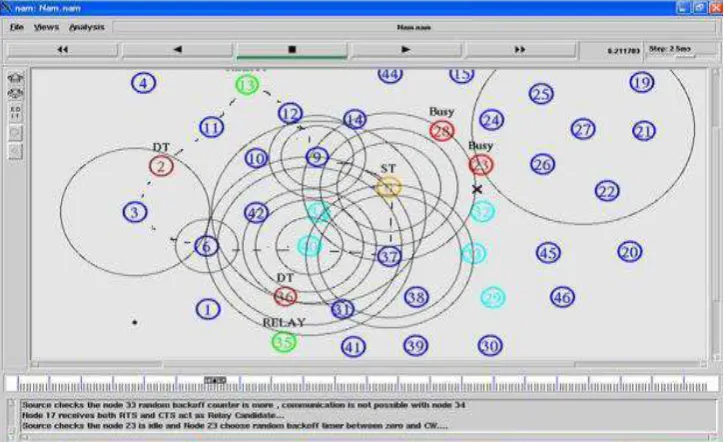
[image:7.595.118.482.374.595.2]This section provides the performance evaluation of the proposed CCDRA+DEL-CMAC protocol by comparing it with the existing DCF and DEL-CMAC protocols. The proposed work is simulated by means of network simulator NS-2.38 and the performance is evaluated based on delay, throughput and network lifetime. Initially the AODV routing protocol chooses a route for packet transmission and transfers the packet through that route. Then, the proposed CCDRA+DEL-CMAC protocol established a route by selecting a winning relay terminal. Now, the source transmits the packets along the established path which is known as cooperative communication. The output trace in Figure: 3. indicates the cooperative transmission between the source and the destination terminal. Figure: 3. demonstrates that the number of relay terminals is increased in the proposed method. It indicates that the proposed work is suitable for large scale network. Figure: 3 also specify the busy terminals in the network, which indicates that the proposed work solves the hidden and the exposed terminal problems. At the same time, the source terminal transmits the packets to more than one destination terminal.
Figure 2: Output Trace of the Proposed Model
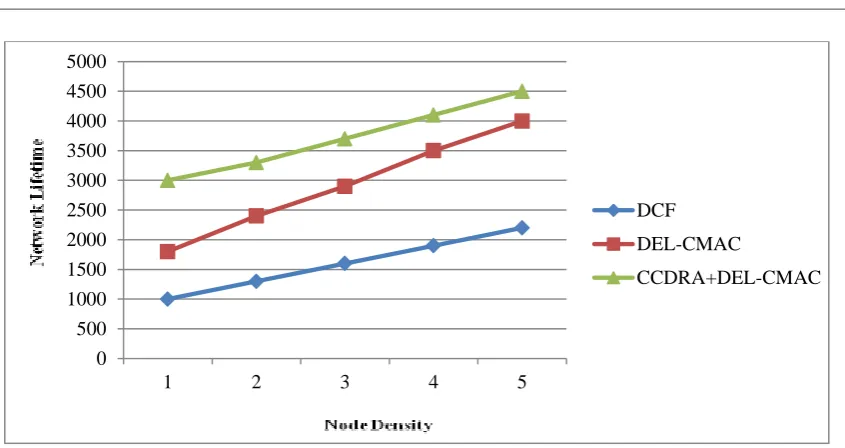
The readings of the energy, delay, relative position, data delivery rate are all observed from the trace file generated in NS-2.38 window and the graphs for network lifetime, overall throughput and packet delay of the proposed system compared with the existing system is shown in Figure: 4, 5 & 6 for 50 terminals. In the proposed work terminals are placed randomly in a square area of 200*200 m2. Figure: 4 shows that the lifetime of the network is increased, at least 1.2 and 2.0 times, by
Figure 3: Life time of the Nodes
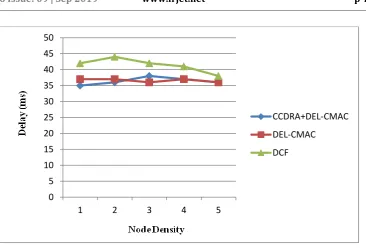
For CCDRA+DEL-CMAC, the network throughput decreases by at most 5.04% and 8.02% compared with DEL-CMAC and DCF (Figure: 5) and the delay increases by at most 2% and 7% in mobile environments, compared with DEL-CMAC and DCF respectively (Figure: 6).
Figure 4: Throughput
0 500 1000 1500 2000 2500 3000 3500 4000 4500 5000
1 2 3 4 5
DCF
DEL-CMAC
CCDRA+DEL-CMAC
0 0.1 0.2 0.3 0.4 0.5 0.6
1 2 3 4 5
[image:8.595.107.489.375.565.2]Figure 5: Average Delay
From the graph it is clear that there is significant reduction in the average delay with relatively low throughput and increased network lifetime with the usage of CCDRA+DEL-CMAC.
Conclusion
In this paper, a novel DEL-CMAC protocol along with efficient cross layer optimization with cooperative diversity routing approach is given by MANETs. By using the DEL-CMAC protocol we can extend the network lifespan. The virtual calculations showed that the demonstrated algorithm in this paper performs better and increases the network lifespan of the system. The demonstrated algorithm gives most favourable path for data transmission and maximizes the lifespan of entire network. The implementation of proposed algorithm is broken down between two measurements in future with a few changes in outline contemplations the execution of the proposed algorithm can be contrast with other energy efficient algorithm. We have utilized little system of 30 nodes, as number of nodes builds the unpredictability.
References
1. Laneman, J.N., Tse, D.N.C., and Wornell, G.W. (2004). “Cooperative Diversity in Wireless Networks: Efficient Protocols and Outage Behaviour,” IEEE Trans. Information Theory, vol. 50, issue no. 12, pp. 3062-3080.
2. Sendonaris, A., Erkip, E., and Aazhang, B. (2003). “User Cooperation Diversity-Part I: System Description,” IEEE Trans. Comm., vol. 51, issue no. 11, pp. 1927-1938.
3. Xiaoyan Wangand Jie Li, (2015). “Improving the Network Lifespan of MANETs through Cooperative MAC Protocol Design” IEEE Transactions on Parallel and Distributed Systems, vol. 26, issue no. 4, pp.1010 – 1020.
4. Nikose, M.D. (2013). “A Review of Cross Layer Design” International Journal of Emerging Trends in Engineering & Technology (IJETET), Vol. 02, issue no.01, pp. 7-18.
5. Akyildiz, I.F., Su, W., Sankarasubramaniam, Y and Cayirci, E. (2002). “A survey on sensor networks,” IEEE Communications Magazine, vol. 40, no. 8, pp. 102–105.
6. Habibi, J., Ghrayeb, A., and Aghdam, A. (2013). “Energy-efficient cooperative routing in wireless sensor networks: a mixed integer optimization framework and explicit solution,” IEEE Transactions on Communications, vol. 61, no. 8, pp. 3424–3437.
7. Chen, Y., Qin, F., Xing, Y., and Buranapanichkit, D. (2014). “Cross-Layer Optimization Scheme Using Cooperative Diversity for Reliable Data Transfer in Wireless Sensor Networks,” International Journal of Distributed Sensor Networks, Vol. 2014, pp. 1-16.
0 5 10 15 20 25 30 35 40 45 50
1 2 3 4 5
CCDRA+DEL-CMAC
DEL-CMAC
8. Wang, X. (2015). “Improving the Network Lifetime of MANETs through Cooperative MAC Protocol Design,” IEEE Transactions on Parallel and Distributed Systems, Vol. 26, No. 4, pp. 1010-1020.
9. Khandani, A.E., Modiano, E., Zheng, L., and Abounadi, J. (2004). Cooperative Routing inWirelessNetworks, chapter inAdvannces in Pervasive Computing and Networking, Kluwer Academic, edited by B. K. Szymanski and B. Yener.