Modeling Simulation and Performance
Analysis of Hybrid Power Generation System
Shashi Kala Kumari
1, Rekha Jha
2P.G. Student, Department of Electrical Engineering, Birsa Institute of Technology, Sindri, Jharkhand, India1 Assistant Professor, Department of Electrical Engineering, Birsa Institute of Technology, Sindri, Jharkhand, India2
ABSTRACT: The rapidly increasing energy consumption, limited resources of fossil fuel, global warming, and damage to environment and ecosystem, created a higher demand for clean and sustainable energy sources like: wind, sea, sun, biomass etc. with high efficiency and less maintenance. Among all renewable energy resources, the energy through photovoltaic and wind energies have the great potential as a power generating energy source, because of their many advantage like inexhaustible sources, ease of accessibility and convertibility of the electricity, low or zero emission of pollutant gases, and low cost. This paper proposes a hybrid energy system combining Solar photovoltaic and wind turbine as a small-scale alternative source of electrical energy used to supply power to those places where conventional generation is not practical. The integration of two or more energy sources as one helps us to increase the output power of the system as a whole. The main objective is to develop a MATLAB/Simulink analysis of photovoltaic and wind energy system. The proposed model is designed with a user friendly icon and a dialogue box like simulink block libraries. In this paper a flexible simulation model for a hybrid off-grid photovoltaic/wind using MATLABTM simulink is presented, the model is thoroughly explained and the components are presented in great details. PV and wind are primary power sources of the system and battery/diesel generator is used as a backup for long run application.
KEYWORDS: Boost converter, Diesel generator, Hybrid generation system, MATLAB simulation, solar energy, Stand-alone application, Wind turbine.
I. INTRODUCTION
Renewable energy from wind turbine and solar photovoltaic are the most environment friendly type of energy to use. They have come of age and are global phenomenon, the world's fastest growing energy resources, a clean and effective modern technology that provides a bonfire of hope for a future based on sustainable, pollution free technology.[1] Small-scale stand-alone power generation systems are an important alternative source of electrical energy, finding applications in locations where conventional generation is not practical. Consider, for example, remote villages in developing countries or ranches located far away from main power lines. In this paper a hybrid energy system combining variable speed Wind Turbine and PV array generating system is presented to supply continuous power to the stand-alone load. The wind and PV are used as main energy sources, while the battery and diesel generator set is used as back-up energy source.
hour to hour throughout the year. Therefore, energy storage systems will be required for each of these systems in order to satisfy the power demands. [3]
Usually storage system is expensive and the size has to be reduced to a minimum possible for the renewable energy system to be cost effective. Hybrid power system can be used to reduce energy storage requirements. With the rapid economic development, energy consumption increased year by year, conventional energy sources are being depleted, so there is an urgent need for renewable energy. In the current renewable energy resources, with the greatest potential and the most development value is wind and solar. Study of wind and photovoltaic power generation is to alleviate the energy shortage, and ensure the implementation of the sustainable development strategy. This makes the wind-solar-storage hybrid generation system has a good application prospect. [4] The wind-solar-wind-solar-storage hybrid generation system is mainly used for regions or users which load demand is small. The characteristic of wind-solar-storage hybrid generation system is that only solar and wind energy is the power source and the energy storage unit works when the output of natural resources can’t meet the load demand.
II. RELATEDWORK
The system with combination of different sources of energy is called hybrid system and the hybrid system is not new concept it has gained more consideration during the last two decades by many researchers such as Diaf et al [5]
Nandi et al [6] evaluated the feasibility of a proposed wind-PV hybrid power system in Bangladesh and showed that wind, PV-battery is economically viable as a replacement for conventional grid energy supply for a community at a minimum distance of about 17 km from grid.
Dihrab et al [7], proposed a hybrid system as a renewable resource of power generation for grid connected applications in three cities in Iraq and showed that it is possible for Iraq to use the solar and wind energy to generate enough power for some villages in the desert or rural.
III.MODELINGOFPVCELL
Solar cell is a p-n junction fabricated in a thin wafer or layer of semiconductor. The electromagnetic radiation of solar energy can be directly converted electricity through photovoltaic effect. Being exposed to the sunlight, photons with energy greater than the band-gap energy of the semiconductor are absorbed and create some electron-hole pairs proportional to the incident irradiation. Under the influence of the internal electric fields of the p-n junction, these carriers are swept apart and create a photocurrent, which is directly proportional to solar insolation. PV system naturally exhibits a nonlinear I-V and P-V characteristics, which vary with the radiant intensity and cell temperature. The equivalent circuit of a solar photovoltaic (PV) cell is given in the following figure. It includes a diode, a shunt resistance and a series resistance. [8]
Fig 1: equivalent circuit of Photovoltaic cell
The voltage-current characteristic equation of a solar cell is given as;
I=IPH–Is[exp q(V + IRS) /kTCA −1]−(V + IRS)/ RSH (1)
In this equation I is the load current, IPH is a light-generated current or photocurrent, IS is the cell/diode saturation of
dark current, V is the terminal voltage of the cell, q (= 1.6 ×10⁻¹⁹C) is an electron charge, k (= 1.38 ×10⁻²³J/K) is a Boltzmann’s constant, TC is the cell’s working temperature, A is an ideal factor, RSH is a shunt resistance, and RS is a
series resistance. The photocurrent mainly depends on the solar insolation and cell’s working temperature, which is described as;
Where ISC is the cell’s short-circuit current at a 25°C and 1kW/m2, KI is the cell’s short-circuit current temperature
coefficient, TRef is the cell’s reference temperature, and λ is the solar insolation in kW/m2. On the other hand, the cell’s
saturation current varies with the cell temperature, which is described as,
Is= IRS (TC/TRef)3 exp[qEG (1/TRef 1/TC )/ kA] (3)
Where IRS is the cell’s reverse saturation current at a reference temperature and a solar radiation EG is the band-gap
energy of the semiconductor used in the cell. The ideal factor A is dependent on PV technology [9].
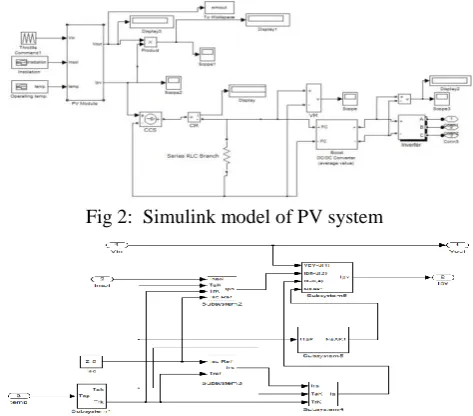
With the help of above equation and description, we designed a simulink module for pv module. The simulink model is presented in fig 2.
Fig 2: Simulink model of PV system
Fig 3: Subsystem implementation of PV Module
IV.MODELINGOFWINDENERGYSYSTEM
Because wind energy has become the least expensive source of new renewable energy that is also compatible with environment preservation programs, many countries promote wind power technology by means of national Programs and market incentives. The wind turbine captures the wind’s kinetic energy in a rotor consisting of two or more blades mechanically coupled to an electrical generator. The fundamental equations governing the mechanical power capture of the wind turbine rotor blades, which drive the electrical generator, are given by;
PWIND = 0.5CpAρv 3
(4) Where : Air density (kg/m3)
A: Area swept by the rotor blades
V: Velocity of air (m/sec),
C p: Power coefficient of the wind turbine
The amount of aerodynamic torque Tw in N-m is given by the ratio between the power extracted from the wind and the turbine rotor speed Ww in rad/s, as follows;
Tw = Pw/ Ww (5)
The power coefficient Cp reaches maximum value equal to 0.593 which means that the power extracted from the wind is always less than 59.3% (Betz’s limit) because various aerodynamic losses depend on rotor construction [10][11]. The power coefficient is a function of the rotor tip-speed to wind-speed ratio (TSR). TSR is defined as the linear speed of the rotor to the wind speed. Tip-speed ratio λ;
λ=Ww R/Vw (6)
Fig4: Simulink model of wind energy system
V. MODELINGOFSTORAGESYSTEM BATTERY
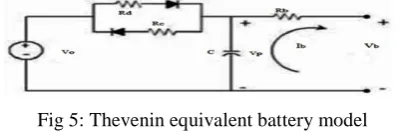
Batteries are the basic component of an energy storage system. A battery consists of one or more electrochemical cells that are electrically connected. The basic components of an electrolytic cell like a lead-acid cell are a positive electrode, a negative electrode, a porous separator and an electrolyte. During cell operation, ions are created and consumed at the two electrode/electrolyte interface by oxidation/reduction reactions. The electrolyte, which cans either, be a solid or liquid chemical, has high conductivity for ions but not for electrons, because if the electrolyte conducts electrons then the battery will self-discharge. The electrolyte completes the internal circuit between the electrodes. In figure 6 the Thevenin equivalent battery model is presented.
Fig 5: Thevenin equivalent battery model
The open circuit voltage, internal capacitor voltage and the terminal voltage are represented by Rc, Rd and Rb and the
polarization capacitance of the battery is represented by C. The current Ia is taken as positive if discharging and negative otherwise. The equation for the circuit model is:
Vp = 1/C[((Vo - Va)/Rd) - Ib]
Vb = Vp - IbRb
Based on these equations a simulink model was developed for battery storage device.
Fig 6: simulink model of Battery
DIESEL GENERATOR
Fig 7: Simulink diagram of Diesel generator
VI.SIMULINKDIAGRAMOFHYBRIDSYSTEM
Fig 8: Simulink diagram of hybrid system
VII. EXPERIMENTAL RESULTS
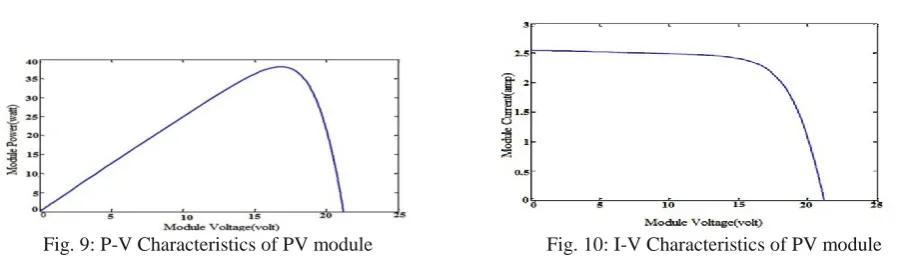
Figure 9 and 10 show non-linear P-V and I-V characteristic of PV module respectively obtained from simulation of PV module.
Fig. 9: P-V Characteristics of PV module Fig. 10: I-V Characteristics of PV module
Figure 11 repersents three phase line output voltage of PMSG which convert wind energy into electrical energy through wind turbine. Figure 12 shows torque in N-m vs time in sec curve of PMSG.
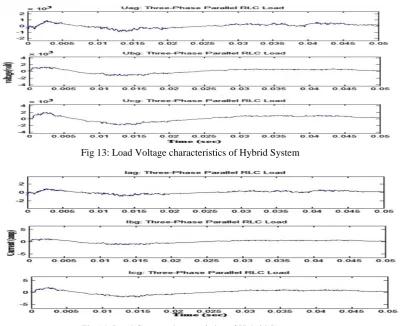
Figure 13and 14 show the output load voltage and current characteristic of hybrid system when battery storage system has been taken as input to the system.
Fig 13: Load Voltage characteristics of Hybrid System
Fig 14: Load Current characteristics of Hybrid System
Figure 15 and 16 represent output load voltage and current characteristic respectively of hybrid system. Peak value of load current is 4.5 ampere and load voltage is 1800 volt. Therefore approximately 3.24 KW of power has been generated when either diesel generator is available as source.
Fig 16: Load Current Characteristics of Hybrid system
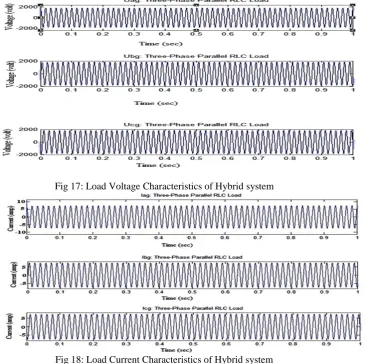
Figure 17 and 18 represent output load current and voltage characteristic respectively of hybrid system 2. Peak value of load current is 7.5 ampere and load voltage is 1800 volt. So, it can able to supply 5.4 KW of power when either solar or wind energy source is available to the system.
Fig 17: Load Voltage Characteristics of Hybrid system
Result analysis
Sl. No Type of Input Peak voltage (volt) Peak current (amp) Calculated power (KW) 1. Battery 1800 1.5 1.08
2. Diesel Generator 1800 4.5 3.24 3. PV/Wind 1800 7.5 5.4
Table I: Output data of different generating system
VIII. CONCLUSION
This work proposed a hybrid energy generation system in which wind and solar (PV) power has been taken as primary source because of its advantages over other conventional sources like ease of availability, inexhaustible, and pollution free. But both sources are seasonal some backup supply has also been taken to maintain the continuity of power supply to the consumer. In this work PV cell, module and array are simulated and effect of environmental conditions on their characteristics is studied and non-linear P-V and I-V characteristic have been obtained. Wind energy system has been also studied and simulated. Both the systems are integrated and the hybrid system is used for different load and approximately 5.4 KW load current and voltage characteristic have been obtained.
Diesel Generator has been studied and simulated and load voltage and current characteristic have been shown in figure 5.19 and 5.20 respectively. Load voltage and current characteristic have been shown in figure 5.16 and 5.17 respectively. By comparing these waveforms, it has been observed that output waveforms of Diesel generator sets contain fewer harmonic than battery output. Off-grid wind-solar hybrid power generation systems have very important aspect for remote and island areas.
The integration of both the solar power generation and the wind power generation as a one will help us to increase the efficiency of the overall system and improve consistency of the power generation; here the interruption of the power flow could be avoided.
REFERENCES
[1] Ahmed N.A.; Miyatake M. A Stand-alone Hybrid Generation System Combining Solar Photovoltaic and Wind Turbine with Simple Maximum Power Point Tracking Control, Power Electronics and Motion Control Conference, 2006. IPEMC2006. CES/IEEE 5th International Volume: 1
DOI:10.1109/ IPEMC.2006. 4777984 , 2006, 1-7
[2] MaoMeiqin ; Su Jianhui ; Liuchen Chang ; Zhang Guorong ; Zhou Yuzhu, Controller for 1 kW – 5 kW wind - solar hybrid generation systems, Electrical and Computer Science Engineering, 2008. Canadian Conference on, 2008; DOI: 10.1109/CCECE.2008.4564723, 2008, 001175 – 001178 [3] Ambia, M.N.; Islam, M.K. ; Shoeb, M.A. ; Maruf, M.N.I. ; Mohsin, A.S.M. An analysis and design on micro generation of a domestic solar- wind hybrid energy system for rural and remote areas perspective Bangladesh, Mechanical and Electronics Engineering (ICMEE), 2010 2nd International Conference on Volume: 2, DOI: 10.1109/ICMEE.2010 .5558476, 2010, V2-107 – V2-110
[4] Guang Yang ; Ming Zhou ; Bing Lin ; Wang yang Du, Optimal scheduling the solar-storage hybrid generation system considering wind-solar correlation, Power and Energy Engineering Conference (APPEEC), 2013 IEEE PES Asia-Pacific, DOI: 10.1109/APPEEC.2013.6837181, 2013, 1-6.
[5] S. Diaf, D. Diaf, M. Belhamel, M. Haddadi, A. Louche, A methodology for optimal sizing of autonomous hybrid PV/wind system, Energy Policy 35 (2007) 5708–5718
[6] Sanjoy Kumar Nandi, HimangshuRanjan Ghosh, A wind.PV-battery hybrid power system at Sitakunda in Bangladesh, Energy Policy 37 (2009) 3659.3664
[7] Salwan S. Dihrab, K. Sopian, Electricity generation of hybrid PV/wind systems in Iraq, Renewable Energy 35 (2010) 1303.1307.
[8] Md. Aminul Islam; Adel Merabet; Rachid Beguenance and Hussein Ibrahim, Modeling Solar Photo voltaic Cell and Simulated Performance Analysis of a 250W PV Module, Eletrical Power and Energy Conference (EPEC), 2013 IEEE, DOI: 10.1109/EPEC.2013 .6802959, 1 – 6.
[9] Huan-Liang Tsai, Ci-Siang Tu, and Yi-Jie Su, Development of Generalized Photovoltaic Model Using MATLAB/ SIMULINK, Proceedings of the World Congress on Engineering and Computer Science 2008 WCECS 2008, October 22 - 24, 2008, San Francisco, USA
[10] Alejandro Rolan, Alvaro Luna, Gerardo Vazquez, Daniel Aguilar, Gustavo Azevedo, Modeling of a Variable Speed Wind Turbine with a Permanent Magnet Synchronous Generator, IEEE International Symposium on Industrial Electronics (ISlE ), 2009
[11] M.Yin, G.Li, M. Zhou and C. Zhao. "Modelling of the wind turbine with permanent magnet synchronous generator for integration", IEEE Power Engineering Society General Meeting, Tampa, Florida, 2007, pp. 1-6