Running Head: IMPROVING READING COMPREHENSION
Improving Reading Comprehension in the Primary Grades: Mediated Effects of a Language-Focused Classroom Intervention
Language and Reading Research Consortium (LARRC) Hui Jiang & Jessica Logan
Author Note
This paper was prepared by a Task Force of the Language and Reading Research
Consortium (LARRC) consisting of Laura Justice (Convener), Mindy Bridges, Hui Jiang, and Jessica Logan. LARRC project sites and investigators are as follows:
Ohio State University (Columbus, OH): Laura M. Justice (Site PI), Richard Lomax, Ann O’Connell, Jill Pentimonti, Stephen A. Petrill1, Shayne B. Piasta
Arizona State University (Tempe, AZ): Shelley Gray (Site PI), Maria Adelaida Restrepo.
Lancaster University (Lancaster, UK): Kate Cain (Site PI).
University of Kansas (Lawrence, KS): Hugh Catts2 (Site PI), Mindy Bridges3, Diane Nielsen.
University of Nebraska-Lincoln (Lincoln, NE): Tiffany Hogan4 (Site PI), Jim Bovaird, J. Ron Nelson.5
1. Stephen A Petrill was a LARRC co-investigator from 2010-2013. 2. Hugh Catts is now at Florida State University.
3. Mindy Bridges is now at the University of Kansas Medical Center. 4. Tiffany Hogan is now at MGH Institute of Health Professions. 5. J. Ron Nelson was a LARRC co-investigator from 2010-2012.
This work was supported by grant # R305F100002 of the Institute of Education Sciences’ Reading for Understanding Initiative. We are deeply grateful to the numerous staff, research associates, school administrators, teachers, children, and families who participated. The views presented in this work do not represent those of the federal government, nor do they endorse any products or findings presented herein.
Abstract
Purpose: This paper includes results from a multi-state randomized controlled trial designed to investigate the impacts of a language-focused classroom intervention on primary grade students’ proximal language skills and distal reading comprehension skills.
Method: The sample included 938 children from 160 classrooms in four geographic regions in the United States; each classroom was randomly assigned to one of two experimental conditions (two variations of a language-focused intervention) or business-as-usual (BAU) control. For this study, the two experimental conditions were collapsed as they represented minor differences in the language-focused intervention. All children completed assessments at multiple time points during the academic year. Proximal measures (curriculum-aligned measures of vocabulary, comprehension monitoring, and understanding narrative and expository text) were administered throughout the school year. Distal measures of reading comprehension were administered at the beginning and the end of the school year.
Results: Multilevel multivariate regression was conducted with results showing that students receiving the language-focused intervention significantly outperformed those in the control group in comprehension monitoring and vocabulary, with effect sizes ranging from .55-1.98. A small effect in understanding text (narrative) was found in third grade only. Multilevel path analyses were then conducted to examine if the intervention had a positive impact on reading comprehension through the influence of proximal language outcomes. In all three grades, instruction impacted reading comprehension via the mediation of vocabulary, with sizable effects (1.89-2.26); no other indirect pathways were significant.
Conclusions:
This study provides evidence that a language-focused intervention can positively impact students’ performance on language measures that are closely aligned with the
Improving Reading Comprehension in the Primary Grades: Mediated Effects of a Language-Focused Classroom Intervention
Poor reading comprehension among U.S. children and youth is an ongoing concern; indeed, nationally representative data show stagnant performance in reading achievement over the past decades (Snyder, de Brey, & Dillow, 2016), with only about one-third of fourth graders exhibiting proficient reading skill (National Assessment of Educational Progress, 2017). Poor reading achievement is associated with adversities in a number of areas, including educational progress, employment opportunities, and health outcomes (Ritchie & Bates, 2013). In recent decades, considerable efforts have been directed towards developing effective interventions for improving children’s decoding skills, many with successful outcomes (Ball & Blachman, 1988; Connor, Morrison, Fishman, Schatschneider, & Underwood, 2007). In contrast, there has been less attention to improving children’s reading comprehension, although it is a decidedly important component of skilled reading. To address this issue, the Institute of Education Sciences (IES) of the U.S. Department of Education created the Reading for Understanding (RFU) Initiative in 2010. The purpose of this initiative was to commit extensive funding (more than $100,000,000) to investigative teams to develop, refine, and evaluate effective approaches for improving reading comprehension for children and youth.
LARRC team was to determine the effects of language-focused whole-class
interventions, representing an enhancement of or supplement to the typical classroom language-arts curriculum – for improving reading comprehension in the primary grades.
LARRC’s focus on language-focused intervention as a means for improving overall reading comprehension is based on firm theoretical evidence showing that children’s language comprehension is intricately related to reading comprehension skills (e.g., Kintsch & Kintsch, 2005; Perfetti, 1999; Scarborough, 1998). By third grade, children’s language skills explain an estimated 60% of the variance in children’s reading comprehension (Language and Reading Research Consortium, 2015), and the
contribution of language skill to reading contribution is important across the continuum
of reading skill (Language and Reading Research Consortium & Logan, 2017). In fact,
among the least-skilled comprehenders in third grade (bottom tertile), skills in grammar,
vocabulary, and higher-level language appear more influential to reading comprehension
than for the most-skilled comprehenders (Language and Reading Research Consortium &
Logan, 2017). This suggests that language skill may be an important lever of change for
improving reading comprehension across the full distribution of reading skill.
Among the most critical determinants of language comprehension are language skills transcending both lower- (i.e., automatic) and higher-level (i.e., integrative)
Higher-comprehension monitoring, and these skills are viewed as critical for the integrative elements of skilled reading comprehension that allow one to create a mental model of text (Cain, Oakhill, Barnes, & Bryant, 2001).
Given the contribution of language skills to skilled reading comprehension, some have proposed that instruction directly targeting language skills has the potential to result in improvements in reading comprehension (Bowyer‐Crane et al., 2008; Williams, Hall, & Lauer, 2004). This argument was first tested in a seminal study conducted by Beck and colleagues (Beck, Perfetti, & McKeown, 1982), in which fourth grade students were provided with explicit vocabulary instruction using a variety of tasks, such as word definition activities. Results indicated that the vocabulary instruction had a positive, significant effect on not only vocabulary skills but also students’ reading comprehension. These studies, as well as others (Cirino, Pollard-Durodola, Foorman, Carlson, & Francis, 2007; Zipke, Ehri, & Cairns, 2009), provide preliminary evidence that providing direct instruction in language skills can positively impact children’s reading comprehension.
Typically, efforts to positively impact reading comprehension via language instruction focus on one specific language skill, such as vocabulary or inference making. For instance, Beck and colleagues’ (Beck et al., 1982) previously cited work showed that instruction targeting vocabulary knowledge can lead to improvements in reading
comprehension across the continuum of reading skill (Language and Reading Research Consortium & Logan, 2017).
To date, relatively few multi-component language interventions have been examined for effects on reading comprehension, with a few exceptions (Clarke,
Snowling, Truelove, & Hulme, 2010; Williams et al., 2014; Williams, Stafford, Lauer, Hall, & Pollini, 2009). One example is seen in work by Williams and colleagues , who developed and tested a supplemental classroom intervention for second-grade students that provided explicit instruction targeting a variety of language skills, including vocabulary, grammar and text-structure knowledge (Williams et al., 2009). Vocabulary instruction focused on concepts central to the topic of texts being read (e.g., warm- and cold-blooded animals) but also on “clue words” that helped children to comprehend certain expository texts. For instance, when reading compare-contrast texts, children received instruction on such clue words as both, compare, and alike. Also, children engaged in extensive textual analysis of expository text, including grammatical analyses (e.g., examining coherence within paragraphs) and text-structure analysis (e.g., producing graphic organizers depicting a paragraph’s expository structure). Compared to children in two counterfactual conditions, children provided explicit instruction focused on
vocabulary, narrative ability, and listening comprehension outperformed students in a control condition on a standardized measure of reading comprehension, and these gains were maintained at an 11-month follow-up. It is important to note that the instruction provided in this study was delivered individually, not in a classroom setting.
Similar to the intervention developed and tested by Clarke and colleagues (2010), the present experiment examined effects of a comprehensive language-focused
intervention – Let’s Know! - on the language skills and reading comprehension of first- to third-grade students; a principal distinction between the present work and Clarke et al was that the intervention described here was implemented by classroom teachers and delivered to the entire classroom. Designed as a supplement to the classroom’s typical language-arts curriculum, Let’s Know! was developed and tested over a three-year period in a process that adhered to the Curriculum Research Framework (CRF) approach
developed by Clements and colleagues (Clements, 2007). The CRF is a systematic 10-step approach for generating and testing research-based curricular methods that
transcends establishing the educational goals of the curriculum (Step 1) to evaluating the curriculum in an experimental large-scale trial (Step 10).
LARRC’s approach to curricular development based on the CRF, as well as a detailed description of the intervention, is thoroughly discussed under separate cover (Language and Reading Research Consortium, 2016). In brief, Let’s Know! was designed to provide primary-grade teachers a systematic and explicit approach to targeting
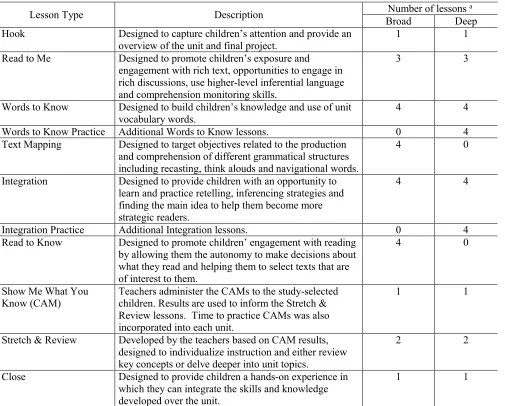
Organized into four stand-alone thematically based instructional units, teachers provided whole-class instruction for approximately 30-minutes per day using semi-scripted lesson plans design to articulate a scope and sequence of language-focused instruction (see Table 1). Each unit consisted of a sequenced set of instructional lessons focused on various language skills (e.g., vocabulary was targeted in “Words to Know” lessons and text-structure knowledge was targeted in “Text Mapping” lessons).
Let’s Know! was designed to augment but not supplant the core language-arts program used by teachers, as initial input from educators indicated that an intervention would be of more value to school districts if it could be embedded into existing language arts programs (see LARRC, 2016). Thus, design of the intervention included attention to examining the extent to which primary-grade teachers could use the intervention with fidelity in conjunction with a variety of language-arts curricula (e.g., Language and Reading Research Consortium, Pratt, & Logan, 2014).
Two variations of Let’s Know! were developed, one targeting a broader array of language skills than the other, with the latter focusing more intensively on vocabulary with repetition of vocabulary-focused lessons. The distinguishing features of the two versions are reported elsewhere and referenced in Table 1 (see Language and Reading Research Consortium, 2016). Generally, studies do not find the two instantiations to be significantly different in their impact on students’ language skills (e.g., Language and Reading Research Consortium, Arthur, & Davis, 2016); thus, in the present study we do not differentiate between Let’s Know! versions, although classrooms were randomly assigned to implement either of the two variations.
effects of the intervention on students’ language skills, including vocabulary and text-structure knowledge (Language and Reading Research Consortium et al., 2016; Language and Reading Research Consortium, Jiang, & Davis, 2017a). Preliminary results from the two-cohort randomized controlled trial reported here included examiniation of treatment effects among the first cohort of students whose teachers implemented Let’s Know!. That study showed statistically significant effects on measures of comprehension monitoring and vocabulary relative to control (Language and Reading Research Consortium et al., 2017). These results provide promising preliminary evidence that explicit, targeted instruction can positively impact those language skills shown to be important for later reading comprehension. Distinct from these prior works, the present study represents the complete evaluation of impacts of the language-focused intervention on students’ reading comprehension in the primary grades, with a specific focus on testing the theory of change inherent to the intervention’s design – namely, that Let’s Know! yields positive effects on language skills which, in turn, positively affect reading comprehension.
classrooms on these outcomes, thus generally serving to replicate preliminary findings recently reported in the literature (Language and Reading Research Consortium, Jiang, & Davis, 2017b). The second purpose was to determine the extent to which the effects of the intervention on children’s language skills would transfer to effects on
reading-comprehension skills, as reflected in the theory of change that guided design of the Let’s Know! intervention. Specifically, this theory of change contends that children’s reading comprehension is highly influenced by their language skills (Language and Research Research Consortium & Logan, 2017), and that instruction targeting such skills should causally affect reading comprehension. This theory therefore proposes that the effects of
Let’s Know! on students’ reading comprehension is mediated by their language skills. Thus, the questions addressed in this study were twofold: (1) To what extent does Let’s Know! impact the language skills of primary-grade children, including comprehension monitoring, vocabulary, and language comprehension, and (2) To what extent does Let’s Know! impact the reading comprehension skills of primary-grade children via the influence of language skills?
Methods
Participants
students’ language and reading-comprehension outcomes. As most preschool and kindergarten students cannot read text, curricular effects for these youngsters were assessed using language-specific measures, and results are examined under separate cover. Note that the sample utilized in this study partially overlaps with that described in LARRC, Jiang, and Davis (2017), which examined the effects of the Let’s Know!
intervention on curriculum-aligned language measures using the preschool to third grade sample from cohort 1 of the RCT.
Teacher sample. To recruit teachers into the study, school districts across six
we emphasized that teachers assigned to one of two experimental conditions would need to be prepared to make adjustments to their language-arts curriculum.
The sample of 184 first- to third-grade teachers was primarily white/Caucasian (91%), although 6% were Asian, and 3% were of other races or multiracial. Four percent of teachers identified as Hispanic or Latino. On average, teachers were 42 years old (SD
= 10.5 years, range = 23 to 65 years) and had nearly eight years of experience teaching the current grade level (SD = 6.2 years, range = 0 to 32 years). An average classroom included 22 children (SD = 3.4, range = 8 to 30). Almost two-thirds of classrooms were in suburban settings (62%), with 25% in urban settings, and 13% in rural settings. According to teacher report, nearly all (95%) classrooms were using a specific language-arts curriculum, to which Let’s Know! served as a supplement.
Student sample. All children whose teachers enrolled in the study were exposed
Out of all eligible children for whom consent was received, six were randomly selected from each classroom to be assessed throughout the year. In cases in which fewer than six children were eligible in a classroom, all were selected. The decision to select six children per classroom was based on a priori power analyses which were conducted to ensure adequate statistical power for detecting differences among the study conditions for student-level outcomes. These estimates assured us that the study was designed with sufficient power to detect educationally-meaningful effects.
In total, 997 first- to third-grade students were enrolled in the study, representing 184 first- to third-grade classrooms and an average of slightly more than 5 children per classroom. After removing cases that had missing data on all outcome variables, we retained an analytic sample of 938 children from 160 classrooms. Detailed missing data analyses are reported in the Results section (see “Attrition and Initial Equivalence”).
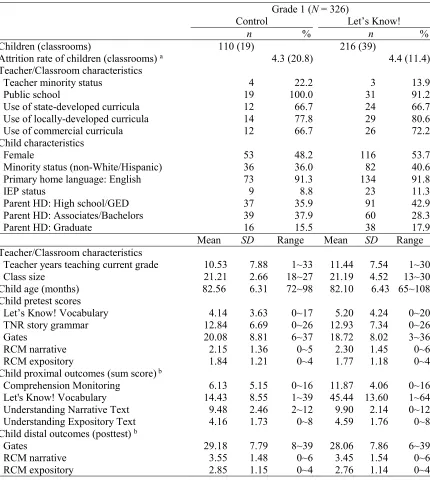
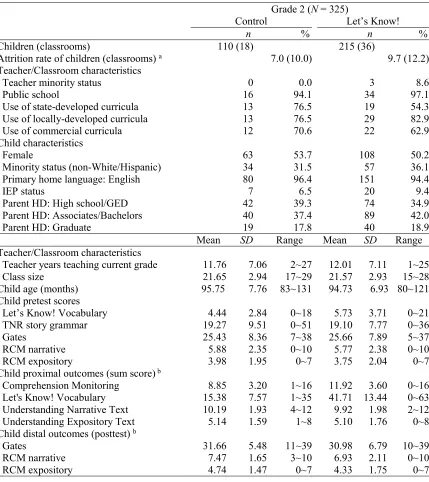
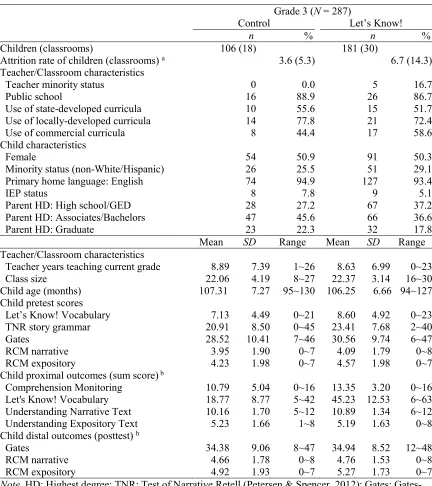
Selected descriptive information of the final sample (N = 938) is summarized by grade in Table 2. Across all grade levels, 51~53% of the students were female and 29~43% were identified as ethnic minorities. The average age at the start of the academic year was 6:10 for grade 1, 7:11 for grade 2, and 8:11 for grade 3 (range = 65 to 131 months). Per caregiver report, 6~11% of children had an Individualized Education Plan and the majority of families (>90%) spoke English as the primary language at home. To characterize the students’ socioeconomic status (SES), information about maternal education was captured; 41% of children’s mothers had high school degree as their highest level of education earned, 31% had associates or bachelor’s degree, and 17% had advanced degree. Thus, this sample was diverse with respect to SES.
Prior to the start of the school year, and after teachers provided informed consent, each classroom was randomly assigned to one of three condition, representing the two version of Let’s Know! or a business-as-usual (BAU) control. Random assignment was blocked by site and grade to ensure uniformity in assignment procedures.
In classrooms assigned to one of the two Let’s Know! conditions, teachers implemented the whole-class intervention over a 25-week period, whereas those in the BAU condition were asked to maintain their typical language-arts curriculum. Regardless of study condition, all participating teachers completed the same number of hours of professional development (῀6 hours total) prior to the fall semester, with those in the BAU condition receiving training on neutral topics (e.g., classroom management); received similar incentives; and went through similar data collection procedures.
Therefore, implementation of Let’s Know! was the only distinguishing characteristic for experimental versus control classrooms.
students’ skills in these areas over an academic year.
The whole-class intervention for each grade consisted of four units, two
emphasizing narrative texts and two emphasizing expository texts, with an overarching focus across all four units on science-related topics. The first three units consisted of a series of 24 structured, ordered lessons, whereas unit four had 13 lessons (see Table 1), each of which follows a specific instructional routine. Lessons were organized into three 7-week units plus one 4-week unit (Unit 1: Fiction, Unit 2: Animals, Unit 3: Earth Materials, Unit 4: Folktales), for a total of 25 weeks. Each lesson targets one or more of the key language skills within the scope and sequence of instruction. All lessons were semi-scripted, were designed to last about 20- to- 30-minutes, and followed a gradual release of responsibility model. Specifically, each lesson opened with a ‘Set’ in which the teacher explicitly stated the goal of the lesson; this was followed by three successive segments of ‘I Do’ (teacher models a skill or objective), ‘We Do’ (students practice with teacher scaffolding), and ‘You Do’ (students practice independently). Each lesson ended with a ‘Close,’ in which the teacher restated the goal of the lesson. The entire curricular supplement can be downloaded at no cost at https://larrc.ehe.osu.edu/.
knowledge. In general, children who received the Deep version out-performed those in the Broad version on their knowledge of words targeted during the 25-period of
instruction. In the present study, for the purposes of parsimony, we collapsed both
treatment conditions into a single Let’s Know!, given our interest in examining the effects of Let’s Know! on reading comprehension via children’s language skills.
Fidelity of implementation to Let’s Know! was measured in two primary ways. First, teachers maintained written logs of their daily implementation of lessons, and these were collected by staff regularly. Examination of logs by project staff showed that, on average, 68 of 85 total lessons (80%) were implemented (range: 8% ~ 100%). Second, research staff conducted seven observations per teacher across the academic year for randomly selected Let’s Know! lessons. Staff coded for the absence or presence of 12 key features of lessons using a fidelity checklist developed for this purpose. Across all observations conducted (n = 635), teachers implemented an average of 9 of the key features (range: 2~10). As with many large-scale classroom-based interventions, fidelity did not achieve the gold standard of implementation and there was a high level of variability across teachers (Bleses et al., 2017). Thus, the present study represents intervention effects achieved in less-than-ideal implementation.
though in the BAU classroroms these were not actually aligned to the language-arts
curriculum. The major distinction between teacher experiences across the treatment and BAU conditions is that the latter teachers did not receive the Let’s Know! materials (e.g.,
lesson plans, storybooks) nor training in their use, and they were not observed for fidelity
to the Let’s Know! lessons.
Measures
Of primary interest in the present study are measures of students’ language skills and reading comprehension. Two types of measures were used to represent potential effects of Let’s Know! on children’s skills. First, curriculum-aligned measures (CAMs) that were closely aligned to the intervention’s scope and sequence were collected at the end of each instructional unit by children’s teachers. Second, a distal measure of children’s reading comprehension was conducted in the fall and spring of the academic year by research staff.
Curriculum-aligned measures (CAMs). CAMs were administered by teachers across the academic year and served as proximal measures of Let’s Know! effects on children’s skills in three areas: comprehension monitoring, vocabulary, and text
comprehension. CAMS were administered by children’s teachers near the end of the first through fourth units (week 6, week 13, week 20, week 24) following standardized scripts and scoring instructions. Teachers also were provided training on implementing the CAMs via a narrated PowerPoint training completed prior to implementing the first CAM. Extensive pilot work was done prior to field implementation to ensure that teachers could reliably score the CAMs. Note that CAMs were conducted by both
to be used as proximal outcomes in the analyses.
Comprehension Monitoring. A comprehension monitoring measure was used to
assess children’s ability to apply comprehension-monitoring strategies when listening to short passages containing incongruous information. Passages were aligned with the Let’s Know! instructional content. In one-on-one sessions, teachers read the child two passages and asked the child to identify what did not make sense in the passage and to identify a fix-up strategy they could apply (e.g., re-read text). The teacher used a rubric to score each item as correct (2 points), correct after prompting (1 point), or incorrect (0 points). The maximum possible points was four per unit and 16 over four CAM assessments. Reliability as measured by ordinal alpha was 0.85.
Vocabulary. A vocabulary measure was used to assess children’s knowledge of
vocabulary words taught across the four Let’s Know! units. Words taught and tested were selected based on their prevalence in children’s books featured in Let’s Know! lessons, importance for understanding unit content, and relevance to a variety of learning contexts (e.g., reading, math, science). All words were lower-frequency words. For each of four separate administrations, corresponding to the close of each of four units within the Let’s Know! classrooms, teachers asked children to provide a definition of each of eight target words, and teachers rated responses as correct (2 points), partially correct (1 point), or incorrect (0 points) using a scoring protocol that listed acceptable answers. The maximum possible points was 16 per unit and 64 over four CAM assessments, and reliability was very high (alpha = 0.96).
Text comprehension. A text comprehension measure (also referred to as
comprehend narrative and expository text. Children listened to passages that were
narrative or expository in nature and then answered three comprehension questions; each was scored as correct (1 point) or incorrect (0 points), for a total of 12 possible points across CAMs for narrative passages, and eight possible points for expository passages. The text comprehension measure at the end of Unit 1 and 4 used narrative text, whereas the measure after Unit 2 and 3 featured expository text. The content of the expository passages mirrored the units in terms of the general topic and text structure of focus (e.g., compare/contrast, cause/effect), whereas the comprehension questions required children to identify the main ideas or supporting details. Reliability was 0.71 for the overall scale.
Distal measures: Reading comprehension. Reading comprehension was assessed using an adaptation of the Qualitative Reading Inventory-5 (Leslie & Caldwell, 2011), hereafter referred to as the Reading Comprehension Measure (RCM), and the
Gates-MacGinitie Reading Tests, 4th Edition (Gates; MacGinitie et al., 2000). These were
individually administered to each child by research staff in the fall and spring of the academic year, prior to and following implementation of Let’s Know!. The RCM contained three narrative passages adapted from the original instrument and three
seven expository questions; grade 3: eight narrative and seven expository questions). All responses were audio-recorded and post-scored (0 or 1 point for each question) by research staff. The maximum possible points vary depending on the grade level. Interrater reliability of scoring was high (.93), and reliability for our sample was good (Cronbach’s alpha = .76, .77, and .80 for grades 1 through 3).
The Gates is a commonly used measure that includes narrative and expository text segments. There are three levels to this test which correspond to grade levels 1-3. For grade levels 1-2, each text segment is accompanied by a panel of three pictures, and the child’s task is to choose the picture in each panel that illustrated the segment or that answered a question about the segment. For grade 3, comprehension items are provided in the form of text instead of pictures. A total of 39 items were administered to grade 1 and grade 2, and 48 items were administered to grade 3. Reliability (Cronbach’s alpha) was reported to be 0.92, and was high for our current sample (0.89~0.92). Criterion validity was also adequate, as evidenced by the correlation between Gates and
standardized tests (correlation with Iowa Test of Basic Skills was .77; correlation with TerraNova Comprehensive Test of Basic Skills was .79 per the test manual). Raw scores of Gates were used in the current study.
teacher, classrooms, and schools. During the first 3- to 4-weeks, children completed pretest assessments administered by research staff, on a number of cognitive measures aligned to similar constructs as the CAMs. These included measures of Let’s Know!
vocabulary and the Test of Narrative Retell: School-Age (TNR; Petersen & Spencer, 2012). Specifically, the vocabulary measure mirrored the Let’s Know! Vocabulary CAM probe except that it included only 16 targeted vocabulary words (four from each unit). In addition, the TNR was implemented to evaluate children’s narrative skills at baseline, which serve as important control variables for children’s initial skills. In the test,
narrative retells were audio-recorded and scored for a variety of story grammar elements (interrater reliability = .86~.95). The total possible points for the story grammar
composite was 36 (G1) or 56 (G2-G3).
Analytical Approach
equivalence analyses are described in the Results section.
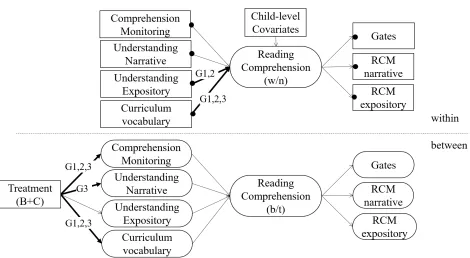
To evaluate the effects of Let’s Know! on the proximal measures (CAMs), we conducted multilevel multivariate regression with CAM scores serving as outcomes of interest (Figure 1). Since CAMs were administered at multiple time points over the academic year, and CAM items varied across the three grade levels, we treated each grade as a separate sample and analyzed sum scores combined across units. A multilevel (mixed) model was applied, in which classroom effects were treated as random
components, to account for the nested data structure. For each grade, treatment effects were estimated for all proximal measures simultaneously using multivariate modeling to account for the correlation between outcomes.
To test the effects of Let’s Know! on the distal outcome of reading
comprehension, we employed multilevel structural equation modeling (SEM) to model cascading pathways, specifically the effects of Let’s Know! on four proximal outcomes (CAMs) and in turn their influence on reading comprehension, represented by a latent construct measured by three observed indicators (Figure 2). We hypothesized that the effects of Let’s Know! on reading comprehension would be completely mediated by children’s improvements in targeted language skills as represented by the CAMs. To appropriately assess the unique contribution of Let’s Know!, we controlled for
pathways (ab) in the model. Fit of the structural equation models was assessed with Root Mean Square Error of Approximation (RMSEA), Comparative Fit Index (CFI), and Standardized Root Mean Square Residual (SRMR). Since the conventional fit index, namely the chi-square fit statistic, tends to be very sensitive to sample size, it is
preferable to take into account multiple indices of model fit to evaluate the adequacy of the model. Generally, models were considered an acceptable fit for the data if the SRMR and RMSEA were less than .08, and the CFI was at least .90 (Hu & Bentler, 1999; MacCallum, Browne, & Sugawara, 1996). In addition, we tested mediation models controlling for potential differences between the Let’s Know! Broad and Deep conditions.
The results were robust to the addition of the condition variable for all grade levels, and
suggested that intervention variation did not led to significant differences in the process
models. We therefore report here the models combining the two Let’s Know! conditions.
The primary analyses to estimate relations and assess model fit were conducted in Mplus 7.11 (Muthén & Muthén, 1998-2010). The significance of the standardized path coefficients was determined by comparing the z ratio to a critical value at 0.05 level. Aside from statistical significance, we further estimated effect sizes (d) following the guidelines recommended by the What Works Clearinghouse.
Missing Data
1998) was conducted separately for each grade, such that MI models included all proximal and distal measures, as well as other variables theoretically or empirically related to the outcomes or missingness, based on the analyses of attrition and initial equivalence described above. Ten datasets were imputed in Blimp 6.6 (Keller & Enders, 2017) for each grade using multilevel (mixed-effects) linear models, in which classroom effects were treated as random components. These imputed datasets were then analyzed via the MI module in Mplus, from which ten sets of results were obtained and combined to generate the final estimates.
Results
Attrition and Initial Equivalence
A total of 938 out of 997 children (94.1%) had data on at least one outcome variable at any time point and were retained in the analytic sample. Out of the 59 children removed from the sample, the majority of attrition (n = 38, 64.4%) was due to teacher withdrawal, such that children were loss from the study if their teacher left the study. The percentage of teacher withdrawal rate did not differ significantly by condition
and curriculum used).
Initial equivalence across study conditions for both classroom- and child-level factors was assessed for each grade. No significant classroom-level difference was detected. As for child-level characteristics, children from the BAU and treatment classrooms did not differ in terms of gender, age, race, ethnicity, parental education, home language, IEP status, or children’s pretest scores on the reading comprehension measures. However, some significant differences existed between conditions on other pretest measures, such that children assigned to the treatments condition scored
significantly higher on Let’s Know! vocabulary as compared to those in BAU at pretest (p
= .028 in G1, .001 in G2, .011 in G3). In G3, children also showed initial differences on a narrative task (p = .015) that favored the treatment condition. Non-equivalent variables were subsequently used as covariates in the primary analyses.
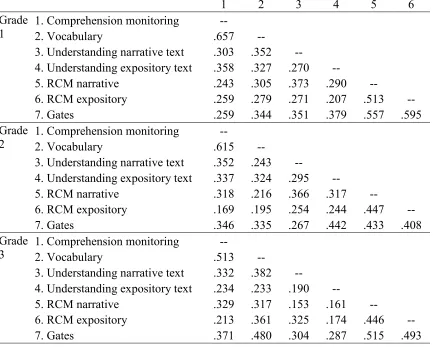
Correlation coefficients among all outcome variables are displayed in Table 3. With the exception of the correlation between comprehension monitoring and vocabulary (.51~.66), correlation among the proximal measures was relatively low (average r = .30), as was the correlation between proximal and distal measures (average r = .292).
Effects of Let’s Know! on Language Skills
To investigate the effects of Let’s Know! on language skills, representing outcomes proximal to the intervention, we conducted multilevel multivariate regression analyses. For each grade level, we simultaneously estimated the impact of Let’s Know!
on four curriculum-aligned measures, namely comprehension monitoring, Let’s Know!
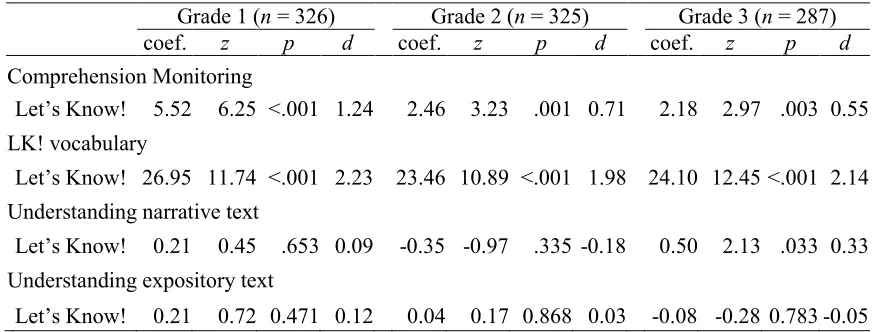
conditions appeared to initially differ. Estimated coefficients of treatment as well as their effect sizes (d) are summarized in Table 4.
Comprehension Monitoring. The intraclass correlation (ICC; generated from the unconditional model) ranged from 0.29 (G3) to 0.54 (G1) across grades for the comprehension monitoring sum scores. This indicates that a substantial amount of variation can be accounted for by classroom differences. After controlling for covariates, an additional 15% (G3) to 39% (G1) of the variance was accounted for by condition. Overall, Let’s Know! had a positive effect on comprehension monitoring scores, in that students in Let’s Know! significantly outperformed those assigned to the control
condition by 2 to 5.5 points, out of a maximum of 16. The effect size was large for grade 1 (1.24), and moderate for grade 2 (0.71) and grade 3 (0.55).
Let’s Know! Vocabulary. The ICC for the Let’s Know! Vocabulary measure ranged from 0.72 (G2) to 0.78 (G1), implying that classroom differences contributed vastly to the variation in vocabulary scores. An additional 38% (G3) to 58% (G2) of the variance was attributable to study condition beyond what was accounted for by
covariates. On average, children from classrooms implementing Let’s Know!
significantly outperformed those in BAU classrooms by 23 to 27 points (out of a maximum of 64). The effect size was large across grades (d > 1.98).
Text Comprehension. The ICC for scores on the narrative text comprehension measures ranged from 0.24 (G3) to 0.42 (G1). After controlling for covariates, condition further accounted for an additional 2% to 7% of variance in total scores. While a
classrooms in grade 1 or grade 2. With respect to expository text comprehension, for the sum scores the ICC ranged from 0.15 (G3) to 0.20 (G1, G2). Condition contributed negligible amount of extra variance (<2%) after controlling for covariates. Children assigned to Let’s Know! classrooms showed no significant differences than those assigned to control classrooms, and all effect sizes were negligible.
Indirect Effects of Let’s Know! on Reading Comprehension
To test the impact of Let’s Know! on reading comprehension, we conducted multilevel path analyses based on the theory of change depicted in Figure 2. Since reading comprehension was treated as a latent variable in the model, we first validated the construct via two-level confirmatory factor analyses (CFA) prior to the primary analyses. Across all grades the model fit was satisfactory (RMSEA < .08; CFI > .95; SRMR < .08).
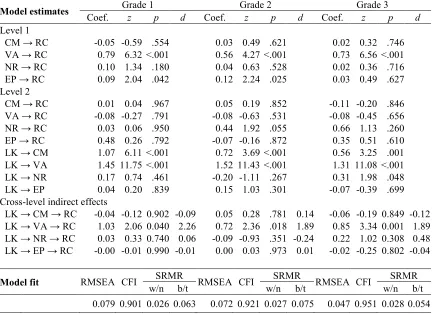
We then investigated whether Let’s Know! exerted an indirect effect on reading comprehension through its influence on language skills, as represented in the CAMs. As shown in Table 5, the theoretical model fits the data reasonably well (RMSEA
= .047~.079; CFI = .901~.951; SRMR within = .026~.028; SRMR between = .054~.075). As reported previously, Let’s Know! significantly impacted children’s performance on comprehension monitoring and vocabulary across all three grade levels, and had a positive effect on narrative text comprehension in grade 3 only. Out of the four proximal outcomes, children’s performance on Let’s Know! Vocabulary consistently predicted reading comprehension (p < .001), whereas scores of expository text comprehension were associated with reading comprehension only in grade 1 (p = .042) and grade 2 (p = .025).
simultaneously estimated along with the pathways from predictor to mediators (a) and mediators to outcomes (b) via the product of the pathways (ab). For all three grades, Let’s Know! significantly impacted reading comprehension via the mediation of vocabulary (ab
= 0.72~1.03, p < .05), with sizable effects (d = 1.89~2.26). However, other indirect pathways were non-significant.
Discussion
Reading comprehension is a multi-component skill that is influenced by both decoding and language comprehension (Hoover & Gough, 1990). Among skilled readers, language skills explain a greater amount of variance in reading comprehension than decoding (Language and Reading Research Consortium & Logan, 2017), leading to considerable efforts to identify strategies for improving those language skills that contribute most strongly to skilled reading comprehension. The investigation presented here was designed to leverage the relations between language skills and reading
comprehension as a means for improving the latter. In all three grades, the language-focused Let’s Know! intervention impacted reading comprehension via the mediation of vocabulary, with sizable effects. These results converge with a small but growing line of research showing that explicit instruction focusing on lower- and/or higher-language skills can positively impact those target skills and have an indirect contribution to reading comprehension as well (e.g., Clarke et al., 2010; Williams et al., 2004, 2009).
The findings of this work have practical as well as theoretical appeal. With
respect to practical implications, Let’s Know! is a multi-component curricular supplement that targets a variety of language components rather than focusing on one specific
are few programs that are specifically designed to explicitly address multiple components of oral language (but see Clarke et al., 2010; Williams et al., 2009). One potential benefit of instructing on a variety of skills is that it is currently unclear which domains of
language are most influential to skilled reading comprehension. Research reports suggest that an array of lower- and higher-level skills contribute to reading comprehension, including grammar, vocabulary, text-structure knowledge, comprehension monitoring, and inferencing (Cain & Oakhill, 1999; Cain et al., 2001; Clarke et al., 2010; Williams et al., 2014; Williams et al., 2009). Let’s Know! was designed in such a way that the explicit skills targeted were interspersed throughout an entire academic year and were targeted relatively deeply. Research has shown that learning opportunities that are distributed across time are an advantageous way to provide learning opportunities to students (e.g., Cepeda, Pashler, Vul, Wixted, & Rohrer, 2006).
vocabulary skills, comprehension monitoring, and text comprehension – which in turn can elevate children’s reading comprehension via mediating pathways.
However, also relevant to considering these practical implications is that many
students in this study did not receive the full Let’s Know! intervention due to low levels
of implementation by some teachers. For instance, we reported that an average of 80% of
lessons were implemented with significant range across teachers (8% to 100%). This
suggests that some primary-grade teachers may require support when implementing Let’s
Know! or similar language-focused interventions. Evolving research on effective avenues
for coaching and mentoring teachers suggests that a variety of methods may be effective
for improving implementation, such as situated coaching models embedded in the
classroom (Friedman & Woods, 2015) and telecoaching using bug-in-the-ear
technologies (Schaefer & Ottley, 2018).
Theoretically, this experiment further solidifies the critically important
contribution of language skills to reading comprehension, as indoctrinated in the simple view of reading (Hoover & Gough, 1990) and supported in a large number of
correlational studies (e.g., Catts, Adlof, & Weismer, 2006; Kershaw & Schatschneider, 2012; Tunmer & Chapman, 2012). The simple view of reading proposes that reading comprehension is a product of decoding and language comprehension, with language comprehension becoming more influential to reading comprehension as the reader matures and becomes a more fluent decoder (Language and Reading Research
difficulties received explicit, systematic language-focused instruction thrice weekly in 30 minutes sessions for 20 weeks. Although reading comprehension was not explicitly taught, and children did not work with written texts, they showed a significant improvement in reading comprehension relative to children in two counterfactual
conditions; moreoever, these positive effects persisted to nearly one-year later. That study provided convincing evidence of the causal role of language skill in reading
comprehension. However, with the intervention delivered in pairs or individually by trained research staff, it was unclear whether such work could generalize to whole classes of students and language-focused intervention being delivered by the public-school teacher. Thus, the results of this study have both theoretical and practical utility.
A few ancillary matters regarding the present experiment warrant note and help to highlight future research directions. First, assessment of teachers’ implementation of
might have particular relevance to providing instruction in text comprehension, which is a higher-level language skill that might pose challenges for some teachers. Future work should attempt to identify supports that would increase implementation fidelity while also monitoring whether such an increase would lead to additional positive impacts on student outcomes. Additionally, it would be useful to determine whether certain aspects of Let’s Know! were more or less used by teachers or presented specific challenges for
implementation.
Second, despite targeting text comprehension in the language-focused
intervention, analyses showed a lack of effects across grades on the text comprehension tasks (expository and narrative CAMs). Possibly, this is due to the intervention design, in which we included attention to both narrative and expository text comprehension within the intervention. We chose to include both types of text in order to provide exposure to critical skills related to reading comprehension. Reading narratives to young children is an engaging activity commonly utilized in elementary classrooms and provides teachers an opportunity to teach children important story grammar elements as well as expose them to rich and complex language. Expository texts build crucial background knowledge that assists with text comprehension and include a wide variety of text structures,
of text, students did not receive the intensity that was necessary to afford changes in this skill. Future research should consider whether instruction on both expository and
narrative texts in each unit would lead to increased benefits.
Third, it is especially important to highlight the strong mediating role of vocabulary skills in affecting students’ reading comprehension. At every grade, we found that Let’s Know! affected students’ reading comprehension significantly via the pathway of improved vocabulary. This finding builds upon work presented by Beck and colleagues more than 30 years ago, in which they found that directly teaching a relatively small set of lower-frequency but “useful and interesting” words to fourth graders had a significant, positive effect on reading comprehension (Beck et al., 1982). Similar to the methods used in Let’s Know!, Beck et al’s intervention featured repeated, direct
to play a decisive role in transfer effects of the intervention to reading comprehension. Further investigations of the impact of vocabulary-focused interventions on reading comprehension are warranted as a result of this finding.
Several limitations of this work warrant note. First, teachers enrolled in the study were self-selected, and thus may differ in important ways from teachers who would not select into such a study. This should be considered when making strong causal
interpretations from this study. Second, our CAMS, representing key proximal outcomes in this study, were developed for the purpose of this intervention and investigation. While considerable efforts were undertaken to enhance their psychometric characteristics, they may not function as strongly as more well-tested measures. Third, we were not able to address the sustainability of observed gains in student outcomes following the end of the year of involvement in the study. Ideally, research could provide information about the extent to which students maintained learned skills, as Clarke and colleagues did in their 2010 investigation of language-focused interventions for children with
reading-comprehension difficulties. Finally, in relation to the implementation fidelity of Let’s Know!, it was past the scope of this study to examine teacher characteristics that lead to increased fidelity of implementation. Future research should attempt to identify if such characteristics exist.
setting and within the context of whole-class instruction. The promising results provide an impetus for ongoing investments into leveraging students’ language skills as a route for improving reading comprehension, to include further investigations of the benefits of
References
Ball, E. W., & Blachman, B. A. (1988). Phoneme segmentation training: Effect on reading readiness. Annals of Dyslexia, 38(1), 208-225.
Beck, I., Perfetti, C. A., & McKeown, M. (1982). Effects of long-term vocabulary instruction on lexical access and reading comprehension. Journal of Educational Psychology, 74(4), 506.
Bleses, D., Højen, A., Justice, L. M., Dale, P. S., Dybdal, L., Piasta, S. B., . . . Haghish, E. (2017). The Effectiveness of a Large‐Scale Language and Preliteracy Intervention: The SPELL Randomized Controlled Trial in Denmark. Child development.
Bowyer‐Crane, C., Snowling, M. J., Duff, F. J., Fieldsend, E., Carroll, J. M., Miles, J., . . . Hulme, C. (2008). Improving early language and literacy skills:
Differential effects of an oral language versus a phonology with reading intervention. Journal of Child Psychology and Psychiatry, 49(4), 422-432. Cabell, S. Q., Justice, L. M., Piasta, S. B., Curenton, S. M., Wiggins, A., Turnbull, K. P.,
& Petscher, Y. (2011). The impact of teacher responsivity education on
preschoolers' language and literacy skills. American Journal of Speech-Language Pathology, 20(4), 315-330.
Cain, K., & Oakhill, J. (1999). Inference making ability and its relation to comprehension failure in young children. Reading and writing, 11(5-6), 489-503.
Cain, K., Oakhill, J., Barnes, M. A., & Bryant, P. E. (2001). Comprehension skill, inference-making ability, and their relation to knowledge. Memory & Cognition, 29(6), 850-859.
Cain, K., Oakhill, J., & Bryant, P. (2004). Children's reading comprehension ability: Concurrent prediction by working memory, verbal ability, and component skills.
Journal of Educational Psychology, 96(1), 31.
Catts, H. W., Adlof, S. M., & Weismer, S. E. (2006). Language deficits in poor comprehenders: A case for the simple view of reading. Journal of speech, language and hearing research, 49(2), 278.
Cirino, P. T., Pollard-Durodola, S. D., Foorman, B. R., Carlson, C. D., & Francis, D. J. (2007). Teacher characteristics, classroom instruction, and student literacy and language outcomes in bilingual kindergartners. The Elementary School Journal, 107(4), 341-364.
Clarke, P. J., Snowling, M. J., Truelove, E., & Hulme, C. (2010). Ameliorating
Children’s Reading-Comprehension Difficulties A Randomized Controlled Trial.
Psychological Science, 21(8), 1106-1116.
Clements, D. H. (2007). Curriculum research: Toward a framework for" research-based curricula". Journal for Research in Mathematics Education, 35-70.
Connor, C. M., Morrison, F. J., Fishman, B. J., Schatschneider, C., & Underwood, P. (2007). Algorithm-guided individualized reading instruction. SCIENCE-NEW YORK THEN WASHINGTON-, 315(5811), 464.
Coyne, M., McCoach, D. B., & Kapp, S. (2007). Vocabulary intervention for
Coyne, M., McCoach, D. B., Loftus, S., Zipoli Jr, R., Ruby, M., Crevecoeur, Y. C., & Kapp, S. (2010). Direct and Extended Vocabulary Instruction in Kindergarten: Investigating Transfer Effects. Journal of Research on Educational Effectiveness, 3(2), 93-120. doi:10.1080/19345741003592410
Friedman, M., & Woods, J. (2015). Coaching teachers to support child communication across daily routines in Early Head Start classrooms. Infants & Young
Children, 28(4), 308-322.
Hoover, W. A., & Gough, P. B. (1990). The simple view of reading. Reading and writing, 2(2), 127-160.
Hu, L. T., & Bentler, P. M. (1999). Cutoff criteria for fit indexes in covariance structure analysis: Conventional criteria versus new alternatives. Structural Equation Modeling, 6(1), 1-55.
Keller, B. T., & Enders, C. K. (2017). Blimp User's Manual (Version 1.0). Los Angeles, CA.
Kershaw, S., & Schatschneider, C. (2012). A latent variable approach to the simple view of reading. Reading and writing, 25(2), 433-464.
Language and Reading Research Consortium. (2015). Learning to read: should we keep things simple? Reading research quarterly, 50(2), 151-169.
Language and Reading Research Consortium. (2016). Use of the Curriculum Research Framework (CRF) for developing a reading-comprehension curricular supplement for the primary grades. Elementary School Journal, 116(3), 459-486.
Language and Reading Research Consortium, Arthur, A. M., & Davis, D. L. (2016). A Pilot Study of the Impact of Double-Dose Robust Vocabulary Instruction on Children's Vocabulary Growth. Journal of Research on Educational
Effectiveness, 9(2), 173-200.
Language and Reading Research Consortium, Jiang, H., & Davis, D. (2017a). Let's Know! Proximal impacts on prekindergarten through grade 3 students' comprehension-related skills
SKILLS. Elementary School Journal, 118(2), 177-206.
Language and Reading Research Consortium, Jiang, H., & Davis, D. (2017b). Let’s Know! Proximal Impacts on Prekindergarten through Grade 3 Students’
Comprehension-Related Skills. The Elementary School Journal, 118(2), 177-206. Language and Reading Research Consortium, & Logan, J. (2017). Pressure Points in
Reading Comprehension: A Quantile Multiple Regression Analysis. . Journal of Educational Psychology, 109(4), 451-464.
Language and Reading Research Consortium, Pratt, A., & Logan, J. (2014). Improving language-focused comprehension instruction in primary-grade classrooms: impacts of the Let’s Know! experimental curriculum. Educational Psychology Review, 26(3), 357-377.
Leslie, L., & Caldwell, J. S. (2011). Qualitative reading inventory (5 ed.): Pearson. Little, R. J., & Rubin, D. B. (1987). Statistical analysis with missing data. New York,
NY: John Wiley & Sons.
MacGinitie, W. H., MacGinitie, R. K., Maria, K., & Dreyer, L. G. (2000). Gates-MacGinitie Reading Tests, 4th Edition (GMRT-4). Rolling Meadows, IL: Riverside Publishing.
Muthén, L. K., & Muthén, B. O. (1998-2010). Mplus User’s Guide. Sixth Edition. (Version 4.1). Los Angeles, CA: Muthén & Muthén.
Perfetti, C. (2007). Reading ability: Lexical quality to comprehension. Scientific studies of reading, 11(4), 357-383.
Petersen, D. B., & Spencer, T. D. (2012). The Narrative Language Measures: Tools for language screening, progress monitoring, and intervention planning. Perspectives on Language Learning and Education, 19(4), 119-129.
Pianta, R. C., Mashburn, A. J., Downer, J. T., Hamre, B. K., & Justice, L. M. (2008). Effects of web-mediated professional development resources on teacher-child interactions in pre-kindergarten classrooms. Early Child Res Q, 23(4), 431-451. Preacher, K. J., Zyphur, M. J., & Zhang, Z. (2010). A general multilevel SEM framework
for assessing multilevel mediation. Psychological Methods, 15(3), 209 –233. Schaefer, J. M., & Ottley, J. R. (2018). Evaluating Immediate Feedback via Bug-in-Ear
as an Evidence-Based Practice for Professional Development. Journal of Special Education Technology, 33(4), 247-258.
Schafer, J. L., & Olsen, M. K. (1998). Multiple imputation for multivariate missing-data problems: A data analyst's perspective. Multivariate behavioral research, 33(4), 545-571.
Snyder, T. D., de Brey, C., & Dillow, S. A. (2016). Digest of Education Statistics 2014, NCES 2016-006. National Center for Education Statistics.
Tunmer, W. E., & Chapman, J. W. (2012). The simple view of reading redux vocabulary knowledge and the independent components hypothesis. Journal of learning disabilities, 45(5), 453-466.
Verhoeven, L., & Van Leeuwe, J. (2008). Prediction of the development of reading comprehension: A longitudinal study. Applied Cognitive Psychology, 22(3), 407-423.
Williams, J. P., Hall, K. M., & Lauer, K. D. (2004). Teaching expository text structure to young at-risk learners: Building the basics of comprehension instruction.
Exceptionality, 12(3), 129-144.
Williams, J. P., Pollini, S., Nubla-Kung, A. M., Snyder, A. E., Garcia, A., Ordynans, J. G., & Atkins, J. G. (2014). An intervention to improve comprehension of
cause/effect through expository text structure instruction. Journal of Educational Psychology, 106(1), 1.
Williams, J. P., Stafford, K. B., Lauer, K. D., Hall, K. M., & Pollini, S. (2009).
Embedding reading comprehension training in content-area instruction. Journal of Educational Psychology, 101(1), 1.
Table 1
Overview of Let’s Know! lesson s within a unit by condition
Lesson Type Description Broad Number of lessons Deep a
Hook Designed to capture children’s attention and provide an
overview of the unit and final project. 1 1
Read to Me Designed to promote children’s exposure and engagement with rich text, opportunities to engage in rich discussions, use higher-level inferential language and comprehension monitoring skills.
3 3
Words to Know Designed to build children’s knowledge and use of unit
vocabulary words. 4 4
Words to Know Practice Additional Words to Know lessons. 0 4 Text Mapping Designed to target objectives related to the production
and comprehension of different grammatical structures including recasting, think alouds and navigational words.
4 0
Integration Designed to provide children with an opportunity to learn and practice retelling, inferencing strategies and finding the main idea to help them become more strategic readers.
4 4
Integration Practice Additional Integration lessons. 0 4
Read to Know Designed to promote children’ engagement with reading by allowing them the autonomy to make decisions about what they read and helping them to select texts that are of interest to them.
4 0
Show Me What You
Know (CAM) Teachers administer the CAMs to the study-selected children. Results are used to inform the Stretch & Review lessons. Time to practice CAMs was also incorporated into each unit.
1 1
Stretch & Review Developed by the teachers based on CAM results, designed to individualize instruction and either review key concepts or delve deeper into unit topics.
2 2
Close Designed to provide children a hands-on experience in which they can integrate the skills and knowledge developed over the unit.
1 1
Note. a For the last unit (Folktales), the number of lessons were reduced but followed the same
Table 2
Descriptive information by condition and grade for the analytic sample (N=938)
Grade 1 (N = 326)
Control Let’s Know!
n % n %
Children (classrooms) 110 (19) 216 (39)
Attrition rate of children (classrooms) a 4.3 (20.8) 4.4 (11.4)
Teacher/Classroom characteristics
Teacher minority status 4 22.2 3 13.9
Public school 19 100.0 31 91.2
Use of state-developed curricula 12 66.7 24 66.7
Use of locally-developed curricula 14 77.8 29 80.6
Use of commercial curricula 12 66.7 26 72.2
Child characteristics
Female 53 48.2 116 53.7
Minority status (non-White/Hispanic) 36 36.0 82 40.6
Primary home language: English 73 91.3 134 91.8
IEP status 9 8.8 23 11.3
Parent HD: High school/GED 37 35.9 91 42.9
Parent HD: Associates/Bachelors 39 37.9 60 28.3
Parent HD: Graduate 16 15.5 38 17.9
Mean SD Range Mean SD Range
Teacher/Classroom characteristics
Teacher years teaching current grade 10.53 7.88 1~33 11.44 7.54 1~30
Class size 21.21 2.66 18~27 21.19 4.52 13~30
Child age (months) 82.56 6.31 72~98 82.10 6.43 65~108
Child pretest scores
Let’s Know! Vocabulary 4.14 3.63 0~17 5.20 4.24 0~20 TNR story grammar 12.84 6.69 0~26 12.93 7.34 0~26
Gates 20.08 8.81 6~37 18.72 8.02 3~36
RCM narrative 2.15 1.36 0~5 2.30 1.45 0~6
RCM expository 1.84 1.21 0~4 1.77 1.18 0~4
Child proximal outcomes (sum score) b
Comprehension Monitoring 6.13 5.15 0~16 11.87 4.06 0~16 Let's Know! Vocabulary 14.43 8.55 1~39 45.44 13.60 1~64 Understanding Narrative Text 9.48 2.46 2~12 9.90 2.14 0~12 Understanding Expository Text 4.16 1.73 0~8 4.59 1.76 0~8
Child distal outcomes (posttest) b
Gates 29.18 7.79 8~39 28.06 7.86 6~39
RCM narrative 3.55 1.48 0~6 3.45 1.54 0~6
Table 2 (cont’d)
Descriptive information by condition and grade for the analytic sample (N=938)
Grade 2 (N = 325)
Control Let’s Know!
n % n %
Children (classrooms) 110 (18) 215 (36)
Attrition rate of children (classrooms) a 7.0 (10.0) 9.7 (12.2)
Teacher/Classroom characteristics
Teacher minority status 0 0.0 3 8.6
Public school 16 94.1 34 97.1
Use of state-developed curricula 13 76.5 19 54.3
Use of locally-developed curricula 13 76.5 29 82.9
Use of commercial curricula 12 70.6 22 62.9
Child characteristics
Female 63 53.7 108 50.2
Minority status (non-White/Hispanic) 34 31.5 57 36.1
Primary home language: English 80 96.4 151 94.4
IEP status 7 6.5 20 9.4
Parent HD: High school/GED 42 39.3 74 34.9
Parent HD: Associates/Bachelors 40 37.4 89 42.0
Parent HD: Graduate 19 17.8 40 18.9
Mean SD Range Mean SD Range
Teacher/Classroom characteristics
Teacher years teaching current grade 11.76 7.06 2~27 12.01 7.11 1~25
Class size 21.65 2.94 17~29 21.57 2.93 15~28
Child age (months) 95.75 7.76 83~131 94.73 6.93 80~121
Child pretest scores
Let’s Know! Vocabulary 4.44 2.84 0~18 5.73 3.71 0~21 TNR story grammar 19.27 9.51 0~51 19.10 7.77 0~36
Gates 25.43 8.36 7~38 25.66 7.89 5~37
RCM narrative 5.88 2.35 0~10 5.77 2.38 0~10
RCM expository 3.98 1.95 0~7 3.75 2.04 0~7
Child proximal outcomes (sum score) b
Comprehension Monitoring 8.85 3.20 1~16 11.92 3.60 0~16 Let's Know! Vocabulary 15.38 7.57 1~35 41.71 13.44 0~63 Understanding Narrative Text 10.19 1.93 4~12 9.92 1.98 2~12 Understanding Expository Text 5.14 1.59 1~8 5.10 1.76 0~8
Child distal outcomes (posttest) b
Gates 31.66 5.48 11~39 30.98 6.79 10~39
RCM narrative 7.47 1.65 3~10 6.93 2.11 0~10
[image:42.612.93.522.111.593.2]Table 2 (cont’d)
Descriptive information by condition and grade for the analytic sample (N=938)
Grade 3 (N = 287)
Control Let’s Know!
n % n %
Children (classrooms) 106 (18) 181 (30)
Attrition rate of children (classrooms) a 3.6 (5.3) 6.7 (14.3)
Teacher/Classroom characteristics
Teacher minority status 0 0.0 5 16.7
Public school 16 88.9 26 86.7
Use of state-developed curricula 10 55.6 15 51.7
Use of locally-developed curricula 14 77.8 21 72.4
Use of commercial curricula 8 44.4 17 58.6
Child characteristics
Female 54 50.9 91 50.3
Minority status (non-White/Hispanic) 26 25.5 51 29.1
Primary home language: English 74 94.9 127 93.4
IEP status 8 7.8 9 5.1
Parent HD: High school/GED 28 27.2 67 37.2
Parent HD: Associates/Bachelors 47 45.6 66 36.6
Parent HD: Graduate 23 22.3 32 17.8
Mean SD Range Mean SD Range
Teacher/Classroom characteristics
Teacher years teaching current grade 8.89 7.39 1~26 8.63 6.99 0~23
Class size 22.06 4.19 8~27 22.37 3.14 16~30
Child age (months) 107.31 7.27 95~130 106.25 6.66 94~127
Child pretest scores
Let’s Know! Vocabulary 7.13 4.49 0~21 8.60 4.92 0~23 TNR story grammar 20.91 8.50 0~45 23.41 7.68 2~40
Gates 28.52 10.41 7~46 30.56 9.74 6~47
RCM narrative 3.95 1.90 0~7 4.09 1.79 0~8
RCM expository 4.23 1.98 0~7 4.57 1.98 0~7
Child proximal outcomes (sum score) b
Comprehension Monitoring 10.79 5.04 0~16 13.35 3.20 0~16 Let's Know! Vocabulary 18.77 8.77 5~42 45.23 12.53 6~63 Understanding Narrative Text 10.16 1.70 5~12 10.89 1.34 6~12 Understanding Expository Text 5.23 1.66 1~8 5.19 1.63 0~8
Child distal outcomes (posttest) b
Gates 34.38 9.06 8~47 34.94 8.52 12~48
RCM narrative 4.66 1.78 0~8 4.76 1.53 0~8
RCM expository 4.92 1.93 0~7 5.27 1.73 0~7
Note. HD: Highest degree; TNR: Test of Narrative Retell (Petersen & Spencer, 2012); Gates: Gates-MacGinitie Reading Tests, 4th Edition (MacGinitie et al., 2000); RCM: Reading Comprehension
Measures (Leslie & Caldwell, 2011).
a Attrition rate of the initial sample (including analytical sample and the removed cases). For example,
4.3 (20.8) means that for Grade 1, control group, 4.3% of the initially recruited children attritted, and 20.8% of the initially recruited classrooms attritted.
b Maximum scores: Let’s Know! Vocabulary (pretest) = 38; TNR story grammar pretest G1 = 36, G2
[image:43.612.90.522.109.595.2]Table 3
Pearson correlation coefficients among student key outcomes by grade
1 2 3 4 5 6
Grade
1 1. Comprehension monitoring 2. Vocabulary .657 -- --
3. Understanding narrative text .303 .352 --
4. Understanding expository text .358 .327 .270 --
5. RCM narrative .243 .305 .373 .290 --
6. RCM expository .259 .279 .271 .207 .513 --
7. Gates .259 .344 .351 .379 .557 .595
Grade
2 1. Comprehension monitoring 2. Vocabulary .615 -- --
3. Understanding narrative text .352 .243 --
4. Understanding expository text .337 .324 .295 --
5. RCM narrative .318 .216 .366 .317 --
6. RCM expository .169 .195 .254 .244 .447 --
7. Gates .346 .335 .267 .442 .433 .408
Grade
3 1. Comprehension monitoring 2. Vocabulary .513 -- --
3. Understanding narrative text .332 .382 --
4. Understanding expository text .234 .233 .190 --
5. RCM narrative .329 .317 .153 .161 --
6. RCM expository .213 .361 .325 .174 .446 --
7. Gates .371 .480 .304 .287 .515 .493
Table 4
Effects on language outcomes: Results of multilevel multivariate regression
Grade 1 (n = 326) Grade 2 (n = 325) Grade 3 (n = 287)
coef. z p d coef. z p d coef. z p d
Comprehension Monitoring
Let’s Know! 5.52 6.25 <.001 1.24 2.46 3.23 .001 0.71 2.18 2.97 .003 0.55 LK! vocabulary
Let’s Know! 26.95 11.74 <.001 2.23 23.46 10.89 <.001 1.98 24.10 12.45 <.001 2.14 Understanding narrative text
Let’s Know! 0.21 0.45 .653 0.09 -0.35 -0.97 .335 -0.18 0.50 2.13 .033 0.33 Understanding expository text
Let’s Know! 0.21 0.72 0.471 0.12 0.04 0.17 0.868 0.03 -0.08 -0.28 0.783-0.05
Coef. = coefficient; z =ratio of the parameter estimate to its standard error, used for approximate z-test; d = child-level effect size computed in accordance with What Works Clearinghouse recommendations.