On the Achievable Energy Efficiency in Dynamic
Licensed Shared Access
Samuel Onidare, Keivan Navaie, Qiang Ni School of Computing and Communications, (InfoLab21)
Lancaster University
Lancaster, United Kingdom, LA1 4WA
[email protected], [email protected], [email protected]
Abstract—The licensed shared access (LSA) promises to be a
viable alternative solution to the well-reported spectrum under-utilization. The higher priority of the incumbent in the spectrum sharing arrangement implies that the licensee access to the spectrum can be revoked or restricted at any time. This has been observed to result in degradation of some critical performance metrics of the latter. In this paper, we investigate the effect of this on the energy efficiency (EE) of an LSA sharing between an airport incumbent and a mobile network operator licensee. We formulate expressions for the operating transmit power of the licensee when its spectrum access right is revoked/restricted in both the uplink and downlink transmission directions. We then propose a power allocation scheme that maximizes the EE of the licensee during these time intervals in which the licensee operating transmit power is constrained by the incumbent sys-tem’s utilization of the spectrum. We further provide analytical discussion on how the achievable EE during this time compares to when the licensee access to the spectrum is free of any restriction from the incumbent. The results obtained shows that while the EE suffers degradation in the uplink when the licensee spectrum access right is restricted, there is no noticeable difference in the achievable EE in the downlink direction. Furthermore, in the uplink, the optimal power allocation provides better EE even than when the spectrum is free especially at lower transmit power and channel number, while in the downlink, the optimal power allocation EE is consistently better than the free spectrum EE.
I. INTRODUCTION
The under-utilization of the sub - 6 GHz radio spectrum and its resultant ‘spectrum scarcity’ necessitated dynamic spectrum sharing (DSS) schemes such as the licensed shared access (LSA). The sharing rules of the LSA is expected to ensure certain level of quality of service (QoS) guarantees for both the incumbent, the original owner of the spectrum under the traditional fixed/static spectrum access, and the LSA licensee, a secondary user granted authorised usage by the incumbent [1]. However, the licensee right of access is dependent on when and/or where the incumbent is actively utilizing its spectrum. This means the incumbent can revoke the spectrum license or access right, granted to the licensee, when and where, it reckons its own operation could be adversely affected by the licensee’s activity.
Against this background, several studies have investigated the effect of the incumbent’s revocation of access right on the licensee’s system performance. Investigating an LSA scheme
between an airport incumbent and a mobile network operator (MNO) licensee, [2] examines the service time unavailability and the resulting packet loss for the licensee system as a result of the incumbent’s revocation of the licensee’s spectrum access right. Adopting the queuing theory concept, the authors of [3] model the LSA licensee network (an MNO) as a two server system, one reliable and the other unreliable. The main cellular band of the MNO is modelled as the reliable server, while due to the possibility of spectrum access revocation, the rented spectrum (from an airport incumbent) is modelled as the unreliable server. They then investigated the non-interruption and blocking probability as well as the service delay in the unreliable server of the LSA band.
Similarly, due to the inhomogeneous nature of airport traffic, the authors of [4] modelled the LSA operation as an inhomoge-neous birth-death process. Going a step further, they obtained bounds for the performance limiting characteristics (interrup-tion probability, blocking probability, and average number of users) of the incumbent’s revocation of the licensee’s spectrum access right. Amongst other things, the work in [5] also provides insights into the blocking probability of the LSA band.
Under the original framework of the LSA, the revocation of the licensee’s spectrum license or right of access means complete suspension of the licensee transmission within the exclusion zone. In some instances, the exclusion zone could include a relatively large area, as wide as 25km radius for an airport incumbent and even larger for other incumbents such as the United States department of defence Naval communication system [6]. The huge spectrum hole(s) thus created, is equiv-alent to reverting to the problem of spectrum under-utlization that DSS schemes such as the LSA is meant to address [7]. This inspires the need for a dynamic exclusion/protection zone as specified in [8].
does not exceed the maximum tolerable interference at the incumbent system. Mathematical formulation and analysis of the reduced transmit power is also presented in [9]. However, while the limited power regime fills the spectrum hole created by the outright revocation of the spectrum, it may nonetheless result in significant degradation of the licensee’s achievable network capacity [5].
Considering the fact that energy efficiency (EE) is a critical performance target of the emerging wireless technology, it is noteworthy that while other works have investigated different performance characteristics of the LSA, attention has not been given to the EE, especially as a result of the incumbent’s demanding the use of its borrowed spectrum. In the light of this, this paper investigate the effect of incumbent’s revocation of the licensee’s spectrum access right on the EE of an LSA system. Specifically, we consider the effect of the limited transmit power implementation of the dynamic LSA, on the li-censee system EE. Earlier works have investigated the harmful effect of the licensee’s transmission on the uplink direction and thus analysed the effect on the licensee’s various performance metrics. We in this work, for the first time, have given consideration to both the uplink and downlink transmissions and factored in its effect in examining the licensee’s system EE during the time the incumbent is utilizing its spectrum.
The main contributions of this paper are summarised below:
• We have for the first time, given consideration to both the uplink and downlink transmissions and factored in its effect in examining the licensee’s system EE during the time the incumbent is utilizing its spectrum.
• An expression for the limited transmit power in both
the uplink and downlink transmission directions when the licensee spectrum access right is revoked by the incumbent was derived.
• We then propose an optimal power allocation technique
for optimization of the licensee EE when it is operating with the limited transmit power.
• Finally, we examine how the proposed optimal power
allocation improves the EE of the licensee when its spectrum access right is revoked by the incumbent. The rest of this paper is organised as the following. In Section II, we present the system model and derive an expres-sion for the limited transmisexpres-sion power as a function of the radiated interference both in the uplink and downlink direction. Then in Section III, we formulate an optimization problem to optimize licensee’s EE during the time it is transmitting with the limited power. We then found the solutions to the optimization problems by using fractional programming. In Section IV we discuss the simulation results, and finish the paper by drawing conclusions in Section V
II. SYSTEMMODEL
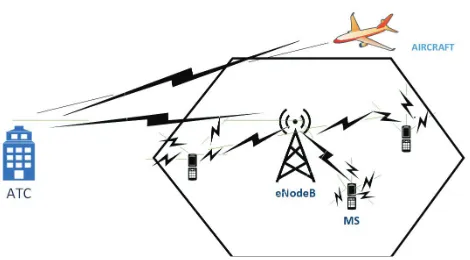
[image:2.595.307.542.103.233.2]In this paper, we consider an LSA arrangement between an airport incumbent and an MNO cellular network as the LSA licensee (Fig. 1). The airport telemetry system uses the spectrum specifically for air traffic control (ATC) i.e., for communication between the ATC tower and aircraft(s) during
Fig. 1. The LSA system model.
and shortly after take-off as well as before landing. It is at these period when the incumbent utilizes its spectrum that it revokes the right of access granted to the licensee. However, as earlier mentioned, under the dynamic LSA implementation recommended in [6], the revocation of the licensee’s spectrum access is an imposition of constraints on the transmission power, rather than an outright vacation of the spectrum. During this period, the licensee transmit power must be set at a level such that the interference received by the incumbent does not exceed its maximum tolerable interference power, i.e., the incumbent’s interference threshold.
In this work, we assume interference from both the uplink and downlink of the licensee, a cellular MNO. For the uplink, we focus on the interference to the flying aircraft as a result of the omni-directional transmissions of the user equipments (UEs) while for the downlink, we assume the eNodeB is at a height comparable to the ATC tower’s horizon (Fig. 1). Furthermore, we also assume that the transmission link from the ATC to the aircraft uses the same channel as our licensee uplink transmission and equivalently the reverse link, i.e., from the aircraft to the ATC, uses the same channel as the MNO downlink. Therefore, we will consider the effect of the reduced transmission power on the licensee’s system EE in both transmission directions.
A. The Limited Transmit Power
When the licensee has unrestricted access to the spectrum, the MNO can transmit up to its maximum rated power. How-ever, when the incumbent demands the use of its spectrum, the MNO must reduce its transmit power by an amount that will ensure the aggregate interference at the incumbent receiver (either the aircraft or the ATC tower, depending on the transmission link direction) is at most equal to its maximum tolerable interference. Similar to the approach in [5], we define this transmit power differentialP∆ as follow:
P∆=IΞ−Ith, (1)
the eNodeB or the UEs’, hence Ξ∈ {UPLINK,DOWNLINK} andIth is the incumbent’s interference threshold. The limited power can then be written as:
PLT =
Pmax−P∆ P∆>0,
Pmax otherwise,
(2)
where PLT, is the limited power which the licensee must transmit with, during the revocation of its spectrum access right; whilePmax, is the transmit power of the licensee when it has full and unrestricted access to the LSA spectrum.
Equation (2) implies that, if the interfering signal power of the licensee is less than or equal to the incumbent’s tolerable interference threshold, it will not be necessary for the transmit power of the licensee to be reduced. However, as expected, if the interfering power of the licensee is greater than the incumbent’s maximum tolerable interference, the licensee’s transmit power must be reduced by an equivalent amount when the incumbent demand the use of its spectrum.
Assuming an incumbent receiver is located at a point y, within the interfering range of the licensee, IΞ is given as
IΞ= X t∈T
Pthtl(ky−tk),
l(t) =ktk−n,
(3)
where T is the set of all transmitting nodes,ht represents the power fading coefficient for a node twith transmit powerPt,
l denotes distance related power loss, whilenis the path loss exponent.
In the downlink direction,IΞ is the interference due to the eNodeB transmission. If we assume a single eNodeB coverage area, we can, therefore, write (3) as
IΞ=IBS=PDhDl(D), (4) where IBS is the interference received at the ATC tower due to the eNodeB’s transmissions with transmit powerPD, while
hD and l(D) are the power fading and path loss along the transmission path between the MNO eNodeB and the ATC tower.
However, for the uplink direction,IΞis the aggregate or cu-mulated interference of many transmitters (UEs) characterized by the poisson spatial distribution of the UEs in the eNodeB coverage area. Therefore the interference to a given aircraft located at a point within the vicinity of the UEs transmission range is
IΞ=IM S= X k∈ϕ
Pkhkl(k),
ϕ={k1, k2, ...kK},
(5)
where similarly to (4), IM S, Pk, hk and l(k) are the UEs equivalent of interference, transmit power, fading and path loss respectively, along the transmission path between the MNO UEs and the flying aircraft. ϕis the stochastic point process describing the spatial distribution of the UEs in the eNodeB
coverage area of the LSA licensee. Forn >2, the probability density function (PDF) ofIM S is [10]:
fI(i;β) =
1 πi
∞
X k=1
Γ(βk+ 1) k!
λIπΓ(1−β)
iβ
k
sinkπ(1−β),
(6) where β= 2n,Γ(.)is the gamma function.
By substituting (1) and (4) into (2), we obtain the limited power for the downlink thus:
PD
1−hDl(D)
+Ith, Pmax=PD. (7)
In order to obtain the limited power for the uplink, we decoupleIth as in [11], by introducing a new set of variables
[Ithk, . . .]we can thus write the uplink limited transmit power for each UE as:
Pk
1−hkl(k)
+Ithk, Pmax=Pk. (8)
From (5), we define UEs’ to eNodeB sub-channel set K = [k1, . . . kK]. Similarly, the equivalent downlink (eNodeB to UEs’) sub-channel set can be defined as D = [d1, . . . dD]. Hence forP∆>0, the limited transmit power in the licensee downlink as well as uplink transmission direction is re-written as:
PLT = ( PD
d=1Pd
1−hDl(D)
+Ith Pmax=PD,
Pk
1−hkl(k)
+Ithk Pmax=Pk,
(9) where PD
d=1Pd=PD.
III. ENERGYEFFICIENCY
EE reflects the communication system energy performance and is defined as the achieved spectrum efficiency (SE) in bit/sec/Hz for a Joule of energy consumed in the system. Therefore, EE,η, is:
η= C
PS
. (10)
The achieved spectrum efficiency,C is
C=
{K,D}
X Ξ=1
1 2log2
1 +PΞgΞ
.
where gΞ is the normalised sub-channel gain over noise [12] for either the uplink or downlink transmission direction.The total consumed power,PS is
PS =Pc+
1 ǫ
{K,D}
X Ξ=1
PΞ,
wherePc is the circuit power andǫis the amplifier efficiency. During the time when the incumbent system revoke the unrestricted right of access to its spectrum, the EE of the licensee is
η=
P{K,D} Ξ=1 12log2
1 +PLTgΞ
Pc+1ǫP{Ξ=1K,D}PLT
A. Energy Efficient Limited Power Allocation
Assuming perfect channel state information (CSI) at the transmitter, in this section we formulate optimal power al-location to maximize the EE of the licensee system, during the period its right of spectrum access is constrained by the interference threshold of the incumbent. By substituting (9) into (11), we formulate the EE optimization problem for the uplink as follows:
ηU L∗ = max (P)
PK k=112log2
1 +Pk !
1−hkl(k)
+Ithk LkN
Pc+1ǫPKk=1Pk
1−hkl(k)
+Ithk
, (12)
and for the downlink as
ηDL∗ = max
(P) PD
d=112log2
1 +Pd !
1−hDl(D)
+IthD LdN
Pc+1ǫPDd=1Pd
1−hDl(D)
+Ith D
, (13)
where gΞ= 1
LΞN andLΞis the transmission channel path loss
between the eNodeB and the UEs in both uplink and downlink andNis the noise power. In (13), to obtain the fraction of the interference to be factored into each of the downlink channel power allocation, we decouple, Ith by averaging it over the total number of the downlink channels.
Equations (12) and (13), are ratio of two functions and hence, not concave. However, since the numerator C, are concave, (12) and (13) is strictly quasi-convex; we can thus apply classical convex optimization solution. Therefore, the solutions to the optmization problems in (12) and (13) can be obtained using fractional programming [13]. By the vari-able transformation method [13], we introduce Ψ =
Pc+ 1
ǫ
P{K,D}
Ξ=1 PLT]−1. Thus the equivalent concave optimization problems for the uplink is:
max
P Ψ.C,
(14)
s.t. Ψ.
Pc+
1 ǫ K X k=1 Pk
1−hkl(k)
+Ithk
= 1
(15)
Pk>0 k= 1,2, . . . , K.
(16) and for the downlink is:
max
P Ψ.C,
(17)
s.t. Ψ.
Pc+
1 ǫ D X d=1 Pd
1−hDl(D)
+Ith D
= 1
(18)
Pd>0 d= 1,2, . . . , D.
(19)
The Lagrangian function corresponding to (14), (15) and (16) (for the uplink) is:
L(Pk, χ, vk) =
Ψ.C−χ "
Ψ.
Pc+ 1 ǫ K X k=1 Pk
1−hkl(k)
+Ithk
−1 # + K X k=1
vkPk.
(20)
The Karush-Kuhn-Tucker (KKT) stationarity conditions cor-responding to the Lagrangian in (20) are:
δL(Pk, χ, vk)
δPk
= 0, δL(Pk, χ, vk)
δΨ = 0,
which are respectively written as:
!
1−hkl(k).Ψ 2 ln(2)(LkN+Pk
!
1−hkl(k) +Ithk
− χ.Ψ
1−hkl(k)
ǫ
+vk= 0
(21)
and
C−χ
"
Pc+
1 ǫ K X k=1 Pk
1−hkl(k)
+Ithk #
= 0 (22)
Solving for P in (21), the optimal power allocation in the uplink transmisson direction is then obtained as
P∗ k=
ǫ
2 ln(2).χ1−l(k)hk
− "
Lk.N+Ithk 1−l(k)hk
#
, k= 1, . . . , K.
(23)
Following similar steps, the solution to the optimization problems in (17)-(19), yields the equivalent optimal power allocation in the downlink transmission direction as
P∗ d =
ǫ
2 ln(2).χ1−l(D)hD
− "
D(Ld.N) +Ith
D.1−l(D)hD
#
,
d= 1, . . . , D.
(24)
IV. SIMULATIONRESULTS ANDANALYSIS
In this section we present numerical analysis of the effect of the incumbent’s revocation of spectrum access right on the licensee’s system EE. We assume a single eNodeB coverage area within the vicinity of the incumbent, an airport traffic control system. The system parameters are shown in Table I. Fig.2 and Fig.3 shows the licensee EE vs. the transmit power curve in the uplink direction while that of the downlink is shown in Fig.4 and Fig.5.
TABLE I SIMULATIONPARAMETERS
Parameter Value
Cell Radius 500 (metres)
No. of Users 2, 5, 20
Node Distribution Poisson (λ=1)
Downlink Transmit Power 12-60 w (40.8-48 dBm) Uplink Transmit Power 0.2-2.52 w (23-34 dBm)
Noise Density -60 dBm
Circuit Power 0 (dB)
Amplifier Efficiency 38%
ATC Type-B Receiver Noise Figure(NF) 3 (dB) Boltzmann’s constant(k) 1.38 x 10⁻²³
(J/K)
Bandwidth (B) 10 MHz
Temperature (T) 290 K
Noise Power 10log(kTB) + NF (dB) Protection Ratio (I/N) -10 (dB)
achieved EE of the two transmit power regime increases with increasing number of transmitting UEs.However, the margin of difference between the two transmit power regimes becomes slightly narrower with increasing operating power.
[image:5.595.54.284.106.283.2]In Fig.3, we examine the achievable EE using the uplink optimal power allocation obtained in section III-A for the lim-ited power regime. The comparison of this with the other two scenarios reveal a significant improvement in the achievable EE. For the two users, the EE with optimal power allocation is higher than even the EE when the spectrum is free and the licensee nodes can transmit at maximum operating power for the whole transmit power range considered. However, for five users, the optimized EE is only higher than the EE when the spectrum is free for the licensee unrestricted access, at lower transmit power.
Fig.4, show the comparison of the EE during the time
0 0.5 1 1.5 2 2.5 3
Transmit Power (Watts)
0 2 4 6 8 10 12 14 16
EE(b/J/Hz)
[image:5.595.308.537.515.702.2]nUser=2,busy spectrum nUser=5,busy spectrum nUser=2,free spectrum nUser=5,free spectrum
Fig. 2. Uplink EE vs.transmit power for the busy and free spectrum.
0 0.5 1 1.5 2 2.5 3
Transmit Power (Watts)
0 5 10 15 20 25
EE(b/J/Hz)
nUser=2,optimized nUser=5,optimized nUser=2,busy spectrum nUser=5,busy spectrum nUser=2,free spectrum nUser=5,free spectrum
Fig. 3. Uplink EE vs.transmit power for optimal power allocation.
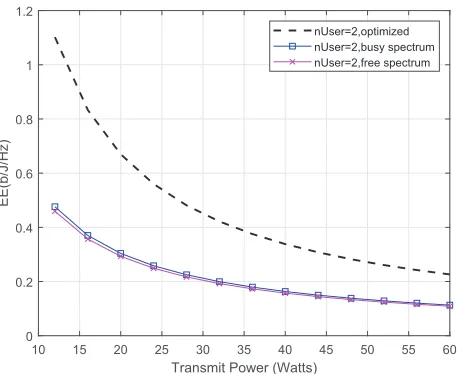
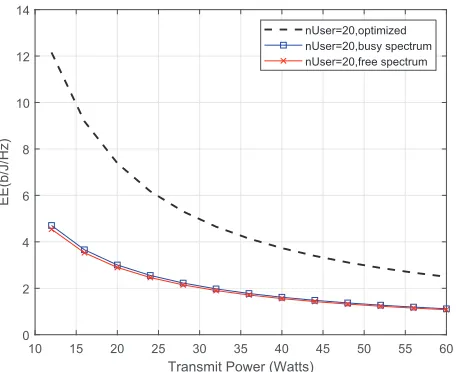
when the spectrum is free and busy as well as the optimal power allocation for busy spectrum in the downlink direction. Unlike in the uplink, the EE of the licensee does not suffer significant degradation when the licensee spectrum access is revoked in the downlink. This could be explained by that fact that the interference to the incumbent system in the downlink is from the eNodeB, a static and fixed source and as such, results in a linear relationship between the maximum operating and limited transmit power. As a result, there is a significant improvement in the EE with the optimal power allocation, than even when the licensee has free and restricted access to the spectrum. As Fig.5 shows, even with increasing number of users in the network, there is no degradation in the EE when
10 15 20 25 30 35 40 45 50 55 60
Transmit Power (Watts)
0 0.2 0.4 0.6 0.8 1 1.2
EE(b/J/Hz)
nUser=2,optimized nUser=2,busy spectrum nUser=2,free spectrum
[image:5.595.54.282.525.711.2]10 15 20 25 30 35 40 45 50 55 60
Transmit Power (Watts)
0 2 4 6 8 10 12 14
EE(b/J/Hz)
[image:6.595.54.282.95.281.2]nUser=20,optimized nUser=20,busy spectrum nUser=20,free spectrum
Fig. 5. Downlink EE vs.transmit power for 20 channels
the access right of the licensee is restricted.
V. CONCLUSION
In this paper, we investigated the effect of the revocation of the licensee’s spectrum access right on the energy efficiency (EE) of an LSA sharing between an airport incumbent and a mobile network operator licensee. We formulated expressions for the operating transmit power of the licensee, when its spec-trum access right is revoked/restricted in both the uplink and downlink transmission direction. We then proposed a power allocation scheme that maximizes the EE of the licensee during this time interval in which the licensee operating transmit power is limited. The results obtained show that while the EE suffer degradation in the uplink when the licensee spectrum access right is restricted, there is no noticeable difference in the achievable EE in the downlink direction. Furthermore, in the uplink, the optimal power allocation provides better EE even than when the spectrum is free especially at lower transmit power and number of users. However, with increasing number of users and transmit power, the free spectrum EE’s is better than the proposed optimal power allocation for the limited power. In the downlink however, the optimal power allocation EE is consistently better than the free spectrum EE. At low transmit power, the proposed optimal power allocation yields approximately two hundred percent (200%) increase in the uplink busy spectrum EE while it is about one hundred and fifty percent (150%) for the downlink.
ACKNOWLEDGMENT
The work of Samuel Onidare is supported by the National Information Technology Development (NITDA), under the Federal Ministry of Communication Technology, Federal Re-public of Nigeria.
REFERENCES
[1] ETSI, “TR 103 113 - V1.1.1 - Electromagnetic compatibility and Radio spectrum Matters (ERM); System Reference document (SRdoc); Mobile broadband services in the 2 300 MHz - 2 400 MHz frequency band under Licensed Shared Access regime,” European Telecommunications Standards Institute, Tech. Rep., July, 2013.
[2] V. Y. Borodakiy,et. al, “Modeling Unreliable LSA Operation in 3GPP LTE Cellular Networks,” in2014 6th International Congress on Ul-tra Modern Telecommunications and Control Systems and Workshops (ICUMT), Oct 2014, pp. 390–396.
[3] I. Gudkova,et. al, “Service Failure and Interruption Probability Analysis for Licensed Shared Access Regulatory Framework,” in2015 ICUMT, Oct 2015, pp. 123–131.
[4] I. Gudkova, A. Korotysheva, A. Zeifman, G. Shilova, V. Korolev, S. Shorgin, R. Razumchik, “Modeling and Analyzing Licensed Shared Access Operation for 5G Network as an Inhomogeneous Queue with Catastrophes,” in2016 ICUMT, Oct 2016, pp. 282–287.
[5] I. Gudkova,et. al, “Modeling the Utilization of a Multi-tenant band in 3GPP LTE System with Licensed Shared Access,” in2016 ICUMT, Oct 2016, pp. 119–123.
[6] A. Ponomarenko-Timofeev,et. al, “Highly Dynamic Spectrum Man-agement within Licensed Shared Access Regulatory Framework,”IEEE Communications Magazine, vol. 54, no. 3, pp. 100–109, March 2016. [7] Q. Ni and C. C. Zarakovitis, “Nash Bargaining Game Theoretic
Scheduling for Joint Channel and Power Allocation in Cognitive Radio Systems,”IEEE Journal on Selected Areas in Communications, vol. 30, no. 1, pp. 70–81, January 2012.
[8] Fp7 project adel. [Online]. Available: http://www.fp7-adel.eu [9] E. Mokrov, A. Ponomarenko-Timofeev, I. Gudkova, P. Masek, J. Hosek,
S. Andreev, Y. Koucheryavy, and Y. Gaidamaka, “Transmit Power Reduction for a Typical Cell With Licensed Shared Access Capabilities,”
IEEE Transactions on Vehicular Technology, vol. 67, no. 6, pp. 5505– 5509, June 2018.
[10] M. Haenggi,Stochastic Geometry for Wireless Networks, 1st ed. New York, NY, USA: Cambridge University Press, 2012.
[11] W. Yu, “Sum-capacity computation for the gaussian vector broadcast channel via dual decomposition,”IEEE Transactions on Information Theory, vol. 52, no. 2, pp. 754–759, Feb 2006.
[12] Z. Song, Q. Ni, K. Navaie, S. Hou, S. Wu, and X. Sun, “”On the Spectral-Energy Efficiency and Rate Fairness Tradeoff in Relay-Aided Cooperative OFDMA Systems”,”IEEE Transactions on Wireless Communications, vol. 15, no. 9, pp. 6342–6355, Sep. 2016.