Utilization of Waste Plastic as Partial Replacement of Fine and Coarse
Aggregates in Concrete Blocks
Dr. M Lokeshwari
1, Nikunj Ostwal
2, Nipun K H
2, Prakhar Saxena
2, Pracheer Pranay
21
Associate Professor Department of Civil Engineering RVCE, Bengaluru, India
2U.G Student Department of Civil
Engineering RVCE, Bengaluru, India
---***---Abstract -
Plastic is generated in large quantities all over
the world. It is believed that the breakdown of plastic takes time of more than thousand years. Improper plastic waste management leads to several environmental and health hazards. To overcome this problem recycled plastic aggregate (RPA) made using shredded plastic waste Polypropylene (PP) has been added by replacing it with various percentages (0-20%) of both fine and coarse aggregates. Several tests including fresh state properties like workability and hardened state properties like compressive strength test, split tensile strength test and dry density test were performed on the partially replaced specimens of cubes (150mm X 150mm X 150mm) and cylinders (150mm X 300mm) after 3, 7 ,14 and 28 days of curing period. Later based on the results of properties of mixed concrete with plastic aggregates were examined and compared with the original control mix concrete with normal aggregates. Replacement of natural aggregates by recycled plastic aggregate (RPA) can be used as an alternative and sustainable approach towards environmental friendly construction practice. The use of plastic waste material as a substitution of variable percentage of fine and coarse aggregates (0-20%) designed for M-40 grade concrete although reduces the concrete properties namely the fresh and hardened state properties of the concrete but can be used for various lower grade strength applications such as precast bricks, partition wall, panel wall, canal lining and so on.
Key Words
:
Concrete, Recycled Plastic Aggregate, Polypropylene, Shredded Plastic Waste, Fresh state Properties, Hardened state properties, Strength.
1.
INTRODUCTION
The world has created over 9 billion plenty of plastic since 1950. As of 2015 only 9% of the plastic waste was recycled, about 12% incinerated and about 79% ended up in landfills or some place in the environment (PlasticsEurope Market Research Group, 2018). Moreover about 180 billion plastic bottles were purchased in 2006 which raised to 480 billion after a decade (The Guardian, 2017). Only 7% of the waste plastic bottles turned into new bottles and the rest ended up in land fills or oceans. According to Ecowatch the usage of plastic bags worldwide annually lies between 500 billion to 1 trillion. A research by (National Geographic, 2018) states that there will be about 12 billion metric tonnes of plastic in landfills by 2050 if the plastic consumption increases at the current rate. Despite of limitations being imposed on the
production and usage of plastic, post consumer plastic waste the problem is not yet solved. India in the present scenario discards 70% of its total plastic production as waste. It is estimated that 5.6million tonnes per annum (TPA) of plastic waste is generated in this country (Central Pollution Control Board, Delhi, 2013). The various types of plastic are Polyethylene Terephthalate (PET), High Density Polyethylene (HDPE), Polyvinyl Chloride (PVC), Low density Polyethylene (LDPE), Polypropylene (PP), Polystyrene (PS) etc. The waste plastics availability based on various types of plastic are 23% LDPE, 17.3% HDPE, 18.5% PP, 12.3% PS, 10.7% PVC, 8.5% PET and 9.7% of other types (Zoorob and Suparma, 2000).
So many foraging cows in India have died from ingesting plastic bag litter that many of the states in the country have banned the distribution of plastic bag and the effect of plastic waste has a direct and a deadly effect on marine and wildlife after ingesting plastic or getting entangled in it. The availability of conventional fine aggregates i.e. river sand has become scarce and sand mining affects the riverbed characteristics increasing the cost of concrete. Polypropylene (PP) is one of the most widely used consumer plastic and has a wide range of applications like manufacturing of pipes, kettles, plastic containers, plastic bags, bottles, food containers, stationary folders, packaging, protective covers and storage boxes. PP being recyclable has a resin identification code of number “5”.
temperature. Moreover, the tests showed that higher the replacement of (RPA’s) in the specimen, lower is the corresponding workability of the mix. (Nursyamsi and Winner., 2016) conducted research by knowing the effect of using pet plastic waste gradations and concluded that lower fineness modulus of waste plastic aggregate caused lighter production of concrete. (Semiha et al., 2009) conducted laboratory tests on the usage of shredded waste PET bottles with GBFS and deduced that the mortar produced could be used as an earthquake resistant material as the dead weight of the specimen dwindled. Moreover its use termed productive for the environmental concern. (Batayneh et al., 2007) studied the impact of waste ground plastic on the slump of specimen. Partial replacement of fine aggregate by waste plastic aggregate upto 20% replacement was studied. It was observed that the slump was reduced to 25% compared to the control specimen for a 20% replacement of fine aggregate with plastic particle content. (Choi et al,, 2005) noticed the effect of using PET waste aggregate on workability of concrete. The water-cement ratio were planned to be 0.45,0.49 and 0.53 and the waste plastic replacement ratios were 0%,25%,50% and 75% of fine aggregate by volume. As the water-cement ratio increases the increase in the workability was observed to be 52%, 104% and 123% respectively. (Ismail et al., 2007) reported that as the waste plastic ratio increases the slump is prone to decrease drastically. This decrease can be ascribed to the fact that the plastic waste particle was not only spherical and smooth in shape but were also non uniform in shape which caused less fluidity. (Babu et al., 2004) noticed better flow and less segregation while using expanded plastic mixes without the use of bonding additives. (Al-Manaseer and Dalal., 1997) reported the impact of waste plastic aggregate on the bulk density on concrete. The bulk density reduced and was noticed to be directly proportional to the waste plastic aggregate content further it was reduced by 2.5%, 6% and 13% for the concrete specimen containing 10%, 30% and 50% plastic aggregates respectively.
2.
EXPERIMENTAL PROGRAM
2.1 General
Specimens were cast for different volume percentages of plastic partially replacing natural aggregates in concrete with recycled plastic aggregates (fine-coarse) i.e of 0-0%, 5-5%, 10-10%, 15-15% and 20-20% conforming to IS:10262-2009.
2.2 Material Properties
2.2.1 Cement
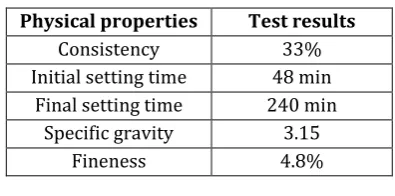
[image:2.595.334.532.119.217.2]Grade 43 Birla Shakti ordinary portland cement (OPC) was used for casting cubes and cylinders for all concrete mixes. Laboratory tests conforming to IS: 4031-1988 conducted on cement are given below in Table 1.
Table -1:
Physical properties of cement
Physical properties Test results
Consistency 33%
Initial setting time 48 min Final setting time 240 min
Specific gravity 3.15
Fineness 4.8%
2.2.2 Aggregate
As per the laboratory tests the various physical properties of fine and coarse aggregates are given in Table 2.
Table -2:
Physical properties of fine and coarse aggregate
Physical properties
Fine aggregate Coarse aggregate
Type M-sand Crushed
Specific gravity 2.57 2.6
Water absorption
14.46% 3.645%
Max size Nil 10mm
Fineness modulus
2.875 7.68
Grading zone IS:383-1970, conforms zone
II
IS:383-1970, conforms 10mm
downsize
2.2.3 Water
Water used conforms to IS: 3025 (part 22, 23)
2.2.4 Waste plastic (PP) fine aggregate
Waste PP collected was grinded in a blade mill to the size of 0.1-3mm. The grinded PP was washed and sun dried to obtain the final product. Then the obtained particles were separated through sieves and subsequently reassembled according to the granulometric curve of the fine aggregate.
2.2.5 Waste plastic (PP) coarse aggregate
Waste PP collected was grinded in a blade mill to the size of 0.1-3mm to form flakes. These flakes obtained are heated to a temperature ranging between 1700 C and 1800C to form melted blocks. The melted blocks are cooled to form solidified PP blocks. The agglomerate of PP are crushed using a crushing machine to obtain desired size (8-10mm).
3.
MIX DESIGN
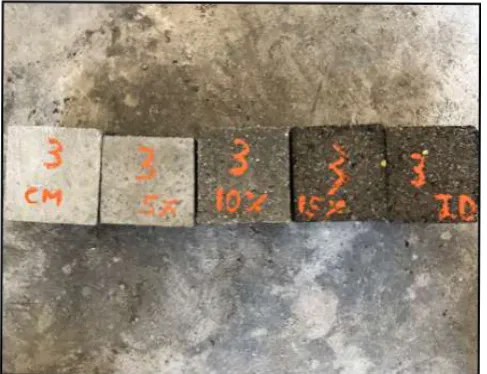
[image:2.595.312.558.303.469.2]with Recycled plastic aggregates(fine-coarse)i.e.of 0-0%, 5-5%, 10-10%, 15-15% and 20-20% conforming to. IS:10262-2009 as shown in Figure 1. Cube specimens of size 150 mm X 150 mm X 150 mm were casted for different proportions with RPA’s and compared with the properties of concrete prepared without RPA (control mix). Cylinder specimens of size 150 mm x 300mm were casted for different proportions with RPA’s and compared with the properties of concrete prepared without RPA (control mix). The mix proportion is shown in Table 3.
Fig -1: Cube specimens (0-20%) replacement
4.
RESULTS AND DISCUSSIONS
4.1
Slump
The slump is decreasing sharply with increase in waste plastic ratio as shown in Chart 1. Owing to the reduced slump values of waste plastic concrete mixes is due to slighter fluidity and non uniformity in shape of plastic particles.
Chart -1: Graph for Slump vs % replacement of aggregates
4.2
Compressive strength test
Cubical specimens of size 150mm were used to cast desired cubes for various curing ages as per IS: 516-1992 and the average strength of three cubes was taken as the compressive strength of that specimen overall for better accuracy. The trend is shown in Chart 2. It is observed that there was a decrease in compressive strength by 27.7%, 47.7%, 71.9%, 81.0% with an increase in plastic content for various % replacement respectively. This reduction is attributed to the decrease in adhesive strength between cement paste and plastic aggregate.
4.3
Split Tensile strength test
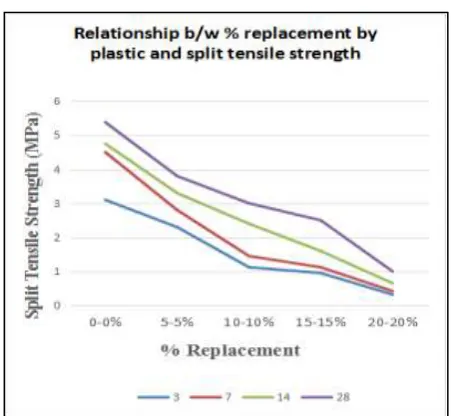
Cylindrical specimens of size 150mm dia x 300mm height were cast for various curing ages and for various % replacement of fine and coarse aggregates. The tensile strength of resultant mix is obtained by taking average of three specimens. The trend is shown in Chart 3.
4.4
Dry density
[image:3.595.41.285.228.415.2]Table -3: Mix proportions for 1 meter cube of concrete with various plastic percentage
fact that plastic possess lower unit weight compared to the density of coarse aggregate. The average of three samples was taken for every type of replaced specimen to achieve accuracy. Similar observations were also made by various other researchers. Table 4 shows the unit weight of respective specimens.
Chart -2: Compressive strength for different % replacements
Chart -3: Split tensile strength for different % replacements
Table -4: Dry densities of control mix concrete and plastic added concrete
5.
CONCLUSION
The present study observes that both the fresh and hardened state properties tend to decrease as the percentage replacement of plastic in the concrete mix increases. The slump decreases sharply with increase in waste plastic ratio. Nonetheless these type of mixes can be utilized in situations which require low degree workability. Moreover the compressive and Split tensile strength of the concrete mix also decreases with increase in waste plastic ratio for all curing ages. There was a decrease in compressive strength by 27.7%, 47.7%, 71.9%, 81.9% with respective increase in plastic content. The control mix was designed for M-40 grade and with a replacement of 5-5% the achieved strength was almost M-30 which can be used to make pathways, roadways and external walls and slabs. With a replacement of 10-10%, the achieved strength was almost M-20 which can be used as bedding of footings, domestic floors with reduced cost. Furthermore with a replacement of 15-15% the achieved strength was likely as M-10 which can be used as patio slabs, pathways and other nonstructural works. With lesser density the 10, 15, 20% replaced specimens fall under light weight concrete category hence decreasing the dead weight of the structure. The various civil engineering applications where it can be used are namely precast bricks, partition walls, panel walls, canal ling and so forth.
Fine Aggregate Coarse Aggregate Concrete
Mix
Cement (kg/m3)
Water (kg/m3)
w/c NA (kg/m3)
RPA (kg/m3)
NA (kg/m3)
RPA (kg/m3)
RPA (%)
CM(Cont--rol Mix)
463 208 0.45 955 0 814 0 0-0%
Mix 1 463 208 0.45 907 48 773 41 5-5%
Mix 2 463 208 0.45 860 96 733 82 10-10%
Mix 3 463 208 0.45 812 144 692 123 15-15%
Mix 4 463 208 0.45 764 192 651 164 20-20%
% Replacement Unit Weight (Kg/m3)
0-0% (CM) 2440
5-5% 2263
10-10% 2024
15-15% 1940
[image:4.595.48.274.540.748.2]REFERENCES
[1] PlasticsEurope,2018.<http://www.plasticseurope.org/> [2] TheGuardian.,2017.http://www.theguardian.eu/index.p
hp/home
[3] Ecowatch.,2018.<http://www.ecowatch.org/Domino_en
glish/ecowatch.htm>
[4] NationalGeographic.,2018.<http://www.nationalgeogra
phic.org>
[5] Central Pollution Control Board.,
2013<http://www.cpcb.nic.in>
[6] Zoorob, S.E, Suparma, L.B., 2000. “Laboratory design and
investigation of the properties of continuously graded Asphaltic concrete containing recycled plastics aggregate replacement (Plastiphalt)”. Cement & Concrete Composites (22) 233-242
[7] Sheelan Hama and Nahla Hilal.,2017. “Fresh properties
of self-compacting concrete with plastic waste as partial replacement of sand” . International Journal of Sustainable Built Environment (6), 299-308.
[8] Liliana Ávila Córdoba, Gonzalo Martínez-Barrera, Carlos
Barrera Díaz, Fernando Ureña Nuñez, and Alejandro Loza Yañez.,2013. “Effects on mechanical properties of recycled PET in cement-based composites” . International Journal of Polymer Science Volume 2013, Article ID 763276.
[9] F. Pacheco-Torgal, Yining Ding and Said Jalali.,2011.
“Properties and durability of concrete containing polymeric wastes (tyre rubber and polyethylene terephthalate bottles):An overview”. Construction and Building Materials 30 (2012) 714-724.
[10] C. Albano, N. Camacho, M. Hernandez, A. Matheus and A.
Gutierrez., 2009. “Influence of content and particle size of waste PET bottles on concrete behaviour at different w/c ratios”. Waste Management 29 (2009) 2707-2716.
[11] Togay Ozbakkaloglu, Lei Gu and Aliakbar
Gholampour.,2017. “Short term mechanical properties of concrete containing recycled polypropylene coarse aggregates under ambient and elevated temperature”. Journals of Materials in Civil Engineering ASCE ISSN 0899-1561.
[12] Nursyamsi and Winner Syukur Berkat Zebua.,2016.
“Influence of PET plastic waste gradations as coarse aggregate towards compressive strength of light concrete”. ELSEVIER Procedia Engineering 171 (2017) 614-619.
[13] Semiha Akcaozoglu, Cengiz Duran Atis and Kubilay
Akcaozoglu.,2009. “An investigation on the use of shredded waste PET bottles as aggregate in lightweight concrete”. ELSEVIER Waste Management 30 (2010) 285-290.
[14] Batayneh M, Marie I, Asi I., 2007. “Use of selected waste
materials in concrete mixes”. Waste Management (27) 1870–1876.
[15] Choi, Y.W., Moon, D.J., Chung, J.S., Cho, S.K., 2005. “Effects
of waste PET bottles aggregate on properties of concrete”. Cement and Concrete Research 35, 776–781.
[16] Zainab Z, Ismail, E, Hashmi A., 2007. “Use of waste
plastic in concrete mixture as aggregate replacement” Waste Management 30 (2), 285-290.
[17] D. Saradhi Babu and Ganesh Babu., 2004. “Performance
of fly ash concretes containing lightweight EPS aggregates”. Cement and Concrete Composites 26(6):605-611
[18] Al-Manaseer AA, Dalal TR., 1997. “Concrete containing