SYNTHESIS AND STRUCTURAL CORRELATION TWO
COPPER(II)COMPLEXES
Jeeva, J.* and Ramachandramoorthy, T.
PG and Research Department of Chemistry, Bishop Heber College (Autonomous),
Tiruchirappalli-620 017, Tamil nadu, India.
ABSTRACT
Copper(II) complexes with 4- hydroxypyridine and cyanate ion /
thiocyanate ion were synthesised in microwave field using a
microwave oven. They were characterized and these two complexes
were compared for their structural and biological activities.
KEY WORDS: far Copper(II)Complex, 4 Hydroxypyridine, Thermogram, Antimicrobial.
INTRODUCTION
Many branches of science and technology have close association with
the development of chemistry and particularly coordination chemistry
[1]
With the development in progress many compounds were synthesized and studied for their
properties. Copper complex are few such compound prepared due to its involvement in all
fields of chemistry. One such compound 1-hydorxyethylienediphosphoric acid (HEDP) has
been known for the past many years by Chemists[2-4]. Other compounds such as cytochrome
oxidase consisting of heme and copper in the ratio of 1:1 and tryrosinases were first such
enzymes in which copper was detected to be its essential constituent. Another important
haemocyanin is a cupro protein found in mammals and functions as oxygen carrier.
MATERIALS AND METHODS
Copper nitrate used was of AnalaR grade. The solvents used viz., DMSO, acetonitrile, DMF, methanol, ethanol were also of AnalarR grade and used as such.
4-hydroxypyridine was purchased from Alfa Aesar company.
Article Received on 05 July 2014,
Revised on 29 July 2014, Accepted on 24 August 2014
*Correspondence for Author Dr. Jeeva, J
PG and Research Department of
Chemistry, Bishop Heber College
(Autonomous),
Tiruchirappalli-620 017, Tamil nadu, India.
INSTRUMENTAL ANALYSES
The following instrumental analysis were carried out for the complexes. Elemental analysis
was done using elementar Vario EL III. Metal estimation for copper was done
volumetrically. Electrical conductivity measurements were carried out in acetonitrile
medium (10-3M) at 300C using a digital conductivity bridge (Equiptronics, EQ660). The
magnetic susceptibility measurements were done by Lakeshore VSM-7410. Electronic
spectra were recorded by solid state diffused reflectance method. IR spectra were recorded
using Perkin Elmer Spectrum RXI spectrometer in 4000-400 cm-1 range with KBr pellet
technique. Far – IR spectra were recorded using Bruker 3000 Hyperion spectrometer. The
cyclic voltammetric measurement were done by Princeton Applied Research, model-versa
stat mc. Thermal analysis were done in Perkin Elmer, Diamond TGA/DTA instrument. EPR
spectra were taken using Miniscope EPR Spectrometer. Antimicrobial activities were done
using agar well diffusion method. Antioxidantal measurements were carried out by DPPH
radical scavenging method.
SYNTHESIS OF COMPLEXES
To a solution of copper nitrate 1.00 g each (4.2 mmol and 4.2 mmol respectively) in
methanol, 0.79g(8.32mmol) of 4-hydroxypyridine in methanol was added in drops with
constant stirring. The mixture was irradiated in a microwave oven (IFB – 25PG IS) at
900 W for about 10 seconds. Then sodium cyanate 0.54g and 0.83g (8.4 mol each)
respectively in ethanol was added and the mixture was irradiated for about 10 seconds in
microwave oven. The preceipitated green and yellowish green coloured complexes were
filtred, washed with ethonal, driedand kept in air - tight glass containers.
RESULTS AND DISCUSSION
On the basis of elemental analysis, the composition of metal complexes were arrived at
percentage of various elements helps to formulate the complexes. Low molar conductane
values indicate the complexes are non electrolytes[5]. The values are given in Table 1.
Table 1 Analytical Data of Complexes S.
No. Complex Colour
Yield %
Elemental Analysis
(ohm-1 Cm2 mol-1)
C% H% N% S% Metal%
1 [Cu(OCN)2 (4-HP)2] Green 58.6
42.65 (42.67)
2.96 (2.98)
16.56
(16.58) -
17.15
(17.17) 70.2
2 [Cu(SCN)2 (4-HP)2] Yellowi
sh green 48.7
38.94 (38.96) 2.70 (2.72) 15.12 (15.14) 17.31 (17.33) 18.80
Theoritical values are given in paranthesis
Magnetic Susceptibility
The observed magnetic moments of these two copper(II)complexes agree with the presence
of one unpaired electron, with the value of 1.76 BM[6]. The value for cyanate complex is
1.81 BM and for thiocyanate complex is 1.83 BM.
Electronic Spectra
The absorption band at 234 nm and 239nm in both the complexes indicate the charge transfer
spectral frequencies[7]. Strong absorption bands at 528 nm and 504nm for cyanate and
thiocyanate complexes is due to transitions 2Eg 2B1g, 2B1g 2B1g, 2 A1g 2 B1g which
gives an indication of the structure as tetragonally distorted octahedral for these two
[image:3.595.164.440.347.496.2]complexes (7) Table 2.
Fig. 1: UV – Visible Spectrum of [Cu(OCN)2 (4-HP)2]
Table 2: UV – Visible Spectral Data of Complexes
S.No. Complex max(nm) Assignment Probable
geometry
1 [Cu(OCN)2 (4-HP)2]
234
528
Charge Transfer 2Eg 2
B1g 2
B2g 2B1g 2
A1g 2B1g
Tetragonally distorted octahedral
2 [Cu(SCN)2 (4-HP)2]
239
504
Charge Transfer 2Eg 2
B1g 2B2g 2
B1g 2A1g 2
B1g
Cyclic Voltammetric Study
This study is done to monitor spectral and structural changes accompanying electron transfer
[9]
. The reduction of copper(II) is reversible. Ipa / Ipa is equal to unity indicates the
chemical reversibility of the redox change and the value is also an indication of the
[image:4.595.142.449.189.348.2]reversibility of the reaction[10] Table 3.
Fig. 2 Cyclic Voltammogram of [Cu(OCN)2 (4-HP)2)]
Table 3 Cyclic Voltammetric Values Of Complexes
Sl. No. Complex Epc1(Epc2), Epc2 (Epc2) Ep1a Ep26 Epal(Epa/2)
1 [Cu(OCN)2 (4-HP)2)] -0.76(0.69), -1.57(-1-49) -0.09 -0.14 -0.59(-0.67)
2 [Cu(SCN)(4-Hp)2] -0.87(-0.76) -0.09 - -0.62(-0.75)
INFRARED SPECTRA
In the infrared spectra of the ligand 4-HP a characteristic band is observed at 3400 cm-1 for
phonetic –OH, 2430 cm-1 for aromatic C-H and 1377cm-1 for C=N [11]. The displacements
of the band by 10-30cm-1 towards lower region in complexes has been attributed to the
formation of co-ordination bond between 4-HP pyridine ring nitrogen and metal ion[12].
Such observations have also been made in case of cyanate ion complex and thiocyanate ion
Fig. 3 IR Spectrum of [Cu(OCN)2(4-HP)2]
Table 4 Infrared Spectral Data of The Complexes Cm-1 S.
No. Compound -OH
C-H Aromatic
ring
C=N
OCN Symmetric
Stretching
OCN Asymmetric
Stretching
SCN Symmetric Stretching
SCN Assymmetric
stretching
1 4-HP 3400 2930 1377 - - - -
2 [Cu (OCN)2(4-HP)2] 3376 2998 1411 1251 2110 - -
3 [Cu (SCN)2(4-HP)2] 3407 2971 1375 - - 1217 2153
FAR INFRARED SPECTRA
In complex [Cu(OCN)2(4-HP)2] the ligating N atom of metal nitrogen bond frequency
(M-NCO) values are at 375cm-1 and 523cm-1. In [Cu(SCN)2 (4-HP)2] the ligating N atom of
(M-NCO) values are at 488cm-1. This is well agreed with the reported value [13]. Thus the
ligating atom is confirmed Table 5.
Table 5 Far Infrared Spectra Data Of Complexes Cm-1 S.
No. Complex
Metal Nitrogen
Metal –Nitrogen Stretching
frequency
Metal – 4 HP Nitrogen Stretching
frequency
1 [Cu(OCN)2 (4-HP)2] 375 - 240
2 [Cu(SCN)2 (4-HP)2] - 488 238
Epr Sprectra
The EPR spectra of samples in DMSO at liquid nitrogen temperature could provide values
of g, gII and gav. It has been suggested that the value other than an isotropic g-values from
the powdered spectrum can be assigned. From the spectrum considerable interaction between
the copper(II)centres can be interpreted and also that it is anti ferromagnetic[14]. The g, gII
tetragonally distorted octahedral. The deviation from the free – spin value may be due to
[image:6.595.143.417.114.269.2]covalent bonding. Same result occurs for thiocyanate complex also. Table 6.
Fig. 4 EPR Spectrum of [Cu(OCN)2 (4-HP)2]
Table 6 EPR Spectral Data of Complexes At LNT
S. No. Complex A11 x 10-4 cm-1 gII g gav 2
1 [Cu(OCN)2 (4-HP)2] 185.88 2.1493 2.6620 2.1880 0.8164
2 [Cu(SCN)2 (4-HP)2] 186.92 2.1534 2.6810 2.2131 0.9985
THERMAL ANALYSIS
The thermogram of cyanate complex shows gradual release of CO2 with time and at 2360C to
2580C with a weight loss of 5% two molecules of 4-HP is released. This suggest the
structural make up of the complex. Similar observations are seen in the themogram of
thiocyanate complex[15].
[image:6.595.133.464.513.690.2]Table 7 Thermal Analysis Value For Complexes. S.
No. Complex
Type of Degradation
Temperature %
Degradation
Possible Species Evolved
Start 0C End0C
1 [Cu(OCN)2 (4-HP)2] Endothermic 236 258 5% Two moles of 4-HP
2 [Cu(SCN)2 (4-HP)2] Endothermic
167
369
203
384
12%
9%
Two moles of SCN Two moles of 4-HP
Antimictrobial Activities
The results show antimicrobial activity depends on central metal ion and coordination
number when compared to the ligand. Two bacteria staphylococcus aures and Bacillus subtilis were taken with one fungus Aspergillus flavus [16]. The thiocyanate complex shows moderate activity against these two bacterial growth. The cyanate complex is not active
against these two bacteria. The cyanate complex is less active against the fungus when
compared to the thiocyanate complex [17]. Table 8.
Fig. 6 Zone Of Inhibition of [Cu(OCN)2 (4-HP)2]
Table -8 Antimicrobial Activities Of Complexes (Mm) S.
No. Complex
Zone of inhibition in mm Staphylococous
Aureus
Bacillus Subtilis
Aspergillus flavus
1 [Cu(OCN)2 (4-HP)2] - - 10
2 [Cu(SCN)2 (4-HP)2] 10 8 -
3 Ampicillin - 15 -
4 Fluconozole - - 20
Antioxidant Properties
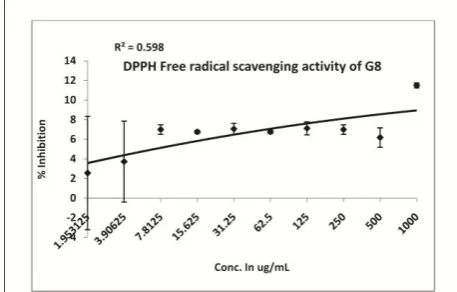
For [Cu(OCN)2(4-HP)2] the IC50 value is above 1000 g/ml which shows the low
antioxidant property. For [Cu(SCN)2(4-HP)2] the IC50 value is above thousand at 1260.13
µg/ml which also show low antioxidant property. Similar result, above 1000 μg/ml results
for 4-HP, these values were compared with the standard vitamin C which have 136 μg/ml [18].
Fig. 7 DPPH Free Radical Scavenging Activity of [Cu(OCN)2(4-HP)2]
Table 9 IC50 Values For Complexes (Μg/Ml)
Sr.No. Complex IC50 Values in µg/ml
1 Vitamin C 136
2 [Cu(OCN)2(4-HP)2] Above 1000
3 [Cu(SCN)2(4-HP)2] 1260.13
4 4-HP Above 1000
CONCLUSION
Both the copper complexes with 4- hydroxypyridine were synthesized by similar method.
From the physical, spectral, electrochemical, thermal, and biological activities these two
complexes have the molecular formulae [Cu(OCN)2(4-HP)2] and [Cu(SCN)2(4-HP)2] These
complexes have tetragonally distorted octahedral geometry. Low antimicrobial activities
were observed for 4-HP and the complexes. Also the complexes have very low antioxidantal
property were recorded.
ACKNOWLEDGEMENT
The authors thank the Principal and Management of Bishop Heber College (Autonomous),
Tiruchirappalli. For providing laboratory facilities for the research work. The also thanks
SJC(ACIC)- Trichy, SAIF – Chennai, SAIF – Mumbai, STIC – Cochin and Gowri Bio tech
– Thanjavur for providing the required data.
REFERENCES
1. Lau KY, Mayr A and Cheung KK. Synthesis of transition metal isocyanide, bonding sites
in peripheral location. Inorg. Chim. Acta.1999; 285; 223-232. Sun XH, Li SJ, Liu YF,
Chen B, Jia YQ and Tao Y. Study on the Synthesis and Biological Activity of Sciff
2. Arvind KS, Parthasarthy R, Kshitiz J, Geeta M. Synthesis, Characterization and
antibacterial activity of 1,3,4 – thiadiazole derivatives. Inter J Sci Innovation Discovery,
2011;1(3): 353 – 361.
3. Costes JP and Fernandez – Garcia MI. Easy synthesis of ‘half – units’ ; their use as
ligands or as precursors of Non – Symmetrical Schiff base complexes. Inorg chim Acta,
1995; 237 : 57-63.
4. Tanveer A, Arvind KS, Nupur J, Deepika S. Synthesis and pharmacological activity of
1,3,4 – thiadiazole derivatives : a review. Int Res J Pharm, 2013; 3(3): 70-82.
5. Dehghanpour S, Mahmoudkhani AN and Amirnasr AM. Synthesis and characterization of
[Cu(Phca2en)(PPh3)x] (x=Cl, Br, I, NCS, N3) complexes. Crystal structures of
[Cu(phca2en)(PPh3)Br] and [Cu(phca2en) (PPh3)I]. Struct Chem, 2006; 17:255-262.
6. Habibi MH, Montazerozohori M, Lalegani A, Harington RW, and clegg W, N-N1-Bis
[2-nitrocinnameldehyde) ethylenediam inedicholorozinc (II). Anal Sci: X-Ray Struct Anal
Online, 2007; 23:X51-53.
7. Lever ABP. Inorganic Electronic Spectroscopy 2nd ed., New York; Elsevier : 1984
8. Elemile EE, Oviawe AP and otuokere IE. Potentiation of the antimicrobial activity of
4-benzylimino–2,3-dimethyl-1– phenyl pyrazole–5–one by metal chelation. Res J of
chemical sci, 2011; 1(8):6-11.
9. Raman N, Sakthivel A and Rajasekaran K. synthesis spectral characterization of
antifungal sensitive sciff base transition metal complexes, Mycobiology, 2007;
35(3):150-153.
10.Shaker Shayma A and Yang Farina. Preparing and Characterization of some mixed ligand
complexes of 1,3,7 trimethylxanthin, - picoline and thiocyanate with some metal ions.
American Journal of Scientific Research, 2009; 5(2009): 20-26.
11.Kazoo Nakmoto. Infra red and Raman spectra of Inorganic aad Coordination compounds,
3rd ed., New York : John Wiley and sons : 1978.
12.Meera Moydeen A, Syed Ali Padusha MB, Hany Hamsharya, Mohamed H.
El-Newehya and Salem S. AL-deyab. Synthesis, characterization and antimicrobial study of
N-Mannich base and its complex. Der Chemica Sinica, 2013; 4(3): 93-99.
13.Muruganandam C, Krishna Kumar K, Balasubramanian K, Synthesis characterization,
Antibacterial, Antifungal and Anticancer studies of a New Antimetabolite :
N-[(Diphenylamine) methy] acetamide and some of its Inner transition Metal Chelates
14.Agarwal Ram K, Deepak Sharma and Himanshu Agarwal. Synthesis, biological, spectral
and thermal investigation of cobalt(II) and nickel(II) complexes of
N-isnicotinamide 2,4-dicholorobenzaldimine. Bioinorganic Chemistry and Applications,
2006; 1-9.
15.Aurora Reiss, Mariana Carmen Chifiriuc, Emilia Amzoiu and Cezar Ionu Spnu.
Transition metal (II) complexes with cefotaxime – Derived Sciff Base : Synthesis,
Characterization and Antimicrobial studies. Bioinorg chem. and Appli.,
2014; 2014:17.
16.Santhosh B, Saravanan J, Mohan S, Asif IC. Synthesis and catimicrobial activity of some
new 2–substituted amino-3-(n-o-fluoro phenyl carboxamide)-6-n-methyl
piperidinothiophenes, J pharm Biol Sci. 2013; 1(1): 12-15.
17.Gulcin I.Antioxida nt activitiy of caffic acid (3,4-dihydroxycinnamic acid)
![Fig. 1: UV – Visible Spectrum of [Cu(OCN)2 (4-HP)2]](https://thumb-us.123doks.com/thumbv2/123dok_us/786292.585312/3.595.164.440.347.496/fig-uv-visible-spectrum-cu-ocn-hp.webp)
![Fig. 2 Cyclic Voltammogram of [Cu(OCN)2 (4-HP)2)]](https://thumb-us.123doks.com/thumbv2/123dok_us/786292.585312/4.595.142.449.189.348/fig-cyclic-voltammogram-of-cu-ocn-hp.webp)
![Fig. 3 IR Spectrum of [Cu (OCN)2(4-HP)2]](https://thumb-us.123doks.com/thumbv2/123dok_us/786292.585312/5.595.135.458.70.241/fig-ir-spectrum-cu-ocn-hp.webp)
![Fig. 4 EPR Spectrum of [Cu(OCN)2 (4-HP)2]](https://thumb-us.123doks.com/thumbv2/123dok_us/786292.585312/6.595.133.464.513.690/fig-epr-spectrum-cu-ocn-hp.webp)