Munich Personal RePEc Archive
Framed field experiments with
heterogeneous frame connotation
Ansink, Erik and Bouma, Jetske
Institute for Environmental Studies, VU University Amsterdam, the
Netherlands
25 January 2013
Framed field experiments
with heterogeneous frame connotation
∗
Erik Ansink
†Jetske Bouma
‡Abstract
We study label framing effects in linear public goods games. By account-ing for heterogeneous frame connotation, we can identify individual framaccount-ing effects. We test for such effects in a field experiment on irrigation manage-ment in India. Using membership of the water users association as a proxy for frame connotation, we find a differential impact on contributions in the game. Members contribute relatively more under the irrigation frame than non-members as compared to an alternative, neutral, frame. We conclude that experimental behaviour is sensitive to framing at the individual level but that such individual effects may cancel out on average, which explains previous studies that find mixed or only weak effects of framing.
Keywords: Framing effects; field experiment; public goods game; frame con-notation; irrigation management
JELclassification: C93; H41; Q15
∗We thank SOPPECOM staff members K.J. Joy and Suhas Paranjape for their support in
de-signing and implementing the experiment. We thank Kiran Lohakare, Suchita Jain, Vinit Raskar and Ashwin Madhaleand for excellent research assistance. We acknowledge financial support from EC FP7 project LiveDiverse under grant No. 211392 and EC FP7 project CombioServe under grant No. 282899.
†Institute for Environmental Studies, VU University Amsterdam. Email: [email protected].
1
Introduction
Experimental evidence suggests that context matters for economic behaviour in
a large range of situations. For example, subjects contribute more to a public
good when they are given the opportunity of cheap talk or voting, or when the
context triggers a social norm of contributing (Messer et al., 2007). Levitt and List
(2007) find that, in economic experiments, context matters and they provide a list
of relevant contextual factors: “relational situations, social norms, frames, past
experiences, and the lessons gleaned from those experiences”. As a consequence, small changes in the framing of a game may induce deviations in behaviour, even
if such changes do not alter the material incentives in the game.
Typically, this framing effect has been studied in the context of social
prefer-ences, where one game was framed as a ‘community’ game and another as a
‘busi-ness’, ‘stock market’, or ‘Wall Street’ game (Elliott et al., 1998; Liberman et al.,
2004; Rege and Telle, 2004). This type of framing is called label framing as it
only changes the wording of the instructions. Valence framing, which is closely
related, changes the reference point of the game (Dufwenberg et al., 2011). Both
types of framing have been studied extensively in public goods games where sub-jects would either ‘give’ resources to a common stock or ‘take’ resources from such
a stock (Andreoni, 1995; Cookson, 2000; Cubitt et al., 2011). A general result is
that framing induce higher contributions under frames with a positive
connota-tion. Dufwenberg et al. (2011) conclude that framing gives subjects a cue about
a comparable social situation, and that based on this situation they form their
beliefs, which affects their behaviour. For instance, when a ‘business’ frame is
perceived negatively, this is likely to affect both first-order and second-order
be-liefs about others’ contributions. As a result, contributions to the common stock
may be lower than under an alternative frame. Building on this insight, Ellingsen et al. (2012) test whether framing affects preferences or beliefs, using Prisoners’
dilemma experiments. Their results support the belief-hypothesis. Specifically,
they demonstrate the presence of coordination-based framing in which framing
induces players to coordinate on frame-specific equilibria (see also Dreber et al.,
2013).
There are also studies that report mixed or only weak effects of framing (e.g.
Levin et al., 1998; Rege and Telle, 2004; Brandts and Schwieren, 2009; Cubitt
on frame-specific equilibria, there are two possible explanations for such effects.
One is that the frame is not sufficiently strong to trigger a framing effect. The
other explanation is that subjects’ connotation to the frame may be heterogeneous,
which causes individual framing effects to cancel out on average. In this paper
we will focus on this second explanation. When subjects are heterogeneous with
respect to their frame connotation, the effects of framing are likely to be
differen-tial, with those who perceive the frame positively behaving differently from those
who perceive the same frame neutrally or negatively. Park (2000), for instance,
shows that the impact of valence framing differs per subject. In his experiment,
the ‘take’ frame affects the contributions of individualistically-oriented subjects, whereas cooperation-oriented subjects are hardly affected. Carpenter and
Carde-nas (2011), in explaining why they do not find label framing effects, state that
individual effects of framing may cancel out due to subject heterogeneity.
We test this heterogeneous-framing effects hypothesis in a field experiment,
in which we control for heterogeneous frame connotation. We have two reasons
for going to the field. The first reason is that in conventional lab experiments,
the subject pool may not be familiar with the context provided in the frame, so
that a frame connotation is absent. For instance, it is not clear whether and
how subjects in the lab relate to for instance a ‘business’ or ‘Wall Street’ frame. From this perspective, framing should be matched to a subject pool to which the
frame applies. Cardenas (2003) and Hayo and Vollan (2012), for example, conduct
common-pool resource experiments in the field with subjects who themselves are
actual commons users. The second reason for going to the field is that the field
context allows us to use endogenous heterogeneity in frame connotation. The
effects of subject heterogeneity on contributions in linear public goods games has
been studied before (cf. Cherry et al., 2005; Buckley and Croson, 2006; Reuben and
Riedl, 2013). These studies, however, assess the effects of exogenously assigned
heterogeneity in terms of e.g. endowments, contribution capacity, and marginal benefits. We take a different approach by using endogenous heterogeneity using
a proxy for frame connotation, the proxy being inferred from behaviour in the
field. This allows us to show the impact of normally unobserved heterogeneity on
experimental outcomes.
Our field experiment is a linear public goods game which we implemented in
the Indian state of Maharashtra. The label frame consisted of contributing to the
water users association (WUA) in terms of user fees and maintenance. The
alter-native frame consisted of contributing to the village festival, which served as the
neutral frame.1 In Section 3 we introduce the two frames in detail. Our proxy for frame connotation is membership of the WUA, which reflects the position of
vil-lagers vis-à-vis the WUA and irrigation management in the village. Based on the
framework of choice with frames introduced by Salant and Rubinstein (2008) and
described in Section 2, we hypothesize that framing has a differential impact on
contributions, with WUA members contributing relatively more under the WUA
frame than non-members as compared to the festival frame. Our results largely confirm this hypothesis.
2
Theory and hypothesis
In terms of the taxonomy of field experiments introduced by Harrison and List
(2004), our experiment is a framed field experiment. Compared with an
arte-factual field experiment, we introduce so-called field context to the information
provided to the subjects. We interpret this field context as a frame, because we
only change information which is seemingly irrelevant to the choices to be made by the subjects in the experiment (unlike e.g. Messer et al., 2007, 2013, who add
context that potentially changes pay-offs). Despite this irrelevance, a large body
of evidence points to the existence of framing effects. The dominant view is that
behaviour is affected because the frame matches a situation that is common to
the subjects. As Henrich et al. (2005) argue: “experimental play often reflects
pat-terns of interaction found in everyday life”. More generally, Salant and Rubinstein
(2008) argue that“a frame triggers the use of a particular rationale by the
individ-ual while making a choice”. We argue that this particular rationale is captured by
a measure of so-called frame connotation.
1The village festival, suggested by our local counterpart SOPPECOM as the most suitable
Based on our expectation that a positive frame connotation is positively related
to contributions in a public goods game with an associated frame, we construct our
main hypothesis. We do so in the context of the framework of choice with frames
as developed by Salant and Rubinstein (2008). This framework extends the
stan-dard model of choice to situations where choice is affected by seemingly
irrele-vant information: the frame (see also Kahneman and Tversky, 1984; Bacharach
and Bernasconi, 1997). A frame is used to construct an extended choice problem,
which we will adapt to accommodate for frame connotation. Formally, an extended
choice problem is a pair ¡A,cif¢, where A denotes the choice problem as a set of possible actions and cif denotes the frame connotation of agent ito frame f with
f ∈{WUA,FESTIVAL}. Agentichooses an actionai∈A, which, in the context of our
experiment, equals the selected contribution in the public goods game. Agents’
actions are stacked in the vectora=(a1, . . . ,an). We denote byπi(a) the material
pay-off to agent iin the game.
We allow for social preferences so that each agent has a utility function of the
form
ui=πi(a)+gi
¡
cif,π−i(a)
¢
. (1)
The function gi() assigns to any composition of the other agents’ pay-offs π−i(a)
a non-negative value. This value is increasing in the sum of contributions by
oth-ers, but not necessarily in each of its elements, and may be transformed by cfi.
This notation allows for a wide range of possible social preferences, including
as-pects such as altruism, reciprocity, and fairness considerations (cf. Bolton and
Ockenfels, 2000; Croson, 2007). In addition, our functional form allows to model both preference- and coordination-based hypotheses of framing effects
(Dufwen-berg et al., 2011; Ellingsen et al., 2012) as discussed in Section 1, and illustrated
in the following two examples.
Example 1(Preference-based framing). Denote positive and negative frame
con-notations by cfi >0 and cif <0 respectively. One possible specification of (1) for preference-based framing effects is
ui=πi(a)+cfi ·gi
¡
π−i(a)
¢
. (2)
prefer-ences and adjusts his own action accordingly, and vice versa.
Example 2(Coordination-based framing). Similarly, a possible specification of (1)
for coordination-based framing effects is
ui=πi(a)+gi
¡
π−i(a)
¢
s.t. ai=aj=hi
¡
cif¢
∀j6=i∈N, (3)
where the function hi
¡
cfi¢
assigns to each level of frame connotation cif a
non-negative value (increasing in cfi). Under a positive frame connotation, agent i
in-creases his expectation of the other agents’ actions—through the ‘belief ’-function
hi
¡
cif¢—and adjusts his own action accordingly, and vice versa. Depending on the existence of multiple equilibria in the game, this function acts as a coordination device to target a specific equilibrium.
Generally, using utility function (1) and given his connotation in the extended
choice problem ¡
A,cfi¢
, each agent chooses the u-maximal element ai ∈ A. Our
results do not allow to distinguish between e.g. (2) and (3) nor any other
speci-fication of (1). Instead, we focus on cif as a measurement for individual framing effects in line with the objective of our paper.
We can now formulate our main hypothesis which states that framing has a
differential impact on contributions. Denote byMthe set of WUA members and by
N the set of non-members. Using WUA membership as a proxy for frame
conno-tation we obtain E£
cWUA i
¤
>0 and E£
cFESTIVAL i
¤
=0 for all i∈M. That is, we expect
WUA members to have a strictly positive frame connotation under the WUA frame
and a neutral frame connotation under the festival frame. Similarly, we obtain
E£cWUA j
¤
≤0 and E£cFESTIVAL j
¤
=0 for all j∈N. That is, we expect non-members to
have a neutral or negative frame connotation under the WUA frame and a neu-tral frame connotation under the festival frame. Driven by this heterogeneity in
frame connotation cif we expect the following relation between contributions in
the public goods game:
EhaWUA i −a
FESTIVAL i > a
WUA j −a
FESTIVAL j
i
∀ i∈M, j∈N. (4)
Based on this inequality, our hypothesis is as follows.
Hypothesis. Framing has a differential impact on contributions, with WUA
compared to the festival frame.
We have two remarks on this hypothesis. First, the identified signs for all four
frame connotationscfi suggest the possibility of making statements aboutabsolute
contribution levels under both treatments. For example, based on cFESTIVAL
i =0 for
alli∈M∪N, we could hypothesize that contributions under the festival treatment
are equal for all subjects. Our hypothesis does not contain such statements. We
ac-knowledge that there may be other, unobserved, factors that cause one group (i.e.
M or N) to contribute more than the other under either frame. Instead, our
hy-pothesis captures the relative difference in contributions between the two groups compared for both treatments.
The second remark is that we have no expectation about the average framing
effect. There is no obvious reason to expect that, on average, subjects will
con-tribute more under the WUA or the festival frame. This observation is, in fact,
related to the core message of our paper. By accounting for heterogeneous frame
connotation, we can identify individual framing effects.
3
Experimental design
Some background information on the setting of the field experiment is necessary
in order to understand the type of framing we applied. We conducted our
experi-ments in three villages—Panumbre, Manadur and Kalundre—at the head of the
Warana basin in the Indian state of Maharashtra. The three villages are
homo-geneous in terms of caste (Kunbi Maratha), religion (Hinduism), land ownership
(quite frequent and homogeneous among land owners) and income (most
house-holds have both farm and off-farm income). Each village has a command area
of canal-irrigated land ranging from 200-400 ha. A major irrigation canal
down-stream of the Chandoli dam serves minor canals of several villages. In the three
villages assessed in this paper, WUAs were established (around 2002) as part of the Cooperative Societies Regulation which supported voluntary decentralisation
of irrigation management. A WUA is established when a majority of households
who own canal-irrigated land is in favour of doing so. The incentives for
establish-ing a WUA are: (i) up to 20% discount on abstracted water from the major canal,
(ii) a formal acknowledgement of water entitlements to the WUA, (iii) a one-time
patterns by the Irrigation Department (although non-compliance was common).
Responsibilities of the WUA are threefold: (i) collecting seasonal water
de-mand forms and developing the water distribution plan accordingly, (ii)
main-tenance of the minor canal (field channels are the farmers’ responsibility), and
(iii) collection of water charges, which consist of an an annual irrigation charge
set by the WUA and a surcharge (of up to 30%) in case the household is not a
member of the WUA. WUA members are primarily responsible for these tasks,
through the elected management committee of the WUA (consisting of rotating
WUA members), which oversees all its affairs. Besides these responsibilities, the
only difference between WUA members and non-members is that members do not pay the surcharge. Any household that owns land in the canal command area can
become a WUA member at a one-time small membership charge. As shown in
Section 4, only slightly more than half of the households are WUA members. This
low membership rate can be explained by a combination of three factors: (i) the
water charge is very low, so that the surcharge is not considered problematic as
compared to the responsibilities and paperwork that come with WUA
member-ship; (ii) there is a widespread belief in the villages that they are not capable of
managing the irrigation systems themselves; and (iii) WUAs are not allowed to
refuse water to non-members or impose any other sanctions solely on the basis of their non-membership.
A team of facilitators from SOPPECOM and VU University Amsterdam
con-ducted the field experiments in December 2011. A couple of days prior to the
ex-periment, SOPPECOM members invited household heads to participate using a
random sample of households owning canal-irrigated land from each village. The
only information provided upon invitation was that they were going to participate
in a game in which they could earn money. Prior to the experiment no further
information about the game or the context of the research project was provided.
Upon arrival, facilitators registered the subjects and randomly assigned them to one of two treatments, as discussed below. Because of possible illiteracy problems,
game instructions (see Appendix) were read out loud and were also acted out. We
tested the subjects’ understanding of the game by asking control questions.
The experiment is based on a standard linear public goods game in which
subjects are anonymously grouped in groups of size 4, using a fixed matching
token was worth 1 Indian Rupee (1 INR = USD 0.02). Subjects were given the
option to contribute tokens to the group account. Contribution decisions were
made simultaneously and in private. Based on the contribution decisions of all
subjects in one group, pay-offπi(a) to subject iin a given round equals
πi(a)=20−ai+0.4·
à 4 X
j=1
aj
!
, (5)
whereaidenotes the contribution in tokens of subjectito the group account. This
pay-off function reflects a social dilemma, in which contributions by other group
members positively affect own pay-offs. The individually optimal decision is to
contribute ai =0, while the socially optimal decision is for each subject in the
group to contributeai=20 (each subject earning 32 tokens). Parameter values of
pay-off function (5) correspond with previous studies that played the linear public
goods game with groups of size 4 (e.g. Fehr and Gächter, 2000).
Contribution decisions were made using cards that were put into coded
velopes. In each round, envelopes with extraction decisions were collected and
en-velopes with feedback were returned by one of the facilitators. Feedback included
individual contributionsaj of each group member j, the resulting group account
P4
j=1aj, and individual pay-offπi in this round. This procedure assured
double-blind interaction. The field setting of our experiment implies that we were forced
to make one major simplification to the standard linear public goods game. We
constrained the contribution decisions by subjects to multiples of 5 tokens. This
decision was based on our experience during pre-tests that the game puts a heavy cognitive load on many subjects. This simple alteration of the game eased the
subjects’ contribution decisions, as it limits their choice set while simultaneously
increasing the differences in pay-off between their possible choices. The game
was repeated for five rounds, with no history (i.e. no remaining tokens from
ear-lier rounds).2 In addition to the show-up fee of 50 INR, the maximum individual pay-off over five rounds equalled 190 INR. On average and including the show-up
fee, subjects earned 189 INR (approximately equal to twice the daily wage), with
2The main reason for playing five rounds was the field experiment context, where there is less
a standard deviation of 22 INR. The experiment lasted approximately one hour,
and including a survey and waiting time the activity took 2.5 hours in total.
Subjects were assigned to one of two treatments: the WUA frame or the village
festival frame. We designed a festival frame, rather than a neutral frame with
abstract wording, in order to have control over the context that subjects might
im-pose on the game themselves (Harrison and List, 2004). There are two differences
between treatments. One is that, depending on the frame, the game instructions
contained three instances of frame-specific wording (see Appendix). For example,
in the WUA treatment, contributions were labelled as “contributions to
irriga-tion system maintenance” while in the festival treatment they were labelled as
“collective effort of organizing the village festival”(translated back from Marathi).
The second difference is unavoidable given the field setting of our experiment. To
prevent communication between subjects in different treatments, subjects in the
festival treatment had to wait in a separate room for the subjects in the WUA
treatment to finish the experiment. We used this waiting time to have these
sub-jects fill out a survey (cf. Bouma and Ansink, 2013). In addition to standard
demo-graphic items, this survey also contained items on various aspects related to WUA
membership, WUA performance, and perceived legitimacy of the WUA. We argue
that there is no ex ante expected difference in game behaviour between having been isolated without a survey or having used this idle time to fill out a survey.
This timing of survey and experiment introduced additional framing to the WUA
treatment, while it did not interfere with the festival framing. Hence, in the WUA
treatment, the survey was conducted before the experiment and in the festival
treatment afterwards.
In total, our sample size consisted of 88 subjects, grouped in 11 WUA
frame-groups and 11 festival frame-frame-groups: 3 of each in Panumbre and 4 of each in both
Manadur and Kalundre.3
3We ran two additional sessions in two villages where no WUA was formed in order to analyse
4
Results
Summary statistics of our sample are provided in Table 1. All subjects were
house-hold heads, which explains both the relatively high average age (50) and the low
percentage of female subjects (11%). The level of illiteracy is high (33%) and a
quarter of the sample is income poor (i.e. income per capita below 740 INR/month,
the official Maharashtra poverty threshold).4 We have two sources of WUA mem-bership data: (i) stated memmem-bership from the survey, and (ii) official memmem-bership
records from the three WUAs. Because the two data sets were quite different, and because we are interested in framing effects, we only use the survey data.
We focus our analysis on first-round contributions only (see Footnote 2).
Fig-ure 1 shows the average first-round contributions separated by frame.
Contribu-tions are relatively high, with a mean contribution in the first round of 11.98
tokens, equivalent to 60% of the maximum possible contribution. The
Mann-Whitney sample statistic does not reject the hypothesis that contributions under
both treatments stem from the same distribution (z=0.525, p=0.600). Clearly,
we do not observe a framing effect when we do not take into account frame
conno-tation. Recall from Section 2 that we had no expectation which of the two frames would perform betteron average.
We proceed to take into account frame connotation by separating out the
first-round contributions by both frame and WUA membership, evaluating four
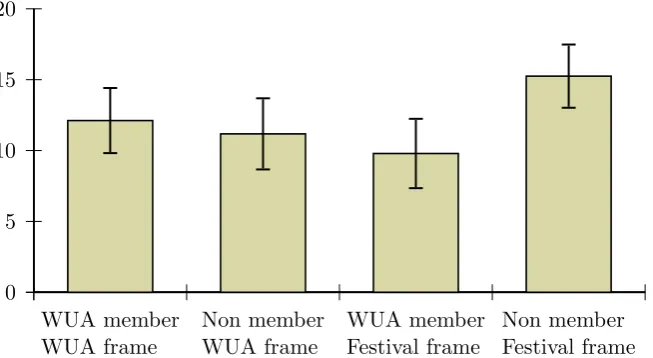
differ-ent groups. Figure 2 shows the average first-round contributions for each of these
groups. A Kruskal-Wallis test, corrected for tied ranks, rejects the hypotheses that
contributions for all four groups stem from the same distribution (χ2=9.02(3), p=0.029). Clearly, when taking into account heterogeneous frame connotation,
we observe an interaction effect with respect to the two framing treatments.
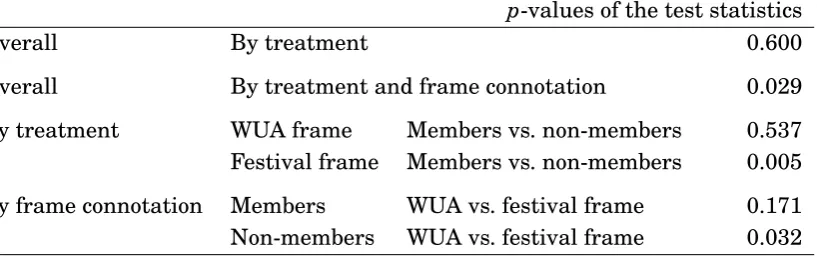
We further analyse this effect by evaluating pairwise differences between the four groups using Mann-Whitney sample statistics. Doing so, we find that most
of the difference is due to (i) non-members contributing more under the festival
frame than members (z= −2.82, p=0.005); and (ii) non-members contributing
more under the festival frame than under the WUA frame (z= −2.15, p=0.032).
The other two pairwise differences were insignificant with (iii) membersnot
con-4From Table 1, literacy and WUA membership seem to be correlated. Although literate subjects
tributing more under the WUA frame than non-members (z= −0.62, p=0.537);
and (iv) members not contributing more under the WUA frame than under the
festival frame (z=1.37, p=0.171). Table 2 summarises the results.
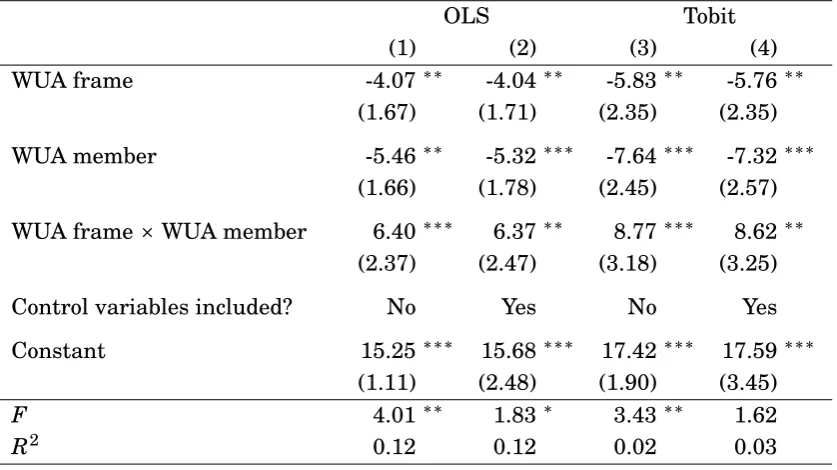
To test econometrically whether frame connotation affects contributions, we
estimated four models. In addition to standard OLS, we used random effects Tobit
because we observe corner solutions at contribution decisions of 0 (4 observations)
and 20 (19 observations), see the histogram in Figure 3. With censored data,
OLS may lead to inconsistent estimates of the coefficients, which is corrected in
Tobit. Nevertheless, Merrett (2012) shows that for public goods game data, Tobit
may create a bias compared to OLS because the simulated Tobit distribution may differ substantially from the common distribution pattern of contributions in a
public goods game. We will show results for both specifications.5 In models (1) and (3), the dependent variable is first-round contributions and the main explanatory
variables are treatment (WUA vs. festival frame), frame connotation (members
vs. non-members) and an interaction variable. In models (2) and (4), additional
control variables were included: age, gender, illiteracy, and a dummy when the
household is income poor. Our hypothesis corresponds to a positive coefficient for
the interaction effect between WUA frame and WUA membership. Results are
shown in Table 3.6
Table 3 shows that sign, effect size and significance of the explanatory
vari-ables are consistent across the four models. The inclusion of control varivari-ables does
not affect the sign, effect size or significance of the main explanatory variables. In
addition, all coefficients for the control variables are economically and statistically
insignificant. In assessing the results, the OLS and Tobit coefficients should be
interpreted differently. The coefficients in OLS models (1)–(2) are marginal effects
on the observed outcomes of first-round contributions while the coefficients in
To-bit models (3)–(4) are marginal effects on the uncensored latent variable. This
difference confirms that the Tobit coefficients may be biased upward and the OLS
5Given the limited number of contribution options (subjects were constrained to contribute
multiples of 5 tokens which creates 5 choice categories), we have also estimated an ordered probit model. Results were consistent, with signs and significance of the explanatory variables being identical to the OLS and Tobit results. Merrett (2012) discusses estimation approaches for public goods game data and finds that continuous estimation approaches outperform discrete approaches such as ordered probit.
6The models reported in Table 3 are extended with legitimacy indicators in the companion
coefficients downward.
Our main explanatory variable of interest, the interaction effect WUA frame
×WUA membership, has the expected positive sign and is both statistically and
economically significant. The OLS and Tobit results indicate that having a
posi-tive frame connotation (as measured by WUA membership) under the associated
frame (WUA) accounts for an increase in first-round contributions of about 7–8
tokens, out of 20 available tokens. This result implies that, by accounting for
heterogeneous frame connotation using WUA membership as a proxy, we have
identified individual framing effects. WUA framing and WUA membership both
have a negative effect on contributions. Recall that we did not have any expecta-tion on the sign or magnitude of these two coefficients. The negative signs of these
coefficients suggest that (i) an unobserved characteristic causes WUA members to
contribute less in general, as speculated in Section 2; and (ii) the WUA frame
induces a negative rather than a neutral frame connotation to non-members. In
general, our econometric results provide strong support for our main hypothesis
that framing has a differential impact on contributions. Combined with the
sam-ple comparisons from the beginning of this section, these results show that WUA
members contribute relatively more under the WUA frame than non-members as
compared to the festival frame.
5
Final remarks
We find a clear differential framing effect on contributions in a public goods game
when taking into account heterogeneous frame connotation. These individual
fects cancel out on average. This difference may explain mixed or only weak
ef-fects of framing found in previous studies, as discussed in Section 1. Our results
show that individual contributions under one frame may not be informative about
contributions under another. One implication is that heterogeneous frame con-notation should be considered in studies of framing effects, or, more generally,
that subject heterogeneity matters (cf. Voors et al., 2011). As a consequence, a
second implication is that the external validity of field experiments is sensitive
to framing. Levitt and List (2007) explain in their comparison of field and lab
experiments the possibility that “subjects view one situation as relevant to social
frame affects this relevance, depending on subjects’ individual frame connotation.
Whether frame connotation triggers preferences or beliefs is something we
can only speculate about. In the debate about the impact of framing on game
behaviour this element is lacking, possibly because most of the framing literature
is conducted with relatively homogeneous Western undergraduate students in the
lab. Further research is required to investigate what drives frame connotations
and resulting behaviour in public goods games.
Appendix: Game instructions
(Translated back from Marathi. Phrases with WUA framing are displayed in bold
font, followed by the corresponding festival framing in parentheses.)
Greetings and welcome to all of you. My name is (. . . ) and I work for the
VU University in Amsterdam, the Netherlands (introduce team). For my research
about participatory irrigation management (about household participation
in community cooperation). I would like to play a few games with you. Depending
on the decisions made by you and others in these games you can earn some money.
The payment that you receive for these games is not from my pocket but from a European university research fund.
Before playing the game we will give you instructions. It is very important
that you listen to these instructions carefully. In case you do not understand the
instructions please raise your hand and ask for clarification. You are not allowed
to communicate during the game. If you violate this rule, you will be dismissed
from the game and will not earn any money.
Now I will start explaining the game. At the start of the game we randomly
divide you into groups of four. You will play the game with these four people, the
groups will remain the same throughout the game. Except for me, nobody will know who is in which group. Neither before, nor after the game, will you learn
with whom you played the game. Thus, your actions are anonymous, and nobody
will come to know your identity.
We will play the game five times, each time with the same group. At the
begin-ning of each game you will each receive 20 tokens. Your task is to decide how much
of the tokens you want to contribute to a group account and how many tokens you
resources, like for example the irrigation system: when you contribute to irrigation system maintenance this will benefit the whole group(as a
shared fund of resources, like the collective effort of organizing the village festival:
when you contribute to the organization of the village festival this will benefit all).
Each token has a value, i.e. 1 token = 1 INR. You can contribute 0, 5, 10, 15 or
20 tokens to the group account. Every 5 tokens that you contribute to the group
account is multiplied by 1.6. For example, when you contribute 5 tokens we add
8 tokens to the group account, which will be evenly shared by the members of
your group. Clearly, the pay-offs to contributing to irrigation system
main-tenance are non-monetary(to investing effort in organizing the village festival are non-monetary), but the principle that collaborative investments in a collective
resource generate higher returns is the same. Every 5 tokens that you keep for
yourself raises your own earnings with 5 INR. Thus, every token that you keep
raises your own earning and every token that you contribute raises the earnings
of your group members as well. Also, you get earnings for each token that is
contributed by other members of your group to the shared group account.
In the envelope which you received you will find pieces of paper with the
numbers of tokens that you can contribute to the group account (show envelope).
Please, leave only the number of tokens that you would like to contribute in the envelope. For example, if you want to contribute 5 tokens, you leave the number
5 in the envelope. You then close the envelope and hand the envelope to my
as-sistant. Do not show the remaining numbers to the other players, remember that
you may be disqualified for doing so and thus not receive any money at the end
of the game. Once all the group members have decided how much they want to
contribute to the group account you will be informed about the contributions of
all group members and how much tokens there are in the group account with the
following sheet (show sheet).
Are there any questions? Then we will now show you some examples to help you gain understanding about the calculation of your earnings.
1. If all four group members decide to contribute nothing, there are no
contri-butions to the group account and each member earns 20 tokens (20 INR)
2. If all four group members decide to contribute all tokens to the group
128 tokens, which are equally divided so that each member receives 32
to-kens (32 INR)
3. If you contribute all 20 tokens to the group account, the second member
con-tributes 10 tokens, the third member concon-tributes 15 tokens and the fourth
member does not contribute anything, there are 45 tokens in the group
ac-count. Total earnings from the group account are 45×1.6=72 tokens (or 18
tokens per member) and the different members earn different amounts:
You earn: 0+18=18 tokens;
Member 2 earns: 10+18=28 tokens;
Member 3 earns: 5+18=23 tokens;
Member 4 earns: 20+18=38 tokens.
4. If the other three members contribute all 20 tokens to the group account but
you do not contribute any token, there are 60 tokens in the group account.
Total earnings from the group account are 60×1.6=96 tokens (or 24 tokens
per member) and the different members earn different amounts:
You earn: 20+24=44 tokens;
Member 2 earns: 0+24=24 tokens;
Member 3 earns: 0+24=24 tokens;
Member 4 earns: 0+24=24 tokens.
Is this clear? Are there any questions?
For the next round of the game you again receive 20 tokens, and you play the
game another time with the same group. After playing the game 5 times, the total
amount of tokens that you earned will be converted and we will pay this amount
to you in real money. So if you, for example, earn 10 tokens in each round of the
game your earnings are 50 tokens and you are paid 50 INR. You will only receive
your money in the end, i.e. after the game is played 5 times. We will keep a record of your earnings to make sure you receive the correct amount.
If you have any remaining questions please raise your hand. Before we start
the game we will test your understanding of the game individually by asking each
of you a couple of questions (Control questionnaire).
1. There are 80 tokens in the group account. How much can you maximally
2. If you extract 10 tokens from the group account, what are your earnings
from the first stage? (Answer: that depends on what the others do)
We will now start the game. Please be silent and do not communicate or
ex-change with others during the game. If you have any questions please raise your
hand and we will come to you. Remember that you are not allowed to communi-cate during the game and that if you violate this rule you will be dismissed from
the game and will not earn any money.
(Exit part) We have now come to the end of the game. Please remain seated
and do not communicate with others until you have left this room. (Please also do
not talk with the group waiting outside: they will play a different game so you will
confuse them if you tell them about the game you played. Outside we will ask you
to fill in a short survey and wait until the next group finishes the game. After they
have finished we will call you back inside.)
We will call you one by one to go to the experimenter, hand in your identifi-cation tag, and learn about your total earnings. We will then ask you to sign a
receipt for the payments and you will receive your earnings and the show up fee
in a closed envelope. You are then free to go home. Do not tell others what you
have earned in the game, this is private information and nobody needs to know
how you played the game. I would like to thank you for your participation in this
game.
References
Andreoni, J. (1995). Warm-glow versus cold-prickle: The effects of positive and
negative framing on cooperation in experiments. Quarterly Journal of
Eco-nomics 110(1), 1–21.
Bacharach, M. and M. Bernasconi (1997). The variable frame theory of focal
points: An experimental study. Games and Economic Behavior 19(1), 1–45.
Bolton, G. and A. Ockenfels (2000). ERC: A theory of equity, reciprocity, and
competition. American Economic Review 90(1), 166–193.
Bouma, J. and E. Ansink (2013). The role of legitimacy perceptions in
self-restricted resource use: A framed field experiment. Forthcoming inForest Policy
Bouma, J., K. Joy, S. Paranjape, and E. Ansink (2013). Legitimacy and
coopera-tion: A framed field experiment. Mimeo, IVM, VU University Amsterdam.
Brandts, J. and C. Schwieren (2009). Frames and economic behavior: An
experi-mental study. Mimeo, Universitat Autònoma de Barcelona.
Buckley, E. and R. Croson (2006). Income and wealth heterogeneity in the
volun-tary provision of linear public goods. Journal of Public Economics 90(4), 935–
955.
Cardenas, J. (2003). Real wealth and experimental cooperation: Experiments in
the field lab. Journal of Development Economics 70(2), 263–289.
Carpenter, J. and J. Cardenas (2011). An intercultural examination of cooperation
in the commons. Journal of Conflict Resolution 55(4), 632–651.
Cherry, T., S. Kroll, and J. Shogren (2005). The impact of endowment
heterogene-ity and origin on public good contributions: Evidence from the lab. Journal of
Economic Behavior and Organization 57(3), 357–365.
Cookson, R. (2000). Framing effects in public goods experiments. Experimental
Economics 3(1), 55–79.
Croson, R. (2007). Theories of commitment, altruism and reciprocity: Evidence
from linear public goods games. Economic Inquiry 45(2), 199–216.
Cubitt, R., M. Drouvelis, and S. Gächter (2011). Framing and free riding:
Emo-tional responses and punishment in social dilemma games. Experimental
Eco-nomics 14(2), 254–272.
Dreber, A., T. Ellingsen, M. Johannesson, and D. Rand (2013). Do people care
about social context? Framing effects in dictator games. Forthcoming in
Exper-imental Economics.
Dufwenberg, M., S. Gächter, and H. Hennig-Schmidt (2011). The framing of games
and the psychology of play. Games and Economic Behavior 73(2), 459–478.
Ellingsen, T., M. Johannesson, J. Mollerstrom, and S. Munkhammar (2012). Social
framing effects: Preferences or beliefs? Games and Economic Behavior 76(1),
Elliott, C., D. Hayward, and S. Canon (1998). Institutional framing: Some
ex-perimental evidence. Journal of Economic Behavior and Organization 35(4),
455–464.
Fehr, E. and S. Gächter (2000). Cooperation and punishment in public goods ex-periments. American Economic Review 90(4), 980–994.
Harrison, G. and J. List (2004). Field experiments. Journal of Economic
Litera-ture 42(4), 1009–1055.
Hayo, B. and B. Vollan (2012). Group interaction, heterogeneity, rules, and
co-operative behaviour: Evidence from a common-pool resource experiment
in South Africa and Namibia. Journal of Economic Behavior and
Organiza-tion 81(1), 9–28.
Henrich, J., R. Boyd, S. Bowles, C. Camerer, E. Fehr, H. Gintis, R. McElreath,
M. Alvard, A. Barr, J. Ensminger, N. Henrich, K. Hill, F. Gil-White, M. Gurven,
F. Marlowe, J. Patton, and D. Tracer (2005). ‘Economic man’ in cross-cultural perspective: Behavioral experiments in 15 small-scale societies.Behavioral and
Brain Sciences 28(6), 795–815.
Kahneman, D. and A. Tversky (1984). Choices, values, and frames. American
Psychologist 39(4), 341–350.
Levin, I., S. Schneider, and G. Gaeth (1998). All frames are not created equal: A
typology and critical analysis of framing effects. Organizational Behavior and
Human Decision Processes 76(2), 149–188.
Levitt, S. and J. List (2007). What do laboratory experiments measuring social
preferences reveal about the real world?Journal of Economic Perspectives 21(2),
153–174.
Liberman, V., S. Samuels, and L. Ross (2004). The name of the game:
Predic-tive power of reputations versus situational labels in determining prisoner’s
dilemma game moves. Personality and Social Psychology Bulletin 30(9), 1175–
1185.
Merrett, D. (2012). Estimation of public goods game data. Economics Working
Messer, K., J. Suter, and J. Yan (2013). Context effects in a negatively framed
social dilemma experiment. Forthcoming inEnvironmental and Resource
Eco-nomics.
Messer, K., H. Zarghamee, H. Kaiser, and W. Schulze (2007). New hope for the
voluntary contributions mechanism: The effects of context. Journal of Public
Economics 91(9), 1783–1799.
Park, E. (2000). Warm-glow versus cold-prickle: A further experimental study
of framing effects on free-riding. Journal of Economic Behavior and
Organiza-tion 43(4), 405–421.
Rege, M. and K. Telle (2004). The impact of social approval and framing on
cooper-ation in public good situcooper-ations. Journal of Public Economics 88(7), 1625–1644.
Reuben, E. and A. Riedl (2013). Enforcement of contribution norms in public good
games with heterogeneous populations. Games and Economic Behavior 77(1),
122–137.
Salant, Y. and A. Rubinstein (2008). (A,f): Choice with frames. Review of
Eco-nomic Studies 75(4), 1287–1296.
Voors, M., E. Bulte, A. Kontoleon, J. List, and T. Turley (2011). Using
arte-factual field experiments to learn about the incentives for sustainable forest
use in developing economies. American Economic Review: Papers and
0 5 10 15 20
[image:22.595.211.388.109.282.2]WUA frame Festival frame
0 5 10 15 20
WUA member WUA frame
Non member WUA frame
WUA member Festival frame
[image:23.595.136.463.115.294.2]Non member Festival frame
0 5 10 15 20 25 30
0 5 10 15 20 Contribution
[image:24.595.153.439.112.264.2]No
Table 1: Summary statistics.
Member Non-member Total
Average age 48 52 50
Female subjects 6% 19% 11%
Illiterate 20% 51% 33%
Income per capita below 740 INR/month 28% 19% 25%
# Observations 50 37 87
Table 2: Summary of contribution differences by treatment and frame connota-tion.
p-values of the test statistics
Overall By treatment 0.600
Overall By treatment and frame connotation 0.029
By treatment WUA frame Members vs. non-members 0.537 Festival frame Members vs. non-members 0.005
Table 3: Regression estimates of heterogeneous frame connotation on first-round contributions.
OLS Tobit
(1) (2) (3) (4)
WUA frame -4.07∗∗ -4.04∗∗ -5.83∗∗ -5.76∗∗
(1.67) (1.71) (2.35) (2.35)
WUA member -5.46∗∗ -5.32∗∗∗ -7.64∗∗∗ -7.32∗∗∗ (1.66) (1.78) (2.45) (2.57)
WUA frame×WUA member 6.40 ∗∗∗ 6.37∗∗ 8.77∗∗∗ 8.62∗∗ (2.37) (2.47) (3.18) (3.25)
Control variables included? No Yes No Yes
Constant 15.25∗∗∗ 15.68∗∗∗ 17.42∗∗∗ 17.59∗∗∗
(1.11) (2.48) (1.90) (3.45)
F 4.01 ∗∗ 1.83∗ 3.43∗∗ 1.62
R2 0.12 0.12 0.02 0.03
Notes: ∗∗∗Significant at the 1 percent level;∗∗ Significant at the 5 percent level;
∗ Significant at the 10 percent level. Robust standard errors are given in