Original citation:
Epps, III, Thomas H. and O'Reilly, Rachel K.. (2016) Block copolymers : controlling
nanostructure to generate functional materials – synthesis, characterization, and
engineering. Chemical Science, 7 (3). pp. 1674-1689.
Permanent WRAP URL:
http://wrap.warwick.ac.uk/78244
Copyright and reuse:
The Warwick Research Archive Portal (WRAP) makes this work of researchers of the
University of Warwick available open access under the following conditions.
This article is made available under the Creative Commons Attribution 3.0 International
license (CC BY 3.0) and may be reused according to the conditions of the license. For more
details see:
http://creativecommons.org/licenses/by/3.0/
A note on versions:
The version presented in WRAP is the published version, or, version of record, and may be
cited as it appears here.
Block copolymers: controlling nanostructure to
generate functional materials
–
synthesis,
characterization, and engineering
Thomas H. Epps, III*aand Rachel K. O’Reilly*b
In this perspective, we survey recent advances in the synthesis and characterization of block copolymers, discuss several key materials opportunities enabled by block copolymers, and highlight some of the challenges that currently limit further realization of block copolymers in promising nanoscale applications. One significant challenge, especially as the complexity and functionality of designer macromolecules increases, is the requirement of multiple complementary techniques to fully characterize the resultant polymers and nanoscale materials. Thus, we highlight select characterization and theoretical methods and discuss how future advances can improve understanding of block copolymer systems. In particular, we consider the application of theoretical/simulation methods to the rationalization, and prediction, of observed experimental self-assembly phenomena. Finally, we explore several next steps for the field and emphasize some general areas of emerging research that could unlock additional opportunities for nanostructure-forming block copolymers in functional materials.
Introduction to block copolymers
Nature uses molecular self-assembly to create precision nano-structures, craunique compartmentalized environments, and
build large constructs through hierarchical assembly. Indeed, recent developments in nanotechnology have mimicked natural approaches by utilizing nucleic acid sequence specicity to create higher order structures through the creation of DNA origami tiles, other three-dimensional structures, and nano-mechanical molecular devices.1 Inspired by these recent advances and motifs, considerable efforts have been initiated to recreate such concepts using synthetic building blocks such as small-molecule surfactants and block copolymers (BCPs).
Thomas H. Epps, III is the Thomas & Kipp Gutshall Asso-ciate Professor of Chemical and Biomolecular Engineering at UD. He received a B.S. in Chemical Engineering (MIT, 1998) and a Ph.D. in Chemical Engineering (University of Min-nesota, 2004). He has received several awards, including the John. H. Dillon Medal from APS, Owens-Corning Award from AIChE, Sigma Xi Young Investi-gator Award, DuPont Young Professor Award, PECASE Award, Air Force Young Investigator Award, and NSF CAREER Award. His research focuses on the nanoscale assembly of somaterials and bio-based systems for transport, templating, thermoplastic elas-tomer, and delivery applications.
Rachel K. O’Reilly is currently a Professor in the Chemistry Department at the University of Warwick. She received a M.Sci. in Natural Sciences, Chemistry (University of Cambridge, 1999) and a Ph.D. in Chemistry (Imperial College, London 2003). She has won a number of awards including the IUPAC-Samsung young polymer scientist award (2012), RSC Hickinbottom medal (2012), ACS Mark Young Scholar award (2013) and the SCI/RSC McBain medal (2014). Her research focuses on bridging the interface between creative synthetic, polymer, and catalysis chemistry, to allow for the development of materials that are of signicant importance in medical, materials and nanoscience applications.
a
Department of Chemical and Biomolecular Engineering and Department of Materials Science and Engineering, University of Delaware, Newark, Delaware 19716, USA. E-mail: [email protected]
bDepartment of Chemistry, University of Warwick, Gibbet Hill, Coventry, CV4 7AL, UK.
E-mail: [email protected] Cite this:Chem. Sci., 2016,7, 1674
Received 17th September 2015 Accepted 20th December 2015
DOI: 10.1039/c5sc03505h
www.rsc.org/chemicalscience
Science
PERSPECTIVE
Open Access Article. Published on 13 January 2016. Downloaded on 04/04/2016 12:34:09.
This article is licensed under a
Creative Commons Attribution 3.0 Unported Licence.
View Article Online
Small-molecule surfactants and BCPs are both fashioned from two or more chemically dissimilar constructs that are covalently-bonded into a single molecule. Through a delicate mix of molecular interactions and materials processing, these molecules form a variety of nanoscale structures. The linking of constitutionally different units permits the combination of distinct properties within a macromolecule and enables inter-esting nanoscale assembly phenomena, and ultimately, unique macroscale behavior.2Importantly, many of the unique physical properties inherent to BCP materials are a result of the nano-scale hybridization of their components and cannot be accessed through simple blending of non-bonded blocks. Furthermore, the increased number of repeat units in BCPs, compared to small molecules, leads to dramatically improved morphological stability. This stability provides signicant opportunities for BCP utilization in a broad range of environments but also necessitates new methodologies to control the precise assembly of organized nanostructures. Indeed, through advances in
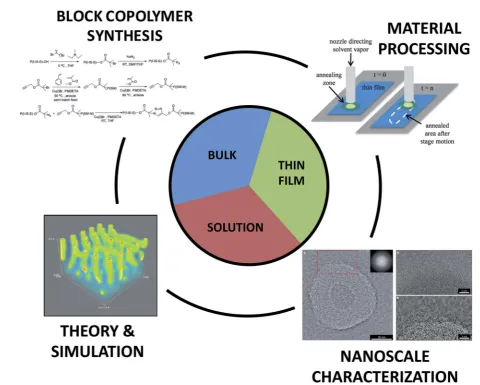
polymer synthesis, functionalization, processing, and charac-terization, it is now possible to design, fabricate, and explore a vast array of BCPs with diverse and sophisticated self-assembly potential in bulk, thinlm, and dilute solution envi-ronments. In Fig. 1 for example, the combination of multiple polymerization methods and targeted coupling chemistries enables the synthesis of complex macromolecules such as tapered BCPs (top le), the use of solvent processing recipes on motorized stages permits the generation of directed nano-structures for thin lm templating (top right), the cryogenic transmission electron microscopy of cylindrical BCP micelles allows one to visualize nanostructure formation in solution environments (bottom right), and self-consistent eld theory simulations of solvent removal in a cylinder-forming BCP thin
lm informs structure/processing relationships (bottom le). (We also note that many hydrogel and concentrated solution systems contain BCPs, but discussion of those materials is not included in this work.)
Fig. 1 Key aspects of block copolymer materials design. The synthesis, material processing, nanoscale characterization, and theory/simulation of block copolymers are all crucial in the development of new hierarchically assembled structures. These factors are intimately linked to the informed design of materials for bulk, thinfilm, and solution applications. Top right image–reprinted with permission from ref. 89 © American Chemical Society; bottom right image–reprinted with permission from ref. 47 © Royal Society of Chemistry; bottom left image–reprinted with permission from ref. 88 © American Chemical Society; top left image–reprinted with permission from ref. 77 © American Chemical Society.
Open Access Article. Published on 13 January 2016. Downloaded on 04/04/2016 12:34:09.
This article is licensed under a
[image:3.595.51.532.288.673.2]Bulk
Bulk assembly has been studied extensively for over 50 years, and the phase behavior of traditional A–B diblock copolymers is well-researched both theoretically and experimentally. In conventional bulk materials self-assembly processes are gov-erned by an unfavorable mixing enthalpy coupled with entropic losses due to macromolecular junctions and chain stretching. Current commercial applications of bulk BCPs (diblock and multiblock) include thermoplastic elastomers for gaskets, cable insulation, footwear, blending, adhesives, automotive bumpers, snowmobile treads,etc.(e.g.Kraton™, Styroex™, Solprene™, Hytrel™, Engage™, Sofprene™); thermoplastics for medical devices, protective headgear, and piping systems; and elasto-mers for car tires (e.g. poly(styrene-b-isoprene-b-butadiene) rubber [SIBR] from Goodyear) among others. For the case of thermoplastic elastomers, BCPs enable the facile and low-cost generation of a myriad of application-specic recyclable, ex-ible, thermoformed (or blow-moldable), creep-resistant, and durable materials as compared to conventional thermosets, primarily as a result of prescribed nanoscale phase separation. Well-dened BCPs can phase separate into a variety of periodic and nanoscale morphologies according to the relative composition of the blocks, the overall degree of polymerization (N), the polymer–polymer interaction parameter (c), and the ratio of statistical segment lengths.3The conceptual ability to tune morphology through adjustments in chemical composi-tion allows one to generate materials tailored toward thermo-plastic elastomer, membrane, and other applications. Though the mechanism underlying nanostructure formation for the simplest classes of BCPs with non-specic interactions is well understood, new macromolecular designs that incorporate multiblocks,4 copolymer mixtures,5 specic interactions (hydrogen-bonding,6 p–p stacking,7 etc.), engineered dis-persity,8tapered segment proles,9sequence-controlled mono-mer distributions,10 small-molecule dopants (e.g. salts, plasticizers, and inorganic precursors),11–13and functional end-groups14 signicantly complicate the understanding of bulk macromolecular assembly, yet potentially yield exciting oppor-tunities for novel material designs such as active membranes for batteries and fuel cells,15 catalyst supports/scaffolds,16,17 actuators, and self-healing or shape-memory systems.18,19
Thinlm
In addition to the factors that affect assembly in bulk, self-assembly processes in thinlms (<several hundred nanome-ters in thickness) are strongly inuenced by surface energetics and lm thickness (commensurability) considerations.20 The incorporation of these additional driving forces, as well as signicant processing history effects due to kinetic limitations associated with thinlm assembly, has a substantial impact on nanostructure formation and surface topology in thin lms. Signicant recent progress has been made in manipulating BCP thin lm morphologies for media storage, photonics, nano-lithography, nanotemplating, and ultraltration applications. A few examples for which thinlm BCPs have received interest in high value industrial processing are: conventional chip
manufacturing,21 nanotemplating for dense bit-patterned media that could facilitate doubling of hard disk drive densi-ties,22 and nanolithography for patterning next-generation semiconductor devices.23 Despite these industrial endeavors, each with its own challenges,24distinct hurdles that limit wide-spread usage of BCP thin lms in emerging technologies remain.25 These hurdles include precise control over the directed assembly of nanoscale domains through cost-effective and scalable approaches, understanding the inuence of nanostructure formation dynamics and processing protocols (such as the inuence of various annealing recipes,lm casting methods, surface energetics, and polymer molecular weights and architectures) on morphology and orientation, elimination (or signicant reduction) of defects, and translation of nano-patterning techniques to non-traditional substrates (e.g.exible substrates, porous scaffolds, graphene, metals).24,26,27A variety of surface elds, thermal and solvent annealing (uniform, gradient, and zone-annealing) protocols,26and other external
elds (e.g. magnetic, electric, mechanical, etc.)28–30have been employed to manipulate nanoscale morphology, orientation, and ordering in BCP thinlms. Further understanding of the many parameters associated with these tools will permit addi-tional BCP applications in coatings,31 nanoporous membranes,32 anti-fouling materials,33 and analytical and process-scale separation membranes,34 electronics,35,36 and optoelectronics,7,37including complex circuits,38,39stretchable/
exible electronics,40 optic and acoustic wave guides,41 sensors,42 and holographic arrays:43 all areas in which three-dimensional or hierarchical structures can transform mate-rials design.32
Surface graed (brush) block copolymers also are receiving signicant interest as nanostructured surface coatings for drag reduction, surface energy modication, biosensing, and cellular manipulation applications.44,45 These brush systems incorpo-rate an additional variable in terms of block order (even in diblock copolymer systems) as a consequence of attachment to a substrate and typically do not possess the same kinetic limi-tations inherent in BCP lms. Some key challenges include high-throughput synthesis and characterization of block copolymer brush systems with high reproducibility and accu-racy, generating a detailed knowledge-base of factors that inuence phase behavior and surface properties, and adapting block copolymer brush systems for specic applications.44,45
Dilute solution
Dilute solution self-assembly is similarly complex because the introduction of a single solvent, or multiple solvents, dramati-cally affects the assembly process and the resultant nano-structures.2,46This added complexity is largely due to additional surface tension, interaction parameter, and entropy effects that can signicantly alter the formation and stability of macromo-lecular assemblies in solution.44,47Thermodynamic and kinetic constraints can lead to the formation of various aggregates such as micelles and vesicles, related to the spherical, cylindrical, and lamellar morphologies, which are found in bulk systems;2,48 although exotic structures such as helices,49 toroids,50 and
Open Access Article. Published on 13 January 2016. Downloaded on 04/04/2016 12:34:09.
This article is licensed under a
networks48,50also have been reported. The majority of research has focused on aqueous self-assembly, for which the driving force is primarily hydrophobic interactions; however, there have been signicant efforts to examine BCP assembly in organic solvents,51 ionic liquids,52 supercritical solvents,53 mixed solvents, and during polymerization.54 The free-energy land-scape, as accessed through assembly protocols, solution pro-cessing (e.g.agitation and shear), hydrogen-bonding, reversible and irreversible stimuli-responses, salts, and cross-linking are critical in determining the nal state of solution assem-blies.44,46,55Several key advantages of BCP solution assemblies (as opposed to low molecular weight surfactant assemblies) include low critical aggregation concentrations (CAC)s and slow inter-aggregate chain exchange in highly selective solvents such as water.2Additionally, high loading capacities coupled with the ability to incorporate a myriad of functionalities and BCP compositions and architectures enables efficient bottom-up strategies to synthesize surfactants for interfacial stabilization such as commercially-relevant Pluronics™and Tetronics™and nanocontainers for biological (therapeutic agent delivery, imaging, diagnostics, theranostics) catalysis, separations, and self-healing applications.44,46,56 Unfortunately, the slow dynamics that normally are advantageous in producing stable nanocarriers also lead to kinetically trapped structures,46,57thus such systems require careful optimization of preparation conditions to produce well-dened, uniform, and reproducible solution assemblies.
Overall, the substantial need for new materials with well-dened and predictable nanoscale and macroscale character-istics has stimulated further study of macromolecular assem-blies in bulk, thinlm, and solution environments, as all arenas are poised to engender ground-breaking technological and societal impacts. The on-going fabrication of more exotic, hierarchical, and nature-inspired BCPs provides tantalizing glimpses toward emerging applications enabled through complex morphology generation; however, further efforts link-ing synthesis, nanostructure fabrication, processlink-ing, charac-terization, and theory (see Fig. 2) are necessary to unlock the full
potential of BCPs. In the following sections, we describe various methods for the synthesis of BCPs, highlight key tools that enable nanoscale characterization of self-assembling so materials, discuss select contributions that link experiment with theory, simulation, and modelling, and emphasize several emerging directions for BCP activities. The focus is on recent literature and is not meant to ignore the wealth of seminal investigations that provide the inspiration for the work dis-cussed herein. For the sake of brevity, much of the foundational work can be found in the references sections of the literature highlighted in each of the topics below. Additionally, the examples provided below are not meant to be all-inclusive, but instead are selected to provide a snapshot of the power and challenges associated with experimental and theoretical devel-opment of BCP nanostructures for wide-ranging materials.
Synthesis of block copolymers
–
designer macromolecules with unique
properties
While, the synthesis of BCPs is an establishedeld with many major advances over the last 50–60 years, more recent efforts in controlled polymer synthesis now enable the preparation of a wide range of BCP architectures including, linear, gra, dendritic, star-like, bottle-brush, hyperbranched, and cyclic BCPs.4All of these macromolecular structures have unique and interesting self-assembly behavior; however, given the diversity of available architectures, this review will focus only on the versatility of linear BCPs, which still possess a myriad of opportunities to advance functional materials design. Within the sub-class of linear BCPs, various block types have been prepared such as organic and bio-hybrid BCPs. Therst type includes a range of organic (non-biological-based) BCPs that can assemble by minimizing the free energy landscape that primarily is inuenced by mixing and chain stretching consid-erations. We also note that signicant work has been carried out in BCP systems that have specic interactions such as
Fig. 2 Generating functional materials from block copolymers. Highlighted features of block copolymers are categorized into synthetic approaches to produce novel materials, processing routes to manipulate nanoscale arrangement, characterization methods to obtain detailed nanoscale information, theoretical and simulation-based approaches to improve fundamental understanding, and directions for future research.
Open Access Article. Published on 13 January 2016. Downloaded on 04/04/2016 12:34:09.
This article is licensed under a
[image:5.595.48.524.520.684.2]hydrogen-bonding, metal-binding, p–p stacking, etc., which leads to self-organizing structures with their own intricate features. Many of these materials have been reviewed exten-sively in the literature,7,58and while of interest, they will not be discussed in exhaustive detail herein. Instead, we will highlight a range of synthetic tools that can be used to prepare specic organic BCPs with unique properties.
The second type, nature-inspired or bio-hybrid BCPs, forms a burgeoning class of self-assembling materials, in which the potential for secondary structure formation and concerted specic interactions promises unparalleled opportunities in hierarchical and function-driven assembly.59 These nature-inspired bio-hybrids oen contain at least one constituent derived from a biomolecular building block such as a peptide, protein, nucleic acid, peptoid, or sugars.60,61The combination of synthetic and bio-blocks in a well-dened macromolecule potentially introduces distinct nanostructures, stimuli-responsive character, and specic functions that are difficult to generate in ‘simpler’ organic–organic BCP systems.59 As a result, these bio-hybrid BCPs provide opportunities for the realization of diverse and highly targeted applications in self-assembled materials (Fig. 3).
In the following sections, we will highlight several note-worthy advances in the synthesis of linear BCPs that can lead to practical nanoscale assemblies for biomedicine, electronics, catalysis, nanotemplating, and responsive surface materials, among other applications. Furthermore, we also hint at several challenges, such as the need for the sustainable, efficient, and environmentally-friendly generation of functional macromole-cules, which will be discussed in greater detail in the emerging directions section of this perspective.
Methods for synthesis
There are numerous routes toward the synthesis of BCPs, which result in an extraordinarily broad range of macromolecules with tailorable and highly specic properties. These approaches can be broadly divided into three different classes: (continuous) sequential polymerization, macroinitiation, and coupling. Within these methods key considerations include the genera-tion of well-dened polymers at high purity with controlled dispersity and high end-group delity, the incorporation of application-specic functional groups, and the ability to combine macromolecules synthesized from diverse polymeri-zation methods, including the coupling of natural and synthetic building blocks. Each of these factors can have marked conse-quences on macromolecular self-assembly. For example, in many BCP generation approaches thenal mixture can contain homopolymer or other“incomplete”contaminants due to loss of end-groupdelity, premature termination, incomplete end-group functionalization, or inefficient coupling. These contaminants can be difficult to remove or quantify; however, they can have a signicant inuence on macromolecular assembly.62Overcoming these limitations will facilitate copol-ymer design, as well as provide opportunities for the automated and high-throughput synthesis of complex architectures to possibly enable sustainable materials discovery.63
Continuous sequential polymerization
Perhaps the most straightforward method to prepare BCPs is through continuous sequential polymerization of two or more monomer sets using a single chain growth mechanism. That is to say, controlled polymerization of one monomer, followed by chain extension with a different monomer without intermediate
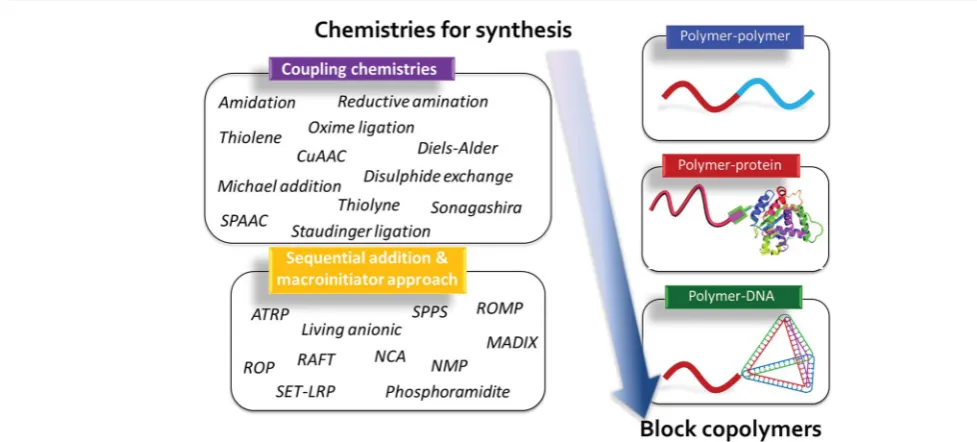
Fig. 3 Chemistries for the synthesis of block copolymers. CuAAC, copper-catalyzed azide–alkyne cycloaddition; SPAAC, strain-promoted azide–alkyne cycloaddition; ATRP, atom-transfer radical polymerization; SPPS, solid phase peptide synthesis; ROMP, ring-opening metathesis polymerization; RAFT, reversible addition–fragmentation chain-transfer; ROP, ring-opening polymerization; SET-LRP, single-electron transfer living radical polymerization; NMP, nitroxide-mediated polymerization; NCA, N-carboxyanhydride; MADIX, macromolecular design by the interchange of xanthates.
Open Access Article. Published on 13 January 2016. Downloaded on 04/04/2016 12:34:09.
This article is licensed under a
[image:6.595.39.528.450.671.2]termination/purication steps, can be used to prepare an AB polymer (or through further monomer addition, multiblock systems).64Sequential polymerization is especially applicable to methods such as living ionic, reversible-deactivation radical polymerization, and ring-opening polymerization. In particular, living anionic polymerization is somewhat restricted to this approach due to difficulties in reinitiating a terminated chain end; however, anionic techniques are still desirable for the ability to generate highly uniform polymers of extremely low dispersity and with excellent end-group delity,3 as demon-strated by Goodyear (SIBR) for tires and by other companies in various applications. Additionally, continuous sequential methodologies can be tuned to produce tapered interfaces between polymer blocks.9 These tapered block copolymers represent an emerging class of BCPs with unique and diverse self-assembly behavior.65 Reversible-deactivation radical poly-merization and ring-opening-based polymers also can be generated through continuous sequential polymerization, but these polymers are amenable to both macroinitiation approaches described below, due to the possibility of reinitiat-ing a dormant chain end. Though sequential polymerization methods are useful for preparing a broad range of BCPs, they are somewhat limited in the polymerization of functional monomers, such as those containing nucleophilic or other reactive functionalities.
One approach to overcome this limitation in functional monomers involves the use of dual initiator (or protected initiator) species such as a hydroxyl-functionalized reversible addition–fragmentation chain-transfer (RAFT) chain transfer agent (CTA), which allows for the orthogonal polymerization of two or more distinct monomers. This route has been used most effectively for the combination of ring-opening and reversible-deactivation radical polymerization methods and unlocks access to a range of functionalizable BCPs.66
Macroinitiator approaches
Although living anionic and anionic ring-opening polymeriza-tions are useful for sequential approaches, the synthetically demanding nature of the reactions typically necessitates a mac-roinitiator approach to generate BCPs with the desired multiple block functionalities. This macroinitiation route can provide well-dened BCPs, but it normally involves a two-step polymer-ization process with the possible need for intermediate puri -cation steps.67 Fortunately, macroinitiation provides a ready means for generating a highly-dened library of macromole-cules for systematic studies. A key consideration is that the polymerization mechanism utilized to synthesize therst block must result in a polymer with excellent end groupdelity to ensure that effective and efficient chain extension is possible.
Two major cases of macroinitiation can be dened;case one: the same polymerization mechanism used to generate the macroinitiator is used for chain extension, andcase two: an orthogonal reaction scheme is used for chain extension. The
rst case is particularly amenable to ring-opening and reversible-deactivation radical polymerizations, in which the macroinitiator can be re-initiated following intermediate
purication. However, challenges still remain in this case. As has been readily demonstrated in the literature, successful BCP formation may still not be possible due to blocking effects, which are based on the reactivity of the macroinitiator towards the chain-extending monomer. Macroinitiator reactivity is especially important when monomers with a more active dormant species (e.g.methacrylate or acrylonitrile) are utilized to extend a macroinitiator of lower activity (e.g.polystyrene or polyacrylate). This factor can be especially problematic when the specic functionality at theaanduends is important and hence reversing the order of polymerization is not possible. Additionally, macroinitiation schemes utilizing a single poly-merization mechanism are not always amenable to the prepa-ration of highly amphiphilic and hybrid BCPs, including those containing poly(ethylene oxide), polypeptides, or nucleic acids. There have been several manipulations to controlled poly-merizations to facilitate BCP synthesis from constituent mono-mers that cannot be polymerized using the same mechanism or initiating scheme (case two). Classic examples are macroinitiators synthesized through anionic or anionic ring-opening polymeri-zation. Polystyrene-b-poly(ethylene oxide) [PS-b-PEO], poly-butadiene-b-PEO [PB-b-PEO], PEO-b-poly(N-isopropylacrylamide) [PEO-b-PNIPAM], and PEO-b-3-polycaprolactone [PEO-b-PCL] are several workhorse synthetic BCPs generated using this route.48 Recent efforts have extended this approach to reversible-deactivation radical polymerizations, for which simple and effective chain end modication chemistries enable orthogonal polymerization mechanisms. Additionally, ring-opening metath-esis polymerization (ROMP) provides an elegant tool for the synthesis of a diverse range of block copolymers.68 ROMP is especially useful for the preparation of BCPs with interesting topologies including cycles,69gras,70and bottle-brushes.71
Two areas that have received recent interest include degradable BCPs, containing polylactide and bio-hybrid systems such as polypeptide BCPs which have possible applications in biomedicine.72,73Additionally, the explosion of click chemistries as a model for polymer functionalization (e.g. polymer chain end modication) has facilitated the manipulation of macro-initiators to allow for a second polymerization mechanism. This functionalization avenue has signicantly broadened the scope of BCPs accessible through a macroinitiator approach especially for such sustainable and degradable polymers.
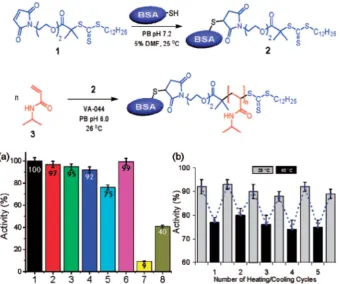
Macroinitiator approaches also are very effective for the preparation of nature-derived BCPs, especially those from natural biopolymers such as cellulose, chitin, or proteins. Although these methods oen lead to more complex architec-tures instead of simple and low dispersity linear BCPs, the manipulation of natural biopolymers to incorporate selective single site modications has shown promise.74This method has been demonstrated for the modication of proteins through selective introduction of a functionality (e.g.a polymerization initiator) to enable polymerization of a second polymer in a ‘graing from’ approach and to afford a bio-hybrid BCP (Fig. 4).74 To extend this approach and ensure effective and high-yielding BCP synthesis, further efforts are required to selectively incorporate functionalities that enable BCP genera-tion in nature-inspired or nature-derived systems.
Open Access Article. Published on 13 January 2016. Downloaded on 04/04/2016 12:34:09.
This article is licensed under a
Post-polymerization coupling
Perhaps the most versatile method for BCP synthesis is the post-polymerization coupling approach, which enables the conju-gation of blocks with very distinct chemistries. This avenue for linking pre-synthesized macromolecules has been facilitated by the exploitation of click chemistries. The concept was intro-duced in 2001 by Sharpless,75 and was later applied in BCP synthesis,76 Click is exemplied by the copper(I)-catalyzed azide–alkyne cycloaddition reaction (CuAAC). This reaction, and other high-yielding and highly-efficient coupling approaches,14allow for the conjugation of a diverse array of end-functionalized polymers to afford a range of BCPs. One chal-lenge in the translation of small molecule click approaches to polymer–polymer conjugation is the requirement for complete end group retention (and/or subsequent functionalization), which has been difficult to achieve for the vast majority of polymerization routes. However, methods such as living anionic polymerization and copper-mediated radical polymerization have demonstrated excellent end-groupdelity and have func-tionalities that can be readily modied to a click-like reactive group (e.g.the termination of the anionic polymerization with ethylene oxide to yield a terminal hydroxyl,67 to then yield a terminal azide77).
Click concepts in macromolecular systems clearly must take into consideration the challenges in purication and detailed
molecular characterization. For cases in which end-group
delity is not maintained, the coupled BCPs mixture also will contain one or both of the un-coupled building blocks that can be difficult if not time-consuming to remove, unless the click-based reaction conditions and stoichiometry are dened to yield only the BCP and an easily separable building block. Furthermore, it is worth noting that not all small molecule click reactions are similarly effective in polymer systems. The radical-mediated thiol–ene reaction is an example of a reaction that has found application in small molecule and polymer modi ca-tions,78 but it has not been as efficient in polymer–polymer couplings. This reaction was demonstrated clearly by DuPrez and Barner-Kowollik to have very limited effectiveness for the coupling of a range of chain-end functionalized polymers.79 Studies such as these highlight the need for in-depth and careful characterization of such BCP reaction schemes to verify the effectiveness of the BCP formation (i.e. homopolymer contamination, etc.). Click-based approaches also have been employed in the post-polymerization modication of pre-formed BCPs. As demonstrated by Hammond and coworkers, alkyne side groups allow the creation of a versatile library of compounds from a single parent BCP through cycloadditions;80 however, the efficiency of the coupling reactions remains a concern when dealing with multiple reaction sites on a long-chain macromolecule.
Fig. 4 Bio-hybrid block copolymers generated through coupling approaches. (Top image) scheme for the synthesis of protein–polymer BCP. (Bottom image, left) activity of (1) BSA, (2) BSA–macro-CTA, (3) BSA–PNIPAM (free BSA present), (4) BSA–PNIPAM thermal precipitate, (5) BSA– PNIPAM thermal precipitate at 40C, (6) BSA physical mixture, (7) PNIPAM, (8) BSA after incubation at 75C for 3 h. (Right) activity of BSA–PNIPAM thermal precipitate during thermal cycling between 25C and 40C [adapted and reprinted with permission from ref. 74 © American Chemical Society].
Open Access Article. Published on 13 January 2016. Downloaded on 04/04/2016 12:34:09.
This article is licensed under a
[image:8.595.130.471.49.333.2]A further challenge to be overcome, which affects all of the synthesis methods described above, is the requirement for compatible solvents for the constituent blocks of the BCP. This constraint can be especially challenging for both macro-initiation and post-polymerization coupling, and if not properly considered can lead to low yields, incomplete BCP formation, and high dispersities, reducing the sustainability of BCP generation. Two classes of macromolecules in which these issues are particularly common are organic-biopolymers, such as nucleic acid–hydrophobic polymer conjugates, and conducting-organic BCPs, given that the conducting blocks oen have limited solubilities in a wide range of solvents. An additional challenge in biomacromolecule coupling is that click-based groups must not undergo reactions with non-target sites, which is a concern in polymer/protein coupling (for example, through thiol–ene chemistry, when the protein construct may contain multiple cysteine residues). Thus, although small molecule click concepts are extremely useful in coupling macromolecular systems, care must be taken to generate well-dened and well-characterized BCPs.
Characterization of complex nanoscale
assemblies
The self-assembly of complex macromolecules generated through various synthetic methods is of critical importance in the fabrication of materials targeted toward next-generation applications. Whereas conventional BCPs are described by a manageable set of parameters (typically cN, block volume fractions, and statistical segment length ratios), many new systems incorporate multiple blocks with various architectures, dopants, and specic interactions.4These factors signicantly complicate BCP self-assembly, as well as confound requisite nanoscale characterization.
Bulk systems
For bulk systems, wide angle and small angle X-ray scattering (WAXS and SAXS), small angle neutron scattering (SANS) transmission electron microscopy (TEM) and TEM tomography, mechanical analysis, birefringence, calorimetry, and transport measurements are some of the common tools employed in materials characterization.3 While these techniques are extremely useful for nanostructure determination, methods such as TEM, calorimetry, and mechanical analysis are not always amenable to rapid materials discovery. Thus, more detailed and customizable characterization tools are necessary to quickly elucidate the intricate structures in complex mate-rials for which macromolecular constituents and processing steps are chosen, not to facilitate characterization, but to enable applications. Recent advances in that direction include the emergence of resonant so X-ray scattering (RSoXS),81which can distinguish between nanoscale domains in BCPs that contain distinct chemical constituents without an over-reliance on strict electron density contrast. Another technique,
energy-ltered TEM (EFTEM), has been used to probe chemical heterogeneity between domains caused by differences in block
chemistries, as well as the locations of small molecule dopants.82 When augmented with other newly pioneered methods in so materials, such as X-ray Photoelectron Spec-troscopy (XPS) with C60+ion sputtering, the elucidation of the spatial distributions of chemical species within multicompo-nent and polymer-based systems is facilitated in bulk and thin
lm (see below) materials.83Though RSoXS, EFTEM, and XPS-C60+ sputtering provide substantial opportunities for the improved nanoscale characterization of somaterials, further progress is necessary to accurately probe three-dimensional and hierarchically-ordered nanomaterials in a rapid fashion.
Thinlms
Similar challenges and opportunities exist in the analysis of nanostructured thinlm systems. Major characterization tech-niques include optical microscopy (OM, to analyze island/hole formation and wetting behavior), atomic force microscopy (AFM), TEM, scanning electron microscopy (SEM), grazing-incidence SAXS (GISAXS), reectivity (neutron and X-ray), XPS, time-of-ight secondary-ion mass spectrometry (ToF SIMS), and contact angle (surface energy) measurements. While techniques such as OM enable rapid materials characterization when combined with high-throughput or gradient approaches,84the remaining nanostructure investigation methods typically are time-consuming and preparation-intensive. There have been substantive recent developments in several advanced tools for expedited thin lm nanoscale characterization;85,86 however, signicant innovations are necessary to probe two-dimensional and three-dimensional structures over large areas, monitor defects, and provide real-time information during nanostructure processing. The incorporation of thermal and solvent annealing apparatuses into GISAXS and AFM experiments has begun to provide some insights into processing effects on nanostructure stability,87 yet the role of thermal, solvent, and surface eld gradients within thin lms remains an underexplored area.24,26,88,89 Neutron scattering techniques such as re ectom-etry, rotational SANS (RSANS), and multiple angle grazing inci-dence K-vector (MAGIK) off-specular reectometry can provide signicant insights into the thin lm ordering processes,90in particular, by elucidating the spatial distribution of solvents in thinlms during casting and processing. Insights such as these will be extremely useful in the design of appropriate conditions to maximize the desired nanostructure ordering. Furthermore, continued development of techniques such as ultra-fast AFM and in situTEM provide key opportunities for monitoring the kinetic processes that are so inuential in thinlm behavior.26,85,91
Solution assembly
The characterization of solution assemblies faces similar chal-lenges, including the impact of kinetics and processing on the overall assembly process. However, solution assemblies face the additional difficulty of a dearth of nanoscale characterization tools that can perform in situ analysis of macromolecular aggregates and allow for determination of key nanostructure characteristics, such as the core radius, hydrodynamic radius and/or radius of gyration of a spherical micelle (Fig. 5). While
Open Access Article. Published on 13 January 2016. Downloaded on 04/04/2016 12:34:09.
This article is licensed under a
methods such as dynamic and static light scattering (DLS and SLS), calorimetry, spectroscopy (e.g. nuclear magnetic reso-nance [NMR] and Raman), and rheology are capable of following gross aggregate evolution, techniques such as SAXS, SANS, TEM, and cryogenic-TEM (cryo-TEM) are capable of probing the ne details of aggregate structures, such as core and corona density proles.92 To fully understand the self-assembly process time-resolved measurements are required; however, methods such as microscopy (and scattering) are challenging to perform in this manner, largely due to the acquisition times and the larger background signals associated with probing a dilute solution environment. Additionally, approaches such as neutron scattering routinely rely on the ability to synthesize systems with the appropriate contrast (i.e. deuterated materials),51 sometimes leading to fabrication for analysis and not application. Furthermore, methods such as TEM involve sample preparations that remove the assemblies from their native environment with sometimes unintended consequences;92thus, new approaches are necessary to capture the true behavior of amphipathic solution assemblies. Synchrotron radiation and pulsed neutron sources, along with stopped-ow techniques,93 have the potential to provide detailed nanostructure information on the time scales of interest, but again, require well-designed systems. Recent studies have shown that real-time/solution state TEM (RT-TEM) is an intriguing alternative for monitoring assembly and stability, while maintaining access to detailed structural infor-mation;94however, it is worth noting that samples with suffi -cient contrast and suitable electron beam stability are necessary to fully take advantage of RT-TEM.
Theory/simulation/modelling
Numerous theoretical advances also can provide signicant insights into BCP assembly and detail key information in the experimental development of new nanostructured systems. Self-consistent eld theory (SCFT), density functional theory, molecular dynamics, and Monte Carlo (MC) simulations have
Fig. 5 Characterization of block copolymer solution assemblies. Schematic showing (a) a subset of the structural information obtainable from various scattering techniques and (b) a subset of images extracted using different microscopy techniques for a spherical polymer micelle. Panel (a) highlights common structural dimensions that can be readily probed in a idealized spherical micelle, along with associated reciprocal-space scattering techniques; these dimensions includeRc(core radius),Rg(radius of gyration),Rh(hydrodynamic radius),R(micelle radius). Panel (b)
illustrates complementary information that can be gleaned from real-space microscopy imaging [reprinted with permission from ref. 92 © Royal Society of Chemistry].
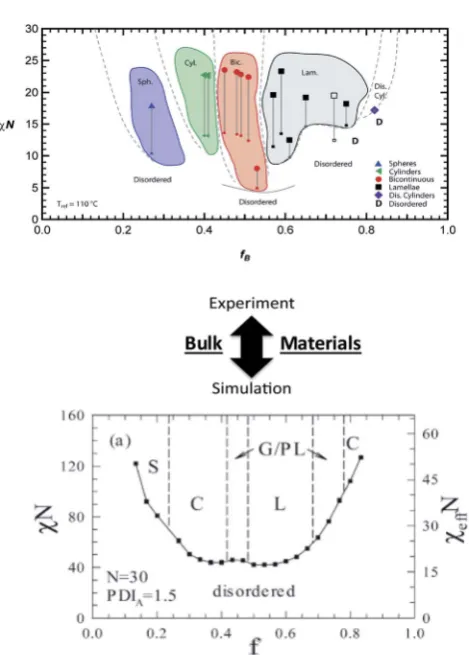
Fig. 6 Linking theory and experiment in block copolymers. Bulk nanostructures–effects of polymer dispersity. (Top image) experi-mental phase diagram of a block copolymer system containing controlled dispersity [reprinted with permission from ref. 8 © American Chemical Society]. (Bottom image) Monte Carlo simulated phase diagram of block copolymer system with a similar dispersity concept [reprinted with permission from ref. 95 © American Chemical Society]. A comparison between the top (experimental) and bottom (simulated) images shows general agreement and illustrates how theory and simulations could potentially direct experimental efforts.
Open Access Article. Published on 13 January 2016. Downloaded on 04/04/2016 12:34:09.
This article is licensed under a
[image:10.595.142.459.47.185.2] [image:10.595.311.546.283.611.2]been particularly useful in improving understanding of BCP nanostructure formation in bulk and thinlms. Recent exam-ples in bulk BCPs include the SCFT work of Hall and coworkers65that examined the inuence of controlled hetero-geneity between homogeneous blocks (i.e. tapering) on self-assembly of a diblock copolymer, and the lattice-based MC simulations of Matsen and coworkers95that explored the effects of controlled dispersity on copolymer phase behavior (Fig. 6). In each of these cases, the theoretical efforts complemented recent experimental work and provided tantalizing information useful in the fabrication of new nanoscale materials.8 Additionally, reports by Wang and coworkers96 (SCFT of salt-doped BCP melts) and Jayaraman and coworkers97(self-consistent Polymer Reference Interaction Site Model [PRISM] theory/MC simula-tions of copolymer coatings on nanoparticles in homopolymer matrices) again show direct experimental links that can aid materials discovery and provide practical trajectories for experimental investigations. In addition to the powerful trends highlighted in the above studies, further theoretical advances could eventually lead to specic predictive capabilities such as exact polymer constituents, molecular weights, architectures, dispersities, graing densities, etc. that would produce the desired macromolecular behavior or specied nanostructure. These capabilities would dramatically streamline synthesis and characterization and lead to informed macromolecular design.
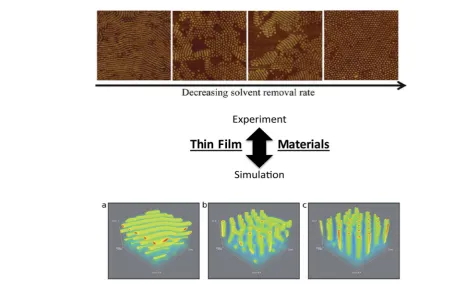
Similar insights have been made in BCP thinlms, recent examples of which include the work of Alexander-Katz and coworkers (forward SCFT simulations in an inverse design algorithm to explore topographic templates for directed self-assembly)98and dePablo and coworkers99(MC simulations of BCP thinlms on nanopatterned surfaces) that have produced detailed information to strengthen practical understanding of directed assembly on designer substrates. Furthermore, efforts by Frederickson and coworkers examined the inuence of solvent removal rate on the stability of cylindrical orientations in ultrathinlms using dynamical eld theory simulations,88 providing key knowledge that can be translated readily to experimental and application-oriented systems (Fig. 7).100 The above examples demonstrate signicant progress in linking theoretical studies to experimental investigations, and continued efforts in understanding the effects of thin lm processing and fabrication methods, substrate interactions, and inuences of macromolecular architectures on kineticvs. thermodynamic assembly could drive signicant advances in nanopatterning and sensing platforms using BCP thinlms.
Solution assembly of BCPs presents great challenges for conventional theoretical/modelling/simulation methodologies. The intrinsic need to explicitly describe key interactions from angstroms to tens of nanometers, over relevant time-scales, necessitates multi-scale approaches; however, accurate
Fig. 7 Linking theory and experiment in block copolymers. Thinfilm nanostructures–effects of processing on nanostructure orientation. (Top image) AFM images of parallel and perpendicular orientations of cylinders as a function of solvent evaporation rate in an ABA-triblock copolymer thinfilm [reprinted with permission from ref. 100 © American Chemical Society]. (Bottom image) parallelvs. perpendicular orientations generated from various solvent evaporation rates and solvent selectivities in BCP thinfilms using a dynamic extension of self-consistentfield theory simulations [reprinted with permission from ref. 88 © American Chemical Society]. In both the experimental and simulation efforts, faster solvent removal (evaporation) rates led to parallel orientations of cylinders, while slower solvent removal (evaporation) rates led to perpendicular cylinders. Refinement of general experimental and simulation trends, such as the correlation between solvent evaporation and nanostructure formation, will facilitate the continued development of nanostructure/processing relationships in thinfilm systems.
Open Access Article. Published on 13 January 2016. Downloaded on 04/04/2016 12:34:09.
This article is licensed under a
[image:11.595.46.515.361.645.2]descriptions of thermodynamic and kinetic processes are hampered by the inability to simultaneously access the neces-sary time-scales and length-scales. Several simulation/theory efforts have made signicant in-roads into the understanding of BCP behavior in solution assemblies. Notable recent efforts include the exploration of equilibrium BCP chain exchange kinetics in dilute micellar solutions,101 examination of the energetics of unimer insertion in concentrated micelle solu-tions,102and combined experimental and theoretical probing of the inuence of BCP molecular weight and composition on critical aggregation concentration.103 While these works indi-cate substantial progress, many challenges remain, especially related to the formation/processing of solution assemblies.104 One path forward is to consider approaches currently applied in protein-engineering, especially in nature-inspired materials, to reconcile the inuence of thermodynamics and kinetics (and processing) on protein folding that may be particularly appli-cable for many solution assembled BCP systems.105
Emerging directions and major
challenges for block copolymer
assemblies
Several challenges exist along the path toward accelerating the design of new nanostructured materials with positive societal and environmental impacts through the leveraging of continued advances in macromolecular synthesis, processing, and characterization. In particular, the desire to unlock exotic and hierarchically complex nanostructures for next-generation applications requires the multidimensional understanding of a myriad of chemistries, molecular architectures, fabrication protocols, and processing techniques.106 This understanding can be facilitated by additional links between experiment and theory that provide true predictive capabilities. Furthermore, although not all-encompassing, three emerging areas that have been foreshadowed by the above discussions are: (1) the sustainable and environmentally-friendly generation and process-ing of materials, (2) the optimization and detailed characterization of nature-inspired materials, and (3) the inuence of processing and fabrication methods on nanoscale structures, in particular, solution assemblies.
Sustainable and environmentally-friendly generation and processing of materials
Major efforts in the sustainable and environmentally-friendly generation and processing of materials have focused on the synthesis of nanostructured polymers from bio-based or renewable feedstocks.107 Many of these “green” systems have attractive functionalities (e.g.aldehydes, hydroxyls, and phenols) that permit the design of new monomers amenable to controlled polymerization techniques (or bio-based sources of “old” monomers) for applications such as thermoplastic elastomers, pressure-sensitive adhesives, nanocarriers for biological and catalysis applications, and blend compatibilizers; however, further efforts in cultivating sustainable and cost-effective feedstocks, achieving efficient syntheses (and purication),
and obtaining suitable macroscale properties (glass transition temperature, degradation temperature, modulus, solubility,etc.) are necessary. As highlighted in the polymer synthesis sections, sustainable macromolecules generation also applies to the continued development of multi-component polymerization and coupling approaches that further reduce waste, solvent usage, and purication requirements.
Optimization and detailed characterization of nature-inspired materials
As nature has become an inspiration for the exploration of self-assembled systems, bio-inspired materials embody many of the strengths and challenges in nanomaterials design. In contrast to biological polymers (such as proteins or DNA), synthetic polymers can be prepared from a much broader range of monomers, to afford polymers with a variety of structures and architectures and hence a vast range of properties and diversity of applications including diagnostics, therapeutic agent delivery, cell culture and tissue engineering, and biomaterials scaffolds and supports. However, a primary limitation of current synthetic polymers is the lack of general methods for producing precise chain structure (i.e. sequence control) and hence complex function (i.e.replication and evolution). Indeed, the development of new methods to enable the mimicking of biological function in macromolecules is an emerging area,59 which holds great potential for the future.
While the basics of conventional BCP synthesis were estab-lished some time ago, it is only more recently that innovations including the fabrication of polymer–peptide, polymer–protein, and other stimuli-responsive materials that take advantage of the exquisite interactions facilitated by unique molecular organization and secondary structure formation are now possible.59 Furthermore, forays into the mechanisms and energetics of peptide/protein folding and function have enabled the discovery of new methods to engineer macromolecules, in which the placement of individual repeat units is controlled to impart specic functions or directional interactions.105 This approach is key as it allows for the preparation of biohybrid BCPs with specic polymer-biomolecular attachments. However, as the precise manipulation of functional groups can have substantial effects on material efficacy in complex systems, it is crucial that researchers continue to explore the necessary structure/property relationships by fully understanding the limitations inherent in many macromolecular and nano-structure characterization techniques.
Additionally, as stimuli-responsive and targeted assemblies become en vogue for therapeutics, diagnostics, and imaging applications, information to correlate the placement of designer functionalities on macromolecules to their spatial arrangement in solution assemblies is increasingly vital to truly design and optimize nanoscale materials for in vivo applica-tions.44,105As one example, techniques such as anomalous SAXS (ASAXS) can probe this link in solution-assembled BCP systems,108but ASAXS comes with the added expense of incor-porating the appropriate moieties (such as selenium labelling) to ensure adequate contrast, along with the necessity of
Open Access Article. Published on 13 January 2016. Downloaded on 04/04/2016 12:34:09.
This article is licensed under a
a synchrotron source; thus, theoretical complements to predict exact constituent/architecture/nanostructure/property relation-ships are vital.
Inuence of processing and fabrication methods on
nanoscale structures
As new materials are envisioned with intricate and precise self-organization potential, the role of nanostructure fabrication and processing becomes an even greater consideration in materials development. As demonstrated in peptide and protein-based systems, thermal history, mechanical processing, and exposure to external elds and environments have substantial and irreversible effects on macromolecular assembly leading to path dependent behavior.109In the case of solution assembly, information gleaned from the detailed literature on biomacromolecules on these processing effects can provide signicant insights into the fabrication and stability of polymer solution constructs.57Studies examining the inuence formulation and processing protocols are particularly relevant in light of work describing the impact of the above variables on solution assembled nanostructure size and shape, which ultimately will control nanocarrier delivery and function. We note that fabrication and processing effects are not limited to solution assemblies and biomaterials but also are inherent in bulk and thinlm assemblies as highlighted in the previous sections. Similar key challenges also are present in nano-composites,110 organic electronic materials,7 and resins,111 among other arenas comprising block copolymers.
In summary, while efforts in high-throughput, automated, and gradient synthesis and characterization have accelerated materials development in conventional systems as well as the three areas highlighted above,25,26the sheer diversity of possi-bilities necessitates the intimate interfacing of experimental designs with theory/simulation/modelling. To facilitate this meshing of theory and experiment, it is vital that theoretical/ modelling efforts continue to consider relevant processing protocols and molecular architectures in designing appropriate systems. However, it is also important that experimental studies take advantage of the complete suite of synthetic, molecular characterization, and nanostructure characterization tools to fully and accurately characterize macromolecular assemblies. The complexity of the chemical and biological units and the plethora of possible building blocks of the next-generation of block copolymers stretch the limits of nanomaterials charac-terization, which reinforces the urgent need for enhanced theoretical-experimental methods inde novomaterials design. Thus, by harnessing the inherent strengths of so materials chemistry, physics, processing, and theory to generate complex nanomaterials, new systems and tools will be developed to unlock the full potential of BCPs and continue to shrink the gap between concept and application.
Author contributions
T. H. E. and R. K. O. R. jointly discussed the content of the review and jointly wrote the manuscript.
Con
fl
ict of interest
The authors declare no competingnancial interests.
Acknowledgements
The authors thank the University of Warwick, the University of Delaware (Thomas and Kipp Gutshall Professorship), and the Engineering and Physical Sciences Research Council for nan-cial support. The authors thank Angela Holmberg and Ming Luo for helpful discussions.
References
1 N. C. Seeman, C. Mao and H. Yan, Guest Editorial: Nucleic Acid Nanotechnology,Acc. Chem. Res., 2014,47, 1643–1644. 2 Y. Y. Mai and A. Eisenberg, Self-assembly of block
copolymers,Chem. Soc. Rev., 2012,41, 5969–5985.
3 N. Hadjichristidis, S. Pispas and G. A. Floudas, Block Copolymers: Synthetic Strategies, Physical Properties, and Applications, Wiley-Interscience, 2003.
4 F. S. Bates, M. A. Hillmyer, T. P. Lodge, C. M. Bates, K. T. Delaney and G. H. Fredrickson, Multiblock Polymers: Panacea or Pandora’s Box?, Science, 2012,336, 434–440.
5 C.-T. Lo and P.-W. Chou, Effect of Molecular Properties of Random Copolymers on the Stability and Domain Dimension of Block Copolymer/Random Copolymer Blends,J. Phys. Chem. B, 2014,118, 12763–12771.
6 S. H. Han, J. K. Kim, V. Pryamitsyn and V. Ganesan, Phase Behavior of Binary Blends of Block Copolymers Having Hydrogen Bonding,Macromolecules, 2011,44, 4970–4976. 7 R. A. Segalman, B. McCulloch, S. Kirmayer and J. J. Urban,
Block Copolymers for Organic Optoelectronics, Macromolecules, 2009,42, 9205–9216.
8 J. M. Widin, A. K. Schmitt, A. L. Schmitt, K. Im and M. K. Mahanthappa, Unexpected Consequences of Block Polydispersity on the Self-Assembly of ABA Triblock Copolymers,J. Am. Chem. Soc., 2012,134, 3834–3844. 9 P. Hodrokoukes, G. Floudas, S. Pispas and
N. Hadjichristidis, Microphase separation in normal and inverse tapered block copolymers of polystyrene and polyisoprene. 1. Phase state, Macromolecules, 2001, 34, 650–657.
10 J.-F. Lutz, M. Ouchi, D. R. Liu and M. Sawamoto, Sequence-Controlled Polymers,Science, 2013,341, 1238149.
11 A.-V. G. Ruzette, P. P. Soo, D. R. Sadoway and A. M. Mayes, Melt-Formable Block Copolymer Electrolytes for Lithium Rechargeable Batteries, J. Electrochem. Soc., 2001, 148, A537–A543.
12 A. C. Finnefrock, R. Ulrich, G. E. S. Toombes, S. M. Gruner and U. Wiesner, The plumber’s nightmare: a new morphology in block copolymer-ceramic nanocomposites and mesoporous aluminosilicates,J. Am. Chem. Soc., 2003,
125, 13084–13093.
Open Access Article. Published on 13 January 2016. Downloaded on 04/04/2016 12:34:09.
This article is licensed under a
13 C. E. Sing, J. W. Zwanikken and M. O. de la Cruz, Electrostatic control of block copolymer morphology,Nat. Mater., 2014,13, 694–698.
14 P. L. Golas and K. Matyjaszewski, Marrying click chemistry with polymerization: expanding the scope of polymeric materials,Chem. Soc. Rev., 2010,39, 1338–1354.
15 M. C. Orilall and U. Wiesner, Block copolymer based composition and morphology control in nanostructured hybrid materials for energy conversion and storage: solar cells, batteries, and fuel cells, Chem. Soc. Rev., 2011, 40, 520–535.
16 W. Q. Cai, J. G. Yu, C. Anand, A. Vinu and M. Jaroniec, Facile Synthesis of Ordered Mesoporous Alumina and Alumina-Supported Metal Oxides with Tailored Adsorption and Framework Properties,Chem. Mater., 2011,23, 1147–1157. 17 P. D. Yang, D. Y. Zhao, D. I. Margolese, B. F. Chmelka and G. D. Stucky, Block copolymer templating syntheses of mesoporous metal oxides with large ordering lengths and semicrystalline framework,Chem. Mater., 1999,11, 2813– 2826.
18 J. Hentschel, A. M. Kushner, J. Ziller and Z. Guan, Self-Healing Supramolecular Block Copolymers,Angew. Chem., Int. Ed., 2012,51, 10561–10565.
19 B. S. Lee, B. C. Chun, Y.-C. Chung, K. I. Sul and J. W. Cho, Structure and Thermomechanical Properties of Polyurethane Block Copolymers with Shape Memory Effect,Macromolecules, 2001,34, 6431–6437.
20 I. W. Hamley, Ordering in thinlms of block copolymers: fundamentals to potential applications, Prog. Polym. Sci., 2009,34, 1161–1210.
21 C. Hanisch and R. Bogue, Self-assembly: a review of recent developments,Assemb. Autom., 2008,28, 211–215.
22 G. Liu, P. F. Nealey, R. Ruiz, E. Dobisz, K. C. Patel and T. R. Albrecht, Fabrication of chevron patterns for patterned media with block copolymer directed assembly, J. Vac. Sci. Technol., B: Nanotechnol. Microelectron.: Mater., Process., Meas., Phenom., 2011,29, 06F204.
23 P. A. R. Delgadillo, R. Gronheid, C. J. Thode, H. Wu, Y. Cao, M. Neisser, M. Somervell, K. Nafus and P. F. Nealey, Implementation of a chemo-epitaxyow for directed self-assembly on 300-mm wafer processing equipment, J. Micro/Nanolithogr., MEMS, MOEMS, 2012,11, 031302. 24 C. M. Bates, M. J. Maher, D. W. Janes, C. J. Ellison and
C. G. Willson, Block Copolymer Lithography, Macromolecules, 2013,47, 2–12.
25 J. N. L. Albert and T. H. Epps, III, Self-assembly of Block Copolymer Thin Films,Mater. Today, 2010,13, 24–33. 26 M. Luo and T. H. Epps, III, Directed Block Copolymer Thin
Film Self-Assembly: Emerging Trends in Nanopattern Fabrication,Macromolecules, 2013,46, 7567–7579.
27 J. W. Choi, M. Kim, N. S. Safron, M. S. Arnold and P. Gopalan, Transfer of Pre-Assembled Block Copolymer Thin Film to Nanopattern Unconventional Substrates, ACS Appl. Mater. Interfaces, 2014,6, 9442–9448.
28 P. W. Majewski, M. Gopinadhan and C. O. Osuji, Magnetic
eld alignment of block copolymers and polymer nanocomposites: scalable microstructure control in
functional so materials, J. Polym. Sci., Part B: Polym. Phys., 2012,50, 2–8.
29 S. Pujari, M. A. Keaton, P. M. Chaikin and R. A. Register, Alignment of perpendicular lamellae in block copolymer thinlms by shearing,SoMatter, 2012,8, 5358–5363. 30 M. Sano, S. Nakamura, M. Hara, S. Nagano, Y. Shinohara,
Y. Amemiya and T. Seki, Pathways toward Photoinduced Alignment Switching in Liquid Crystalline Block Copolymer Films,Macromolecules, 2014,47, 7178–7186. 31 S. H. Anastasiadis, Development of Functional Polymer
Surfaces with Controlled Wettability, Langmuir, 2013,29, 9277–9290.
32 H. Sai, K. W. Tan, K. Hur, E. Asenath-Smith, R. Hovden, Y. Jiang, M. Riccio, D. A. Muller, V. Elser, L. A. Estroff, S. M. Gruner and U. Wiesner, Hierarchical Porous Polymer Scaffolds from Block Copolymers, Science, 2013,
341, 530–534.
33 Z. L. Zhou, D. R. Calabrese, W. Taylor, J. A. Finlay, M. E. Callow, J. A. Callow, D. Fischer, E. J. Kramer and C. K. Ober, Amphiphilic triblock copolymers with PEGylated hydrocarbon structures as environmentally friendly marine antifouling and fouling-release coatings, Biofouling, 2014,30, 589–604.
34 A. Asatekin and C. Vannucci, Self-Assembled Polymer Nanostructures for Liquid Filtration Membranes: A Review,Nanosci. Nanotechnol. Lett., 2015,7, 21–32. 35 C. T. Black, R. Ruiz, G. Breyta, J. Y. Cheng, M. E. Colburn,
K. W. Guarini, H. C. Kim and Y. Zhang, Polymer self assembly in semiconductor microelectronics, IBM J. Res. Dev., 2007,51, 605–633.
36 H. C. Kim, S. M. Park and W. D. Hinsberg, Block Copolymer Based Nanostructures: Materials, Processes, and Applications to Electronics,Chem. Rev., 2010,110, 146–177. 37 S. B. Darling, Block copolymers for photovoltaics,Energy
Environ. Sci., 2009,2, 1266–1273.
38 A. F. Hannon, Y. Ding, W. Bai, C. A. Ross and A. Alexander-Katz, Optimizing Topographical Templates for Directed Self-Assembly of Block Copolymers via Inverse Design Simulations,Nano Lett., 2014,14, 318–325.
39 M. P. Stoykovich, M. M¨uller, S. O. Kim, H. H. Solak, E. W. Edwards, J. J. de Pablo and P. F. Nealey, Directed Assembly of Block Copolymer Blends into Nonregular Device-Oriented Structures,Science, 2005,308, 1442–1446. 40 S. H. Kim, K. Hong, W. Xie, K. H. Lee, S. Zhang, T. P. Lodge
and C. D. Frisbie, Electrolyte-Gated Transistors for Organic and Printed Electronics,Adv. Mater., 2013,25, 1822–1846. 41 M. Ma, K. Titievsky, E. L. Thomas and G. C. Rutledge,
Continuous Concentric Lamellar Block Copolymer Nanobers with Long Range Order, Nano Lett., 2009, 9, 1678–1683.
42 E. Reimhult and F. Hook, Design of Surface Modications for Nanoscale Sensor Applications, Sensors, 2015, 15, 1635–1675.
43 F. H. Schacher, P. A. Rupar and I. Manners, Functional Block Copolymers: Nanostructured Materials with Emerging Applications, Angew. Chem., Int. Ed., 2012, 51, 7898–7921.
Open Access Article. Published on 13 January 2016. Downloaded on 04/04/2016 12:34:09.
This article is licensed under a
44 E. G. Kelley, J. N. L. Albert, M. O. Sullivan and T. H. Epps, III, Stimuli-responsive copolymer solution and surface assemblies for biomedical applications, Chem. Soc. Rev., 2013,42, 7057–7071.
45 M. E. Welch and C. K. Ober, Responsive and patterned polymer brushes,J. Polym. Sci., Part B: Polym. Phys., 2013,
51, 1457–1472.
46 R. C. Hayward and D. J. Pochan, Tailored assemblies of block copolymers in solution: it is all about the process, Macromolecules, 2010,43, 3577–3584.
47 M. A. Dyson, A. M. Sanchez, J. P. Patterson, R. K. O’Reilly, J. Sloan and N. R. Wilson, A new approach to high resolution, high contrast electron microscopy of macromolecular block copolymer assemblies,SoMatter, 2013,9, 3741–3749.
48 S. Jain and F. S. Bates, On the origins of morphological complexity in block copolymer surfactants,Science, 2003,
300, 460–464.
49 S. Zhong, H. G. Cui, Z. Y. Chen, K. L. Wooley and D. J. Pochan, Helix self-assembly through the coiling of cylindrical micelles,SoMatter, 2008,4, 90–93.
50 S. J. Holder and N. A. J. M. Sommerdijk, New micellar morphologies from amphiphilic block copolymers: disks, toroids and bicontinuous micelles,Polym. Chem., 2011,2, 1018–1028.
51 J. Lu, F. S. Bates and T. P. Lodge, Chain exchange in binary copolymer micelles at equilibrium: conrmation of the independent chain hypothesis, ACS Macro Lett., 2013, 2, 451–455.
52 L. Meli, J. M. Santiago and T. P. Lodge, Path-dependent morphology and relaxation kinetics of highly amphiphilic diblock copolymer micelles in ionic liquids, Macromolecules, 2010,43, 2018–2027.
53 E. Buhler, A. V. Dobrynin, J. M. DeSimone and M. Rubinstein, Light-scattering study of diblock copolymers in supercritical carbon dioxide: CO2 density-induced micellization transition, Macromolecules, 1998,
31, 7347–7355.
54 S. Sugihara, A. Blanazs, S. P. Armes, A. J. Ryan and A. L. Lewis, Aqueous Dispersion Polymerization: A New Paradigm for In Situ Block Copolymer Self-Assembly in Concentrated Solution, J. Am. Chem. Soc., 2011, 133, 15707–15713.
55 V. A. Vasantha, S. Jana, S. S.-C. Lee, C.-S. Lim, S. L.-M. Teo, A. Parthiban and J. G. Vancso, Dual hydrophilic and salt responsive schizophrenic block copolymers - synthesis and study of self-assembly behavior,Polym. Chem., 2015,
6, 599–606.
56 A. Lu and R. K. O’Reilly, Advances in nanoreactor technology using polymeric nanostructures, Curr. Opin. Biotechnol., 2013,24, 639–645.
57 E. G. Kelley, R. P. Murphy, J. E. Seppala, T. P. Smart, S. D. Hann, M. O. Sullivan and T. H. Epps, III, Size evolution of highly amphiphilic macromolecular solution assemblies via a distinct bimodal pathway,Nat. Commun., 2014,5, 3599.
58 B. Rybtchinski, Adaptive Supramolecular Nanomaterials Based on Strong Noncovalent Interactions, ACS Nano, 2011,5, 6791–6818.
59 P. Theato, B. S. Sumerlin, R. K. O’Reilly and T. H. Epps, III, Stimuli responsive materials, Chem. Soc. Rev., 2013, 42, 7055–7056.
60 D. H. Zhang, S. H. Lahasky, L. Guo, C. U. Lee and M. Lavan, Polypeptoid Materials: Current Status and Future Perspectives,Macromolecules, 2012,45, 5833–5841. 61 D. Kedracki, I. Sar, N. Gour, K. Ngo and C. Vebert-Nardin,
in Bio-synthetic Polymer Conjugates Vol. 253 Advances in Polymer Science, ed. Helmut Schlaad, Springer, Berlin Heidelberg, 2013, ch. 181, pp. 115–149.
62 H. Benoit and G. Hadziioannou, Scattering theory and properties of block copolymers with various architectures in the homogeneous bulk state,Macromolecules, 1988,21, 1449–1464.
63 F. A. Leibfarth, J. A. Johnson and T. F. Jamison, Scalable synthesis of sequence-dened, unimolecular macromolecules by Flow-IEG, Proc. Natl. Acad. Sci. U. S. A., 2015,112, 10617–10622.
64 A. H. Soeriyadi, C. Boyer, F. Nystr¨om, P. B. Zetterlund and M. R. Whittaker, High-Order Multiblock Copolymers via Iterative Cu(0)-Mediated Radical Polymerizations (SET-LRP): Toward Biological Precision, J. Am. Chem. Soc., 2011,133, 11128–11131.
65 J. R. Brown, S. W. Sides and L. M. Hall, Phase Behavior of Tapered Diblock Copolymers from Self-Consistent Field Theory,ACS Macro Lett., 2013,2, 1105–1109.
66 K. J. Thurecht, A. M. Gregory, S. Villarroya, J. Zhou, A. Heise and S. M. Howdle, Simultaneous enzymatic ring opening polymerisation and RAFT-mediated polymerisation in supercritical CO2,Chem. Commun., 2006, 4383–4385. 67 M. A. Hillmyer and F. S. Bates, Synthesis and
characterization of model polyalkane-poly(ethylene oxide) block copolymers,Macromolecules, 1996,29, 6994–7002. 68 C. W. Bielawski and R. H. Grubbs, Living ring-opening
metathesis polymerization,Prog. Polym. Sci., 2007,32, 1–29. 69 A. J. Boydston, T. W. Holcombe, D. A. Unruh, J. M. J. Fr´echet and R. H. A. Grubbs, Direct Route to Cyclic Organic Nanostructures via Ring-Expansion Metathesis Polymerization of a Dendronized Macromonomer, J. Am. Chem. Soc., 2009,131, 5388–5389.
70 K. Nomura and M. M. Abdellatif, Precise synthesis of polymers containing functional end groups by living ring-opening metathesis polymerization (ROMP): efficient tools for synthesis of block/gra copolymers, Polymer, 2010,51, 1861–1881.
71 M. A. Sowers, J. R. McCombs, Y. Wang, J. T. Paletta, S. W. Morton, E. C. Dreaden, M. D. Boska, M. F. Ottaviani, P. T. Hammond, A. Rajca and J. A. Johnson, Redox-responsive branched-bottlebrush polymers for in vivo MRI and uorescence imaging,Nat. Commun., 2014,5, 5460.
72 N. Petzetakis, A. P. Dove and R. K. O’Reilly, Cylindrical micelles from the living crystallization-driven
self-Open Access Article. Published on 13 January 2016. Downloaded on 04/04/2016 12:34:09.
This article is licensed under a