A Thesis Submitted for the Degree of PhD at the University of Warwick
Permanent WRAP URL:
http://wrap.warwick.ac.uk/83231
Copyright and reuse:
This thesis is made available online and is protected by original copyright.
Please scroll down to view the document itself.
Please refer to the repository record for this item for information to help you to cite it.
Our policy information is available from the repository home page.
M A
O
D
C
S
Assimilating Data into Mathematical
Models
by
Daniel Sanz-Alonso
Thesis
Submitted for the degree
Doctor of Philosophy
Mathematics Institute
The University of Warwick
Contents
Acknowledgments iv
Declarations v
Chapter 1 Introduction 1
1.1 A Bird’s-Eye View . . . 1
1.2 Inverse Problems and Filtering: Guiding Examples . . . 3
1.2.1 Inverse Problems: an Example . . . 3
1.2.2 Filtering: an Example . . . 6
1.3 Algorithms . . . 9
1.3.1 Gaussian Approximation Algorithms . . . 11
1.3.2 Particle Approximation Algorithms . . . 13
1.3.3 Literature Review . . . 14
1.4 Identifying Challenges and Choosing Algorithms . . . 16
1.4.1 Large Dimension, Small Noise, Nonlinearities . . . 16
1.4.2 Brief Comparison of Algorithms . . . 17
1.5 Main Contributions . . . 18
1.5.1 Filtering Chaotic Dynamical Systems . . . 18
1.5.2 Importance Sampling: Computational Complexity and Intrin-sic Dimension . . . 19
1.6 Ongoing and Future Research . . . 19
Chapter 2 Filter Accuracy for Chaotic Dynamical Systems: a Gen-eral Framework 21 2.1 Introduction . . . 21
2.2 Set-up . . . 23
2.3 Suboptimal Filters . . . 27
2.3.1 3DVAR Filter . . . 27
2.4 Stochastic Stability of Suboptimal Filters and Filter Accuracy . . . . 29
2.4.1 The Lyapunov Method for Stability of Stochastic Filters . . . 29
2.4.2 Filter Accuracy with Global Squeezing Property . . . 30
2.4.3 Filter Accuracy for Chaotic Deterministic Dynamics . . . 33
2.5 Application to Relevant Models . . . 36
2.5.1 Finite Dimensions (Lorenz ’63 and ’96 Models) . . . 36
2.5.2 Infinite Dimensions (Navier-Stokes Equation) . . . 42
2.6 Conclusions . . . 45
Chapter 3 Filter accuracy for the Lorenz ’96 Model 46 3.1 Introduction . . . 46
3.2 Set Up . . . 48
3.3 Lorenz ’96 Model . . . 50
3.4 Fixed Observation Operator . . . 52
3.4.1 Continuous Assimilation . . . 52
3.4.2 Discrete Assimilation . . . 55
3.5 Adaptive Observation Operator . . . 57
3.5.1 3DVAR . . . 59
3.5.2 Extended Kalman Filter . . . 62
3.6 Conclusions . . . 65
Chapter 4 Importance Sampling: Computational Complexity and In-trinsic Dimension 78 4.1 Introduction . . . 78
4.1.1 Our Purpose . . . 78
4.1.2 Organization of the Chapter and Notation . . . 81
4.1.3 Literature Review . . . 82
4.2 Importance Sampling . . . 84
4.2.1 General Setting . . . 85
4.2.2 The Second Moment of the Target-Proposal Density . . . 85
4.2.3 Effective Sample Size . . . 88
4.2.4 Probability Metrics . . . 88
4.2.5 High State Space Dimension and Absolute Continuity . . . . 89
4.2.6 Singular Limits . . . 91
4.2.7 Literature Review . . . 91
4.3 Importance Sampling and Inverse Problems . . . 96
4.3.1 General Setting . . . 97
4.3.3 Absolute Continuity . . . 100
4.3.4 Singular Limits . . . 102
4.3.5 Literature Review . . . 105
4.4 Importance Sampling and Filtering . . . 110
4.4.1 General Setting . . . 110
4.4.2 Intrinsic Dimension . . . 114
4.4.3 Absolute Continuity . . . 114
4.4.4 Singular Limits . . . 117
4.4.5 Literature Review . . . 119
4.5 Conclusions . . . 121
4.6 Appendix . . . 122
4.6.1 Gaussian Measures in Hilbert Space . . . 122
4.6.2 Proofs Section 4.2 . . . 125
4.6.3 Proofs Section 4.3 . . . 130
Acknowledgments
First of all I would like to thank Andrew Stuart; I could not have asked for a better supervisor either at a mathematical or a personal level. Thanks also to my second supervisor Gareth Roberts from whom I have learned so much, and to my examiners Adam Johansen and Arnaud Doucet, who took the interest and time to read this thesis from cover to cover. I am particularly thankful to Sergios Agapiou and Omiros Papaspiliopoulos for their continuous support. The memory of our time together at Warwick, Barcelona, and Savannah will stay with me forever, as will my friendship with you. I am also grateful to my collaborators Kody Law and Abhishek Shukla, to my first year mentor David Kelly, and to Rodrigo Targino and Gareth Peters for their warm hospitality in my visits to London.
I thank everyone who has made so enjoyable my years at Warwick. Thanks to my tennis friends and rivals (Andy, Atanas, James, Lukasz, Lynn, Tony, and Yuan) and to Faz, Felipe, Gianmarco and Rachele. My biggest thanks to Cyril, Kyung, and Neil.
Declarations
This thesis has four chapters. Chapter 1 is a brief overview of the Bayesian approach to blending mathematical models with data. For this introductory chapter, I do not claim any originality in the material itself, but only in the presentation, and in the choice of contents. Chapters 2, 3 and 4 are transcripts of published and submitted papers, with minimal cosmetic modifications. I now detail my contributions to each of these papers.
Chapter 2 is a transcript of the published paper “Long-time Asymptotics of the Filtering Distribution for Partially Observed Chaotic Dynamical Systems” [Sanz-Alonso and Stuart, 2015] written in collaboration with Andrew Stuart. The idea of building a unified framework for studying filtering of chaotic dissipative dynamical systems is from Andrew. My ideas include the truncation of the 3DVAR algorithm that allows for unbounded observation noise, using the squeezing property as the unifying arch across all models, and most of the links with control theory. I stated and proved all the results of the paper. I also wrote the first version of the paper, which was subsequently much improved with Andrew’s input.
Chapter 3 is a transcript of the published paper “Filter Accuracy for the Lorenz 96 Model: Fixed Versus Adaptive Observation Operators” [Law et al., 2016], written in collaboration with Kody Law, Abhishek Shukla, and Andrew Stuart. My contribution to this paper was in proving most of the theoretical results. I did not contribute to the numerical experiments. The idea of using adaptive observation operators is from Abhishek.
Chapter 1
Introduction
This thesis touches on a number of subjects, including inverse problems, nonlinear filtering, data assimilation, uncertainty quantification, and computational statistics. The recurrent theme is that of combining mathematical models (often differential equations) with observed data. I have aimed to improve the current understanding of the theoretical and computational challenges that arise when doing so. Identifying these challenges precisely is fundamental in developing new algorithms that tackle them.
1.1
A Bird’s-Eye View
The question underlying most of this thesis is how to improve on the incomplete understanding that mathematical models provide about physical systems by using noisy, indirect observations of the system. This is a problem with many faces. In this thesis I use a wide set of mathematical tools that includes the theory of (chaotic) ordinary and partial (stochastic) differential equations, control theory, variational data assimilation algorithms, Kalman filtering and generalizations, importance sam-pling and particle filters, probability theory in infinite dimensional Banach spaces, and the Bayesian formulation of inverse problems in function space.
I focus on two classes of problems: inverse problems and filtering. In the former the data is assimilated all at once, while in the latter the data is assimilated sequentially in time, as it becomes available. Thesequential nature of filtering poses distinct computational challenges, especially if online algorithms are required.
knowledge and the mathematical model (thepriordistribution), into the conditional distribution given the observed data (theposterior orfiltering distribution). At the heart of this update is Bayes’ formula.
In almost all cases of applied interest some algorithm is needed in order to approximate the updated measures. This is because Bayes’ formula often in-volves analytically intractable integrals. Crucially, there are two settings where Bayes’ formula can be readily computed: finite-state problems, and problems with a linear and Gaussian structure. Both are of central applied importance, but their key role goes beyond that. Indeed, most algorithms used outside the finite-state or linear-Gaussian set-up proceed byimposingsome particle or linear-Gaussian ap-proximation, and then computing Bayes’ formula exactly with an approximate prior and observation model. We remark that other closed conjugate analyses outside the finite-state or linear Gaussian set-ups are possible but of less applied relevance, see [Bernardo and Smith, 1994] and [Vidoni, 1999].
In this thesis I address a number of theoretical and computational questions arising from the Bayesian formulation, and from the algorithmic approximations thereof. From a theoretical viewpoint, it is of the essence to have theoretical guar-antees that as more data (generated from some “truth”) are incorporated into the prior, the updated measures concentrate around the underlying truth. I have stud-ied this question in the mathematically rich, and practically important framework of filtering deterministic chaotic dynamical systems. From a computational view-point, I have investigated three main sources of challenges: the high dimensional nature of the systems arising in applications, small noise regimes, and highly non-linear problems. I have aimed to give a precise meaning to these challenges. This is important in order to build new algorithms that tackle them, and to compare the performance of different algorithms on a sound basis. Moreover, I have contributed towards a better understanding of how these precisely defined challenges affect the performance of algorithms based on importance sampling.
widely used in the Bayesian assimilation of data: Gaussian methods (which will be largely studied in Chapters 2 and 3), and particle methods (which will be studied in Chapter 4). Section 1.4 loosely presents three situations where the algorithmic approximation of measures is particularly challenging: large dimensional systems, small noise regimes, and highly nonlinear problems. I show how these challenging settings impact in different ways the performance of Gaussian and particle methods. I also give a brief account of the relative advantages of these algorithms. Section 1.5 summarizes the main contributions of this thesis, and Section 1.6 closes with some future research directions.
1.2
Inverse Problems and Filtering: Guiding Examples
We illustrate the Bayesian approach by means of examples. Subsection 1.2.1 intro-duces Bayesian inverse problems, and Subsection 1.2.2 Bayesian filtering. In each subsection a motivating example is followed by a discussion and a literature review. The examples show the advantages and limitations of the Bayesian approach in con-crete settings. The discussion and literature review aim to provide a wider picture, and to highlight the paradigmatic features of the examples.
1.2.1 Inverse Problems: an Example
1.2.1.1 Mathematical Model, Prior, Data and Posterior
Consider the mathematical model of an elliptic partial differential equation, defined in a bounded domainD⊂Rd with Lipschitz boundary ∂D,
−∇ ·(κ∇p) =f, x∈D,
p= 0, x∈∂D, (1.2.1)
flows. In such scenarios it is difficult to determine by measurements the permeability functionκ:D→(κmin,∞) that should be plugged into (1.2.1). Thus, even if the toy model (1.2.1) were a perfect model for the pressurepof interest, there is uncertainty in the solution coming from the uncertainty on the inputκ.
The first step of the Bayesian approach is to acknowledge the uncertainty in κ by viewing it as a random variable whose distribution is called the prior. In practice the prior should encode all the available knowledge on κ. For instance, it may be known that the function κ has certain smoothness. Alternatively, it may be known that the medium is composed of two different rocks, each having known constant permeability. In this later case, the uncertainty reduces to determining the surface that separates the rocks. Both examples show a common trait: although the aim is to recover the infinite dimensional objectκ, and thereby the pressure p, the problem is heavily constrained by the prior.
The second step of the Bayesian approach is to use indirect data in order to reduce the uncertainty in κ. Let us assume that we have access to J noisy measurements of the pressurep
yj =lj(p) +ηj, 1≤j≤J,
where thelj are linear functionals onV, and ηj is some random noise. Noting that
pis a nonlinear function of κ,this can be rewritten as
y=G(κ) +η,
wherey := [y1, . . . , yJ]T ∈RJ, η := [η1, . . . , ηJ]T ∈RJ,and Gj(κ) = lj(p). The key
object of interest in the Bayesian formulation is the posterior distribution, which is the conditional distribution of κ given y. The posterior can be pushed forward through the mathematical model (1.2.1) to produce a distribution on p. This dis-tribution may be used to compute the ‘most likely’ value ofp, known as the MAP (maximum a posteriori) estimator. Importantly, it also contains quantitative and qualitative information on the uncertainty remaining in the quantity of interestp.
1.2.1.2 Discussion and Theoretical Challenges
reduce the uncertainty in the values of the pressure by the use of data. Practical implementation of step (iii) may be problematic in complex models arising in ap-plications. This issue will not be considered in this thesis, as we focus on steps (i) and (ii).
In our example the uncertainty stems from the input parameterκ; the data consists of observations of the true pressure. Further examples include (i) the inverse problem of determining the solution of an evolution equation at time T > 0 with uncertain initial condition, by use of partial and noisy observations of the solution at time T∗ > 0. This problem will be discussed in the next section in a filtering set-up; and (ii) Electrical Impedance Tomography (EIT), where the conductivity of a body is inferred from electrode measurements on its surface.
All these inverse problems are clearlyunderdetermined: they aim to recover an infinite dimensional object (the function κ, and hence p in our example) from a finite number of noisy observations. The Bayesian formulation acts as a natural regularization —with a clear probabilistic interpretation— of the inverse problem through the introduction of a prior distribution on the unknown. The prior is fun-damental in two ways. First, it reduces dramatically the number of parameters that are effectively estimated by imposing structure and correlations on the unknown. We will give an insightful interpretation of this in Chapter 4, where we relate the dimension of the Bayesian inverse problem to the notion of effective number of pa-rameters from statistics and machine learning. Second, introducing probabilistic information on the unknown results naturally —through the Bayesian machinery— in a posterior distribution on the unknown as the solution to the inverse problem. The Bayesian solution to the inverse problem is a probability distribution that ac-counts for the uncertainty in the reconstruction due to the underdetermined nature of the problem. This is in contrast with traditional approaches where the solution is typically limited to a point estimate. The choice of the prior is, however, critical for the success and validity of the Bayesian approach. Some interesting theoretical re-search questions are: How should the prior be chosen so that the posterior contracts at optimal rate around the unknown as more data are collected? How to quantify the errors introduced by discretization of function space inverse problems, account-ing for both discretization of the stochastic input parameter space, and temporal and spatial discretizations of the underlying mathematical model?
1.2.1.3 Literature Review
introductory text with a focus on methods based on generalized polynomial chaos expansions is [Xiu, 2010].
A review of the classical approach to inverse problems is given in [Engl et al., 1996], [Mueller and Siltanen, 2012]. Excellent surveys of the Bayesian approach are [Kaipio and Somersalo, 2005], and [Stuart, 2010]. The latter deals with the formulation of the problems in function space.
The classical elliptic inverse problem is studied in [Banks and Kunisch, 2012] and [Richter, 1981], and the Bayesian formulation in [Dashti et al., 2012] and [Dashti and Stuart, 2011]. Posterior consistency results were established in [Vollmer, 2013]. The regularizing effect of the prior in the Bayesian approach can be inter-preted as a Tikhonov-Phillips regularization in the classical formulation [Kaipio and Somersalo, 2005]. The connection between MAP estimators and the classical regu-larized solution of the inverse problem is also discussed in [Kaipio and Somersalo, 2005]. [Dashti et al., 2013] extended the results to Banach separable spaces.
The inverse EIT problem was formulated and studied in [Somersalo et al., 1992], and in function space setting in [Dunlop and Stuart, 2015]. See [Iglesias et al., 2015] for a Bayesian level set formulation of geometric inverse problems, where the goal is to recover the surfaces separating different media.
1.2.2 Filtering: an Example
1.2.2.1 Mathematical Model, Data and Filtering Distribution
Consider as mathematical model the following differential equation, defined in a Hilbert space (H,h·,·i,| · |),
dv
dt +Av+B(v, v) =f. (1.2.2) We will be interested in filtering dissipative systems of the form (1.2.2) with energy conserving nonlinearity. Thus we will impose that, for someλ >0,and for allv∈ H, hAv, vi ≥λ|v|2 and hB(v, v), vi= 0. Dissipative models of the form (1.2.2) include the Lorenz ’63 model, the Lorenz ’96 model, and the Navier Stokes equation on a two-dimensional torus. The underlying spaces areH=R3 for the Lorenz ’63 model,
H = Rd, d ≥ 3 for the Lorenz ’96 model, and certain infinite dimensional space
to estimate the solutionv(t) at timet >0 based on the data available at that given time.
The first step of the Bayesian approach to filtering is, in analogy with Section 1.2.1, to assume that the initial condition is only known statistically,v0 ∼µ0.Thus µ0 can be thought of as a prior measure on the initial condition of the system. The priorµ0, together with the model (1.2.2), suggest a prior measure νton anyv(t) by
pushing-forwardµ0 by the solution semigroup Ψt associated with (1.2.2). That is,
νt(·) =µ0 Ψ−t1(·)
.
The second step is to use indirect data in order to reduce the uncertainty inv(t). We consider the most realistic scenario where the data arrives discretely in time, everyh >0 units of time. Denotev(jh) =vj,j≥1, and let
yj :=h(vj) +ηj, (1.2.3)
where h is some observation function, and ηj is some random noise. The aim of
filtering is to compute sequentially in time the filtering distributions,
µj(·) :=P(vj ∈ ·|y1, . . . , yj), j≥1, (1.2.4)
as new observations become available.
For later reference we now introduce some terminology and a concrete math-ematical setting for filtering. The process of interest is called thesignal process, and is denoted{vj}j≥0.Theobservation processis denoted{yj}j≥0, wherey0 = 0 so that
there is effectively no observation at discrete timej = 0.We denote Yj :={yi}ji=1. The signal and observation processes satisfy
vj+1 = Ψ(vj) +ξj, j ≥0,
yj+1 =Hvj+1+ηj+1, j ≥0,
(1.2.5)
where Ψ :Rdv → Rdv and H ∈Rdy×dv.We make the following statistical
assump-tions:
(i) The initial conditionv0 is only known statistically,v0∼N(m0, C0). (ii) The ξj’s form an i.i.d. sequence, independent of v0, withξ0 ∼N(0, Q). (iii) The ηj’s form an i.i.d. sequence, independent of v0,{ξj}j≥0
, with η1 ∼ N(0, R).
The assumption that the signal is finite dimensional, vj ∈Rdv, is made for
of the formyj+1 =h(vj+1) +ηj are of applied importance. When the signal arises
from a differential equation (such as (1.2.2)), the map Ψ is the ∆t time solution semigroup, with ∆t > 0 the time between observations. Note that deterministic dynamics corresponds to the degenerate caseQ= 0.
1.2.2.2 Discussion and Theoretical Challenges
The filtering setting (1.2.5) can be cast into the more general language of hidden Markov models. Our interest in models of the specific form (1.2.5) comes from geophysical applications, in particular weather forecasting. Distinct features of these filtering problems are (i) the huge dimension of the unknown and the data (currently of the order of 109 and 106, respectively, in operating weather forecasting models in the United Kingdom), (ii) the turbulent character of the dynamics, and (iii) that observations are often sparse in time and space, and subject to small noise. The term data assimilationis often used in the geosciences to refer to filtering problems with these features. The mathematical model (1.2.2) is flexible and allows for models containing these three features in different degrees. For this reason it has been often used to test filtering algorithms. Filtering has many applications outside the geosciences, some of which will be briefly reviewed in the next subsection.
The filtering distributions (1.2.4) depend on the choice of the initial prior distribution µ0. It is of crucial theoretical and applied importance to determine whether, for sufficiently large discrete timej,the distributionµj essentially ‘forgets’
the prior µ0. This question has given rise to an extensive literature on nonlinear filtering stability. On the theoretical side, filtering stability provides a justification for the Bayesian approach: the choice of the prior becomes, for sufficiently large j, irrelevant for the Bayesian solution µj. On the applied side, filtering stability
is essential for algorithms to successfully approximate the filtering distributions: it guarantees that the approximation error at a given time step is not amplified at later times. A further key question is whether in the long-time asymptotic the filtering distributions concentrate around the realization of the signal that underlies the data. This is calledfilter accuracy. In this thesis we encounter scenarios where the signal dynamics are unpredictable and only sparse observations of them are available, but still the filtering distributions provide useful information on the state of the signal. In the terminology of the previous section, we will study partially and noisily observed chaotic dynamics where theνt’s contain scarce information on the
state of the signal, while theµtare peaked around the true value of the signal that
1.2.2.3 Literature Review
An excellent survey of nonlinear filtering, that makes apparent the depth and breadth of the subject, is [Crisan and Rozovskii, 2011]. Recent books on Bayesian filtering and data assimilation are [Law et al., 2015], [Majda and Harlim, 2012], [S¨arkk¨a, 2013], [Reich and Cotter, 2015], and [Capp´e et al., 2009]. Other fundamen-tal books include [Jazwinski, 2007] and [Kalnay, 2003]. As mentioned before, the filtering problems studied in this thesis are motivated mainly by geophysical appli-cations. The list of applications of nonlinear filtering is endless, with an enormous body of literature associated with each of them. To give the reader a flavour of the breadth of applications we replicate here the (incomplete) list in [Van Handel, 2006]: navigation and target tracking, changepoint detection, stochastic control, finance, audio and image enhancement, biology, quantum optics, speech recognition, and communication theory. We refer to [Van Handel, 2006] for pointers to the literature on each of those applications.
The starting point of the study of stability of nonlinear filters is the seminal paper [Kunita, 1971], which addressed the related question of filter ergodicity. The development and popularization of particle filters in the 1990s gave rise to a renewed interest in the subject, which resulted in numerous papers built on [Kunita, 1971]. Unfortunately, Kunita’s paper had a mistake in one of the proofs, where an unjusti-fied exchange of supremum and intersection ofσ-fields was performed. This mistake was inherited by many papers in the 1990s. A key contribution that helped to clarify these issues is [Budhiraja, 2003], where several desirable properties of filters —that include filter stability, filter ergodicity and permissibility of the interchange of supremum and intersection of certainσ-fields— are proved to be equivalent. Re-cent state-of-the-art studies on filter stability include [Kleptsyna and Veretennikov, 2008], [Douc et al., 2009], and [Tong and Van Handel, 2014]. See also [Crisan and Rozovskii, 2011] for more references.
A pioneering work on filter accuracy is [C´erou, 2000]. Some of the questions investigated in the second and third chapters of this thesis are motivated by this paper, and more directly by the subsequent body of work that studied the accuracy of suboptimal filters that approximate the filtering distributions: [Brett et al., 2013], [Law et al., 2014], [Kelly et al., 2014].
1.3
Algorithms
in the filtering setting (1.2.5). Our presentation is biased toward algorithms that are sequential, meaning that the cost of approximating the filtering distribution at time j+1 given an approximation at timejdoes not depend onj. Some of the algorithms described here have also been recently used to approximate posterior distributions arising from non-sequential Bayesian inverse problems. Gaussian approximation methods will be studied in much more detail in Chapters 2 and 3, and particle approximation methods in Chapter 4. Both classes bypass the intractability of Bayes’ formula by invoking different approximations. For convenience we recall Bayes’ formula, which can be non-rigorously written as
P(θ|y)
| {z } posterior
∝P(θ) |{z} prior
P(y|θ)
| {z } likelihood
. (1.3.1)
Hereθ should be interpreted as the quantity of interest, andy as data. P(θ) is the
distribution ofθ before the datayis assimilated. P(y|θ) represents the likelihood of
the datay given a valueθof the unknown. P(θ|y) is the distribution of interest, i.e.
the distribution of the quantity of interestθgiven datay.The normalizing constant that makes the right-hand side of (1.3.1) a probability distribution is typically hard to compute.
Gaussian and particle methods rely, respectively, on the following key facts: • IfP(θ) is Gaussian, and P(y|θ) is Gaussian, thenP(θ|y) is Gaussian.
• IfP(θ) is a particle measure with equal weights, informally written asP(dθ) =
1
N
PN
=1δθn(dθ),then P(θ|y) is a weighted particle measure. Moreover,
P(dθ|y)∝
N
X
n=1
P(y|θn)δθn(dθ). (1.3.2)
A third class of algorithms, which we do not study in this thesis, is that of Markov Chain Monte Carlo (MCMC) methods. They rely on the following key fact: • It is often possible to construct a Markov Chain with unique invariant distri-butionP(θ|y),and so this distribution can be approximated by the occupation
measure of the Markov Chain over some time interval.
methodological developments have suggested the potential of these methods in se-quential filtering problems. Both Gaussian and particle methods have also their own merits and caveats, which we will explore in the next section. It is noteworthy that much of the methodological progress in the last ten years has revolved around two ideas. The first one is to combine algorithms from the three classes above that retain their respective advantages while mitigating their disadvantages. The sec-ond related idea is to develop sequential algorithms for static inverse problems, and modifying algorithms well suited for static problems for their use in sequential ones. The remainder of this section is organized as follows. Subsection 1.3.1 de-scribes Gaussian approximation methods, and Subsection 1.3.2 dede-scribes particle approximation methods. The section closes with a literature review in Subsection 1.3.3.
We work in the framework of (1.2.5). The aim will be to approximate the filtering distributions (recall (1.2.4))
µj(·) :=P(vj ∈ ·|Yj), j≥1.
Some of the algorithms approximate, as an intermediate step, the predictive distri-butions
b
µj+1(·) :=P(vj+1∈ ·|Yj), j≥0. (1.3.3)
1.3.1 Gaussian Approximation Algorithms
These algorithms rely on the key fact that Bayes’ formula can be easily computed when the prior is Gaussian and the observations are linear and Gaussian. More precisely,supposethat the predictive distribution was Gaussian, say
b
µj+1 =N(mbj+1,Cbj+1).
Then, using the linearity and Gaussianity of the observation model (1.2.5), is easy to check that the filtering distribution is again Gaussian, say µj+1 =N(mj+1, Cj+1).
Moreover, its mean mj+1 and covarianceCj+1 are given by the Kalman formulae
Cj+1= (I−Kj+1H)Cbj+1,
mj+1=mbj+1+Kj+1(yj+1−Hmbj+1),
(1.3.4)
whereKj+1 is the so-called Kalman gain
The predictive distributions{µbj}arenotGaussian except in the case of linear
dynamics Ψ(v) =M v.Gaussian approximation algorithms proceed by approximat-ingthe predictive distribution by a Gaussian,
b
µj+1 ≈N(mbj+1,Cbj+1). (1.3.6) and then applying Bayes’ rule exactly with this (possibly uncontrolled) approxima-tion of the prior. As implied by the previous discussion, this procedure results in a Gaussian approximation of the filtering distribution, with mean and covariance given by (1.3.4)
Different algorithms in the family differ in the way the Gaussian approxima-tion to the predictive distribuapproxima-tions (1.3.6) is performed. A very basic descripapproxima-tion of some of these algorithms follows. The starting point for all of them is a Gaussian approximation of the filtering distribution at timej, µj ≈N(mj, Cj). The output
is a Gaussian approximation,µj+1 ≈N(mj+1, Cj+1),of the filtering distribution at
timej+ 1.
• Three dimensional variational (3DVAR) method:
1. Setmbj+1:= Ψ(mj),Cbj+1 :=C,for someC independent of timej. 2. Computemj+1 and Cj+1 using (1.3.4) and (1.3.5).
• Extended Kalman filter (ExKF):
1. Setmbj+1:= Ψ(mj),Cbj+1 :=DΨ(mj)CjDΨ(mj)T +Q. 2. Computemj+1 and Cj+1 using (1.3.4) and (1.3.5). • Ensemble Kalman filter (EnKF):
1. GenerateN samples, {vnj}N
n=1, fromN(mj, Cj).
2. Propagate them: bvnj+1 := Ψ(vnj) +ξjn,1≤n≤N, ξjn∼N(0, Q). 3. Setmbj+1 := N1 PNn=1bv
n
j+1,Cbj+1 := 1
N
PN
n=1(bv
n
j+1−mbj+1)(bv
n
j+1−mbj+1)
T.
4. Computemj+1 and Cj+1 using (1.3.4) and (1.3.5).
The mere formulation of the algorithms above suggests that the main dilemma facing Gaussian approximation algorithms is how to propagate the covariance ma-trix through the nonlinear dynamics. The 3DVAR method provides the simplest solution: it essentially ignores the problem. The ExKF propagates the covariance through the linearized dynamics. The EnKF uses an empirical approximation.
We now close this brief description of Gaussian filters. We refer to Subsection 1.3.3 for literature review, to Section 1.4 for a discussion on their strengths and weaknesses, and to Chapters 2 and 3 for new theoretical and numerical results on these algorithms.
1.3.2 Particle Approximation Algorithms
These algorithms rely on the key fact that Bayes’ formula can be easily computed when the prior is a particle measure and the likelihood can be evaluated. Again we aim for a simple but clear presentation. The input will be a particle approximation of the filtering distribution at time j, µj ≈ N1 PNn=1δvn
j. The output is a particle approximation of the filtering distribution at timej+ 1, µj+1≈ N1 PNn=1δvn
j. The most simple algorithm is as follows:
1. Generate a particle approximation of the predictive distributionµbj+1:
b
vnj+1 ∼N Ψ(vnj), Q, 1≤n≤N, bµj+1 ≈ 1 N
N
X
n=1 δbvn
j+1.
2. Use (1.3.2) with prior N1 PN
n=1δbv
n
j+1 and likelihoodN(yj+1;Hvj+1, R) to
pro-duce a weighted particle approximation of the filtering distributionµj+1. 3. Sample N times from the distribution obtained in 2 to produce a particle
approximation with equal weights.
This algorithm is called thebootstrap filter, and is a simple form of Sequential Im-portance Resampling (SIR) method. The bootstrap filter, as the Gaussian methods of the previous subsection, split the filtering step into two steps:
µj
|{z} :=P(vj|Yj)
prediction
−−−−−−→ µbj+1 | {z } :=P(vj+1|Yj)
analysis
−−−−−→ µj+1 | {z } :=P(vj+1|Yj+1)
.
First the predictive distribution is approximated, and then a closed form of Bayes’ formula is used to assimilate the new observation yj+1. These two steps are called
approach, since for these methods Bayes’ formula needs to be employed with Gaus-sian prior and linear-GausGaus-sian observations. In contrast, Bayes’ formula for particle measures can be used as long as the corresponding likelihood can be evaluated. This opens the possibility of studying particle algorithms associated with other decom-positions of the filtering step, such as
µj
|{z} :=P(vj|Yj)
−
→ P(vj|Yj+1) −→ µj+1 | {z } :=P(vj+1|Yj+1)
.
The well-known resulting algorithm is often called SIR with optimal proposal. It can be implemented in simple settings such as (1.2.5). However, in more general problems it is usually not implementable, since it requires evaluation ofP(yj+1|vj)
and propagation of conditioned dynamics. We will clarify this point in Chapter 4, where we will also provide new mathematical understanding as to why the optimal proposal algorithm is advantageous when implementable.
1.3.3 Literature Review
Our description of the algorithms is inspired by [Law et al., 2015]. Some novel features of our presentation are: (i) we emphasize how Gaussian and particle al-gorithms are built on the observation that Bayes’ formula is tractable for linear Gaussian models and particle measures, and (ii) our unified description of Gaussian methods, which goes one step further than [Law et al., 2015] by resorting to the basic formulation of the EnKF in [Vanden-Eijnden and Weare, 2012].
applica-tions has been limited due to the costly growth of the required sigma-points with the dimension of the problem.
Accuracy of the 3DVAR algorithm in tracking the signal has been studied in [Law et al., 2014], [Brett et al., 2013], [Bloemker et al., 2014]. Chapters 2 and 3 will contribute to this topic. The analysis of the EnKF is more subtle: the low-rank empirical approximation of the prediction covariance may cause catastrophic filter divergence, whereby ensemble-state estimates explode to machine infinity. This can occur even for dissipative systems satisfying an absorbing ball property [Harlim and Majda, 2010], [Gottwald and Majda, 2013]. A better understanding of the mechanism that leads to such a catastrophic behaviour of ensemble methods is given in [Kelly et al., 2015], and [Tong et al., 2015]. Catastrophic divergence arises through amplification of energy in the analysis step in situations where the observations lie in the complement of the subspace generated by the ensemble. It can be avoided by using some inflation of the covariance which makes the filter stable [Tong et al., 2015], see also [Kelly et al., 2014].
The particle algorithms in Subsection 1.3.2 are the basis of particle filters, also known as sequential Monte Carlo (SMC) methods. The popularity of these methods has only grown since the introduction of the bootstrap filter in [Gordon et al., 1993]. We refer to [Doucet and Johansen, 2009] for an excellent survey, and to [Doucet et al., 2000]. SMC algorithms have given rise to an extensive body of deep mathematics [Del Moral, 2004]. They have been often claimed to perform poorly in high dimensions [Bengtsson et al., 2008], [Bickel et al., 2008], but are extremely successful in small or moderate dimensional highly nonlinear problems arising in engineering, tracking, finance, etc. In Chapter 4 we will explore their potential use in geophysical applications. Moreover, we will give new mathematical understanding on how the dimensionality of the problem affects the performance of these methods. Markov Chain Monte Carlo algorithms [Metropolis et al., 1953], [Hastings, 1970], [Liu, 2008] are not treated in this thesis. Contrary to the Gaussian and particle methods described above, MCMC are typically not sequential, meaning that the cost of updating the distribution at time j depends on j. A key recent development of the MCMC machinery in this respect is the particle MCMC method proposed in [Andrieu et al., 2010], which combines in nontrivial fashion MCMC and SMC methods. A further development in this line is the SMC2 method [Chopin et al., 2013]. Note also that many SMC methods make use of MCMC as a building block, see for instance [Kantas et al., 2014].
2013], [Chustagulprom et al., 2015], [Stordal et al., 2011], 3DVAR and EnKF [Hamill and Snyder, 2000], 4DVAR and EnKF [Zhang et al., 2009], etc. Another trend is to modify sequential methods for their use in static problems: [Chopin, 2002], [Schillings and Stuart, 2016], [Beskos et al., 2015], and [Iglesias et al., 2013].
1.4
Identifying Challenges and Choosing Algorithms
In this section we identify three sources ofcomputationalchallenges in the Bayesian approach: large dimensional systems, small noise regimes, and highly nonlinear problems. This thesis aims to provide a better understanding of, and give a precise meaning to, all these challenges, and to determine conditions under which certain algorithms can overcome them. Computational challenges should be distinguished from theoretical ones. For instance, it is intuitively clear that small observational noise is in theory desirable, since it helps the concentration of the posterior around the unknown of interest. However, small observational noise causes the posterior to be far from the prior, which poses a challenge for many algorithms. Subsection 1.4.1 introduces and briefly describes these challenges, and Subsection 1.4.2 discusses how they affect Gaussian and particle methods. More broadly, Subsection 1.4.2 provides a comparison between these two classes of algorithms, and their relative merits.
1.4.1 Large Dimension, Small Noise, Nonlinearities
Arguably the main computational challenge facing the Bayesian approach today is how to deal with the increasingly large dimension of unknowns of interest, and data sets available. The sheer dimension makes it costly to perform basic operations (e.g.. evaluating functions, storing matrices), and computing gradients is often unfeasible. When implementing discretized versions of problems defined in function spaces, it is important to understand the changes in computational cost and errors of the algorithms as the level of the discretizations are refined. It is also desirable to combine this analysis with a theoretical understanding of the errors introduced by the discretization itself.
and high regularity of the prior all contribute to moving the posterior away from the prior. In Chapter 4 we define a notion of intrinsic dimension for Bayesian inverse problems that combines all of these ingredients. We will study how the intrinsic dimension, and each of its ingredients, impacts the distance between posterior and prior, and hence the performance of algorithms based on importance sampling.
As well as contributing to increased intrinsic dimension, small noise regimes pose a different algorithmic challenge in filtering settings. Degenerate observation noise, and small or degenerate noise in the dynamics, can compromise the ergodicity, controllability, and observability of the system. As already noted in Subsection 1.2.2.2, ergodicity acts as a dissipation mechanism for algorithmic errors.
Lastly, nonlinearities pose a problem to the propagation of covariances in Gaussian methods. The current theoretical understanding of the errors introduced by these Gaussian approximations in nonlinear settings is far from satisfactory. Moreover, nonlinear systems typically result in multimodal updated measures, which are often harder to approximate.
1.4.2 Brief Comparison of Algorithms
The Gaussian ansatz underlying Gaussian methods is not justified in nonlinear set-tings. In such scenarios, these methods cannot hope to recover the distribution of interest, but only the first two moments. In Chapters 2 and 3 we will show, how-ever, that even though statistical information is lost when using these methods in highly nonlinear settings, they can reliablytrackthe signal, i.e. find the mean of the filtering distribution. The accuracy of particle methods in approximating the whole filtering distribution is –contrary to that of Gaussian methods– not dependent on linear or Gaussian assumptions on the filtering set-up. Indeed, under mild assump-tions, it can be shown that these algorithms provide a consistent approximation to the updated measures: any desired accuracy can be in principle achieved by using a large enough number of particles in the approximation. Particle methods are how-ever not well suited for problems were the updated measures are far from the prior. This often happens in large dimensional problems or small noise regimes, as will be made precise in Chapter 4 through the notion of intrinsic dimension.
Among Gaussian methods, the EnKF has two main advantages. First, the nonlinear character of the dynamics is not ignored while propagating the covariance. Second, the empirical approach provides a low-rank approximation of the covariance. This is particularly well suited for high dimensional problems, where the number of samples is usually much lower than the dimension dv of the signal. For instance,
a matrix of sizedv×dv ≈109×109and the numberN of samples is of the orderN =
102. Thus,Cbj+1 is approximated by a matrix of rankN ≤102. When the algorithm is carefully implemented it only needs to store and propagate matrices of sizeN×dv
rather than the full covariance of size 10dv×dv. In contrast, the ExKF requires to store and propagate the full covariance, and to compute a gradient which is often not feasible in high dimensional problems. Our results In Chapters 2 and 3 show that for accurate tracking of the signal it is often enough to assimilate data containing information on the unstable directions of the dynamics. In particular, Chapter 3 shows that tracking can be successful even with extremely small dimensional observation space, provided that at each time step the observations are allowed to align with the unstable parts of the dynamics. In the language of Chapter 4, this implies a dramatic reduction of the intrinsic dimension of the problem.
1.5
Main Contributions
In the following two subsections I summarize some of the contributions of this thesis.
1.5.1 Filtering Chaotic Dynamical Systems
advan-tages of using adaptive observations within the 3DVAR algorithm and the ExKF was numerically investigated.
1.5.2 Importance Sampling: Computational Complexity and
In-trinsic Dimension
Importance sampling is a simple building block of many state-of-the art sampling algorithms, which has often been claimed to deteriorate in high dimensions and in small noise regimes [Bengtsson et al., 2008], [Ades and Van Leeuwen, 2013]. It is however unclear what should be understood by ‘dimension’ in the Bayesian frame-work. The prior infuses information and correlations on the components of the un-known, reducing the number of parameters that are estimated [Agapiou et al., 2015]. I have brought ideas from machine learning and statistics [Zhang, 2002], [Lu and Math´e, 2014] in order to define anintrinsicdimension of inverse problems, which can be interpreted as the number of components in which the data substantially changes the prior. It is the intrinsic dimension that affects importance sampling. Crucially, I show that Bayesian inverse problems defined in infinite dimensional Hilbert spaces can potentially have small intrinsic dimension, and importance sampling can be suc-cessfully used, as long as the posterior is absolutely continuous with respect to the prior. Further, I established a direct link between absolute continuity and intrinsic dimension, and I found precise rates of degeneracy of importance sampling in terms of intrinsic dimension under various parameter regimes relevant to practitioners. I have explored the implications that these insights have in the context of particle filters, and I have linked our intrinsic dimension to other notions of dimension, such as those in [Chorin and Morzfeld, 2013], [Bickel et al., 2008].
1.6
Ongoing and Future Research
Here is a sketch of some ideas I am currently exploring, and some possible future lines:
• Large dimension, small noise, nonlinearities. It would be interesting to gen-eralize our notion of intrinsic dimension, which currently assumes linearity, to nonlinear systems. A related idea is the design of algorithms that automat-ically detect the coordinates of the system in which the data is informative. This is of key importance in the function space setting, where truncating the measures is needed in numerical computations, and there is a risk that by truncating in the wrong place much information is lost.
Chapter 2
Filter Accuracy for Chaotic
Dynamical Systems: a General
Framework
2.1
Introduction
The evolution of many physical systems can be successfully modelled by a determin-istic dynamical system for which the initial conditions may not be known exactly. In the presence of chaos, uncertainty in the initial conditions will be dramatically amplified even in short time-intervals. However, when observations of the system are available, they may be used to ameliorate this growth in uncertainty and poten-tially lead to accurate estimates of the state of the system. In this work we provide sufficient conditions on the observations of a wide class of dissipative chaotic differ-ential equations that guarantee long-time accuracy of the estimated state variables. The equations covered by our theory include the Lorenz ’63 and ’96 models as well as the Navier Stokes equation on a two-dimensional torus. The importance of these model problems within geophysical applications is highlighted in [Majda and Wang, 2006], and their use for testing the efficacy of filtering algorithms is exemplified in [Majda and Harlim, 2012; Law and Stuart, 2012].
signals and the linear Gaussian case— the analytical expression for these filtering distributions involves integrals that cannot be computed in closed form. It is thus necessary to employ a numerical algorithm to sequentially approximate the filtering distributions. In order to develop good algorithms a thorough understanding of the properties of these distributions is desirable. The interplay between properties of the filtering distributions and those of their numerical approximations is perhaps best exemplified by the case of filter stability and particle filtering: the long-time behaviour of particle filtering algorithms depends crucially on the sensitivity of fil-tering distributions to their initial condition [Del Moral, 2004], [Crisan and Heine, 2008], [Lei and Bickel, 2013]. The main result of this paper shows long-time concen-tration of the filtering distributions towards the true underlying signal for partially observed chaotic dynamics. The proofs combine the asymptotic boundedness of a new suboptimal filter with the mean-square optimality of the mean of the filtering distribution as an estimator of the signal [Williams, 1991]. All our examples rely on synchronization properties of dynamical systems. This tool underlies the study of noise-free data assimilation initiated in [Hayden et al., 2011] for the Lorenz ’63 and the Navier Stokes equation. The paper [Hayden et al., 2011] motivated studies of the 3DVAR filter (three-dimensional variational method) for a variety of dissipative chaotic dynamical systems, conditioned on noisy observations, in [Brett et al., 2013] (Navier Stokes), [Law et al., 2014] (Lorenz ’63) and [Law et al., 2016] (Lorenz ’96). The 3DVAR filter from meteorology [Lorenc, 1986; Parrish and Derber, 1992] is a method which, iteratively in time, solves a quadratic minimization problem repre-senting a compromise between matching the model and the data. Here we study the filtering distribution itself, using modifications of the 3DVAR filter which exploit dissipativity to obtain upper bounds on the error made by the optimal filter. We also provide a unified methodology for the analysis. Furthermore, whereas previous work in [Brett et al., 2013], [Law et al., 2016] required the observation noise to have bounded support, here only finite variance is assumed.
much recent attention [Snyder et al., 2008], [Rebeschini and van Handel, 2015], [Beskos et al., 2014a]. By understanding properties of the filtering distribution in high and infinite dimensions we provide insight that may inform future development of particle filters.
The chapter is organized as follows. In Section 2.2 we set up the notation and formulate the questions we address in the rest of the chapter. Section 2.3 reviews the 3DVAR algorithm from data assimilation and its relation to more general nonlinear observers from the control theory literature. A new truncated nonlinear observer is also introduced. In Section 2.4 we prove long-time asymptotic results for these suboptimal filters, and thereby deduce long-time accuracy of the filtering distributions. Section 2.5 contains some applications to relevant models and we close in Section 2.6.
2.2
Set-up
Filtering problems are naturally formulated within the framework of Hidden Markov Models. The general setting that we consider is that of a Markov chain{vj, yj}j≥0, where {vj}j≥0 is the signal process, and {yj}j≥0 is the observation process. We assume throughouty0= 0 so thaty0 gives no information on the initial value of the signal and that, for eachj≥1, yj is a noisy observation of vj.We are interested in
the value of the signal, but have access only to outcomes of the observation process. We suppose that both take values in a separable Hilbert space H = (H,h·,·i,| · |) and that the signal is randomly initialized with distributionµ0, v0 ∼µ0.We assume further that there is adeterministic map Ψ such that
vj+1 = Ψ(vj), forj≥0, (2.2.1)
and therefore all the randomness in the signal comes from its initialization. The observation process is given by
yj =P vj+wj, forj≥1, (2.2.2)
v0 ∼µ v1 v2 · · ·
y1 y2
[image:32.595.235.406.106.162.2]Ψ Ψ Ψ
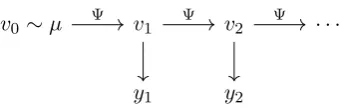
Figure 2.1: Graphic representation of the dependence structure assumed through-out this chapter. Conditional on v0, . . . , vj, the distribution of vj+1 is completely determined by vj via a deterministic map Ψ; therefore the signal process forms a
Markov chain. Similarly, conditional on{vj}j≥0,{yj}j≥1 is a sequence of indepen-dent random variables such that the conditional distribution of yj depends only on
vj.
and P w1 =w1 a.s.1 Thus Q is a projection operator onto the unobserved part of the system. Forj ≥0, we letYj :=σ(yi, i≤j) be the σ–algebra generated by the
observations up to the discrete timej.
Note that the law of {vj, yj}j≥0 is completely determined by four elements: the law of v0, the map Ψ, the law of w1 and the observation operator P. We will denote by P the law of {vj, yj}j≥0 and by E the corresponding expectation.
It will be assumed throughout that E|v0|2 < ∞ and that the observation noise satisfies Ew1 = 0 and E|w1|2 <∞. For convenience and without loss of generality
we normalize the latter so thatE|w1|2 = 1.
The main object of interest in filtering theory are the conditional distribu-tions of the signal at discrete timej≥1 given all observations up to time j. These are known asfiltering distributions and will be denoted by
µj(·) :=Pvj ∈ ·|Yj
.
The meanbvj of the filtering distributionµj is known as theoptimal filter
b
vj :=E[vj|Yj] =
Z
H
v µj(dv).
By the mean-square minimization property of the conditional expectation [Williams, 1991], this filter is optimal in the sense that, among all Yj-measurable random
variables, it is the only one —up to equivalence— that minimizes the L2 distance
1
More generally, when an operatorT :H → Hacts on the observations it should be implicitly understood thatT :H → HsatisfiesT =P T.Moreover it will often be assumed thatT
P :PH →
PH is positive definite and then the operatorT−1 :H → H should be interpreted as satisfying
P T−1=T−1
P, QT
−1≡
to the signalvj:
E|vj−bvj| 2≤
E|vj−zj|2, for allYj–measurablezj. (2.2.3)
In words,vbj is the best possible estimator (in the mean-square sense) of the state of
the signal at timejgiven information up to timej.The optimal filter is usually, like the filtering distributions, not analytically available. However, by studying suitable suboptimal filters{zj}j≥0 and using (2.2.3) we can find sufficient conditions under which the optimal filter is close to the signal in the long-time horizon. We thus provide sufficient conditions under which the observations counteract the potentially chaotic behaviour of the dynamical system, and allow predictability on infinite time-horizons.
The main objective of this chapter is to investigate the long-time asymptotic behaviour of the filtering distribution for discrete-time chaotic signals, arising from the solution to a dissipative quadratic system with energy-conserving nonlinearity
dv
dt +Av+B(v, v) =f, (2.2.4) which is observed at discrete timestj =jh, j ≥1, h >0.The bilinear formB(·,·)
will be assumed throughout to be symmetric. We denote by Ψt the one-parameter
solution semigroup associated with (2.2.4), i.e. for v0 ∈ H, Ψt(v0) is the value at
timetof the solution to (2.2.4) with initial conditionv0.Furthermore we introduce the abbreviation Ψ = Ψh.
Our theory —developed in Section 2.4— relies on two assumptions that we now state and explain.
Assumptions 2.2.1.
1. (Absorbing ball property.) There are constants r0, r1 >0 such that |Ψt(v0)|2≤exp(−r1t)|v0|2+r0 1−exp(−r1t)
, t≥0. (2.2.5) Therefore, setting r = √2r0, the ball B := {u ∈ H : |u| ≤ r} is absorbing and forward invariant for the dynamical system (2.2.1).
2. (Squeezing property.) There is a functionV : H →[0,∞)such thatV(·)1/2 is a Hilbert norm equivalent to| · |,a bounded operator D,an absorbing setBV ={u∈ H:V(u)1/2 ≤R} ⊃ B,and a constant α∈(0,1)such that, for all u∈ B, v∈ BV,
V(I−DP) Ψ(v)−Ψ(u)
The absorbing ball property concerns only the signal dynamics. It is satisfied by many dissipative models of the form (2.2.4) —see Section 2.5. The squeezing property involves both the signal dynamics and the observation operator P. It is satisfied by several problems of interest provided that the assimilation time h is sufficiently small and that the ‘right’ parts of the system are observed; see again Section 2.5 for examples. We remark that several forms of the squeezing property can be found in the dissipative dynamical systems literature. They all refer to the existence of a contracting part of the dynamics. Their importance for filtering has been explored in [Hayden et al., 2011], [Brett et al., 2013] and [Chueshov, 2014]. It also underlies the analysis in [Kelly et al., 2014] and [Law et al., 2016], as we make apparent here. We have formulated the squeezing property to suit our analyses and with the intention of highlighting the similar role that it plays to detectability for linear problems, as explained in Subsection 2.4.2. The function V will represent a Lyapunov type function in Section 2.4. For all the chaotic examples in Section 2.5 the operator D will be chosen as the identity, but other choices are possible. As we shall see, the absorbing ball property is not required when a global form of the squeezing property, as may arise for linear problems, is satisfied.
We will construct suboptimal filters {mj}j≥0 that are forced to lie in BV.
By the absorbing ball property the signalvj is contained, for large j and with high
probability, in the forward-invariant ball B. Therefore, intuitively, the squeezing property can be applied, for largej,tomj ∈ BV, vj ∈ B.
The main result of the chapter, Theorem 2.4.8, shows that, when Assumption 2.2.1 holds, the optimal filter accurately tracks the signal. Specifically we show that there is a constant c >0,independent of the noise strength, such that
lim sup
j→∞ E
|vj−bvj|
2 ≤c2. (2.2.6)
Note that (2.2.6) not only guarantees that in the low noise regime the optimal filter (i.e. the mean of the filtering distribution) is —on average— close to the signal, but also that the variance of the filtering distribution is —on average— small. Indeed, since
var[vj
Yj] =E
(vj −bvj)⊗(vj−bvj)
Yj
it follows by taking expectations and using linearity of the trace operator that
TraceEvar[vj
and therefore (2.2.6) implies
lim sup
j→∞
TraceEvar[vj
Yj]≤c2.
We hence see that (2.2.6) guarantees that the variance of the filtering distributions scales as the size of the observation noise, like O(2). Thus the initial uncertainty in the initial condition which is O(1) is reduced, in the large-time asymptotic, to uncertainty of O(): the observations have overcome the effect of chaos. Small variance of the long-time filtering distribution had been previously proposed as a condition for successful data assimilation [Chorin and Morzfeld, 2013].
2.3
Suboptimal Filters
The aim of this section is to introduce a suboptimal filter, designed to track dynamics satisfying Assumption 2.2.1. This filter is based on the 3DVAR algorithm from data assimilation, and nonlinear observers from control applications. We give the necessary background on these in Subsection 2.3.1 before introducing the new filter in Subsection 2.3.2.
2.3.1 3DVAR Filter
The 3DVAR filter approximates the filtering distributionµj+1by a GaussianN(zj+1, C)
whose mean can be found recursively starting from a deterministic pointz0 ∈ Hby solving the variational problem
zj+1 := argminz
1 2 C
−1/2
] z−Ψ(zj)
2
+ 1 22
Γ
−1/2(y
j+1−P z)
2
, (2.3.1)
where C] is a fixed model covariance that represents the lack of confidence in the
model Ψ,and Γ is the covariance operator of the observation noisew1.
The covariance C of the 3DVAR filter is determined by the Kalman update formula
C−1 =C]−1+PTΓ−1P.
It is immediate from (2.3.1) that zj is Yj-measurable for all j ≥ 0, and it
can be shown [Law et al., 2015] that the solution zj+1 to this variational problem satisfies
whereK is the Kalman gain
K=C]PT(P C]PT +2Γ)−1.
The 3DVAR filter was introduced, and has been widely applied, in the mete-orological sciences [Parrish and Derber, 1992; Lorenc, 1986]. Long-time asymptotic stability and accuracy properties —that guarantee that the meanszj become close
to the signalvj— have recently been studied for the Lorenz ’63 model [Law et al.,
2014] subject to additive Gaussian noise, and the Lorenz ’96 and Navier-Stokes equation observed subject to bounded noise [Law et al., 2016], [Brett et al., 2013].
It will be convenient to allow for other choices of operator K in the above definition, and consider the more general recursion
zj+1 = (I−DP)Ψ(zj) +Dyj+1, (2.3.3) where D is some linear operator that we are free to choose as desired. Filters of the form (2.3.3) are known as nonlinear observers [Thau, 1973], [Tarn and Rasis, 1976]. The 3DVAR filter can be seen as an instance of these where the operator Dis determined by model and noise covariances, and by the observation operator. We now derive a recursive formula for the error made by nonlinear observers when approximating the signal. To that end note, firstly, that the signal{vj}j≥0 satisfies
vj+1 = (I−DP)Ψ(vj) +DPΨ(vj).
Secondly, using (2.2.2) at timej+ 1,combined with the assumption thatP wj+1 = wj+1,
zj+1= (I−DP)Ψ(zj) +DPΨ(vj) +DP wj+1
Therefore, substracting the previous two equations, we obtain that the errorδj :=
vj−zj satisfies
δj+1 = (I−DP) Ψ(vj)−Ψ(zj)
2.3.2 Nonlinear Observers and Truncated Nonlinear Observers
In the remainder of this section we introduce a truncated nonlinear observer that is especially tailored to exploit the absorbing ball property of the underlying dynamics. Given a non-empty closed convex subsetC ⊂ H,takem0∈ C and, forj ≥0, define theC-truncated nonlinear observer mj+1 by
mj+1 :=PC
(I−DP)Ψ(mj) +Dyj+1
, (2.3.5)
where PC is the orthogonal (with respect to a suitable inner product) projection
operator onto the set C; this is well-defined for any non-empty closed convex set [Rudin, 1987]. In the next section we will analyze the long-time behaviour of this filter whenCis chosen asBV and the inner product is the one induced byV1/2 (see Assumption 2.2.1). The main advantage of this truncated filter is thatmj ∈ BV for
allj≥0,and large uninformative observationsyjcorresponding to large realizations
of the observation noisewj will not hinder the performance of the filter. Examples
of other truncated stochastic algorithms can be found in [Kushner and Yin, 2003].
2.4
Stochastic Stability of Suboptimal Filters and Filter
Accuracy
In this section we prove long-time accuracy of certain suboptimal filters under differ-ent assumptions on the underlying dynamics and observation model. These results are used to establish long-time concentration of the filtering distributions. We start in Subsection 2.4.1 by recalling the Lyapunov method for proving asymptotic bound-edness of stochastic algorithms. In Subsection 2.4.2 we employ this method to show asymptotic accuracy of nonlinear observers when a global form of the squeezing property is satisfied, as happens for certain linear problems. Finally, in Subsection 2.4.3 we use truncated nonlinear observers to deal with chaotic models where only the weaker Assumption 2.2.1 holds.
2.4.1 The Lyapunov Method for Stability of Stochastic Filters
Consider a Markov chain {δj}j≥0 and think of it as the random sequence of errors made by some filtering procedure. The next result, from [Tarn and Rasis, 1976], underlies much of the analysis in the following subsections.
Lemma 2.4.1. Let δ1
j and δj2 be two realizations of the H-valued random variable
1. V(0) = 0, V(x)≥θ|x|2 for allx∈ H and someθ >0.
2. There are real numbers K >0 and α∈(0,1)such that, for all ∆j ∈ H,
E[V(∆j+1)|∆j]≤K+αV(∆j).
Then, for any a∈ H,
θE[|∆j|2|∆0=a]≤αjV(a) +K j−1 X
i=0 αi.
Therefore, regardless of the initial state∆0,
lim sup
j→∞ E
|∆j|2≤
K θ(1−α).
2.4.2 Filter Accuracy with Global Squeezing Property
The following results show that if, for some suitable operatorD,the map (I−DP)Ψ satisfies a global Lipschitz condition, then it is possible to use nonlinear observers to deduce long-time accuracy of the filtering distributions. Although such a global condition does not typically hold for dissipative chaotic dynamical systems arising in applications, the following discussion serves as a motivation for the more general theory in Subsection 2.4.3. Moreover, the results in this subsection are of interest in their own right. In particular they are enough to deal with the important case of linear signal dynamics.
Theorem 2.4.2. Assume that there is a Hilbert norm V(·)1/2 in H, equivalent to | · |,and a bounded operator Dand constant α ∈(0,1)such that
V(I−DP) Ψ(v)−Ψ(u)
≤αV(v−u) ∀u, v∈ H.
Define{zj}j≥0 by (2.3.3). Then there is a constant c >0,independent of the noise strength , such that
lim sup
j→∞ E
|vj−zj|2 ≤c2.
Then, using equation (2.3.4) and the independence structure,
E[V(δj+1)|δj] =E
h V
(I−DP) Ψ(vj)−Ψ(zj)
−Dwj+1
δj
i =E
h
V(I−DP) Ψ(vj)−Ψ(zj)
δj
i
+2EV(Dwj+1) ≤E
h V
(I−DP) Ψ(vj)−Ψ(zj)
δj
i +C2 ≤αV(δj) +C2,
whereC >0 is independent ofand to obtain the first inequality we used equivalence of norms and the fact thatDis bounded. Thus the second condition in Lemma 4.1 holds and the proof is complete.
The following corollary is an immediate consequence of the L2 optimality property of the optimal filter (2.2.3).
Corollary 2.4.3. Under the hypothesis of the previous theorem lim sup
j→∞ E
|vj−bvj|
2≤c2, lim sup
j→∞
TraceEvar[vj
Yj]≤c2.
In the remainder of this subsection we apply, for the sake of motivation, the previous theorem to the case of linear finite dimensional dynamics. We takeH=Rd
and let the signal be given by
vj+1 =Lvj, j≥1, v0 ∼µ0. (2.4.1)
This framework has been widely studied within the control theory community, mostly —but not exclusively— in the case where both the initial distribution of the signal and the observation noise are Gaussian. Other than its modelling appeal, this linear Gaussian setting has the exceptional feature that the filtering distribu-tions are themselves again Gaussian. Moreover, their means and covariances can be iteratively computed using the Kalman filter [Kalman, 1960]. Since the optimal filter is the mean of the filtering distribution, the explicit characterization of the Kalman filter yields an explicit characterization of the optimal filter. Suppose that, for some given bv0 ∈ R
d and C0 ∈
Rd×d, µ0 =N(ˆv0, C0) and suppose further that
w1 ∼N(0,Γ).Then the filtering distributions are Gaussian, µj =N(bvj, Cj), j≥1, and the means and covariances satisfy the recursion (see [Law et al., 2015])
b
vj+1= (I−Kj+1P)Lvbj +Kj+1yj+1,
where thepredictive Kalman covariance Cj+1|j and Kalman gainKj+1 are given by Cj+1|j =LCjLT,
Kj+1=Cj+1|jPT(P Cj+1|jPT +2Γ)−1.
Similar formulae are available when the covariance operator Γ is not invertible in the observation space [Law et al., 2015].
Remark 2.4.4. It is clear from (2.4.2) that the Kalman filter covariance Cj, which
is the covariance of the filtering distribution µj, is deterministic and in particular
does not make use of the observations. It follows from the discussion in Section 2.2 that in the linear Gaussian setting
lim sup
j→∞ E
|vj−bvj| 2≤c2
implies
lim sup
j→∞
TraceCj ≤c2.
In the linear setting the global squeezing property in Theorem 2.4.2 reduces to the control theory notion of detectability, that we now recall.
Definition 2.4.5. The pair (L, P) is called detectable if there exists a matrix D such thatρ(L−DP)<1, where ρ(·) denotes spectral radius.
We remark that the condition ρ(L−DP) < 1 guarantees the existence of a Hilbert norm in Rd in which the linear map defined by the matrix L−DP is
contractive. It therefore yields a global form of the squeezing property. Note that detectability may hold for unstable dynamics withρ(L)>1.However the observa-tions need to contain information on the unstable direcobserva-tions. It is not necessary that these are directly observed, but only that we can retrieve information from them by exploiting any rotations present in the dynamics. This is the interpretation of the matrix D in the definition. The next result states the abstract global theorem of the previous section in the setting of linear dynamics. Our aim in including it here is to make apparent the connection between classical control theory [Lancaster and Rodman, 1995], ideas from data assimilation concerning the 3DVAR filter [Brett et al., 2013], [Kelly et al., 2014], [Law et al., 2016], and the new results for chaotic systems observed with unbounded noise in Section 2.4.3.
Theorem 2.4.6. Assume that H=Rd and Ψ(v) =Lv with L∈Rd×d. Then if the
, such that
lim sup
j→∞ E
|vj−bvj|
2 ≤c2, and consequently in the linear Gaussian setting
lim sup
j→∞
TraceCj ≤c2.
Proof. By the Hautus lemma [Sontag, 1998] the pair (L, P) is detectable if and only if
Rank λI−L P
! =d
for all λ with |λ| ≥ 1 or, in other words, if Ker(λI−L)∩Ker(P) = {0} for all λ with |λ| ≥ 1. Using this characterization of detectability it is immediate from the identity
Ker(λI−L)∩Ker(P L) = Ker(λI−L)∩Ker(P), λ6= 0,
that (L, P) is detectable iff (L, P L) is detectable. Now by hypothesis (L, P) is detectable and so there exists a matrixD such that ρ (I −DP)L
<1.Hence the linear map defined in Rd by the matrix (I−DP)L is globally contractive in some
Hilbert norm. The result follows from Theorem 2.4.2 and Corollary 2.4.3.
2.4.3 Filter Accuracy for Chaotic Deterministic Dynamics
In this section we study filter accuracy for signals satisfying Assumption 2.2.1. Our analysis now makes use oftruncatednonlinear observers (2.3.5), which are forced to lie in the absorbing ballBV. The idea is that, once the signal gets into the absorbing ball, projecting the filter intoBV reduces the distance from the signal, as measured
by the Lyapunov function V. This is the content of the following lemma. PBVx denotes the closest point (in the V1/2 norm) to x ∈ H in the set BV. Therefore, PBVx=R
1/2 x
V1/2(x) forx /∈ BV.
Lemma 2.4.7. Let V1/2(·) be a Hilbert norm and let R > 0 be arbitrary. Set BV :={b∈ H:V(b)≤R} similarly as in Assumption 2.2.1. Then,
V(PBVx−b)≤V(x−b), x∈ H, b∈ BV. (2.4.3) Proof. The case x ∈ BV is obvious so we assume V(x) > R. Let h·,·iV denote the inner product associated with the normV1/2.We claim that