
http://wrap.warwick.ac.uk/
Original citation:
Broome, Matthew R., Zányi, Eva, Hamborg, Thomas, Selmanovic, Elmedin, Czanner,
Silvester, Birchwood, Max, Chalmers, Alan and Singh, Swaran P.. (2013) A high-fidelity
virtual environment for the study of paranoia. Schizophrenia Research and Treatment,
Volume 2013
, Article number 538185.
Permanent WRAP url:
http://wrap.warwick.ac.uk/58526
Copyright and reuse:
The Warwick Research Archive Portal (WRAP) makes this work of researchers of the
University of Warwick available open access under the following conditions.
This article is made available under the Creative Commons Attribution- 3.0 Unported
(CC BY 3.0) license and may be reused according to the conditions of the license. For
more details see
http://creativecommons.org/licenses/by/3.0/
A note on versions:
The version presented in WRAP is the published version, or, version of record, and may
be cited as it appears here.
Volume 2013, Article ID 538185,7pages
http://dx.doi.org/10.1155/2013/538185
Research Article
A High-Fidelity Virtual Environment for the Study of Paranoia
Matthew R. Broome,
1,2Eva Zányi,
1Thomas Hamborg,
3Elmedin Selmanovic,
4Silvester
Czanner,
5Max Birchwood,
1,6Alan Chalmers,
4and Swaran P. Singh
11Division of Mental Health and Wellbeing, Warwick Medical School, University of Warwick, Coventry CV4 7AL, UK
2Department of Psychiatry, University of Oxford, Oxford OX3 7JX, UK
3Division of Health Sciences,Warwick Medical School, University of Warwick, Coventry CV4 7AL, UK
4Visualisation Group, WMG, University of Warwick, Coventry CV4 7AL, UK
5School of Computing, Mathematics and Digital Technology, MMU, Manchester M1 5GD, UK
6Department of Psychology, University of Birmingham, Birmingham B15 2TT, UK
Correspondence should be addressed to Matthew R. Broome; [email protected]
Received 4 July 2013; Accepted 2 October 2013
Academic Editor: Anil K. Malhotra
Copyright © 2013 Matthew R. Broome et al. This is an open access article distributed under the Creative Commons Attribution License, which permits unrestricted use, distribution, and reproduction in any medium, provided the original work is properly cited.
Psychotic disorders carry social and economic costs for sufferers and society. Recent evidence highlights the risk posed by urban upbringing and social deprivation in the genesis of paranoia and psychosis. Evidence based psychological interventions are often not offered because of a lack of therapists. Virtual reality (VR) environments have been used to treat mental health problems. VR may be a way of understanding the aetiological processes in psychosis and increasing psychotherapeutic resources for its treatment. We developed a high-fidelity virtual reality scenario of an urban street scene to test the hypothesis that virtual urban exposure is able to generate paranoia to a comparable or greater extent than scenarios using indoor scenes. Participants (𝑛 = 32) entered the VR scenario for four minutes, after which time their degree of paranoid ideation was assessed. We demonstrated that the virtual reality scenario was able to elicit paranoia in a nonclinical, healthy group and that an urban scene was more likely to lead to higher levels of paranoia than a virtual indoor environment. We suggest that this study offers evidence to support the role of exposure to factors in the urban environment in the genesis and maintenance of psychotic experiences and symptoms. The realistic high-fidelity street scene scenario may offer a useful tool for therapists.
1. Introduction
Psychosis, and psychotic disorders such as schizophrenia, is characterized by the presence of hallucinations (false perceptions) and delusions (false beliefs). It has become clear in recent years that the marked heterogeneity in the rates of schizophrenia and psychotic disorders across population
groups [1] can be partly explained by urban birth and
upbringing, migration, ethnicity, and what Cantor-Graae
and Selten have termed “social defeat” [2,3]. A particularly
important recent body of research is the MRC AESOP study that demonstrated a twentyfold rate increase in the incidence of psychosis in London, compared with Nottingham and Bristol, and the very highest rates being within the Black and
ethnic minority groups [4–8]. These epidemiological findings
have strengthened continuum models of psychosis [9], which
state that psychotic-like experiences are distributed in a normal nonclinical population and might be dependent upon many of the same variables as causally responsible for cases of
the disorder [10]. Trying to connect psychological, biological,
and social models of psychosis, and relating these to psy-chotic experiences and urbanicity in the general population, has become increasingly important to both clinicians and
researchers [11].
In a series of remarkable studies, Myin-Germeys and
other colleagues from Maastricht [12–16] demonstrated a
2 Schizophrenia Research and Treatment
and exaggerated reasoning biases linked to the formation
and maintenance of delusions [17]. Hence for schizophrenia
and other psychotic disorders, recent epidemiological work has demonstrated both the heterogeneity of incidence rates and the role the urban environment, being part of an ethnic minority group and/or being a migrant, plays in the rates of the disorder. Further, experimental data suggests that being in the urban environment has an immediate and measurable impact upon levels of paranoia in both healthy controls and patients.
This study seeks to build on these recent findings and experimentally create an urban social environment where risk variables of interest can be carefully modified and controlled to test hypotheses as to the role the social envi-ronment and in particular the urban envienvi-ronment play in the generation of psychotic-like experiences, offering an experimental approach to examine social variables relevant to the generation of psychosis. Further, such a virtual environ-ment may serve as a useful tool in the delivery of cognitive behavioural therapy (CBT) with patients with paranoia: the virtual environment serves as a safe, replicable place for behavioural experiments that can be manipulated and utilized by the patient remotely from the therapist. Virtual reality has been used as an important tool to study the aetiology of paranoia but thus far the scenarios developed have been those of a library and of a London underground
train [18–20], both enclosed, internal spaces. With these
studies, the focus has been on the “internal” psychological variables of the participants and how they predict paranoia. Our concern here is with environmental “external” variables, such as crowd density, traffic, and the nature of the buildings and street planning that may elicit paranoia and hence an urban street scene offers an environment whereby several features and variables can be manipulated independently and hence the role in the genesis of paranoia determined. Following the data outlined above, we would predict that a virtual urban experience would lead to higher levels of paranoia than a scenario in which the participants travelled on a virtual underground train.
Our aims and hypotheses in this study were as follows: firstly, to create a virtual reality scenario, using multimodal sensory inputs, that simulated a busy deprived inner city street scene; as such, this study was initially a feasibility and proof of concept study; secondly, to examine if exposure to this virtual environment evoked paranoid thoughts, such as believing that an element of the urban experience, for example, an avatar, posed a threat to them. Our hypothesis was that the urban street experience may be more likely to produce paranoia than that reported in published data utilizing an existing scenario used to evoke paranoia and also may be more useful for research examining social causes of psychosis and for developing adjunctive strategies to psychological interventions for psychosis.
2. Methods
2.1. Participants. The study was approved by the University
of Warwick Ethics committee and participants were recruited
from amongst the undergraduate and postgraduate students. Recruitment for the study was carried out by leaflet distri-bution, posters on campus, e-mails, and Internet webpage recruitment site. Participants were excluded from the study if they had a physical or sensory disability that would prohibit them from using the virtual reality equipment, if there was a history of psychiatric or neurological illness, or if they were dependent on alcohol or illicit drugs. All participants were blind to the hypotheses of the study.
Participants provided informed written consent. All test-ing, interviews, and exposure to the virtual reality scenario took place at the Warwick Manufacturing Group (WMG) International Digital Lab at the University of Warwick.
2.2. Scenario Design, Presentation, and Technical Specifications
2.2.1. Technology. The system comprised a NVIS nVisor SX
head mounted display (HMD) and a Polhemus PATRIOT 6DOF Motion Tracking System controlled by an Intel Q6600 2.40 GHz Core 2 Quad with 4 GB of 800 MHz RAM and an
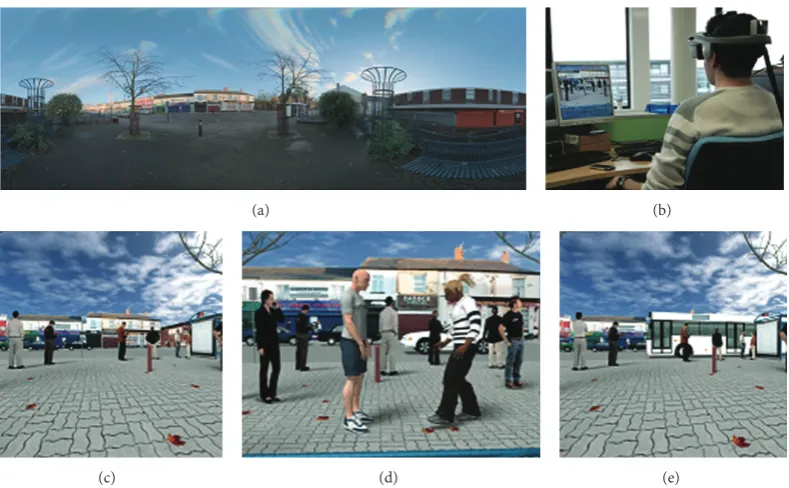
NVIDIA GeForce 8800 GTX graphics card; seeFigure 1. The
HMD has SXGA resolution (1280×1024, 24-bit per eye), 60∘
diagonal field of view with 100% overlap, refresh rate of 60 Hz, and stereo headphones. It weighs approximately 1 kg and is
connected to the PC via 2×VGA cables.
2.2.2. Scenario. The virtual reality environment used is a
highly realistic multimodal (graphics and audio) virtual urban setting based on an actual street in the deprived area
of Handsworth, Birmingham (UK) [21], including both the
environment and virtual people (avatars). See Figure 1. In
the scenario, the user of the system is sitting at the bus stop waiting for a bus. The environment was built using C++ with the OGRE game engine and a high dynamic range (HDR) panoramic image captured at the real bus stop using a Spheron SpheroCam HDR. Pouzar and Autodesk Maya software packages were used for the modelling and animations. The animation lasts for 4 minutes:
0:00–1:30 mins: background with people and cars,
1:30–1:40 mins: young men arrive in the scene,
1:40–3:30 mins: young men stand around at bus stop,
3:30–4:00 mins: bus arrives and at the same time men leave,
4:00: end of experiment.
2.3. Measures. Prior to being exposed to the virtual reality
scenario, all participants took part in an interview and completed questionnaires with one of the research team (EZ). These questionnaires included the Depression Anxiety
Stress Scale (DASS, [1]), the Green et al. Paranoid Thoughts
Scale (G-PTS [22]), Cardiff Anomalous Perceptions Scale
(CAPS [23]), the Social Avoidance and Distress Scale (SADS
[24]), Penn State Worry Questionnaire (PSWQ, [25]), and the
(a) (b)
(c) (d) (e)
Figure 1: (a) Panoramic image of bus stop in Handsworth, (b) system set-up, (c) background scene, (d) avatars of young men in the scene, and (e) bus arrives.
Subsequent to completing these questionnaires, partici-pants donned the virtual reality headmounted display and entered the scenario where they remained for 4 minutes. The information the subjects received was that they were going to see a virtual bus stop in Handsworth, Birmingham, and that they would be sitting on a bench in front of it. They were
asked to wait at the bus stop until the bus arrived (Figure 1).
At the end of the scenario, they were debriefed and completed
the State Social Paranoia Scale (SSPS, [27]). This scale has 10
items related to persecutory thoughts; each rated on a 5-point Likert scale and is designed to measure state paranoia elicited after an experimental exposure. A score of 1 on each item signifies absence and hence only scores totalled of greater than 10 signify the presence of paranoia. In total the whole procedure lasted for about 1.5 hrs per subject.
2.4. Statistical Analysis. Primary outcome of the statistical
evaluation of this study was participants’ persecutory ideation ascertained by SSPS score. SSPS scores after exposure to the urban street scene were compared to data published by
Freeman and colleagues [20] for their study with participants
in a virtual underground tube train. Two different analyses were conducted. First, as in the prior study, the data were dichotomised into participants who experienced paranoia (defined as SSPS score greater than 10) and those participants who did not (SSPS score less than or equal to 10). A
likelihood-ratio𝜒-square test was conducted to compare the
odds for experiencing paranoia between the two studies. A second analysis, informing about differences in the trend of score values, compared SSPS scores from both studies using
six ordinal categories devised by Freeman et al. [20], SPSS
scores<10, 11–15, 16–20, 21–25, 26–30,>30. The categories are
shown inTable 3. The comparison was performed employing
an ordinal logistic regression model in which SSPS score is the outcome variable and study is the independent predictor. Furthermore an exploratory analysis investigating the association of SSPS score (outcome) with demographic variables and pre-VR measures (predictors) was conducted. Adjusting for age and eye problems, an ordinal logistic regression model was fitted for each predictor separately. Estimates for predictors are presented as ordered odds ratios. The proportional odds assumption has held for all analyses.
All analyses were performed using SAS version 9.22.
3. Results
3.1. Participants. We recruited 32 participants. The
partici-pants were predominantly male, in their mid-20s, single, and international students studying for a postgraduate qualifica-tion with students from the whole campus being represented
(seeTable 1).
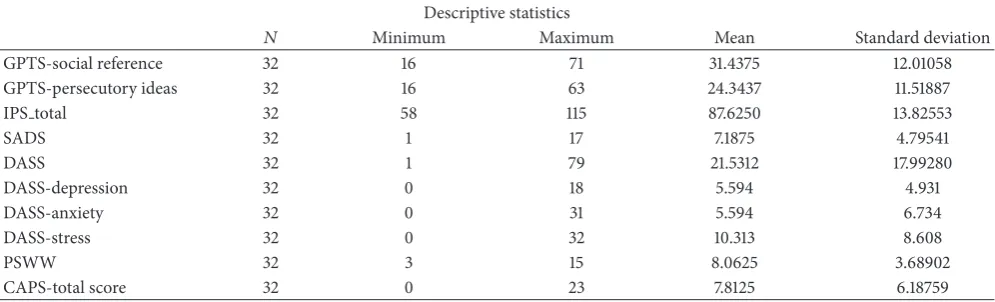
3.2. Pre-VR Measures. Data was collected on all participants
on the measures detailed above. The G-PTS generates two scores, one for persecutory ideas and one for social reference, and these have been presented independently.
There were no significant correlations between any of the baseline, pre-VR measures, or the demographic variables.
We were unable to determine any strong predictors of paranoid thinking. That is, none of the investigated baseline and pre-VR measures significantly improved the model fit of the ordinal logistic regression model when included as a predictor. Furthermore, only one variable category (being short sighted) was significantly different from an odds-ratio
[image:4.600.103.498.70.314.2]4 Schizophrenia Research and Treatment
Table 1: Demographic data on participants.
Age (mean, SD) Gender (M : F) UK nationality (%) Relationship
status
Years of higher education (mean, SD)
Status of degree being studied for
undergraduate : postgraduate
25.9 (SD 4.2) 23 : 9 34.4%
78.1% single, 21.9% married
or in relationship
5.7 (SD 2.7) 5 : 27
Table 2: Pre-VR measures including Green et al. [22] Paranoid Thoughts Scale (G-PTS), Interpersonal Sensitivity Scale (IPS), Social Avoidance and Distress Scale (SADS), Depression Anxiety Stress Scale (DASS), the Penn State Worry Questionnaire (PSWW), and Cardiff Anomalous Perceptions Scale (CAPS).
Descriptive statistics
𝑁 Minimum Maximum Mean Standard deviation
GPTS-social reference 32 16 71 31.4375 12.01058
GPTS-persecutory ideas 32 16 63 24.3437 11.51887
IPS total 32 58 115 87.6250 13.82553
SADS 32 1 17 7.1875 4.79541
DASS 32 1 79 21.5312 17.99280
DASS-depression 32 0 18 5.594 4.931
DASS-anxiety 32 0 31 5.594 6.734
DASS-stress 32 0 32 10.313 8.608
PSWW 32 3 15 8.0625 3.68902
CAPS-total score 32 0 23 7.8125 6.18759
3.3. Post-VR Measures. SeeTable 4. A striking finding with
the SSPS data is that 65.6% of the participants experienced some persecutory ideation whilst taking part in the virtual reality scenario. Further, the mean SSPS in our sample is higher than reported by Freeman and colleagues, as is the proportion of participants who experienced any degree of paranoia whatsoever.
As detailed above, we carried out two analyses comparing our data in the urban street scene with that of Freeman and
colleagues [20] stemming from an underground tube train
scenario. First the data were dichotomised into participants who experienced paranoia (SSPS score greater than 10) and those participants who did not. In the Warwick study 65.6% (21/32) experienced paranoia, whereas only 47.5% (95/200) of the participants experience paranoia in the Freeman et al.
[20] study. The estimated odds-ratio value for experiencing
paranoia is 2.11 (95% CI = (0.967; 4.605)) which implies that participants in the Warwick study are more than twice as likely to experience paranoia. There is moderate evidence
(𝑃 = 0.055) against the null hypothesis that the odds
of experiencing paranoia in the two scenarios are in fact identical.
The second analysis compares the SSPS scores from both
studies using categories as shown inTable 4. Individual SSPS
scores for Freeman et al. were not available. The estimated odds that a Warwick study participant is in a higher score category instead of the given category is (odds-ratio =) 3.649 (95% CI = (1.833; 7.266)) times the odds for this being the
case for Freeman et al. [20] participants. A fairly substantial
association exists, Warwick participants tend to experience higher levels of paranoia. The likelihood-ratio statistic for
the null hypothesis that study affiliation has no effect on SSPS
score is highly significant (𝑃 < 0.001) so that it can be
concluded that there is a strong association between study and score, with Warwick participants being more likely than
those reported by Freeman et al. [20] to achieve a higher
score.
4. Discussion
This study demonstrates that we have been successful in producing a virtual reality street scene, specifically of an urban, deprived environment including pedestrians. Further, this scenario was effective in producing paranoid ideation in the participants with approximately two-thirds of the subjects reporting persecutory thoughts after exposure to the scenario.
In comparison to a large study of healthy volunteers using
a scenario of riding on the London underground [20], our
[image:5.600.51.549.220.371.2]Table 3: Individual variables are adjusted (controlled) for gender and having eye problems, apart from gender and eye problem themselves.
The∗symbol indicates statistical significance (𝑃 < 0.05).
Variable Odds ratio 95% confidence
interval Gender
Female 0.77 0.18–3.29
Eye problem
No problem — —
Short sight 4.62∗ 1.03–20.83
Other problem 1.01 0.19–5.44
Age 0.99 0.85–1.15
Plays computer games
Yes 1.46 0.30–7.14
Nationality
Non-British 1.82 0.48–6.84
Ethnicity
White — —
Asian 1.53 0.38–6.10
Other 1.89 0.28–12.82
Social reference (3G-PTS) 0.97 0.92–1.03
Persecutory ideas (3G-PTS) 0.97 0.91–1.03
Interpersonal sensitivity 1.02 0.97–1.07
CAPS 1.02 0.90–1.15
DASS 0.99 0.96–1.03
DASS-depression 0.97 0.86–1.10
DASS-anxiety 0.98 0.89–1.08
DASS-stress 0.98 0.91–1.06
PSWQ 0.98 0.77–1.25
Table 4: Post-VR State Social Paranoia Scale (SSPS), comparing results from the Warwick urban scenario with Freeman and colleagues’ [20] London underground tube journey scenario.
SSPS (mean and score frequency) Warwick VR scenario Freeman et al. 2008 [20]
Mean (SD) 17.5 (7.9) 12.26 (4.8)
≤10 11/32 34.4% 105/200 52.5%
11–15 6/32 18.8% 64/200 32%
16–20 4/32 12.5% 16/200 8%
21–25 5/32 15.6% 9/200 4.5%
26–30 2/32 6.25% 3/200 1.5%
>30 4/32 12.5% 3/200 1.5%
by Freeman and colleagues. Our participants were much younger (mean age of 26 years, as opposed to 37), they were all students, the bulk of our participants were non-UK nationals who had come to Warwick University to pursue their studies, and the quality of the virtual environment was marginally higher (realistic high dynamic range images for representing the environment rather than less realistic computer models). Further, we were unable to directly compare the two groups of participants in terms of their pre-VR measures due to these data not being reported in the paper detailing exposure to the London underground VR scenario. Hence, it may be possible that our participants may have started at a higher baseline of
[image:6.600.52.550.487.588.2]6 Schizophrenia Research and Treatment
allowing investigators to manipulate independently variables, for example, traffic and pedestrian density, and determine these variables’ effect on levels of paranoia. Such work would aid in the development of studying both the aetiology and
treatment of psychosis and psychotic disorders [28–31].
5. Conclusion
We suggest that this study offers further experimental evi-dence to support the role of exposure to factors common in the urban environment in the genesis and maintenance of psychotic experiences and symptoms. Further, the realistic high-fidelity street scene scenario may offer a useful tool for therapists in constructing behavioural experiments with their clients.
Future work will consider further how the fidelity of the computer simulation may affect the quality of the exposure. In particular, as part of investigating the role of urban vari-ables, we will investigate the impact of additional modalities, such as smell, for example, of alcohol on young men’s breath.
Acknowledgments
The authors would like to thank the IMRC at the University of Warwick for funding the study and all the students who took part. The authors would also like to thank Professor Daniel Freeman for his invaluable advice and guidance during the development of the scenario. Professors Birchwood and Singh were part-funded by the National Institute for Health Research (NIHR) through the Collaboratios for Leadership in Applied Health Research and Care for Birmingham and Black Country (CLAHRC-BBC). The views expressed in this publication are not necessarily those of the NIHR, the Department of Health, NHS Partner Trusts, University of Birmingham, or the CLAHRC-BBC Theme 3 Management Group.
References
[1] J. J. McGrath, “The surprisingly rich contours of schizophrenia
epidemiology,”Archives of General Psychiatry, vol. 64, no. 1, pp.
14–16, 2007.
[2] E. Cantor-Graae and J. Selten, “Schizophrenia and migration: a
meta-analysis,”Schizophrenia Research, vol. 67, no. 1,
suupple-ment 1, article 63, 2004.
[3] J.-P. Selten and E. Cantor-Graae, “Social defeat: risk factor for
schizophrenia?”British Journal of Psychiatry, vol. 187, pp. 101–
102, 2005.
[4] P. Fearon, J. B. Kirkbride, C. Morgan et al., “Incidence of schiz-ophrenia and other psychoses in ethnic minority groups: results
from the MRC AESOP Study,”Psychological Medicine, vol. 36,
no. 11, pp. 1541–1550, 2006.
[5] P. Fearon and C. Morgan, “Environmental factors in
schiz-ophrenia: the role of migrant studies,”Schizophrenia Bulletin,
vol. 32, no. 3, pp. 405–408, 2006.
[6] J. B. Kirkbride, P. Fearon, C. Morgan et al., “Neighbourhood variation in the incidence of psychotic disorders in Southeast
London,”Social Psychiatry & Psychiatric Epidemiology, vol. 42,
no. 6, pp. 438–445, 2007.
[7] J. B. Kirkbride, P. Fearon, C. Morgan et al., “Heterogeneity in incidence rates of schizophrenia and other psychotic
syn-dromes: findings from the 3-center AESOP study,”Archives of
General Psychiatry, vol. 63, no. 3, pp. 250–258, 2006.
[8] J. B. Kirkbride, C. Morgan, P. Fearon, P. Dazzan, R. M. Murray, and P. B. Jones, “Neighbourhood-level effects on psychoses:
re-examining the role of context,”Psychological Medicine, vol. 37,
no. 10, pp. 1413–1425, 2007.
[9] L. C. Johns and J. van Os, “The continuity of psychotic
expe-riences in the general population,”Clinical Psychology Review,
vol. 21, no. 8, pp. 1125–1141, 2001.
[10] M. R. Broome, J. B. Woolley, P. Tabraham et al., “What causes
the onset of psychosis?”Schizophrenia Research, vol. 79, no. 1,
pp. 23–34, 2005.
[11] P. A. Garety, P. Bebbington, D. Fowler, D. Freeman, and E. Kuipers, “Implications for neurobiological research of
cogni-tive models of psychosis: a theoretical paper,” Psychological
Medicine, vol. 37, no. 10, pp. 1377–1391, 2007.
[12] I. Myin-Germeys, P. Delespaul, and J. van Os, “Behavioral
sensitization to daily life stress in psychosis,” Psychological
Medicine, vol. 35, no. 5, pp. 733–741, 2005.
[13] I. Myin-Germeys, L. Krabbendam, P. Delespaul, and J. van Os, “Can cognitive deficits explain differential sensitivity to life
events in psychosis?”Social Psychiatry & Psychiatric
Epidemi-ology, vol. 38, no. 5, pp. 262–268, 2003.
[14] I. Myin-Germeys, L. Krabbendam, P. A. E. G. Delespaul, and J. van Os, “Do life events have their effect on psychosis by
influencing the emotional reactivity to daily life stress?”
Psycho-logical Medicine, vol. 33, no. 2, pp. 327–333, 2003.
[15] I. Myin-Germeys, F. Peeters, R. Havermans et al., “Emotional reactivity to daily life stress in psychosis and affective disorder:
an experience sampling study,”Acta Psychiatrica Scandinavica,
vol. 107, no. 2, pp. 124–131, 2003.
[16] I. Myin-Germeys, J. van Os, J. E. Schwartz, A. A. Stone, and P. A. Delespaul, “Emotional reactivity to daily life stress in psychosis,” Archives of General Psychiatry, vol. 58, no. 12, pp. 1137–1144, 2001. [17] L. Ellett, D. Freeman, and P. A. Garety, “The psychological effect of an urban environment on individuals with persecutory
delusions: the Camberwell walk study,”Schizophrenia Research,
vol. 99, no. 1, pp. 77–84, 2008.
[18] D. Freeman, M. Slater, P. E. Bebbington et al., “Can virtual reality
be used to investigate persecutory ideation?”Journal of Nervous
& Mental Disease, vol. 191, no. 8, pp. 509–514, 2003.
[19] L. R. Valmaggia, D. Freeman, C. Green et al., “Virtual reality and paranoid ideations in people with an ’at-risk mental state’
for psychosis,”The British Journal of Psychiatry, vol. 191, no. 51,
pp. s63–s68, 2007.
[20] D. Freeman, K. Pugh, A. Antley et al., “Virtual reality study of
paranoid thinking in the general population,” The British
Journal of Psychiatry, vol. 192, no. 4, pp. 258–263, 2008. [21] E. Z´anyi, E. Selmanovic, M. Broome et al., “Interactive highly
realistic virtual reality as a tool for understanding the genesis
and treatment of psychotic symptoms,”Studies in Health
Tech-nology and Informatics, vol. 144, pp. 138–140, 2009.
[22] C. E. L. Green, D. Freeman, E. Kuipers et al., “Measuring ideas of persecution and social reference: the Green et al. Paranoid
Thought Scales (GPTS),”Psychological Medicine, vol. 38, no. 1,
pp. 101–111, 2008.
[23] V. Bell, P. W. Halligan, and H. D. Ellis, “The Cardiff Anomalous Perceptions Scale (CAPS): a new validated measure of
anoma-lous perceptual experience,”Schizophrenia Bulletin, vol. 32, no.
[24] D. Watson and R. Friend, “Measurement of social-evaluative
anxiety,”Journal of Consulting and Clinical Psychology, vol. 33,
no. 4, pp. 448–457, 1969.
[25] T. J. Meyer, M. L. Miller, R. L. Metzger, and T. D. Borkovec, “Development and validation of the penn state worry
question-naire,”Behaviour Research and Therapy, vol. 28, no. 6, pp. 487–
495, 1990.
[26] P. Boyce and G. Parker, “Development of a scale to measure
interpersonal sensitivity,”Australian and New Zealand Journal
of Psychiatry, vol. 23, no. 3, pp. 341–351, 1989.
[27] D. Freeman, K. Pugh, C. Green, L. Valmaggia, G. Dunn, and P. Garety, “A measure of state persecutory ideation for
experimen-tal studies,”Journal of Nervous & Mental Disease, vol. 195, no. 9,
pp. 781–784, 2007.
[28] M. R. Broome, P. Wuyts, and P. Fusar-Poli, “Philosophical and
ethical issues in the prodromal phase of psychosis,” inOxford
Handbook of Philosophy and Psychiatry, K. W. M. Fulford, M. Davies, G. Graham, J. Sadler, G. Stanghellini, and T. Thornton, Eds., Oxford University Press, Oxford, UK, 2013.
[29] M. R. Broome, F. Day, I. Valli et al., “Delusional ideation, manic symptomatology and working memory in a cohort at
clinical high-risk for psychosis:a longitudinal study,”European
Psychiatry, vol. 27, no. 4, pp. 258–263, 2012.
[30] M. Broome and P. Fusar-Poli, “Philosophical issues in the
prodromal phase of psychosis,”Current Pharmaceutical Design,
vol. 18, no. 4, pp. 596–605, 2012.
[31] L. Bortolotti and M. R. Broome, “Affective dimensions of the
phenomenon of double bookkeeping in delusions,”Emotion
Submit your manuscripts at
http://www.hindawi.com
Hindawi Publishing Corporation
http://www.hindawi.com Volume 2013
Oxidative Medicine and Cellular Longevity
Hindawi Publishing Corporation
http://www.hindawi.com Volume 2013
Hindawi Publishing Corporation
http://www.hindawi.com Volume 2013
The Scientific
World Journal
International Journal of
Endocrinology
Hindawi Publishing Corporationhttp://www.hindawi.com Volume 2013
ISRN
Anesthesiology
Hindawi Publishing Corporation
http://www.hindawi.com Volume 2013
Oncology
Journal ofHindawi Publishing Corporation
http://www.hindawi.com Volume 2013
PPAR
R e s e a r c h
Hindawi Publishing Corporation
http://www.hindawi.com Volume 2013
Ophthalmology
Journal of Hindawi Publishing Corporationhttp://www.hindawi.com Volume 2013
ISRN
Allergy
Hindawi Publishing Corporation
http://www.hindawi.com Volume 2013
BioMed Research International
Hindawi Publishing Corporation
http://www.hindawi.com Volume 2013
Obesity
Journal ofHindawi Publishing Corporation
http://www.hindawi.com Volume 2013
ISRN
Addiction
Hindawi Publishing Corporation
http://www.hindawi.com Volume 2013
Hindawi Publishing Corporation
http://www.hindawi.com Volume 2013
Computational and Mathematical Methods in Medicine
ISRN AIDS
Hindawi Publishing Corporation
http://www.hindawi.com Volume 2013
Clinical & Developmental Immunology
Hindawi Publishing Corporation
http://www.hindawi.com Volume 2013
Diabetes ResearchJournal of
Hindawi Publishing Corporation
http://www.hindawi.com Volume 2013
Evidence-Based Complementary and Alternative Medicine
Volume 2013 Hindawi Publishing Corporation
http://www.hindawi.com Hindawi Publishing Corporation
http://www.hindawi.com Volume 2013 Gastroenterology Research and Practice
Hindawi Publishing Corporation
http://www.hindawi.com Volume 2013 ISRN
Biomarkers
Hindawi Publishing Corporation
http://www.hindawi.com Volume 2013
![Table 4: Post-VR State Social Paranoia Scale (SSPS), comparing results from the Warwick urban scenario with Freeman and colleagues’ [20]London underground tube journey scenario.](https://thumb-us.123doks.com/thumbv2/123dok_us/9576437.461577/6.600.53.552.98.450/paranoia-comparing-warwick-scenario-freeman-colleagues-underground-scenario.webp)
