Abstract—Most studies to date have focused on price coordination in the traditional channel structure, mostly composed of two echelons. Little attention has been given to the multi-level channel. This paper studies price coordination problem in a three-level supply chain composed of a single supplier, a single manufacturer and a single retailer. Three types of channel structures are considered, namely, the decentralized, the semi-integrated, and the integrated. Two power structures are studied for the decentralized and the semi-integrated channels. We explore the effects of power structures, channel structures and market parameters on equilibrium prices and profits.
Index Terms—Supply chain, pricing, Stackelberg game, Nash
game.
I. INTRODUCTION
As the development of supply chain management, more emphasis has been put on integrating suppliers, manufacturers, distributors and retailers efficiently. Making pricing strategy in channel wide is not only a matter concerned with each enterprise individually, but the other channel members, as well as the whole channel system. However, Pareto-optimal pricing decisions always cannot be achieved for the channel members, since different objectives of channel members result in conflicts between them, see [4]. Hence, coordination of different echelons of the channel is emphasized, see [11] for example.
Jeuland and Shugan ([7]) study the effect of cooperation between the manufacturer and the retailer comparing an independent channel structure with a vertically integrated channel and conclude that cooperation always results in higher profit. Choi ([4]) considers pricing problem for a channel structure consisting of two competing manufacturers and one common retailer who sells both manufacturers’ products. He studies three non-cooperative games of different power structure between the two manufacturers and the retailer. Charles and Mark ([3]) explore channel coordination by a manufacturer that sells an identical product to two competing retailers. Minakshi ([12]) studies channel competition by analyzing three channel structures, the least constrained of which deals with two competing manufacturers and two retailers. In the above research, cooperative or non-cooperative pricing decisions have been
Manuscript received February 23, 2010.
Yun Huang is with the Department of Industrial and Manufacturing Systems Engineering, University or Hong Kong, Hong Kong (phone: (00852) 64851458; e-mail: [email protected]).
George Q. Huang is with the Department of Industrial and Manufacturing Systems Engineering, University or Hong Kong, Hong Kong (e-mail: [email protected])
made to coordinate the channel members. However, these research focus on the traditional channel structure, always composed of two echelons (buyer /manufacturer and seller/retailer) with different power division between them. Alan and Medini ([2]) study pricing in a three-level system (manufacturer-retailer-customer). They conclude that the manufacturer would like to cooperate with the retailer to sell the product to the customer to maximize his profit. Although they consider a multi-level channel, the customer does not join in making pricing decision. In fact, it is still a traditional channel structure problem.
This paper considers a single product three-level price model consisting of one supplier, one manufacturer and one retailer. Two different channel structures are considered in this supply chain. The first is decentralized channel that the manufacturer uses the independent supplier and retailer, in which they optimize their own profit individually and non-cooperatively. The second is that the manufacturer integrates with the supplier / the retailer and uses the independent retailer / the supplier simultaneously. This channel is called by semi-integrated channel. Leader-follower and independent power balance scenarios are both considered for the two channel structures. This paper studies the effects of the above channel structures, different power structures and market environment on the equilibrium prices and profits of individual channel members and the supply chain system.
The remainder of this paper is organized as follows: §2 gives the notations and optimizing model for the supplier, the manufacturer and retailer. §3 illustrates two non-cooperative game models for the decentralized channel and gives solutions to the two models. §4 studies the semi-integrated channel structure and focuses on the integration of the manufacturer and the retailer. Two game models are developed for this integration and solutions are given. §5 discusses effects of power structures, channel structures and market parameters on the equilibrium price and profits. The last section summarizes major work and further research areas.
II. MODEL FORMULATION AND NOTATIONS
We consider the supply chain of one supplier, one manufacturer and one retailer of a product with price sensitive demand. The supplier provides the manufacturer with the sole raw material used to produce a single product sold to the retailer. Then the retailer sells the product to customers. This simple monopoly structure allows us to focus on the competition and coordination between different echelons, without the distraction of multiple products,
Game-theoretic Price Coordination in a
Three-level Supply Chain with Different
Channel Structures
multiple suppliers, manufacturers and retailers. Similar assumptions can be seen from [2, 7], etc. We use ‘s’, ‘m’, ‘r’ to index the supplier, the manufacturer, the retailer, respectively.
We further assume that all customer demand for the retailer will be satisfied. We study a one period static model. With the deterministic market demand, it is mild to assume that the manufacturer has the capacity to produce enough to satisfy the retailer’s demand and the supplier could also provide enough material for the manufacturer.
Given the level of demand, to determine the profits of the retailer, the manufacturer and the supplier, we assume the supplier provides its raw material at a price of ps and the manufacturer sells its product at a wholesale price pm. Let mm and mr denote the manufacturer’s profit margin and the retailer’s profit margin, respectively. Further, we denote the supplier’s procurement cost per unit raw material as cs and the production cost per unit product as cm.
sis assumed to be the usage amount of unit raw material per unit product. This means that if the manufacturer will produce D unit product, he will purchase
sD
from the supplier.Assuming that the retailer controls the values of the retail price pr, the manufacturer controls the values of the wholesale price pm and the supplier controls the value of the raw material price ps. Then the retailer’s profit function is given as:
r
p
rm D p
r r
, (1)where
m
r
p
r
p
m.The manufacturer’s profit function is:
m
p
mm D p
m r
, (2) wherem
m
p
m
p
s
s
c
m.The supplier’s profit function is:
s
p
sp
sc
s sD p
r
(3) Using the profit functions identified above, we then determine the optimal pricing decisions of the retailer, the manufacturer and the supplier under different channel structures and power structures.
Demand is assumed to be a function of the retailer’s retail price (pr) paid by end customers. If demand is price sensitive with constant price elasticity, we employ the following non-linear demand function:
b,
0,
0
r r
D p
ap
a
b
(4) where a is a scaling parameter, and b is the price elasticity of the demand, which is always positive. This is becauseb
0
implies that D increases at a diminishing rate as pr decreases. This demand function is fairly common in marketing literature (see [1, 8, 10, 16]).III. DECENTRALIZED CHANNEL
In this section, we consider the decentralized channel structure, in which the manufacturer uses independent supplier and retailer. We consider two power balance scenarios under this channel structure, leader-follower and independent scenarios. For the first scenario, the manufacturer takes the channel leadership, while the supplier and the retailer are the followers. For the second one, the
supplier, the manufacturer and the retailer are of independent equal status and no one dominates over others. We use Stackelberg game structure to model the first scenario and Nash game structure for the second one.
Manufacturer Stackelberg
We use Stackelberg game to model the leader-follower power balance scenario. In fact, it is a sequential game, composed of two Stackelberg games. For convenience, we call this game model as Manufacture Stackelberg (MS). The first Stackelberg game is between the manufacturer and the supplier. In this game, the manufacturer chooses its profit margin using the reaction function of the supplier. The supplier sets its raw material price, conditional on the manufacturer’s profit margin. The second Stackelberg game is between the manufacturer and the retailer, in which the manufacturer chooses its profit margin using the retailer’s reaction function and the retailer determines its profit margin given the manufacturer’s profit margin.
Under the above assumption, the manufacturer takes the supplier’s and retailer’s reaction functions into consideration for its pricing decision. We first solve the second Stackelberg game. The retailer’s reaction function can be derived from the first-order condition of (1):
r0
rr r m
r r
D p
D p
p
p
p
p
(5)From (5), the retailer’s reaction function can be derived:
r r m
p
p
p
(6) The supplier determines its raw material price given the manufacturer’s profit margin mm. Usingm m s s m
p
m
p
c
and (6), we have:
r r m s s m
p
p m
p
c
(7) Substituting (7) into the profit maximization condition for the supplier:
,
0
r
s r
r s s r s s s
s r s
D p
p
p p
D p
p
c
p
p
p
. (8) Then we can derive the reaction function for the supplier:
'
s s r s m
p
p
p
p
p
(9) Substituting the supplier and the retailer’s reaction functions (6) and (9) into the manufacturer’s profit maximization condition:
1 0
r
m s r
s r m s s m
m m r m
D p
p p
D p p p c
p p p p
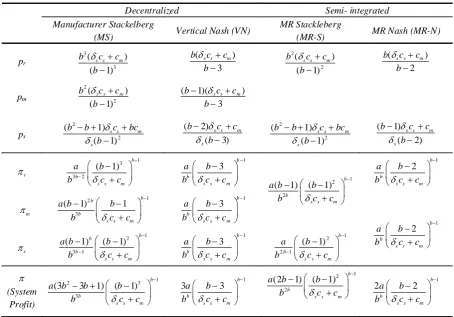
. (10) We can obtain the Stackelberg equilibrium of the two games as a solution for the Manufacturer Stackelberg model. The equilibrium prices and profits for this game structure can be referred from Table 1.
Vertical Nash
convenience, we call this game Vertical Nash (VN). In this game, the supplier chooses its raw material price conditional on the manufacturer’s profit margin and the retailer’s profit margin to maximize its profit. The manufacturer chooses its profit margin conditional on the supplier’s raw material price and retailer’s profit margin. The retailer sets its profit margin so as to maximize its profit conditional on the supplier’s raw material price and the manufacturer’s profit margin.
The Nash equilibrium for the Vertical Nash model can be represented as a solution for our pricing problem. The first-order condition for this equilibrium involves the retailer profit maximization condition (5) and the following two profit maximization conditions:
r0
m
r m s s m
m r
D p
D p
p
p
c
p
p
(11)
2
0
r ss r s s s
s r
D p
D p
p
c
p
p
(12)Substituting the
D p
r with non-linear demand function (4) and simultaneously solving (5), (11) and (12), we have the results for optimal prices and profits shown in Table 1.IV. SEMI-INTEGRATED CHANNEL
In the semi-integrated channel, the manufacturer chooses to integrate with either the retailer or the supplier first and then works with the supplier or the retailer independently. In effect, the supply chain with this channel structure is a two-level system where the manufacturer integrates with another echelon to be a single decision maker.
Without loss of generality, we mainly consider the channel structure that the manufacturer integrates forward with the retailer in the three-level supply chain. We call this channel structure as MR-integration channel. Also, two power balance scenarios are considered for the MR-integration channel, leader-follower and independent. The first one is the two integrated chain members (the manufacturer and the retailer) act as the leader, while the independent member (supplier) acts as the follower. The second one is that the two integrated members and the independent member are of equal status. We formulate Stackelberg and Nash games for the two scenarios respectively. Since the manufacturer and the retailer integrate together, we assume that there in no transfer price between them. Hence, there is no need to specify the manufacturer’s price in the modeling process.
MR-Stackelberg
We first consider the leader-follower power balance scenario that the manufacturer and the retailer integrate and act as the leader of the supply chain, while the supplier acts as the follower. We formulate Stackelberg game between the integrated manufacturer and retailer and the independent supplier. We call this game model as MR-Stackelberg (MR-S). The manufacturer and the retailer agree to make their own profit margin decision taking the supplier’s reaction function into account. The supplier conditions its raw material price on the profit margin given by the manufacturer and the retailer.
The profit function for the manufacturer and the retailer is:
mrm D p
mr r
(13) wherem
mr
p
r
p
s
s
c
m.mr
m
is the profit margin for the integrated manufacturer and retailer. The supplier’s reaction function can be derived from the first-order condition of (3):
2
0
r ss r s s s
s r
D p
D p
p
c
p
p
(14)Then we can obtain the supplier’s reaction function:
s s r
p
p
p
(15) Taking (15) into account, the manufacturer can obtain its optimal pricing decision through the following first-order condition of (13):
1
0
r
mr s
s r r s s m
r r r
D p p
D p p p c
p p p
. (16) Substituting
D p
r with demand function (4), we have the Stackelberg equilibrium results for this game structure on prices and profits in Table 1. MR-Nash
The independent power balance scenario here features that the integrated manufacturer and retailer are of equal power with the supplier. We formulate Nash game between them called by MR-Nash (MR-N). The supplier chooses its raw material price conditional on the profit margin given by the manufacturer and the retailer to maximize its profit. The manufacturer and the retailer integrate to choose its profit margin conditional on the supplier’s raw material price to maximize their total profit. The equilibrium conditions for Nash game can be derived from the first order conditions of (3) and (13).
2
0
r ss r s s s
s r
D p
D p
p
c
p
p
(17)
r0
mr
r r s s m
r r
D p
D p
p
p
c
p
p
(18)Simultaneously solving (17) and (18), we have the Nash equilibrium results for prices and profits shown as Table 1.
V. DISCUSSION
This section discusses several implications that are observed from the results. We focus particularly on the effects of power structures, channel structures and market parameters. In the following discussion, we use superscript MS, VN, MR-S, MR-N, SM-S, SM-N and I to denote the corresponding quantities for the MS (Manufacture Stackelberg), VN (Vertical Nash), MR-S (MR-Stackelberg), MR-N (MR-Nash) respectively.
three-level supply chain. Integrated channel is not discussed since it does not involve different power structures. The following proposition illustrates the effects of the two different power structures of the decentralized channel and MR-integration channel respectively.
PROPOSITION 1. For the decentralized channel, all the supply chain members and the entire system prefer the MS case to the VN case for the lower equilibrium prices and the larger profits; For the MR-integration channel, MR-S case is preferred by all the supply chain members and the entire system.
Proof. We assume
b
3
. Compare the retail price, the wholesale price and the raw material price in the MS case with those in the VN case:
2 3 2
3 3 2
3
3
1
3
3
1
1
MSMS m r
VN VN
r m
b
b
p
p
b
b
p
p
b
b
b
b
(19)
2
1
1
0
1
2
MS
s s s m
VN
s s s m
p
c
c
b
p
b
b
c
c
(20) Hence, we have the relationships: MS VN
r r
p
p
,p
mMS
p
mVN ,p
sMS
p
VNs . The equilibrium prices for all supply chain members in the MS case are no higher than those in the VN case.Compare the retailer’s, the manufacturer’s, the supplier’s profits and the entire system profit in the MS case with those in VN case:
Obviously,
1 1
3 3 2
2 3 2
1
3
3
1
1
3
3
b b
MS r VN r
b
b
b
b
b
b
b
b
(21)
3 11 2
1
1
3
b MS
m
b
VN b
m
b
b
b
, this is because
3 1 1 2
1
3
b
b b
b
b
b
is decrement function of b. When b tends toinfinite, MS m VN m
tends to the lowest value 1. That is,
3 11 2
1
lim
1
3
bb b
b
b
b
b
.Similarly, we have:
3 21 2 1
1
1
3
b MSs
b
VN b
s
b
b
b
. Thus,1
MSVN
.So, the profits for all chain members and the entire supply chain system in the MS case are no less than those in the VN case:
rMS
VNr ,
mMS
mVN ,
sMS
VNs ,MS VN
. For the MR-integration channel, the proof is similar. We do not present here.□From Proposition 1, we can see that, when non-linear demand function (1) is employed, for the decentralized or the MR-integrated system, the leader-follower power scenario is preferred by the supply chain compared with the independent power scenario. That is, the manufacturer or the integrated manufacturer and retailer would rather take the leadership of the decentralized channel or the MR-integration channel. Proposition 1 is also consistent with the results for the traditional channel structure[7] SM-S and SM-N cases, the results are similar with those of MR-S and MR-N cases. Discussions are omitted here.
With channels of distribution changing rapidly, the importance of channel selection has been emphasized. Different channel structures will influence the pricing decisions and profits for all the supply chain members. Supply chain members would like to select the channel structure that could bring larger profits for them. In this subsection, we study the effects of different channel structures of the three-level supply chain. We first propose the following proposition.
PROPOSITION 2. Compared with the decentralized channel, the manufacturer’s forward integration with the retailer can always provide larger profits for all the supply chain members and the entire system when price elasticity b satisfies
b
3.5396
.Proof. Proposition 1 shows that in the decentralized channel, the MS case provides larger profits for all the chain members and the entire system than the VN case and the MR-S case provides larger profits than the MR-N case in the MR-integration channel. Thus, we just need to compare the profits of the individual supply chain members and the entire system in the MR-N case with those in the MS case. If the MR-N case could provide larger profits than the MS case, the MR-S (or MR-N) case will also have larger profits than the MS (or VN) case. That is the integration of the manufacturer and the retailer can always provide larger profits for all the chain members and the entire system.
Compare the joint profit of the retailer and the manufacturer in the MS case with that in MR-N case:
3 3 2
1 2
1
2
2
1
2
b MS MS
r m
b
MR N b
mr
b
b
b
b
b
(22 )
3 3 2
1 2
1
2
2
1
2
b
b b
b
b
b
b
b
is decrement function of b. Some numerical methods, such as bisection method, Newton’s method, can be employed to find out the root of
3 3 2
1 2
1
2
2
1
1
2
b
b b
b
b
b
b
b
. Here, we use bisectionmethod and find out the root,
b
3.5396
.in MR-N case:
3 2
2 1 1
(
1)
(
2)
MS b
s
MR N b b
s
b
b
b
. (23)It is decrement function of b. When b tends to 3, MS s MR N s
tends to the highest value 0.5267. Hence, we haveMS MR N
s s
.Similarly, the entire system of the MS case and that of the
MR-N case have the following relationship:
MS
MR N . This completes the proof of Proposition 2. □From Proposition 2, we can see that the integration for the manufacturer and the retailer cannot always maximize the joints profit even in a monopoly.
[image:5.595.73.528.202.519.2]The market environment has great influence on the firm strategies and the performance of the entire supply chain ([13, 15]). The effect of market parameters have been studied by many empirical works ([7, 14]). They show that market parameters as a major factor influence the pricing and profits of the supply chain members. In this subsection, we consider the effects of the scaling parameter a and price elasticity b in demand function (1) on the pricing decisions and profits of the individual chain members under the decentralized channel structure. The semi-integrated and integrated channels are not analyzed here since their price and profit structures are much similar with those of the decentralized channel. Table 3 and Table 4 summarize the effects of scaling parameter a and price elasticity b on the equilibrium prices and profits for the MS and VN cases.
A larger market scale implies a better market environment, while the degree of benefits for individual chain members depends on the underlying power structure. The following propositions summarize the major findings of the prices and profits as the change of market scale under the decentralized channel.
PROPOSITION 3 (a). All the channel members will not change their equilibrium prices as scaling parameter a changes.
(b). In the MS case, the retailer benefits most from the
increase of scaling parameter a while the manufacturer benefits the least. In the VN case, each member has the same profit increase as the increase of a.
(c). Scaling parameter a has more significant effect on the MS case than that on the VN case.
Proof.In our decentralized channel, we consider the first order partial derivatives of price and profit with respect to a. For the MS case and VN case, we have:
0
MS MS
MS
m s
r p p
p
a a a
, 0 VN VN VN m s
r p p
p
a a a
.
This completes the proof of part (a).
0
MS MS
MS
s m
r
a a a
,
0
VN VN VN
m s r
a a a
.
This completes the proof of part (b).
Decentralized Semi- integrated
Manufacturer Stackelberg
(MS) Vertical Nash (VN)
MR Stackleberg
(MR-S) MR Nash (MR-N)
pr
3
3
( )
( 1) s s m
b c c
b
( )
3 s s m
b c c
b 2 2 ( ) ( 1) s s m
b c c
b
( )
2 s s m
b c c
b pm 2 2 ( ) ( 1) s s m
b c c
b
( 1)( )
3 s s m
b c c
b ps 2 2 ( 1) ( 1) s s m s
b b c bc
b ( 2) ( 3)
s s m s
b c c
b 2 2 ( 1) ( 1) s s m s
b b c bc
b ( 1) ( 2)
s s m s
b c c
b r 1 3 3 2
( 1) b b
s s m
a b
b c c
1 3 b b
s s m
a b
b c c
1 2 b b
s s m
a b
b c c
m 1 2 3
( 1) b 1 b b
s s m
a b b
b c c
1 3 b b
s s m
a b
b c c
1 2 2
( 1) ( 1) b b
s s m
a b b
b c c
s 1 2 3 1
( 1)b ( 1) b b
s s m
a b b
b c c
1 3 b b
s s m
a b
b c c
1 2 2 1
( 1) b b
s s m
a b
b c c
1 2 b b
s s m
a b
b c c
(System Profit) 1 2 3 3
(3 3 1) ( 1) b b
s s m
a b b b
b c c
1
3 3 b
b
s s m
a b
b c c
1 2 2
(2 1) ( 1) b b
s s m
a b b
b c c
1
2 2 b
b
s s m
a b
b c c
MS VN
r r
a
a
,MS VN
m m
a
a
,MS VN
s s
a
a
,MS VN
a
a
.This completes the proof of part (c). □
Price sensitivity is fundamental to many important aspects of retail policy, such as pricing, promotions ([6]). We then consider the influence of price elasticity b on the equilibrium prices and profits for the MS and VN cases. Firstly, take the first order partial derivatives of profits with respect to b, for the MS case, we have:
1 3 3 2
(
1)
b MSMS r
r b
s s m
a
b
b
b
c
c
1
2 3
(
1)
1
bMS b
MS m
m b
s s m
a b
b
b
b
c
c
1
2 3 1
(
1)
(
1)
bMS b
MS s
s b
s s m
a b
b
b
b
c
c
where
1
2
3ln 1
1
MS
r
b
s sc
c
mb
b
,
1
2
3ln 1
1
1
MSm
b
s sc
c
mb
b
,
1
2
1
3ln 1
1
(
1)
MSs s s m
b
b
c
c
b
b b
.For the VN case:
1
3 b
VN VN
VN
VN
m s
r
b
s s m
a b
b b b b c c
, where
3
2
ln 1
1
3
VNs s m
b
c
c
b
b
.PROPOSITION 4. (a) An increased price elasticity b results in the reduced equilibrium price for each supply chain member; the reduction of the retail price is larger than that of the wholesale price.
(b). In the MS case, if b satisfies
rMS
0
,the profit for each supply chain member increases as price elasticity b increases; If
sMS
0
, no one could benefit from an increased b. In the VN case, if
VN0
, the increase of price elasticity b will benefit all the supply chain members; otherwise, all may lose.This proposition suggests that when the market demand becomes more sensitive to the retail price, all the supply chain members will reduce their equilibrium prices and the retailer has a more price reduction than the manufacturer. Meanwhile, the change of the profits of the individual chain members depends on the value of price elasticity b. Proposition 4(b) presents the distinguish conditions for the
variation tendency of the chain members’ profits with the changing of price elasticity b.
VI. CONCLUSION
This paper extends the growing literature of channel studies by analyzing pricing strategies for a three-level supply chain consisting of supplier, manufacturer and retailer. Three different channel structures are considered. They are the decentralized channel, the semi-integrated channel and the integrated channel. Two non-cooperative games are used to model different power structures for the first two channel structures, i.e., Stackelberg and Nash games. We also investigate the effects of power structures, channel structures and market parameters on the pricing decisions and profits for channel members. Our results show that when the manufacturer or the integrated members take the leadership of the supply chain for either decentralized or semi-integrated channel, the equilibrium prices are lower and profits are higher compared with the channel without such leadership. Our results also provide fresh new insights into vertical integration. In MR-integration channel, the integration of the manufacturer and the retailer cannot provide larger profits for them or the other channel member unless the price elastic b is no less than a certain level (3.5396). In general, the integration for the manufacturer and the retailer cannot always improve their profits in a monopoly when a multi-level channel is considered.
REFERENCES
[1] Abad, Prakash L., “Supplier pricing and lot sizing when demand is price sensitive”, European Journal of Operational Research, 78, pp. 334 –354, 1994.
[2] Alan G. Kalton, Medini R. Singh, “Pricing in a three-tier manufacturer-retailer-customer system”, technical report, pp. 92-48, 1992.
[3] Charles A. Ingene, Mark E. Parry, “Channel coordination when retailers compete”, Marketing Science, 14, pp. 360-377, 1995.
[4] Choi S. Chan, “Price competition in a channel structure with a common retailer”, Marketing Science, 10(4), pp. 271-296, 1991.
[5] Choi S. Chan, “Price competition in a duopoly common retailer channel”, Journal of retailing, 72(2), pp. 117-134, 1996.
[6] Hoch, Stephen J, Byung-Do Kim, Alan L. Montgomery, Peter E. Rossi, “Determinants of store-level price elasticity”, Journal of Marketing Research, 32(1), pp. 17-29, 1995.
[7] Jeuland A. P., Shugan S. M., “Managing channel profits”, Marketing Science, 2, pp. 239-272, 1983.
[8] Joseph G. Szmerekovsky, Jiang Zhang, “Pricing and two-tier advertising with one manufacturer and one retailer”, European Journal of Operational Research, accepted 3 October, 2007.
[9] Kim, Daesoo, Lee, Woon J., “Optimal joint pricing and lot sizing with fixed and variable capacity”, European Journal of Operational Research, 109 (1), pp. 212–227, 1998.
[10] Li, S.X., Huang, Z., Ashley, A., “Inventory, channel coordination and bargaining in a manufacturer–retailer system”, Annals of Operations Research, 68, pp. 47–60, 1996.
[11] Martha C. Cooper, Lisa M. Ellram, “Characteristics of supply chain management and the implications for purchasing and logistics strategy”, The International Journal of Logistics Management, 4, pp. 13-24, 1993.
[12] Minakshi Trivedi, “Distrubution channels: an extension of exclusive relationship”, Management Science, 44(7), pp. 896-909, 1998. [13] Park, Myung-Ho, Mason, J. Barry, “Toward an integrated model of
determinants of business performance”, Research in Marketing, 10, pp. 157-201, 1990.
marketing and inventory decisions in a supply chain”, International Journal of Integrated Supply Management, 2006.
[15] Venkatraman, N., John E. Prescott, “Environment-strategy coalignment: an empirical test of its performance”, Implications Management Journal, 11, pp. 1-24, 1990.