Automatic Creation of Arabic Named Entity Annotated Corpus Using
Wikipedia
Maha Althobaiti, Udo Kruschwitz, and Massimo Poesio School of Computer Science and Electronic Engineering
University of Essex Colchester, UK
{mjaltha, udo, poesio}@essex.ac.uk
Abstract
In this paper we propose a new methodology to ex-ploit Wikipedia features and structure to automati-cally develop an Arabic NE annotated corpus. Each Wikipedia link is transformed into an NE type of the target article in order to produce the NE an-notation. Other Wikipedia features - namely redi-rects, anchor texts, and inter-language links - are used to tag additional NEs, which appear without links in Wikipedia texts. Furthermore, we have de-veloped a filtering algorithm to eliminate ambiguity when tagging candidate NEs. Herein we also in-troduce a mechanism based on the high coverage of Wikipedia in order to address two challenges partic-ular to tagging NEs in Arabic text: rich morphology and the absence of capitalisation. The corpus cre-ated with our new method (WDC) has been used to train an NE tagger which has been tested on differ-ent domains. Judging by the results, an NE tagger trained onWDCcan compete with those trained on manually annotated corpora.
1 Introduction
Supervised learning techniques are well known for their effectiveness to develop Named Entity Recognition (NER) taggers (Bikel et al., 1997; Sekine and others, 1998; McCallum and Li, 2003; Benajiba et al., 2008). The main disadvantage of supervised learning is that it requires a large an-notated corpus. Although a substantial amount of annotated data is available for some languages, for other languages, including Arabic, more work is needed to enrich their linguistic resources. In fact, changing the domain or just expanding the set of classes always requires domain-specific ex-perts and new annotated data, both of which cost time and effort. Therefore, current research fo-cuses on approaches that require minimal human intervention to facilitate the process of moving the NE classifiers to new domains and to expand NE
classes.
Semi-supervised and unsupervised learning ap-proaches, along with the automatic creation of tagged corpora, are alternatives that avoid manu-ally annotated data (Richman and Schone, 2008; Althobaiti et al., 2013). The high coverage and rich informational structure of online encyclope-dias can be exploited for the automatic creation of datasets. For example, many researchers have in-vestigated the use of Wikipedia’s structure to clas-sify Wikipedia articles and to transform links into NE annotations according to the link target type (Nothman et al., 2008; Ringland et al., 2009).
In this paper we present our approach to au-tomatically derive a large NE annotated corpora from Arabic Wikipedia. The key to our method lies in the exploitation of Wikipedia’s concepts, specifically anchor texts1 and redirects, to handle the rich morphology in Arabic, and thereby elim-inate the need to perform any deep morphologi-cal analysis. In addition, a capitalisation probabil-ity measure has been introduced and incorporated into the approach in order to replace the capitalisa-tion feature that does not exist in the Arabic script. This capitalisation measure has been utilised in or-der to filter ambiguous Arabic NE phrases during annotation process.
The remainder of this paper is structured as fol-lows: Section 2 illustrates structural information about Wikipedia. Section 3 includes background information on NER, including recent work. Sec-tion 4 summarises the proposed methodology. Sections 5, 6, and 7 describe the proposed algo-rithm in detail. The experimental setup and the evaluation results are reported and discussed in Section 8. Finally, the conclusion features com-ments regarding our future work.
1The terms ‘anchor texts’ and ‘link labels’ are used inter-changeably in this paper.
2 The Structure of Wikipedia
Wikipedia is a free online encyclopedia project written collaboratively by thousands of volunteers, using MediaWiki2. Each article in Wikipedia is uniquely identified by its title. The title is usually the most common name for the entity explained in the article.
2.1 Types of Wikipedia Pages 2.1.1 Content Pages
Content pages (aka Wikipedia articles) contain the majority of Wikipedia’s informative content. Each content page describes a single topic and has a unique title. In addition to the text describing the topic of the article, content pages may contain ta-bles, images, links and templates.
2.1.2 Redirect Pages
A redirect page is used if there are two or more alternative names that can refer to one entity in Wikipedia. Thus, each alternative name is changed into a title whose article contains a redi-rect link to the actual article for that entity. For ex-ample, ‘UK’ is an alternative name for the ‘United Kingdom’, and consequently, the article with the title ‘UK’ is just a pointer to the article with the title ‘United Kingdom’.
2.1.3 List of Pages
Wikipedia offers several ways to group articles. One method is to group articles by lists. The items on these lists include links to articles in a particu-lar subject area, and may include additional infor-mation about the listed items. For example, ‘list of scientists’ contains links to articles of scientists and also links to more specific lists of scientists.
2.2 The Structure of Wikipedia Articles 2.2.1 Categories
Every article in the Wikipedia collection should have at least one category. Categories should be on vital topics that are useful to the reader. For example, the Wikipedia article about the United Kingdom in Wikipedia is associated with a set of categories that includes ‘Countries bordering the Atlantic Ocean’, and ‘Countries in Europe’.
2An open source wiki package written in PHP
2.2.2 Infobox
An infobox is a fixed-format table added to the top right-hand or left-hand corner of articles to provide a summary of some unifying parameters shared by the articles. For instance, every scientist has a name, date of birth, birthplace, nationality, and field of study.
2.3 Links
A link is a method used by Wikipedia to link pages within wiki environments. Links are enclosed in doubled square brackets. A vertical bar, the ‘pipe’ symbol, is used to create a link while labelling it with a different name on the current page. Look at the following two examples,
1 - [[a]] is labelled ‘a’ on the current page and links to taget page ‘a’.
2 - [[a|b]] is labelled ‘b’ on the current page, but links to target page ‘a’.
In the second example, the anchor text (aka link label) is ‘a’, while ‘b’, alink target, refers to the title of the target article. In the first example, the anchor text shown on the page and the title of the target article are the same.
3 Related Work
Current NE research seeks out adequate alter-natives to traditional techniques such that they require minimal human intervention and solve deficiencies of traditional methods. Specific deficiencies include the limited number of NE classes resulting from the high cost of setting up corpora, and the difficulty of adapting the system to new domains.
One of these trends is distant learning, which depends on the recruitment of external knowledge to increase the performance of the classifier, or to automatically create new resources used in the learning stage.
Kazama and Torisawa (2007) exploited Wikipedia-based features to improve their NE machine learning recogniser’s F-score by three percent. Their method retrieved the corresponding Wikipedia entry for each candidate word sequence in the CoNLL 2003 dataset and extracted a cate-gory label from the first sentence of the entry.
performed as well as manually annotated training data. Nothman et al. (2008) exploited Wikipedia to create a massive corpus of named entity annotated text. They transformed Wikipedia’s links into named entity annotations by classifying the target articles into standard entity types3. Compared to MUC, CoNLL, and BBN corpora, their Wikipedia-derived corpora tend to perform better than other cross-corpus train/test pairs.
Nothman et al. (2013) automatically created massive, multilingual training annotations for named entity recognition by exploiting the text and internal structure of Wikipedia. They first categorised each Wikipedia article into named entity types, training and evaluating on 7,200 manually-labelled Wikipedia articles across nine languages: English, German, French, Italian, Polish, Spanish, Dutch, Portuguese, and Russian. Their cross-lingual approach achieved up to 95% accuracy. They transformed Wikipedia’s links into named entity annotations by classifying the target articles into standard entity types. This technique produced reasonable annotations, but was not immediately able to compete with exist-ing gold-standard data. They better aligned their automatic annotations to the gold standard corpus by deducing additional links and heuristically tweaking the Wikipedia corpora. Following this approach, millions of words in nine languages were annotated. Wikipedia-trained models were evaluated against CONLL shared task data and other gold-standard corpora. Their method out-performed Richman and Schone (2008) and Mika et al. (2008), and achieved scores 10% higher than models trained on newswire when tested on manually annotated Wikipedia text.
Alotaibi and Lee (2013) automatically de-veloped two NE-annotated sets from Arabic Wikipedia. The corpora were built using the mechanism that transforms links into NE an-notations, by classifying the target articles into named entity types. They used POS-tagging, morphological analysis, and linked NE phrases to detect other mentions of NEs that appear without links in text. By contrast, our method does not require POS-tagging or morphological analysis and just identifies unlinked NEs by matching phrases from an automatically constructed and filtered alternative names with identical terms in
3The terms ‘type’, ‘class’ and ‘category’ are used inter-changeably in this paper.
the articles texts, see Section 6. The first dataset created by Alotaibi and Lee (2013) is called WikiFANE(whole) and contains all sentences retrieved from the articles. The second set, which is called WikiFANE(selective), is constructed by selecting only the sentences that have at least one named entity phrase.
4 Summary of the Approach
All of our experiments were conducted on the 26 March 2013 Arabic version of the Wikipedia dump4. A parser was created to handle the medi-awiki markup and to extract structural information from the Wikipedia dump such as a list of redirect pages along with their target articles, a list of pairs containing link labels and their target articles in the form ’anchor text, target article’, and essential information for each article (e.g., title, body text, categories, and templates).
Many of Wikipedia’s concepts such as links, an-chor texts, redirects, and inter-language links have been exploited to transform Wikipedia into a NE annotated corpus. More details can be found in the next sections. Generally, the following steps are necessary to develop the dataset:
1. Classify Wikipedia articles into a specific set of NE types.
2. Identify matching text in the title and the first sentence of each article and label the match-ing phrases accordmatch-ing to the article type. 3. Label linked phrases in the text according to
the NE type of the target article.
4. Compile a list of alternative titles for articles and filter out ambiguous ones.
5. Identify matching phrases in the list and the Wikipedia text.
6. Filter sentences to prevent noisy sentences being included in the corpus.
We explain each step in turn in the following sec-tions.
5 Classifying Wikipedia Articles into NE Categories
Categorising Wikipedia articles is the initial step in producing NE training data. Therefore, all Wikipedia articles need to be classified into a specific set of named entity types.
5.1 The Dataset and Annotation
In order to develop a Wikipedia document clas-sifier, we used a set of 4,000 manually classi-fied Wikipedia articles that are available free on-line5. The set was manually classified using the ACE (2008) taxonomy and a new class (Product). Therefore, there were eight coarse-grained cate-gories in total: Facility, Geo-Political, Location, Organisation,Person,Vehicle,Weapon, and Prod-uct. As our work adheres to the CoNLL definition, we mapped these classified Wikipedia articles into CoNLL NE types – namely person, location, or-ganisation, miscellaneous, or other – based on the CoNLL 2003 annotation guidelines (Chinchor et al., 1999).
5.2 The Classification of Wikipedia Articles
Many researchers have already addressed the task of classifying Wikipedia articles into named entity types (Dakka and Cucerzan, 2008; Tardif et al., 2009). Alotaibi and Lee (2012) is the only study that has experimented with classifying the Arabic version of Wikipedia into NE classes. They have explored the use of Naive Bayes, Multinomial Naive Bayes, and SVM for classifying Wikipedia articles, and achieved a F-score ranging from 78% and 90% using different language-dependent and independent features.
We conducted three experiments that used a simple bag-of-words features extracted from dif-ferent portions of the Wikipedia document and metadata. We summarise the portions of the doc-ument included in each experiment below:
Exp1: Experiment 1 involved tokens from the article title and the entire article body.
Exp2: Rich metadata in Wikipedia proved ef-fective for the classification of articles (Tardif et al., 2009; Alotaibi and Lee, 2012). Therefore, in Experiment 2 we included tokens from categories, templates – specifically ‘Infobox’ – as well as to-kens from the article title and first sentence of the document.
Exp3: Experiment 3 involved the same set of tokens as experiment 2 except that categories and infobox features were marked with suffixes to dif-ferentiate them from tokens extracted from the ar-ticle body text. This step of distinguishing tokens based on their location in the document improved the accuracy of document’s classification (Tardif et al., 2009; Alotaibi and Lee, 2012).
5www.cs.bham.ac.uk/∼fsa081/
In order to optimise features, we implemented a filtered version of the bag-of-words article repre-sentation (e.g., removing punctuation marks and symbols) to classify the Arabic Wikipedia doc-uments instead of using a raw dataset (Alotaibi and Lee, 2012). In addition, the same study shows the high impact of applying tokenisation6 as opposed to the neutral effect of using stem-ming. We used the filtered features proposed in the study of Alotaibi and Lee (2012), which in-cluded removing punctuation marks, symbols, fil-tering stop words, and normalising digits. We ex-tended the features, however, by utilising the to-kenisation scheme that involves separating con-junctions, prepositions, and pronouns from each word.
The feature set has been represented using Term Frequency-Inverse Document Frequency (T F −
IDF). This representation method is a numeri-cal statistic that reflects how important a token is to a document.
5.3 The Results of Classifying the Wikipedia Articles
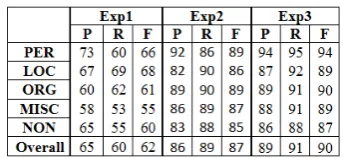
[image:4.595.330.502.618.697.2]As for the learning process, our Wikipedia doc-uments classifier was trained using Liblinear7. 80% of the 4,000 hand-classified Wikipedia articles were dedicated to the training stage, while 20% were specified to test the classifier. Table 1 is a comparison of the precision, recall, and F-measure of the classifiers that resulted from the three experiments. The Exp3 classifier performed better than the other classifiers. Therefore, it was selected to classify all of the Wikipedia articles. At the end of this stage, we obtained a list of pairs containing each Wikipedia article and its NE Type. We stored this list in a database in preparation for the next stage: developing the NE-tagged training corpus.
Table 1: The results of the three Wikipedia docu-ment classifiers.
6 The Annotation Process
6.1 Utilising the Titles of Articles and Link Targets
Identifying corresponding words in the article ti-tle and the entire body of text and then tagging the matching phrases with the NE-type can be a risky process, especially for terms with more than one meaning. For example, the title of the article de-scribing the city ( àA¿, ‘Cannes’)8 can also, in Ara-bic, refer to the past verb ( àA¿, ‘was’). The portion of the Wikipedia article unlikely to produce errors during the matching process is the first sentence, which usually contains the definition of the term the Wikipedia article is written about (Zesch et al., 2007).
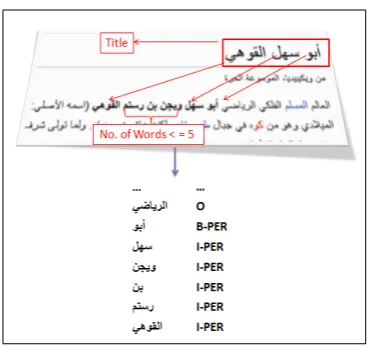
When identifying matching terms in the arti-cle title and the first sentence, we found that ar-ticle titles often contain abbreviations, while the first sentence spells out entire words. This pat-tern makes it difficult to identify matching terms in the title and first sentence, and frequently ap-pears in biographical Wikipedia articles. For ex-ample, one article is entitled (ø P@QË@ QºK. ñK.@, ‘Abu Bakr Al-Razi’), but the first sentence states the full name of the person: (ø P@QË@ AKQ» P áK. úæm' áK. YÒm× QºK. ñK.@, ‘Abu Bakr Mohammad Bin Yahia Bin Zakaria Al-Razi’). Therefore, we decided to address the prob-lem with partial matching. In this case, the sys-tem should first identify all corresponding words in the title and the first sentence. Second, the sys-tem should annotate them and all words that fall between, provided that:
• the sequence of the words in the article title and the text are the same in order to avoid errors in tagging. For example, if the title of the article is ( QÖßAJË@ Qî E, ‘The River Thames’), but the first sentence reads (.... ú ¯ ©®K Qî E ñë QÖßAJË@ , ‘The Thames is a river flowing through southern England....’), then the text will not be properly tagged.
• the number of tokens located between matched tokens is less than or equal to five9.
Figure 1 shows one example of partial matching.
8Throughout the entire paper, Arabic words are repre-sented as follows: ( Arabic word,‘English translation’).
[image:5.595.324.508.58.231.2]9An informal experiment showed that the longest proper Arabic names are 5 to 7 tokens in length.
Figure 1: Example of Partial Matching
The next step is to transform the links be-tween Wikipedia articles into NE annotations ac-cording to the link target type. Therefore, the link ([[AÓAK.ð@ ¼@PAK.|AÓAK.ð@]]/[[Barack Obama|Obama]]) would be changed to (AÓAK.ð@ PER) (Obama PER), since the link target (Barack Obama) is the title of an article about person. By the end of this stage, all NE anchor texts (anchor texts referring to NE articles) on Wikipedia should be annotated based on the NE-type of the target article.
6.2 Dictionaries of Alternative Names
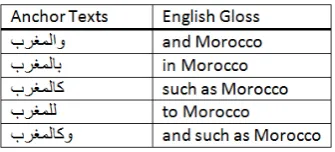
Depending only on NE anchor texts in order to derive and annotate data from Wikipedia results in a low-quality dataset, as Wikipedia contains a fair amount of NEs mentioned without links. This can be attributed to the fact that each term on Wikipedia is more likely to be linked only on its first appearance in the article (Nothman et al., 2008). These unlinked NE phrases can be found simply by identifying the matching terms in the list of linked NE phrases10 and the text. The process is not as straightforward as it seems, however, because identifying corresponding terms may prove ineffective, especially in the case of morphologically rich language in which unlinked NE phrases are sometimes found agglutinated to prefixes and conjunctions. In order to detect un-linked and inflected forms of NEs in Wikipedia text, we extended the list of articles titles that were used in the previous step to find and match the pos-sible NEs in the text by including NE anchor texts. Adding NE anchor texts to the list assists in find-ing possible morphologically inflected NEs in the text while eliminating the need for any
logical analysis. Table 2 shows examples from the dictionary of NE anchor texts.
Table 2: Examples from the dictionary of NE An-chor Texts.
Spelling variations resulting from varied transliteration of foreign named entities in some cases prevent the accurate matching and identifi-cation of some unlinked NEs, if only the list of NE anchor texts is used. For example, (@QÊm. '@, ‘Eng-land’) has been written five different ways: (èQÊm. '@,
@QÊ ª K@, èQÊ ª K@, @Qʾ K@, èQʾ K@). Therefore, we compiled a list of the titles of redirected pages that send the reader to articles describing NEs. We refer to these titles in this paper as NE redirects. We consider to the lists of NE redirects and anchor texts a list of alternative names, since they can be used as alternative names for article titles.
The list of alternative names is used to find unlinked NEs in the text by matching phrases from the list with identical terms in the articles texts. This list is essential for managing spelling and morphological variations of unlinked NEs, as well as misspelling. Consequently, the process increases the coverage of NE tags augmented within the plain texts of Wikipedia articles.
6.2.1 Filtering the Dictionaries of Alternative Names
One-word alternative names: Identifying matching phrases in the list of alternative names and the text inevitably results in a lower quality corpus due to noisy names. The noisy alternative names usually occur with meaningful named entities. For example, the article on the person ( áÓB@ éÊË@YJ.« ñK.@, ‘Abu Abdullah Alamyn’) has an alternative name consisting only of his last name ( áÓB@, ‘Alameen’), which means ‘custo-dian’. Therefore, annotating every occurrence of ‘Alamyn’ asPERwould lead to incorrect tagging and ambiguity. The same applies to the city with the name (èYKYm.Ì'@, ‘Aljadydah’), which literally means ‘new’. Thus, the list of alternative names should be filtered to omit one-word NE phrases
that usually have a meaning and are ambiguous when taken out of context.
In order to solve this problem, we introduced a capitalisation probability measure for Arabic words, which are never capitalised. This involved finding the English gloss for each one-word alter-native name and then computing its probability of being capitalised using the English Wikipedia. To find the English gloss for Arabic words, we exploited Wikipedia Arabic-to-English cross-lingual links that provided us with a reasonable number of Arabic and corresponding English terms. If the English gloss for the Arabic word could not be found using inter-language links, we resorted to an online translator. Before translating the Arabic word, a light stemmer was used to remove prefixes and conjunctions in order to get the translation of the word itself without its associated affixes. Otherwise, the Arabic word (XCJ.ÊË) would be translated as (in the country). The capitalisation probability was computed as follows:
P r[EN] = f(EN)isCapitalised
f(EN)isCapitalised+f(EN)notCapitalised
where: EN is the English gloss of the alter-native name; f(EN)isCapitalised is the number of times the English gloss EN is capitalised in English Wikipedia; and f(EN)notCapitalised is the number of times the English glossEN is not capitalised in English Wikipedia.
This way, we managed to build a list of Arabic words and their probabilities of being capitalised. It is evident that the meaningful one-word NEs usually achieve a low probability. By specifying a capitalisation threshold constraint, we prevented such words from being included in the list of alternative names. After a set of experiments, we decided to use the capitalisation threshold equal to 0.75.
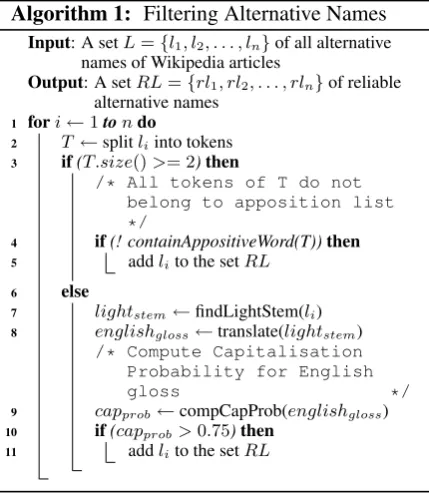
Rashid’). As a result, the system will mistakenly annotate words like Dubai, Council, Ministers as PER. Our solution to this problem is to omit the multi-word alternative name, if any of its words belong to the list of apposition words, which usually appear adjacent to NEs such as (KP, ‘President’), (QK Pð, ‘Minister’), and (Õ»Ag, ‘Ruler’). The filtering algorithm managed to exclude 22.95% of the alternative names from the original list. Algorithm 1 shows pseudo code of the filtering algorithm.
Algorithm 1: Filtering Alternative Names
Input: A setL={l1, l2, . . . , ln}of all alternative
names of Wikipedia articles
Output: A setRL={rl1, rl2, . . . , rln}of reliable
alternative names 1 fori←1tondo
2 T←splitliinto tokens
3 if(T.size()>= 2)then
/* All tokens of T do not belong to apposition list */
4 if(! containAppositiveWord(T))then 5 addlito the setRL
6 else
7 lightstem←findLightStem(li)
8 englishgloss←translate(lightstem) /* Compute Capitalisation Probability for English
gloss */
9 capprob←compCapProb(englishgloss)
10 if(capprob>0.75)then
11 addlito the setRL
[image:7.595.75.290.227.474.2]The dictionaries derived from Wikipedia by exploiting Wikipedia’s structure and adopting the filtering algorithm is shown in Table 3.
Table 3: Dictionaries derived from Wikipedia.
6.3 Post-processing
The goal of Post-processing was to address some issues that arose during the annotation process as a result of different domains, genres, and con-ventions of entity types. For example, national-ities and other adjectival forms of nations, reli-gions, and ethnic groups are consideredMISC in the CoNLL NER task in the English corpus, while
the Spanish corpus consider themNOTnamed en-tities (Nothman et al., 2013). As far as we know, almost all Arabic NER datasets that followed the CoNLL style and guidelines in the annotation pro-cess consider nationalities NOT named entities. On Wikipedia all nationalities are linked to ar-ticles about the corresponding countries, which makes the annotation tool tag them as LOC. We decided to consider themNOT named entities in accordance with the CoNLL-style Arabic datasets. Therefore, in order to resolve this issue, we com-piled a list of nationalities, and other adjectival forms of religion and ethnic groups, so that any anchor text matching an entry in the list was re-tagged as aNOTnamed entity.
The list of nationalities and apposition words used in section 6.2.1 were compiled by exploiting the ‘List of’ articles in Wikipedia such as list of people by nationality,list of ethnic groups,list of adjectival forms of place names, andlist of titles. Some English versions of these ‘List of’ pages have been translated into Arabic, either because they are more comprehensive than the Arabic ver-sion, or because there is no corresponding page in Arabic.
7 Building the Corpus
After the annotation process, the last step was to incorporate sentences into the corpus. This resulted in obtaining an annotated dataset with around ten million tokens. However, in order to obtain a corpus with a large number of tags with-out affecting its quality, we created a dataset called Wikipedia-derived corpus (WDC), which included only sentences with at least three annotated named entity tokens. TheWDCdataset contains 165,119 sentences consisting of around 6 million tokens. The annotation style of theWDCdataset followed the CoNLL format, where each token and its tag are placed together in the same file in the form
< token > \s < tag >. The NE boundary is specified using theBIOrepresentation scheme, where B- indicates the beginning of the NE, I-refers to the continuation (Inside) of the NE, and O indicates that the word is not a NE. TheWDC dataset is available online to the community of re-searchers11
8 Experimental Evaluation
To evaluate the quality of the methodology, we usedWDCas training data to build an NER model. Then we tested the resulting classifier on datasets from different domains.
8.1 Datasets
For the evaluation purposes, we used three datasets: ANERcorp, NEWS, and TWEETS.
ANERcorp is a news-wire domain dataset built and tagged especially for the NER task by Bena-jiba et al. (2007). It contains around 150k tokens and is available for free. We tested our method-ology on the ANERcorp test corpus because it is widely used in the literature for comparing with existing systems. The NEWS dataset is also a news-wire domain dataset collected by Darwish (2013) from the RSS feed of the Arabic version of news.google.com from October 2012. The RSS consists of the headline and the first 50 to 100 words in the news articles. This set contains approximately 15k tokens. The third test set was extracted randomly from Twitter and contains a set of 1,423 tweets authored in November 2011. It has approximately 26k tokens (Darwish, 2013).
8.2 Our Supervised Classifier
All experiments to train and build a probabilistic classifier were conducted using Conditional Ran-dom Fields (CRF)12. Regarding the features used in all our experiments, we selected the most suc-cessful features from Arabic NER work (Benajiba et al., 2008; Abdul-Hamid and Darwish, 2010; Darwish, 2013). These features include:
• The words immediately before and after the current word in their raw and stemmed forms.
• The first 1, 2, 3, 4 characters in a word.
• The last 1, 2, 3, 4 characters in a word.
• The appearance of the word in the gazetteer.
• The stemmed form of the word.
The gazetteer used contains around 5,000 entries and was developed by Benajiba et al. (2008). A light stemmer was used to determine the stem form of the word by using simple rules to re-move conjunctions, prepositions, and definite ar-ticles (Larkey et al., 2002).
12http://www.chokkan.org/software/crfsuite/
8.3 Training the Supervised Classifier on Manually-annotated Data
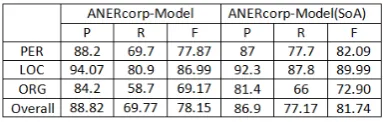
[image:8.595.320.512.227.288.2]The supervised classifier in Section 8.2 was trained on the ANERcorp training set. We refer to the resulting model as theANERcorp-Model. Ta-ble 4 shows the results of the ANERcorp-Model on the ANERcorp test set. The table also shows the results of the state-of-the-art supervised clas-sifier ‘ANERcorp-Model(SoA)’ developed by Dar-wish (2013) when trained and tested on the same datasets used forANERcorp-Model.
Table 4: The results of Supervised Classifiers.
8.4 Results
[image:8.595.328.504.486.529.2]We compared a system trained on WDC with the systems trained by Alotaibi and Lee (2013) on two datasets, WikiFANE(whole) and Wiki-FANE(selective), which are also automatically col-lected from Arabic Wikipedia. The evaluation pro-cess was conducted by testing them on the AN-ERcorp set. The results shown in Table 5 prove that the methodology we proposed in this paper produces a dataset that outperforms the two other datasets in terms of recall and F-measure.
Table 5: Comparison of the system trained on WDC dataset with the systems trained on Wiki-FANEdatasets.
which appear in the text along with NEs (e.g.,
éªÓAg./university, é JKYÓ/ city, é»Qå /company), are usu-ally considered part of NE names. So, the phrase ‘Shizuoka Prefecture’ that is mentioned in some Arabic Wikipedia articles is considered an entity and linked to an article that talks about Shizuoka, making the system annotate all words in the phrase as NEs as follows: (é ¢ ¯Am× B-LOC A¿ð Q I-LOC/ ShizuokaB-LOCPrefectureI-LOC). On the other hand, in ANERcorp corpus, only the the word af-ter the keyword (éKBð, ‘Prefecture’) is considered NE. In addition, although sport facilities (e.g., sta-diums) are categorized in Wikipedia as location, some of them are not even considered entities in ANERcorp test corpus.
Secondly, the ANERcorp-Model and the WDC-Model were tested on the ANERcorp test data. The point of this comparison is to show how well the WDC dataset works on a news-wire domain, which is more specific than Wikipedia’s open do-main. The table shows that the ANERcorp-model outperforms the F-score of the WDC-Model by around 13 points. However, in addition to the fact that training and test datasets for the ANERcorp-Model are drawn from the same domain, 69% of NEs in the test data were seen in the training set (Darwish, 2013).
Thirdly, the ANERcorp-Model and the WDC-Model were tested on NEWS corpus, which is also a news-wire based dataset. The results from Ta-ble 6 reveal the quality of theWDCdataset on the NEWS corpus. The WDC-Model achieves rela-tively similar results to the ANERcorp-Model, al-though the latter has the advantage of being trained on a manually annotated corpus extracted from the similar domain of the NEWS test set.
Finally, testing the ANERcorp-Model and the WDC-Model on data extracted from a social net-works like Twitter proves that models trained on open-domain datasets like Wikipedia perform bet-ter on social network text than classifiers trained on domain-specific datasets, as shown in Table 6.
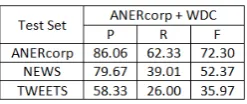
[image:9.595.336.498.60.235.2]In order to show the effect of combining our corpus (WDC) with a manually annotated dataset from a different domain, we mergedWDCwith the ANERcorpdataset. Table 7 shows the results of a system trained on the combined corpus when test-ing it on three test sets. The system trained on the combined corpus achieves results that fall between the results of the systems trained on each corpus separately when testing them on the ANERcorp
Table 6: The F-scores of ANERcorp-Model and WDC-Model on ANERcorp, NEWS, & TWEETS datasets.
test set and NEWS test set. On the other hand, the results of the system trained on the combined corpus when tested on the third test set (TWEETS) show no significant improvement.
Table 7: The results of combiningWDCwith AN-ERcorpdataset.
9 Conclusion and Future Work
We have presented a methodology that requires minimal time and human intervention to gener-ate an NE-annotgener-ated corpus from Wikipedia. The evaluation results showed the high quality of the developed corpus WDC, which contains around 6 million tokens representing different genres, as Wikipedia is considered an open domain. Further-more, WDC outperforms other NE corpora gen-erated automatically from Arabic Wikipedia by 8 to 12 points in terms of F-measure. Our methodol-ogy can easily be adapted to extend to new classes. Therefore, in future we intend to experiment with finer-grained NE hierarchies. In addition, we plan to carry out some domain adaptation experiments to handle the difference in annotation convention for different domains.
References
[image:9.595.355.479.356.408.2]recog-nition. InProceedings of the 2010 Named Entities Workshop, pages 110–115. Association for Compu-tational Linguistics.
Fahd Alotaibi and Mark Lee. 2012. Mapping Arabic Wikipedia into the Named Entities Taxonomy. In
COLING (Posters), pages 43–52.
Fahd Alotaibi and Mark Lee. 2013. Automatically De-veloping a Fine-grained Arabic Named Entity Cor-pus and Gazetteer by utilizing Wikipedia. In IJC-NLP.
Maha Althobaiti, Udo Kruschwitz, and Massimo Poe-sio. 2013. A Semi-supervised Learning Approach to Arabic Named Entity Recognition. InRANLP, pages 32–40.
Joohui An, Seungwoo Lee, and Gary Geunbae Lee. 2003. Automatic acquisition of named entity tagged corpus from world wide web. InProceedings of the 41st Annual Meeting on Association for Computa-tional Linguistics-Volume 2, pages 165–168. Asso-ciation for Computational Linguistics.
Yassine Benajiba, Paolo Rosso, and Jos´e Miguel Bened´ıruiz. 2007. Anersys: An Arabic Named Entity Recognition System based on Maximum En-tropy. InComputational Linguistics and Intelligent Text Processing, pages 143–153. Springer.
Yassine Benajiba, Mona Diab, and Paolo Rosso. 2008. Arabic Named Entity Recognition using optimized feature sets. InProceedings of the Conference on Empirical Methods in Natural Language Process-ing, pages 284–293. Association for Computational Linguistics.
Daniel M Bikel, Scott Miller, Richard Schwartz, and
Ralph Weischedel. 1997. Nymble: a
high-performance learning name-finder. InProceedings of the fifth conference on Applied natural language processing, pages 194–201. Association for Compu-tational Linguistics.
Nancy Chinchor, Erica Brown, Lisa Ferro, and Patty Robinson. 1999. 1999 Named Entity Recognition Task Definition.MITRE and SAIC.
Wisam Dakka and Silviu Cucerzan. 2008. Augment-ing Wikipedia with Named Entity Tags. InIJCNLP, pages 545–552.
Kareem Darwish. 2013. Named Entity Recognition using Cross-lingual Resources: Arabic as an Exam-ple. InACL.
Junichi Kazama and Kentaro Torisawa. 2007. Exploit-ing Wikipedia as external knowledge for named en-tity recognition. InJoint Conference on Empirical
Methods in Natural Language Processing and Com-putational Natural Language Learning, pages 698– 707.
L.S. Larkey, L. Ballesteros, and M.E. Connell. 2002. Improving stemming for Arabic information re-trieval: light stemming and co-occurrence analysis. In Annual ACM Conference on Research and De-velopment in Information Retrieval: Proceedings of the 25 th annual international ACM SIGIR confer-ence on Research and development in information retrieval, volume 11, pages 275–282.
Andrew McCallum and Wei Li. 2003. Early results for named entity recognition with conditional random fields, feature induction and web-enhanced lexicons. InProceedings of the seventh conference on Natural language learning at HLT-NAACL 2003-Volume 4, pages 188–191. Association for Computational Lin-guistics.
Peter Mika, Massimiliano Ciaramita, Hugo Zaragoza, and Jordi Atserias. 2008. Learning to Tag and Tag-ging to Learn: A Case Study on Wikipedia. vol-ume 23, pages 26–33.
Joel Nothman, James R Curran, and Tara Murphy. 2008. Transforming Wikipedia into Named Entity training data. InProceedings of the Australian Lan-guage Technology Workshop, pages 124–132. Joel Nothman, Nicky Ringland, Will Radford, Tara
Murphy, and James R Curran. 2013.
Learn-ing multilLearn-ingual Named Entity Recognition from Wikipedia.Artificial Intelligence, 194:151–175. Alexander E Richman and Patrick Schone. 2008.
Min-ing Wiki Resources for MultilMin-ingual Named Entity Recognition. InACL, pages 1–9.
Nicky Ringland, Joel Nothman, Tara Murphy, and James R Curran. 2009. Classifying articles in English and German Wikipedia. In Australasian Language Technology Association Workshop 2009, page 20.
Satoshi Sekine et al. 1998. NYU: Description of the Japanese NE system used for MET-2. InProc. of the Seventh Message Understanding Conference (MUC-7), volume 17.
Sam Tardif, James R. Curran, and Tara Murphy. 2009. Improved Text Categorisation for Wikipedia Named Entities. InProceedings of the Australasian Language Technology Association Workshop, pages 104–108.