Deep Residual Learning for Weakly-Supervised Relation Extraction
Yi Yao Huang
Department of Electrical Engineering National Taiwan University
Taipei, Taiwan
William Yang Wang Department of Computer Science University of California, Santa Barbara
Santa Barbara, CA 93106 USA [email protected]
Abstract
Deep residual learning (ResNet) (He et al., 2016) is a new method for training very deep neural networks using identity map-ping for shortcut connections. ResNet has won the ImageNet ILSVRC 2015 clas-sification task, and achieved state-of-the-art performances in many computer vi-sion tasks. However, the effect of resid-ual learning on noisy natural language pro-cessing tasks is still not well understood. In this paper, we design a novel convolu-tional neural network (CNN) with resid-ual learning, and investigate its impacts on the task of distantly supervised noisy rela-tion extracrela-tion. In contradictory to popu-lar beliefs that ResNet only works well for very deep networks, we found that even with 9 layers of CNNs, using identity map-ping could significantly improve the per-formance for distantly-supervised relation extraction.
1 Introduction
Relation extraction is the task of predicting at-tributes and relations for entities in a sentence ( Ze-lenko et al., 2003; Bunescu and Mooney, 2005; GuoDong et al., 2005). For example, given a sentence“Barack Obamawas born inHonolulu, Hawaii.”, a relation classifier aims at predicting the relation of“bornInCity”. Relation extraction is the key component for building relation knowl-edge graphs, and it is of crucial significance to natural language processing applications such as structured search, sentiment analysis, question an-swering, and summarization.
A major issue for relation extraction is the lack of labeled training data. In recent years, distant supervision (Mintz et al.,2009;Hoffmann et al.,
2011;Surdeanu et al.,2012) emerges as the most popular method for relation extraction— it uses knowledge base facts to select a set of noisy in-stances from unlabeled data. Among all the ma-chine learning approaches for distant supervision, the recently proposed Convolutional Neural Net-works (CNNs) model (Zeng et al.,2014) achieved the state-of-the-art performance. Following their success, Zeng et al. (2015) proposed a piece-wise max-pooling strategy to improve the CNNs. Var-ious attention strategies (Lin et al., 2016; Shen and Huang, 2016) for CNNs are also proposed, obtaining impressive results. However, most of these neural relation extraction models are rela-tively shallow CNNs—typically only one convo-lutional layer and one fully connected layer were involved, and it was not clear whether deeper mod-els could have benefits on distilling signals from noisy inputs in this task.
In this paper, we investigate the effects of train-ing deeper CNNs for distantly-supervised relation extraction. More specifically, we designed a con-volutional neural network based on residual learn-ing (He et al.,2016)—we show how one can in-corporate word embeddings and position embed-dings into a deep residual network, while feed-ing identity feedback to convolutional layers for this noisy relation prediction task. Empirically, we evaluate on the NYT-Freebase dataset (Riedel et al.,2010), and demonstrate the state-of-the-art performance using deep CNNs with identify map-ping and shortcuts. In contrast to popular beliefs in vision that deep residual network only works for very deep CNNs, we show that even with a mod-erately deep CNNs, there are substantial improve-ments over vanilla CNNs for relation extraction. Our contributions are three-fold:
• We are the first to consider deeper convolu-tional neural networks for weakly-supervised
relation extraction using residual learning;
• We show that our deep residual network model outperforms CNNs by a large margin empirically, obtaining state-of-the-art perfor-mances;
• Our identity mapping with shortcut feedback approach can be easily applicable to any vari-ants of CNNs for relation extraction.
2 Deep Residual Networks for Relation Extraction
In this section, we describe a novel deep residual learning architecture for distantly supervised rela-tion extracrela-tion. Figure1describes the architecture of our model.
2.1 Vector Representation
Letxibe thei-th word in the sentence ande1,e2be the two corresponding entities. Each word will ac-cess two embedding look-up tables to get the word embeddingWFiand the position embeddingPFi. Then, we concatenate the two embeddings and de-note each word as a vector ofvi= [WFi,PFi]. 2.1.1 Word Embeddings
Each representation vi corresponding to xi is a real-valued vector. All of the vectors are encoded in an embeddings matrixVw ∈Rdw×|V|whereV is a fixed-sized vocabulary.
2.1.2 Position Embeddings
In relation classification, we focus on finding a relation for entity pairs. Following (Zeng et al., 2014), a PF is the combination of the relative dis-tances of the current word to the first entitye1and
the second entitye2. For instance, in the sentence
”Steve Jobs is the founder of Apple.”, the relative distances fromfoundertoe1(Steve Job) ande2are
3 and -2, respectively. We then transform the rel-ative distances into real valued vectors by looking up one randomly initialized position embedding matricesVp ∈Rdp×kPkwhere P is fixed-sized dis-tance set. It should be noted that if a word is too far from entities, it may be not related to the rela-tion. Therefore, we choose maximum valueemax and minimum valueeminfor the relative distance. In the example shown in Figure1, it is assumed thatdw is 4 and dp is 1. There are two position embeddings: one fore1, the other fore2. Finally,
we concatenate the word embeddings and position
embeddings of all words and denote a sentence of lengthn(padded where necessary) as a vector
v=v1⊕v2⊕...⊕vn
where⊕is the concatenation operator andvi ∈Rd (d=dw+dp×2).
2.2 Convolution
Let vi:i+j refer to the concatenation of words vi,vi+1, ...,vi+j. A convolution operation in-volves a filter w ∈ Rhd, which is applied to a window of hwords to produce a new feature. A feature ci is generated from a window of word vi:i+h−1 by
ci =f(w·xi:i+h−1+b)
Here b ∈ R is a bias term andf is a non-linear function. This filter is applied to each possible window of words from v1 to vn to produce fea-ture c = [c1, c2, ..., cn−h+1] with c ∈ Rs(s = n−h+ 1).
2.3 Residual Convolution Block
Residual learning connects low-level to high-level representations directly, and tackles the vanishing gradient problem in deep networks. In our model, we design the residual convolution block by ap-plying shortcut connections. Each residual con-volutional block is a sequence of two convolu-tional layers, each one followed by an ReLU ac-tivation. The kernel size of all convolutions ish, with padding such that the new feature will have the same size as the original one. Here are two convolutionalfilterw1, w2 ∈ Rh×1. For the first
convolutional layer:
˜
ci =f(w1·ci:i+h−1+b1)
For the second convolutional layer:
´
ci =f(w2·˜ci:i+h−1+b2)
Hereb1,b2 are bias terms. For the residual
learn-ing operation:
c=c+ ´c
Conveniently, the notation of c on the left is changed to define as the output vectors of the block. This operation is performed by a shortcut connection and element-wise addition. This block will be multiply concatenated in our architecture.
2.4 Max Pooling, Softmax Output
We then apply a max-pooling operation over the
Figure 1: The architecture of ResCNN used for relation extraction.
We have described the process by whichone fea-ture is extracted from one filter. Take all fea-tures into one high level extracted feature z = [ˆc1,ˆc2, ...,cˆm](note that here we have m filters). Then, these features are passed to a fully con-nected softmax layer whose output is the proba-bility distribution over relations. Instead of using
y = w·z+bfor output unity in forward prop-agation, dropout uses y = w·(z◦r) +bwhere
◦is the element-wise multiplication operation and r∈Rmis a ’masking’ vector of Bernoulli random variables with probabilitypof being 1. In the test procedure, the learned weight vectors are scaled bypsuch thatwˆ =pwand used (without dropout) to score unseen instances.
3 Experiments
3.1 Experimental Settings
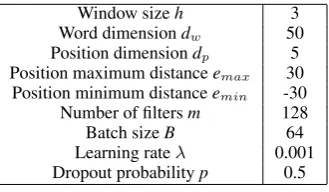
In this paper, we use the word embeddings re-leased by (Lin et al., 2016) which are trained on the NYT-Freebase corpus (Riedel et al.,2010). We fine tune our model using validation on the train-ing data. The word embeddtrain-ing is of size 50. The input text is padded to a fixed size of 100. Training is performed with tensorflow adam optimizer, us-ing a mini-batch of size 64, an initial learnus-ing rate of 0.001. We initialize our convolutional layers following (Glorot and Bengio,2010). The imple-mentation is done using Tensorflow 0.11. All ex-periments are performed on a single NVidia Titan X (Pascal) GPU. In Table1we show all parame-ters used in the experiments.
We experiment with several state-of-the-art base-lines and variants of our model.
• CNN-B: Our implementation of the CNN baseline (Zeng et al., 2014) which contains one convolutional layer, and one fully con-nected layer.
Window sizeh 3
Word dimensiondw 50 Position dimensiondp 5 Position maximum distanceemax 30
Position minimum distanceemin -30 Number of filtersm 128
Batch sizeB 64
Learning rateλ 0.001 Dropout probabilityp 0.5
Table 1: Parameter settings
• CNN+ATT: CNN-B with attention over in-stance learning (Lin et al.,2016).
• PCNN+ATT: Piecewise CNN-B with atten-tion over instance learning (Lin et al.,2016).
• CNN: Our CNN model which includes one convolutional layer and three fully connected layers.
• CNN-x: Deeper CNN model which has x convolutional layers. For example, CNN-9 is a model constructed with 9 convolutional lay-ers (1 + 4 residual cnn block without identity shortcut) and three fully connected layers.
• ResCNN-x: Our proposed CNN-x model with residual identity shortcuts.
We evaluate our models on the widely used NYT freebase larger dataset (Riedel et al.,2010). Note that ImageNet dataset used by the original ResNet paper (He et al., 2016) has 1.28 million training instances. NYT freebase dataset includes 522K training sentences, which is the largest dataset in relation extraction, and it is the only suitable dataset to train deeper CNNs.
[image:3.595.335.500.237.333.2]Figure 2: Comparing ResCNN to different CNNs.
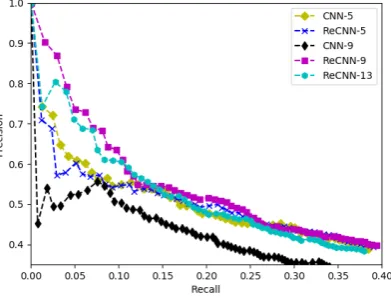
Figure 3: Varying the depths of our models.
us to train a deep network. Similar to previous work (Zeng et al.,2015;Lin et al.,2016), we eval-uate our model using the held-out evaluation. We report both the aggregate curves precision/recall curves and Precision@N (P@N).
In Figure2, we compare the proposed ResCNN model with various CNNs. First, CNNs with mul-tiple fully-connected layers obtained very good sults, which is a novel finding. Second, the re-sults also suggest that deeper CNNs with resid-ual learning help extracting signals from noisy dis-tant supervision data. We observe that overfitting happened when we try to add more layers and the performance of CNN-9 is much worse than CNN. We find that ResNet can solve this prob-lem and ResCNN-9 obtains better performance as compared to CNN-B and CNN and dominates the precision/recall curve overall.
We show the effect of depth in residual net-works in Figure 3. We observe that ResCNN-5 is worse than CNN-5 because the ResNet does not work well for shallow CNNs, and this is
consis-P@N(%) 100 200 300 Mean
CNN+ATT 76.2 68.6 59.8 68.2
PCNN+ATT 76.2 73.1 67.4 72.2
CNN-B 41.0 40.0 41.0 40.7
CNN 64.0 61.0 55.3 60.1
CNN-5 64.0 58.5 54.3 58.9
ResCNN-5 57.0 57.0 54.3 56.1
CNN-9 56.0 54.0 49.7 53.2
[image:4.595.85.281.78.229.2]ResCNN-9 79.0 69.0 61.0 69.7 ResCNN-13 76.0 65.0 60.3 67.1 Table 2: P@N for relation extraction with different models. Top: models that select training data. Bottom: models with-out selective attention.
tent with the original ResNet paper. As we in-crease the network depth, we see that CNN-9 does overfit to the training data. With residual learning, both ResCNN-9 and ResCNN-13 provide signif-icant improvements over CNN-5 and ResCNN-5 models. In contradictory to popular beliefs that ResNet only works well for very deep networks, we found that even with 9 layers of CNNs, using identity mapping could significantly improve the performance learning in a noisy input setting.
The intuition of ResNet help this task in two as-pect. First, if the lower, middle, and higher lev-els learn hidden lexical, syntactic, and semantic representations respectively, sometimes it helps to bypass the syntax to connect lexical and semantic space directly. Second, ResNet tackles the van-ishing gradient problem which will decrease the effect of noise in distant supervision data.
In Table2, we compare the performance of our models to state-of-the-art baselines. We show that our ResCNN-9 outperforms all models that do not select training instances. And even without piece-wise max-pooling and instance-based attention, our model is on par with the PCNN+ATT model.
For the more practical evaluation, we compare the results for precision@N where N is small (1, 5, 10, 20, 50) in Table 3. We observe that our ResCNN-9 model dominates the performance when we predict the relation in the range of higher probability. ResNet helps CNNs to focus on the highly possible candidate and mitigate the noise effect of distant supervision. We believe that resid-ual connections actresid-ually can be seen as a form of renormalizing the gradients, which prevents the model from overfitting to the noisy distant super-vision data.
[image:4.595.85.281.276.425.2]Resid-P@N(%) 1 5 10 20 50
PCNN+ATT 1 0.8 0.9 0.75 0.7
[image:5.595.78.290.61.96.2]ResCNN-9 1 1 0.9 0.9 0.88
Table 3: P@N for relation extraction with different models where N is small. We get the result of PCNN+ATT using their public source code.
ual learning could significantly improve the per-formance for deeper CNNs.
4 Conclusion
In this paper, we introduce a deep residual learning method for distantly-supervised relation extrac-tion. We show that deeper convolutional models help distill signals from noisy inputs. With short-cut connections and identify mapping, the perfor-mances are significantly improved. These results aligned with a recent study (Conneau et al.,2017), suggesting that deeper CNNs do have positive ef-fects on noisy NLP problems.
References
Razvan Bunescu and Raymond J Mooney. 2005. Sub-sequence kernels for relation extraction. In NIPS, pages 171–178.
Alexis Conneau, Holger Schwenk, Lo¨ıc Barrault, and Yann Lecun. 2017. Very deep convolutional net-works for natural language processing. EACL 2017. Xavier Glorot and Yoshua Bengio. 2010. Understand-ing the difficulty of trainUnderstand-ing deep feedforward neural networks. InInternational Conference on Artificial Intelligence and Statistics, pages 249–256.
Zhou GuoDong, Su Jian, Zhang Jie, and Zhang Min. 2005. Exploring various knowledge in relation ex-traction. InProceedings of the 43rd annual meeting on association for computational linguistics, pages 427–434. Association for Computational Linguis-tics.
Kaiming He, Xiangyu Zhang, Shaoqing Ren, and Jian Sun. 2016. Deep residual learning for image recog-nition. InProceedings of the IEEE Conference on Computer Vision and Pattern Recognition, pages 770–778.
Raphael Hoffmann, Congle Zhang, Xiao Ling, Luke Zettlemoyer, and Daniel S Weld. 2011. Knowledge-based weak supervision for information extraction of overlapping relations. InProceedings of the 49th Annual Meeting of the Association for Computa-tional Linguistics: Human Language Technologies-Volume 1, pages 541–550. Association for Compu-tational Linguistics.
Yankai Lin, Shiqi Shen, Zhiyuan Liu, Huanbo Luan, and Maosong Sun. 2016. Neural relation extraction with selective attention over instances. InACL 2016.
Mike Mintz, Steven Bills, Rion Snow, and Dan Juraf-sky. 2009. Distant supervision for relation extrac-tion without labeled data. In Proceedings of the Joint Conference of the 47th Annual Meeting of the ACL and the 4th International Joint Conference on Natural Language Processing of the AFNLP: Vol-ume 2-VolVol-ume 2, pages 1003–1011. Association for Computational Linguistics.
Sebastian Riedel, Limin Yao, and Andrew McCal-lum. 2010. Modeling relations and their mentions without labeled text. In Machine Learning and Knowledge Discovery in Databases, pages 148–163. Springer.
Yatian Shen and Xuanjing Huang. 2016. Attention-based convolutional neural network for semantic re-lation extraction. InProceedings of COLING 2016, the 26th International Conference on Computational Linguistics: Technical Papers.
Mihai Surdeanu, Julie Tibshirani, Ramesh Nallapati, and Christopher D Manning. 2012. Multi-instance multi-label learning for relation extraction. In Pro-ceedings of the 2012 Joint Conference on Empirical Methods in Natural Language Processing and Com-putational Natural Language Learning, pages 455– 465. Association for Computational Linguistics. Dmitry Zelenko, Chinatsu Aone, and Anthony
Richardella. 2003. Kernel methods for relation ex-traction. Journal of machine learning research, 3(Feb):1083–1106.
Daojian Zeng, Kang Liu, Yubo Chen, and Jun Zhao. 2015. Distant supervision for relation extraction via piecewise convolutional neural networks. In Pro-ceedings of the 2015 Conference on Empirical Meth-ods in Natural Language Processing (EMNLP), Lis-bon, Portugal, pages 17–21.