2180
A Capsule Network-based Embedding Model for Knowledge Graph
Completion and Search Personalization
Dai Quoc Nguyen1, Thanh Vu2, Tu Dinh Nguyen1, Dat Quoc Nguyen3, Dinh Phung1
1Monash University, Australia;3The University of Melbourne, Australia
2The Australian e-Health Research Centre, CSIRO, Australia
1{dai.nguyen,tu.dinh.nguyen,dinh.phung}@monash.edu 2[email protected];3[email protected]
Abstract
In this paper, we introduce an embedding model, named CapsE, exploring a capsule net-work to model relationship triples(subject, re-lation, object). Our CapsE represents each triple as a 3-column matrix where each col-umn vector represents the embedding of an element in the triple. This 3-column matrix is then fed to a convolution layer where mul-tiple filters are operated to generate different feature maps. These feature maps are recon-structed into corresponding capsules which are then routed to another capsule to produce a continuous vector. The length of this vector is used to measure the plausibility score of the triple. Our proposed CapsE obtains better performance than previous state-of-the-art em-bedding models for knowledge graph comple-tion on two benchmark datasets WN18RR and FB15k-237, and outperforms strong search personalization baselines on SEARCH17.
1 Introduction
Knowledge graphs (KGs) containing relationship triples (subject, relation, object), denoted as (s,
r, o), are the useful resources for many NLP and
especially information retrieval applications such
as semantic search and question answering (Wang
et al., 2017). However, large knowledge graphs, even containing billions of triples, are still incom-plete, i.e., missing a lot of valid triples (West et al.,
2014). Therefore, much research efforts have
fo-cused on the knowledge graph completion task which aims to predict missing triples in KGs, i.e., predicting whether a triple not in KGs is likely to be valid or not (Bordes et al.,2011,2013;Socher et al.,2013). To this end, many embedding models have been proposed to learn vector representations for entities (i.e.,subject/head entity andobject/tail entity) and relations in KGs, and obtained
state-of-the-art results as summarized by Nickel et al.
(2016a) and Nguyen (2017). These embedding models score triples(s, r, o), such that valid triples have higher plausibility scores than invalid ones (Bordes et al., 2011, 2013; Socher et al., 2013). For example, in the context of KGs, the score for
(Melbourne, cityOf, Australia) is higher than the
score for(Melbourne, cityOf, United Kingdom).
Triple modeling is applied not only to the KG completion, but also for other tasks which can be formulated as a triple-based prediction prob-lem. An example is in search personalization, one would aim to tailor search results to each spe-cific user based on the user’s personal interests and preferences (Teevan et al.,2005, 2009; Ben-nett et al., 2012; Harvey et al., 2013; Vu et al.,
2015,2017). Here the triples can be formulated as
(submitted query, user profile, returned document)
and used to re-rank documents returned to a user given an input query, by employing an existing KG
embedding method such as TransE (Bordes et al.,
2013), as proposed byVu et al.(2017). Previous studies have shown the effectiveness of modeling triple for either KG completion or search person-alization. However, there has been no single study investigating the performance on both tasks.
Conventional embedding models, such as
TransE (Bordes et al., 2013), DISTMULT (Yang
et al.,2015) and ComplEx (Trouillon et al.,2016), use addition, subtraction or simple multiplication operators, thus only capture the linear relation-ships between entities. Recent research has raised interest in applying deep neural networks to
triple-based prediction problems. For example,Nguyen
best of our knowledge, however, none of the exist-ing models has a “deep” architecture for modelexist-ing the entries in a triple at the same dimension.
Sabour et al. (2017) introduced capsule
net-works (CapsNet) that employ capsules (i.e., each
capsule is a group of neurons) to capture entities in
images and then uses a routing process to specify connections from capsules in a layer to those in the next layer. Hence CapsNet could encode the intrinsic spatial relationship between a part and a whole constituting viewpoint invariant knowledge that automatically generalizes to novel viewpoints. Each capsule accounts for capturing variations of an object or object part in the image, which can be efficiently visualized. Our high-level hypothesis is that embedding entries at the same dimension of the triple also have these variations, although it is not straightforward to be visually examined.
To that end, we introduce CapsE to explore a novel application of CapsNet on triple-based data for two problems: KG completion and search per-sonalization. Different from the traditional mod-eling design of CapsNet where capsules are con-structed by splitting feature maps, we use capsules to model the entries at the same dimension in the entity and relation embeddings. In our CapsE,vs,
vr andvo are uniquek-dimensional embeddings
ofs, r ando, respectively. The embedding triple
[vs, vr, vo] of(s, r, o) is fed to the convolution
layer where multiple filters of the same1×3shape are repeatedly operated over every row of the
ma-trix to produce k-dimensional feature maps.
En-tries at the same dimension from all feature maps
are then encapsulated into a capsule. Thus, each
capsule can encode many characteristics in the embedding triple to represent the entries at the
corresponding dimension. These capsules are then
routed to another capsule which outputs a contin-uous vector whose length is used as a score for the triple. Finally, this score is used to predict whether the triple(s, r, o)is valid or not.
In summary, our main contributions from this paper are as follows:
•We propose an embedding model CapsE using
the capsule network (Sabour et al.,2017) for mod-eling relationship triples. To our best of knowl-edge, our work is the first consideration of explor-ing the capsule network to knowledge graph com-pletion and search personalization.
• We evaluate our CapsE for knowledge graph
completion on two benchmark datasets WN18RR
(Dettmers et al.,2018) and FB15k-237 (Toutanova and Chen, 2015). CapsE obtains the best mean rank on WN18RR and the highest mean reciprocal rank and highest Hits@10 on FB15k-237.
•We restate the prospective strategy of
expand-ing the triple embeddexpand-ing models to improve the ranking quality of the search personalization sys-tems. We adapt our model to search
personaliza-tion and evaluate on SEARCH17 (Vu et al.,2017)
– a dataset of the web search query logs. Ex-perimental results show that our CapsE achieves the new state-of-the-art results with significant im-provements over strong baselines.
2 The proposed CapsE
LetGbe a collection of valid factual triples in the form of(subject, relation, object)denoted as(s, r,
o). Embedding models aim to define ascore
func-tiongiving a score for each triple, such that valid triples receive higher scores than invalid triples.
We denotevs,vr andvo as thek-dimensional
embeddings of s, r and o, respectively. In our
proposed CapsE, we followNguyen et al.(2018)
to view each embedding triple [vs, vr, vo] as a
matrix A = [vs,vr,vo] ∈ Rk×3, and denote Ai,: ∈R1×3 as thei-th row ofA. We use a filter ω∈R1×3operated on the convolution layer. This
filter ω is repeatedly operated over every row of
Ato generate a feature mapq= [q1,q2, ...,qk]∈ Rk, in which qi = g(ω·Ai,:+b) where ·
de-notes a dot product, b ∈ R is a bias term and g
is a non-linear activation function such as ReLU. Our model uses multiple filters∈ R1×3 to
gener-ate feature maps. We denote Ωas the set of
fil-ters andN =| Ω |as the number of filters, thus
we haveNk-dimensional feature maps, for which
each feature map can capture one single character-istic among entries at the same dimension.
We build our CapsE with two single capsule layers for a simplified architecture. In the first
layer, we constructkcapsules, wherein entries at
the same dimension from all feature maps are en-capsulated into a corresponding capsule. There-fore, each capsule can capture many characteris-tics among the entries at the corresponding dimen-sion in the embedding triple. These characteris-tics are generalized into one capsule in the second layer which produces a vector output whose length is used as the score for the triple.
s r o
k = 4
matrix 4×3 5 filters 1×3
convolution 5 feature maps
1 capsule with 2 neurons ReLU
u!
First capsule layer
Second capsule layer
CNN layer
4 capsules, each with 5 neurons
Routing process
u"
u#
u$
e ||e||
s
[image:3.595.85.507.67.234.2]squash squash
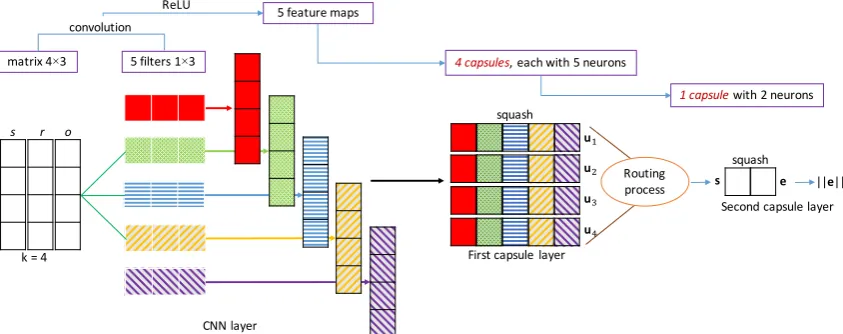
Figure 1: An example illustration of our CapsE withk= 4,N= 5, andd= 2.
output ui ∈ RN×1. Vector outputs ui are
mul-tiplied by weight matrices Wi ∈ Rd×N to
pro-duce vectors ˆui ∈ Rd×1 which are summed to
produce a vector input s ∈ Rd×1 to the capsule
in the second layer. The capsule then performs the non-linear squashing function to produce a vector outpute∈Rd×1:
e=squash(s) ; s=X
i
ciuˆi ; uˆi =Wiui
where squash(s) = 1+kskksk22ksks , and ci are
cou-pling coefficients determined by the routing
pro-cess as presented in Algorithm 1. Because there
is one capsule in the second layer, we make only one difference in the routing process proposed by Sabour et al. (2017), for which we apply the
softmaxin a direction from all capsules in the
pre-vious layer to each of capsules in the next layer.1
forall capsule i∈the first layerdo
bi←0
foriteration= 1, 2, ..., mdo
c←softmax(b)
s←P
iciuˆi
e=squash(s)
forall capsule i∈the first layerdo
bi←bi+ ˆui·e
Algorithm 1:The routing process is extended
fromSabour et al.(2017).
1Thesoftmax in the original routing process proposed
bySabour et al.(2017) is applied in another direction from
each of capsules in the previous layer to all capsules in the next layer.
We illustrate our proposed model in Figure 1
where embedding size: k = 4, the number of
fil-ters: N = 5, the number of neurons within the
capsules in the first layer is equal to N, and the number of neurons within the capsule in the
sec-ond layer: d= 2. The length of the vector output
eis used as the score for the input triple.
Formally, we define the score functionffor the
triple(s, r, o)as follows:
f(s, r, o) =kcapsnet(g([vs,vr,vo]∗Ω))k
where the set of filters Ω is shared parameters
in the convolution layer; ∗denotes a convolution
operator; andcapsnet denotes a capsule network
operator. We use the Adam optimizer (Kingma
and Ba, 2014) to train CapsE by minimizing the loss function (Trouillon et al.,2016;Nguyen et al.,
2018) as follows:
L= X
(s,r,o)∈{G∪G0}
log 1 + exp −t(s,r,o)·f(s, r, o)
in which,t(s,r,o)=
1for(s, r, o)∈ G −1for(s, r, o)∈ G0
hereG andG0 are collections of valid and invalid triples, respectively.G0is generated by corrupting valid triples inG.
3 Knowledge graph completion evaluation
In the knowledge graph completion task (Bordes
et al.,2013), the goal is to predict a missing entity given a relation and another entity, i.e, inferring a head entitysgiven(r, o)or inferring a tail entity
ogiven(s, r). The results are calculated based on ranking the scores produced by the score function
3.1 Experimental setup
Datasets: We use two recent benchmark datasets
WN18RR (Dettmers et al.,2018) and FB15k-237
(Toutanova and Chen,2015). These two datasets are created to avoid reversible relation problems, thus the prediction task becomes more realistic
and hence more challenging (Toutanova and Chen,
2015). Table1presents the statistics of WN18RR
and FB15k-237.
Dataset #E #R #Triples in train/valid/test WN18RR 40,943 11 86,835 3,034 3,134 FB15k-237 14,541 237 272,115 17,535 20,466
Table 1: Statistics of the experimental datasets. #E is the number of entities. #R is the number of relations.
Evaluation protocol: Following Bordes et al.
(2013), for each valid test triple (s, r, o), we re-place eithersoroby each of all other entities to create a set of corrupted triples. We use the “Fil-tered” setting protocol (Bordes et al., 2013), i.e., not taking any corrupted triples that appear in the KG into accounts. We rank the valid test triple and corrupted triples in descending order of their scores. We employ evaluation metrics: mean rank (MR), mean reciprocal rank (MRR) and Hits@10 (i.e., the proportion of the valid test triples ranking in top 10 predictions). Lower MR, higher MRR or higher Hits@10 indicate better performance. Final scores on the test set are reported for the model ob-taining the highest Hits@10 on the validation set.
Training protocol:We use the common Bernoulli
strategy (Wang et al., 2014; Lin et al., 2015b)
when sampling invalid triples. For WN18RR,
Pin-ter and Eisenstein(2018)2found a strong evidence to support the necessity of a WordNet-related se-mantic setup, in which they averaged pre-trained word embeddings for word surface forms within the WordNet to create synset embeddings, and then used these synset embeddings to initialize en-tity embeddings for training their TransE associa-tion model. We follow this evidence in using the pre-trained 100-dimensional Glove word embed-dings (Pennington et al., 2014) to train a TransE model on WN18RR.
2
Pinter and Eisenstein(2018) considered WN18RR and
evaluated their M3GM model only for 7 relations as they
em-ployed the inverse rule model (Dettmers et al.,2018) for 4
remaining symmetric relations. Regarding a fair comparison to other models, we use the M3GM implementation released
by Pinter and Eisenstein(2018) to re-train and re-evaluate
the M3GM model for all 11 relations. We thankPinter and
Eisenstein(2018) for their assistance running their code.
We employ the TransE and ConvKB
implemen-tations provided by Nguyen et al. (2016b) and
Nguyen et al.(2018). For ConvKB, we use a new process of training up to 100 epochs and monitor the Hits@10 score after every 10 training epochs to choose optimal hyper-parameters with the Adam initial learning rate in {1e−5,5e−5,1e−4} and the number of filtersNin{50,100,200,400}. We obtain the highest Hits@10 scores on the vali-dation set when using N= 400 and the initial
learn-ing rate5e−5 on WN18RR; and N= 100 and the
initial learning rate1e−5on FB15k-237.
Like in ConvKB, we use the same pre-trained entity and relation embeddings produced by TransE to initialize entity and relation embeddings in our CapsE for both WN18RR and FB15k-237 (k= 100). We set the batch size to 128, the num-ber of neurons within the capsule in the second capsule layer to 10 (d= 10), and the number of it-erations in the routing algorithmmin{1,3,5,7}. We run CapsE up to 50 epochs and monitor the Hits@10 score after each 10 training epochs to
choose optimal hyper-parameters. The highest
Hits@10 scores for our CapsE on the validation
set are obtained when usingm= 1,N= 400and
the initial learning rate at1e−5on WN18RR; and
m = 1, N = 50 and the initial learning rate at
1e−4on FB15k-237.
3.2 Main experimental results
Table 2 compares the experimental results of
our CapsE with previous state-of-the-art pub-lished results, using the same evaluation proto-col. Our CapsE performs better than its closely related CNN-based model ConvKB on both ex-perimental datasets (except Hits@10 on WN18RR and MR on 237), especially on FB15k-237 where our CapsE gains significant
improve-ments of 0.523 − 0.418 = 0.105 in MRR
(which is about 25.1% relative improvement), and
59.3%−53.2% = 6.1% absolute improvement
in Hits@10. Table 2 also shows that our CapsE
obtains the best MR score on WN18RR and the highest MRR and Hits@10 scores on FB15k-237. FollowingBordes et al.(2013), for each relation
r in FB15k-237, we calculate the averaged
num-berηsof head entities per tail entity and the
aver-aged numberηo of tail entities per head entity. If
ηs <1.5 andηo <1.5,ris categorized one-to-one
(1-1). If ηs <1.5 and ηo ≥1.5, r is categorized
Method WN18RR FB15k-237
MR MRR H@10 MR MRR H@10 DISTMULT (Yang et al.,2015) 5110 0.425 49.1 254 0.241 41.9 ComplEx (Trouillon et al.,2016) 5261 0.444 50.7 339 0.247 42.8 ConvE (Dettmers et al.,2018) 4187 0.433 51.5 244 0.325 50.1 KBGAN (Cai and Wang,2018) – 0.213 48.1 – 0.278 45.8 M3GM (Pinter and Eisenstein,2018) 1864 0.311 53.3 – – – TransE (Bordes et al.,2013) 743? 0.245? 56.0? 347 0.294 46.5 ConvKB (Nguyen et al.,2018) 763? 0.253? 56.7? 254? 0.418? 53.2?
[image:5.595.124.476.62.181.2]OurCapsE 719 0.415 56.0 303 0.523 59.3
Table 2: Experimental results on the WN18RR and FB15k-237 test sets. Hits@10 (H@10) is reported in %. Results of DISTMULT, ComplEx and ConvE are taken fromDettmers et al.(2018). Results of TransE on FB15k-237 are taken from Nguyen et al. (2018). Our CapsE Hits@1 scores are 33.7% on WN18RR and 48.9% on FB15k-237. Formulas of MRR and Hits@1 show a strong correlation, so using Hits@1 does not really reveal any additional information for this task. The best score is in bold, while the second best score is in underline.?denotes our new resultsfor TransE and ConvKB, which are better than those published byNguyen et al.(2018).
1-1 1-M M-1 M-M
0 20 40 60 80 100 47 . 4 47 . 72 59 . 78 57 . 28 51 . 56 57 . 15 49 . 51 48 . 85 Hits@10 Predictinghead CapsE ConvKB
1-1 1-M M-1 M-M
0 20 40 60 80 100 47 . 92 17 . 48 80 . 26 58 . 59 50 11 . 37 83 . 58 53 . 46 Hits@10 Predictingtail CapsE ConvKB
1-1 1-M M-1 M-M
0 0.2 0.4 0.6 0.8
0 . 45 0 . 28 0 . 59 0 . 51 0 . 47 0 . 37 0 . 48 0 . 37 MRR Predictinghead CapsE ConvKB
1-1 1-M M-1 M-M
0 0.2 0.4 0.6 0.8
[image:5.595.80.518.270.362.2]0 . 45 0 . 17 0 . 69 0 . 52 0 . 46 9 . 6 · 10 − 2 0 . 72 0 . 39 MRR Predictingtail CapsE ConvKB
Figure 2: Hits@10 (in %) and MRR on the FB15k-237 test set w.r.t each relation category.
hypern ym deri vationally related form member meron ym has part instance hypern ym synset domain topic of also see verb group member ofdomain region member ofdomain usage similar to 0 20 40 60 80 100 28 . 3 97 . 2 26 . 9 37 . 5 60 47 . 4 74 . 1 97 . 4 36 . 5 39 . 6 100 29 . 4 96 . 7 34 . 6 35 . 5 56 .6 48 . 2 71 . 4 97 . 4 28 . 8 43 . 8 100 Hits@10 CapsE ConvKB 0 10 20 30 40 50
39.9
34.3
8.1 5.5 3.9 3.6 1.8 1.2 0.8 0.8 0.1
%T riples w .r .t each relation
%Triples in Test
hypern ym deri vationally related form member meron ym has part instance hypern ym synset domain topic of also see verb group member ofdomain region member ofdomain usage similar to 0 0.2 0.4 0.6 0.8 1 0 . 11 0 . 89 0 . 13 0 . 16 0 . 35 0 . 27 0 . 6 0 . 74 0 . 15 0 . 18 0 . 5 0 . 11 0 . 43 0 .18 0 . 13 0 .36 0 . 33 0 . 24 0 .37 0 . 16 0 . 29 0 . 29 MRR CapsE ConvKB
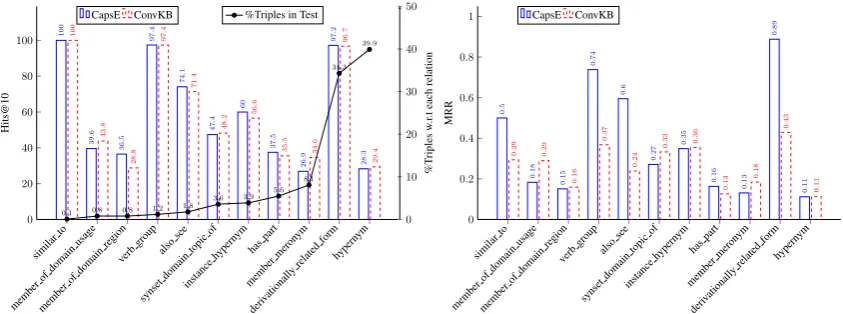
Figure 3: Hits@10 and MRR on the WN18RR test set w.r.t each relation. The right y-axis is the percentage of triples corresponding to relations.
categorized many-to-one (M-1). If ηs ≥1.5 and
ηo ≥1.5, r is categorized many-to-many (M-M).
As a result, 17, 26, 81 and 113 relations are la-belled 1-1, 1-M, M-1 and M-M, respectively. And 0.9%, 6.3%, 20.5% and 72.3% of the test triples in FB15k-237 contain 1-1, 1-M, M-1 and M-M rela-tions, respectively.
Figure 2shows the Hits@10 and MRR results
for predicting head and tail entities w.r.t each rela-tion category on FB15k-237. CapsE works better than ConvKB in predicting entities on the “side M” of triples (e.g., predictingheadentities in M-1
and M-M; and predictingtailentities in 1-M and
M-M), while ConvKB performs better than CapsE in predicting entities on the “side 1” of triples (i.e.,
predictinghead entities in 1-1 and 1-M; and
pre-dictingtailentities in 1-1 and M-1).
Figure 3 shows the Hits@10 and MRR
scores w.r.t each relation on WN18RR.
also see, similar to, verb group and
[image:5.595.89.511.389.546.2]m 10 20 30 40 50
1 48.37 52.60 53.14 53.33 53.21
3 47.78 52.34 52.93 52.99 52.86
5 47.03 52.25 45.80 45.99 45.76
[image:6.595.79.285.61.132.2]7 40.46 45.36 45.79 45.85 45.93
Table 3: Hits@10 on the WN18RR validation set with
N= 50and the initial learning rate at1e−5w.r.t each
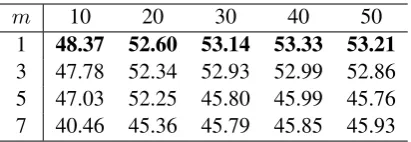
number of iterations in the routing algorithm m and each 10 training epochs.
shown in Figures 2 and 3 are consistent. These
also imply that our CapsE would be a potential candidate for applications which contain many M-M relations such as search personalization.
We see that the length and orientation of each capsule in the first layer can also help to model the important entries in the corresponding dimen-sion, thus CapsE can work well on the “side M” of triples where entities often appear less fre-quently than others appearing in the “side 1” of
triples. Additionally, existing models such as
DISTMULT, ComplEx and ConvE can perform well for entities with high frequency, but may not for rare entities with low frequency. These are rea-sons why our CapsE can be considered as the best one on FB15k-237 and it outperforms most exist-ing models on WN18RR.
Effects of routing iterations: We study how
the number of routing iterations affect the
per-formance. Table3 shows the Hits@10 scores on
the WN18RR validation set for a comparison w.r.t each number value of the routing iterations and
epochs with the number of filters N = 50 and
the Adam initial learning rate at 1e−5. We see
that the best performance for each setup over each
10 epochs is obtained by setting the numbermof
routing iterations to 1. This indicates the opposite side for knowledge graphs compared to images. In the image classification task, setting the numberm
of iterations in the routing process higher than 1 helps to capture the relative positions of entities in an image (e.g., eyes, nose and mouth) properly. In contrast, this property from images may be only right for the 1-1 relations, but not for the 1-M, M-1 and M-M relations in the KGs because of the high variant of each relation type (e.g., symmetric relations) among different entities.
4 Search personalization application
Given auser, a submittedqueryand thedocuments
returned by a search system for that query, our
approach is to re-rank the returned documents so that the more relevant documents should be ranked
higher. FollowingVu et al. (2017), we represent
the relationship between the submitted query, the user and the returned document as a(s, r, o)-like triple(query, user, document). The triple captures how much interest a user puts on a document given a query. Thus, we can evaluate the effectiveness of our CapsE for the search personalization task.
4.1 Experimental setup
Dataset: We use the SEARCH17 dataset (Vu
et al.,2017) of query logs of 106 users collected by a large-scale web search engine. A log en-tity consists of a user identifier, a query, top-10 ranked documents returned by the search en-gine and clicked documents along with the user’s dwell time.Vu et al.(2017) constructed short-term (session-based) user profiles and used the profiles to personalize the returned results. They then em-ployed the SAT criteria (Fox et al.,2005) to iden-tify whether a returned document is relevant from the query logs as either a clicked document with a dwell time of at least 30 seconds or the last clicked document in a search session (i.e., a SAT click). After that, they assigned arelevantlabel to a re-turned document if it is a SAT click and also
as-signedirrelevantlabels to the remaining top-10
documents. The rank position of therelevant
la-beled documents is used as the ground truth to evaluate the search performance before and after re-ranking.
The dataset was uniformly split into the train-ing, validation and test sets. This split is for the purpose of using historical data in the training set to predict new data in the test set (Vu et al.,2017). The training, validation and test sets consist of 5,658, 1,184 and 1,210 relevant (i.e., valid) triples; and 40,239, 7,882 and 8,540 irrelevant (i.e., in-valid) triples, respectively.
Evaluation protocol: Our CapsE is used to
re-rank the original list of documents returned by a search engine as follows: (i) We train our model and employ the trained model to calculate the score for each (s, r, o) triple. (ii) We then sort the scores in the descending order to obtain a new ranked list. To evaluate the performance of our proposed model, we use two standard evalu-ation metrics: mean reciprocal rank (MRR) and
[email protected] For each metric, the higher value
cates better ranking performance.
We compare CapsE with the following
base-lines using the same experimental setup: (1) SE:
The original rank is returned by the search en-gine. (2) CI (Teevan et al.,2011): This baseline uses a personalized navigation method based on
previously clicking returned documents. (3) SP
(Bennett et al., 2012; Vu et al., 2015): A search personalization method makes use of the session-based user profiles. (4) FollowingVu et al.(2017), we use TransE as a strong baseline model for the search personalization task. Previous work shows that the well-known embedding model TransE, de-spite its simplicity, obtains very competitive
re-sults for the knowledge graph completion (Lin
et al.,2015a;Nickel et al.,2016b;Trouillon et al.,
2016;Nguyen et al.,2016a,2018). (5) The CNN-based model ConvKB is the most closely related model to our CapsE.
Embedding initialization: We follow Vu et al.
(2017) to initialize user profile, query and doc-ument embeddings for the baselines TransE and ConvKB, and our CapsE.
We train a LDA topic model (Blei et al.,2003)
with 200 topics only on the relevant documents
(i.e., SAT clicks) extracted from the query logs. We then use the trained LDA model to infer the probability distribution over topics for every re-turned document. We use the topic proportion vec-tor of each document as its document embedding
(i.e. k = 200). In particular, the zth element
(z = 1,2, ..., k) of the vector embedding for doc-umentdis: vd,z = P(z |d)whereP(z|d)is the probability of the topiczgiven the documentd.
We also represent each query by a
probabil-ity distribution vector over topics. Let Dq =
{d1, d2, ..., dn} be the set of top n ranked
docu-ments returned for a queryq(here,n= 10). The
zth element of the vector embedding for query
q is defined as in (Vu et al., 2017): vq,z =
Pn
i=1λiP(z | di), where λi =
δi−1
Pn
j=1δj−1 is the
exponential decay function ofiwhich is the rank
ofdi inDq. Andδ is the decay hyper-parameter
(0 < δ < 1). FollowingVu et al.(2017), we use
δ= 0.8. Note that if we learn query and document embeddings during training, the models will over-fit to the data and will not work for new queries and documents. Thus, after the initialization pro-cess, we fix (i.e., not updating) query and docu-ment embeddings during training for TransE,
Con-search engine, so Hits@10 scores are same for all models.
vKB and CapsE.
In addition, as mentioned by Bennett et al.
(2012), the more recently clicked document
ex-presses more about the user current search inter-est. Hence, we make use of the user clicked docu-ments in the training set with the temporal weight-ing scheme proposed byVu et al.(2015) to initial-ize user profile embeddings for the three embed-ding models.
Hyper-parameter tuning:For our CapsE model,
we set batch size to 128, and also the number of neurons within the capsule in the second capsule layer to 10 (d= 10). The number of iterations in
the routing algorithm is set to 1 (m = 1). For
the training model, we use the Adam optimizer with the initial learning rate∈ {5e−6,1e−5,5e−5,
1e−4, 5e−4}. We also use ReLU as the
activa-tion funcactiva-tion g. We select the number of filters
N ∈ {50,100,200,400,500}. We run the model up to 200 epochs and perform a grid search to choose optimal hyper-parameters on the validation set. We monitor the MRR score after each training epoch and obtain the highest MRR score on the
validation set when usingN= 400and the initial
learning rate at5e−5.
We employ the TransE and ConvKB
implemen-tations provided by Nguyen et al. (2016b) and
Nguyen et al.(2018) and then follow their train-ing protocols to tune hyper-parameters for TransE and ConvKB, respectively. We also monitor the MRR score after each training epoch and attain the highest MRR score on the validation set when
us-ing margin = 5,l1-norm and SGD learning rate at
5e−3for TransE; andN= 500and the Adam
ini-tial learning rate at5e−4for ConvKB.
4.2 Main results
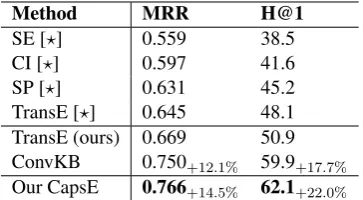
Table 4 presents the experimental results of the
baselines and our model. Embedding models
Method MRR H@1
[image:8.595.91.273.62.162.2]SE [?] 0.559 38.5 CI [?] 0.597 41.6 SP [?] 0.631 45.2 TransE [?] 0.645 48.1 TransE (ours) 0.669 50.9 ConvKB 0.750+12.1% 59.9+17.7% Our CapsE 0.766+14.5% 62.1+22.0%
Table 4: Experimental results on the test set. [?] de-notes the results reported in (Vu et al.,2017). Hits@1 (H@1) is reported in %. In information retrieval, Hits@1 is also referred to as P@1. The subscripts de-note the relative improvement over our TransE results.
0 10 20 30 40 50 60 70
Epoch 0.64
0.66 0.68 0.70 0.72 0.74 0.76
MRR
50 100 200 400 500
Figure 4: Learning curves on the validation set with the initial learning rate at5e−5.
significant withp <0.05using thepaired t-test). To illustrate our training progress, we plot per-formances of CapsE on the validation set over
epochs in Figure 4. We observe that the
perfor-mance is improved with the increase in the num-ber of filters since capsules can encode more use-ful properties for a large embedding size.
5 Related work
Other transition-based models extend TransE to additionally use projection vectors or matrices to
translate embeddings of s and o into the vector
space of r, such as: TransH (Wang et al.,2014), TransR (Lin et al.,2015b), TransD (Ji et al.,2015) and STransE (Nguyen et al.,2016b). Furthermore,
DISTMULT (Yang et al., 2015) and ComplEx
(Trouillon et al., 2016) use a tri-linear dot prod-uct to compute the score for each triple.
More-over, ConvKB (Nguyen et al.,2018) applies
con-volutional neural network, in which feature maps are concatenated into a single feature vector which is then computed with a weight vector via a dot
product to produce the score for the input triple. ConvKB is the most closely related model to our CapsE. See an overview of embedding models for
KG completion in (Nguyen,2017).
For search tasks, unlike classical methods, per-sonalized search systems utilize the historical in-teractions between the user and the search system, such as submitted queries and clicked documents to tailor returned results to the need of that user (Teevan et al.,2005,2009). That historical infor-mation can be used to build theuser profile, which is crucial to an effective search personalization system. Widely used approaches consist of two separated steps: (1) building the user profile from the interactions between the user and the search system; and then (2) learning a ranking function
tore-rankthe search results using the user profile
(Bennett et al., 2012;White et al., 2013; Harvey et al.,2013;Vu et al., 2015). The general goal is to re-rank the documents returned by the search system in such a way that the more relevant doc-uments are ranked higher. In this case, apart from the user profile, dozens of other features have been proposed as the input of a learning-to-rank algo-rithm (Bennett et al., 2012; White et al., 2013).
Alternatively, Vu et al. (2017) modeled the
po-tentialuser-oriented relationship between the sub-mitted query and the returned document by apply-ing TransE to reward higher scores for more rele-vant documents (e.g., clicked documents). They achieved better performances than the standard ranker as well as competitive search personaliza-tion baselines (Teevan et al.,2011;Bennett et al.,
2012;Vu et al.,2015).
6 Conclusion
[image:8.595.79.284.258.405.2]Acknowledgements
This research was partially supported by the ARC Discovery Projects DP150100031 and DP160103934. The authors thank Yuval Pinter for assisting us in running his code.
References
Paul N. Bennett, Ryen W. White, Wei Chu, Susan T. Dumais, Peter Bailey, Fedor Borisyuk, and Xi-aoyuan Cui. 2012. Modeling the impact of short-and long-term behavior on search personalization. In Proceedings of the International ACM SIGIR Conference on Research and Development in Infor-mation Retrieval, pages 185–194.
David M Blei, Andrew Y Ng, and Michael I Jordan. 2003. Latent dirichlet allocation. Journal of Ma-chine Learning Research, 3:993–1022.
Antoine Bordes, Nicolas Usunier, Alberto Garc´ıa-Dur´an, Jason Weston, and Oksana Yakhnenko. 2013. Translating Embeddings for Modeling Multi-relational Data. InAdvances in Neural Information Processing Systems 26, pages 2787–2795.
Antoine Bordes, Jason Weston, Ronan Collobert, and Yoshua Bengio. 2011. Learning Structured Embed-dings of Knowledge Bases. In Proceedings of the Twenty-Fifth AAAI Conference on Artificial Intelli-gence, pages 301–306.
Liwei Cai and William Yang Wang. 2018. KBGAN: Adversarial Learning for Knowledge Graph Embed-dings. InProceedings of The 16th Annual Confer-ence of the North American Chapter of the Associ-ation for ComputAssoci-ational Linguistics: Human Lan-guage Technologies, page to appear.
Tim Dettmers, Pasquale Minervini, Pontus Stenetorp, and Sebastian Riedel. 2018. Convolutional 2D Knowledge Graph Embeddings. InProceedings of the 32nd AAAI Conference on Artificial Intelligence, pages 1811–1818.
Steve Fox, Kuldeep Karnawat, Mark Mydland, Susan Dumais, and Thomas White. 2005. Evaluating im-plicit measures to improve web search. ACM Trans-actions on Information Systems, 23(2):147–168.
Morgan Harvey, Fabio Crestani, and Mark J. Carman. 2013. Building user profiles from topic models for personalised search. InProceedings of the ACM In-ternational Conference on Information and Knowl-edge Management, pages 2309–2314.
Guoliang Ji, Shizhu He, Liheng Xu, Kang Liu, and Jun Zhao. 2015. Knowledge Graph Embedding via Dynamic Mapping Matrix. In Proceedings of the 53rd Annual Meeting of the Association for Compu-tational Linguistics and the 7th International Joint Conference on Natural Language Processing (Vol-ume 1: Long Papers), pages 687–696.
Diederik Kingma and Jimmy Ba. 2014. Adam: A method for stochastic optimization. arXiv preprint arXiv:1412.6980.
Yankai Lin, Zhiyuan Liu, Huanbo Luan, Maosong Sun, Siwei Rao, and Song Liu. 2015a. Modeling Rela-tion Paths for RepresentaRela-tion Learning of Knowl-edge Bases. In Proceedings of the 2015 Confer-ence on Empirical Methods in Natural Language Processing, pages 705–714.
Yankai Lin, Zhiyuan Liu, Maosong Sun, Yang Liu, and Xuan Zhu. 2015b. Learning Entity and Re-lation Embeddings for Knowledge Graph Comple-tion. InProceedings of the Twenty-Ninth AAAI Con-ference on Artificial Intelligence Learning, pages 2181–2187.
Dai Quoc Nguyen, Tu Dinh Nguyen, Dat Quoc Nguyen, and Dinh Phung. 2018. A Novel Embed-ding Model for Knowledge Base Completion Based on Convolutional Neural Network. In Proceed-ings of the 2018 Conference of the North American Chapter of the Association for Computational Lin-guistics: Human Language Technologies, Volume 2 (Short Papers), pages 327–333.
Dat Quoc Nguyen. 2017. An overview of embedding models of entities and relationships for knowledge base completion. arXiv preprint, arXiv:1703.08098.
Dat Quoc Nguyen, Kairit Sirts, Lizhen Qu, and Mark Johnson. 2016a. Neighborhood Mixture Model for Knowledge Base Completion. In Proceedings of The 20th SIGNLL Conference on Computational Natural Language Learning, pages 40–50.
Dat Quoc Nguyen, Kairit Sirts, Lizhen Qu, and Mark Johnson. 2016b. STransE: a novel embedding model of entities and relationships in knowledge bases. In Proceedings of the 2016 Conference of the North American Chapter of the Association for Computational Linguistics: Human Language Tech-nologies, pages 460–466.
Maximilian Nickel, Kevin Murphy, Volker Tresp, and Evgeniy Gabrilovich. 2016a. A Review of Rela-tional Machine Learning for Knowledge Graphs. Proceedings of the IEEE, 104(1):11–33.
Maximilian Nickel, Lorenzo Rosasco, and Tomaso Poggio. 2016b. Holographic Embeddings of Knowledge Graphs. InProceedings of the Thirtieth AAAI Conference on Artificial Intelligence, pages 1955–1961.
Jeffrey Pennington, Richard Socher, and Christo-pher D. Manning. 2014. Glove: Global vectors for word representation. In Proceedings of the 2014 Conference on Empirical Methods in Natural Lan-guage Processing, pages 1532–1543.
Sara Sabour, Nicholas Frosst, and Geoffrey E Hinton. 2017. Dynamic routing between capsules. In Ad-vances in Neural Information Processing Systems, pages 3859–3869.
Richard Socher, Danqi Chen, Christopher D Manning, and Andrew Ng. 2013. Reasoning With Neural Ten-sor Networks for Knowledge Base Completion. In Advances in Neural Information Processing Systems 26, pages 926–934.
Jaime Teevan, Susan T. Dumais, and Eric Horvitz. 2005. Personalizing search via automated analysis of interests and activities. In Proceedings of the International ACM SIGIR Conference on Research and Development in Information Retrieval, pages 449–456.
Jaime Teevan, Daniel J. Liebling, and Gayathri Ravichandran Geetha. 2011. Understanding and predicting personal navigation. In Proceedings of the ACM International Conference on Web Search and Data Mining, pages 85–94.
Jaime Teevan, Meredith Ringel Morris, and Steve Bush. 2009. Discovering and using groups to im-prove personalized search. In Proceedings of the ACM International Conference on Web Search and Data Mining, pages 15–24.
Kristina Toutanova and Danqi Chen. 2015. Observed Versus Latent Features for Knowledge Base and Text Inference. InProceedings of the 3rd Workshop on Continuous Vector Space Models and their Com-positionality, pages 57–66.
Th´eo Trouillon, Johannes Welbl, Sebastian Riedel, ´Eric Gaussier, and Guillaume Bouchard. 2016. Complex Embeddings for Simple Link Prediction. In Pro-ceedings of the 33nd International Conference on Machine Learning, pages 2071–2080.
Thanh Vu, Dat Quoc Nguyen, Mark Johnson, Dawei Song, and Alistair Willis. 2017. Search personal-ization with embeddings. InProceedings of the Eu-ropean Conference on Information Retrieval, pages 598–604.
Thanh Vu, Alistair Willis, Son Ngoc Tran, and Dawei Song. 2015. Temporal latent topic user profiles for search personalisation. In Proceedings of the Eu-ropean Conference on Information Retrieval, pages 605–616.
Quan Wang, Zhendong Mao, Bin Wang, and Li Guo. 2017. Knowledge Graph Embedding: A Survey of Approaches and Applications. IEEE Transactions on Knowledge and Data Engineering, 29(12):2724– 2743.
Zhen Wang, Jianwen Zhang, Jianlin Feng, and Zheng Chen. 2014. Knowledge Graph Embedding by Translating on Hyperplanes. InProceedings of the Twenty-Eighth AAAI Conference on Artificial Intel-ligence, pages 1112–1119.
Robert West, Evgeniy Gabrilovich, Kevin Murphy, Shaohua Sun, Rahul Gupta, and Dekang Lin. 2014. Knowledge Base Completion via Search-based Question Answering. In Proceedings of the 23rd International Conference on World Wide Web, pages 515–526.
Ryen W. White, Wei Chu, Ahmed Hassan, Xiaodong He, Yang Song, and Hongning Wang. 2013. En-hancing personalized search by mining and model-ing task behavior. InProceedings of the World Wide Web conference, pages 1411–1420.