Domain Adaptation for CRF-based Chinese Word Segmentation using
Free Annotations
Yijia Liu†‡, Yue Zhang†, Wanxiang Che‡, Ting Liu‡, Fan Wu† †Singapore University of Technology and Design
‡Research Center for Social Computing and Information Retrieval Harbin Institute of Technology, China
{yjliu,car,tliu}@ir.hit.edu.cn {yue zhang,fan wu}@sutd.edu.sg
Abstract
Supervised methods have been the domi-nant approach for Chinese word segmen-tation. The performance can drop signif-icantly when the test domain is different from the training domain. In this paper, we study the problem of obtaining par-tial annotation from freely available data to help Chinese word segmentation on dif-ferent domains. Difdif-ferent sources of free annotations are transformed into a unified form of partial annotation and a variant CRF model is used to leverage both fully and partially annotated data consistently. Experimental results show that the Chi-nese word segmentation model benefits from free partially annotated data. On the SIGHAN Bakeoff 2010 data, we achieve results that are competitive to the best re-ported in the literature.
1 Introduction
Statistical Chinese word segmentation gains high accuracies on newswire (Xue and Shen, 2003; Zhang and Clark, 2007; Jiang et al., 2009; Zhao et al., 2010; Sun and Xu, 2011). However, man-ually annotated training data mostly come from the news domain, and the performance can drop severely when the test data shift from newswire to blogs, computer forums and Internet literature (Liu and Zhang, 2012).
Several methods have been proposed for solv-ing the domain adaptation problem for segmenta-tion, which include the traditional token- and type-supervised methods (Song et al., 2012; Zhang et al., 2014). While token-supervised methods rely on manually annotated target-domain sentences, type-supervised methods leverage manually as-sembled domain-specific lexicons to improve
target-domain segmentation accuracies. Both
.. 浦
. 东
. 开
. 发
. 与
. 法
. 制
. 建
. 设
. b
.
b .
b
.
b
.
b .
b
.
b .
b
.
b
.
m
.
m
.
m
.
m
.
m
.
m
.
m
.
m
.
m
.
e .
e
.
e .
e
.
e
.
e .
e
.
e .
e
.
s
.
s
.
s
.
s .
s
.
s
.
s
.
s
.
[image:1.595.323.507.209.294.2]s
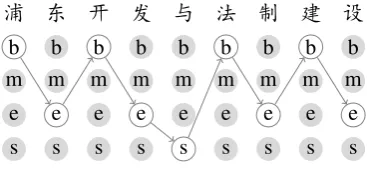
Figure 1: The segmentation problem, illustrated
using the sentence “浦东(Pudong) 开发
(devel-opment) 与(and) 法制 (legal) 建设
(construc-tion)”. Possible segmentation labels are drawn
un-der each character, whereb, m, e, s stand for the
beginning, middle, end of a multi-character word, and a single character word, respectively. The path shows the correct segmentation by choosing one label for each character.
methods are competitive given the same amount of annotation effects (Garrette and Baldridge, 2012; Zhang et al., 2014). However, obtaining manually annotated data can be expensive.
On the other hand, there are free data which
contain limited but useful segmentation informa-tion over the Internet, including large-scale un-labeled data, domain-specific lexicons and semi-annotated web pages such as Wikipedia. In the last case, word-boundary information is contained in hyperlinks and other markup annotations. Such free data offer a useful alternative for improving the segmentation performance, especially on do-mains that are not identical to newswire, and for which little annotation is available.
In this paper, we investigate techniques for adopting freely available data to help improve the performance on Chinese word segmentation. We propose a simple but robust method for construct-ing partial segmentation from different sources of free data, including unlabeled data and the Wikipedia. There has been work on making use of both unlabeled data (Sun and Xu, 2011; Wang et al., 2011) and Wikipedia (Jiang et al., 2013)
to improve segmentation. However, no empiri-cal results have been reported on a unified ap-proach to deal with different types of free data. We use a conditional random fields (Lafferty et al., 2001; Tsuboi et al., 2008) variant that can lever-age the partial annotations obtained from different sources of free annotation. Training is achieved by a modification to the learning objective, incorpo-rating partial annotation likelihood, so that a single model can be trained consistently with a mixture of full and partial annotation.
Experimental results show that our method of using partially annotated data can consistently im-proves cross-domain segmentation performance. We obtain results which are competitive to the best reported in the literature. Our segmentor
is freely released at https://github.com/
ExpResults/partial-crfsuite.
2 Obtaining Partially Annotated Data
We model the Chinese word segmentation task as a character sequence tagging problem, which is to give each character in a sentence a word-boundary
tag (Xue and Shen, 2003). We adopt four tags,b,
m, eands, which represent thebeginning,middle,
end of a multi-character word, and a single
char-acter word, respectively. A manually segmented sentence can be represented as a tag sequence, as shown in Figure 1.
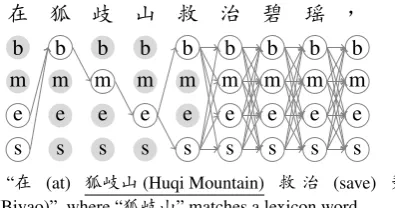
We investigate two major sources of freely-available annotations: lexicons and natural anno-tation, both with the help of unannotated data. To make use of the first source of informa-tion, we incorporate words from a lexicon into unannotated sentences by matching of character sequences, resulting in partially annotated sen-tences, as shown in Figure 2a. In this example,
the word “狐 岐 山 (the Huqi Mountain)” in the
unannotated sentence matches an item in the lex-icon. As a result, we obtain a partially-annotated sentence, in which the segmentation ambiguity of
the characters “狐(fox)”, “岐 (brandy road)” and
“山 (mountain)” are resolved (“狐” being the
be-ginning, “岐” being the middle and “山” being the
end of the same word). At the same time, the seg-mentation ambiguity of the surrounding characters
“在 (at)” and “救 (save)” are reduced (“在”
be-ing either a sbe-ingle-character word or the end of
a multi-character word, and “救” being either a
single-character word or the beginning of a multi-character word).
.. 在
. 狐
. 歧
. 山
. 救
. 治
. 碧
. 瑶
. , . b . b . b . b . b . b . b . b . b . m . m . m . m . m . m . m . m . m . e . e . e . e . e . e . e . e . e . s . s . s . s . s . s . s . s . s
(a) “在 (at) 狐岐山(Huqi Mountain) 救 治 (save) 碧 瑶(Biyao)”, where “狐岐山” matches a lexicon word.
.. 如
. 乳
. 铁
. 蛋
. 白
. 、
. 溶
. 菌
. 酶
. b . b . b . b . b . b . b . b . b . m . m . m . m . m . m . m . m . m . e . e . e . e . e . e . e . e . e . s . s . s . s . s . s . s . s . s
[image:2.595.321.519.67.171.2](b) “如(e.g.)乳铁蛋白(lysozyme)、 溶菌酶(lactoferrin)”, where “乳铁蛋白” is a hyperlink.
Figure 2: Examples of partially annotated data. The paths show possible correct segmentations.
Natural annotation, which refers to word boundaries that can be inferred from URLs, fonts or colors on web pages, also result in partially-annotated sentences. Taking a web page shown in Figure 2b for example. It can be inferred from
the URL tags on “乳铁蛋白” that “乳” should be
either the beginning of a multi-character word or
a single-character word, and “白” should be either
the end a multi-character word or single-character word. Similarly, possible tags of the surrounding
character “如” and “、” can also be inferred.
We turn both lexicons and natural annotation
into the same form of partial annotation with
same unresolved ambiguities, as shown in Figure
2, and use them together with availablefull
anno-tation (Figure 1) as the training data for the seg-mentor. In this section, we describe in detail how to obtain partially annotated sentences from each resource, respectively.
2.1 Lexicons
People’s Daily
看到(saw)海南(Hainan)旅游业(tourist industry)充满(full)希望(hope)
saw tourist industry in Hainan is full of hope
Wikipedia 主要mainly is tourist industry and software industry(mainly)是(is)旅游(tourist)业(industry)和(and)软件(software)产业(industry)
(a) Case of incompatible annotation on “旅游业(tourist industry)” between People’s Daily and Wikipedia.
Literature 《说文解字the segmented and annotated version of Shuo Wen Jie Zi(Shuo Wen Jie Zi, a book)段(segmented)注(annotated)》
Computer 每条each record is splitted into several fields(each)记录(record)被(is)分隔(splitted)为(into)字段(fields)
(b) Similar subsequence “字段(field)” is segmented differently under different domains in Wikipedia.
Table 1: Examples natural annotation from Wikipedia. Underline marks annotated words.
et al., 2005). But for obtaining the partial labeled data with lexicon, the matching method can still be a solution. Since we do not aim to recognize every word from sentence, we can select a lexicon with smaller coverage but less ambiguity to achieve rel-atively precise matching result.
In this paper, we apply two matching schemes to the same raw sentences to obtain partially an-notated sentences. The first is a simple forward-maximum matching (FMM) scheme, which is very close to the forward maximum matching al-gorithm of Wu and Tseng (1993) for Chinese word segmentation. This scheme scans the input sen-tence from left to right. At each position, it at-tempts to find the longest subsequence of Chi-nese characters that matches a lexicon entry. If such an entry is found, the subsequence is tagged with the corresponding tags, and its surrounding characters are also constrained to a smaller set of tags. If no subsequence is found in the lexicon, the character is left with all the possible tags. Taking the sentence in Figure 2a for example. When the
algorithm scans the second character, “狐”, and
finds the entry “狐岐山” in the lexicon, the
sub-sequence of characters is recognized as a word,
and tagged with b, mand e, respectively. At the
same time, the previous character “在” can be
in-ferred as only end of a multi-character word (e) or
a single-character word (s). The second matching
scheme is backward maximum matching, which can be treated as the application of FMM on the reverse of unlabeled sentences using a lexicon of reversed words.
To mitigate the errors resulting from one single matching scheme, we combine the two matching results by agreement. The basic idea is that if a subsequence of sentence is recognized as word by
multiple matching results, it can be considered as a more precise annotation. Our algorithm reads par-tial segmentation by different methods and selects the subsequences that are identified as word by all methods as annotated words.
2.2 Natural Annotation
We use the Chinese Wikipedia for natural anno-tation. Partially annotated sentences are readily formed in Wikipedia by markup syntax, such as URLs. However, some subtle issues exist if the sentences are used directly. One problem is in-compatibility of segmentation standards between the annotated training data and Wikipedia. Jiang et al. (2009) discuss this incompatibility problem between two corpora — the CTB and the Peo-ple’s Daily; the problem is even more severe on Wikipedia because it can be edited by any user. Table 1a shows a case of incompatible annota-tion between the People’s Daily data and natural annotation in Wikipedia, where the three
charac-ters “旅游业” are segmented differently. Both can
be treated as correct, although they have different segmentation granularities.
Another problem is the intrinsic ambiguity of segmentation. The same character sequence can be segmented into different words under differ-ent contexts. If the training and test data contain different contexts, the learned model can give in-correct results on the test data. This is particu-larly true across different domains. Table 1b gives such an example, where the character sequence
“字段” is segmented differently in two of our test
achieve better performance of domain adaptation using Wikipedia, one intuitive approach is to se-lect more domain-related data and less irrelevant data to minimize the risks that result from incom-patible annotation and domain difference.
To this end, we assume that there are some raw sentences on the target domain, which can be used to evaluate the relevance between Wikipedia and target domain test data. We assume that URL-tagged entries reflect the segmentation standards of Wikipedia sentence, and use them to match Wikipedia sentences with the raw target domain data. If the character sequence of any URL-tagged entry in a Wikipedia sentence matches the target domain data, the Wikipedia sentence is selected for training. Another advantage of such data se-lection is that the training time consumption can be reduced by reducing the size of training data.
3 CRF for Word Segmentation
We follow the work of Zhao et al. (2010) and Sun and Xu (2011), and adopt the Conditional Random Fields (CRF) model (Lafferty et al., 2001) for the sequence labeling problem of word segmentation. Given an input characters sequence, the task is to
assign one segmentation label from{b, m, e, s}on
each character. Let x = (x1, x2, ..., xT) be the
sequence of characters in sentence whose length isT, andy = (y1, y2, ..., yT) be the
correspond-ing label sequence, where yi ∈ Y. The
linear-chain conditional random field for Chinese word segmentation can be formalized as
p(y|x) = 1 Zexp
T ∑
t=1
∑
k
λkfk(yt, yt−1,x) (1)
whereλkare the model parameters,fkare the
fea-ture functions andZis the probability normalizer.
Z =∑
y
exp∑T
t=1
∑
k
λkfk(yt, yt−1,x) (2)
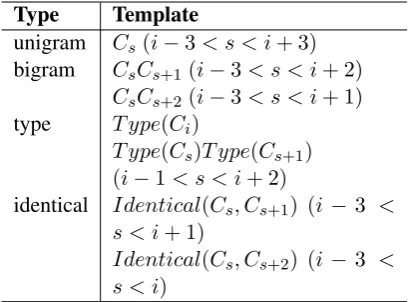
We follow Sun and Xu (2011) and use the fea-ture templates shown in Table 2 to model the
seg-mented task. Forith character in the sentence, the
n-gram features represent the surrounding
charac-ters of this character;T ypecategorizes the
charac-ter it intodigit,punctuation,englishandother;
Identicalindicates whether the input character is the same with its surrounding characters. This
feature captures repetition patterns such as “试
试(try)” or “走走(stroll)”.
Type Template
unigram Cs(i−3< s < i+ 3)
bigram CsCs+1(i−3< s < i+ 2)
CsCs+2(i−3< s < i+ 1) type T ype(Ci)
T ype(Cs)T ype(Cs+1)
(i−1< s < i+ 2)
identical Identical(Cs, Cs+1) (i− 3 <
s < i+ 1)
Identical(Cs, Cs+2) (i− 3 <
[image:4.595.314.520.62.213.2]s < i)
Table 2: Feature templates for theith character.
For fully-annotated training data, the learning problem of conditional random fields is to maxi-mize the log likelihood over all the training data (Lafferty et al., 2001)
L=∑N
n=1
logp(y(n)|x(n))
HereN is the number of training sentences. Both
the likelihoodp(y(n)|x(n))and its gradient can be calculated by performing the forward-backward algorithm (Baum and Petrie, 1966) on the se-quence, and several optimization algorithm can be adopted to learn parameters from data, including L-BFGS (Liu and Nocedal, 1989) and SGD (Bot-tou, 1991).
4 Training a CRF with partially annotated data
For word segmentation with partially annotated data, some characters in a sentence can have a definite segmentation label, while some can have multiple labels with ambiguities
remain-ing. Taking the partially annotated sentence
in Figure 2a for example, the corresponding
potential label sequence for “在狐岐山救” is
{(e, s),(b),(m),(e),(b, s)}, where the characters
“狐”, “岐” and “山” have fixed labels but for “在”
and “救”, some ambiguities exist. Note that the
full annotation in Figure 1 can be regarded as a special case of partial annotation, where the num-ber of potential labels for each character is one.
We follow Tsuboi et al. (2008) and model marginal probabilities over partially annotated data. Define the possible labels that correspond to the partial annotation asL = (L1, L2, ..., LT),
where eachLiis a non-empty subset ofY that
YLbe the set of all possible label sequences where
∀y ∈ YL, yi ∈ Li. The marginal probability of
YLcan be modeled as
p(YL|x) = 1Z ∑
y∈YL
exp T
∑
t=1 ∑
k
λkfk(yt, yt−1,x) (3)
Defining the unnormalized marginal probability as
ZYL =
∑
y∈YL
exp∑T
t=1
∑
k
λkfk(yt, yt−1,x),
and the normalizerZ being the same as Equation
2, the log marginal probability ofYLoverN
par-tially annotated training examples can be formal-ized as
LYL =
N ∑
n=1
logp(YL|x) =
N ∑
n=1
(logZYL−logZ)
The gradient of the likelihood can be written as
∂LYL
∂λk = N
∑
n=1
T
∑
t=1 ∑
yYL∈Lt,
y′ YL∈Lt−1
fk(yYL, yY′L,x)pYL(yYL, yY′ L|x)
− N
∑
n=1
T
∑
t=1 ∑
y,y′
fk(y, y′,x)p(y, y′|x)
BothZYL and its gradient are similar in form to
Z. By introducing a modification to the
forward-backward algorithm,ZYL andLYL can be
calcu-lated. Define theforward variablefor partially
an-notated dataαYL,t(j) =pYL(x⟨1,...,t⟩, yt=j). A modification on the forward algorithm can be for-malized as
αYL,t(j) =
{ 0 j /∈L
t
∑
i∈Lt−1Ψt(j, i, xt)αYL,t−1(i) j∈Lt
whereΨt(j, i, x)is a potential function that equals
∑
kλkfk(yt =j, yt−1 =i, xt). Similarly, for the
backward variableβYL,t,
βYL,t(i) =
{
0 i /∈Lt
∑
j∈Lt+1Ψt(j, i, xt+1)βYL,t+1(j) i∈Lt
ZYL can be calculated by αYL(T),
and pYL(y, y′|x) can be calculated by
αYL,t−1(y′)Ψt(y, y′, xt)βYL,t(y).
Note that if each element inYLis constrained
to one single label, the CRF model in Equation 3
degrades into Equation 1. So we can train a unified model with both fully and partially annotated data. We implement this CRF model based on a open
source toolkit CRFSuite.1 In our experiments, we
use the L-BFGS (Liu and Nocedal, 1989) algo-rithm to learn parameters from both fully and par-tially annotated data.
5 Experiments
We perform our experiments on the domain adap-tation test data from SIGHAN Bakeoff 2010 (Zhao et al., 2010), adapting annotated training sentences from People’s Daily (PD) (Yu et al., 2001) to different test domains. The fully annotated data is selected from the People’s Daily newspaper in January of 1998, and the four test domains from the SIGHAN Bakeoff 2010 include finance, medicine, literature and computer. Sample seg-mented data in the computer domain from this bakeoff is used as development set. Statistics of the data are shown in first half of Table 3. We
use wikidump201404192 for the Wikipedia data.
All the traditional Chinese pages in Wikipedia are converted to simplified Chinese. After filtering
functional pages likeredirectionand removing
du-plication, 5.45 million sentences are reserved. For comparison with related work on using a lexicon to improve segmentation, another set of test data is chosen for this setting. We use the Chi-nese Treebank (CTB) as the source domain data, and Zhuxian (a free Internet novel, also named as “Jade dynasty”, referred to as ZX henceforth) as
the target domain data.3 The ZX data are written
in a different style from newswire, and contains many out-of-vocabulary words. This setting has been used by Liu and Zhang (2012) and Zhang et al. (2014) for domain adaptation of segmentation and POS-tagging. We use the standard training, development and test split. Statistics of the test data annotated by Zhang et al. (2014) are shown in the second half of Table 3.
The data preparation method in Section 2 and the CRF method in Section 4 are used for all the experiments. Both recall of out-of-vocabulary
words (Roov) and F-score are used to evaluate the
1http://www.chokkan.org/software/
crfsuite/
2http://dumps.wikimedia.org/zhwiki/
20140419/
3Annotated target domain test data and lexicon are avail-able fromhttp://ir.hit.edu.cn/˜mszhang/
PD
→
SIGHAN
Data set Train Development Test
PD Computer Finance Medicine Literature Computer
# sent. 19,056 1,000 560 1,308 670 1,329
# words 1,109,734 21,398 33,035 31,499 35,735 35,319
OOV 0.1766 0.0874 0.1102 0.0619 0.1522
CTB5
→
ZX Data set Train Development Test Unlabeled
W
ikipedia
Unlabeled
CTB5 ZX
# sent. 18,086 788 1,394 32,023 5,456,151
# words 493,934 20,393 34,355
[image:6.595.93.507.61.203.2]OOV 0.1377 0.1550
Table 3: Statistics of data used in this paper.
segmentation performance. There is a mixture of Chinese characters, English words and numeric expression in the test data from SIGHAN Bakeoff 2010. To test the influence of Wikipedia data on Chinese word segmentation alone, we apply reg-ular expressions to detect English words and
nu-meric expressions, so that they are marked asnot
segmented. After performing this preprocessing step, cleaned test input data are fed to the CRF model to give a relatively strong baseline.
5.1 Free Lexicons 5.1.1 Obtaining lexicons
For domain adaption from CTB to ZX, we use a lexicon released by Zhang et al. (2014). The
lexicon is crawled from a online encyclopedia4,
and contains the names of 159 characters and ar-tifacts in the Zhuxian novel. We follow Zhang et
al. (2014) and name itNRfor convenience of
fur-ther discussion. The NR lexicon can be treated as a strongly domain-related, high quality but rel-atively small lexicon. It’s a typical example of freely available lexicon over the Internet.
For domain adaptation from PD to medicine and computer, we collect a list of page titles under the corresponding categories in Wikipedia. For
medicine, entries under essential medicines,
bi-ological system and diseases are collected. For
computer, entries under computer network,
Mi-crosoft Windows and software widgets are se-lected. These lexicons are typical freely available lexicons that we can access to.
5.1.2 Obtaining Unlabeled Sentences
For ZX, partially annotated sentences are obtained
using theNRlexicon and unlabeled ZX sentences
by applying the matching scheme described in
4http://baike.baidu.com/view/18277.htm
90.1 90.2 90.3 90.4
1 2 4 8 16 32
# of sentences * 1000
F score on de
v
elopment
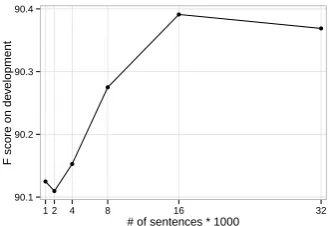
Figure 3: F-score on the development data when using different numbers of unlabeled data.
Section 2. The CTB5 training data and the par-tially annotated data are mixed as the final train-ing data. Different amounts of unlabeled data are applied to the development test set, and results are shown in Figure 3. From this figure we can see that incorporating 16K sentences gives the high-est accuracy, and adding more partial labeled data does not change the accuracy significantly. So for the ZX experiments, we choose the 16K sentences as the unlabeled data.
For the medicine and computer experiments, we selected domain-specific sentences by matching with the domain-specific lexicons. About 46K out of the 5.45 million wiki sentences contain subse-quences in the medicine lexicon and 22K in the case of the computer domain. We randomly se-lect 16K sentences as the unlabeled data for each domain, respectively.
5.1.3 Final results
[image:6.595.333.498.241.354.2]Domain ZX Medicine Computer
F Roov F Roov F Roov
Baseline 87.50 73.65 91.36 72.95 93.16 84.02
Baseline+Lexicon Feature 90.36 80.69 91.60 74.39 93.14 84.27
Baseline+PA (Lex) 90.63 84.88 91.68 74.99 93.47 85.63
Zhang et al. (2014) 88.34 - - - -
-Table 4: Final result for adapting CTB to Zhuxian and adapting PD to the medicine and computer
domains, using partially annotated data (referred to asPA) obtained from unlabeled data and lexicons.
trained our baseline model on the PD training data with the same feature template setting.
Previous research makes use of a lexicon by adding lexicon features directly into a model (Sun and Xu, 2011; Zhang et al., 2014), rather than transforming them into partially annotated sen-tences. To make a comparison, we follow Sun and Xu (2011) and add three lexicon features to
repre-sent whetherciis located at the beginning, middle
or the end of a word in the lexicon, respectively. For each test domain, the lexicon for the lexi-con feature model lexi-consists of the most frequent words in the source domain training data (about 6.7K for CTB5 and 8K for PD, respectively) and the domain-specific lexicon we obtained in Sec-tion 5.1.1.
The results are shown in Table 4, where the first row shows the performance of the baseline mod-els and the second row shows the performance of the model incorporating lexicon feature. The third row shows our method using partial anno-tation. On the ZX test set, our method outforms the baseline by more than 3 absolute per-centage. The model with partially annotated data performs better than the one with additional lexi-con features. Similar lexi-conclusion is obtained when adapting from PD to medicine and computer. By incorporating the partially annotated data, the seg-mentation of lexicon words, along with the con-text, is learned.
We also compare our method with the work of Zhang et al. (2014), who reported results only on the ZX test data. We use the same lexicon settings. Our method gives better result than Zhang et al. (2014), showing that the combination of a lexicon and unannotated sentence into partially annotated data can lead to better performance than using a dictionary alone in type-supervision. Given that we only explore the use of free resource,
combin-ing a lexicon withunannotatedsentences is a
bet-ter option than using the lexicon directly. Zhang et al.’s concern, on the other hand, is to compare
Method Com. DevF Roov
Baseline 93.56 83.75
Baseline+PA (Random 160K) 94.29 86.58
[image:7.595.124.478.62.147.2]Baseline+PA (Selected) 95.00 88.28
Table 5: The performance of data selection on the development set of the computer domain.
type- and token-annotation. Our partial annota-tion can thus be treated as a compromise to obtain some pseudo partial token-annotations when full
token annotations are unavailable. Another thing to note is that the model of Zhang et al. (2014) is a joint model for segmentation and POS-tagging, which is generally considered stronger than a sin-gle segmentation model.
5.2 Free Natural Annotation
When extracting word boundaries from Wikipedia sentences, we ignore natural annotations on En-glish words and digits because these words are rec-ognized by the preprocessor. Following Jiang et al. (2013), we also recognize a naturally annotated two-character subsequence as a word.
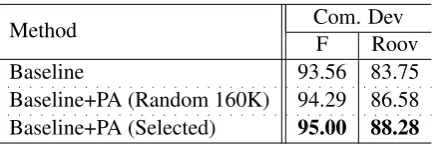
5.2.1 Effect of data selection
[image:7.595.309.527.193.266.2]Method FFinanceRoov FMedicineRoov LiteratureF Roov ComputerF Roov Avg-F
Baseline 95.20 86.90 91.36 72.90 92.27 73.61 93.16 83.48 93.00
Baseline+PA
(Ran-dom 160K) 95.16 87.60 92.41 78.13 92.17 75.30 93.91 83.48 93.41
Baseline+PA
(Selected) 95.54 88.53+0.34 +1.1192.47 78.28 92.49+0.22 76.84 93.93 87.53 93.61+0.77
[image:8.595.82.518.62.174.2]Jiang et al. (2013) 93.16 93.34 93.53 91.19 92.80
Table 6: Experimental results on the SIGHAN Bakeoff 2010 data.
the domain adaption accuracy.
5.2.2 Final Result
The final results on the four test domains are shown in Table 6. From this table, we can see that significant improvements are achieved with the help of the partially annotated Wikipedia data, when compared to the baseline. The models trained with selected partial annotation perform better than those trained with random partial an-notation. Our F-scores are competitive to those re-ported by Jiang et al. (2013). However, since their model is trained on a different source domain, the results are not directly comparable.
5.2.3 Analysis
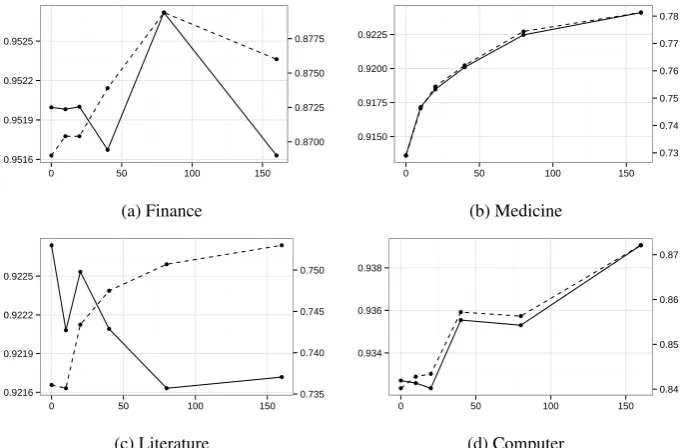
In this section, we study the effect of Wikipedia on domain adaptation when no data selection is per-formed, in order to analyze the effect of partially annotated data. We randomly sample 10K, 20K, 40K, 80K and 160K sentences from the 5.45 mil-lion Wikipedia sentences, and incorporate them into the training process, respectively. Five models are obtained adding the baseline, and we test their performances on the four test domains. Figure 4 shows the results.
From the figure we can see that for the medicine and computer domains, where the OOV rate is rel-atively high, the F-score generally increases when more data from Wikipedia are used. The trends of F-score and OOV recall against the volume of Wikipedia data are almost identical. However, for the finance and literature domains, which have low OOV rates, such a relation between data size and accuracy is not witnessed. For the literature do-main, even an opposite trends is shown.
We can draw the following conclusions: (1) Natural annotation on Wikipedia data contributes to the recognition of OOV words on domain adap-tation; (2) target domains with more OOV words benefit more from Wikipedia data. (3) along with
Method Med. Com.F F
Baseline 91.36 93.16
Baseline+PA (Lex) 91.68 93.47
Baseline+PA (Natural) 92.47 93.93
Baseline+PA (Lex+Natural) 92.63 94.07
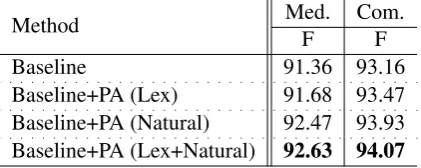
Table 7: Results by combining different sources of free annotation.
the positive effect on OOV recognition, Wikipedia data can also introduce noise, and hence data se-lection can be useful.
5.3 Combining Lexicon and Natural Annotation
To make the most use of free annotation, we com-bine available free lexicon and natural annotation resources by joining the partially annotated sen-tences derived using each resource, training our CRF model with these partially annotated sen-tences and the fully annotated PD sensen-tences. The tests are performed on medicine and computer do-mains. Table 7 shows the results, where further improvements are made on both domains when the two types of resources are combined.
6 Related Work
[image:8.595.312.523.209.293.2]0.9516 0.9519 0.9522 0.9525
0 50 100 150
0.8700 0.8725 0.8750 0.8775
(a) Finance
0.9150 0.9175 0.9200 0.9225
0 50 100 150
0.73 0.74 0.75 0.76 0.77 0.78
(b) Medicine
0.9216 0.9219 0.9222 0.9225
0 50 100 150
0.735 0.740 0.745 0.750
(c) Literature
0.934 0.936 0.938
0 50 100 150
0.84 0.85 0.86 0.87
[image:9.595.128.469.67.291.2](d) Computer
Figure 4: Performance of the model incorporating difference sizes of Wikipedia data. The solid line represents the F-score and dashed line represents the recall of OOV words.
study domain adaptation using an unsupervised self-training method. In contrast to their work, we make use of not only unlabeled data, but also leverage any free annotation to achieve better re-sults for domain adaptation.
There has also been work on making use of a dictionary and natural annotation for segmenta-tion. Zhang et al. (2014) study type-supervised do-main adaptation for Chinese segmentation. They categorize domain difference into two types: dif-ferent vocabulary and difdif-ferent POS distributions. While the first type of difference can be effec-tively resolved by using lexicon for each domain, the second type of difference needs to be resolved by using annotated sentences. They found that given the same manual annotation time, a com-bination of the lexicon and sentence is the most effective. Jiang et al. (2013) use 160K Wikipedia sentences to improves segmentation accuracies on several domains. Both Zhang et al. (2014) and Jiang et al. (2013) work on discriminative mod-els using the structure perceptron (Collins, 2002), although they study two different sources of infor-mation. In contrast to their work, we unify both types of information under the CRF framework.
CRF has been used for Chinese word segmenta-tion (Tseng, 2005; Shi and Wang, 2007; Zhao and Kit, 2008; Wang et al., 2011). However, most pre-vious work train a CRF by using full annotation only. In contrast, we study CRF based segmenta-tion by using both full and partial annotasegmenta-tion.
Several other variants of CRF model has been proposed in the machine learning literature, such as the generalized expectation method (Mann and McCallum, 2008), which introduce knowledge by incorporating a manually annotated feature dis-tribution into the regularizer, and the JESS-CM (Suzuki and Isozaki, 2008), which use a EM-like method to iteratively optimize the parameter on both the annotated data and unlabeled data. In contrast, we directly incorporate the likelihood of partial annotation into the objective function. The work that is the most similar to ours is Tsuboi et al. (2008), who modify the CRF learning objec-tive for partial data. They focus on Japanese lexi-cal analysis using manually collected partial data, while we investigate the effect of partial annota-tion from freely available sources for Chinese seg-mentation.
7 Conclusion
Acknowledgments
We thank the anonymous reviewers for their con-structive comments. This work was supported by the National Key Basic Research Program of China via grant 2014CB340503 and the National Natural Science Foundation of China (NSFC) via grant 61133012 and 61370164, the Singapore Ministry of Education (MOE) AcRF Tier 2 grant T2MOE201301 and SRG ISTD 2012 038 from Singapore University of Technology and Design.
References
Leonard E Baum and Ted Petrie. 1966. Statistical inference for probabilistic functions of finite state
markov chains. The annals of mathematical
statis-tics, pages 1554–1563.
L´eon Bottou. 1991. Stochastic gradient learning in
neural networks. In Proceedings of Neuro-Nˆımes
91, Nimes, France. EC2.
Michael Collins. 2002. Discriminative training meth-ods for hidden markov models: Theory and
experi-ments with perceptron algorithms. InProceedings
of the 2002 Conference on Empirical Methods in Natural Language Processing, pages 1–8. Associ-ation for ComputAssoci-ational Linguistics, July.
Jianfeng Gao, Mu Li, Andi Wu, and Chang-Ning Huang. 2005. Chinese word segmentation and named entity recognition: A pragmatic approach.
Comput. Linguist., 31(4):531–574, December.
Dan Garrette and Jason Baldridge. 2012. Type-supervised hidden markov models for part-of-speech
tagging with incomplete tag dictionaries. In
Pro-ceedings of the 2012 Joint Conference on Empirical Methods in Natural Language Processing and Com-putational Natural Language Learning, pages 821– 831, Jeju Island, Korea, July. Association for Com-putational Linguistics.
Wenbin Jiang, Liang Huang, and Qun Liu. 2009. Au-tomatic adaptation of annotation standards: Chinese word segmentation and pos tagging – a case study. In Proceedings of the Joint Conference of the 47th Annual Meeting of the ACL and the 4th International Joint Conference on Natural Language Processing of the AFNLP, pages 522–530, Suntec, Singapore, August. Association for Computational Linguistics.
Wenbin Jiang, Meng Sun, Yajuan L¨u, Yating Yang, and Qun Liu. 2013. Discriminative learning with natu-ral annotations: Word segmentation as a case study. InProceedings of the 51st Annual Meeting of the As-sociation for Computational Linguistics (Volume 1: Long Papers), pages 761–769, Sofia, Bulgaria, Au-gust. Association for Computational Linguistics.
John D. Lafferty, Andrew McCallum, and Fernando C. N. Pereira. 2001. Conditional random fields: Probabilistic models for segmenting and labeling se-quence data. InProceedings of the Eighteenth Inter-national Conference on Machine Learning, ICML ’01, pages 282–289, San Francisco, CA, USA. Mor-gan Kaufmann Publishers Inc.
Zhongguo Li and Maosong Sun. 2009. Punctuation as implicit annotations for chinese word segmentation.
Comput. Linguist., 35(4):505–512, December. D. C. Liu and J. Nocedal. 1989. On the limited
mem-ory bfgs method for large scale optimization. Math. Program., 45(3):503–528, December.
Yang Liu and Yue Zhang. 2012. Unsupervised domain adaptation for joint segmentation and POS-tagging. In Proceedings of COLING 2012: Posters, pages 745–754, Mumbai, India, December. The COLING 2012 Organizing Committee.
Gideon S. Mann and Andrew McCallum. 2008.
Generalized expectation criteria for semi-supervised
learning of conditional random fields. In
Proceed-ings of ACL-08: HLT, pages 870–878, Columbus, Ohio, June. Association for Computational Linguis-tics.
Yanxin Shi and Mengqiu Wang. 2007. A dual-layer crfs based joint decoding method for cascaded seg-mentation and labeling tasks. InProceedings of the 20th International Joint Conference on Artifical In-telligence, IJCAI’07, pages 1707–1712, San Fran-cisco, CA, USA. Morgan Kaufmann Publishers Inc. Yan Song, Prescott Klassen, Fei Xia, and Chunyu Kit. 2012. Entropy-based training data selection for
do-main adaptation. InProceedings of COLING 2012:
Posters, pages 1191–1200, Mumbai, India, Decem-ber. The COLING 2012 Organizing Committee. Weiwei Sun and Jia Xu. 2011. Enhancing chinese
word segmentation using unlabeled data. In
Pro-ceedings of the 2011 Conference on Empirical Meth-ods in Natural Language Processing, pages 970– 979, Edinburgh, Scotland, UK., July. Association for Computational Linguistics.
Jun Suzuki and Hideki Isozaki. 2008. Semi-supervised sequential labeling and segmentation using
giga-word scale unlabeled data. InProceedings of
ACL-08: HLT, pages 665–673, Columbus, Ohio, June. Association for Computational Linguistics.
Huihsin Tseng. 2005. A conditional random field word
segmenter. InIn Fourth SIGHAN Workshop on
Chi-nese Language Processing.
Yiou Wang, Jun’ichi Kazama, Yoshimasa Tsuruoka, Wenliang Chen, Yujie Zhang, and Kentaro Tori-sawa. 2011. Improving chinese word segmentation and pos tagging with semi-supervised methods using large auto-analyzed data. InProceedings of 5th In-ternational Joint Conference on Natural Language Processing, pages 309–317, Chiang Mai, Thailand, November. Asian Federation of Natural Language Processing.
Pak-kwong Wong and Chorkin Chan. 1996. Chinese word segmentation based on maximum matching
and word binding force. InProceedings of the 16th
Conference on Computational Linguistics - Volume
1, COLING ’96, pages 200–203, Stroudsburg, PA,
USA. Association for Computational Linguistics. Zimin Wu and Gwyneth Tseng. 1993. Chinese text
segmentation for text retrieval: Achievements and problems. J. Am. Soc. Inf. Sci., 44(9):532–542, Oc-tober.
Nianwen Xue and Libin Shen. 2003. Chinese word
segmentation as lmr tagging. InProceedings of the
Second SIGHAN Workshop on Chinese Language Processing - Volume 17, SIGHAN ’03, pages 176– 179, Stroudsburg, PA, USA. Association for Com-putational Linguistics.
Shiwen Yu, Jianming Lu, Xuefeng Zhu, Huiming Duan, Shiyong Kang, Honglin Sun, Hui Wang, Qiang Zhao, and Weidong Zhan. 2001. Processing norms of modern chinese corpus. Technical report. Yue Zhang and Stephen Clark. 2007. Chinese
segmen-tation with a word-based perceptron algorithm. In
Proceedings of the 45th Annual Meeting of the As-sociation of Computational Linguistics, pages 840– 847, Prague, Czech Republic, June. Association for Computational Linguistics.
Meishan Zhang, Yue Zhang, Wanxiang Che, and Ting Liu. 2014. Type-supervised domain adaptation for
joint segmentation and pos-tagging. In
Proceed-ings of the 14th Conference of the European Chap-ter of the Association for Computational Linguistics, pages 588–597, Gothenburg, Sweden, April. Asso-ciation for Computational Linguistics.
Hai Zhao and Chunyu Kit. 2008. An empirical com-parison of goodness measures for unsupervised chi-nese word segmentation with a unified framework. InIn: The Third International Joint Conference on Natural Language Processing (IJCNLP-2008. Hai Zhao, Chang-Ning Huang, Mu Li, and Bao-Liang