Proceedings of the 2nd Workshop on Multilingual Surface Realisation (MSR 2019), pages 75–80 75
Improving Language Generation from Feature-Rich Tree-Structured
Data with Relational Graph Convolutional Encoders
*†Xudong Hong,†Ernie Chang,†Vera Demberg
*Dept. of Computer Vision and Machine Learning, MPI Informatics †Dept. of Language Science and Technology, Saarland University
{xhong,cychang,vera}@coli.uni-saarland.de
Abstract
The Multilingual Surface Realization Shared Task 2019 focuses on generating sentences from lemmatized sets of universal dependency parses with rich features. This paper describes the system design and the results of our par-ticipation in the deep track. The core inno-vation in our approach is to use a graph con-volutional network to encode the dependency trees given as input. Upon adding morpho-logical features, our system achieves the sec-ond rank in the deep track without using data augmentation techniques or additional compo-nents (such as a re-ranker).
1 Introduction
The goal in the Multilingual Surface Realization Shared Task 2019 (MSR’19) is to generate flu-ent text from Universal Dependencies (UD) struc-tures. The task makes available UD-annotated resources in 11 languages for the shallow task, and three languages (English, Spanish, French) for the deep track. Developing surface genera-tion systems that are largely language-independent is a central objective of the shared task (Mille et al.,2018). To generate sentences based on the UD structure and morphological features, recent neural approaches mainly adopt neural sequence-to-sequence architectures (Cabezudo and Pardo,
2018;Madsack et al., 2018; Elder and Hokamp,
2018). While representing the feature-rich data in a linearized manner proved to be a viable option, we argue that these linear sequences do not opti-mally exploit the input information. We therefore propose to encode the dependency trees using a graph convolutional network (GCN) and find that this GCN encoder leads to a substantial boost in performance, compared to a sequential encoder.
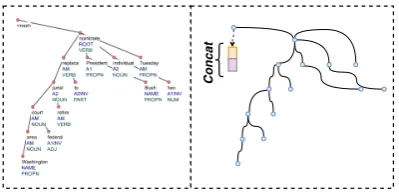
The datasets in the deep track consist of seman-tic representations induced from syntacseman-tic depen-dency parses, see Figure1 for an example. This
[image:1.595.317.517.220.316.2]Concat
Figure 1: An example of a UD structure with concate-nated feature embeddings from the MSR’19 deep task.
task is reflects the information that’s realistically available in real-world natural language genera-tion task.
Our method works as follows: We first apply delexicalization to the datasets, replacing rare to-kens with placeholders. Next, encode the de-pendency trees using graph representation learn-ing techniques (Li et al.,2015;Xu et al.,2018a), in order to improve the encoding of structured data within the encoder-decoder architecture. Our model hence learns a mapping between graph in-puts and sequence outin-puts. Our ablation study in the evaluation demonstrates that encoding UD structure in this manner does embed additional se-mantic information and subsequently improves the performance across the three languages available for the deep track (i.e. English, French, and Span-ish). Finally, we use an LSTM decoder with copy mechanism and attention to generate surface text.
Our contributions are as follows:
1. We show that a GCN encoder for UD input structures outperforms sequential encoders.
2. We propose to use a variant of relational GCN (R-GCN) to better represent edge labels in the graph, and show that this boosts overall performance.
2 Related Work
2.1 Neural NLG
Systems proposed as part of the Surface Realiza-tion Shared Task 2018 are largely sequence-to-sequence models targeting the Shallow Task. Most systems in the past contain two separate compo-nents: 1) preprocessing of the UD dataset, and the 2) neural generator with the encoder-decoder ar-chitecture.
Most neural generators combine features by concatenating the aligned feature sequences and feed them as a single sequence into the neural gen-erator (Elder and Hokamp,2018;Madsack et al.,
2018). In these systems, a pre-trained embed-ding is typically used to represent each lemmas, before concatenated with embeddings of surface-level morphological categories and dependency relations. A form of Recurrent Neural Network (RNN) are utilized to map the input to a latent space, and another RNN then decodes into target output. Examples of common RNN usage include Long Short-Term memory (LSTM) or the Bi-directional LSTM as used in Elder and Hokamp
(2018);Madsack et al.(2018).
2.2 Graph-to-text Generation
Considering the fact that a dependency tree is a special case of a directed acyclic graph, surface re-alization is a graph-to-text generation tasks. Graph neural networks have been successfully applied to different graph to text generation task like SQL to text generation (Xu et al., 2018b), AMR-to-text generation (Beck et al., 2018) and semantic ma-chine translation (Song et al.,2019). LSTM can be modified to model graph-level information (Song et al., 2018). Graph Convolutional Networks (GCN), originally designed for semi-supervised learning of node representations in graphs (Kipf and Welling, 2017), explicitly exploit tree struc-ture data and outperform LSTM and TreeLSTM on AMR-to-text generation (Damonte and Cohen,
2019). To also model different types of edges in graphs, Relational Graph Convolutional Networks (R-GCN) represent each type of edge with a cor-responding parameter matrix (Schlichtkrull et al.,
2018). We leverage the R-GCN by grouping in-edge and out-in-edge together and apply to a graph-to-text generation task.
3 Our Approach
3.1 Feature Representations
The input format of the MSR’19 deep track is multi-source in the sense that each type of fea-ture corresponds to a sequence of feafea-tures, i.e., part-of-speech tags (POS), morphological features etc. As shown in Figure1, we transform the tree-structured data into a graph. We construct node representations by simply concatenating token and its features. Then we use an embedding matrix to map the representations into low-dimensional vec-tor space.
To handle rare words in input tokens, we firstly perform delexicalization for all datasets as fol-lows:
1. Replace tokens that have part-of-speech tags ofNAME, PROPN, NUM andX with place-holders jointly indexed by the number of head and the number of entities.
2. Build a dictionary from placeholders to orig-inal tokens for each input-output pair.
After obtaining the model output, we lexicalize the text by looking up each generated placeholder in the corresponding dictionary and insert the origi-nal token.
For our official submission to the shared task, we did not make use of features, in order to see whether the dependency tree is informative enough for surface realization. However, we per-formed additional experiments to show the effec-tiveness of GCN encoder with selected concate-nated features, see Table1.
3.2 Model
The graph-to-text generation task has a directed acyclic graph as input G = {V, E}, where V is a set of nodes andE is a set of directed edges e between nodes. In this paper, a node is an em-bedding vector containing a token and its features. An edge is the dependency relation between two nodes. The outputY is a sequence of tokens which form a sentence expressing the input. We ex-tend the architecture byMarcheggiani and Perez-Beltrachini(2018) which combines a graph con-volutional encoder and attentional LSTM decoder as described in Figure2.
R-GCN
...
LSTM
GCN Encoder
...
LSTM Decoder
=
=
= =
(A) (B)
[image:3.595.86.502.64.210.2]Add Dense Connection
Figure 2:(A): depicts the conceptual relationship between the GCN encoder and LSTM decoder.(B): Addition of a dense layer is analogous to adding extra connections between multiple layers of graphical representation.
graph-structure input explicitly. Given a directed graphG, we represent each node with an embed-ding vectorxv ∈Rd. Then thel-th R-GCN layer compute the hidden representation for node v in (l+ 1)-th layer as follows:
hlv+1 =f(Whlv+ X u∈N(v)
Wehlu) (1)
whereW,We ∈ Rd×h ande ∈ E. f is the lin-ear rectifier (ReLU), a non-linlin-ear activation func-tion. N(v) is the set of all neighbours of node v. This design is over-parameterized and there is no parameter sharing between similar edge labels. Therefore we redesign the update rule to:
hlv+1 =f(Whlv+ X u∈N(v)
Wdir(e)hlu◦re) (2)
where “◦” is the Hadamard production,Wr(u,v)∈
Rd×h, dir(e) ∈ {in, out}represents direction of the edgeeu,vandre∈Rhis an embedding vector of the label ofeu,v.
Each layer aggregates the direct neighbours of each node. To model neighbours of neighbours, we stackLGCN layers whereLis set to the aver-age radius of all graphs (here, averaver-age depth of all trees). Stacking GCN into deep neural networks could lead to gradient vanishing problem, thus we add residual connections (He et al.,2016) or dense connections (Huang et al.,2017) for each layer.
LSTM Decoder We apply stacked LSTM layers (Hochreiter and Schmidhuber, 1997) as the de-coder on top of the GCN. The first layer is an input-feed LSTM (Luong et al.,2015) that aggre-gates the hidden representations of nodes into one hidden vectorhC for the whole graph. The sec-ond LSTM layer decodes the hidden vector and
generates the representations of output token at each time step. We use global attention (Luong et al., 2015) to re-weight the hidden representa-tions from the first layer and merge them into a global hidden vectorhG. In order to generate the placeholder directly from the input, we apply the copying mechanism (Gu et al.,2016), which is ef-fective when using lexcalization. The probability of token yt conditioned on input Gand previous token y1:t−1 is obtained by applying a softmax
layer on the decoder output asP(yt|y1:t−1, G) =
sof tmax(g(hG,hC)), where g is a perceptron. The model is trained to maximize the likelihood functionL=Qt=1
|Y| P(yt|y1:t−1, G).
Encoder BLEU NIST DIST
GCN (*) 23.0 6.88 42
LSTM 28.8 8.13 44.48
BiLSTM 31.2 8.53 46.86
GCN 35.9 8.73 52.86
R-GCN (residual) 39.81 9.24 55.45
R-GCN (dense) 41.01 9.43 56.49
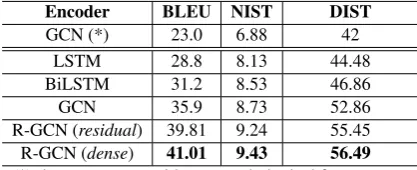
(*) denotes system without morphological features, which is also our official submission to the shared task.
Table 1: Ablation study: results of models on the MSR’19 validation set of UD English EWT (enewt-ud-dev) corpus. We compare different encoders while keeping decoder constant, i.e., LSTM decoder with copy mechanism and coverage attention. For beam search we maintain a constant use of blocking 3-gram.
3.3 Experiments
[image:3.595.311.520.464.549.2]Encoder Output
BiLSTM President Bush threw two members to replace manufacturers in the Washington area to replace manufacturers in federal nations.
GCN In Tuesday, President Bush commissioned two connections to
replace the federal individual of federal statements in the Washington area.
RGCN In Tuesday, President Bush nominated two individuals to replace jurist trials to the Washington area.
[image:4.595.102.498.60.199.2]Gold President Bush on Tuesday nominated two individuals to replace retiring jurist on federal courts in the Washington area.
Table 2: Comparison of outputs from systems with encoder variants given the graph in Figure1 as input. We highlighted obvious erroneous blocks of text for contrast. Note that the only variants are the encoders, all other configurations remain the same.
Dev Test
Corpus GCN (*) R-GCN (dense) GCN (*) R-GCN (dense)
en ewt-ud 23.0 41.01 23.35 18.37
en gum-ud 17.71 34.47 17.97 14.6
en lines-ud 18.32 12.7 20.96 14.89
en partut-ud 18.54 35.3 17.19 12.85
es ancora-ud 21.09 37.2 18.59 36.85
es gsd-ud 20.56 33.39 18.69 35.92
fr gsd-ud 20.48 35.12 15.83 10.65
fr partut-ud 19.16 33.57 14.06 6.07
fr sequoia-ud 21.07 34.49 18.52 10.22
en pud-ud - - 18.11 12.31
en ewt-Pred-HIT - - 22.42 39.05
en pud-Pred-LATTICE - - 17.3 35.85
es ancora-Pred-HIT - - 21.1 37.2
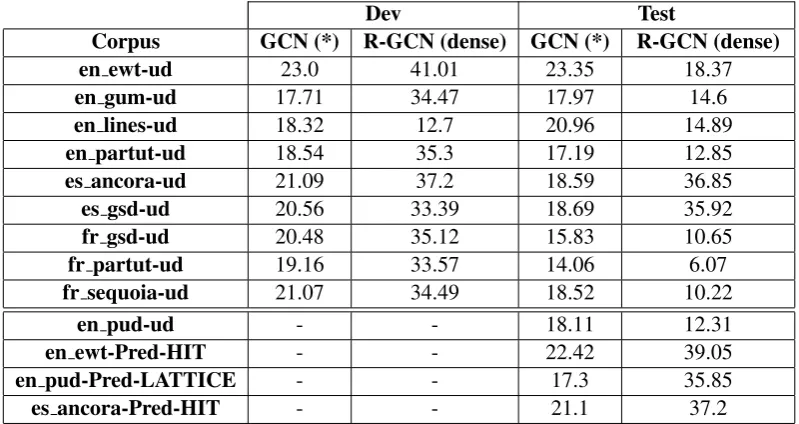
(*) denotes our submission to the shared task, which doesn’t use morphological features
Table 3: Evaluation of our submissions to MSR’19Deep Task across all corpora on both Test and Dev sets. Numbers are BLEU scores.
layers with dense connections as encoder and train the model with dropout rate of 0.5. We per-form early stopping when the training accuracy is higher than the validation accuracy and choose the checkpoint before over-fitting for evaluation.
4 Results and Analysis
4.1 Encoder Model Selection
As indicated in Table1, we compare R-GCN with different encoders. Systems are evaluated on the validation set of UD English EWT (enewt-ud-dev) corpus. With the same linearized inputs, we began with a LSTM encoder before moving on to bi-directional LSTM (BiLSTM). With 2.4 BLEU points improvement, BiLSTM appeared to be the option in terms of sequential encoder. Next,
we employed the variant of GCN by Marcheg-giani and Perez-Beltrachini(2018) with four fully-connected layers. We observed that this change gave an additional 4.7 BLEU points boost, which outperforms sequential encoders significantly. We then compare our R-GCN model to the GCN, which obtains additional 3.91 BLEU points. We further add dense conenctions to R-GCN, termed the dense, that eventually result in 41.01 BLEU points on the validation set. This was an overall 12 BLEU points improvement from the initial LSTM encoder.
4.2 Ablation Study: Decoder
[image:4.595.99.499.255.467.2]attention. The copy mechanism was shown to be beneficial in numerous similar tasks such as data-to-text generation (Li and Wan,2018). With the addition of copy mechanism while keeping the encoder unchanged, an average of 1 BLEU score improvement can be observed; reusing the global attention for copying mechanism gave the system another 5 BLEU point boost.
4.3 Discussion
Our analysis shows that structural encoding of the UD trees leads to substantial improvements in per-formance. It also shows that including morpholog-ical features is crucial to performance of the sur-face realizer — without these features, we observe many errors in tense and agreement.
We also analyzed the system outputs to look for evidence to substantiate the intuition that a structural encoder can better represent the a pri-ori linguistic information. One of such examples is shown in Table2, where we observe fluency im-provements going from BiLSTM encoder to GCN, and finally to R-GCN, where an overall improve-ment in fluency is conspicuous.
We report the results of our submissions in Table 3. Comparing to the validation results, GCN(*) trained without morphological features performs similarly across validation and test datasets of each corpus, howeverR-GCN(dense) has a significant drop from validation to test and experiences over-fitting. Importantly, we no-tice substantial BLEU rise and drop going from GCN(*) to R-GCN(dense) on the test datasets. We postulate that addition of relational modeling of edges (R-GCN) on top of rich features constrain the model to learn specific subset of a priori lin-guistic structures, thereby mitigating the overall performance.
5 Conclusion
We have shown that without additional modules such as re-ranker or data augmentation, the tra-ditional encoder-decoder architecture can still be competitive by exploiting the existing structural input information. For future work, we intend to see if the performance can be further improved with pre-trained language models such as GPT-2 (Radford et al.).
Acknowledgements
This research was funded in part by the Ger-man Research Foundation (DFG) as part of SFB 1102 “Information Density and Linguistic Encod-ing” and SFB 248 “Foundations of Perspicuous Software Systems”. Xudong Hong is supported by International Max Planck Research School for Computer Science (IMPRS-CS) of Max-Planck Institute for Informatics (MPI-INF). We sincerely thank the anonymous reviewers for their insightful comments that helped us to improve this paper.
References
Daniel Beck, Gholamreza Haffari, and Trevor Cohn. 2018. Graph-to-Sequence Learning using Gated Graph Neural Networks.
Marco Antonio Sobrevilla Cabezudo and Thiago Pardo. 2018. Nilc-swornemo at the surface realiza-tion shared task: Exploring syntax-based word or-dering using neural models. InProceedings of the First Workshop on Multilingual Surface Realisation, pages 58–64.
Marco Damonte and Shay B. Cohen. 2019. Struc-tural Neural Encoders for AMR-to-text Generation. pages 3649–3658.
Henry Elder and Chris Hokamp. 2018. Generating high-quality surface realizations using data augmen-tation and factored sequence models. In Proceed-ings of the First Workshop on Multilingual Surface Realisation, pages 49–53.
Jiatao Gu, Zhengdong Lu, Hang Li, and Victor OK Li. 2016. Incorporating copying mechanism in sequence-to-sequence learning. arXiv preprint arXiv:1603.06393.
Kaiming He, Xiangyu Zhang, Shaoqing Ren, and Jian Sun. 2016. Deep residual learning for image recog-nition. In Proceedings of the IEEE conference on computer vision and pattern recognition, pages 770– 778.
Sepp Hochreiter and J¨urgen Schmidhuber. 1997. Long short-term memory. Neural computation, 9(8):1735–1780.
Gao Huang, Zhuang Liu, Laurens Van Der Maaten, and Kilian Q Weinberger. 2017. Densely connected con-volutional networks. In Proceedings of the IEEE conference on computer vision and pattern recog-nition, pages 4700–4708.
Guillaume Klein, Yoon Kim, Yuntian Deng, Jean Senellart, and Alexander Rush. 2017. Opennmt: Open-source toolkit for neural machine translation. In Proceedings of ACL 2017, System Demonstra-tions, pages 67–72.
Liunian Li and Xiaojun Wan. 2018. Point precisely: Towards ensuring the precision of data in generated texts using delayed copy mechanism. In Proceed-ings of the 27th International Conference on Com-putational Linguistics, pages 1044–1055.
Yujia Li, Daniel Tarlow, Marc Brockschmidt, and Richard Zemel. 2015. Gated Graph Sequence Neu-ral Networks.
Minh-Thang Luong, Hieu Pham, and Christopher D Manning. 2015. Effective approaches to attention-based neural machine translation. arXiv preprint arXiv:1508.04025.
Andreas Madsack, Johanna Heininger, Nyamsuren Davaasambuu, Vitaliia Voronik, Michael K¨aufl, and Robert Weißgraeber. 2018. Ax semantics submis-sion to the surface realization shared task 2018. In Proceedings of the First Workshop on Multilingual Surface Realisation, pages 54–57.
Diego Marcheggiani and Laura Perez-Beltrachini. 2018. Deep graph convolutional encoders for structured data to text generation. arXiv preprint arXiv:1810.09995.
Simon Mille, Anja Belz, Bernd Bohnet, Yvette Gra-ham, Emily Pitler, and Leo Wanner. 2018. The first multilingual surface realisation shared task (sr18): Overview and evaluation results. InProceedings of the First Workshop on Multilingual Surface Realisa-tion, pages 1–12.
Alec Radford, Jeffrey Wu, Rewon Child, David Luan, Dario Amodei, and Ilya Sutskever. Language mod-els are unsupervised multitask learners.
Michael Schlichtkrull, Thomas N. Kipf, Peter Bloem, Rianne van den Berg, Ivan Titov, and Max Welling. 2018. Modeling Relational Data with Graph Con-volutional Networks. Lecture Notes in Computer Science (including subseries Lecture Notes in Arti-ficial Intelligence and Lecture Notes in Bioinformat-ics), 10843 LNCS(1):593–607.
Linfeng Song, Daniel Gildea, Yue Zhang, Zhiguo Wang, and Jinsong Su. 2019. Semantic neural ma-chine translation using amr. Transactions of the As-sociation for Computational Linguistics, 7:19–31.
Linfeng Song, Yue Zhang, Zhiguo Wang, and Daniel Gildea. 2018. A Graph-to-Sequence Model for AMR-to-Text Generation. pages 1616–1626.
Kun Xu, Lingfei Wu, Zhiguo Wang, Yansong Feng, Michael Witbrock, and Vadim Sheinin. 2018a.
Graph2Seq: Graph to Sequence Learning with Attention-based Neural Networks. pages 1–18.