Proceedings of the 2019 Conference on Empirical Methods in Natural Language Processing 5784
Entity, Relation, and Event Extraction
with Contextualized Span Representations
David Wadden† Ulme Wennberg† Yi Luan‡ Hannaneh Hajishirzi†∗ †Paul G. Allen School of Computer Science & Engineering, University of Washington
‡Google AI Language∗Allen Institute for Artificial Intelligence
{dwadden,ulme,hannaneh}@cs.washington.edu [email protected]
Abstract
We examine the capabilities of a unified, multi-task framework for three information extrac-tion tasks: named entity recognition, rela-tion extracrela-tion, and event extracrela-tion. Our framework (called DYGIE++) accomplishes all tasks by enumerating, refining, and scoring text spans designed to capture local (within-sentence) and global (cross-(within-sentence) con-text. Our framework achieves state-of-the-art results across all tasks, on four datasets from a variety of domains. We perform ex-periments comparing different techniques to construct span representations. Contextual-ized embeddings like BERT perform well at capturing relationships among entities in the same or adjacent sentences, while dynamic span graph updates model long-range cross-sentence relationships. For instance, propagat-ing span representations via predicted coref-erence links can enable the model to disam-biguate challenging entity mentions. Our code is publicly available at https://github.
com/dwadden/dygieppand can be easily
adapted for new tasks or datasets.
1 Introduction
Many information extraction tasks – including named entity recognition, relation extraction, event extraction, and coreference resolution – can benefit from incorporating global context across sentences or from non-local dependencies among phrases. For example, knowledge of a coreference relation-ship can provide information to help infer the type of a difficult-to-classify entity mention. In event extraction, knowledge of the entities present in a sentence can provide information that is useful for predicting event triggers.
To model global context, previous works have used pipelines to extract syntactic, discourse, and other hand-engineered features as inputs to struc-tured prediction models (Li et al.,2013;Yang and
BERT
Relation propagation
Coreference propagation
Graph propagation Events Entities
Relations
Span enumeration Event propagation Coreference
Auxiliary
[image:1.595.308.525.224.351.2]Sentence Sentence … … Sentence
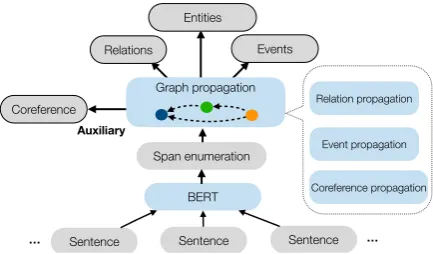
Figure 1: Overview of our framework: DYGIE++. Shared span representations are constructed by refin-ing contextualized word embeddrefin-ings via span graph updates, then passed to scoring functions for three IE tasks.
Mitchell, 2016;Li and Ji,2014) and neural scor-ing functions (Nguyen and Nguyen,2019), or as a guide for the construction of neural architectures (Peng et al.,2017;Zhang et al.,2018;Sha et al., 2018;Christopoulou et al.,2018). Recent end-to-end systems have achieved strong performance by dynmically constructing graphs of spans whose edges correspond to task-specific relations (Luan et al.,2019;Lee et al.,2018;Qian et al.,2018).
Meanwhile, contextual language models (Dai and Le, 2015;Peters et al., 2017, 2018; Devlin et al.,2018) have proven successful on a range of natural language processing tasks (Bowman et al., 2015;Sang and De Meulder,2003;Rajpurkar et al., 2016). Some of these models are also capable of modeling context beyond the sentence boundary. For instance, the attention mechanism in BERT’s transformer architecture can capture relationships between tokens in nearby sentences.
spans and encodes them using contextual language models and task-specific message updates passed over a text span graph. Our framework achieves state-of-the results across three IE tasks, leveraging the benefits of both contextualization methods.
We conduct experiments and a thorough anal-ysis of the model on named entity, relation, and event extraction. Our findings are as follows: (1) Our general span-based framework produces state-of-the-art results on all tasks and all but one sub-tasks across four text domains, with relative error reductions ranging from 0.2 - 27.9%. (2) BERT encodings are able to capture important within and adjacent-sentence context, achieving improved performance by increasing the input window size. (3) Contextual encoding through message passing updates enables the model to incorporate cross-sentence dependencies, improving performance be-yond that of BERT alone, especially on IE tasks in specialized domains.
2 Task and Model
Our DYGIE++framework extends a recent span-based model for entity and relation extraction (Luan et al.,2019) as follows: (1) We perform event extraction as an additional task and propagate span updates across a graph connecting event triggers to their arguments. (2) We build span representations on top of multi-sentence BERT encodings.
2.1 Task definitions
The input is a document represented as a sequence of tokens D, from which our model constructs spans S = {s1, . . . , sT}, the set of all possible within-sentence phrases (up to a threshold length) in the document.
Named Entity Recognition involves predicting the best entity type labelei for each spansi. For all tasks, the best label may be a “null” label. Rela-tion ExtracRela-tion involves predicting the best relaRela-tion type rij for all span pairs (si, sj). For the data sets studied in this work, all relations are between spans within the same sentence. The coreference resolution task is to predict the best coreference antecedentcifor each spansi. We perform coref-erence resolution as auxiliary task, to improve the representations available for the “main” three tasks.
Event Extraction involves predicting named enti-ties, event triggers, event arguments, and argument roles. Specifically, each tokendi is predicted as an event trigger by assigning it a labelti. Then, for each triggerdi, event arguments are assigned
to this event trigger by predicting an argument role aij for all spanssj in the same sentence asdi. Un-like most work on event extraction, we consider the realistic setting where gold entity labels are not available. Instead, we use predicted entity mentions as argument candidates.
2.2 DyGIE++ Architecture
Figure1depicts the four-stage architecture. For more details, see (Luan et al.,2019).
Token encoding: DYGIE++ uses BERT for token representations using a “sliding window” approach, feeding each sentence to BERT together with a size-Lneighborhood of surrounding sentences.
Span enumeration:Spans of text are enumerated and constructed by concatenating the tokens repre-senting their left and right endpoints, together with a learned span width embedding.
Span graph propagation: A graph structure is generated dynamically based on the model’s cur-rent best guess at the relations present among the spans in the document. Each span representationgtj
is updated by integrating span representations from its neighbors in the graph according to three vari-ants of graph propagation. In coreference propaga-tion, a span’s neighbors in the graph are its likely coreference antecedents. In relation propagation, neighbors are related entities within a sentence. In event propagation, there are event trigger nodes and event argument nodes; trigger nodes pass messages to their likely arguments, and arguments pass mes-sages back to their probable triggers. The whole procedure is trained end-to-end, with the model learning simultaneously how to identify important links between spans and how to share information between those spans.
More formally, at each iterationtthe model gen-erates an updateutx(i)for spanst∈Rd:
utx(i) = X
j∈Bx(i)
Vxt(i, j)gtj, (1)
Multi-task classification: The re-contextualized representations are input to scoring functions which make predictions for each of the end tasks. We use a two-layer feedforward neural net (FFNN) as the scoring function. For trigger and named entity pre-diction for spangi, we compute FFNNtask(gi). For relation and argument role prediction, we concate-nate the relevant pair of embeddings and compute FFNNtask([gi,gj]).
3 Experimental Setup
Data We experiment on four different datasets: ACE05, SciERC, GENIA and WLPC (Statistics and details on all data sets and splits can be found in AppendixA.). TheACE05corpus provides en-tity, relation, and event annotations for a collection of documents from a variety of domains such as newswire and online forums. For named entity and relation extraction we follow the train / dev / test split fromMiwa and Bansal(2016). Since the ACE data set lacks coreference annotations, we train on the coreference annotations from the OntoNotes dataset (Pradhan et al.,2012). For event extraction we use the split described in Yang and Mitchell (2016);Zhang et al.(2019). We refer to this split as ACE05-E in what follows. TheSciERCcorpus (Luan et al.,2018) provides entity, coreference and relation annotations from 500 AI paper abstracts. TheGENIAcorpus (Kim et al.,2003) provides en-tity tags and coreferences for 1999 abstracts from the biomedical research literature with a substantial portion of entities (24%) overlapping some other entity. The WLPCdataset provides entity, rela-tion, and event annotations for 622 wet lab proto-cols (Kulkarni et al.,2018). Rather than treating event extraction as a separate task, the authors an-notate event triggers as an entity type, and event arguments as relations between an event trigger and an argument.
Evaluation We follow the experimental setups of the respective state-of-the-art methods for each dataset: Luan et al. (2019) for entities and rela-tions, andZhang et al.(2019) for event extraction. An entity prediction is correct if its label and span matches with a gold entity; a relation is correct if both the span pairs and relation labels match with a gold relation triple. An event trigger is correctly identified if its offsets match a gold trigger. An argument is correctly identified if its offsets and event type match a gold argument. Triggers and ar-guments are correctly classified if their event types
Dataset Task SOTA Ours ∆%
ACE05 Entity 88.4 88.6 1.7
Relation 63.2 63.4 0.5
ACE05-Event*
Entity 87.1 90.7 27.9
Trig-ID 73.9 76.5 9.6
Trig-C 72.0 73.6 5.7
Arg-ID 57.2 55.4 -4.2
Arg-C 52.4 52.5 0.2
SciERC Entity 65.2 67.5 6.6
Relation 41.6 48.4 11.6
GENIA Entity 76.2 77.9 7.1
WLPC Entity 79.5 79.7 1.0
[image:3.595.308.524.66.225.2]Relation 64.1 65.9 5.0
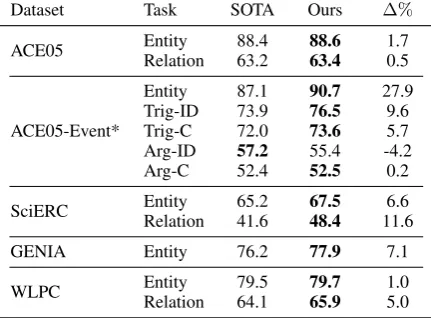
Table 1: DYGIE++ achieves state-of-the-art results. Test set F1 scores of best model, on all tasks and datasets. We define the following notations for events:
Trig: Trigger, Arg: argument, ID: Identification, C: Classification. * indicates the use of a 4-model ensem-ble for trigger detection. See AppendixEfor details. The results of the single model are reported in Table 2 (c). We ran significance tests on a subset of results in AppendixD. All were statistically significant except Arg-C and Arg-ID on ACE05-Event.
and event roles are also correct, respectively.
Model Variations We perform experiments with the following variants of our model architecture. BERT + LSTMfeeds pretrained BERT embed-dings to a bi-directional LSTM layer, and the LSTM parameters are trained together with task specific layers. BERT Finetuneuses supervised fine-tuning of BERT on the end-task. For each vari-ation, we study the effect of integrating different task-specific message propagation approaches.
Comparisons For entity and relation extraction, we compare DYGIE++ against the DYGIE system it extends. DYGIE is a system based on ELMo ( Pe-ters et al.,2018) that uses dynamic span graphs to propagate global context. For event extraction, we compare against the method ofZhang et al.(2019), which is also an ELMo-based approach that re-lies on inverse reinforcement learning to focus the model on more difficult-to-detect events.
ACE05 SciERC GENIA WLPC
BERT + LSTM 85.8 69.9 78.4 78.9
+RelProp 85.7 70.5 - 78.7
+CorefProp 86.3 72.0 78.3
-BERT Finetune 87.3 70.5 78.3 78.5
+RelProp 86.7 71.1 - 78.8
+CorefProp 87.5 71.1 79.5
-Table 2: F1 scores on NER.
ACE05 SciERC WLPC
BERT + LSTM 60.6 40.3 65.1
+RelProp 61.9 41.1 65.3
+CorefProp 59.7 42.6
-BERT FineTune 62.1 44.3 65.4
+RelProp 62.0 43.0 65.5
+CorefProp 60.0 45.3
-Table 3: F1 scores on Relation.
Entity Trig-C Arg-ID Arg-C
BERT + LSTM 90.5 68.9 54.1 51.4
+EventProp 91.0 68.4 52.5 50.3
BERT FineTune 89.7 69.7 53.0 48.8
[image:4.595.72.292.59.342.2]+EventProp 88.7 68.2 50.4 47.2
Table 4: F1 scores on ACE05-E.
Table 5: Comparison of contextualization methods. All ablations are performed on the dev set except for ACE05-E, where the precedent in the literature is to ablate on test.
period. Each of the feed-forward neural networks has two hidden layers and ReLU activations and 0.4 dropout. We use 600 hidden units for event ex-traction and 150 for entity and relation exex-traction (more details in AppendixE).
4 Results and Analyses
State-of-the-art Results Table1shows test set F1 on the entity, relation and event extraction tasks. Our framework establishes a new state-of-the-art on all three high-level tasks, and on all subtasks except event argument identification. Relative error reductions range from 0.2 - 27.9% over previous state of the art models.
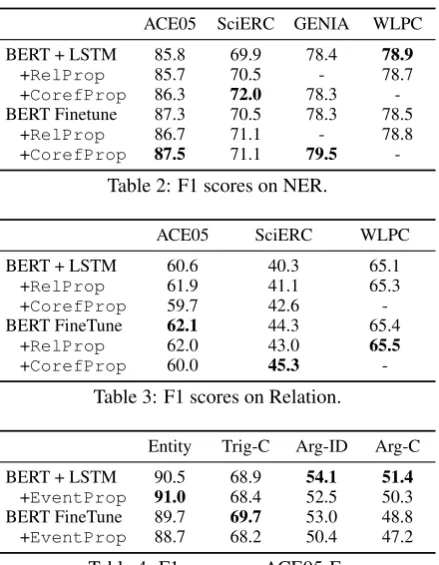
Benefits of Graph Propagation Table2shows that Coreference propagation (CorefProp) im-proves named entity recognition performance across all three domains. The largest gains are on the computer science research abstracts of SciERC, which make frequent use of long-range corefer-ences, acronyms and abbreviations.CorefProp
also improves relation extraction on SciERC. Relation propagation (RelProp) improves rela-tion extracrela-tion performance over pretrained BERT, but does not improve fine-tuned BERT. We believe
Task Variation 1 3
Relation BERT+LSTM 59.3 60.6
BERT Finetune 62.0 62.1
Entity BERT+LSTM 90.0 90.5
BERT Finetune 88.8 89.7
Trigger BERT+LSTM 69.4 68.9
BERT Finetune 68.3 69.7
Arg Class BERT+LSTM 48.6 51.4
BERT Finetune 50.0 48.8
Table 6: Effect of BERT cross-sentence context. F1 score of relation F1 on ACE05 dev set and entity, arg, trigger extraction F1 on ACE05-E test set, as a function of the BERT context window size.
this occurs because all relations are within a single sentence, and thus BERT can be trained to model these relationships well.
Our best event extraction results did not use any propagation techniques (Table4). We hypothesize that event propagation is not helpful due to the asymmetry of the relationship between triggers and arguments. Methods to model higher-order interac-tions among event arguments and triggers represent an interesting direction for future work.
Benefits of Cross-Sentence Context with BERT Table 6shows that both variations of our BERT model benefit from wider context windows. Our model achieves the best performance with a 3-sentence window across all relation and event ex-traction tasks.
Pre-training or Fine Tuning BERT Under Lim-ited Resources Table 5 shows that fine-tuning BERT generally performs slightly better than using the pre-trained BERT embeddings combined with a final LSTM layer.1 Named entity recognition
improves by an average of 0.32 F1 across the four datasets tested, and relation extraction improves by an average of 1.0 F1, driven mainly by the per-formance gains on SciERC. On event extraction, fine-tuning decreases performance by 1.6 F1 on average across tasks. We believe that this is due to the high sensitivity of both BERT finetuning and event extraction to the choice of optimization hy-perparameters – in particular, the trigger detector begins overfitting before the argument detector is finished training.
Pretrained BERT combined with an LSTM layer and graph propagation stores gradients on 15 mil-lion parameters, as compared to the 100 milmil-lion
pa-1Pre-trained BERT without a final LSTM layer performed
[image:4.595.306.526.64.181.2]SciERC GENIA
Entity Relation Entity
Best BERT 69.8 41.9 78.4
Best SciBERT 72.0 45.3 79.5
Table 7: In-domain pre-training: SciBERT vs. BERT
rameters in BERTBASE. Since the BERT + LSTM + Propagation approach requires less memory and is less sensitive to the choice of optimization hyperpa-rameters, it may be appealing for non-experts or for researchers working to quickly establish a reason-able baseline under limited resources. It may also be desirable in situations where fine-tuning BERT would be prohibitively slow or memory-intensive, for instance when encoding long documents like scientific articles.
Importance of In-Domain Pretraining We re-placed BERT (Devlin et al., 2018) with SciB-ERT (Beltagy et al.,2019) which is pretrained on a large multi-domain corpus of scientific publica-tions. Table7compares the results of BERT and SciBERT with the best-performing model configu-rations. SciBERT significantly boosts performance for scientific datasets including SciERC and GE-NIA. These results indicate that introducing unla-beled text of similar domains for pre-training can significantly improve performance.
Qualitative Analysis To better understand the mechanism by which graph propagation improved performance, we examined all named entities in the SciERC dev set where the prediction made by the BERT+LSTM+CorefPropmodel from Table 2 was different from the BERT+LSTM model. We found 44 cases where theCorefPropmodel corrected an error made by the base model, and 21 cases where it introduced an error. The model withoutCorefPropwas often overly specific in the label it assigned, labeling entities asMaterialor
Methodwhen it should have given the more general labelOther Scientific Term. Visualizations of the disagreements between the two model variants can be found in AppendixC. Figure2shows an exam-ple where span updates passed along a coreference chain corrected an overly-specific entity identifica-tion for the acronym “CCRs”. We observed similar context sharing via CorefProp in the GENIA data set, and include an example in AppendixC.
Coreference propagation updated the span repre-sentations of all but one of 44 entities, and in 68% of these cases the update with the largest
corefer-(a) The green spanCCRsin sentence 2 is updated based on its predicted coreference antecedent.
(b) The mention ofCCRsin sentence 2 serves as a bridge to propagate information from sentence 1 to the mention of
CCRsin sentence 3
(c) Coreference link strength. Red is strong.
Figure 2: CorefPropenables a correct entity pre-diction. In each subplot, the green token is being updated by coreference propagation. The preceeding tokens are colored according to the strength of their predicted coreference links with the green token. To-kens inboldare part of a gold coreference cluster dis-cussingCCRs. During theCorefPropupdates, the span CCRs in sentence 2 is updated based on its an-tecedentCategory Cooccurrence Restrictions. Then, it passes this information along to the spanCCRsin sen-tence 3. As a result, the model changes its prediction forCCRsin sentence 3 fromMethod– which is overly specific according to theSciERC annotation guideline – to the correct answerOther Scientific Term.
ence “attention weight” came from a text span in a different sentence that was itself a named entity.
5 Conclusion
Acknowledgments
This research was supported by the ONR MURI N00014-18-1-2670, ONR N00014-18-1-2826, DARPA N66001-19-2-4031, NSF (IIS 1616112), Allen Distinguished Investigator Award, and Sam-sung GRO. We thank Mandar Joshi for his valuable BERT finetuning advice, Tongtao Zhang for shar-ing the ACE data code, anonymous reviewers, and the UW-NLP group for their helpful comments.
References
Iz Beltagy, Arman Cohan, and Kyle Lo. 2019. Scibert: Pretrained contextualized embeddings for scientific text. ArXiv, abs/1903.10676.
Samuel R. Bowman, Gabor Angeli, Christopher Potts, and Christopher D. Manning. 2015. A large anno-tated corpus for learning natural language inference. InEMNLP.
Fenia Christopoulou, Makoto Miwa, and Sophia Ana-niadou. 2018. A walk-based model on entity graphs for relation extraction. InACL.
Andrew M Dai and Quoc V Le. 2015. Semi-supervised sequence learning. InNeurIPs.
Jacob Devlin, Ming-Wei Chang, Kenton Lee, and Kristina Toutanova. 2018. Bert: Pre-training of deep bidirectional transformers for language understand-ing. InNAACL-HLT.
Matt Gardner, Joel Grus, Mark Neumann, Oyvind Tafjord, Pradeep Dasigi, Nelson F. Liu, Matthew Peters, Michael Schmitz, and Luke S. Zettlemoyer. 2017. Allennlp: A deep semantic natural language processing platform.
Jin-Dong Kim, Tomoko Ohta, Yuka Tateisi, and Jun’ichi Tsujii. 2003. Genia corpus - a semantically annotated corpus for bio-textmining. Bioinformat-ics, 19 Suppl 1:i180–2.
Chaitanya Kulkarni, Wei Xu, Alan Ritter, and Raghu Machiraju. 2018. An annotated corpus for machine reading of instructions in wet lab protocols. In
NAACL-HLT.
Kenton Lee, Luheng He, and Luke S. Zettlemoyer. 2018. Higher-order coreference resolution with coarse-to-fine inference. InNAACL-HLT.
Qi Li and Heng Ji. 2014. Incremental joint extraction of entity mentions and relations. InACL.
Qi Li, Heng Ji, and Liang Huang. 2013. Joint event extraction via structured prediction with global fea-tures. InACL.
Yi Luan, Luheng He, Mari Ostendorf, and Hannaneh Hajishirzi. 2018. Multi-task identification of enti-ties, relations, and coreference for scientific knowl-edge graph construction. InEMNLP.
Yi Luan, Dave Wadden, Luheng He, Amy Shah, Mari Ostendorf, and Hannaneh Hajishirzi. 2019. A gen-eral framework for information extraction using dy-namic span graphs. InNAACL-HLT.
Makoto Miwa and Mohit Bansal. 2016. End-to-end re-lation extraction using lstms on sequences and tree structures. InACL.
Trung Minh Nguyen and Thien Huu Nguyen. 2019. One for all: Neural joint modeling of entities and events. InAAAI.
Nanyun Peng, Hoifung Poon, Chris Quirk, Kristina Toutanova, and Wen tau Yih. 2017. Cross-sentence n-ary relation extraction with graph lstms. Transac-tions of the Association for Computational Linguis-tics, 5:101–115.
Matthew E. Peters, Waleed Ammar, Chandra Bhagavat-ula, and Russell Power. 2017. Semi-supervised se-quence tagging with bidirectional language models. InACL.
Matthew E. Peters, Mark Neumann, Mohit Iyyer, Matt Gardner, Christopher Clark, Kenton Lee, and Luke Zettlemoyer. 2018. Deep contextualized word repre-sentations. InNAACL.
Sameer Pradhan, Alessandro Moschitti, Nianwen Xue, Olga Uryupina, and Yuchen Zhang. 2012. Conll-2012 shared task: Modeling multilingual unre-stricted coreference in ontonotes. In Joint Confer-ence on EMNLP and CoNLL-Shared Task, pages 1– 40. Association for Computational Linguistics.
Yujie Qian, Enrico Santus, Zhijing Jin, Jiang Guo, and Regina Barzilay. 2018. Graphie: A graph-based framework for information extraction. In NAACL-HLT.
Pranav Rajpurkar, Jian Zhang, Konstantin Lopyrev, and Percy Liang. 2016. Squad: 100, 000+ questions for machine comprehension of text. InEMNLP.
Erik F Sang and Fien De Meulder. 2003. Intro-duction to the conll-2003 shared task: Language-independent named entity recognition. InNAACL.
Lei Sha, Feng Qian, Baobao Chang, and Zhifang Sui. 2018. Jointly extracting event triggers and argu-ments by dependency-bridge rnn and tensor-based argument interaction. InAAAI.
Bishan Yang and Tom M. Mitchell. 2016. Joint extrac-tion of events and entities within a document context. InHLT-NAACL.
Tongtao Zhang, Heng Ji, and Avirup Sil. 2019. Joint entity and event extraction with generative adversar-ial imitation learning. Data Intelligence, 1:99–120.