Multi-Document Summarisation Using Generic Relation Extraction
Ben Hachey Centre for Languate Tecnology
Macquarie University NSW 2109 Australia
Capital Markets CRC Limited GPO Box 970
Sydney NSW 2001
Abstract
Experiments are reported that investi-gate the effect of various source docu-ment representations on the accuracy of the sentence extraction phase of a multi-document summarisation task. A novel representation is introduced based on generic relation extraction (GRE), which aims to build systems for relation iden-tification and characterisation that can be transferred across domains and tasks with-out modification of model parameters. Re-sults demonstrate performance that is sig-nificantly higher than a non-trivial base-line that usestf*idf-weighted words and at least as good as a comparable but less gen-eral approach from the literature. Anal-ysis shows that the representations com-pared are complementary, suggesting that extraction performance could be further improved through system combination. 1 Introduction
The goal of summarisation is to take an informa-tion source, extract content from it, and present the most important content in a condensed form (Mani, 2001). The field of automatic summarisa-tion (Mani, 2001; Sp¨arck Jones, 2007) aims to cre-ate tools that address various summarisation tasks with minimal human intervention. Extractive ap-proaches to automatic summarisation create rep-resentations of the source document that are gen-erally based on an easily identified text sub-unit such as sentences or paragraphs. These represen-tations are then used to identify representative or otherwise important snippets of text to place in the summary.
Following Sp¨arck Jones (2007), summarisation systems can be characterised with respect to their approach to three main sub-tasks: 1) interpreta-tion, 2) transformation and 3) generation. The
input consists of the source document (or a col-lection of source documents in the case of multi-document summarisation). The first step (interpre-tation) creates a representation of the source doc-ument by performing some level of interpretation. A simple approach here represents sentences by their tokens (i.e., as an unordered bag-of-words). The next step (transformation) is the compaction step where the source representation is converted into the summary representation, e.g. by identify-ing sentences whose words are most representative of the full text. Finally, in the last step (genera-tion), the output summary is created. In the case of sentence extraction, this includes various opera-tions to maximise coherence such as ensuring that entity references are comprehensible and arrang-ing the sentences in a sensible order.
The current work investigates several represen-tations of source documents. In particular, an ap-proach from the literature based on atomic events (Filatova and Hatzivassiloglou, 2004) is compared to a novel approach based on generic relation ex-traction (GRE), which aims to build systems for relation identification and characterisation that can be transferred across domains and tasks without modification of model parameters (Hachey, 2009). The various representations are substituted in the interpretation phase of a multi-document sum-marisation task and used as the basis for extract-ing sentences to be placed in the summary. Sys-tem summaries are compared by calculating term overlap with reference summaries created by hu-man analysts.
2 Motivation
In seminal work on automatic summarisation, Luhn (1958) introduces a representation based on content words. These are defined as non-function words from the source document that are neither too frequent nor too infrequent. Luhn uses frequency to weight content words and
tracts sentences with the highest combined con-tent scores to form the summary. Subsequent work adapted thetf*idf weighting scheme, where term frequency (tf) is combined with inverse document frequency (idf), an inverse measure of term oc-currence across documents that serves to down-weight common words (Sp¨arck Jones, 1972). In modern work,tf*idf representations are often used as simple but non-trivial baselines. The problem is that these shallow features often break down where underlying linguistic content needs to be compared rather than just surface structure.
The use of representations based on informa-tion extracinforma-tion (IE) has been suggested as one ap-proach to capturing deeper semantic information. This is based on the notion that IE definitions of types for entities, relations and events provide a level of abstraction that is appropriate for auto-matic summarisation. Several approaches in the literature have explored the use of IE-based rep-resentations for extractive summarisation: McK-eown et al. (1998) incorporate patient character-istic templates for matching potential treatments to specific patients in a medical summarisation system; White and Cardie (2002) incorporate a bootstrapped IE system based on Autoslog (Riloff, 1996) for filling event templates; and Harabagiu and Maiorano (2002) incorporate a hybrid ap-proach that uses conventional supervised IE tech-niques for known topics and a more general ap-proach based on WordNet for unknown topics.1
The problem with these systems is that they all use supervised approaches to IE that require that the IE templates be known in advance and addi-tionally require significant investment in writing extraction rules or in annotating data for train-ing. Where more general techniques are used, they still require domain-specific resources, e.g. White and Cardie (2002) bootstrapping approach still re-quires that the extraction templates be known in advance and Harabagiu and Maiorano (2002) ap-proach depends on the WordNet lexical database, for which coverage is not guaranteed for arbitrary domains.
Filatova and Hatzivassiloglou (2004) intro-duce methods using more general IE represen-tations that are not based on supervised learn-ing. Given a named entity recogniser, the
rep-1Comparable approaches using IE in the context of abstractive–as opposed to extractive–summarisation include work by DeJong (1982), Hahn and Reimer (1999), White et al. (2001) and Saggion and Lapalme (2002).
resentation is automatically derived and consists of<Ent, Connector, Ent>event triples, where connectors are verbs or action nouns that occur in between the two NEs. Thus, the approach aims to perform a generic IE task that the authors refer to as atomic event extraction. This representation is shown to outperform atf*idf baseline on a multi-document summarisation task. As we will see in Section 4.3 below, Filatova and Hatzivassiloglou’s approach has three main shortcomings. First, it fo-cuses exclusively on simple atomic events (i.e., en-tity mention pairs with an intervening verbal con-nector), meaning that it will not be able to ad-dress tasks where relations are at least as impor-tant as events (e.g., biographical summarisation). Second, it relies on exact matching between con-nectors, which is not capable of capturing latent semantic similarities (e.g., between ‘work for’ and ‘employed by’). Third, its performance is subject to the coverage of WordNet, which is used to iden-tify action nouns.
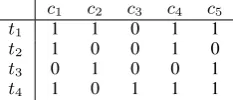
c1 c2 c3 c4 c5
t1 1 1 0 1 1
t2 1 0 0 1 0
t3 0 1 0 0 1
[image:3.595.306.525.60.134.2]t4 1 0 1 1 1
Table 1: Text×concept matrix for set cover ap-proach to automatic summarisation (Filatova and Hatzivassiloglou, 2004).
3 Algorithm for Set Cover Extraction For the sake of comparison, the current evaluation adopts the Filatova and Hatzivassiloglou (2004) summarisation framework. This defines an extrac-tion approach based on a mapping betweentextual units andconcepts. To illustrate, consider the ma-trix in Table 1 where rows represent textual units (e.g., sentences, paragraphs) and columns repre-sent concepts (e.g., words, events, relations) in the input text. Each concept is either absent or present in a given textual unit. Additionally, each con-cept has a weight associated with it. Looking at the problem in this way makes it natural to for-mulate it as follows: the summary should select textual units such that there is maximal coverage of the salient conceptual units.2 This is essentially
the maximum coverage problem, which has been shown to be reducible to the set covering problem, for which there are approximation algorithms in the literature that run in polynomial time or better (Hochbaum, 1997; Bienstock and Iyengar, 2004).
Filatova and Hatzivassiloglou define several greedy algorithms that can be parametrised in terms of the general SUMMARISEfunction in
Fig-ure 1, which takes the text ×concept matrix D and the maximum summary lengthkas input. The SUMMARISEfunction first initialises the summary S to the empty set. Then it enters a loop that continues until the summary reaches the desired length. Within the loop, a text unit is extracted and added to the summary after which the text× con-cept matrix is updated The output of the algorithm is a set S comprising the text units that make up the summary. For the experiments reported here, the text unitstare sentences and LENGTH(ti)
re-2While not considered in the current experiments, a more discourse-oriented approach could be derived within the set cover framework by down-weighting conceptual units that occur e.g. in portions of the source documents that describe background information, where text segments containing background information could be identified using a sentence-level rhetorical status classifier like that developed by Teufel and Moens (2002).
SUMMARISE:D, k 1 S ← {}
2 whilePti∈SLENGTH(ti)< k 3 tj←EXTRACT(D) 4 S ← S ∪tj
[image:3.595.123.240.63.114.2]5 D←UPDATE(D, tj) 6 returnS
Figure 1: Generalised function for Filatova and Hatzivassiloglou (2004) approach to extractive summarisation.
EXTRACT:D
1 cj←arg maxcj∈cols(D)
P
ti∈rows(D)D[ti, cj]
2 tk←arg maxtk∈rows(D)&D[tk,cj]>0SCORE(D, tk) 3 returntk
UPDATE:D, ti
1 foreachcj∈cols(D) 2 ifD[ti, cj]>0
3 foreachtk∈rows(D)
4 D[tk, cj]←0
5 D←DELETE(D, ti) 6 returnD
Figure 2: Extraction and update functions for Fi-latova and Hatzivassiloglou (2004) modified adap-tive algorithm.
turns the count of word tokens in sentenceti. Figure 2 contains the EXTRACT and UPDATE
functions used here.3 The EXTRACTfunction first
identifies the concept cj not yet covered in the summary that has the highest overall weight in the text×concept matrixD. Then it selects the text unittkwith the highest score from among the text units that contain concept cj. The SCORE func-tion is the sum of concept weights for the given text unit, i.e.:
SCORE:D, ti7→return X
cj∈cols(D)
D[ti, cj] (1)
The UPDATE function in Figure 2 aims to
min-imise redundancy in the summary by globally maximising the number of conceptual units cov-ered in the output. In addition to removing the row representing the extracted text unit from the text×
concept matrixD, it iterates through the remaining text units and assigns zero weights to all concepts that are covered by the extracted text unit.
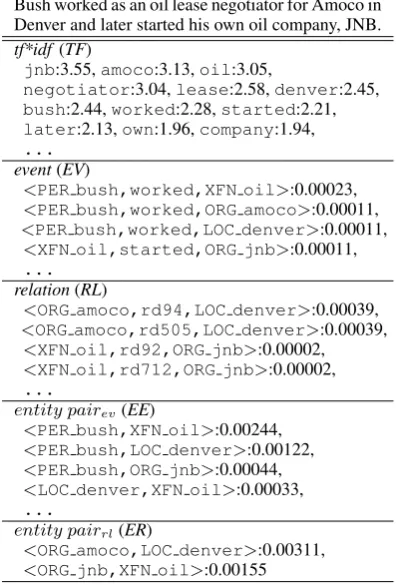
[image:3.595.308.525.199.325.2]Bush worked as an oil lease negotiator for Amoco in Denver and later started his own oil company, JNB.
tf*idf(TF)
jnb:3.55,amoco:3.13,oil:3.05,
negotiator:3.04,lease:2.58,denver:2.45, bush:2.44,worked:2.28,started:2.21, later:2.13,own:1.96,company:1.94, ...
event(EV)
<PER bush,worked,XFN oil>:0.00023, <PER bush,worked,ORG amoco>:0.00011, <PER bush,worked,LOC denver>:0.00011, <XFN oil,started,ORG jnb>:0.00011, ...
relation(RL)
<ORG amoco,rd94,LOC denver>:0.00039, <ORG amoco,rd505,LOC denver>:0.00039, <XFN oil,rd92,ORG jnb>:0.00002, <XFN oil,rd712,ORG jnb>:0.00002, ...
entity pairev(EE)
<PER bush,XFN oil>:0.00244, <PER bush,LOC denver>:0.00122, <PER bush,ORG jnb>:0.00044, <LOC denver,XFN oil>:0.00033, ...
entity pairrl(ER)
[image:4.595.82.284.65.358.2]<ORG amoco,LOC denver>:0.00311, <ORG jnb,XFN oil>:0.00155
Figure 3: Example sentence and various represen-tations of sentence content.
4 Models
Figure 3 contains an example sentence and its rep-resentations corresponding to the various models of sentence content explored here.4 These are
de-scribed in detail in the rest of this section.
4.1 Baselinetf*idf Representation (TF)
The baseline model represents sentences astf*idf -weighted bags-of-words (TF). Document frequen-cies for terms are derived from the same resource used by Filatova and Hatzivassiloglou (2004)–a frequency list compiled from a large sample of web pages. Term weighting is calculated using tf*idf as:
w(i, j) = s
(1 + log (tfi,j))∗log
N
dfi
(2)
wheretfi,jis the number of times termioccurs in sentencej anddfi is the number of documents in which termioccurs. An example sentence and its tf*idf representation can be seen in Figure 3.
4The sentence was selected from document set d47 (from the data set described in Section 5.1 below), which contains articles about Neil Bush and his role in the collapse of Sil-verado Savings and Loan during the U.S. Savings and Loan crisis of the 1980s and 1990s.
4.2 Event Representation (EV)
We also compare to Filatova and Hatzivassiloglou (2004) atomic events (EV). This consists of <Enti, Connectorj, Entk>event triples, where connectorsare verbs or action nouns (i.e., nouns that are hyponyms of event or activity in Word-Net) that occur in between the two entity men-tions. Given a named entity recogniser and a lex-ical resource (WordNet), these are derived auto-matically from the text as follows. In the first step, all pairs of entity mentions that occur together in a sentence are identified. Next, the algorithm char-acterises the entity mention pairs using the con-nector words from the intervening context and dis-cards pairs without an intervening connector word. Event triple weighting is calculated by combin-ing entity pair and connector weights as:
wev(i, j, k) =wne(i, k)∗wcn(j, i, k) (3)
where wne(i, k) is the weight of the entity pair <i, k> consisting of entities i and k and wcn(j, i, k)is the weight of connectorjin the con-text of entity pair<i, j>. wne(i, k)is calculated as the normalised entity pair count, i.e.:
wne(i, k) = CCne(< i, k >)
ne(<∗,∗>) (4)
where Cne(<i, k>) is the count of mentions of entity pair <i, k>5 andC
ne(<∗,∗>) is the total count of entity mention pairs. And,wcn(j, i, k)is calculated as the normalised count of connectorj in the context of the entity pair, i.e.:
wcn(j, i, k) = C <i,k> cn (j)
Ccn<i,k>(∗) (5)
where C<i,k>
cn (j) is the count of occurrences of connector j in the context of entity pair <i, k> andC<i,k>
cn (∗) is the total count of connectors in the context of entity pair <i, k>. An example sentence and itsevent representation can be seen in Figure 3. Event triples generated include <PER bush,worked,ORG amoco> and <PER bush,started,ORG jnb>.
Some erroneous event triples are also generated. The first error has to do with the fact that entities
include named entities identified in the pre-processing as well as the ten most frequent nouns in the document set. In the example sentence from Figure 3, the most frequent nouns include ‘oil’ but not ‘negotiator’ or ‘company’. Therefore, ‘oil’ is labelled as an entity and extracted in a num-ber of triples such as <PER bush,worked, XFN oil> (as opposed to <PER bush, worked,XFN negotiator>). Another problem illustrated by the example sentence has to do with the noisy nature of the surface-level approach to identifying entity mention pairs and connectors which tends to generate many false positive events, e.g. <ORG amoco,started, ORG jnb>. If the algorithm was constrained based on the underlying grammatical structure, it should be able to identity that the arguments of ‘worked’ are ‘Bush’ and ‘Amoco’ (i.e., <PER bush,worked,ORG amoco>) and that ‘worked’ does not describe an event involving ‘Amoco’ and ‘JNB’.
4.3 Relation Representation (RL)
The focus of the current evaluation is a novel rep-resentation based on generic relation extraction (GRE). As mentioned above, GRE is a minimally supervised approach to the relation extraction task that aims to build systems for relation identifica-tion and characterisaidentifica-tion that can be transferred across domains and tasks without modification of model parameters. Relation mentions are identi-fied by taking pairs of entity mentions that have ei-ther 1) no more than two intervening words in the surface order of the sentence or 2) no more than one edge intervening on the shortest path through a dependency parse (see Hachey (2009) for details and experiments comparing different window con-figurations). This is stricter than the Filatova and Hatzivassiloglou approach in that entity mentions have to occur much closer or be connected by a single dependency relation. At the same time, it is less strict in the sense that an action- or event-denoting word is not required in the context, which makes it a more general model of IE.
Relationconnectorsare derived from a model of relation types based on latent Dirichlet allocation (Blei et al., 2003) that incorporates word, entity and dependency path features from the context of a relation-forming entity mention pair (see Hachey (2009) for details). This outputs a topic distribu-tion for each entity mendistribu-tion pair that corresponds
to the type of relation that is described. This rep-resentation 1) models a type of generic IE that in-cludes relations, 2) uses a connector model that ab-stracts away from surface-level event descriptors used by Filatova and Hatzivassiloglou (2004) and 3) does not rely on domain-specific resources like WordNet.6 For the purpose of comparison,
rela-tion triples are weighted in the same way as event triples using Equations 3 and 4 above. However, the connector pair weighting is modified to use the distribution over topics given by the LDA output.7
Relation triples generated for the example sentence in Figure 3 include <ORG amoco, rd94,LOC denver> and <ORG amoco, rd505,LOC denver>, where the connectors (i.e.,rd94andrd505) are identifiers that index particular topics from the LDA output. Here, rd94 and rd505 index topics that correspond to located-in relations so the respective triples both describelocated-inrelations between Amoco and Denver. Relation triples generated for the example sentence also include <XFN oil, rd92,ORG jnb> and <XFN oil,rd712, ORG jnb>. These are erroneous for the same reason as some of the event triples above (i.e., due to the noise inherent in the approach to identifying nominal entity mentions by identifying the ten most frequent nouns in the document set).
4.4 Entity Pair Representations (EE, ER)
Finally, we investigate the performance of rep-resentations that do not model event or re-lation type information. These are identical to the EV and RL representations above, ex-cept they are <Ent, Ent> 2-tuples instead of <Ent, Connector, Ent>3-tuples. That is, entity pairs are included here provided that they meet the relation mention identification constraints. They are weighted using the normalised entity pair count (Equation 4 above). Relation-based entity pairs generated for the example sentence in Fig-ure 3 include<LOC denver,ORG amoco>and <ORG jnb,XFN oil>.
6The GRE representation here does rely on dependency parsing, however, Hachey (2009) shows that it is still directly portable between the news and biomedical domains without modification of model parameters.
5 Experimental Setup
5.1 Data
The experiments here use the multi-document summarisation data from the 2001 Document Un-derstanding Conference (DUC),8 which is the
same data used by Filatova and Hatzivassiloglou (2004). This comprises 30 test document sets, each of which include approximately 10 news sto-ries. Each document set is collected by a human and focuses on a particular topic. Example topics include the nomination of Clarence Thomas to the American Supreme Court, Neil Bush’s role in the collapse of Silverado Savings and Loan and the Exxon Valdez oil spill. Gold standard summaries are provided for each document set for summary lengths of 50, 100, 200 and 400 words. This helps to ensure that the systems are not over-tuned to specific summary lengths. For each summary task (i.e., all 120 document set×summary length com-binations), there are three distinct gold standard summaries created by different human analysts.
Pre-processing includes sentence boundary identification, segmentation of words (tokenisa-tion), labelling words with part-of-speech tags, identification of noninflected base word forms (lemmatisation) from the LT-TTT tools (Grover et al., 2000). It also includes dependency parsing us-ing Minipar (Lin, 1998) and automatic named en-tity recognition using the C&C tagger (Curran and Clark, 2003) trained on the data from the MUC-7 shared task (Chinchor, 1998). Weights for the var-ious IE-based representations are calculated over each input document set.
5.2 Evaluation
The evaluation uses Rouge9 to determine which
representation selects content that overlaps most with human summaries. Rouge estimates the coverage of appropriate concepts (Lin, 2004) in a summary by comparing it to several human-created reference summaries. Rouge-1 does so by computing recall based on macro-averaged un-igram overlap. Rouge-SU4 does so by calculating skip-bigram overlap where bigrams are allowed to
8http://www-nlpir.nist.gov/projects/ duc/index.html
9Rouge stands for recall-oriented understudy for gisting evaluations. While current versions also compute precision and f-score of system summaries, the evaluation here uses recall alone, which is sufficient when the length of the sum-maries being compared is the same. Rouge can be obtained fromhttp://haydn.isi.edu/ROUGE/.
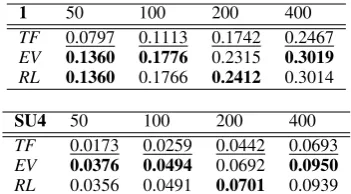
1 50 100 200 400
TF 0.0797 0.1113 0.1742 0.2467
EV 0.1360 0.1776 0.2315 0.3019
RL 0.1360 0.1766 0.2412 0.3014
SU4 50 100 200 400
TF 0.0173 0.0259 0.0442 0.0693
EV 0.0376 0.0494 0.0692 0.0950
[image:6.595.328.504.61.158.2]RL 0.0356 0.0491 0.0701 0.0939
Table 2: Comparison of Rouge scores for thetf*idf (TF),event(EV) andrelation(RL).
be composed of non-contiguous words (with as many as four words intervening). Rouge-SU4 also includes unigrams to decrease the chances of zero scores where there is no skip-bigram overlap.
The configuration is based on comparisons be-tween Rouge and human judgements of content coverage (Lin, 2004), which suggest that Rouge-1 and Rouge-SU4 with stemming and removal of stop words are good measures for evaluating multi-document summarisation tasks, consistently achieving Pearson’s correlation scores above 0.72 and as high as 0.9 for longer summaries. Paired Wilcoxon signed ranks tests across document sets are used to check for significant differences be-tween systems. The paired Wilcoxon signed ranks test is a non-parametric analogue of the pairedt test. The null hypothesis is that the two popula-tions from which the scores are sampled are iden-tical.
6 Results
Can extractive summarisation be improved us-ing representations based on generic
informa-tion extracinforma-tion? Table 2 contains results for
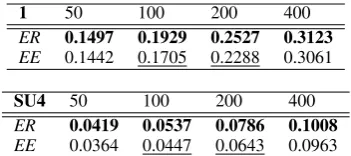
1 50 100 200 400
ER 0.1497 0.1929 0.2527 0.3123
EE 0.1442 0.1705 0.2288 0.3061
SU4 50 100 200 400
ER 0.0419 0.0537 0.0786 0.1008
[image:7.595.93.269.61.139.2]EE 0.0364 0.0447 0.0643 0.0963
Table 3: Comparison of Rouge scores for entity pairs based on relations (ER) and events (EE).
How does entity pair identification for generic relations compare to entity pair identification
for atomic events? Table 3 contains results for
the representations described in Section 4.4. Rows correspond to entity pair identification for rela-tions (ER) and events (EE).10Results suggest that
the entity pair model based on GRE data out-performs the entity pair model based on atomic events, at least for medium sized summaries of 100 and 200 words whereERis significantly better thanEEfor both Rouge measures.
How do the event and relation representations perform with respect to corresponding entity
pair representations? The scores for the entity
pair representations reported in Table 3 are statisti-cally indistinguishable from those for correspond-ing relation andevent representations in Table 2 above. This appears to be a mixed result for both the relation representation introduced here and the Filatova and Hatzivassiloglou event represen-tation. And, while GRE is shown to have a positive effect on Rouge scores when compared to atomic events, the same cannot be said of approaches to characterising relation and event types. How-ever, as the correlation analysis (Section 7.1 be-low) demonstrates, RL and ER do not necessar-ily perform well on the same document sets. This suggests that they are actually complementary to some degree, meaning that a combined system based on both representations would outperform RL and ER on their own.
10In contrast to the results for thetf*idf,relationandevent representations which use the modified adaptive algorithm described above, results for entity pair representations use a simplified version of the EXTRACTfunction that picks the text unit that has the highest score. This performed signifi-cantly better than the modified adaptive algorithm (p≤0.01) for all summary lengths forERand was indistinguishable for
EE. See Hachey (2009) for details.
7 Analysis and Comparison
7.1 Complementarity
Figure 4 contains results for a correlation analy-sis comparing the various representations. This also includes a comparison to the human upper bound (HU), computed by leave-one-out cross val-idation. Cells in the matrix contain the correla-tions values measured across document set Rouge-SU4 scores11using Spearman’sρrank correlation
coefficient (rS). Here, high values mean that two representations tend to perform well on the same document sets such that an ordering of document sets by Rouge scores is similar for the representa-tions being compared. In the figure, correlation strength is represented by shading where light-toned squares indicate strong correlation (and the darkest squares indicate weak negative correla-tion). For example, the upper left cell containsrS between the TF and EV representations. The four squares correspond torS values of -0.085, 0.199, 0.245 and 0.267 respectively for summaries of 50, 100, 200 and 400 words.
The analysis illustrates a number of interest-ing points. First, it demonstrates that none of the representations correlate highly with the hu-man upper bound, meaning that the automatic sys-tems do not necessarily do well on the document sets that may be considered easier as measured by human agreement using Rouge. This suggests that task difficulty does not need to be considered as a possible underlying cause of correlation be-tween the automatic systems. The analysis also illustrates that there is no clear and consistent re-lationship between summary length and correla-tion values. Some cells suggest that correlacorrela-tion may have a monotonic linear relationship increas-ing with length (e.g., TF*EV) while others seem to suggest inverse linear (e.g., TF*RL), quadratic (e.g., EV*HU) and invariant (e.g., EV*EE) rela-tionships with length.
Looking at correlation between automatic sys-tems (i.e., TF, EV, RL, EE and ER), correla-tion values closer to zero suggest that the sys-tems do well on different document sets and that a combined system might therefore be better. By this reasoning, the largest gains would come from combining TF with any other representation. Among the other automatic systems, therelation
-0.1 0.1 0.3 0.5 0.7 Rouge-SU4
400 200 HU 100 50 400 200 ER 100 50 400 200 EE 100 50 400 200 RL 100 50 400 200 EV 100 50
[image:8.595.129.485.94.207.2]ER EE RL EV TF
Figure 4: Comparison of representations using Spearman’s rs. Row and column labels correspond to tf*idf(TF),event(EV),relation(RL),event entity pair(EE),relation entity pair (ER) and human (HU) representations. Lighter toned squares indicate stronger correlation.
representation (RL) shows moderately high poten-tial for combination with its corresponding entity pair representation (ER) with Spearman’srS val-ues in the range from 0.348 to 0.476. This sug-gests that ER should not necessarily be consid-ered a simpler representation of the same infor-mation captured by RL when comparing results. Theeventrepresentation (EV), by contrast, shows the strongest correlation of any comparison with its corresponding entity pair representation (EE) withrSvalues in the range from 0.541 to 0.725.
7.2 Error Analysis
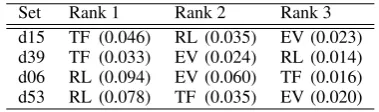
Four document sets were considered for error analysis. These were selected to cover different relative rankings of representations. Rows in Ta-ble 4 give the document set ID and list the repre-sentations in order of their Rouge-SU4 scores. In-spection of the corresponding document sets sug-gests that the different approaches compared here are appropriate for different types of summary tasks. Specifically, it suggests that relation and eventrepresentations perform poorly on summari-sation tasks that are oriented towards sentiment, description or analysis. However, they do well on document sets that are oriented towards fac-tual information typical of information extraction tasks (though current representations do not cap-ture date, time or numeric information). This sup-ports the notion from the previous section that the different representations evaluated here are com-plementary.
The document set (d06) for the summaries in Figure 5 illustrates a case where therelation and event representations perform well with respect
Set Rank 1 Rank 2 Rank 3
[image:8.595.321.511.290.346.2]d15 TF (0.046) RL (0.035) EV (0.023) d39 TF (0.033) EV (0.024) RL (0.014) d06 RL (0.094) EV (0.060) TF (0.016) d53 RL (0.078) TF (0.035) EV (0.020)
Table 4: DUC 2001 document sets chosen for er-ror analysis and corresponding Rouge-SU4 scores.
to tf*idf. The gold standard summary describes a beating event, addressing the basic facts of the Rodney King beating by Los Angeles police as well as the political aftermath which consists pri-marily of an investigation and a summary of re-lated police brutality events. The difference in performance seems to be due to the fact that re-lations and events are central to all aspects of this summary and therelationandevent represen-tations clearly do better than tf*idf at capturing this information. This summary also illustrates an unintended side-effect of the relation representa-tion where the generic relarepresenta-tion identificarepresenta-tion algo-rithm finds relations between components of lex-ical compounds or multi-word phrases. The rep-resentation for the third sentence in the RL sum-mary, for example, includes a relation between ORG police and XFN chief in addition to true positive relations e.g. betweenORG police and PER darylgates and false positive
re-lations e.g. between PER tombradley and
ORG police.
7.3 Comparison to Supervised Extraction
TF
(0.016) (20/29)
[S1]Mr. Williams likened the report to the Knapp Commission, a 1970s blue-ribbon study that exposed widespread corruption in the New York Police Department and led to significant improvements there.[S2]
“There’s no doubt in our mind that the only reason they stopped Joe Morgan was because he is black and he was the first black who happened to come by,” said William Barnes, one of the attorneys representing the former ballplayer. [S3]Joseph McNamara, retired chief of San Jose’s department and now a fellow at Stanford University’s Hoover Institution, said he has been getting calls all summer from[END]cities around the country about racism and brutality in their departments.
EV
(0.060) (9/29)
[S1]A high-ranking commission appointed after the beating, under the chairmanship of Mr Warren Christopher, a lawyer and former deputy secretary of state, concluded that the Los Angeles police de-partment got results, in terms of arrests, but had developed a ‘siege mentality that alienates the officer from the community’.[S2]The images of Los Angeles police swinging nightsticks at King as he lay on the ground, played repeatedly on national news programs, were burned into the national conscience and led to widespread calls for investigation of police brutality. [S3]Besides recommending that Mr Gates should go, the Christopher commission urged a policy[END]of community policing with more foot pa-trols, as well as measures to discipline racist police officers and to improve the investigation of complaints about police brutality.
RL
(0.094) (3/29)
[S1]Mr. Gates opposed the Police Corps because its members would not be professionals.[S2]Shortly after Rodney King’s beating, a news program on ABC illustrating police brutality showed a still photo of police using a martial-arts weapon against a person being arrested, but there was no mention that the episode involved Operation Rescue.[S3]The report was issued yesterday by a commission appointed by Mayor Tom Bradley and Police Chief Daryl Gates in the wake of the videotaped beating March 3 of a black motorist, Rodney King, by Los Angeles police.[S4]Investigations have been launched by the FBI, the Los[END]Angeles County district attorney’s office and the Long Beach Police Department.
HU
(0.400) (15/29)
The most important of the many cases of police brutality reported in southern California 1989-1992, was the beating of Rodney King by four Los Angeles officers on March 3, 1991. An investigating commission outlined steps for improvement of the police department and called for the resignation of Chief Gates. Gates did not resign until the following year after the acquittal of the four officers caused massive rioting. Other cases of police brutality arose in Minneapolis, Chicago and Kansas City. Operation Rescue claimed that its non-violent anti-abortion demonstrators were seriously injured by excessive police tactics in more than[END]50 cities.
Figure 5: Example system andhuman(HU) summaries whererelation(RL) andevent(EV) representa-tions perform well with respect to thetf*idf(TF) representation: Police Brutality Document Set (d06).
the DUC 2001 data. However, it uses supervised machine learning (probabilistic support vector ma-chines) to derive a salience function while we fo-cus on unsupervised approaches that can be ported to new domains and tasks without annotation or training. Interestingly, Wong et al.’s results sug-gest that adding events to a word-based feature set increases the precision of supervised sentence extraction but reduces the recall. By contrast, the current results and analysis provide evidence that word and generic IE-based representations are complementary when using unsupervised salience functions for sentence extraction.
The Wong et al. (2008) paper also provides use-ful results for comparison to state-of-the art. On the 200 word summarisation task, Wong et al. re-port Rouge-1 scores of 0.352 and 0.344 respec-tively for word-based and event-based represen-tations. On the same task, our unsupervised ap-proach achieves Rouge-1 scores of 0.174, 0.232, 0.229, 0.241 and 0.253 respectively for thetf*idf, event, event entity pair, relationand relation en-tity pairrepresentations. Wong et al.’s best overall score is 0.396 using a representation that combines surface, content and relevance features.
8 Conclusion
Acknowledgments
This work was supported by Scottish Enterprise Edinburgh-Stanford Link grant R37588 as part of the EASIE project at the University of Edinburgh. It would not have been possible without the guid-ance of Claire Grover and Mirella Lapata.
References
Daniel Bienstock and Garud Iyengar. 2004. Faster approximation algorithms for packing and covering problems. Technical Report TR-2004-09, Columbia University.
David Blei, Andrew Y. Ng, and Michael I. Jordan. 2003. Latent Dirichlet allocation. Journal of Ma-chine Learning Research, 3:993–1022.
Nancy Chinchor. 1998. Overview of MUC-7. In Pro-ceedings of the 7th Message Understanding Confer-ence, Fairfax, VA, USA.
James R. Curran and Stephen Clark. 2003. Language independent NER using a maximum entropy tagger. In Proceedings of the 7th Conference on Natural Language Learning, Edmonton, Alberta, Canada. Gerald DeJong. 1982. An overview of the FRUMP
system. In Wendy G. Lehnert and Martin H. Ringle, editors, Strategies for Natural Language Process-ing, pages 149–176. Lawrence Erlbaum Associates, Hillsdale, NJ.
Elena Filatova and Vasileios Hatzivassiloglou. 2004. Event-based extractive summarization. In Proceed-ings of the ACL Text Summarization Branches Out Workshop, Barcelona, Spain.
Claire Grover, Colin Matheson, Andrei Mikheev, and Marc Moens. 2000. LT TTT—a flexible tokeni-sation tool. InProceedings of the 2nd International Conference on Language Resources and Evaluation, Athens, Greece.
Ben Hachey. 2009. Towards Generic Relation Extrac-tion. Ph.D. thesis, University of Edinburgh.
Udo Hahn and Ulrich Reimer. 1999. Knowledge-based text summarization: Salience and general-ization operators for knowledge base abstraction. In Inderjeet Mani and Mark T. Maybury, editors, Advances in Automatic Text Summarization, pages 215–232. MIT Press, Cambridge, MA.
Sanda M. Harabagiu and Steven J. Maiorano. 2002. Multi-document summarization with GISTexter. In Proceedings of the 3rd International Conference on Language Resources and Evaluation, Las Palmas, Spain.
Dorit S. Hochbaum. 1997. Approximating covering and packing problems: set cover, vertex cover, in-dependent set and related problems. In Dorit S.
Hochbaum, editor, Approximation Algorithms for NP-Hard Problems, pages 94–143. PWS Publishing Company, Boston, MA.
Dekang Lin. 1998. Dependency-based evaluation of MINIPAR. InProceedings of the LREC Workshop Evaluation of Parsing Systems, Granada, Spain. Chin-Yew Lin. 2004. ROUGE: a package for
auto-matic evaluation of summaries. InProceedings of the ACL Text Summarization Branches Out Work-shop, Barcelona, Spain.
Hans P. Luhn. 1958. The automatic creation of litera-ture abstracts. IBM Journal of Research and Devel-opment, 2(2).
Inderjeet Mani. 2001. Automatic Summarization. John Benjamins, Amsterdam/Philadelphia.
Kathleen R. McKeown, Desmond A. Jordan, and Vasileios Hatzivassiloglou. 1998. Generating patient-specific summaries of online literature. In Proceedings of the AAAI Spring Symposium on In-telligent Text Summarization, Stanford, CA, USA. Ellen Riloff. 1996. Automatically generating
extrac-tion patterns from untagged text. In Proceedings of the 14th National Conference on Artificial Intelli-gence, Portland, OR, USA.
Horacio Saggion and Guy Lapalme. 2002. Generat-ing indicative-informative summaries with SumUM. Computational Linguistics, 28(4):497–526.
Karen Sp¨arck Jones. 1972. A statistical interpretation of term specificity and its application in retrieval. Journal of Documentation, 28(1):11–21.
Karen Sp¨arck Jones. 2007. Automatic summarising: The state of the art. Information Processing and Management, 43:1449–1481.
Simone Teufel and Marc Moens. 2002. Summariz-ing scientific articles – experiments with relevance and rhetorical status. Computational Linguistics, 28(4):409–445.
Michael White and Claire Cardie. 2002. Selecting sentences for multidocument summaries using ran-domized local search. In Proceedings of the ACL Workshop on Automatic Summarization, Philadel-phia, PA, USA.
Michael White, Tanya Korelsky, Claire Cardie, Vincent Ng, David Pierce, and Kiri Wagstaff. 2001. Mul-tidocument summarization via information extrac-tion. InProceedings of the 1st International Con-ference on Human Language Technology Research, San Diego, CA, USA.