Abstract— The infrastructure requirement for setting up
catfish farms include, a source of clean water, an avenue for discharging the waste water and reliable water containment systems. The challenges faced by the operators of these fish ponds include the need for regular feeding of the fish, monitoring of the water quality and the changing of the water when the quality becomes unhealthy for the fish. This work presents an Internet of Things based approach for automating the management of the farms and enabling remote monitoring and management of the ponds. The system comprise of a pond controller which uses appropriate sensors to monitor the water quality of the pond. A CCTV records the activities around the pond and stores them in a cloud location. The Pond controller manages the automatic feeding system of the fish and the water control system for the pond. The system is also designed with capacity for remote operation through a specially designed mobile application which accesses the CCTV files and also controls the operation of the pond controller. This system will enable the management of one or more fish ponds from one mobile device, it will reduce the costs associated with managing the fish farms and improve quality of their yield.
Index Terms—Catfish, Fishpond Management, IoT, Remote
Monitoring
I. INTRODUCTION
ATFISH farming in Nigeria is becoming one of the most lucrative entrepreneurial activities due to the low technology, low cost deployment investment and the 3 to 6 month harvesting cycles. The possibility of utilizing artificial plastic containers, concrete ponds or excavated ponds provides an opportunity for entrepreneurs to participate at different levels. While some focus on the production of fingerlings, other focus on the breeding of the fingerlings to market sizes and a lot of other focus on either
Manuscript received March 29, 2017; revised July 04, 2017. This work was supported by Covenant University This work was supported by Covenant University.
Francis E Idachaba is currently an Associate Professor of Communication Engineering in the department of Electrical and Information Engineering in Covenant University Ota Ogun State. e-mail: [email protected]
Joseph Olowoleni is a PhD student and member of faculty in the Department of Electrical and Information Engineering in Covenant University Ota Ogun state in Nigeria; e-mail: [email protected]
Augustus Ehiremen Ibhaze is a PhD student and faculty the department of Electrical and Information Engineering in Covenant University e-mail: [email protected].
Oluyinka Oni is a PhD student and member of faculty in the Department of Electrical and Information Engineering in Covenant University Ota Ogun State in Nigeria. E-mail: [email protected].
the sale of this fish or the smoking and selling of the fish to consumers. [1]The use of artificial ponds however introduces a number of challenges as the pond owners must monitor and manage the water quality, the changing of the water and the feeding and feeding cycles of the fish. These processes have very significant impact on the growth and wellbeing of the fish as the use of a contained water environment leads to the buildup of toxic chemicals such as ammonia [2]. Other pond water quality parameters are listed in [3]. Feeding or fertilization of the ponds also results in a reduction in the water quality as the amount of dissolved feeds and suspended fertilizers can also impact on the dissolved oxygen. When ponds are fertilized, nutrients stimulate the growth of microscopic plants in the water (phytoplankton). Phytoplankton is food for other organisms (zooplankton and larger animals) that are eaten by fish. Abundant growth of these microscopic plants gives water a turbid, greenish color (called a “bloom”) that can prevent light from reaching the pond bottom and reduce the growth of rooted aquatic weeds. Fish farmers and recreational farm pond owners fertilize ponds to increase fish production and prevent rooted aquatic weeds from becoming established. [4]. The impact of the suspended fertilizer and feeds often time results in the buildup of chemicals which results in death to the fish. The most common cause of major fish kills in ponds is low dissolved oxygen. Fish kills from infectious diseases, pesticides or chemical contamination are extremely rare in private ponds. Minor fish kills in the form of a few dead fish per day are usually due to water quality problems other than dissolved oxygen [5] [6] [7] [8]. The internet of things concept can be defined as a system of interrelated devices with unique identifiers capable of acquiring data, transmitting these data over a transmission media and also receiving control signals over the transmission media without requiring, human-to-human or human-to-computer interaction. The concept enables remote monitoring, autonomous operation and remote control of systems. [9][10][11][12].
Impact of Water Quality on Fish Growth
The quality of water available to the fish is one of the most important factors in fish production. This is made more severe for fish kept in ponds or contained water environments as the fish are not able to move or relocate when the water quality becomes too poor. Water quality directly affects feed efficiency, growth rates and overall health status of the fish. A number of parameters can be used to measure the quality of the water available to the fish but the critical of these parameters include dissolved oxygen, un-ionized ammonia, carbon dioxide, nitrite and
IoT Enabled Real-Time Fishpond Management
System
Francis E. Idachaba, Joseph O. Olowoleni, Augustus E. Ibhaze, Oluyinka O. Oni
nitrate concentration, pH, turbidity and alkalinity levels [13].
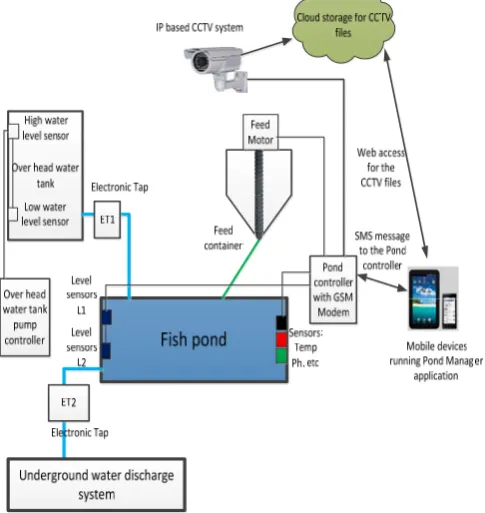
[image:2.595.48.291.354.611.2]II. FISHPONDMANAGEMENTSYSTEM The fish pond management system is implemented using a pond controller which comprises of sensors for monitoring the water quality, a system for feeding the fish and a system for changing the pond water. The fish pond management system is also designed with a remote control capacity using a specially designed mobile application called the Pond Manager. From this mobile application, requests can be sent to the Pond Controller and the readings of the sensors will be sent back to the user. The pond also has an IP based Closed Circuit TV system which records the ponds whenever feeding or water change activities are taking place in the pond. The CCTV can also be activated by motion detectors to record the activities around the pond. The IP enabled CCTV camera is configured to upload the video files to a cloud storage and these files can be accessed on demand through the Pond Manager application of the Mobile device. The feeding and water change activities can also be initiated from the Pond Manager application on the mobile device. The system block diagram is shown in Figure 1.
Figure 1. IoT Enabled Fish Pond Management System
III. SYSTEMDESIGN
A. Water Management
The water management comprise of a sensor system for monitoring the water quality and a system for changing the water in the pond. The sensor (Cleanliness sensor) monitors the cleanliness of the pond by transmitting a light pulse from a transmitter to a receiver. When the dissolved food particles exceeds a threshold where the light pulses can no longer get to the receiver, the sensor interprets this as a state of very poor water quality and this triggers the water change
process. The block diagram of the Cleanliness Sensor (Cls) is shown in figure 2
Figure 2: Cleanliness sensor (Cls) and installation
B. Water Changing System
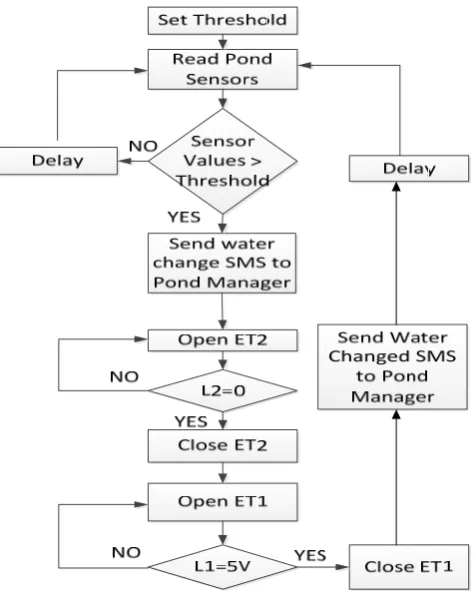
[image:2.595.298.554.478.606.2]The water changing system comprises of a system for managing the discharge of the pond water when it is due for changing either due to the amount of dirt in the pond water or due to high pH or temperature values. The system has an integrated level detection systems which enables the controller know when to start/ stop the discharge of the pond water and when to also start and stop the filling process. The system also incorporates an optional controller for the overhead water storage system on the farm and this system also monitors the overhead water tank level and pumps water into the overhead tank whenever it is below a preset low value. The level monitoring system and the flowchart for controlling the discharge and refill systems are shown in Figure 3.
Figure 3: Water level system
Figure 4: Water changing Flowchart
From the water changing flowchart showing in Fig 4, the pond controller monitors the sensors of the ponds and compares the values with the preset threshold values of each of the sensors. When any of the sensor values exceeds the threshold value, this indicates an unhealthy condition for the fish and the water will have to be changed. The system sends an SMS message to the pond manager application informing him or her of the situation and then the system commences the changing of the pond water. If the sensors are below the threshold values, the pond controller executes a delay which is a period of rest for some minutes before reading the sensors again. After the water changing process is completed, the pond controller executes a longer delay process before repeating the reading of the sensors. The pond controller then sends another message to the pond owner informing him or her of the successful completion of the water changing activity.
C. Feeding Sytem
The feeding of the fish is a very critical aspect of their growth and it must be done frequently and in the right quantities. The pond controller utilizes an off-on cycle where the feed motor is activated for a specific period to dispense the feed stored in the container after which it is switched off for 6 hours and the cycle starts all over to maintain 4 feeding sessions in a 24hour time frame.
The feeding rate and frequencies vary as the fish grows and this should be lowered as the fish grows so as to reduce the protein content of the fish feed intake. Different feed compositions can be used to implement a reduction in the protein quantity however rather than switching to a lower protein diet, feeding less allows the fish farmer or pond owner to use the same feed (protein level) throughout the grow-out period, thereby simplifying feed inventory and
storage. Feeding fish is labor-intensive and expensive. Feeding frequency is dependent on labor availability, farm size, and the fish species and sizes grown. Large catfish farms with many ponds usually feed only once per day because of time and labor limitations, while smaller farms may feed twice per day. Generally, growth and feed conversion increase with feeding frequency. In indoor, intensive fish culture systems, fish may be fed as many as 5 times per day in order to maximize growth at optimum temperatures. [14]
A number of factors affect the feeding rates of the fish. These factors include time of day that the feeds are delivered, season, water temperature, dissolved oxygen levels, and other water quality variables. The feed management system is implemented by a feed delivery system which comprise of a screw system and a feed motor. The motor is controlled by the pond controller and as it revolves, the cork screw shaft delivers the feeds to the pond. This is process is repeated as often as is desired depending on the state and the growth level of the fish. With this system, the quantity and frequency of the fish can be controlled and programed with a high degree of accuracy.
D. Pond Controller
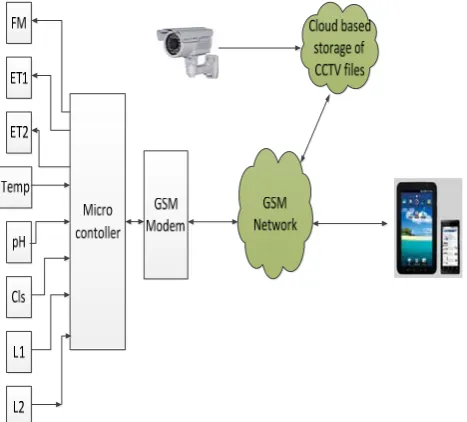
The Pond Controller comprise of a microcontroller interfaced to the Temp and pH sensor, the Electronic Controlled Taps ET1 and ET2, the Pond water level sensors L1 and L2, the cleanliness Sensor (Cls) and the fed motor. The pond controller also has a GSM integrated into it for communicating with the Pond manager. The block diagram of the pond controller is shown in Figure 5.
Figure 5. Pond Controller
E. Pond Manager Application
[image:3.595.307.549.426.607.2]environments. Mobile user interface (UI) design is also essential in the creation of mobile apps. Mobile UI considers constraints, contexts, screen, input, and mobility as outlines for design. The user is often the focus of interaction with their device, and the interface entails components of both hardware and software. User input allows for the users to manipulate a system, and device's output allows the system to indicate the effects of the users' manipulation. Mobile UI design's goal is for an understandable, user-friendly interface. The UI of mobile apps should: consider users' limited attention, minimize keystrokes, and be task-oriented with a minimum set of functions [15] [16]. The Pond Manager Application comprise of a mobile application designed to enable remote monitoring and control of the pond. The application sends SMS signals to the Pond Controller which comprise of the microcontroller and a GSM Modem. The control commands are embedded in SMS messages and sent by the Pond Manager application to the Pond controller. The GSM modem serves as the link between both systems as it enables the reception of the SMS message while the microcontroller decodes the messages and activates the appropriate actuator or Tap. The Pond Manager can also request for the sensor values to know the state of the pond water at any given time. The user or pond owner can initiate a change of the water by sending the change water command while the CCTV files can be viewed by logging onto the cloud storage site for the files of the CCTV recording. The CCTV can be configured to record continuously or can be configured to record on the detection of an intruder in the pond area. This will however require the integration of the appropriate motion detection sensors. The CCTV can also be configured to record whenever the feeding or water change activities are taking place. In view of the use of the GSM network infrastructure for the transmission of the control commands, the Pond Manager mobile application will have to be installed on SIM enabled mobile devices or GSM smartphones. The webpage for the Pond Manager application is shown in Figure 7 while the Pond Manager configuration is shown in figure 6.
Figure 6: Pond Manager Configuration
Sensor Data Value
pH
Temperature
Cls
Message
[image:4.595.47.281.534.745.2]
Figure 7: Pond Manager Application Page
The user interface for the pond manager application has a provision for the name of the pond and it has several buttons used to initiate control activities at the pond. The buttons include:
Feed: This button sends an SMS to the pond controller and it initiates the feeding sequence of the pond
Request for Sensor Data: This button sends an SMS to the pond controller and it causes the pond controller to send a reply comprising of the sensor values from the pH, Temperature and the Cls sensors. The data are populated in the table shown on the user interface.
View Pond: This button causes the mobile device to log on the cloud location where the video files from the CCTV are stored. The CCTV video files are displayed on the CCTV space on the user interface.
Change water: This button activates the water changing process of the pond.
Message: This is where SMS messages from the pond controller are displayed.
IV. CONCLUSION
REFERENCES
[1] Chapter 10: Running a fish farm as a business. Available online
http://www.ag.auburn.edu/fish/international/uganda/docs/catfishmanu
al chapters/Section II and Ch10_Running a Fish Farm as a Business.pdf
[2] J.A Hargreaves and C.S Tucker. Managing Ammonia in Fish Ponds. Southern Regional Aquaculture Center. SRAC Publication No 4603. 2004.
[3] Chapter 5 Water Quality and general Pond management. Available online
http://www.ag.auburn.edu/fish/international/uganda/docs/catfish
manual chapters/Chapter5_WaterQuality and General Pond
Management.pdf
[4] M.W Brunson, N Stone and J.A Hargreaves Fertilization of Fish ponds. Southern Regional Aquaculture Center. SRAC Publication No 471. 1999.
[5] S Jones, N. Stone., A.M Kelly, G.L Selden, B.A Timmons, J.K Whisenhunt and M. Oliver. Farm Pond Management for Recreational Fishing. University of Arkansas at Pine Bluff. Cooperative Extension Program. MP360PD32016RV.
[6] R.M Durborow, D.M Crosby and M.W Brunsom. Ammonia in Fish Ponds. Southern Regional Aquaculture Center. SRAC Publication No 463. 1992
[7] N.M Stone and H.K Thomforde. Understanding Your Fish Pond. Water Analysis Report. University of Arkansas at Pine Bluff. Cooperative Extension Program.
[8] C.C Ngugi, J.R Bowman and O.O Bethuel. A new guide to fish farming in Kenya. Aquaculture Collaborative Research Support Program. College of Agricultural Science Oregon State University [9] O. Vermesan and P. Friess. Internet of Things- from Research and
Innovation to market Deployment. River Publishers series in Communication 2014
[10] Understanding the Internet of Things (IoT) GSM Association 2014 [11] S. Jankowski, J. Covello, H. Bellini, J. Ritchie and D.Costa. Internet
of Things: Making sense of the next mega-trend. Goldman Sachs 2014.
[12] O.Vermesan, P. Friess. P. Guillemin, S. Gusmeroli. H Sundmaeker, A. Bassi, I.S Jubert, M. Mazura., M. Harrison, M. Eisenhauer and P. Doody. Internet of Things Strategic Research Roadmap.
http://www.internet-of-things-research.eu/pdf/IoT_Cluster_Strategic_Research_Agenda_2011.pdf
[13] S.M Samir and AM. Batran Evaluation of Water Quality Parameters in Two Different Fish Culture Regimes. 4th Conference of Central Laboratory for Aquaculture Research (2014), 17-33
[14] S. Craig, and L. A. Helfrich. Understanding Fish Nutrition, Feeds, and Feeding .Virginia Cooperative Extension Virginia state University May 2009.
[15] Mobile Application Development. Wikipedia.
https://en.wikipedia.org/wiki/Mobile_application_development