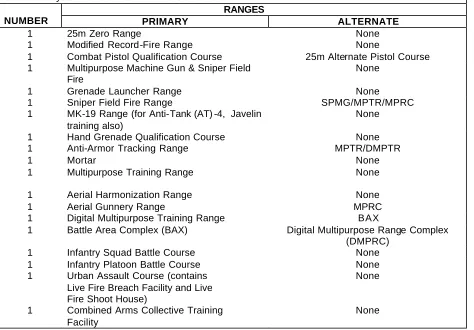
TRAINING RANGES
This publication is available at
Army Knowledge Online
Training Circular HEADQUARTERS No. 25-8 DEPARTMENT OF THE ARMY Washington, DC, 5 April 2004
TRAINING RANGES
Contents
Page
Figures ... iii
Tables ... v
Preface...vii
Chapter 1. Introduction
Overview...1-1 Army Ranges ...1-1 Challenge ...1-2 Approaches ...1-2 Planning 1-2
Chapter 2. Range Modernization
The Range Modernization Program...2-1 Future Outlook ...2-2
Chapter 3. Training Areas and Centers
Introduction...3-1 Local Training Areas (LTA) ...3-1 Major Training Areas (MTA)...3-1 Combat Training Centers (CTC)...3-2 Training Area Functional Uses...3-2
Chapter 4. Range Requirements
Introduction...4-1 Determining Training Requirements...4-1 Assessing Range Needs ...4-2 Range Availability...4-3 Scheduling and Utilization ...4-3 Quantifying Range Requirements...4-5 Throughput Capacity...4-7 Throughput Requirements...4-7 Armored Vehicle Gunnery Requirements ...4-8 Range Selection ...4-11
Chapter 5. Range Development
Introduction...5-1 Planning 5-1
Facilities and Equipment ...5-4 Training Schedules ...5-5 Training Aids, Devices, Simulators, Simulations, and Sub-Caliber Ranges...5-5 Resource Management...5-5 Host Nations…… ...5-5 Alternatives and Justification…………...………5-5 Site Planning Process...5-6 Terrain ...5-7 Range Impact Area Requirements ...5-8 Gun-Target Lines ...5-8 SDZ Requirements ...5-8 Target Areas...5-9 Target Visibility ...5-9 Range Analysis and Design System ...5-9 Target Accessibility and Protection...5-10 Gun-Target Engagement Sequence ...5-10 Preliminary Documentation ...5-10 Project Summary ...5-11
Chapter 6. Range Operations
Introduction...6-1 The Range Organization ...6-1 Range Control and Scheduling ...6-2 Live-Fire Operations ...6-3
APPENDIX A. Range Selection ...A-1
APPENDIX B. Range Equipment ...B-1
APPENDIX C. Live-fire Checklist...C-1
APPENDIX D. Army Ranges ...D-1
APPENDIX E. RTLP Planning Process ... E-1
Glossary...Glossary-1 Section I Abbreviations...Glossary-1 Section II Terms ...Glossary-5
References...Reference-1 Section I Sources...Reference-1 Section II Required Documents ...Reference-1 Section III Recommended Readings...Reference-1
__________________________
APPENDIX A. Range Selection... A-1
APPENDIX B. Range Equipment ... B-1
APPENDIX C. Live-fire Checklist... C-1
APPENDIX D. Army Ranges... D-1
APPENDIX E. RTLP Planning Process ... E-1
Glossary ... Glossary-1 Section I Abbreviations...Glossary-1 Section II Terms ...Glossary-5
References... Reference-1
Section I Sources... Reference-1 Section II Required Documents ... Reference-1 Section III Recommended Readings ... Reference-1
FIGURES
Page
Figure B-54. Low radar cross section tow sphere target... B-42 Figure B-55. Snatch banner target ... B-42 Figure B-56. Aerial gunnery tow target ... B-43 Figure B-57. TRX-4A Towbee ... B-43 Figure B-58. Army rifle target A, 200-300 yards... B-44 Figure B-59. Navy and Marine Corps rifle target A, 200-300 yards ... B-44 Figure B-60. Army rifle target B, 600 yards ... B-45 Figure B-61. Navy and Marine Corps rifle target B, 600 yards ... B-45 Figure B-62. Army rifle target C, 1000 yards ... B-46 Figure B-63. Navy and Marine Corps rifle target C, 1000 yards ... B-46 Figure B-64. Navy and Marine Corps target D, prone ... B-47 Figure B-65. Navy and Marine Corps target D, prone ... B-47 Figure B-66. Range outer limit marker... B-48 Figure B-67. Range lane markers ... B-49 Figure B-68. Target pasters ... B-50 Figure B-69. Range interior limit markers ... B-50
ARMY RANGES
Figure D-1. FCC 17801 RIFLE/MACHINE GUN ZERO RANGE ...D-4 Figure D-2. FCC 17803 AUTOMATED FIELD FIRE (AFF) RANGE ...D-5 Figure D-3. FCC 17805 AUTOMATED RECORD FIRE (ARF) RANGE ...D-6 Figure D-4. FCC 17806 MODIFIED RECORD FIRE (MRF) RANGE ...D-7 Figure D-5. FCC 17809 QUALIFICATION TRAINING RANGE (QTR) ...D-8 Figure D-6. FCC 17812 AUTOMATED SNIPER FIELD FIRE RANGE ...D-9 Figure D-7. FCC 17816 BAYONET ASSAULT COURSE ...D-10 Figure D-8. FCC 17822 AUTOMATED COMBAT PISTOL/MILITARY POLICE FIREAMS
QUALIFICATION COURSE (CP/MPQC) ...D-11 Figure D-9. FCC 17829 HEAVY SNIPER RANGE ...D-12 Figure D-10. FCC 17833 MULTIPURPOSE MACHINE GUN (MPMG) RANGE ...D-13 Figure D-11. FCC 17845 ANTI-ARMOR TRACKING AND LIVE FIRE COMPLEX...D-14 Figure D-12. FCC 17852 MORTAR RANGE ...D-15 Figure D-13. FCC 17856 FIELD ARTILLERY INDIRECT RANGE ...D-16 Figure D-14. FCC 17858 SCOUT/RECONNAISSANCE GUNNERY COMPLEX (SCOUT/RECCE) ...D-17 Figure D-15. FCC 17859 DIGITAL MULTIPURPOSE TRAINING RANGE (DMPTR) ...D-18 Figure D-16. FCC 17860 DIGITAL MULTIPURPOSE RANGE COMPLEX (DMPRC) ...D-19 Figure D-17. FCC 17865 MULTIPURPOSE TRAINING RANGE (MPTR) ...D-20 Figure D-18. FCC 17867 MULTIPURPOSE RANGE COMPLEX (MPRC) ...D-21 Figure D-19. FCC 17870 BATTLE AREA COMPLEX (BAX) ...D-22 Figure D-20. FCC 17872 AIR DEFENSE FIRING RANGE ...D-23 Figure D-21. FCC 17878 URBAN ASSAULT COURSE ...D-24 Figure D-22. FCC 17879 LIVE FIRE EXERCISE SHOOTHOUSE ...D-25 Figure D-23. FCC 17880 LIVE FIRE BREACH FACILITY ...D-26 Figure D-24. FCC 17882 HAND GRENADE QUALIFICATION COURSE...D-27 Figure D-25. FCC 17883 HAND GRENADE FAMILIARIZATION RANGE ...D-28 Figure D-26. FCC 17884 GRENADE LAUNCHER RANGE...D-29 Figure D-27. FCC 17885 LIGHT DEMOLITION RANGE ...D-30 Figure D-28. FCC 17891 INFILTRATION COURSE ...D-31 Figure D-29. FCC 17892 FIRE AND MOVEMENT RANGE ...D-32 Figure D-30. FCC 17893 SQUAD DEFENSE RANGE ...D-33 Figure D-31. FCC 17895 INFANTRY SQUAD BATTLE COURSE ...D-34 Figure D-32. FCC 17897 INFANTRY PLATOON BATTLE COURSE ...D-35 Figure D-33. FCC 17901 COMBINED ARMS COLLECTIVE TRAINING FACILITY (CACTF) ...D-36 Figure D-34 AROCA STANDARD ARMOR RANGE OPERATIONS AND CONTROL AREA
Figure D-35. SROCA STANDARD SMALL ARMS RANGE OPERATIONS AND CONTROL AREA FACILITIES ...D-38
TABLES
Page
Table 4-1. Typical range availability (days) ... 4-3 Table 4-2. Tank gunnery tables - time requirements (minutes) ... 4-6 Table 4-3. BFV team/squad gunnery tables and exercises – time requirements (AP only) (minutes)... 4-10 Table 4-4. BFV section/platoon gunnery tables – time requirements (hours) ... 4-11
PREFACE
This circular provides information about Army ranges. With AR 210-21, Army Ranges and Training
Land Program, this circular provides guidance for developing and operating Army ranges. It is a
working guide for trainers, range and mobilization planners, engineers, coordinators, and mandated range project review boards at all levels of the Active Army, Army National Guard, and Army Reserve. It is the primary guide for installation and major Army command range development plans and for developing the Army Master Range Plan.
Army Regulation 385-63, Policies and Procedures for Firing Ammunition for Training Target Practice and Combat, provides criteria and instructions for developing surface danger zones for weapons fired on Army and Marine Corps ranges. The US Army Training Support Center is the executive agent for the Deputy Chief of Staff for Operations and Plans, Headquarters Department of the Army, for the Army Range and Training Land Program. As such, the Army Training Support Center is the proponent for this circular.
Submit comments and recommendations on Department of the Army Form 2028, (Recommended Changes to Publications and Blank Forms) directly to Commander, US Army Training Support Center, ATTN: ATIC-ATMD, Fort Eustis, Virginia 23604-5166.
“The Division fought to train under realistic conditions in preparation for combat. The priorities were clear and subordinate leaders executed training that produced a disciplined, lethal and flexible force capable of accomplishing any tactical task.
- The requirement for tough realistic training has not changed in the past 227 years. The Division lived under the “train as you fight” motto for the 12 months that preceded the war. The training proficiency, lethality, and maturity of the Division serves as an example for the Army to follow.
- Lessons Learned:
- Key leader and soldier stabilization produced a mature fighting force.
- Combined arms force on force and live-fire exercises prepared units at all levels for
combat.
- Command and control training under offensive conditions at task force through
division level was essential to 3ID(M)’s success.” Operation Iraqi Freedom, Third
Infantry Division (Mechanized) “Rock of the Marne”, After Action Report Final Draft, 12 May 2003
Chapter 1 Introduction
1-1. Overview
a. Effective live training, carried out to a high doctrinal standard, is the cornerstone of operational success. The training of the critical tasks that individual, crew, platoon and companies have to accomplish to be combat ready is directly related to the availability and capability of live-fire ranges and maneuver areas. The continued improvement of live-fire ranges and facilities is key to the development of the go-to-war skills. Live -fire ranges and facilities will be even more important for units in the future as they must be able to be deploy and be operational within ninety-six hours in a combat zone. The successful implementation of the business end of the Future Combat System (FCS) Unit of Action is when the sharing of information in the sensor array allows for precision targeting and grouping of precision fires for target kills. This capability can only be validated on a live fire range or complex.
b. The Army modernization of the combat force from the Current Force to the Future Force will increase the lethality and precision of weapon systems over greater distances. As these weapons are introduced and combined with a net centric digital command and control the achievement of overwhelming tactical dominance and control of the battlefield will be obtained. The precision of the weapon system will allow for the determinate of appropriate force, preventing unnecessary loss of life, as well as laying the foundation for the future operational environment.
1-2. Army Ranges
a. The Army’s family of training ranges provides training opportunities to develop and improve soldier and team proficiency and competence in the use of sophisticated weaponry. Individual soldier proficiency and collective training ranges realistically portray combat conditions to mold the team into an effective fighting unit.
1-3. Challenge
a. As weapon systems become more lethal and capable of delivering greater firepower over increased distances Army ranges must change. Current training ranges are required to support soldiers using their weapons through live-fire, subcaliber devices, and laser and simulation technology. The ranges of the future must serve as the focal point of training as we integrate the Live-Virtual-Constructive linkups and add digital command and control elements. At company level and below soldiers train and hone their combat skills in live-fire and maneuver. In an era of intense resource competition, each dollar spent to develop, mitigate, or restore training ranges must deliver the maximum return in effective training and combat readiness.
b. With greater firepower and maneuver capabilities, the requirement for range land will continue to grow. Acquiring additional range lands will be difficult, so sustaining our current range lands becomes a critical task. Challenges to range land acquisition include: encroachment of commercial and private development, protection of threatened and endangered species, loss of wetlands, prevention of soil, surface and ground water contamination, deterioration of air quality and noise effects.
1-4. Approaches
a. One approach to meet the training challenge is to develop ranges capable of supporting training for multiple purposes, weapons, and combined arms. For example, training on an automated field-fire (AFF) range and an automated record-fire (ARF) range can be provided on a single modified record-fire (MRF) range, a land savings when compared to construction of separate ranges. The qualification training range (QTR) provides a similar capability to combine many other types of ranges, see Figure D-5.
b. Risk management integration is integral to successful range design, construction, use and sustainment. Early application of risk management in the planning process provides the planners and decision makes with alternatives that reduce safety hazards, limit adverse environmental impact and minimize operational constraints. Information and data developed during the risk management process will facilitate and expedite the development of environmental impact documentation and accelerate the approval process.
1-5. Planning
a. Range development projects require careful, deliberate planning by a team who coordinates the Range and Training Land Program (RTLP) process in accordance with Army Regulation (AR) 210-21, Army Ranges and Training Land Program, and this circular. The members of this interdisciplinary team are collectively called “range planners.” Range planners should seek innovative alternatives to fulfill training requirements. At the same time, they consider the need for ranges to support surge requirements on short notice in the event of mobilization. Command interest and support are essential to each step of the development process. Accurate, complete justification ensures that resource expenditures provide an optimum return.
b. The range planning team consists of: (1) trainers
(3) environmental and natural/cultural resource managers (4) financial and manpower resource managers
(5) range officers
(6) safety and occupational health managers (7) force developers
Chapter 2
Range Modernization
2-1. The Range Modernization Program
a. The increased accuracy and lethality of weapons was one driving force to change Army ranges. The other was the need to train soldiers in more realistic environments. The recognition that urban combat is unavoidable has resulted in new types of ranges such as Live Fire Exercise Shoothouses, Urban Assault Course, Battle Area Complex (BAX), and Combined Arms Collective Training Facility (CACTF). As the proponent schools identify training requirements, the Army will continue to modify existing ranges and build new types of ranges as required. The focus for ranges will be interoperability, standardization, improved targetry, digital capability and multi-purpose utility.
b. The Department of the Army (DA), Office of the Deputy Chief of Staff, G-3 (ODCS, G-3), manages the RTLP. The ODCS, G-3 coordinates training range activities with the U.S. Army Training and Doctrine Command (TRADOC), Corps of Engineers (COE), Army Materiel Command (AMC) IAW 350-38, Training Device Policies and Management, and other major Army commands (MACOM) to achieve operational readiness.
c. Army doctrine requires combined arms teamwork and synchronization. Units must train for wartime combined arms operations. Combined arms proficiency results from regular practice of combat missions and tasks in the live domain. It starts with the development of individual skills. Individual skills, when combined and practiced build unit proficiency from crew through brigade task force.
d. The modernization of Army ranges under the RTLP supports this doctrine. Range design and construction must support the development of soldier skills in individual weapons and crew-served weapon systems. The ranges also support unit training to standards established in Army Training and Evaluation Program (ARTEP) and Mission Training Plans (MTP). Multiple-use ranges meet these requirements and reduce construction and operating costs by permitting training with a variety of weapons on the same range. Many of these ranges support collective training for small units.
e. Computer technology can equip ranges with target remote control. These devices can depict realistic battlefield conditions under a variety of offensive and defensive scenarios. Computer-recorded hits and misses enable trainers to analyze performance, provide corrective instruction, and provide accurate AARs. Computer technology combines with other training devices to create stressful, challenging scenarios for soldiers to train as they will fight.
f. Prudent implementation of the standardization program:
(1) Establishes a family of ranges for compatible weapons to provide training of one or more well-defined requirements.
(2) Base range size and configuration on the units that the range will support. The quantity of firing positions and target emplacements can be tailored to user needs, making the most effective use of the range.
(3) Provides training to meet standard weapons qualification and sustainment training requirements.
(4) Permits commanders to assess combat readiness and prepare individuals and units for advanced targeted training.
(6) Provides accurate throughput capabilities of ranges for mobilization planning. This lets mobilization planners determine the number of ranges needed to meet training requirements.
g. Standard design manuals are available for ranges included in the RTLP. These manuals provide layouts of firing positions, lanes, and target arrangements as guidelines for range planners, architects, and construction contractors. The manuals provide flexibility for range development projects to adapt to local throughput, terrain, surface danger zone (SDZ) placement, and environment. These conditions may warrant variances in the number of lanes and targets and in the configuration of ranges from one location to another.
h. The RTLP established automated ranges both in the continental United States (CONUS) and Outside CONUS (OCONUS) and includes active Army, Army Reserve, and Army National Guard installations. The complexities of ranges are from the Automated Field-Fire (AFF) Range which provides entry-level familiarization with the M16-series rifle to the highly sophisticated Digital Multipurpose Range Complexes (DMPRC) that supports collective training at the platoon level. In some cases, DMPRCs support companies in combined arms live -fire exercises (CALFEX) when augmented with adjacent ranges, maneuver areas, and additional targetry.
2-2. Future Outlook
a. Weapon systems currently planned or under development will require land resources to include expanded SDZs. Costs of ordnance used for training and qualifying will likely increase. Increased operating tempos may incur greater costs. Increased reliance on weapon system training simulators, embedded training devices, and the tactical engagement simulation (TES) training system can avoid or offset many of these costs. Planning for range development and range upgrades must anticipate the impact of new weapon systems and training aids, devices, simulators, and simulations (TADSS).
b. Ranges will evolve to support both live-fire and TES using non-live-firing systems similar to the Multiple Integrated Laser Engagement System (MILES). Although the emphasis on multiple-use ranges will continue, constraints on land and fiscal resources will limit construction of large range complexes. Long-range, direct-fire gunnery training will concentrate in areas capable of containing projectiles in existing SDZs or with land available to expand SDZs. Where expansion is not possible, other answers must be found, such as shared use of ranges or use of non-firing training systems.
Chapter 3
Training Areas and Centers
3-1. Introduction
a. Army training doctrine provides for the progressive achievement and sustainment of proficiency in individual and collective tasks. The Army classifies ranges and training areas by level of training from individual soldier qualification skills, through integrated live-fire and maneuver unit training, to large-scale force-on-force exercises using TADSS including progressive excellence in markmanship both in training areas and on ranges.
b. Three types of training areas support progressively higher levels of proficiency—local training areas (LTAs), major training areas (MTAs), and combat training centers (CTCs).
c. LTAs and MTAs support individual, crew and unit collective training using a combin ation of standard ranges that provide the flexibility to support a variety of weapons and weapon systems. Stationary and moving targets, remotely controlled and supplemented with battlefield weapons-effects simulators, provide opportunities to train under challenging conditions. The target arrays portray a threat environment. Units conduct training on LTAs facilities under their installation’s direct purview. These are usually limited in size. Training areas and ranges at home station and Army schools use a combination of ranges and TADSS to develop soldier and crew proficiency and to exercise small-unit mission essential tasks.
d. CTCs offer stressful exercises for maneuver battalions and command and control headquarters. These exercises focus on missions and tasks that enable the unit to capitalize on its strengths and improve its performance.
e. Occasionally units in overseas locations arrange for maneuver rights areas (MRAs) with local jurisdictions and the MACOM. This provides opportunities for periodic maneuver training on land not directly controlled by the Army.
3-2. Local Training Areas (LTA)
a. For CONUS -based active units, homestation training for individual and crew weapons proficiency training typically occurs in the LTA. Local training area facilities allow familiarization, qualification, and sustainment training with minimum impact on resources for travel to and from other types of training areas. Training focuses on individual through platoon weapons proficiency and battalion maneuver requirements. Tactical engagement simulation systems and other weapon system training simulators support maneuver and live-fire exercises.
b. Training land and range availability at overseas LTAs and installations are usually more constrained than those available for CONUS-based active units. Reserve Component (RC) centers, armories, and weekend training sites, face limited LTAs as well. Training proceeds to the extent available resources will support including individual and limited collective weapons proficiency and small-unit maneuver training.
3-3. Major Training Areas (MTA)
a. An MTA usually has enough ranges and training land resources to support: (1) Collective live-fire proficiency.
(2) Combined arms live -fire exercises.
(1) CONUS – Yakima Firing Center, subinstallation and approximately 130 miles southeast of Fort Lewis, Washington.
(2) OCONUS – Grafenwoehr Training Area (GTA) and Hohenfels Training Area (HTA), Germany; Pohakaloa Training Area (PTA), Hawaii.
c. Units training at MTAs concentrate on large unit collective live-fire training (platoon through battalion) and maneuver training (battalion or brigade) according to doctrine and standards. This builds on the training proficiency achieved at LTAs. An MTA provides training to sustain lessons learned from CTC experiences that LTAs could not tactically or doctrinally accommodate. The size of some installations supports simultaneous individual weapons proficiency and both small and large unit collective training (e.g., Fort Hood, Texas).
3-4. Combat Training Centers (CTC)
a. The CTCs are the Army’s premier training centers. Instrumentation systems collect data to support training feedback to units. The Army derives lessons learned from the collected data and uses the lessons learned to improve doctrine, training, leader development, organization, materiel, personnel, and facilities (DTLOMPF). The four CTCs are:
(1) National Training Center (NTC), Fort Irwin, California.
(2) Combat Maneuver Training Center (CMTC), GTA (live-fire) and HTA (maneuver), Germany.
(3) Joint Readiness Training Center (JRTC), Fort Polk, Louisiana.
(4) Battle Command Training Program (BCTP), Fort Leavenworth, Kansas.
b. The three maneuver CTCs (NTC, CMTC, and JRTC) focus on brigade task force training using a combination of live-fire ranges and maneuver training land. The Army’s goal is for battalions to experience the rigorous and realistic training environment at a maneuver CTC during a commander’s tour. Organic to these CTCs are:
(1) A dedicated opposing force unit. (2) Observer-controllers.
(3) Instrumentation systems not available at LTA and MTA sites.
c. The maneuver CTCs require sufficient land to accommodate doctrinal fire and maneuver training using multiple scenarios over varied terrain. This allows rehabilitation of the land and precludes over-familiarization with the terrain, which detracts from training realism.
3-5. Training Area Functional Uses
The Army’s force modernization program has increased the demand for collective training.
(1) The collocation of an MPRC, a multipurpose training range (MPTR), and an infantry squad battle course (ISBC) is desirable at an MTA. This accommodates CALFEX and other forms of combined arms training using a wide variety of weapon systems and units. Collocating these facilities affords the land area and target arrays required to train platoon through company live-fire engagements. Although primarily designed for M1 Abrams tank and M2/M3 Bradley/Cavalry Fighting Vehicle (BFV/CFV) training, all division weapon systems can be trained on the MPRC. The Stryker vehicle can train on a MPRC/digital MPRC (DMPRC) though the BAX is preferred. Air defense artillery, field artillery, and attack helicopters can support combined arms scenarios. The MPRC supports up to company-size light infantry, airborne, and air assault forces. The DMPRC enhances the capabilities of the standard MPRC. The DMPRC increases target count, maneuver area size, and supports the collection of digital data to support the assessment of training.
(2) The MTA maneuver areas provide limited battalion and brigade maneuver force-on-force capabilities.
b. Combat training centers provide an advanced collective training experience for combat, CS, and CSS units. In contrast to MTAs, CTCs have a dedicated opposing force (OPFOR) trained in threat tactics, observer controllers, and instrumentation systems. During force-on-force engagements, an instrumentation system collects, reports, and stores engagement data from TES-equipped participants. OC’s use this information to prepare AARs and post exercise take home packages (THP). Arrays of automated, radio-controlled targets are distributed over a 5-kilometer by 10-kilometer area for the offensive and defensive live-fire ranges. On the offensive live-fire range, the battalion task force employs maneuver and live fire to attack a defending force represented by an appropriate threat target array. On the defensive range, the task force engages a target array that represents multiple threats.
(1) The NTC provides CONUS-based maneuver battalion task forces the experience of a demanding high-intensity force-on-force engagement against an OPFOR organized and trained to replicate a threat motorized rifle regiment. During NTC rotations, battalion task forces also train on offensive and defensive live-fire ranges using organic and supporting direct- and indirect-fire weapon systems, artillery, helicopter gunship, and U.S. Air Force (USAF) close-air support.
(2) The JRTC provides training for contingency forces (light infantry, ranger, airborne, air assault, and special operations) in joint operations. Scenarios include forced and non-forced entry and special operations missions for low- and mid-intensity conflicts worldwide. These scenarios employ elements of the USAF Air Combat Command and Air Mobility Command. The JRTC supports maneuver in day and night exercises. The well-trained OPFOR represents a threat based on the scenario. Planned exercises include urban operations, small boat operations, river crossing operations, and offensive air support. The instrumentation system supports a two-battalion brigade task force with its supporting CS and CSS units.
Chapter 4
Range Requirements
4-1. Introduction
a. Training ranges are major contributors to keeping the Army ready to accomplish its missions. They also represent a considerable investment in time, land, and fiscal resources. Once a range training need is established, range planners must examine other alternatives to a new range such as:
(1) The required range may be available at another installation.
(2) An existing range might be converted to support multiple training requirements.
(3) A simulation, subcaliber training device, or reduced-scale range might satisfy the need. (4) Existing ranges might increase operational hours.
b. Clearly defined requirements for individual, collective, or combined arms training must support decisions to initiate range development projects.
c. This chapter provides guidance on assessing needs for range development. AR 210-21 establishes the requirement for this assessment and lists many of the factors that require consideration.
d. Throughput is an important factor in deciding whether to undertake a major expenditure for range modification or construc tion. Required throughput is the number of individuals, crews, or units requiring a particular type of training. Throughput capacity is the number of soldiers, crews, or units a given range can support during a specific period. Throughput calculations help evaluate alternatives and determine how many firing points, lanes, or ranges are needed to satisfy a training requirement. They must include both peacetime and mobilization requirements.
e. This chapter presents formulae for calculating throughput and examples of applying the formulae to different weapon systems. It also provides a matrix of standard ranges. Appendix A provides tables to help unit trainers select appropriate ranges for training and weapons qualification. It further identifies ranges for the current and future forces including the SBCT.
4-2. Determining Training Requirements
a. Field Manuals (FM) 7.0, Training the Force and FM 7.1, Battle Focused Training are primary references for determining training requirements. As described in the FMs, battle focus enables unit leaders to develop a Mission Essential Task List (METL). The METL comes from the unit’s war plans and external directives. It links the unit’s collective mission essential tasks with the individual tasks that support them. It is also a checklist to identify requirements for collective training of these tasks.
b. Applicable ARTEP MTPs identify conditions and standards for collective training tasks. The MTPs show the relationships among wartime missions, collective tasks, battle drills, and individual tasks. They give examples and guidance for developing situational training exercises (STX) based on mission requirements. The MTPs provide training criteria for critical wartime mission tasks. For additional sources of individual and collective training objectives, see:
(1) DA Pamphlet (Pam) 350-38, Standards in Weapons Training. (2) Soldier’s manuals.
(5) Force modernization plans. (6) General defense plans.
(7) Army Regulations.
4-3. Assessing Range Needs
a. DA Pamphlet 350-38 provides weapon system qualification standards and suggested training strategies to attain and sustain the standards. It establishes prescribed standards and training resources. For each weapon system the pamphlet outlines the number of rounds allocated per training event and the frequency of events for each weapon.
b. To assess range needs, match the METL, individual and collective task training objectives, and associated training range requirements to the suitable weapon system. DA Pamphlet 350-38 provides frequency requirements for each event and can be accessed from the Army Training Support Center (ATSC) website at http://www.atsc.army.mil/atmd/STRAC/stracweb.asp
c. In selecting ranges, consider:
(1) The number of troops and weapon systems at the installation. (2) Range throughput capacity.
(3) External training support requirements; for example, those of the RC.
(4) Availability of Army Target System (ATS) ranges to support the gunnery tables and tasks outlined in weapon system field manuals.
(5) Types of ATS targets available.
(6) Overlapping Surface Danger Zones (SDZs). (7) Environmental restrictions.
(8) Availability of training devices, simulations, and subcaliber munitions. (9) Installation priorities.
d. Factors to consider when assessing range needs include: (1) Unit METL.
(2) Weapon system quantities.
(3) Required gunnery qualification frequencies. (4) STRAC standards.
(5) Availability and throughput capacity of ranges.
4-4. Range Availability
Subtract scheduled and unscheduled maintenance days, holidays, and inclement weather days from 365 calendar days to determine range availability. Master training schedules for tenant and regional units will impact range availability and must be considered by range managers. Table 4-1 indicates typical range availability.
Table 4-1. Typical range availability (days)
Factors AFF/ARF MRF MPTR MPRC DMPRC
Scheduled
Maintenance 22 25 55 59 59
Unscheduled
Maintenance 16 11 15 17 17
Holidays 10 10 10 10 10
Inclement Weather 5 5 5 5 5
Total Non-Available
Days 53 51 85 91 91
Available Days 312 314 280 274 274
4-5. Scheduling And Utilization
a. The Army’s goal is to schedule ranges to be used 80 percent of the days available for training. For example, the MPTR shown in Table 4-1 should be scheduled for use at least 224 days (80% of 280 days) annually. Use of existing facilities is critical to the requirements identification and needs assessment phase discussed in AR 210-21. The Army’s utilization goal for ranges and training land is 90 percent of scheduled days. Therefore, if the MPTR in Table 4-1 is scheduled for 224 days, it should be used at least 202 days of the year.
b. When calculating range requirements for a unit, consider:
(1) The number of training elements (e.g., soldiers, crews, and squads) assigned to the unit. (2) The number of lanes available on the range.
(3) The average time required for one training element to complete a course of firing.
c. For example, experienced soldiers in an infantry company may have a high level of marksmanship proficiency completing the course of firing with greater efficiency than soldiers in other types of units. The analysis described below estimates both day and night firing to require 30 minutes per soldier. Although night firing requires more time because of operations in the dark, other factors compensate. Fewer rounds are fired at night (30 versus 40 for day firing), and the distances fired are shorter (25 and 50 meters versus 50 to 300 meters for day firing).
d. Calculate the time required to cycle one 200-soldier company through an MRF range as follows: NUMBER OF LANES: 16
NUMBER OF SOLDIERS IN COMPANY: 200
NUMBER OF SOLDIERS PER HOUR = 16 ÷ 0.5 = 32
NUMBER OF HOURS = 200 ÷ 32 = 6.25 HOURS PER COMPANY
e. Calculate the total time required for zeroing, sustainment firing, and qualification firing by one company during the course of a year as follows:
Zeroing:
NUMBER OF LANES: 110
NUMBER OF SOLDIERS IN COMPANY: 200
TIME REQUIRED FOR ONE SOLDIER TO COMPLETE FIRING: 0.5 HOUR FREQUENCY OF ZEROING PER YEAR (DAY ONLY): 2
NUMBER OF SOLDIERS PER HOUR = 100 ÷ 0.5 = 200
NUMBER OF HOURS = 2(200 ÷ 200) = 2 HOURS PER COMPANY PER YEAR
Sustainment:
NUMBER OF LANES: 16
NUMBER OF SOLDIERS IN COMPANY: 200
TIME REQUIRED FOR ONE SOLDIER TO COMPLETE FIRING: 0.5 HOUR FREQUENCY OF SUSTAINMENT FIRING PER YEAR: 2 DAY AND 2 NIGHT NUMBER OF SOLDIERS PER HOUR = 16 ÷ 0.5 = 32
NUMBER OF HOURS = 2(200 ÷ 32) = 12.5 DAY HOURS AND 12.5 NIGHT HOURS PER COMPANY PER YEAR
Qualification:
SAME FACTORS AS FOR SUSTAINMENT
NUMBER OF HOURS = 12.5 DAY AND 12.5 NIGHT HOURS PER YEAR
Total time (hours) required for a single company to complete M16-series/M4 firing per year:
ZEROING 2.0 DAY HOURS
SUSTAINMENT 12.5 DAY HOURS 12.5 NIGHT HOURS QUALIFICATION 12.5 DAY HOURS 12.5 NIGHT HOURS
f. Given the foregoing, the annual range requirement (days) for M16-series/M4 rifle training for one company is 3.4 (27.0 hours ÷ 8 hours per day) days and 3.1 (25.0 hours ÷ 8 hours per night) nights.
g. The process shown above can be used to calculate usage requirements for other weapon systems, training requirements, and training elements.
4-6. Quantifying Range Requirements
a. Department of the Army Pamphlet 350-38 identifies weapon system training requirements, frequency of range events, and ammunition resources allocated to training. Using the formula in the throughput calculations paragraph below, installation range personnel can quantify the number of days required to conduct training. They can use this information to determine the number of ranges needed to support training requirements. For example, a mechanized infantry company must qualify its soldiers semiannually with the M16-series and M4 rifle. To meet this requirement, the unit conducts zeroing, practice, and day and night record firing. Two types of ranges support this firing:
(1) 25-meter zero range. (2) 16-lane MRF range.
b. A mechanized infantry division includes five mechanized infantry battalions with four companies each. Based on single-company annual usage requirements of 3.4 days and 3.1 nights, compute one battalion’s annual usage requirements as follows:
DAY: 3.4 DAYS PER COMPANY X 4 COMPANIES PER BATTALION = 13.6 OR 14 DAYS PER BATTALION
NIGHT: 3.1 NIGHTS PER COMPANY X 4 COMPANIES PER BATTALION = 12.4 OR 13 NIGHTS PER BATTALION
To determine battalion, and above, range throughput requirements, round up fractional days or hours to the next whole number.
c. Compute the total divisional annual M16-series and M4 rifle range requirement for mechanized battalions as follows:
DAY: 14 DAYS PER BATTALION X 5 BATTALIONS PER DIVISION = 70 DAYS PER DIVISION NIGHT: 13 NIGHTS PER BATTALION X 5 BATTALIONS PER DIVISION = 65 NIGHTS PER DIVISION
d. An installation’s M16-series and M4 rifle range requirement is determined by totaling the firing requirements of:
(1) Combat units (infantry, armor, field artillery, engineer, air defense, aviation, and cavalry). (2) CS and CSS units.
(3) Installation support personnel. (4) Reserve Component units.
e. A comparison of this total with the range availability determines if the requirement can be met. If not, an availability shortfall exists that indicates the need for additional range capability.
f. Another example is a tank company must qualify its 14 crews semiannually on Gunnery Table VIII-A and B. Before firing for qualification, the unit practices on Table VII-A and B. Either the DMPRC or the DMPTR will support this training requirement.
g. Table 4-2 shows the approximate times for tank units to complete firing all offensive (Off) and
defensive (Def) engagements on the tank tables shown. Time data include the time allowed for each engagement, five minutes between engagements, and ten minutes for the element to clear the range before the next element starts downrange. The time required to cycle a tank crew through a DMPRC or DMPTR is 74 minutes for Table VII-A and B and 76 minutes for Table VIII-A and B. Calculate the hours required for one company of 14 crews to train on the tables as follows:
Table 4-2. Tank gunnery tables - time requirements (minutes)
Table Crew Section Platoon
Table V-A and B 95+
Table VI-A and B 104+
Table VII-A and B 74+
Table VIII-A and B 76+
Table XII-A and B (Off and Def)
120+ + = Approximate times in minutes
TABLE VII-A and B: 74 MINUTES PER CREW X 14 CREWS PER COMPANY DIVIDED BY 60 MINUTES TO GET HOURS OR (74 x 14) ÷ 60 = 17.3 HOURS PER COMPANY.
TABLE VIII-A and B: 76 MINUTES PER CREW X 14 CREWS PER COMPANY DIVIDED BY 60 MINUTES OR (76 X 14) ÷ 60 = 17.7 HOURS PER COMPANY
h. Obtain the time requirement for a single battalion consisting of three tank companies plus the two headquarter’s tanks to train semiannually is as follows:
TABLE VII-A and B: 17.3 HOURS PER COMPANY X 3 COMPANIES + 2 HQ TANKS PER BATTALION = 54.4 HOURS PER BATTALION
TABLE VIII-A and B: 17.7 HOURS PER COMPANY X 3 COMPANIES + 2 HQ TANKS PER BATTALION = 55.6 HOURS PER BATTALION
i. The annual requirement for the battalion is twice the semiannual requirement, or 104 hours for Table VII-A and B and 107 hours for Table VIII-A and B.
j. Obtain the total divisional usage requirements for five battalions:
TABLE VIII-A and B: 107 HOURS PER BATTALION X 5 BATTALIONS PER DIVISION = 535 HOURS PER DIVISION
k. Based on an average of 20 hours per day available for training on DMPTRs and DMPRCs, the total division requirement is approximately 26 days for Table VII-A and B and 27 days for Table VIII-A and B:
TABLE VII-A and B: 520 HOURS PER DIVISION ÷ 20 HOURS PER DAY = 26 DAYS PER DIVISION TABLE VIII-A and B: 535 HOURS PER DIVISION ÷ 20 HOURS PER DAY = 26.75 or 27 DAYS PER DIVISION
l. Range control personnel determine the remaining tank gunnery usage requirements (Tables IX, X, XI, and XII) and BFV gunnery requirements for units that will fire on the DMPRC or DMPTR. Once again, the projected number of available training days must be established and compared to the number of required range days. If the required days exceed the number of available days, a shortfall exists.
4-7. Throughput Capacity
a. Throughput refers to the total number of soldiers or units (e.g., crews, sections, squads, platoons, and companies) to be trained in a given period of time. The throughput capacity of a range is the number of soldiers or units that it can accommodate in a given period of time. For example, a rifle range might have a capacity of one company averaging 200 soldiers over a period of eight hours. This capacity would support at least one day-firing cycle and one night-firing cycle per day. Assuming the range is available 314 days per year, the range would have an annual throughput capacity of 314 companies, or 62,800 soldiers (314 companies x 200 soldiers per company), for day and night firing.
b. Calculation of throughput capacity is based on the type of training, the time required for a single individual or unit to complete a training event or series of events, and the period of time (day, week, month, year) which applies. Throughput calculations for some types of ranges may also include the number of soldiers or units that can train simultaneously.
c. For example, develop the daily throughput capacity of an MRF range with 16 lanes as follows: NUMBER OF LANES: 16
TIME REQUIRED FOR ONE SOLDIER TO COMPLETE FIRING: 30 MINUTES OR 2 SOLDIERS PER HOUR
TIME AVAILABLE FOR TRAINING: 8 HOURS PER DAY
NUMBER OF SOLDIERS PER HOUR: 16 LANES X 2 SOLDIERS PER LANE PER HOUR = 32 SOLDIERS PER HOUR
THROUGHPUT CAPACITY = 32 SOLDIERS PER HOUR X 8 HOURS PER DAY = 256 SOLDIERS PER DAY
d. Obtain the annual capacity by multiplying the daily capacity by the number of days available for training:
ANNUAL THROUGHPUT CAPACITY = 256 SOLDIERS PER DAY X 314 DAYS PER YEAR = 80,384 SOLDIERS PER YEAR
4-8. Throughput Requirements
a. The number of required training iterations is included in the calculation to compute annual throughput requirements. For example, annual M16-series and M4 rifle training for infantrymen consists of:
(1) Two iterations of daytime zeroing with the weapon.
(2) Two day and two night iterations of qualification firing.
(3) Two day and two night iterations of sustainment firing.
b. Compute the total rifle training throughput requirement for a mechanized infantry division as follows:
NUMBER OF SOLDIERS IN COMPANY: 200 NUMBER OF COMPANIES: 30
NUMBER OF ITERATIONS REQUIRED: 6 DAY AND 4 NIGHT ITERATIONS OR 10 ITERATIONS PER YEAR
NUMBER OF SOLDIERS PER COMPANY PER YEAR = 200 SOLDIERS PER COMPANY PER ITERATION X 10 ITERATIONS PER YEAR = 2000 SOLDIERS PER COMPANY PER YEAR
THROUGHPUT REQUIREMENT = 2000 SOLDIERS PER COMPANY PER YEAR X 30 COMPANIES = 60,000 SOLDIERS PER YEAR
c. Comparing the throughput capacity to the throughput requirement (80,384 versus 60,000) reveals an excess capacity of 20,384 soldiers per year.
4-9. Armored Vehicle Gunnery Requirements
a. Tables 4-2 can be used to develop throughput requirements for firing gunnery Tables V through XII for tank battalions. Tables 4-3 and 4-4 can be used to develop throughput requirements for firing gunnery Tables V through XII mechanized battalions. Calculate the time required for a unit to fire a gunnery table by using the formula:
H = N (M ÷ 60), where:
H is the number of hours required to complete the gunnery table. N is the number of vehicle crews required to fire the table.
M is the number of minutes required for one crew to complete day and night firing events (divide by 60 to convert minutes to hours).
N = 14 CREWS
M = 76 MINUTES (FROM TABLE 4-2)
H = 14 (76 ÷ 60) = 17.7 HOURS (17 HOURS AND 42 MINUTES)
c. Determine the number of days required for training by dividing the required hours by the number of hours that the range is available for daily training. In the example above if the Table VIII range were available 16 hours per day, the number of days required for a company to complete firing would be: H ÷ 16 = 17.7 ÷ 16 = 1.1 DAYS (1 DAY, 1 HOUR, AND 36 MINUTES)
This can be expressed in a formula as: D = N(M ÷ 60) ÷ A, where:
D is the number of days required to complete the table.
A is the number of hours that the range is available on a daily basis.
d. Throughput capacity for an MPRC or MPTR, where only one training element (tank) can complete a gunnery table at a time, is developed as follows:
NUMBER OF LANES: 1
TIME REQUIRED FOR ONE TRAINING ELEMENT TO COMPLETE TABLE: FROM TABLE 4-2 TIME AVAILABLE FOR TRAINING: 20 HOURS PER DAY (AVERAGE)
DAYS AVAILABLE FOR TRAINING: 277 (AVERAGE)
NUMBER OF TRAINING ELEMENTS PER DAY: NUMBER OF CREWS, SECTIONS, OR PLATOONS THROUGHPUT CAPACITY = NUMBER OF LANES x ((TIME REQUIRED FOR TRAINING ELEMENT ÷ 60) x TIME AVAILABLE FOR TRAINING) x DAYS AVAILABLE FOR TRAINING
e. For example, a gunnery table requires an average of 87 minutes to complete. Therefore: THROUGHPUT CAPACITY = 1((87 ÷ 60) X 20) X 277 = 8033 CREWS, SECTIONS, OR PLATOONS PER YEAR
f. Develop the tank gunnery training throughput requirement for an armored division assigned 15 tank companies with 14 crews per company as follows:
For crews:
NUMBER OF CREWS: 210 (15 TANK COMPANIES X 14 CREWS PER COMPANY) NUMBER OF CREW TABLES: 4 TABLES PER CREW
NUMBER OF ITERATIONS: 2 PER TABLE PER YEAR
For sections:
NUMBER OF SECTIONS: 105 SECTIONS (15 TANK COMPANIES X 7 SECTIONS PER COMPANY) NUMBER OF SECTION TABLES: 2 TABLES PER SECTION
NUMBER OF ITERATIONS: 2 PER TABLE PER YEAR
TR = 105 SECTIONS X 2 TABLES PER SECTION X 2 PER TABLE PER YEAR = 420 SECTIONS PER YEAR
For platoons:
NUMBER OF PLATOONS: 60 (15 TANK COMPANIES X 4 PLATOONS PER COMPANY) NUMBER OF PLATOON TABLES: 2 TABLES PER PLATOON
NUMBER OF ITERATIONS: 2 PER PLATOON PER YEAR
TR = 60 PLATOONS X 2 TABLES PER PLATOON X 2 PER TABLE PER YEAR = 240 PLATOONS PER YEAR
Total tank gunnery training:
TOTAL TR = 1680 CREWS + 420 SECTIONS + 240 PLATOONS = 2,340 TRAINING ELEMENTS PER YEAR.
g. Comparing the throughput requirement to the capacity (2,340 versus 8,033) indicates an excess capacity of 5,693 training elements per year. This excess capacity can help meet BFV gunnery requirements of the division’s mechanized battalions. Trainers develop the throughput requirement for these battalions in the same manner.
h. Table 4-3 displays the average time required to complete BFV Tables V-A and B through VIII-A and B and squad firing exercises. These times are not consistent worldwide. Trainers should adjust for local conditions including the level of range automation and the distance traveled down range between engagements.
Table 4-3. BFV team/squad gunnery tables and exercises – time requirements (AP only) (minutes)
Table Team/Squad
Table V-A and B 68
Table VI-A and B 69
Table VII-A and B 81
Table VIII-A and B 81
i. Bradley Tables IX, X, XI and XII involve gunnery tasks associated with missions. Day and night engagements occur in one or more missions, as determined by the unit commander. Timelines for day and night engagements of these missions follow:
MOVEMENT TO CONTACT: 3.8 HOURS
ATTACK: 3.7 HOURS
RAID: 3.4 HOURS
AMBUSH: 3.3 HOURS
RECON/SECURITY: 3.6 HOURS
DEFENSE: 3.4 HOURS
RETROGRADE: 3.4 HOURS
AVERAGE: 3.5 HOURS
j. Table 4-4 displays the average time required for day and night firing on BFV Tables IX, X, XI, and XII.
Table 4-4. BFV section/platoon gunnery tables – time requirements (hours)
Table Section Platoon
Table IX (Day and Night) 3.5 Table X (Day and Night) 3.5 Table XI (Day and Night)
Table XII (Day and Night)
3.5 3.5
k. Scout sections perform Tables IX-A and B and X-A and B. Timing for these tables depends on terrain, weather, and distance between engagements. The estimated time for completion of these tables is eight hours for Table IX-A and B and eight hours for Table X-A and B.
4-10. Range Selection
Chapter 5
Range Development
5-1. Introduction
This chapter provides procedures to implement the range modernization and standardization policies in AR 210-21. It discusses the range design and construction process and describes the quality assurance features in the range modernization program.
5-2. Planning
a. As identified in paragraph 1-5, the “range planners” coordinate the RTLP planning process in accordance with AR 210-21.
b. Planning an Army training range at installation level must be comprehensive, coordinated, and systematic. The first step is to determine facility needs based on the training and unit throughput requirements discussed in Chapter 4. The next step – range planning and location (the pre-design phase) – consists of project initiation, site analysis and selection, and documentation.
c. Planners must consider the resources available to support the development of training ranges. Project planning must follow the Army’s planning, programming, budgeting, and execution system (PPBES) to ensure sufficient funds are allocated for construction and maintenance. Installation resource managers are familiar with the PPBES and can provide assistance to project planners.
d. The installation master plan must consider current and future use of installation and adjoining land when identifying suitable land for ranges and maneuver training areas. Maneuver areas should accommodate and be configured for units that will use them. Force structure, weapon systems, applicable doctrine, and METLs developed per 7-0 Training the Force and appropriate type unit Field Manuals. Training Circular (TC) 25-1, Training Land, is the guide to determining maneuver land requirements.
e. Planners evaluate requirements based on annual schedules, throughput capacity based on range or training land availability, and actual use. Requirements for additional range and maneuver area capabilities are valid where throughput requirements exceed the capacity of existing facilities.
f. Adverse environmental impact, safety and occupational health, and industrial hygiene aspects of range construction and operations must be taken into account. Contaminated impact areas will not be created unless an exception to policy has been approved per AR 200 -1, Environmental Protection and
Enhancement, and AR 210-20, Master Planning for Army Installations. Undertaking construction in an
existing impact area will require expensive ordnance clearance to ensure the safety of construction personnel. Planned weapons impact areas must meet requirements for current weapon systems and those programmed for fielding. Planners should consider the effects of impact areas and SDZs on current ranges and maneuver areas; this avoids reducing the availability or capability of existing training areas. Planning should also address airspace requirements for combined arms training.
g. Planners must locate facilities and equipment storage to meet the needs of the proposed training and support planned land use. For example, grouping small-arms ranges with close-in training facilities reduces the need for separate support facilities (e.g., latrines, instruction buildings, and parking areas). Planners must also consider fuel consumption. Fuel is a critical resource so maneuver areas and ranges should be located as close as practical to cantonment and bivouac areas to minimize travel and provide expansion potential.
i. Operations and maintenance plans for new facilities, including ranges and training areas must achieve manpower and other resource savings.
j. Documentation for new facilities should include information on the size, condition, and capacity of land, as well as the ranges and training facilities available locally or at other accessible training areas. Safety requirements, environmental considerations, and terrain profiles for proposed range locations should also be included. Much of this information is in the catalog of installation firing ranges required by the local range regulation. Land condition and capability data can be obtained from the installation directorate of public works (DPW) natural resources office. These data are based on land-condition trends determined by using the Integrated Training Area Management (ITAM) program. The ITAM program includes the geographic information system (GIS). Information on the ITAM program is available from Headquarters, Department of the Army (DAMO-TRS) or go to http://www.adtdl.army.mil .
k. Doctrine and training strategies, information on types of units, personnel, frequency, specific weapon systems, and assigned missions provide the basis for the range/training area planning phase. Use Standards in Training Commission (STRAC) guidance as a baseline to determine alternatives to construction or land acquisition.
l. Information on the arrival of a new weapon system and the associated facility requirements is contained in Army Modernization Reference Data (AMRD), distributed on compact disc – read only memory (CD-ROM) by HQDA (DAMO-FDR), and a support facility annex (SFA) published by the U.S. Army Corps of Engineers (USACE). An SFA-assessment of the facility impact of weapons development and fielding is accomplished through logistics management for major and directed acquisition programs per AR 700-127, Integrated Logistical Support (ILS) Manager’s Guide. Support facility annex data are updated in coordination with the materiel system program executive officer (PEO) or program manager (PM) and TRADOC system manager (TSM) as weapon system development matures.
m. Engineering expertise is provided by: (1) The divisional engineer staff officer.
(2) The local DPW or US Army National Guard facility management officer. (3) The Corps of Engineers division or district engineer.
(4) The USACE RTLP Mandatory Center of Expertise (RTLP-MCX). (5) The USACE Ordnance and Explosives Center of Expertise (OE-CX) (6) COE laboratories.
n. The installation DPW includes training facilities requirements in the installation real property master plan.
o. The installation safety manager provides range safety expertise. This expertise is also available at each MACOM safety office. The technical advisor for range safety (TRADOC Safety Office) provides additional assistance. Special-use airspace matters are processed and coordinated under the provisions of AR 95-2, Air Traffic Control, Airspace, Airfields, Flight Activities and Navigation Aids. In addition to the installation air traffic and airspace officer and the DA regional representative (DARR) to the Federal Aviation Administration, policy and strategy guidance can be obtained from the U.S. Army Aeronautical Services Office, Fort Belvoir, VA.
(1) U.S. Army Center for Health Promotion and Preventive Medicine, ATTN: HPPM-MIL, Aberdeen Proving Ground, MD 21010-5422 (health assessment).
(2) U.S. Army Environmental Awareness Resource Center, Huntsville, AL (environmental support services and products).
(3) U.S. Army Environmental Center, ATTN: CETHA -TS-S, Edgewood Area, Building E4460, Aberdeen Proving Ground, MD 21010-5401 (design review assessment).
q. Military construction projects (both live-fire range construction and land acquisition) are long lead time requirements (five-t o-seven years). Planners must consider practical alternatives. When evaluating alternatives or determining if existing training facilities can support new weapons systems or missions, planners should consider the:
(1) Number and types of training facilities available. (2) Use rates.
(3) User density.
(4) Ammunition authorized.
(5) Serviceability or remaining life spans of facilities.
(6) Current and projected throughput requirements. (7) Current use and potential for new or multiple uses. (8) Adequacy to meet training standards.
(9) Life-cycle, operating, and maintenance costs.
(10) Adverse environmental impacts, including contamination of surface and ground water, bio-diversity, soil, cultural resources, deterioration of air quality and environmental noise impact.
(11) Contamination of impact areas and the potential for creating new contaminated impact areas.
(12) Land-use impact and compatibility, including current and future use of installation and adjoining land.
r. For additional assistance, contact:
(1) The MACOM.
(2) U.S. Army Training Support Center, ATTN: ATIC-ATMD, Fort Eustis, VA. (3) U.S. Army Corps of Engineers, ATTN: CEMP-EA, Washington, DC.
(4) Range – Mandatory Center of Expertise (RNG-MCX), U.S. Army Engineering and Support Center, Huntsville, ATTN: CEHNC-IS -SP, Huntsville, AL.
5-3. Project Initiation
a. Project initiation includes:
(1) Identifying the training requirement.
(2) Identifying training facility needs based on adequacy and availability of existing facilities. (3) Considering alternatives to facility modification or new construction.
(4) Developing a project milestone schedule. (5) Collecting resource data.
b. Project initiation is a coordinated effort of planners from:
(1) The directorate of plans, training, and mobilization (DPTM)/G3 (trainers, range officers, force developers).
(2) The DPW (facility engineers; installation master planners; environmental, natural, and cultural resource managers).
(3) Major using units.
(4) Installation resource management office. (5) Security and safety agencies.
c. Representatives from the Directorate of Reserve Components, Staff Judge Advocate, and Public Affairs Office should participate as required.
d. Planners:
(1) Review training requirements.
(2) Consider alternatives to facility modification or new construction.
(3) Evaluate resources available to support development of a training range.
(4) Determine the specific type of range required, including weapon systems and ammunition. (5) Consider construction impact on both the installation master plan and the RTLP.
.
5-4. Range Land
Land must be identified that accommodates the range layout, the SDZ of applicable weapon systems, and impact area requirements. An environmental analysis determines the impact of range construction and operations.
5-5. Facilities and Equipment
5-6. Training Schedules
Range construction projects may impact training schedules for nearby ranges. Coordination with scheduling activities of the installation DPTM/G-3 must take place early in the planning process.
5-7. Training Aids, Devices, Simulators, Simulations, and Sub-Caliber Ranges
Use of these devices should be maximized to save full-caliber ammunition for zero, qualification, and sustainment firing. The acquisition of TADSS should be accomplished through AMC in accordance with AR 350-38.
5-8. Resource Management
a. Efficient use of manpower and resources for operations and maintenance should be planned. b. Planners must consider the impact on operating costs when selecting a range location. Travel time and fuel are critical resources.
5-9. Host Nations
Range projects in overseas areas require coordination with host nation officials throughout the development process. Requirements will vary from nation to nation. The unit G-3 or local area commander should have information concerning any host nation agreement or legalities.
5-10. Alternatives and Justification
a. The Master Planning Board (MPB) approves decisions of installation planners to build new range facilities.
(1) Sharing use of an existing facility at another installation.
(2) Converting an older or specialized range to a multipurpose range. (3) Using TADSS or additional portable targets on existing facilities. (4) Increasing the hours of operation of existing ranges.
b. When deciding whether to share use of an existing range at another installation, commanders and planners consider:
(1) Availability of the other range.
(2) Distance and cost of travel to the alternate range.
(3) Frequency of firing required to meet weapons training standards. (4) Possible limitations on the use of ammunition required for training. (5) Obsolescence of equipment, facilities, or range design.
(6) Potential restrictions and waivers on range use. c. Factors bearing on justification of a facility include:
(2) Fielding needs to meet unit training requirements and throughput levels.
(3) A change in the installation mission or force structure requiring an increased capability to conduct training.
(4) Capability of standard ranges to meet homestation peacetime and mobilization training requirements. For example, modernization of one range could satisfy training needs and allow the installation to close other ranges to free land for other training needs.
d. The construction and use of multipurpose training ranges ensure better management of training activities, facilities, and land.
5-11. Site Planning Process
a. Once the decision to develop a range is made and approved according to AR 210-21, the site planning process begins. The steps in the procedure are:
(1) Analyze training task requirements. (2) Determine the type of range needed. (3) Identify candidate sites.
(4) Analyze sites. (5) Select the best site.
b. Site planning is crucial to successful training facility planning and development. Site planning must comply with requirements outlined in AR 200-1, AR 200-2, Environmental Effects of Army Actions, AR 210-20, TC 25-1, and this training circular.
c. The trainer works with the installation DPW (including environmental, natural, and cultural resource managers) and safety officials to coordinate range-site decisions that enable effective training. A new or modified range may have environmental impact, especially noise, on the installation and nearby communities. Planners should minimize the impact, but they must maintain a balance between environmental concerns and training requirements. For example, keeping maximum natural vegetation promotes realism and reduces environmental damage. Information on planting programs that enhance cover and concealment for training realism is available from the U.S. Army Construction Engineering Research Laboratory’s pamphlet, Tactical Concealment Area, August 1999.
d. Planners consider the location of the proposed range in relation to the rest of the installation. The site should not isolate useful maneuver terrain, cut off impact areas, or make clearance operations difficult. When the proposed range requires frequent maintenance, the site should provide easy access when adjacent ranges are active. Unusable terrain should be incorporated into impact areas. Moreover, the range should have potential for growth and improvement to accommodate new weapon systems. The key to efficient operations is a site that is easily accessible to using units. Planners need to consider overall training requirements and the flow to and from ranges when determining site locations. Training areas, such as small-arms ranges and bayonet courses, should be close to garrisons. Tracked-vehicle and artillery ranges may be located further away from unit housing. When ranges are remote, planners should consider overnight parking and bivouac facilities.
and construction time required to clear the site of unexploded ordnance to ensure safe construction operations.
5-12. Terrain
a. Terrain configuration will influence the extent of construction and the cost required to transform land into a usable range. Contour profile, soil content, and trafficability requirements affect the extent of moving and other clearing work needed. Sites requiring minimal earthwork to create level trails, visible targets, and good drainage are preferred.
b. Terrain has a major effect on direct-fire weapon systems. It influences target locations, target visibility, and a soldier’s ability to fire on moving targets. Training in challenging terrain with well-planned scenarios can improve a soldier’s ability to hit a moving target. Terrain features that influence target location are:
(1) Topography. (2) Soil characteristics. (3) Surface composition. (4) Hydrology.
(5) Vegetation.
(6) Man-made obstacles.
c. These features also directly affect range maintenance and the environmental impact of construction and operations.
d. A terrain profile of the proposed range should be developed to support feasibility estimates, review safety requirements, and determine target locations.
e. Range sites must be selected to ensure that terrain allows maximum use of weapon systems. Planners attempt to develop ranges in areas with different types of terrain to promote weapon-firing skills under varying conditions. The site should slope downward from the firing points to the target area. This assists drainage, provides visibility, and helps contain projectiles within the SDZs. Fire-and-movement ranges should have both natural and manmade cover and concealment islands. Vegetation, however, should be removed only to provide a clear view of targets. Planners must balance the need for realism with unit training objectives. A land maintenance plan provides for regrading, revegetation, and erosion control to maintain training realism and reduce long-term maintenance costs.
f. Water areas contribute to training and increase combat realism. Reflections and temperature variations over or near water create conditions that can only be learned through experience. However, unexploded (dud) ordnance embedded in shallow water could hamper future land clearing and decontamination operations. Precautions must also be exercised if lasers are used on a range; the reflection of laser beams on water is a potential eye hazard, and open water directly in front of or behind targets could render the range unusable with laser devices. Water areas should be sited as part of the overall storm water runoff and erosion control without detrimentally affecting the use of the range.
5-13. Range Impact Area Requirements
Impact area requirements vary with training requirements and with SDZs. New contaminated impact areas will not be created unless an exception to policy is approved per ARs 200-1, 210-20, and 210-21. Conveniently located hill masses or other natural terrain features may significantly reduce real estate requirements for SDZs. Ranges should be sited so they do not restrict maneuver areas. Refer to AR 385-63, Range Safety , and DA PAM 385-63, Range Safety. Impact area requirements are based on:
a. The number and type of ranges required. b. The SDZ for each type of weapon.
c. The use of common impact areas, if possible.
5-14. Gun-Target Lines
a. The gun-target line (GTL), also known as the “line of fire,” is an imaginary line drawn from a weapon system (firing position) to a target. For efficient small-arms range operations, it is best to orient the GTL to the northeast in the Northern Hemisphere. This places light on the face of the target for the longest part of the day. Orient small-arms marksmanship ranges so that soldiers are not required to fire into the rising or setting sun. However, direction of fire is not as important as accessibility, security, and safety.
b. Consider terrain configuration when orienting the GTL in order to reduce the area covered by the SDZ. If a site is on rough terrain, the GTL should be perpendicular to high ground. Since small-arms ranges are usually on flat terrain, the GTL should be horizontal or slightly below horizontal. Range planners must avoid sites requiring the GTL for direct-fire, line-of-site weapon systems to pass over public roads or navigable waters. If firing over installation roads is unavoidable, it is mandatory that these firing areas be marked with appropriate signs and separate warnings and closed during firing periods. Indirect artillery firing over public access areas must comply with procedures in AR 385-63 and DA Pam 385-63.
c. Planning GTLs for vehicle-mounted weapon systems presents a greater challenge. Vehicular weapon systems such as tanks, Bradleys, and Strykers require that GTLs be planned for multiple targets from stationary firing points and for single and multiple targets from a moving tank or Bradley Fighting Vehicle.
d. Firing on the move requires planners to analyze a series of GTLs from various firing points along the path of the moving vehicle or within designated “firing boxes.” Multiple firing scenarios for combat vehicle ranges that include both stationary and moving gun platforms and stationary and moving targets require a series of