Non-renewable Resource Use,
and Uncertainty
A Thesis Submitted for
the
Degree
of
Doctor of Philosophy
in
the
University of Canterbury
by
W.R. Baker
(03 .
. 0 !~, ((_ '/' .. r:j
{\bstract of a thesis submitted for the Degree of Doctor of Philosophy in the
University of Canterbury
Consistent Dynamic Choice, Non~renewable Resource Use,
and Uncertainty
by W.R. Baker
The principles which guide non-renewable resource use are based part-lyon theoretical investigations of the consequences and the merits of use, which are both uncertain. Existing economic approaches to uncer-tainty do not correctly reflect a decision-maker's position in time. The power to determine future decisions is overstated, and a limited range of objectives can be investigated.
These problems are addressed by developing a new approach to choice over long time periods. The approach is recursive: each of a sequence of decision-makers decides on the immediate action to take, given the ex-pected consequences, among which are the future actions. Each deci-sion-maker forecasts how future decisions will be made by forecasting what the future decision-makers' objectives a~d options will be. The
re-sulting forecast actions are consistent: there is no foreseen reason why they will later need revision.
Virtually any sequence of objectives can be investigated with the ap-proach. Applying it to non-renewable resource use over three periods reveals that the optimal initial use: changes if future decision-makers use discount rates different from the first; changes if the future discount rates become uncertain; changes with a change in the time at which fu-ture technological improvements become known.
Keywords
Contents
page
List of tables 5
List of figures 5
Chapter 1: Introduction 7
1.1 Resources and actions 8
1.2 Decision-making 10
1.3 Current decision-making about non-renewable resource use 14 1.4 Outline of this dissertation . . . . . . .. 16
Chapter 2: Economics and uncertainty 19
2.1 Individual choice under uncertainty 19
2.1.1 The probabilistic supposition 20
2.1.2 The ex-pected utility maximization supposition 22
2.2 Social choice under uncertainty 25
2.2.1 Description of consequences 25
2.2.2 Social welfare criteria 25
2.3 Uncertainty over time 28
2.3.1 Solution concepts for intertemporal models 29
2.3.2 Intertemporal consistency 29
2.3.3 Multi-period SEU choice 31
2.3.4 Social risk-aversion over time 32
2.4 Conclusions 33
Chapter 3: Depletion under uncertainty: The economic literature 35 3.1 Early views on depletion and uncertainty 36
3.2 Descriptive investigations . . . 37
3.2.1 Expectations: the base case 37
3.2.2 Competitive extraction under uncertainty 38
3.2.3 Uncertainty and market structure 42
3.2.4 Expectations and disequilibrium 43
3.3 Prescriptive investigations of substitute uncertainty 3.3.1 The nature of substitutes
3.3.2 The substitute arrival date 3.3.3 Research and development
3.4 Prescriptive investigations of resource uncertainty 3.4.1 Two deposit approaches . . . 3.4.2 Gradually resolved resource uncertainty
3.4.3 Exploration . . .
3.5 Numerical investigations
3.5.1 Sectoral optimization models 3.5.2 National models
3.5.3 Discussion 3.6 Conclusions
Chapter 4: Recursive decision models 4.1 Heuristic development
4.1.1 Decision trees 4.1.2 Rolling planning . 4.1.3 Choice versus forecast 4.1.4 Choice procedures 4.1.5 Irreducible unknowns
4.1.6 Features of a sound approach to dynamic choice 4.2 Recursive trees . . . . .
4.2.1 Branches and nodes 4.2.2 Sequences and strategies 4.2.3 Probabilities
4.2.4 Recursive thinning 4.2.5 The initial problem
4.3 On the existence of an optimal commitment-forecast 4.3.1 The meaning of non-existence
4.3.2 Well-defined choice in recursive trees 4.3.3 Recursion feasibility in recursive trees
4.4 Extensions
4.4.1 Discrete time recursive programs 4.4.2 Recursive and dynamic programs 4.4.3 'Solution' existence and open sets 4.5 The representation of beliefs
4.5.1 Bayesian rationality
4.5.2 Choice procedures, dynamics and uncertainty 4.6 Conclusions
Chapter 5: Further features of recursive choice 5.1 A two-period representation
5.1.1 Uncertainty . . . . 5.1.2 Choice procedures
5.2 Choice procedures for recursive decision models 5.2.1 Justifiable choice procedures
5.2.2 Orders and utility functions
5.2.3 Expected summed discounted utility 5.2.4 Subjective expected utilitarian choice 5.2.5 Attitudes to uncertainty . . . . 5.2.6 The arguments of choice procedures 5.3 Analytical procedures . . . .
5.3.1 Analytical tools and their limits 5.3.2 Approximation procedures 5.3.3 Standard problems
5.4 Optimal commitment-forecasts
5.4.1 Representation of predictive beliefs 5.4.2 Representation of choice procedures 5.4.3 Representation of the 'solution' 5.5 Conclusions . . . .
Chapter 6: Changing choice procedures 6.1 Initial belief formulation . . . . 6.2 Derivation of optimal initial action 6.3 Suggestive results
6.4 Discussion . . . .
Chapter 7: Uncertain choice procedures 7.1 Initial belief formulation
7.2 Derivation of optimal initial action 7.3 Suggestive results
7.4 Discussion
Chapter 8: Resolution timing 8.1 Initial belief formulation
8.1.1 Late resolution
8.1.2 Derivation of optimal initial action 8.1.3 Suggestive results
8.2 Early resolution . . . . 8.2.1 Formulation
8.2.2 Derivation of optimal initial action 8.2.3 Suggestive results
8.3 Resolution timing sensitivity 8.4 Discussion
Chapter 9: Conclusions 9.1 Main findings
9.1.1 Existing approaches 9.1.2 The recursive approach 9.2 Implications for policy . 9.3 Implications for research .
9.3.1 Existing approaches 9.3.2 The recursive approach
Acknowledgements
References
Appendix: Methods for uncertainty A.1 Expected utility and risk attitudes A.2 Mean-preserving increases
A.3 Jensen's inequality
List of Tables
Table
3.1 Investigations of uncertainty about substitutes
3.2 Investigations of uncertainty about the resource base
List of Figures
Figure
page
48
66
page
2.1 Social risk attitudes . . . 32
3.1 Optimal depletion with uncertain substitute cost 3.2 Optimal resource use before substitute arrival 3.3 Justice and expected objective levels . . . . 3.4 Optimal resource use: uncertain second deposit size
3.5 Optimal resource use: uncertain second deposit size or cost 3.6 Optimal paths with stationary uncertain exploration
3.7 State transitions with optimal exploration
4.1 A tree of possible futures
4.2 Forecasting later choice procedures
4.3 A thinned tree . . . .
51
5760
6971
82
8598
.104Figure
5.1 Optimal two-period depletion 5.2 Two-period uncertainty
page
.136 .136 5.3 Optimum as a function of forecast beliefs . 138 5.4 Optimum as a function of initial choice belief . 138 5.5 Conditional probabilities . . . . 152 5.6 Irreducible uncertainty about conditional probabilities . 153 5.7 Choice procedures and optimal initial actions .155
6.1 Stylistic representation of three-period resource use choice . 160 6.2 Optimal second period commitment . . . .. . 164 6.3 Optimal commitment as a function of resource availability . 165 6.4 Second period use-fraction versus second period discount rate . 169 6.5 Contours for optimal initial fractional use in discount rate space 172
7.1 Three-period resource use with uncertain choice procedures . 177
7.2 Expected value of unused resources . 181
7.3 The impact of uncertain discount rates .185
8.1 Resolution timing independence . . . . . 190 8.2 Uncertainty about third period events . 192 8.3 Early resolution of third period uncertainty . 201
A.l Expected utility maximization
A.2 Mean-preserving increase in uncertainty A.3 Jensen's inequality and increasing uncertainty
Chapter One
Introduction
Most societies depend on using metals and fossil fuels to maintain living standards. There are limited stocks of these things and they are irre-versibly degraded in use. This raises the fear that they may one day run out, causing living standards to collapse. The immediate question is: what implications does this possibility have for current decisions?
Attempts to answer this question have greatly refined and clarified the issue. Running out in physical terms is not likely to be a problem, be-cause running out of economically exploitable reserves will occur first. Limited reserves alone are not a problem, but limited reserves for which no substitute can be provided may be a problem. Every refine-ment of the issue leads to a more detailed restaterefine-ment of the same ques-tions: what implications for current decisions (on energy use, on
exploration, on research) do the future possibilities (uncertain sub-stitutes, uncertain new finds, uncertain future tastes) have?
These questions cannot be answered without making two sorts of judge-ments, covering firstly what the consequences of current actions are, and secondly how the merits of actions are to be gauged. Because each of these judgements must be to some extent arbitrary, the best situation that a decision-maker can hope for is to be well-informed: to be aware of the range of consequences, and the range of merits, of the options for action, before the decision.
the interactions between current and future decisions, or for the range of possible attitudes towards uncertainty.
The recursive decision approach developed in later chapters is intended to address these problems, and so contribute to more fully informed de-cision-making. These chapters are outlined below, after the problems of making decisions about non-renewable resources, in dynamic, uncer-tain situations, have been more fully discussed.
1.1 Resources and actions
Resources
The set J of 'resources' is defined to consist of all material things seen as presently or potentially useful to humans. This is an explicitly anthro-pocentric definition. Each resource might improve human wellbeing at some time, because use of the resource enables a preferred situation to be realized, or because continued existence of the resource ensures that undesirable situations are avoided. For example, since coal may at some time be burnt to provide warmth and the ozone layer filters radia-tion to a comfortable level, both coal and the ozone layer are currently resources. J depends at each time t on the current and expected: pref-erences of humans; technology (broadly interpreted) with which hu-mans can transform things; environment, or the way things transform themselves.
The definition of R(t) is more useful if environmental transformations which supplement or erode qr (t) at very slow rates, by human standards, are ignored, along with technologies which can supplement or restore qr (t) at very slow rates relative to the use rate at any current or envis-aged t. R( t) depends on the technology, preferences and understanding at t. In principle, all resources are candidates for R, because no state of things can be exactly repeated. If the history of each unit of a resource is important to preferences, then each unit is in principle non-renew-able, since each unit has a unique history. However, if preferences make no distinction between unit histories then the resource mayor may not be in R.
Use of any reR irreversibly alters the opportunities which can be taken up in future. Some future opportunities requiring use of r must be missed, but other future opportunities may be created by current use, so that opportunities overall may expand or contract.
Actions
Actions are all the physical acts undertaken by humans which move or change an object, however small; thinking is an action. Actions and en-vironmental transformations make up the full set of transformation pro-cesses, which develop and change each other through time. Many things, including resource stocks, may appear to be untransformed on time scales adopted for human purposes.
level of aggregation - the transformations described are composed of other transformations which require different, finer dimensions for de-scription.
Strictly speaking only human individuals can act, but it is convenient to refer to group and social undertakings as 'actions'. In this study non-re-newable resource actions are described using economic dimensions; ac-tions include 'coal extraction at an opencast mine', and 'total resource use in the time period'. Other consistent sets of dimensions might rec-ognise the actions' place within a 'corporation', a 'community', or an 'ecosystem' .
Some hypotheses about transformations are maintained throughout this study. Environmental transformations are mostly determined by cumu-lative causation, whereby the nature of things at each instant dictates the nature of things at the next instant. However the transformations may involve a 'random' element, or be poorly understood, so that sto-chastic relationships provide the best description. By contrast, at least some human actions are selected from a feasible set in a way that is not fully determined by cumulative causation. The 'do nothing' or more properly 'just think' action is always among the options.
The concept of an aggregate selection (e.g. society 'chooses' a tax level) is convenient in analysing institutions (e.g. laws, taxes), and in norma-tive discussion of societal options (e.g. which resource use patterns are intergenerationallyequitable?).
1.2 Decision-making
fu-ture impact of the decision may be unimportant to the decision-maker, or highly uncertain, or both.
Decision-makers have two sorts of beliefs: some cover how transforma-tions work, and enable the consequences of possible actransforma-tions to be ex-plored; others cover preferences or 'the good' and enable an
appropriate action to be singled out from the alternatives. Each deci-sion utilizes some beliefs of each sort, although they may be rudimen-tary and may not be explicitly expressed.
Beliefs about transformations cover the current state of the world, the relationships governing environmental transformations, how others might act currently and in future, and how the decision-maker's future choices might be made. A set of actions is believed to be possible in the current, and in each possible future, situation. Scientific theories have immediate application here, in showing (subject to the inductive premise) that certain worlds are not possible.
Preferences, and beliefs as to the good, cover which beings or things should be members of the 'moral community', what rights should be ex-tended to them, which of their interests should be taken into account, how conflicting rights and interests should be dealt with, and how things are to be valued.
be rejected: if all actions are morally repugnant the dilemma of how to act must still be faced and overcome.
If beliefs about the consequences of action are rational, in that they are based on scientific delineation of the possibilities, then they must con-tain irreducible uncercon-tainties. Scientific predictions employ the arbi-trary inductive premise - that the theory or 'law' will continue to be corroborated in future. Judgement as to the degree-of-belief in rival theories, or rival parameter settings, is arbitrary.
Reality is evolutionary: things which were inconceivable occur, and the result of thought and experimentation cannot be exactly known in ad-vance, so it is known that exact predictions of future beliefs will event-ually be wrong. Beliefs are a cognitive structure and so must fall short of the reality they describe on logical grounds, and on the more con-straining grounds that human rationality is limited by the capabilities of the human brain.
Other decision-makers may be deciding on action at the same time, so each individual's beliefs must cover the actions of others. If a collective agreement precedes the decision time, beliefs at that time must cover the possibility of defaults. This mutual dependence, or outguessing, in-troduces a further arbitrary element to beliefs.
Also, choice is inherently normative. A decision-maker who wishes to act in a justifiable way (say, a 'just way' or a 'good way') must first relate actions to consequences and then relate both actions and consequences to 'justice' or 'the good'. There are various competing conceptions of these notions. Some ideas such as 'ethical consistency' throw a great deal of light on the different value positions, but argument cannot fully settle semantic and ethical issues. Non-renewable resource activities are likely
a priori
to influence the existence, nature and well-being of potential persons in the distant future. The ethical arguments about the status of these persons are far from settled at present, so there is irre-ducible doubt on these grounds (among others) about the merits of non-renewable resource actions.Uncertainty and the normative nature of choice set limits to the powers of rationality in determining the 'best' action at a decision time, but the alternative decision-making schemes (perhaps religious codes, or ran-domized selection) are more arbitrary still. Therefore, any investigation can only seek to inform the decision-maker about the meaning and me-rits of actions. There is no final answer, but 'informed decision-making' is more or less achieved when, before the decision time, the decision-maker is more or less aware of the consequences and merits of each possible action, according to each tenable set of beliefs.
1.3 Current decision-making about non-renewable resource use
Currently, societal decision-maki:p.g about non-renewable resources is less than fully informed in several obvious respects. Most of these corre-spond to theoretical deficiencies and are freely admitted to by many de-cision-makers and theoreticians. Chapters Two and Three enlarge on the following points.
A very narrow range of ethical positions are examined in practice or in theoretical exercises. The prevailing orthodoxy is the ethical judgement of 'consumer sovereignty', whereby the beliefs of individuals acting in markets determine which resource activities are appropriate (within the limits of a complex of environmental, safety, planning and anti-trust law). The beliefs of current buyers and sellers of resources and down-stream products (and those who could buy or sell) therefore determine which consequences prevail.
Consumer sovereignty is open to question on several grounds: why are individuals' choices 'good'?; why should market choices prevail?; why should the existing distribution of endowments (power to choose) be re-spected? When uncertainty is present: why should individuals' expecta-tions and attitudes to risk receive approval? This is not to suggest that consumer sovereignty should be abandoned. However, consumer sover-eignty is not sufficiently morally compelling to make redundant the in-vestigation of other ethical positions.
Few sets of assumptions about possible future transformations are used in practice or in theory. In New Zealand government practice is guided largely by theoretical economic results and casual empirical observa-tions. Another guide is econometric forecasting, which is usually extra-polative but may also cover subjective forecasts of future shifts in government policy. These generally have horizons of less than three years.
An exception to this has been the planning studies of the Ministry of En-ergy which cover fifteen years in general and longer for some issues in-cluding, notably, gas reservoir depletion. These studies were
undertaken in a rolling planning scheme and used a lot of physical data. The consumer sovereignty judgement was used, with the results gener-ally being plans which maximized the net present value of revenues ad-justed to reflect taxation content. Major uncertainties were generally investigated with scenarios.
The most ambitious attempt to inform decision-makers about distant fu-ture possibilities also used scenarios and a great deal of information about possible transformations. The "Four Futures" study (Boshier et
Theoretical investigations of resource issues generally examine a highly restricted set of possibilities - most often including perfect foreknowl-edge. As with ethical positions, the solution sought is not an explicit re-lationship between beliefs (about possibilities, now) and current actions, but is a time-path or strategy. Many of the beliefs remain im-plicit in the dynamic structure of the model used, and many could never be tenable belief sets on commonsense grounds. For example, no initial decision-maker could reasonably believe that no future decision-makers will wish to deviate from the strategy adopted at the initial moment under the initial decision-maker's definition of appropriate actions. This belief is implicit in virtually all studies to date.
1.4 Outline of this dissertation
The sections above contend that the dynamic, uncertain context of deci-sion-making about non-renewable resources is poorly understood, or at least poorly incorporated, in theoretical investigations. Resource use decisions are therefore likely to be guided by principles which are defi-cient, in that they do not take proper account of this context.
It follows that a deeper investigation of non-renewable resource use in dynamic, uncertain contexts has the potential to make decision-makers more fully informed about the consequences and the merits of their ac-tions. This dissertation contributes to such an investigation.
The investigations of non-renewable resource use in dynamic uncertain contexts are reviewed in Chapter Three. The limitations of the eomic approaches carry through to these investigations. The chapter con-cludes with a discussion of the need for an approach which can deal with the choices of a sequence of decision-makers with varying attitudes to uncertainty.
Chapter Four develops such an approach. The recursive decision ap-proach forecasts future choice procedures, treats future chosen actions as part of the forecast, and restricts each decision-maker to implementa-tion of the current acimplementa-tions only. The recursive approach is first de-veloped heuristically by extending a decision tree, and then stated in more formal terms. The existence of a 'solution' and possible exten-sions of the approach are discussed before the chapter concludes by dis-cussing the potential of the approach.
The recursive approach is elaborated upon in Chapter Five. A simple example brings out the structure of the approach, and choice proce-dures for use in recursive models are discussed. Analytical tractability is briefly covered before some mappings useful in representing 'solutions' are outlined.
The next three chapters apply the recursive approach to issues in non-re-newable resource use, for the dual purpose of testing the approach and investigating the issues. Chapter Six examines the reaction of initial re-source use to expected changes in future choice procedures, and Chap-ter Seven extends the enquiry to uncertain contexts. ChapChap-ter Eight investigates the importance for resource use of the timing of uncertainty resolution. Each chapter concludes with a discussion of the findings and of the performance of the approach.
CbapterTwo
Economics and Uncertainty
Economic approaches predominate in theoretical investigations of non-renewable resource use under uncertainty. To facilitate the review of these investigations the central features of economic approaches to un-certainty are now examined.
The theory of individual choice is discussed before social choice theory is outlined. Some factors which are important in intertemporal contexts are then reviewed. The conclusions identify the main limitations of using the approaches as the basis for investigating appropriate non-re-newable resource use. Some methods of investigating choice under un-certainty are illustrated in the Appendix.
2.1 Individual choice under uncertainty
Most economic investigations of uncertainty describe or explain the choices of individuals or firms (Diamond and Rothschild, 1978; Lippman and McCall, 1981). Social choice when outcomes are uncer-tain has been relatively neglected, and is treated as analogous to individ-ual choice.
2.1.1 The probabilistic supposition
The concept of a probability measure is mathematically clear-cut, but its meaning and use are disputable (Faden, 1984; Schoemaker, 1982).
Objective definitions
Some schools define probability 'objectively': as being external to any observer. The frequency school defines probabilities as the observed or extrapolated long-run likelihoods of the outcomes of repetitive trials. A problem is that exact replication seems to call for the same outcome. This concept is inapplicable to unique events, including most (perhaps all) events of economic interest, such as the size of a coal reserve, or fu-ture oil prices.
The classical (Laplacean) postulate is that there is an exhaustive set of 'elementary' outcomes. The 'Principle of Insufficient Reason' applies: if there is no reason to believe that any elementary outcome is more likely than the others they are all equiprobable. The standard conjunc-tive rule gives the probability of any compound outcome. Taking elementary outcomes to be equally probable makes this definition of probability appear circular.
A third objective view is that probability is a weak form of logical state-ment: a relationship between the truth of a proposition and the weight of evidence in support of it. However, no satisfactory objective measure of 'weight of evidence' has been found.
Subjective definitions
future oil prices. The primitive concept is 'belief - it is postulated that any 'coherent' structure of beliefs satisfies axioms which give degrees of belief the same properties (summing to one, conjunctive and disjunctive rules) as a probability measure.
Supplementary postulates about learning, or the modification of beliefs by experience, are necessary to 'explain' why different people attribute the same probabilities to such things as coin-toss outcomes. Coherent sets of degree of belief satisfy the 'laws' relating joint, marginal and con-ditional probability distributions: Bayes Rule governs envisaged updat-ing of beliefs over time (Savage, 1954; Pratt et al., 1964).
Other positions
'Risky' situations are where the assumptions of the frequency school are met, or the law of large numbers operates, and in other situations intui-tive estimates, and intuiintui-tive judgements as to the reliability of those esti-mates, are used in making choices (Knight, 1946). Intuition is not subjective probability - entrepreneurs must contend with unknowable change. Profits are the reward of successful 'uncertainty bearing'. Knight (pxiv) is " ... puzzled at the insistence of many writers on treating the uncertainty of result in choice as if it were a gamble on a known mathematical chance ... ".
An alternative postulate is that agents attach a degree of 'surprise' to each possible outcome. Potential surprise is a mental property measur-ing (ex-ante) how surprised the agent thinks he or she would be if the
'subjec-tive', or 'real' time, where the perceived past and future are properties of the present, and action is a creative process (Shackle, 1972; Ford, 1983; Bausor, 1982-83, 1984; O'Driscoll and Rizzo, 1985).
The behavioural view of uncertainty also emphasizes that in the evol-utionary human situation qualitatively new situations are always occur-ring. In addition the limited reasoning powers of humans provide only bounded rationality, which is insufficient to sustain a consistent prob-ability-based picture of the future (Simon, 1959; 1983).
Psychological research indicates humans do not form consistent prob-abilistic beliefs, and better corroborates other theories on belief forma-tion (Tversky and Kahneman, 1974; Schoemaker, 1982; Machina, 1987).
2.1.2 The expected utility maximization supposition
The maximization of mathematical expectation has a long history as a basis for choice theories (Arrow, 1951b). Axiomatic versions demon-strate that if agents meet 'rationality' axioms on preferences, then a utility function over consequences exists, such that choices maximize the mathematical expectation of the utility of consequences (von Neu-mann and Morgenstern, 1944; Savage, 1954; Pratt
et
at.,
1964). This ap-proach is labelled subjective expected utilitarian (SEU) choice.The utility function is not the classical economic measure of 'pleasures and pains'. It represents the agent's 'attitude to risk' as well as to the prospects. This is illustrated in the Appendix.
Func-tions with inflection points are needed to 'explain' the coexistence of gambling and insurance (Friedman and Savage, 1948).
Other positions
Many theories of choice have been proposed. Some have been ex-pounded for financial or income consequences only, although their cen-tral criterion may apply equally well to the utility of consequences.
Examples are:
• Stochastic dominance: eliminating inferior (dominated)
decisions. A decision is first degree dominated if there is another decision which has better (utility of) consequences under all possible futures, and second degree dominated if another decision has a higher probability of exceeding every possible (utility of) consequence level (Lippman and McCall, 1981; Bawa, 1982).
• Approaches not using probabilities (beyond requiring
bounded possible consequences) deal with a situation dubbed 'total ignorance'. Under the maximin criterion the preferred action maximizes the (utility of the) consequences occurring in the worst possible case (Wald, 1950). Maximax is analogously defined, and these are generalized under the Hurwicz
criterion where the preferred action maximizes a linear combination of best possible and worst possible (utility of) consequences (Arrow and Hurwicz, 1972). The minimax regret approach postulates that the preferred action
minimizes the maximum 'opportunity cost' which could occur, given that action. The Laplacean criterion takes 'elementary' outcomes as equiprobable and seeks the action which
Sets of axioms providing foundations for these approaches are discussed in Maskin (1979).
• Mean-variance approaches maximize the mean outcome of the gamble minus a multiple of the variance of the gamble. The size of the multiple supposedly captures the attitude to risk. In general this is not equivalent to expected utility maximization (Markowitz, 1959; Porter, 1973).
• The safety-first approach minimizes the probability of a defined set of bad outcomes (Roy, 1952; Telser, 1955; Arzac, 1976).
• Shackle an surprises of defined absolute losses and gains can be used to form a 'focus loss' and 'focus gain' on the basis of which the agent's preferred actions can be identified (Shackle,
1949-50; Arrow, 1951b). Similarly the probabilistic expected loss may be the focus for choice (Fishburn, 1984).
• The behavioural theory of satisficing postulates that the first action which is found to meet specified minimum standards of consequences is adopted (Simon, 1983).
• A currently active research field is the exploration of the variants of SEU theory given by weakening the axiomatic foundations. 'Prospect theory' (Kahneman and Tversky, 1979), 'regret theory' (Loomes and Sugden, 1982), and 'generalized EU theory' (Machina, 1982), all envisage that individuals have preferences about the probabilities of
2.2 Social choice under uncertainty
Prescriptive economic investigations of social choice under uncertainty use analogies of the theory of the individual agent.
2.2.1 Description of consequences
According to the individualistic view of societal welfare, the socially relevant consequences of an action are (in principle) the resulting flows of commodities and experiences of all individuals. With uncertainty, a (possibly infinite) set of fully described flows represents the set of possible consequences of an action.
It is not clear whether the possible ex-post effects, or the ex-ante effects including individuals' experiences of uncertainty, are more appropriate as the basis for social choice (Diamond, 1967; Dreze, 1970; Starr, 1973; Guesnerie and Montbrial, 1974; Mirlees, 1974; Harris and Olewiler, 1979; Hammond, 1981). This is further discussed below.
Probabilities over the ex-post possibilities cannot be objectively based,
but it is not clear whose subjective probabilities should be used as the
basis for ex-post social choice. Expert opinion is often judged to be
ap-propriate, but like any other belief, expert opinion can only ever be tested (before the fact) for its coherence.
2.2.2 Social welfare criteria
It is well known that with or without uncertainty, constructing a social
Further, different actions lead to future people having different natures, and eventually being genetically different people. The social welfare judgements therefore cover choices between different existences, and not only different consumption or utility levels for the same people. Un-settled ethical issues are involved here (Parfit, 1982).
A social criterion covering uncertainty requires in addition an assess-ment of the relevance of the uncertainty experienced by individuals, and perhaps a statement on the appropriate social attitude to (aggregate) un-certainty. There are two major positions:
Ex-ante
Here, individuals' initial experience of uncertainty is judged relevant. The individual's preference order or expected utility covers the individ-ual's view of their whole future. Aggregating initial expected utility over individuals to form a measure of social welfare includes the expec-tation in the 'mental' welfare of the individual.
Ex-post
Here individuals' experience of uncertainty does not influence the so-cial evaluation. Individual preference orderings or utility functions over 'delivered' ex-post outcomes are the basis for aggregation. The exist-ence of such orderings in an uncertain world, and their relation to the expected utility orderings, are open questions.
Comparison
The merits of the ex-ante and ex-post positions are the subject of debate
(Harris and Olewiler, 1979; Hammond, 1981). The ex-ante position is
generally adopted in extending the 'efficiency' (Pareto Optimality) crite-rion to uncertain situations.
The welfare theorems can be extended to show that an intertemporal equilibrium under uncertainty is ex-ante efficient, and that ex-ante effi-cient equilibria can be supported by a price system under certain condi-tions. These theorems use much weaker axioms on choice than those supporting SEU choice (Debreu, 1959).
However, ex-ante efficiency is questionable on several grounds. It takes
agents' likelihood judgements as parameters whatever they may be. These judgements seem questionable in ways tastes are not: should be-liefs which are demonstrably irrational count in determining the social allocation?; are individuals' choices of how informed to be, to be re-spected? Similarly, agents attitudes to risk are parameters, and are questionable: must society respect the wishes of (say) extremely risk-lov-ing individuals?
If equity is considered on the basis of ex-ante judgements, further issues arise. Individuals with pessimistic beliefs (Hey, 1984) must be given correspondingly high weight.
Neither ex-post criterion can in general be achieved by a decentralized price system with transfers. The exception is when the ex-post social welfare function is linear in individuals' ex-post utility, and 'social' prob-abilities coincide with all individual probprob-abilities. In general, the trans-fer mechanisms which seek to support the ex-post target create the potential for ex-ante gains from trade, and, if acted on, these prevent the ex-post target from being reached (Harris and Olewiler, 1979).
Intertemporal inconsistency (see below) is a possibility for both ex-ante and ex-post approaches to social choice. The ex-post approach can be limited to using consistent social welfare judgements or preferences, but this does not alter the ex-post implementation problems.
Aggregate models
Directly aggregated models also require extra judgements to cover un-certainty. Optimal growth models generally allow for uncertainty by maximizing the expected value of the original certain objective, which is often the sum over time of discounted utilities.
This is most easily interpreted as an ex-post position: the expected value of a measure of 'delivered' social satisfaction is maximized. The ques-tions applying to ex-post social welfare functions apply here also: whose probability judgements are used, and why is the neutral attitude to ag-gregate risk appropriate?
2.3 Uncertainty over time
2.3.1 Solution concepts for intertemporal models
'Dynamic' or intertemporal models cover sequences of time periods. The concerns of decision-makers are likely to extend beyond the im-mediate period. Decision-makers preferences will likely distinguish be-tween future actions as well as current actions.
Some terminology is required to identify types of intertemporal sequen-ces. An arbitrary 'plan' is a sequence of actions, one for each time peri-od. An arbitrary 'strategy' is a collection of actions, one for each possible state of the system in each time period. 'Policy' is sometimes used for 'strategy', particularly where the strategy comprises a time-in-variant function from the state to the optimal action. A precommit-ment plan or strategy is a plan or strategy discussed or selected by the initial decision-maker as if all decisions were within the power of the in-itial (version of the) decision-maker.
A 'commitment' is an action a decision-maker can irreversibly adopt. A commitment extends from the moment of adoption until the first time at which the action can be reassessed, and changed if then desired. A 'recourse' is a future action which may be resorted to if some specified outcome happens. A 'forecast' is a consistent belief structure covering all future actions and outcomes, perhaps represented by a probability tree or a stochastic process.
2.3.2 Intertemporal consistency
Economic approaches to intertemporal choice under uncertainty gener-ally examine one decision-maker's choice of pre commitment strategy. This strategy is intertemporallY inconsistent if foreseeable changes to preferences lead to revision of the strategy (Strotz, 1955-56; Pollak,
in-itially discarded will come to be preferred and adopted. This might occur because a later (version of the) decision-maker, with different preferences on later actions, makes later decisions.
A sufficient condition, for an optimal pre commitment strategy to be in-tertemporally consistent, is that all preferences are consistent. That is, later choices are the same as those preferred by early decision-makers.
Only a time sequence of preference positions can be intertemporally (in)consistent, but it is sometimes stated that a single preference struc-ture is intertemporally (in)consistent. What is meant is that using the preference structure in each period, over outcomes dated relative to that period, eventually leads to (in)consistent choices. Non-exponen-tial discounting procedures, and risk attitudes which may vary with the time until the risk, are possible bases for preferences which are inter-temporally inconsistent.
Two approaches have been considered for intertemporal choice when preferences are inconsistent. Neither explicitly allows for uncertainty. The first approach, 'naive' choice, consists of ignoring the inconsistency and repeatedly implementing the initial action of the optimal precom-mitment plan. Clearly, a 'naive' decision-maker adopts a plan despite knowing it will not be followed, so 'naive' choice does not seem rational.
The second approach, 'sophisticated' choice, involves selecting the best plan according to initial preferences, from among the plans which will be carried out. This approach seems more rational, but can present ana-lytical difficulties, as decision-makers may well face non-convex, and perhaps open, sets ofimplementable plans (Peleg and Yaari, 1973).
(Kreps,1979). Hammond (1976) considers sophisticated choice is a questionable way of achieving consistency, because the resulting choice mapping may be 'incoherent'. This means that addition of options can lead to a switch in the chosen plan within the original option set, im-plying that sophisticated choice is not equivalent to an order, or to maximization of a utility function, on the intertemporal plans. This does not seem to be a compelling criticism, because the full set of plans is not the option set for any decision-maker with a place in time.
2.3.3 Multi-period SEU choice
When there is uncertainty, the multi-period extension of the SEU ap-proach (MPSEU) deals with choice between pre commitment strategies, by maximizing the expected value of a utility function defined on the time-streams of outcomes. Whether the strategy is intertemporally con-sistent depends on whether the future objectives are concon-sistent with the first.
MPSEU takes no account of the timing of uncertainty resolution. Each strategy leads to a set of outcome possibilities, which is gradually re-duced with time. MPSEU uses the outright probability of each member of the set, but ignores the structure of its resolution over time.
A number of approaches seek to generalize MPSEU. Choice proce-dures can be constructed so as to separately reflect time and risk pref-erences (Selden, 1978), or to reflect a preference for flexibility
(Koopmans, 1964; Jones and Ostroy, 1984).
non-MPSEU choice procedures are therefore in full agreement with the SEU axioms.
2.3.4 Social risk-aversion over time
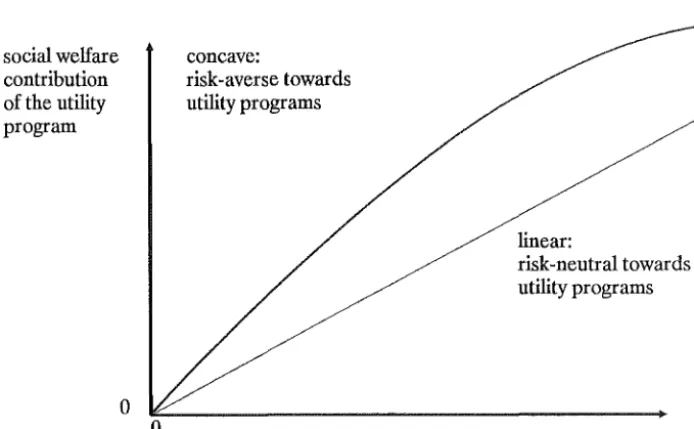
In aggregate formulations, the convention is to label society 'risk neu-tral' when uncertainty is accounted for by employing the expected value of the measure of delivered social welfare. The linear function in Figure 2.1 depicts this social risk attitude: the expected value of social welfare is not affected by the transformation. By contrast society is la-belled 'risk averse' when social welfare is taken to be an increasing, strictly concave function of the integral measure. Here, as the concave function in Figure 2.1 shows, the risk attitude lowers the expected value of the welfare measure whenever uncertainty is present. This is further illustrated in the Appendix.
social welfare contribution of the utility program
o
concave:
[image:34.562.105.452.431.645.2]risk-averse towards utility programs
Figure 2.1: Social risk attitudes
linear:
risk-neutral towards utility programs
There is a need, when using utilitarian objectives, to distinguish be-tween types of risk aversion. The standard integral of discounted con-cave instantaneous utilities is a risk-averse utility indicator with regard to each time's outcome: the integral is concave with respect to each time's utility argument. Similarly, for stationary utility and stationary profiles of utility argument, the integral is concave in the profile level and in this sense is risk-averse over outcome sequences: a mean-preserv-ing spread in the uncertainty about the profile level will decrease the ex-pected value of the integral.
However, the expected utilitarian form exhibits no risk-aversion about total discounted utility levels: the overall objective is linear in this level, and hence risk neutral towards it. In this study, this property is referred to as 'program risk-neutrality'. When it appears, a mean-preserving-spread in the possible integral values leaves the overall measure of worth unchanged.
2.4 Conclusions
The economic approaches to choice under uncertainty are questionable on many grounds. Investigations of non-renewable resource use which employ these approaches are equally questionable.
The model of individual choice is not well-developed for multi-period situations and is at odds with empirical evidence from static situations. Much of the richness of attitudes, towards risks of different sizes at dif-ferent times, cannot be explored with the standard MPSEU approach. No model yet allows that preferences change with time in an uncertain way: the position in time of decision-making is poorly reflected.
con-sideration of long time periods, so the largely static nature of the theory is a serious weakness. Long time periods might be expected to require consideration of changing preferences, and of complex attitudes to un-folding possibilities. Neither of these can currently be explored: ex-ante approaches deal with individuals' 'once and for all' selections, and both ex-post and aggregate approaches employ social objectives of MPSEU type, which ignore the timing of uncertainty resolution.
Ethical questions about the two approaches to aggregation (ex-ante cf. ex-post), and about how to treat potential persons, remain unresolved. This weakens the recommendatory power of investigations using the ap-proaches.
Chapter Three
Depletion Under Uncertainty:
The Economic Literature
Economic approaches predominate in theoretical investigations of non-renewable resource use under uncertainty. These studies are reviewed below, so as to establish their current potential for informing decision-makers.
The theory is grouped firstly by approach, and within this largely by what is uncertain. In all cases the studies build on investigations of a fully known situation; that is, uncertainty is always treated as an 'addi-tional complication'.
The first group, the descriptive or 'positive' examinations, are relevant to optimal societal resource use for two reasons. Firstly, an under-standing of how resource allocation systems operate is an important pre-requisite to achieving many societal goals. Secondly, the societal goal may be ex-ante efficiency, or, almost equivalently, consumer sovereignty may be deemed to be appropriate. It is well-known that these stand-ards are often satisfied by the decentralized systems studied in 'positive' approaches.
The investigations in the second group are directly normative. They use a modified optimal growth theory approach: an aggregate technology and resource base limit the consumption possibilities, and an explicit so-cietal objective is specified, so that optimal resource use patterns can be derived.
3.1 Early views on depletion and uncertainty
Prior to 1974, prescriptive economic investigations of non-renewable re-sources use deterministic approaches. The view commonly adopted in early 'positive' work is that uncertainty about future prospects compels producers of non-renewable resources to speed-up early extraction (Paish, 1938; Watkins, 1944).
One pathbreaking work briefly mentions uncertainty in connection with a social optimum based on consumer surplus. In questioning whether the interest rate should be used as a discount rate, it is claimed that the view that" ... future pleasures are ethically equivalent to present plea-sures of the same intensity ... " must be tempered with the facts that capi-tal is productive (a partial equilibrium framework is used), and future pleasures are uncertain (Hot elling, 1931, p145). The nature of this un-certainty is not further explored, and there is no indication of which of the possible "pleasures" should be evaluated, or if the appropriate dis-count rate varies with the risk.
If the social objective is to maximize net present revenue from the re-source, risk and uncertainty can be taken into account as deductions from revenues and additions to costs, according to Ciriacy-Wantrup (1944). This adjustment is thought to make it possible to treat resource use plans as finite, since the additions to costs and deductions from revenues at some distant date make use after that date appear worth-less.
uncer-tainty before and after this finite year is to be treated by using the best deterministic approximation available.
These three views account for uncertainty by adjusting the deterministic evaluation procedure. In each case a single specified outcome is
evalu-(
ated. There is no explicit examination of strategy, or foreseen need to adjust plans given new information.
3.2 Descriptive investigations
Until recently 'positive' economic investigations assumed resource owners and consumers had sufficient knowledge of the future to estab-lish and follow an intertemporal equilibrium with no need for strategy (Hotelling, 1931; Herfindahl, 1967; Peterson and Fisher, 1977; Crabbe, 1977; Dasgupta and Heal, 1979; Withagen, 1981).
Uncertainty weakens the validity of the 'partial equilibrium' assump-tion, which is relied on in considering the resource sector in isolation. Risky extraction decisions depend on which other risky activities are available. A portfolio of activities may be adopted to reduce risk. Agents may share risks or obtain insurance. These possibilities affect the appropriate risk-attitude for a resource extracting company.
3.2.1 Expectations: the base case
It is not necessary that all agents have perfect expectations. A full set of futures markets for the resource enables information to be shared and the whole equilibrium path to be established at the initial time (Kemp and Long, 1980). Without futures markets, to sustain the intertemporal equilibrium some agents must have sufficient foresight to be able to ar-bitrage across the spot markets for the resource. This is true if resource owners have perfect foresight of the demand functions, or if consumers know future demand functions and can store the resource costlessly (Weinstein and Zeckhauser, 1975).
With non-renewable resources myopic perfect foresight is not sufficient to sustain the full perfect foresight equilibrium. Infinite foresight, or a set of futures markets covering an infinite future, is required if the in-itial price level is to allow the perfect foresight terminal condition (stock exhaustion as choke price is reached) to be satisfied (Stiglitz, 1974).
3.2.2 Competitive extraction under uncertainty
The investigations of intertemporal equilibrium resource use when there is uncertainty are now reviewed. They are grouped according to which item is treated as uncertain.
Price uncertainty
pro-gram risk may be captured in a utility function over the asset value of the resource stock.
When extraction is costless and owners are program risk-neutral, the ex-pected price rises at the interest rate. Extraction falls over time on aver-age. Under risk-aversion the increasing uncertainty reduces the
contribution to expected utility of later extraction, so early extraction in-creases, and the equilibrium rate of increase in the expected resource price exceeds the interest rate.
If costs are convex in the extraction rate, an increase in price uncer-tainty causes the cost increases in high price periods to outweigh the cost decreases in low price periods, and induces risk-neutral owners to increase early use. Concave costs reverse the effect.
Alternatively, there may be current and future price uncertainty. Ex-traction is decided each period before price is revealed, and the prob-ability distribution over prices is a stationary function of aggregate supply (Lewis, 1977; Burness, 1978). Owners are now assumed to maximize the expected sum over time of the discounted utility of net profit, with the utility function reflecting risk attitudes.
This reformulation of price uncertainty reverses the impact of risk-aver-sion found above. The price 'risk' increases in proportion with the ex-traction quantity, so risk-averse owners reduce initial resource
Tenure uncertainty
At equilibrium, risk-neutral owners who attribute some likelihood to fu-ture nationalization of their resource holdings extract faster than those who perceive secure tenure (Long, 1975). Risk-aversion increases the tendency to faster extraction, but expected compensation can counter-balance the result.
Substitute development date uncertainty
The possibility of substitute development speeds the extraction of risk-neutral and risk-averse owners. The impact of uncertainty about the
de-velopment date is ambiguous (Dasgupta and Stiglitz, 1976, 1981). An
increase in this uncertainty can lead to higher initial extraction rates when the stock is small and lower initial extraction rates when the stock is big, if the (stationary) demand function is elastic enough at high prices. This is because very high rents are immediately attainable when there is a small stock, and these are foregone if and when the substitute appears.
Resource uncertainty
Most investigations of uncertainty about resource holdings use formula-tions involving maximization of a societal utility function, with no men-tion of markets or demands (Cropper, 1976; Kemp, 1976, 1977; Gilbert, 1979; Hoel, 1978a; Loury, 1978; Heal, 1979). These investigations are reviewed in section 3.3. If the utility function is interpreted as a concave utility of profit function, analogies give some insight into extraction be-haviour.
on the probability distribution over reserves. Increasing the discount rate may result in increased exposure to risk.
Different results are found if there is no current reserve uncertainty, but future reserves fluctuate according to a stochastic process, so ulti-mate reserves are unknown. The terminal extraction time is when aver-age profit first falls to zero - perhaps because of lack of reserves - and is unknown initially. With risk-neutral resource owners the expected rate of change of the equilibrium price is the same as under certainty, if ex-traction costs are linear in reserves. The exex-traction levels adopted by risk-neutral owners may be affected through the impact of uncertainty on the terminal condition. Risk-averse owners speed extraction (Pin-dyck, 1980).
Exploration
The equilibrium for the certain case provides a basis for comparison. When the increase in reserves given by 'exploratory' effort is fully known, the cost savings from postponing exploration are traded off against the cost savings in extraction which are assumed to follow from maintaining large reserves by exploration.
If initial reserves are small, equilibrium extraction initially increases as reserves are developed by exploration and hold down extraction costs. Eventually, as the returns to exploration worsen, reserves fall and extrac-tion decreases over time (Pindyck, 1978). The associated price path is V-shaped. Large initial reserves lead to a monotonically decreasing ex-traction rate equilibrium paralleling the Hotelling rule result.
reserve-extrac-tion ratio, and faster extracreserve-extrac-tion, than for the surplus maximizing case. Monopolistic rights to exploration territories lead to the opposite effect.
Uncertainty about exploration results can lead to an increase or de-crease in both exploration efforts and initial extraction at equilibrium (Devarajan and Fisher, 1982). Under risk-neutrality, and current uncer-tainty about exploration results, expected marginal discovery cost ex-ceeds rent at equilibrium if extraction productivity is increasing in reserves. The competitive equilibrium is not efficient if the resource in-dustry as a whole faces a risk, due to the scarcity of exploration pros-pects, which is overlooked by firms in deciding on exploration levels.
With no current uncertainty about discoveries, and risk-neutral re-source owners, uncertainty has no effect on the expected rate of change in the resource price. Exploratory efforts, extraction rates, and the price level at equilibrium may change. The direction and size of these effects is sensitive to the discovery function (Pindyck, 1980).
3.2.3 Uncertainty and market structure
When the returns to exploration are uncertain, risk-neutral firms with market power in non-renewable resources explore less than competitive firms, since the discovery of extra reserves depresses future resource prices (Solow, 1977; Stewart, 1979). However, 'rule of capture' may alter this result if there is free entry to exploration prospects. The firm may over-explore to protect its monopoly in the resource, and by main-taining high resource prices may induce over-exploration by others.
3.2.4 Expectations and disequilibrium
In the formulations above, agents' beliefs about uncertain elements are modelled as exogenous stochastic processes which the elements are 'known' to follow. These processes are not explicitly related to hypo-theses about agents' observations (e.g. of the extraction rate), or to the-ories the agent accepts (e.g. that prices will support an intertemporal equilibrium), or to empirical observations of belief formation. The sto-chastic processes are not learnt about as the agent gains experience.
The exogenous stochastic processes are therefore arbitrary as theoreti-cal foundations. They are misleading if real expectations formation can-not support the results. This is more critical when, as in reality, there are few futures and contingent markets in which expectations can be ex-pressed and developed.
In three different adaptive (i.e. extrapolative) expectations formulations the short run price path is sensitive to the elasticity of demand and the parameters of the expectations form. The paths are unstable; a small perturbation initiates an increasing cycle of fluctuations, or an increas-ing trend away from a 'well-behaved' path. The resource markets are more stable when owners' expectations are influenced by quantity sig-nals such as consumption rates and resource stocks, rather than purely by past prices (Heal, 1975, 1981).
More sophisticated adaptive expectations formulations lead competitive markets for non-renewable resources to a constant-price equilibrium in the short run. These paths do not even asymptotically obey Hotelling's rule. Therefore, the perfect foresight paths cannot be supported, even in the short-run, by adaptive expectations (Marks and Sweeny, 1982).
'Rational' expectations about non-renewable resource use are largely unexplored to date. In this context resource owners must decide about extraction rates and about holding resources or other assets. If owners have rational expectations they foresee and take account of the impact of these decisions on the intertemporal price path.
A unique intertemporal equilibrium exists for the competitive case with non-renewable resources, spot markets, an infinite horizon, demand un-certainty, and risk-neutral resource owners with rational expectations (Orosel, 1985). At equilibrium the resource price paths are expected to increase over time at the discount rate. Prices therefore satisfy a sto-chastic version of Hotelling's rule.
ra-tional expectations, in the same way as stock prices move 'too much' ... In fact, the importance of rational expectations may lie in their showing the basic principles of economic theory are difficult to reconcile with ob-servations."{p712).
However, the resource price movement which might be expected in a world of cartel members, fringe suppliers, and consumers, all of whom have rational expectations about that price movement, has yet to be determined. Empirical research into expectations forms is required be-fore the impact of uncertainty on non-renewable resource supply can be determined with any confidence.
3.2.5 Ex-ante efficiency and market depletion
The two fundamental welfare theorems relate competitive equilibria to Pareto optimal social states, i.e. ex-ante efficient outcomes (Koopmans, 1957; Debreu, 1959). Section 2.2.2 discusses ex-ante efficiency as a so-cial goal, but there are many well-known reasons why market outcomes may not be efficient. Many of these reasons are relevant to non-renew-able resources, and may not be amennon-renew-able to solution by (say) govern-ment involvegovern-ment.
Market inefficiencies
Property right structures, market concentration, and the policy environ-ment are all possible sources of inefficiency which are widely discussed in the resource economics literature (Herfindahl and Kneese, 1974; Howe, 1979; Fisher, 1981; Hartwick and Olewiler, 1986).
Private and social risks
risk of nationalization of resource holdings induces inefficient market outcomes (Long, 1975). The reverse is that society faces a risk about the total resource endowment, and if this risk is ignored by firms the market exploration levels are sources of inefficiency (Devarajan and Fisher, 1982).
Risk attitudes and uncertainty
The efficiency of market outcomes under uncertainty when resource owners are risk-averse is a subject of dispute. Weinstein and Zeck-hauser (1975), Heal (1975), and Hoel (1978a) claim that risk-averse firms' reaction to uncertainty is a source of inefficiency. Kemp and Long (1980) counterclaim that this result follows from inconsistent as-sumptions about shareholders and consumers, and that the competitive outcomes are efficient. Kemp and Long also claim that a competitive situation and resource base uncertainty are mutually contradictory, be-cause owners must anticipate the possibility of monopoly and this in-fluences extraction.
Availability of markets and uncertainty
When the probability an agent attributes to possible states-of-the-world depends on the agent's actions the Arrow-Debreu proof of efficiency of a full set of contingent commodity markets does not apply (Debreu, 1959). Extraction from uncertain resource stocks involves such depend-ence. To ensure efficiency the usual contingent markets must be
Private and social discounting
There is disagreement about which discounting procedures must be used by individuals, firms, and the state, if efficient outcomes are to be achieved (Lind et al., 1982).
When there is no public sector, and given the usual assumptions (endow-ments, preferences, technology, enough foresight and/or markets, and contract enforcement) a competitive equilibrium over intertemporal markets brings about equality between: each individual's consumption rate of interest (CRI), the social rate of time preference (SRTP), the market interest rate, the marginal rate of return to private sector invest-ment, and the social opportunity cost of capital (SOC) at each time.
Taxation of company income is a widely discussed reason for a 'wedge' between the SRTP and the SOC (generally it is thought that
SRTP
<
SOC): firms only undertake investments with a pre-tax margi-nal rate of return that is higher than the CRI by an amount which covers company income tax and the tax paid by the individual shareholder on dividends. "Since consumers and firms are facing different rates of re-turn, there is presumptive evidence of inefficiency ... " (Arrow, 1982, p117). The wedge causes a bias against long-term investments, and a lower level of investment. Where there are such taxes, therefore, mar-ket outcomes may not be efficient - non-renewable resource use may be too fast.3.3 Prescriptive investigations of substitute uncertainty
The future locations of this curve are uncertain, and depend on the preceding success at invention and innovation, resulting from research and development efforts. These vary with the perceived rewards, which are likely to increase as resource use rates, and the remaining stock, fall. Therefore, in reality, choice of resource use rates both affects and is af-fected by estimated future substitute availability.
Only the impact of substitute uncertainty on resource use is investigated in the prescriptive economic literature. As Table 3.1 summarizes, uncer-tainty about substitute availability is approximated by an uncertain amount available, or production cost, or invention date.
Table 3.1: Investigations of uncertainty about substitutes
Uncertain item
Future Substitutes
Uncertain attribute
size of flow
production cost
existence
date available
3.3.1 The nature of substitutes
Type of uncertainty
exogenous
exogenous
exogenous
exogenous influenced
3.3.1.1 Uncertain substitute 'costs'
An exact substitute for a non-renewable resource becomes available, without limit, at a fixed 'cost' h, at date T. Only a probability distribu-tion over possible cost levels is available before T (Hoel, 1978b).
Letting t index time, the society must decide on the rate a(t) at which the resource is extracted from the stock Q( t) before T, and the extrac-tion rate b(t) and substitute use rate m(t) after T. The resource and sub-stitute use rates determine each times' level of utility U(.), and the substitute cost is a charge on utility. The social objective is to maximize the sum over time of utility, discounted exponentially at rate r. Uncer-tainty is accounted for by maximizing the expected value of this objec-tive.
Letting E denote the expectation operator, this is formulated as an opti-mal control problem:
T
max
I
e-rtU(a(t» dt +o
E h G(Ql,h)a(t)
subject to: O(t) = -a(t), O:::;t <T Q(O) = Qo
Ql = Q(T)
Q(t), a(t)~O, O:::;t<T
where 00
G(Ql,h) = maxI e-rt [U(b(t) +m(t» - h.m(t)] dt
T
b(t) m(t)
subject to: O(t) = -b(t), T:::;t Q(T) = Ql
Let U(.) be continuous and twice differentiable with U'>O, U"<O, lim U'(a) = 00.
a~O '
The cost distribution is bounded allowing derivation of bounds to sub-stitute use rates, which eventually will equalize the subsub-stitute cost and marginal utility; by assumption some substitute use is always worthwhile.
The optimum strategy
The optimum pre commitment strategy reduces to two deterministic ex-traction paths: one before T, the other calculated at T when the cost becomes known to society. Depending on the size of the initial stock and on the uncertainty about the substitute cost, a jump in resource use may occur at T. Before T, the optimum balances the current marginal value of resource use with the expected marginal value of resource use after T, satisfying:
aG
E [ ], (a constant), all O::;;t::;;T. aQl
h
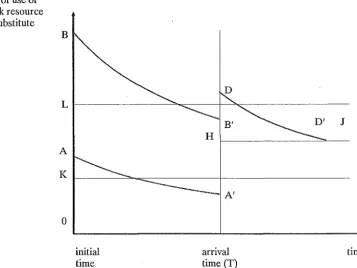
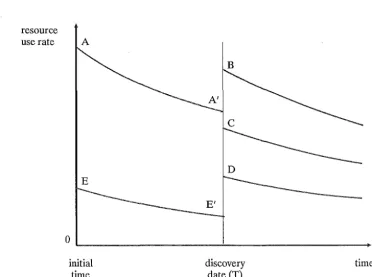
Possible optimal strategies are illustrated in Figure 3.1. The range K-L of possible optimal substitute use rates is derived from the range of possible costs, and it is assumed that the cost h revealed at T makes use rate H optimal.
rate of use of stock resource or substitute
B
L~---~~---+~~---J
A
K ~ ____ ~~=-________ -+ ________________ __ A'
o
initial
[image:53.562.101.458.117.384.2]time arrival time (T) time
Figure 3.1: Optimal depletion with uncertain substitute cost
BB'DD'] is optimal for a larger stock, exhausted at D'. Along BB' the discounted marginal utility of resource use is constant, and resource use falls. High initial use rates do not exhaust the resource stock before T: it is better if some stock is kept for use after T. The optimal resource use after T depends on the substitute cost. Any remaining stock is used to keep discounted marginal utility constant for as long as possible. The optimal resource use drops to zero from D' when the resource stock is exhausted. Substitute use then begins, and continues at rate H.
Reactions to risk-aversion and uncertainty about costs
risk-neutral society. Program risk-aversion reduces extraction at all times before T.
The optimal strategic use of stocks may be faster or slower than if the mean cost outcome is assumed.
33.1.2 Cost uncertainty resolved at a chosen time
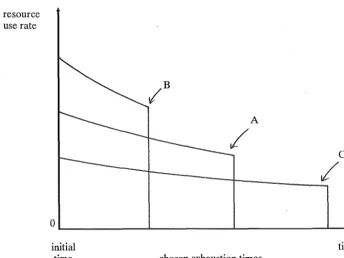
Alternatively, T is a variable. The substitute cost is discovered when and if the initial stock is exhausted. The value of the remaining pro-gram is, like G, positive, decreasing and convex over costs. Assuming risk-neutrality, uncertainty about costs at the exhaustion date translates into a higher expected reward than if the mean cost occurred with cer-tainty. Therefore, optimal extraction is larger and ends sooner under cost uncertainty (Oren and Powell, 1985).
33.13 Cost uncertainty with capital accumulation
When capital and the resource are inputs to production of a capital-consumption good, which may also be required in producing the sub-stitute, uncertainty about costs is captured with a probability
distribution over the input requirements for substitute production.
Under risk-neutrality the optimum initial resource use and capital for-mation are greater under uncertainty than under certainty with the same mean. However under extreme risk-aversion (which avoids worst possible outcomes) the optimum initial resource use and capital forma-tion are lower than under risk-neutrality (Hanson, 1977).
33.1.4 Uncertainty about substitute flows
uncertain and becomes known at T, rather than being chosen. If the substitute is costless, the deterministic optimal value function G(Ql,h) is replaced with F(Ql,k) in the initial objective function, where:
00
F(Ql, k) = max
f
e-rtU(b(t)+
k) dt Tb(t)
subject to: 6(t) = -b(t), T~t
Q(T) = Ql
Q(t), b(t)~O, T~t
At optimality, before T, resource use a(t) satisfies:
aF
E [ - ] , O~t~T. k aQl
Under risk neutrality, a mean-preserving increase in uncertainty about k reduces optimal non-renewable resource use at all times before T (Heal, 1979). This effect is opposite that for cost uncertainty.
3.3.1.5 Conclusions
When uncertainty is focused on substitute costs the value of the remain-ing program at T is a positive, decreasremain-ing, convex function of the sub-stitute cost. By Jensen's inequality, a mean-preserving increase in uncertainty about costs increases the expected value of the remaining program at T, so it appears less worthwhile to keep stocks for use after T. Therefore use rates before T increase as substitute cost uncertainty increases.