Nurse Practitioners’ Perceptions of their Role and Value in
UK General Practice
HALL, Julie
Available from Sheffield Hallam University Research Archive (SHURA) at: http://shura.shu.ac.uk/14749/
This document is the author deposited version. You are advised to consult the publisher's version if you wish to cite from it.
Published version
HALL, Julie (2016). Nurse Practitioners’ Perceptions of their Role and Value in UK General Practice. Doctoral, Sheffield Hallam University.
Copyright and re-use policy
See http://shura.shu.ac.uk/information.html
Faculty of Health and Well Being
Nurse Practitioners’ Perceptions of their
Role and Value in UK General Practice
Julie Hall
A doctoral project report submitted in partial fulfilment of
the requirements of
Sheffield Hallam University
For the degree of Doctor of Professional
Studies
ii
Abstract
This research explores the role and value of nurse practitioners to UK general practice from the perspective of nurses working in these advanced roles. Nursing has had a presence in general practice for decades, but it is only over the last twenty years that it has extended into a traditional medical domain of care and treatment. Research has understandably focused on the ability of nurses to substitute for doctors and there has been relatively little investigation of what nursing at an advanced level contributes. The study is located within a qualitative interpretive paradigm utilising a Social
Constructionist (SC) approach which recognises that knowledge is not based solely on objective observations of the world, but is generated between individuals in the course of their everyday life. The theoretical perspective grounded in this epistemological paradigm is symbolic interactionism (SI). This emphasises the construction of the social world and meaning through the use of symbols, particularly language.
Thematic Analysis (TA) is utilised deliberately as a research strategy guiding sampling, data generation, collection and analysis. A purposive sample of ten nurse practitioners was selected. Semi-structured interviews were conducted, digitally recorded,
transcribed and the data analysed using Braun and Clarke’s model.
Four broad themes were identified from the narratives; the enactment and
development of the nurse practitioner role, its value to the organisation and function of general practice, the impact of nurse consultation upon the patient experience and finally, how the role has integrated into the primary health care team.
iii
.
Acknowledgements
My grateful thanks to:
Dr Hilary Piercy and Dr Denyse Hodgson for their patience,
support and advice throughout this project. Though I came to
dread the phrases, “interrogate the data” and “it’s coming
along nicely”, I valued their insights and the time they
committed to my project through many drafts and inevitable
moments of doubt.
The enthusiastic, conscientious and inspirational nurse
practitioners who answered my call for participants. They
demonstrated the very best of nursing and I learned much
from them.
Chris, for his patience and love, I could never have completed
iv
If you want to go quickly, go alone
If you want to go far, go together
v
Contents
Page
Abstract ii
Acknowledgement iii
Contents
v - viii
Introduction 1 - 4
Aim and Objectives 1
Structure of the report 3
Chapter One Research in context 5 - 19
1.1. The study in context 5
1.2. History and development of general practice 5
1.3. Function of general practice 10
1.4. History of the advanced nursing role 11
1.5. Definition of the nurse practitioner role 17
1.6. Measuring value in general practice 18
Chapter Two Literature Review 20 - 37
2.1. Review question 20
2.2. Search strategy 20
2.3. Search terms 21
2.4. Value to general practice 24
2.5. Value to patients 29
2.6. Value to other health professionals 32
2.7. Discussion 34
2.8. Conclusion 36
2.9. Study Question and Objectives 37
Chapter Three Research Design 38 - 57
3.1. Introduction 38
3.2. Epistemological approach 39
3.3. Constructionism or Social Constructionism 41
3.4. Theoretical perspective 42
vi
3.6. Methods 44
3.6.1. Recruitment to the study 44 3.6.2. Selection of study participants 46 3.6.3. Data generation 47 3.6.4. Interview schedule 48 3.6.5. Data collection 49 3.6.6. Data analysis 49
3.7. Ethical Considerations 52
3.8. Ensuring and enhancing rigour in research 53
3.8.1. Validity / Credibility 54 3.8.2. Reliability / Dependability 55 3.8.3. Generalisability / Transferability 56
3.9. Reflexivity 57
Chapter Four Reflexivity 58 – 64
4.2. My experience of advanced practice 59
4.3. A novice researcher 60
4.3.1. Interviews 61
4.3.2. Data coding and analysis 62
Chapter Five Participant Characteristics and Themes 65 - 71
5.1. Participants 65
5.1.1. Dawn 65
5.1.2. Mandy 65
5.1.3. Ellie 66
5.1.4. Naomi 67
5.1.5. Sandra 67
5.1.6. Gaynor 68
5.1.7. Barbara 68
5.1.8. Claire 69
5.1.9. Jane 69
5.1.10. Mel 70
5.2. Research findings
71
Chapter Six Nuts and Bolts of the NP role 72 -92
6.1. Working as a nurse practitioner 72
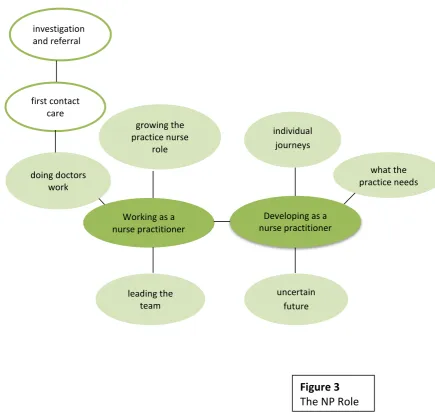
6.1.1 Doing Doctors’ work 73 6.1.1.1 First contact care 73 6.1.1.2 Investigations and referrals 76 6.1.2 Growing the practice nurse role 78 6.1.3 Leading the team 79
vii
6.2.3 Uncertain future 87
6.3. Discussion 89
Chapter Seven The General Practice appointment 93 – 110
7.1. The nurse practitioner appointment in general practice 94
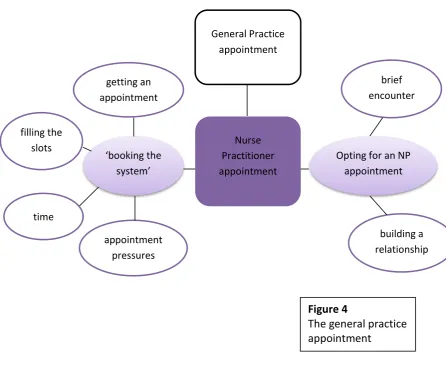
7.2. Booking the system 94 7.2.1. Getting an appointment 94 7.2.2. Filling the slots
97
7.2.3. Time 101
7.2.4. Appointment pressures 103
7.3. Opting for a nurse practitioner appointment 105
7.3.1. Brief encounter 106
7.3.2. Building a relationship 107
7.4. Discussion 108
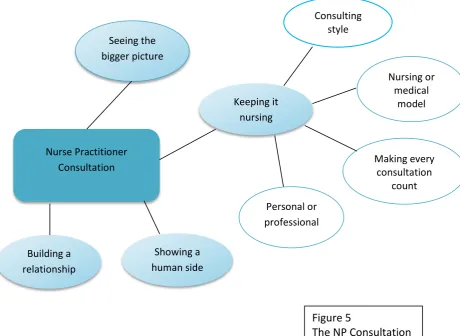
Chapter Eight The Nurse Practitioner Consultation 111 - 127 8.1. Seeing the bigger picture 112
8.2. Keeping it nursing 115
8.2.1. Consulting style 115
8.2.2. Nursing or medical model 116
8.2.3. Making every consultation count 118
8.2.4. Personal or professional attributes 119
8.3. Showing their human side 121
8.4. Building relationships 123
8.5. Discussion 124
Chapter Nine Professional Relationships 128 - 149 9.1. A new team structure 128
9.1.1. Overlap with medical roles 131
9.1.2. Overlap with nursing roles 132
9.1.3. A new hierarchy of expertise 134
9.2. Overcoming barriers 136
9.2.1. Professional resentment 136
9.2.2. Professional threat 138
9.3. Building a new role 140
9.3.1. Blurring roles 140
9.3.2. Role uncertainty 141
9.3.3. Changing minds 142
9.3.4. Establishing credibility 144
9.3.5. Sustainability of the role 145
viii
Chapter Ten Discussion, Conclusions and Recommendations 150 – 180
10.1. Summary of themes 150
10.1.1. Nuts and bolts of the NP role 150
10.1.2. The general practice appointment 151
10.1.3. The NP consultation 152
10.1.4. Negotiating professional relationships 153
10.2. Discussion of key findings 153
10.2.1 How do we recognised advanced practice 154
10.2.2. regulation of the advanced role in practice 160
10.2.3. Implications for general practice 163
10.2.3.1 Risk to public safety 163
10.2.3.2. Lack of role clarity 166
10.2.4. Value of the unregulated role to general practice 168 10.2.5
.
The future of the NP role 17010.3. Reflection upon the research findings 171
10.4. Strength and limitations of the study 172
10.5. Conclusions and Recommendations 175
10.5.1. Recommendations 175
10.5.1.1. For nursing’s professional body 175
` 10.5.1.2. For Clinical Commissioning Groups 176
10.5.1.3. For General Practice 177
10.5.1.4. For Higher Education Institutions 178
10.5.1.5. For future research 178
References 181
Tables and Figures
T
able 1 Eligibility criteria 23 Figure 1 Search strategy 22 Figure 2 General themes 71 Figure 3 The NP role 72Figure 4 The General Practice appointment 93
Figure 5 The NP consultation 111
Figure 6 Negotiating professional relationships 130
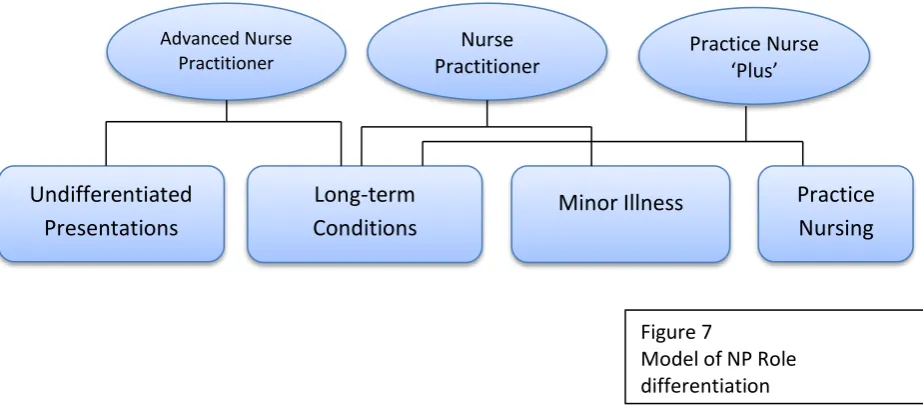
Figure 7 Model of NP role differentiation 156
Appendices ix - xxii Appendix 1 ICN Characteristics of Advanced Practice ix
Appendix 2 Participant Map x
Appendix 3 Interview Schedule xi
ix
1
Introduction
This project explores the nurse practitioner (NP) role in UK general practice and intends to develop an understanding of the role from the perspective of individual nurses with particular emphasis on how they articulate value to general practice.
The research aim is;
To explore nurse practitioners’ perceptions of their role and value to general practice.
The objectives which will facilitate this aim are;
1. To articulate the scope and development of their individual roles.
2. To explore how NPs perceive they contribute to the organisation and delivery of services in general practice.
3. To explore how the NPs perceive their role impacts on patient care in general practice.
4. To consider how the NPs perceive their role impacts on other members of the practice team.
5. To articulate the meaning the nursing element of the role still has for nurse practitioners in general practice.
Uniquely in general practice, nurses are managing complete episodes of care from undifferentiated presentations of acute and minor illness to long term conditions such as Diabetes Mellitus and Asthma. This demands a level of clinical skill together with diagnostic reasoning and prescribing which have not previously been seen in nursing. It inevitably changes the nursing role, now straddling a medical and nursing divide and combining a medical toolkit with a nursing orientation.
2
into the role itself, what meaning it has from the nurse’s perspective and what value
nursing contributes to the new service.
This project has particular significance at this time. The NHS is changing, and for reasons of economy, workforce and patient-centredness, there is movement of services from secondary to primary care. This brings the delivery of care in general practice sharply into focus and issues around workforce flexibility and funding occupy government and NHS organisations.
Professionally there is renewed interest in advanced level practice. Nursing is changing; new roles are emerging in response to healthcare changes and challenges from new health professionals make it more important than ever that nurses working in advanced roles can articulate what they do which is unique and has value.
The project has particular personal significance too. In common with the participants in my study, I am a nurse practitioner in general practice. In 2001, whilst working as a practice nurse I was presented with an opportunity to apply for and secure a nurse practitioner role across two general practices; a 4th generation Personal Medical Services initiative expressly tasked with improving patient access. The nurse practitioner role was one of the central pillars of the new initiative and has been successful. I studied to Masters’ level to underpin the role and became an
independent nurse prescriber in 2005; part of the first cohort to be able to prescribe from the entire British National Formulary excluding controlled drugs.
Nationally I have a role as committee member for the Royal College of Nursing
Advanced Nurse Practitioner forum, tasked with advising and promoting the advanced role within the college and on the wider professional stage. The forum’s involvement in the development of a process of credentialing for advanced practice is very exciting and if it comes to fruition will be a great achievement for all who have worked
3
Structure of the Report
Following this general introduction, chapter one focuses on the context of the research study, general practice, its development, organisation and function. The advanced nursing role will then be explored, outlining how it has developed professionally and politically and its introduction into general practice. A broad definition of the role and function is included.
Chapter two is a review of the literature. It will present a broad view of the research which has already focused on the nurse practitioner role in general practice, its contribution to the service and what value it is perceived to have.
Chapter three outlines the research design. The aim of the study is to explore the value of the advanced nursing role in general practice and the meaning that role holds for nurses. For this reason the approach is qualitative. Epistemological and theoretical perspectives will be discussed and the study set within an ethical framework.
Methodology and methods will discuss broad strategy and the processes utilised in the delivery of this study. Thematic analysis provides the framework; recruitment, sample selection, interviews and analysis will be detailed here.
Chapter four contains my personal reflections upon a journey as an experienced practitioner and novice researcher and the impact of both on the study.
Chapter five provides an outline of the participants, their individual and practice characteristics. It also includes a diagram representing the subsequent four chapters and their domains of practice.
Chapter six begins the process of presenting the findings of the study with an exploration of the scope and boundaries of the role from the perspective of the individual nurses.
4
Chapter eight examines the nurse practitioner appointment as the location of the therapeutic interaction and assesses what happens within this which differs from a GP consultation.
Chapter nine explores the effect of the introduction and integration of a new nursing role into the existing general practice and wider primary health care team.
5
Chapter One: Research Context
This chapter will explore the background to the study; to place it within a historical and situational context, to identify the main themes and drivers, political and professional, which have seen the nurse practitioner role develop in UK general practice. And finally to explore the concept of value within healthcare and begin to consider what the value of the advanced nursing role might be and how it could be evaluated.
1.1 The Study in Context
Nursing has had a presence in general practice for decades. Employed directly by general practitioners or attached to an extended primary health care team, nurses have played an important role in the delivery of primary care services to the wider community. In the early years practice-based roles were mainly limited to provision of basic nursing services within the surgery (Reedy, Phillips and Nevell 1976). The decades since then have seen the development of extended or advanced nursing roles in all areas of primary, secondary and tertiary care (Atkin and Lunt 1996, Barton 2006), but it is within one specific area of primary and community care that this study is
grounded; within general practice.
1.2 History and Development of UK General Practice
With the formation of the NHS in 1948, General Practitioners (GPs) assumed
responsibility for the provision of primary care and management of access to specialist care for the entire population. Within one month, 90 per cent of the population had registered with a GP. The 1960s saw new contracts which capped practice list size at 2000 patients per doctor and provided resources for GPs to employ support staff such as practice nurses. The creation of the Royal College of General Practitioners in 1972 saw a renewed focus on the specialism of general practice and from 1976, mandatory training and qualifications for all doctors wishing to train as GPs (The King’s Fund 2011).
6
freedom not available to their consultant colleagues. This freedom came under greater scrutiny during the 1980s and 1990s and the first move towards pay for performance was evident in the 1990 contract when GPs were paid for having smoking cessation, weight reduction and health screening clinics in their practices; clinics largely managed by practice nurses (The King’s Fund 2011).
Until 1991 GPs played no part in commissioning health services for their patients, rather it was the local health authorities who were responsible for both the planning and contracting of services for the entire population.The NHS and Community Care Act (1990) changed this, creating 'purchasers' and 'providers' in the local health system. It created two models or tiers of commissioning; one based on health authorities, and the other based on general practice. (Department of Health DOH, 1990). From 1991, GP practices which fulfilled specific criteria could apply to be ‘fundholding’ practices. They held real budgets from which they purchased primarily non urgent care, deciding where they placed contracts for services as diverse as orthopaedics and dermatology. They also had the right to keep any savings they made. This was a radical departure from the original spirit of the NHS and put GPs in competition with other provider services and each other.
The first health initiative of Tony Blair’s labour government in 1997 ‘The New NHS: Modern, Dependable’ dismantled much of the internal market characterised by GP fundholding because of concerns that it increased inequality through a two tier system of healthcare. In its place it established Primary Care Groups(PCGs) responsible to District Health Authorities (DHAs), tasked with developing primary and community services, commissioning specialist services and improving the health of local
populations (DOH 1997a). In a further reorganisation in 2001, DHAs were replaced by Strategic Health Authorities and PCGs by larger Primary Care Trusts (DOH 2001). Further structural changes in 2006 reduced the number and increased the size and responsibilities of both of these organisations; however this served to weaken their ties to local communities.
7
clinical roles including the nurse practitioner, into practice (DOH 1997b). PMS contracts were funded at a higher rate than the traditional General Medical Services (GMS) contract, with the additional funding intended to pay for these new practice-based services (DOH 1997b).
The defining feature of the Labour government’s approach to health policy in the period 1997 to 2009 was a new emphasis on reducing health inequality and improving healthcare quality. Major initiatives of that period focused on reducing waiting times in secondary care and providing timely access to general practice (The Kings Fund 2011, O’Shea 2013). Access targets for general practice were first introduced in the NHS Plan (DOH 2000), and established the principle that from 2004, patients should be seen by a primary care professional within 24 hours and a general practitioner within 48 hours. To meet these targets the government incentivised practices through a series of contractual measures such as extra payments, delivered and monitored, through the Quality and Outcomes framework (QOF).
The ‘Darzi report’, ‘High Quality Care for All” published in 2008 under Gordon Brown’s Labour government, shifted the emphasis from rapid delivery of care with centrally imposed access and treatment targets to quality measures which encompassed patient outcomes and experiences and greater local flexibility in service delivery(DOH 2008).
For primary care, the report advocated establishing at least one large polyclinic
independent of the local general practices in each PCT area. These clinics could provide a list-based GP practice and GP access for patients who wanted a walk-in or
pre-bookable appointment, but who were registered with a GP practice elsewhere. This proposal was controversial from the beginning. The BMA opposed it stating that funds allocated to the new polyclinics would be better used funding general practice, and some PCTs expressed concern that they were being forced to allocate resources to develop a centre which they did not need (Monitor 2014).
8
it was suggested that practices could reduce back-house costs and invest in new services (RCGP 2007). The proposal was different from the polyclinics because in most models GPs retained control, simply coming together as,
…an association of general practices and community primary care teams that come together to share responsibility for developing high quality, patient focussed services for their local community (RCGP 2008a p3). In the years since then, the number of primary care federations in England has increased until in 2015 a national survey suggested that 37% of GPs were working within an informal or formal collaborative network (RCGP: Nuffield Trust 2015). A change of government in 2010 saw another health service reform and another change of direction for general practice. The Health and Social Care Act launched in 2012 by the Conservative-Liberal Democrat coalition introduced substantial changes in the way health services were organised (DOH 2012). For general practice it meant a further reorganisation in the commissioning of services; the abolition of PCTs and the transfer of responsibility for purchasing services to groups of GPs and other
professionals in newly designated Clinical Commissioning Groups (DOH 2012). There is more change ahead as CCGs now have the opportunity to take responsibility for co-commissioning of general practice services, including negotiation of local incentive schemes as an alternative to the QOF framework (NHS England and NHS clinical commissioners 2014).
And this remains the current organisational context of most UK general practices. Still independent health organisations, sub-contracted to the NHS, organised and managed by general practitioners working alone or in collaborative networks, delivering services to their local community within a broader context of clinically-led commissioning with GPs taking the lead in purchasing care for their communities.
9
stagnant economy, increasing demands from an ageing population and increasing costs of medicines and other treatments (Roberts, Marshall and Charlesworth 2012). In addition to financial pressures impacting on general practice, a policy briefing prepared by the Nuffield Trust before the 2015 general election outlined further organisational problems facing the service. Whilst the authors maintained that there was no crisis in standards of care and that public satisfaction with the service remained generally high, they did identify a looming workforce crisis which could potentially destabilise general practice. They outlined crucial contributory factors; low morale and burnout leading large numbers of existing GPs to consider retirement, insufficient GPs in training to replace them and a general lack of funding for general practice services and infrastructure (Dayan, Arora, Rosen and Curry 2014).
In the new Conservative Government’s first Spending Review and Autumn statement in 2015, the Department of Health announced extra funding over a four year period intended to address the economic and workforce issues of general practice and transform it into a seven day service, the aim being that by 2020-21, everyone will be able to access GP services in the evenings and weekends. The review further suggested this was achievable by recruiting an additional 5000 GPs to the workforce together with 5000 new ‘healthcare professionals’(Department of Health and HM Treasury 2015). One problem with attempting to increase the GP workforce in such a short timescale is that training one additional GP takes a total of ten years. As the retirement ‘bubble’ is predicted within the next five years there would appear to be a serious underestimate in the real number of GPs required simply to maintain rather than to expand the service.
10
The political direction of general practice may have undergone several transformations during the years since the creation of the NHS in 1948, but it remains as it was first conceived, the first point of entry for the majority of patients accessing health care. Having reviewed the history and development, the function of general practice will be explained.
1.3 Function of General Practice
“90% of all patient journeys begin and end in primary care”
John Hutton MP, Secretary of State for Health (DOH 2002 p2)
General practice services in the United Kingdom are still delivered through a ‘cottage industry’ model in which individual practices of varying sizes provide services to a defined and predominantly local community (Addicott and Ham 2014 p7). In many cases the general practitioners still own their practice premises and subcontract their services to the NHS through a regularly renegotiated contract. They usually deliver services in partnership with other GPs and lead a team of clinicians including nurse practitioners and support staff who together form the primary care team (Addicott and Ham 2014).
The bulk of the work of the general practice team is carried out during appointments in the surgery. The general practice appointment provides the environment for the basic currency of health care; a therapeutic meeting and conversation between clinician and patient. Traditionally general practitioner appointments are organised into surgeries conducted in the early morning and late afternoon leaving time for home visits, management and administrative duties. General practitioners usually have ten minutes in which to complete a consultation. The ten minute appointment is a legacy of a previous age of general practice; before an ageing population with complex multiple co-morbidities changed the practice demographic (Freeman, Horder, Howie, Hungin, Hill, Shah and Wilson 2002). A survey of general practitioners in 2012 revealed that over 80% of practices still adhered to the ten minute appointment (Irving and Holden 2012).
11
branches, mapping the important micro and macro initiatives which facilitated its introduction into secondary and primary care.
1.4 History of the Advanced Nursing Role
Advanced nursing practice is recognised as a higher level of nursing which
encompasses a range of non-traditional, post-elementary nursing roles (DOH 2010). It is broadly divided into two domains; role expansion, in which core elements of nursing are preserved and additional skills and areas of practice are encompassed into a specialist role and role extension; in which skills or areas of practice previously the remit of another professional group are incorporated into an advanced generalist role (Daly and Carnwell 2003).
Both of these share common roots with the development of advanced roles in the United States; the advanced generalist from the need for primary care doctors in rural areas in the 1960s, and the clinical nurse specialist from the work of Francis Reiter, who identified a need to focus on and improve patient care in hospital settings as far back as the 1940’s (Leary, Crouch, Lezard, Rawcliffe, Boden and Richardson 2008). The modern clinical nurse specialist first emerged in the early 1970s following the publication of the Salmon Report which suggested a new hierarchical management structure for nurses in hospital settings, a hierarchy with titles above ward sister (Ministry of Health and Scottish Home and Health Department 1966). Ruth Martin was a pioneering clinical nurse specialist in the 1970s, working in neurosurgery in
12
The new hierarchy of clinical specialism was expanded further in 1999 with the publication of ‘Making a Difference’, the new Labour government’s framework for a more flexible career framework linked to proposed changes in NHS pay and conditions. It defined a form of consultancy incorporating four clinical practitioner levels with nurse consultant at the top. It further suggested that nurse, midwife and health visitor consultant posts would have responsibilities in four areas, expert practice; professional leadership and consultancy; education and development; practice and service
development linked to research and evaluation (DOH 1999). An additional clinical specialist role appeared in 2001 when the NHS plan (2000) called for a ‘matron figure’ a senior experienced nurse tasked with ensuring the basics of ward nursing were being performed properly and the patient experience of hospital care was improved (DOH 2000).
Since then the clinical specialist role has developed rapidly and has a presence across secondary care. The focus of the role can be a specific disease area such as diabetes or inflammatory bowel disease; a particular population group such as children; a care arena such as pain management or a treatment category such as chemotherapy (Vidall, Barlow, Crowe, Harrison and Young 2011). In many cases nurses are non-medical prescribers and also incorporate education and management into their roles. They are seen as valuable team members and their work as crucial to the changing configuration of the NHS and to patient outcomes (Vidall et al 2011).
Politically the road to advanced generalist nursing role in general practice was rather slower. In the 1970s, whilst practice nurses in the UK were still carrying out tasks delegated by their General Practitioner employers, American nurses working in similar settings had started to extend their role into new areas, performing clinical
assessments of patients autonomously, managing common disorders and in some cases working as surrogates for physicians (Reedy 1978).
13
practitioner courses in the United Kingdom, courses which produced the first leaders of the nurse practitioner community.
The Cumberledge Report on community nursing in 1986 strengthened the case for advancing nursing asserting that “the principle should be adopted of introducing the nurse practitioner into primary health care”(p32), further suggesting that key tasks would involve interviewing patients, diagnosing and treating specific diseases and conditions within agreed medical protocols and importantly, allowing direct access by any patient who wished to consult (Department of Health and Social Security DHSS 1986).
After a tentative beginning, numbers of nurses working in advanced roles expanded rapidly during the late 1990s and early part of the 21st century. Significantly, new Personal Medical Services (PMS) contracts introduced as a result of the 1997 NHS Primary Care Act, allowed general practitioners greater flexibility in employing staff to directly address the health needs of their patient populations (DOH 1997b). As a result there emerged new clinical posts straddling the nurse-medical interface which allowed services, previously considered to be core medical, to be undertaken by experienced and appropriately trained nurses (Por 2008). The introduction of access targets (DOH 2000), a medical recruitment and retirement crisis created by the 2004 GP contract, transfer of services from primary to secondary care (DOH 2006), and an ageing population (National Statistics 2010)further increased the need for new practitioners in general practice and opened the way for nurses to expand their roles. ‘Liberating the Talents’ outlined a framework for nursing in primary care which encouraged nurses to take on new clinical roles in practice and work in innovative ways to meet the needs of the local population (DOH 2002).
14
The final element in the development of the advanced role in a political context was the ability to prescribe medicines. It was the Cumberledge Report (DHSS 1986) that first recommended community nurses should be able to prescribe from a limited formulary. But it was not until a private members bill in 1992, that primary legislation was introduced which lifted restrictions on non-medical prescribing and opened the way for appropriately trained nurses to prescribe (DOH 1992). It soon became clear that for nurses working autonomously in general practice a restricted formulary of medicines was not enough to manage complete episodes of care. A further layer of prescribing qualification was introduced, Independent and Supplementary, and from 2006 all nurses with this qualification, now termed Nurse Independent Prescribers, who were registered with the Nursing and Midwifery Council were able to prescribe from the entire formulary, with the exception of controlled medicines (Royal College of Nursing 2012a).
Professionally, the publication of the United Kingdom Central Council for Nursing, Midwifery and Health Visiting (UKCC) ‘The Scope of Professional Practice’, first identified and promoted the expansion of the nursing role (UKCC 1992). This was followed in 1994 by the post-registration and practice (PREP) document which
established a framework and standards for specialist practice and offered a conceptual descriptor for advanced practice (UKCC 1994). The increasingly dynamic nature of healthcare and nursing roles required a more definitive framework and the UKCC embarked upon a ‘listening exercise’ involving key stakeholders in advanced practice from across the four countries of the UK. Consensus amongst the participants was that advanced practice should be aligned to a holistic expansive view of nursing. However the final recommendation by Council was that as there were neither agreed definitions of advanced practice nor criteria against which standards could be set, the UKCC should avoid setting explicit standards and instead consider how specialist practice could embrace nurse practitioners working at advanced level (Rolfe 2014). Whilst a further attempt was made to recognise and clarify advanced practice through the work of the ‘Higher Level Practice Steering Group’ which formally piloted
15
Eight years later, the NMC made a further attempt at consultation on advanced practice, on this occasion by online survey and questionnaire. Despite a warning that the process was flawed the NMC accepted the findings and determined that the new level of practice should be termed ‘advanced nursing practice’ and that it should be registered (NMC 2004). Whilst this remained the stated position of nursing’s
regulatory body, work on the new framework was delayed and finally overtaken in 2009 when a report to the UK Department of Health by the Council for Healthcare Regulatory Excellence (CHRE) suggested that nursing’s professional code encompassed advanced practice and further regulation was therefore, unnecessary,
…what is often call advanced practice across many of the health professions does not make statutory regulation necessary (p1)
As a consequence, in March 2012, a statement from the NMC postponed any work on the regulatory framework for advanced practice and outlined its intention, in an austere financial environment, to focus instead on fitness to practice (NMC 2012b). ‘Modernising Nursing Careers’ (2006) published by the Scottish Executive but representing a four countries approach, outlined changes needed in the nursing workforce to reflect and address changes in healthcare. Importantly for advanced practice it advocated the ‘standardisation of advanced level skills’ (p15). This call for change led to a Department of Health position statement, a generic benchmark which applied to all clinical nurses working at advanced level regardless of setting or patient group. It identified a minimum threshold of twenty eight elements, clustered around four themes or pillars of advanced practice; clinical/direct care practice; leadership and collaborative practice; improving quality and developing practice; developing self and others (DOH 2010).
Publications by the three other countries within the UK have addressed the same issues of advanced practice within their own health and education systems. The first and most comprehensive of these is the ‘advanced practice toolkit’ developed by NHS Scotland (2008), hosted on their website but intended for use UK wide. It contains a consensus framework for advanced practice which is grounded in the ICN definition and framework for advanced practice and RCN competencies and which also
16
Health for Northern Ireland (National Leadership and Innovation Agency 2010, DOH 2014).
The Royal College of Nursing has attempted to clarify the position for nurses working in advanced generalist roles through the publication of competences for practice (RCN 2012).This document details areas such as receiving patients with undifferentiated and undiagnosed problems, having the authority to admit and discharge patients from their caseload, refer to other health care providers and provide a leadership or
consultancy function as required.
But even with these publications and statements there is still confusion. The decade since ‘Modernising Nursing Careers’ has seen a number of different advanced or expanded nursing roles emerge. Barton (2006) suggests that the consequence of this is an “unregulated and confusing array of titles” presenting particular challenges and problems in the recognition and development of advanced practice. A survey
conducted by the Royal College of Nursing (RCN) and the Department of Health (Ball 2005), identified 5 commonly used role titles: nurse practitioner (NP), clinical nurse specialist (CNS), nurse consultant (NC), specialist nurse (SN) and advanced nurse practitioner (ANP). The review established that, of these, SNs, NCs and CNS are more likely to be employed in secondary care and be involved in some clinical work but with more educational or research focus to their roles. In contrast, NPs and ANPs spend most of their time on direct patient care; interacting directly with patients, assessing health needs, performing physical examinations, making diagnoses, prescribing and initiating treatment plans (Ball 2005).
17
generalist roles, midwifery, anaesthetics and clinical specialisms (Duffield, Gardener, Chang and Catling-Paull 2009). Within Europe, Ireland has possibly the most defined and formal recognition of advanced practice. Nurses working in advanced roles as nurses or midwives have been registered with the Nursing and Midwifery Board of Ireland since 2011 (International Council of Nurses 2014).
In the UK however, non-regulation together with a lack of registered professional titles and standardisation of educational pathways has led to role confusion for nurses, other health professionals and the public (Carney 2016). A broad definition will now be presented.
1.5 Definition of the Nurse Practitioner Role
Emerging from this global context the NP role is recognised by the International Council of Nurses’ Nurse Practitioner/ Advanced Practice Nursing Network (2001) as,
…a registered nurse who has acquired the expert knowledge base, complex decision-making skills and clinical competencies for expanded practice, the characteristics of which are shaped by the context and/or country in which s/he is credentialed to practice. A master's degree is recommended for entry level (p1).
This definition is a commonly quoted broad benchmark of advanced generalist
practice. It recommends Masters’ level entry but leaves credentialing or registration to the individual countries. In terms of characteristics of practice it advocates a broad church which incorporates elements of the four pillars of advanced practice detailed by the four countries of the UK (DOH 2010). ICN recommendations are appended (appendix one).
The RCN recognises the ‘expertise’ of the NP as his or her ability to operate as a ‘generalist’, providing complete episodes of care to patients with urgent needs, long-term conditions and in preventive health (RCN 2012b). And these advanced generalist roles are found in the greatest numbers in general practice.
18
in the research literature. And for reason of continuity, the term ‘nurse practitioner’ will be used throughout this report.
1.6 Measuring Value in General Practice
Value is a difficult concept to define. In its literal sense it can indicate a fair price or return, a principle or quality deemed desirable or worthwhile, or the worth in usefulness or importance of the holder (Oxford Dictionary 2016).How value is
measured depends upon its meaning in context. Articulating and measuring value in a specific role or situation is often subjective, its contribution difficult to fully uncover and clarify. Articulating value in the health care system exemplifies this difficulty. It can be measured in positivist terms; in observable outcomes, improved mortality data,
crude numbers seen in clinics or practices, clinical frameworks which seek to promote value which has statistical significance. In general practice the Quality and Outcome Framework (QOF) is used as a proxy for value through thresholds passed and points awarded for achievement of specific standards, for example, the number of patients with blood pressure in target range or simple recording of seizure frequency for patients with epilepsy within the previous 12 months.
19
This chapter has located the nurse practitioner role in general practice within a
historical and professional context. General concepts of value in health care have been explored and will be further examined within the next chapter; review of the
20
Chapter Two: Review of the Literature
The aim of this project is to explore nurse practitioners’ perspective of their role and value in UK general practice; to identify and explore what they feel they add to a service traditionally undertaken by GPs. The literature review is intended to
contextualise this aim, to explore the contribution made by this advanced nursing role to the organisation and function of general practice and also to examine what impact it has on stakeholders; the public and other health professionals.
A systematic approach to searching the literature was utilised because it ensured a comprehensive and rigorous methodological approach. Explicit statements about inclusion and exclusion criteria ensured that the articles identified addressed the search question. A critical review of the literature that explicitly considered the methodological approaches adopted in the individual studies and the rigour with which those studies were conducted was utilised in order to offer a balanced judgement of the contribution of outcomes and conclusions to the study question.
2.1. The search question
The question to be answered by this review is;
What is the contribution of advanced nursing practice to general practice?
2.2. Search Strategy
A search strategy was developed to identify research articles whose focus was
specifically on general practice in the United Kingdom. Research into advanced roles in other sectors of the NHS or other international health care systems was not included. Whilst the advanced nursing role is in evidence around the world, health care systems are very different and results might not reflect the context or reality of the NP role in the UK.
21
Grey literature sources:
Websites (Department of Health, Royal College of Nursing, National Statistics Online, Nursing and Midwifery Council, Royal College of General Practitioners) Incremental searches – reference lists from retrieved research articles.
Initial searches were completed during 2012 and further searches were conducted at regular intervals until the end of 2015 to identify any new research. Databases were searched from January 1999 onwards for relevant studies. This time-frame reflects the greatest expansion in advanced nursing roles in general practice, an expansion framed and supported by three critical policy documents; ‘Making a Difference’ (DOH 1999) which identified a new career structure for nurses incorporating a ‘higher level of practice’; The NHS Plan (2000) which articulated an expanded role for nurses in
primary care and ‘Liberating the Talents (2002) which further outlined that role in first contact care and in the management of long term conditions. This generated a burst of research activity into these new roles as they emerged in general practice.
2.3. Search Terms
Sets used:
1. advanced nurs*; nurse practitioner; general practice
2. advanced nurs*; nurse practitioner; general practice; patient*; patient satisfaction; consumer satisfaction; contribution; value
3. advanced nurs*; nurse practitioner; general practice; attitude*; contribution; value Both ‘nurse practitioner’ and ‘advanced nurse practitioner’ were used for the search because they are the titles commonly used in general practice. Clinical nurse specialist and nurse consultant are titles generally associated with secondary care and were not utilised. Even limiting in this way identified some studies based outside of general practice, for example, in unscheduled care settings.
22
general practice did not identify sufficient studies as not all specifically identified ‘UK’ in their titles.
Contribution was captured using the proxy terms; ‘quality’, ‘contribution’, ‘worth’, ‘impact’ and ‘patient satisfaction’.
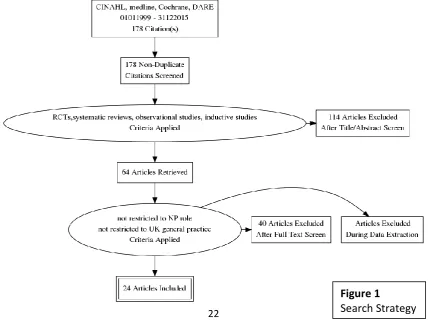
Having retrieved the articles in hard copy, the biographies were searched for other articles which might be relevant but had been missed on the electronic search. It was reassuring that this uncovered very few potential new articles. It was reassuring also that the articles I had retrieved were cited several times in other bibliographies. As a result of these initial searches, 178 potential studies and papers were identified. These were examined and individual items selected for inclusion in the review if they were considered relevant to focus (119 excluded for example ‘opinion’ articles). Manual review of abstracts and full text excluded a further40 papers for reasons of inappropriate study settings (not United Kingdom), or not restricted to focus (not related to general practice).
[image:32.595.112.541.461.781.2]In order to be considered the articles had to be randomised controlled trials, systematic reviews, inductive studies and observational studies.
Figure 1
23
Table 1 Eligibility criteria
Inclusion Criteria Exclusion Criteria
Paper reports on NP or ANP practice Paper not focused on NP or ANP Context is UK general practice Context is not UK general practice Published between 1.1999 and 12.2015 Published before this time framework Published in a peer reviewed journal Discussion document, editorials. Published in English language Not published in English language
The research studies were critically appraised prior to inclusion in the review. A relatively quick measure of quality was made on external factors. Determining the source of the study, for example, the journal of publication, the reputation of the author and the academic institution were useful indicators (Booth 1996). More detailed assessment was made using a critical appraisal tool specific to the research paradigm. Critical appraisal skills programme (CASP) assessment tools relevant to the study design were utilised (CASP 2013). None of the remaining 19 articles were excluded on the basis of poor quality. There were concerns about the Cochrane review’s overall findings (Laurent, Hermens, Braspenning, Grol and Sibbald 2005) and about a large review by Bonsall and Cheater (2008). Both are included as they contain some useful evidence within the overall structure, but the issues of quality will be addressed.
As discussed earlier, the early years of the 21st century saw the greatest expansion in numbers of nurse practitioners in general practice and consequentially the greatest number of studies examining that role. The priority for clinical enquiry at that time was to examine the ability of nurses to take on some part of the medical role, in effect to ‘substitute’ for doctors and deliver care traditionally seen as the remit of the
24
2.4. Value to General Practice
A comprehensive review for the Cochrane Library, Laurent et al (2005) identified sixteen quantitative studies which examined substitution by nurses either in first contact care (twelve studies) or management of chronic conditions (four studies). Of these, thirteen were randomised or quasi-randomised controlled trials and three were controlled before and after studies. Quality was assessed against nine criteria,
however, none of the included studies matched more than seven criteria and some matched as few as three or less. Whilst it is not clear what assessment tool was utilised, and Cochrane subsequently moved to a domain-based evaluation in 2007, it would seem unlikely that a score of three demonstrates a study of high quality.
However, the review team concluded that “...appropriately trained nurses can produce as high quality care and achieve as good clinical outcomes for patients as doctors...”
(p2). Only one study was powered to assess equivalence of care and there were significant methodological limitations in all studies. At least one was conducted in North America where first contact care is very different and others were located in non-general practice services. Despite publication in 2005, many of these studies were conducted in the 1970s when the nurse practitioner role was barely established and certainly would be unrecognisable from the expanded role of the last decade. Included in the Cochrane review was a randomised controlled trial (RCT) which has been frequently referenced individually and has direct relevance to the question and the time frame. Published in 2000, it was a large multicentre study based solely in general practice focusing on the differences in care between general practitioners and nurse practitioners (Kinnersley, Anderson, Parry, Clement, Archard, Turton,
Stainthorpe, Fraser, Butler and Rogers). The study was rigorously constructed with sample size powered to demonstrate significance in the primary outcomes (patient satisfaction and resolution of symptoms at two weeks), with effective recruitment and randomisation strategies and statistical analysis included in the report. Having
calculated the primary outcomes together with the number of prescriptions issued and investigations ordered, both proxy measures of comparability with medical
25
with nurse practitioners were longer than for medical colleagues but did not attempt to explain why and how this impacted on patient satisfaction.
In their systematic review published in 2002, Horrocks, Anderson and Salisbury combined data from Kinnersley et al’s (2000) research and other randomised controlled trials and prospective observational studies to determine whether or not nurse practitioners working in primary care could provide equivalent care to doctors. Disappointingly, due to the dearth of quality studies in the United Kingdom they included in their review a small number of North American studies and non-first contact general practice services. In their summary of evidence from the qualitative studies they determined that,
Nurse practitioners seemed to provide a quality of care that is at least as good, and in some ways better, than doctors (p821).
They based this on specific quality measures including communication skills, accurate diagnosis, appropriate investigations performed and relevant advice on
self-management or treatment. Clearly here there is some evidence of value-added to the service by a nursing role which is synthesised with core medical skills.
In contrast to the quantitative approach taken in studies so far, a substantive
‘integrative’ but not systematic review examined the limitations and benefits of nurses taking on aspects of the clinical role of general practitioners, from a qualitative
26
also little consideration of cost-effectiveness or use of resources. Conclusions also focused on lack of patient choice and nurses’ ability to manage complex problems. In their review of literature, Bonsall and Cheater (2008) attempted to identify the impact of the advanced nursing role on patients, nurses and colleagues. It is included here not as evidence of the contribution and value of the advanced role, but rather as evidence of the difficulty in using published research to direct or support practice. It did not claim to be a systematic review, rather to provide an overview of recent changes in the delivery of first contact services. It included 88 studies, many from New Zealand, America, Canada and Australia. No inclusion criteria for studies was specified, rather it was determined by the scrutiny of one researcher. No discussion of the methodological quality was attempted and inevitably then, there is insufficient linkage between conclusions and evidence. The studies were a mix of quantitative and
qualitative, isolated RCTs alongside observational alongside single case studies. It made broad claims for the role; that it improved access to general practice services for
some patients, that it provided equivalent care for some medical conditions, that it
may benefit and facilitate workload changes. However, the range and scope of this paper, the number of articles included and the lack of clear information about study quality make it impossible to draw any real conclusion about the contribution and value of the expanded nursing role in general practice. Studies were included from widely different health care systems and again these are not easy to accurately identify within the review. In such a project, good quality research which might inform and illuminate is lost in a melee of mediocre and poor studies. It is therefore impossible to assess whether or not even the overview offered by the authors has any real value to clinical practice.
27
appropriateness”, in which individual patients with the most complex problems are allocated to the practitioners with the most expertise and experience, the general practitioners, and those with minor or self-limiting illness to nurses. Clearly there is some value to general practice in making the most appropriate use of limited resources. Yet there is still an effect of this change to be considered; that allocation based on the health professional’s judgement of “fit”, matching the presenting problem with the resources inevitably detracts from patient choice and reduces an individual, in the authors’ words, to little more than a “biomedical diagnosis”. In such a process, nurse practitioners are actually preventing patients from seeing doctors when they and their problems are deemed to be ‘inappropriate’.
A small amount of research has focused on the value of the advanced nursing role to general practice in economic terms, and more specifically cost-effectiveness. The transfer of some core medical duties to nurses would suggest a cost saving to the National Health Service (NHS), a saving which could potentially fund other services. Yet the case for economic effectiveness is also not proven. A multicentre randomised trial conducted in 2000, examined the cost effectiveness of nurse practitioners and general practitioners as first point of contact in general practice. It concluded that NP
appointments were considerably longer than those of GPs (11.57v7.28min; adjusted difference 4.20, 95% confidence interval 2.98 to 5.41), they performed more tests and asked patients to return more often. When patient satisfaction and clinical outcomes were included in the results, there was no evidence for greater cost effectiveness despite significant salary savings for the service (Venning P, Durie, Roland, Roberts, Leese and Venning C. 2000). The authors concluded that savings on salary appear to be offset by longer consultations, higher patient recall and increased use of tests and investigations.
28
scales have changed over the last sixteen years and without financial additions such as medical defence fees, the stark pay differential would suggest that nurse practitioners are considerably less expensive than salaried GPs with average hourly rates of £25.37 v £43.06 quoted in a survey conducted in 2014/2015 for a general practice managers group (First Practice Management 2015). However, as with Horrocks et al’s (2006) evaluation other factors, such as shorter consultations and more patients seen by salaried doctors in each surgery session should be taken into account.
Nonetheless, practices have continued to employ nurse practitioners to manage increasing demands for access to their services. In a systematic review of innovations in service provision in the UK, Chapman, Zechel, Carter and Abbott (2004) identified telephone triage and nurse led care in general practice as two areas in which access to and capacity of general practice has been changed by the introduction of the nurse practitioner role. They concluded that whilst there was some evidence that telephone triage improved access for some, there was an inevitable trade-off for those patients who preferred a face-to-face consultation with their own GP. Further evidence from the ESTEEM trial, a pragmatic cluster-randomised controlled trial of telephone triage in four centres in the UK demonstrated that nurse triage resulted in an overall increase in total primary care workload compared with usual care, but a decrease in GP face to face contacts, suggesting a redistribution of work from GPs to nurses. However the ESTEEM study report failed to differentiate between nurse practitioners and practice nurses with additional training (Campbell, Fletcher, Britten, Green, Holt, Lattimer, Richards D, Richards S, Salisbury, Calitri, Bowyer, Chaplin, Kandiyali, Murdoch, Roscoe, Varley, Warren and Taylor 2014).
Nurse practitioner triage of requests to general practice for in-hours home visits was examined in a non-randomised comparative study based in a large general practice in London (Edwards, Bobb and Robinson 2009). The nature and outcome of each patient contact was recorded on a data collection form and this, together with the patient’s electronic record, was scrutinised by the research team. Outcomes included
29
resulted in more face to face consultations with patients and more prescriptions issued.
A small qualitative study by Perry, Thurston, Killey and Miller (2005) using a
convenience sample of patients and staff in a single UK general practice, attempted to identify whether or not the nurse practitioner role facilitated access to care that met the need of patients. Semi-structured interviews were conducted with eleven
members of the clinical and administrative staff and with fourteen patients who had consulted with the nurse practitioner. The study demonstrated that within this individual practice, the nurse practitioner role did widen access and did increase the number of appointments available. However the authors concluded that this could have been achieved by the addition of any practitioner to the team, suggesting that the fact the practitioner was a nurse, was incidental. It was also noted that much of the satisfaction expressed by patients related to the caring dimension of the individual nurse’s role; a characteristic which could be person, gender or role-specific.
Whilst research in this section has discussed contribution to general practice and the implications of nurse practitioners substituting for general practitioners, evidence of value has been difficult to uncover. If there is to be evidence of added value from the introduction of the nurse practitioner role in general practice, it is perhaps more likely to emerge from the patient satisfaction agenda. Value to the patient journey will now be reviewed.
2.5. Value to Patients
30
measures were used to generate statistical data. The authors found that patients were generally more satisfied with nurse than general practitioner consultations; this was statistically significant in the areas that measured general satisfaction, professional care and perceived time (Shum, Humphreys, Wheeler, Cochrane, Skoda and Clement 2000).
A rather different view emerges in a later qualitative study by Redsell, Stokes, Jackson, Hastings and Baker (2007) which attempted to determine patients’ views on the introduction of the advanced nursing role to manage a range of minor illness. Based in two volunteer general practices, researchers interviewed 28 patients attending for urgent, ‘same day’ appointments prior to their consultation with either the GP or the nurse practitioner, and with 19 of the original 28 participants after their consultation. Before the consultation patients were asked to talk about who they were consulting with on that day and whether or not they would have preferred to consult with someone else. After the consultation they talked about more general issues of who they would prefer to consult with and why. General themes emerging from the study focused more on the role of the GPs, seeing them as the experts and nurses as a resource to facilitate the smooth delivery of care. GPs were regarded as having
greater skills, knowledge and authority and remained the preferred health professional for serious problems. Patients in this study did not consider that nurses could
substitute for doctors but did value the extra time and information provided by the nurses. A major theme identified by the participants was the value of continuity of care. However they saw this as a continuing relationship with their general practitioner and not with the nurse. Whilst this was a small study, only two general practices and two nurses, it does demonstrate that patients seem to value nurses but prefer to see them enhancing care given in general practice rather than ‘substituting’ for general practitioners.
31
Kiger and Lee 2007). It was a large study, representing views from general practices throughout Scotland, with a full range of age groups, educational backgrounds and income. The quantitative data from the returned questionnaires was analysed for satisfaction, attitudes and preferences of the respondents. They concluded that patients would always want their choice of health professional to be available as first contact and that most preferred this to be a doctor. The mixed method design allowed researchers to explore the patient perspective in greater detail, and confirmed the findings of other studies that whilst the nurse practitioner role was ‘acceptable’, the choice agenda was being ignored.
More detail about which presentations patients felt could be managed by nurses is offered in one section of a large qualitative study undertaken in general practices in Torbay. Researchers sought the views of patients regarding the redistribution of
medical work from general practitioners to nurses (Branson and Badger 2008). A postal questionnaire achieved a relatively poor response, only 28% (241 of 860) were
returned. Further information was gathered through focus groups recruited via posters in general practice waiting rooms. Patients’ views were generally positive with 68% of the admittedly low quotient returned questionnaires agreeing that work could be delegated from doctors to nurses. However the tasks they thought could be delegated were current nursing duties and management of self-limiting illness. They were less willing to consider delegation of more complex acute presentations and expressed reluctance in these cases to see professionals other than GPs.
A comparative study of general practitioner and nurse practitioner consultations by Seale, Anderson and Kinnersley in 2005, explored treatment advice given to patients. An observational study, it analysed digital recordings of consultations for time spent with patients and amount and type of information provided. Eighteen matched pairs of consultations from nine general practices were included, consultations where ‘same day’ appointments had been sought by patients for acute illness. The results
demonstrated that nurse practitioner appointments were longer than those for
medical colleagues, in part because they provided a disproportionately greater amount of advice and information concerning treatments and potential side-effects. The
32
social factors. Whilst other studies have demonstrated similar outcomes, as an
observational rather than a retrospective study which relies on practitioner or patient recall, it does seem to provide contemporaneous evidence and support for the nursing role.
The time factor is explored in greater detail by Williams and Jones (2006), in their qualitative examination of nurse practitioner consultations. They interviewed a
‘judgement’ sample of ten patients, the number determined by their expressed wish to
“limit the breadth of exploration while maximising the opportunity for in-depth
analysis”. Consultations were with the same nurse practitioner, interviews were transcribed and thematic analysis by both authors suggested that ‘time’ was a recurring feature of all narratives. Patients appeared to value the time the nurse was able to spend with them, discussing not only their immediate illness but also external factors which might influence this; family, work and relationships. They further appreciated the more detailed information and advice provided.
The third theme which emerged from the literature review was the effect that the nurse practitioner role had on other health professionals within the practice, the wider primary care team and wider still, within the profession of nursing. This will be
explored in more detail.
2.6. Value to other Health Professionals
GPs have been identified as the main beneficiaries of the advanced nursing role in general practice. It has been conjectured that workload would reduce, that nurses would take on more of the acute presentations leaving GPs to manage the more complex. This should have value, as identified in the ‘hierarchy of appropriateness’ by utilising scarce professional resources judiciously. But the few studies which have been conducted into this new medical / nursing interface have demonstrated mostly barriers and antagonism motivated by concerns about professional territory and identities.
33
study utilising the information drawn from these initial interviews, Carr, Armstrong, Hancock and Bethea (2002)developed a postal questionnaire which was sent to all GPs within Lincolnshire and Sheffield. Of the 33% returned, approximately 25% were from GPs who already employed nurse practitioners and perhaps not surprisingly, were overwhelmingly in favour of greater expansion of the role in primary care. However, they perceived treatment room work to be an integral part of the role, perhaps suggesting more an expansion of the roles of their practices nurses than an
autonomous practitioner. There was also broad support for the role from the GPs who did not employ nurse practitioners, although very few had any fixed intention of introducing the role into their practices in the near future.
Wilson, Pearson and Hassey (2002)conducted four focus groups involving 25 GPs from training practices in Yorkshire to explore their attitudes towards the developing nurse practitioner role. They identified three main areas of concern; nurse capabilities, threats to GP status including job and financial security and structural and
organisational barriers. One of the practices involved in the study admitted to having initial concerns about the nursing role but having employed one nurse practitioner, they found the difficulties were completely outweighed by the positive contribution she had made to the practice.
It appears from the literature that attitudes of nurses towards those working in advanced roles in general practice have not always been supportive either.In a qualitative study of the nursing roles within a primary health care team, interview transcripts revealed considerable antagonism towards nurses extending their roles. This move was seen as a threat to the profession and professional identity, adversely affecting traditional roles within general practice and the wider community team (Williams and Sibbald 1999). The research team concluded that the erosion of professional boundaries could lead to uncertainty and low morale.
Long, McCann, Mcknight and Bradley (2004) conducted focus groups and interviews with members of three multidisciplinary primary care teams including general
34
support from most members of the team, some were confused about the role and others were simply resistant to the introduction of a new ‘specialist’ role. They concluded that much of the antagonism was caused by a lack of understanding of the new role and suggested that better definition of boundaries would assist in
integration.
The issue of identity, of role boundaries within the nursing profession is echoed in the study by Charles-Jones et al (2003). A view emerged of nurses moving away from their traditional role into a hybrid role which aligns them more closely with medicine. This separation of function leads to a hierarchy within general practice nursing teams which has not existed before. It creates a hierarchy as damaging as the “hierarchy of
appropriateness”; the hierarchy of value in which advanced nurses categorise
themselves at the top separated from other nurses and from a view of the traditional nursing self by their newly acquired ‘medical’ skills.
It only remains to ask if value to the wider nursing profession can be identified from the expansion of the nursing role into this new territory. In his ethnographic study of student nurses undertaking a clinical degree programme (BSc Nurse Practitioner) Barton (2006) found that an area to be considered is that of career progression. Nursing has long laboured within a structure which is very limited, both in terms of horizontal role change and vertical hierarchy. The expansion of nursing into this advanced clinical area certainly provides another option for an underdeveloped occupational structure, one which might keep good, experienced clinical nurses at the frontline of health care rather than moving into management or academia to further their careers.