metal-organic papers
m1840
Baiet al. [CdMoO4(C12H8N2)2]H2O doi:10.1107/S1600536805026073 Acta Cryst.(2005). E61, m1840–m1842 Acta Crystallographica Section E
Structure Reports
Online
ISSN 1600-5368
[Cd(phen)
2{MoO
4}]
H
2O, a one-dimensional
coordination polymer with bridging molybdate
groups
Xiuli Bai,a,bYing Luaand Enbo Wanga*
a
Institute of Polyoxometalate Chemistry, Department of Chemistry, Northeast Normal University, Changchun 130024, People’s Republic of China, andbDepartment of Chemistry Changchun Teacher’s College, Changchun 130032, People’s Republic of China
Correspondence e-mail: [email protected]
Key indicators
Single-crystal X-ray study
T= 283 K
Mean(C–C) = 0.007 A˚
Rfactor = 0.038
wRfactor = 0.128
Data-to-parameter ratio = 15.9
For details of how these key indicators were automatically derived from the article, see http://journals.iucr.org/e.
#2005 International Union of Crystallography Printed in Great Britain – all rights reserved
In the title compound,catena -poly[[bis(1,10-phenanthroline)-cadmium(II)]--tetraoxomolybdato], {[CdMoO4(C12H8N2)2
]-H2O}n, the Cd
II
ion has a distorted octahedral geometry, defined by four N atoms of two chelating phen (phenanthro-line) ligands and two O atoms from two MoO4tetrahedra. The
MoVIatom has a distorted tetrahedral geometry, defined by two terminal O atoms and two bridging (to Cd) O atoms. The compound exhibits a one-dimensional corrugated chain structure, and is further extended into a three-dimensional
inorganic–organic hybrid compound via hydrogen-bonding
and weaker–bonding interactions.
Comment
In the past decade, organic–inorganic hybrid materials have attracted extensive attention due to their potential applica-tions in catalysis, magnetism, electron conductivity and photochemistry as well as their interesting structural features (Gouzerh & Proust, 1998; Hagrmanet al., 1999; Hagrman & Zubieta, 1999). Hydrothermal methods are a key technique for preparing such materials (Yaghi & Li, 1995).
One topic of interest to us is the integration of metal– organic complexes with molybdenum oxide moieties into a single hybrid structure. A variety of such phases have been
prepared and characterized including [Mn(phen)(H2
O)-MoO4]H2O (phen is 1,10-phenanthroline; Zhanget al., 2004),
[Cu(phen)MoO4]H2O (Hagrman & Zubieta, 1999) and
[FeCl(2,20-bpy)MoO
4] (2,20-bpy is 2,20-bipyridine; Zapf et al.,
1998). In these complexes, the organonitrogen components act not only as charge compensators and space-filling constituents, but also as ligands bonded directly to a secondary metal center. We report here the synthesis and structure of the title compound, (I), a new one-dimensional coordination polymer containing {MoO4} tetrahedra and [Cd(phen)2O2] octahedra.
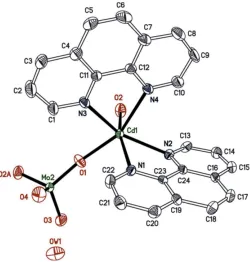
As shown in Fig. 1, there is one crystallographically inde-pendent Cd center and one Mo atom in the asymmetric unit. The octahedral coordination environment about Cd is defined (Table 1) by four N atoms from two chelating phen ligands, and two O atoms from two {MoO4} tetrahedra. The average
Cd—N distance is 2.400 (4) A˚ , and the Cd—O bond lengths are 2.211 (3) and 2.191 (3) A˚ . The Mo atom, residing in a tetrahedral environment, is coordinated by two terminal O atoms and two bridging O atoms, with Mo—O bond lengths in the range 1.731 (4)0–1.762 (3) A˚ . The {CdO2N4} octahedra
and {MoO4} tetrahedra are connected by corner-sharing O
atoms to form a one-dimensional chain, which is similar to the nickel–molybdate chains in [Ni(3,40-bipyridine)
2MoO4]3H2O
(LaDucaet al., 2002). In (I), adjacent chains are held together
via two types of supramolecular interactions. One involves O—H O hydrogen bonds arising from the non-coordinated water molecule (Table 2). The other involves weak aromatic
—stacking of the phen groups; the close contact distance
between adjacent aromatic rings of phen is 3.841 A˚ . (I) is finally extended into a three-dimensional structure by these weak interactions (Fig. 3).
Experimental
A mixture of Cd(NO3)28H2O (0.5 mmol), Na2MoO42H2O (0.5 mmol), 1,10-phenanthroline (0.6 mmol) and water (10 ml) was stirred for 20 min in air. The mixture was then transferred to a 23 ml Teflon reactor and kept at 433 K for 72 h under autogenous pressure. Crystals of (I) suitable for X-ray analysis were obtained after the reactor had been cooled and opened.
Crystal data
[CdMoO4(C12H8N2)2]H2O
Mr= 650.76 Monoclinic,P21=c a= 13.901 (3) A˚
b= 15.370 (3) A˚
c= 10.742 (2) A˚ = 101.61 (3) V= 2248.2 (8) A˚3
Z= 4
Dx= 1.923 Mg m
3
MoKradiation
Cell parameters from 20706 reflections
= 3.0–27.5
= 1.55 mm1
T= 283 (2) K Block, colorless 0.340.280.26 mm
Data collection
Rigaku R-AXIS RAPID IP diffractometer
oscillation scans
Absorption correction: multi-scan (ABSCOR; Higashi, 1995)
Tmin= 0.611,Tmax= 0.668
20706 measured reflections
5060 independent reflections 4251 reflections withI> 2(I)
Rint= 0.047
max= 27.5 h=18!16
k=19!19
l=13!13
metal-organic papers
Acta Cryst.(2005). E61, m1840–m1842 Baiet al. [CdMoO
[image:2.610.314.566.69.366.2] [image:2.610.47.297.70.332.2]4(C12H8N2)2]H2O
m1841
Figure 1A view of the building units of (I), showing 50% probability displacement ellipsoids (H atoms omitted for clarity). Atom O2Ais generated by the symmetry code (x,1
2y,z 1
2). H atoms have been omitted.
Figure 2
A view of the one-dimensonal chain formed by alternating {MoO4}
[image:2.610.45.295.389.484.2]tetrahedra and [CdN2O2] units. H atoms have been omitted.
Figure 3
Refinement
Refinement onF2 R[F2> 2(F2)] = 0.038
wR(F2) = 0.128
S= 1.01 5060 reflections 318 parameters
H-atom parameters constrained
w= 1/[2(F
o2) + (0.09P)2]
whereP= (Fo2+ 2Fc2)/3
(/)max= 0.001
max= 0.60 e A˚ 3
min=0.98 e A˚ 3
Table 1
Selected bond lengths (A˚ ).
Cd1—O2 2.191 (3)
Cd1—O1 2.211 (3)
Cd1—N2 2.374 (4)
Cd1—N3 2.375 (4)
Cd1—N1 2.390 (4)
Cd1—N4 2.457 (4)
Mo2—O3 1.730 (3)
Mo2—O4 1.746 (3)
Mo2—O2i
1.762 (3)
Mo2—O1 1.763 (3)
Symmetry code: (i)x;yþ1 2;z
1 2.
Table 2
Hydrogen-bond geometry (A˚ ,).
D—H A D—H H A D A D—H A
O1W—H1 O4 0.85 1.91 2.743 (5) 165
O1W—H2 O3ii
0.85 1.93 2.739 (6) 158
Symmetry code: (ii)xþ2;y;z.
C-bound H atoms were placed in idealized positions (C—H = 0.93 A˚ ) and refined as riding with the constraintUiso(H) = 1.2Ueq
applied. The water H atoms were positioned geometrically (O—H = 0.85 A˚ ) and refined as riding, withUiso(H) values freely refined.
Data collection: PROCESS-AUTO (Rigaku, 1998); cell
refine-ment: PROCESS-AUTO; data reduction: PROCESS-AUTO;
program(s) used to solve structure: SHELXS97 (Sheldrick, 1997); program(s) used to refine structure:SHELXL97(Sheldrick, 1997); molecular graphics: SHELXTL (Bruker, 1998); software used to prepare material for publication:SHELXL97.
This work was supported financially by the National Natural Science Foundation of China (No. 20371011).
References
Bruker (1998). SHELXTL. Version 5.16. Bruker AXS Inc., Madison, Wisconsin, USA.
Gouzerh, P. & Proust, A. (1998).Chem. Rev.98, 77–112.
Hagrman, P.-J., Hagrman, D. & Zubieta, J. (1999).Angew. Chem. Int. Ed.38, 2638–2684.
Hagrman, P. J. & Zubieta, J. (1999).Inorg. Chem.38, 4480–4485. Higashi, T. (1995).ABSCOR. Rigaku Corporation, Tokyo, Japan. Rigaku (1998).PROCESS-AUTO. Rigaku Corporation, Tokyo, Japan. LaDuca, R. L. Jr, Desiak, M., Rarig, R. S. Jr & Zubieta, J. (2002).Inorg. Chim.
Acta,332, 79–86.
Sheldrick, G. M. (1997). SHELXS97 and SHELXL97. University of Go¨ttingen, Germany.
Yaghi, O.-M. & Li, H.-L. (1995).J. Am. Chem. Soc.117, 10401–10402. Zapf, P.-J., Hammond, R.-P., Haushalter, R.-C. & Zubieta, J. (1998).Chem.
Mater.10, 1366–1373.
Zhang, Q.-Z., Lu, C.-Z., Yang, W.-B., Chen, S.-M., Yu, Y.-Q., He, X., Yan, Y., Liu, J.-H., Xu, X.-J., Xia, C.-K., Wu, X.-Y. & Chen, L.-J. (2004).J. Solid State Chem.177, 2862–2866.
metal-organic papers
m1842
Baiet al. [CdMoOsupporting information
sup-1
Acta Cryst. (2005). E61, m1840–m1842
supporting information
Acta Cryst. (2005). E61, m1840–m1842 [https://doi.org/10.1107/S1600536805026073]
[Cd(phen)
2{MoO
4}]
·
H
2O, a one-dimensional coordination polymer with
bridging molybdate groups
Xiuli Bai, Ying Lu and Enbo Wang
catena-poly[[bis(1,10-phenanthroline)cadmium(II)]-µ-tetraoxomolybdato]
Crystal data
[CdMoO4(C12H8N2)2]·H2O
Mr = 650.76
Monoclinic, P21/c
Hall symbol: -P 2ybc a = 13.901 (3) Å b = 15.370 (3) Å c = 10.742 (2) Å β = 101.61 (3)° V = 2248.2 (8) Å3
Z = 4
F(000) = 1280 Dx = 1.923 Mg m−3
Mo Kα radiation, λ = 0.71073 Å Cell parameters from 20706 reflections θ = 3.0–27.5°
µ = 1.55 mm−1
T = 283 K Block, colorless 0.34 × 0.28 × 0.26 mm
Data collection
Rigaku R-AXIS RAPID IP diffractometer
Radiation source: Rotation anode Graphite monochromator
Detector resolution: 0.01 pixels mm-1
oscillation scans
Absorption correction: multi-scan (ABSCOR; Higashi, 1995) Tmin = 0.611, Tmax = 0.668
20706 measured reflections 5060 independent reflections 4251 reflections with I > 2σ(I) Rint = 0.047
θmax = 27.5°, θmin = 3.0°
h = −18→16 k = −19→19 l = −13→13
Refinement
Refinement on F2
Least-squares matrix: full R[F2 > 2σ(F2)] = 0.038
wR(F2) = 0.128
S = 1.01 5060 reflections 318 parameters 2 restraints
Primary atom site location: structure-invariant direct methods
Secondary atom site location: difference Fourier map
Hydrogen site location: inferred from neighbouring sites
H-atom parameters constrained w = 1/[σ2(F
o2) + (0.09P)2]
where P = (Fo2 + 2Fc2)/3
(Δ/σ)max = 0.001
Δρmax = 0.60 e Å−3
supporting information
sup-2
Acta Cryst. (2005). E61, m1840–m1842 Special details
Geometry. All e.s.d.'s (except the e.s.d. in the dihedral angle between two l.s. planes) are estimated using the full covariance matrix. The cell e.s.d.'s are taken into account individually in the estimation of e.s.d.'s in distances, angles and torsion angles; correlations between e.s.d.'s in cell parameters are only used when they are defined by crystal symmetry. An approximate (isotropic) treatment of cell e.s.d.'s is used for estimating e.s.d.'s involving l.s. planes.
Refinement. Refinement of F2 against ALL reflections. The weighted R-factor wR and goodness of fit S are based on F2,
conventional R-factors R are based on F, with F set to zero for negative F2. The threshold expression of F2 > σ(F2) is used
only for calculating R-factors(gt) etc. and is not relevant to the choice of reflections for refinement. R-factors based on F2
are statistically about twice as large as those based on F, and R- factors based on ALL data will be even larger.
Fractional atomic coordinates and isotropic or equivalent isotropic displacement parameters (Å2)
x y z Uiso*/Ueq
supporting information
sup-3
Acta Cryst. (2005). E61, m1840–m1842
C14 0.9756 (3) 0.1102 (3) 0.7320 (4) 0.0257 (9) H14A 1.0064 0.1475 0.7960 0.031* C15 0.9773 (3) 0.0227 (3) 0.7515 (4) 0.0246 (9) H15A 1.0076 −0.0002 0.8297 0.030* C16 0.9325 (3) −0.0330 (3) 0.6516 (4) 0.0200 (8) C17 0.9345 (4) −0.1262 (3) 0.6628 (4) 0.0255 (10) H17A 0.9644 −0.1514 0.7395 0.031* C18 0.8940 (3) −0.1777 (3) 0.5651 (4) 0.0259 (9) H18A 0.8989 −0.2378 0.5735 0.031* C19 0.8430 (3) −0.1399 (3) 0.4469 (4) 0.0213 (9) C20 0.7995 (3) −0.1906 (3) 0.3418 (4) 0.0255 (9) H20A 0.8026 −0.2510 0.3465 0.031* C21 0.7527 (4) −0.1507 (3) 0.2330 (4) 0.0275 (10) H21A 0.7251 −0.1835 0.1619 0.033* C22 0.7467 (3) −0.0597 (3) 0.2294 (4) 0.0255 (9) H22A 0.7135 −0.0333 0.1553 0.031* C23 0.8361 (3) −0.0493 (3) 0.4343 (4) 0.0171 (8) C24 0.8839 (3) 0.0061 (3) 0.5375 (3) 0.0179 (8)
Atomic displacement parameters (Å2)
U11 U22 U33 U12 U13 U23
supporting information
sup-4
Acta Cryst. (2005). E61, m1840–m1842
C16 0.018 (2) 0.027 (2) 0.0159 (17) 0.0026 (16) 0.0061 (17) 0.0045 (15) C17 0.030 (3) 0.027 (2) 0.018 (2) 0.0046 (18) 0.0009 (19) 0.0065 (16) C18 0.028 (2) 0.021 (2) 0.027 (2) 0.0033 (18) 0.0028 (19) 0.0065 (17) C19 0.023 (2) 0.026 (2) 0.0168 (19) 0.0005 (16) 0.0089 (18) 0.0040 (15) C20 0.029 (2) 0.019 (2) 0.028 (2) 0.0016 (18) 0.0046 (19) 0.0010 (17) C21 0.034 (3) 0.027 (2) 0.021 (2) −0.0033 (19) 0.005 (2) −0.0037 (16) C22 0.030 (2) 0.025 (2) 0.0197 (19) 0.0011 (18) 0.0003 (18) 0.0033 (16) C23 0.0137 (19) 0.024 (2) 0.0160 (18) 0.0016 (15) 0.0080 (16) 0.0020 (15) C24 0.0141 (19) 0.026 (2) 0.0146 (17) 0.0008 (15) 0.0052 (16) 0.0020 (15)
Geometric parameters (Å, º)
Cd1—O2 2.191 (3) C6—C7 1.429 (7) Cd1—O1 2.211 (3) C6—H6A 0.9300 Cd1—N2 2.374 (4) C7—C12 1.407 (6) Cd1—N3 2.375 (4) C7—C8 1.420 (7) Cd1—N1 2.390 (4) C8—C9 1.338 (8) Cd1—N4 2.457 (4) C8—H8A 0.9300 Mo2—O3 1.730 (3) C9—C10 1.404 (7) Mo2—O4 1.746 (3) C9—H9A 0.9300 Mo2—O2i 1.762 (3) C10—H10A 0.9300
Mo2—O1 1.763 (3) C11—C12 1.453 (6) O1W—H1 0.8501 C13—C14 1.393 (7) O1W—H2 0.8500 C13—H13A 0.9300 O2—Mo2ii 1.762 (3) C14—C15 1.360 (7)
N1—C22 1.323 (5) C14—H14A 0.9300 N1—C23 1.368 (5) C15—C16 1.416 (6) N2—C13 1.332 (6) C15—H15A 0.9300 N2—C24 1.354 (6) C16—C24 1.409 (5) N3—C1 1.337 (6) C16—C17 1.437 (6) N3—C11 1.364 (6) C17—C18 1.344 (7) N4—C10 1.325 (6) C17—H17A 0.9300 N4—C12 1.351 (6) C18—C19 1.446 (6) C1—C2 1.376 (8) C18—H18A 0.9300 C1—H1A 0.9300 C19—C23 1.400 (6) C2—C3 1.357 (8) C19—C20 1.405 (6) C2—H2A 0.9300 C20—C21 1.364 (6) C3—C4 1.408 (7) C20—H20A 0.9300 C3—H3A 0.9300 C21—C22 1.401 (6) C4—C11 1.406 (7) C21—H21A 0.9300 C4—C5 1.422 (7) C22—H22A 0.9300 C5—C6 1.340 (8) C23—C24 1.449 (5) C5—H5A 0.9300
supporting information
sup-5
Acta Cryst. (2005). E61, m1840–m1842
O1—Cd1—N3 87.75 (13) C9—C8—H8A 119.9 N2—Cd1—N3 146.91 (13) C7—C8—H8A 119.9 O2—Cd1—N1 163.27 (12) C8—C9—C10 119.3 (5) O1—Cd1—N1 90.70 (12) C8—C9—H9A 120.4 N2—Cd1—N1 70.17 (12) C10—C9—H9A 120.4 N3—Cd1—N1 92.54 (13) N4—C10—C9 122.7 (5) O2—Cd1—N4 88.48 (12) N4—C10—H10A 118.7 O1—Cd1—N4 156.46 (13) C9—C10—H10A 118.7 N2—Cd1—N4 83.91 (12) N3—C11—C4 122.7 (4) N3—Cd1—N4 69.15 (13) N3—C11—C12 117.6 (4) N1—Cd1—N4 94.61 (12) C4—C11—C12 119.7 (4) O3—Mo2—O4 110.96 (19) N4—C12—C7 122.4 (4) O3—Mo2—O2i 110.48 (17) N4—C12—C11 119.1 (4)
O4—Mo2—O2i 108.00 (16) C7—C12—C11 118.5 (4)
O3—Mo2—O1 108.39 (17) N2—C13—C14 123.1 (4) O4—Mo2—O1 109.16 (17) N2—C13—H13A 118.4 O2i—Mo2—O1 109.84 (16) C14—C13—H13A 118.4
Mo2—O1—Cd1 155.5 (2) C15—C14—C13 119.4 (4) H1—O1W—H2 115.4 C15—C14—H14A 120.3 Mo2ii—O2—Cd1 152.79 (19) C13—C14—H14A 120.3
supporting information
sup-6
Acta Cryst. (2005). E61, m1840–m1842
C5—C6—H6A 119.2 N2—C24—C23 119.0 (4) C7—C6—H6A 119.2 C16—C24—C23 118.7 (4)
Symmetry codes: (i) x, −y+1/2, z−1/2; (ii) x, −y+1/2, z+1/2.
Hydrogen-bond geometry (Å, º)
D—H···A D—H H···A D···A D—H···A
O1W—H1···O4 0.85 1.91 2.743 (5) 165 O1W—H2···O3iii 0.85 1.93 2.739 (6) 158