©IJRASET: All Rights are Reserved
787
An Efficient Data Reduction Technique using
Change Coding for Wireless Visual Sensor
Network
Miss.
Nikhita V. Kapase
1, Prof. A. L. Renke
21, 2Department of Electronics Engineering, Kit’s college of Engineering (Autonomous), Kolhapur
Abstract: Wireless Visual Sensor Network is one of the most important applications of Wireless Sensor Network which provide a sensor based intelligent distributed system. Visual Sensor Networks has less complexity, identical performance and better quality of service. Visual Sensor Network contains a large number of camera nodes for providing a visual view of an object. The majority of industries use a network of cameras in order to obtain real-time data for monitoring and control. These networks are wired based in which data is sent over a wired link and power is available from wall power supplies. By using this system, the Captured Image from Camera and dataset is created .this data set is stored in local device which is raspberry pi. Raspberry pi has 1 GB RAM and 1.4 GHz frequency as well as it has unique features than other embedded system devices. This captured Dataset needs to a reduction in the Images for uploading to the server. Before this some morphological image processing techniques are applied for getting good quality of an image. Then for reduction of those images, change coding technique is applied. In change coding XOR operation of two adjacent frames is takes place. Finally, an image will be uploading to the Server.
Keywords: Change coding, Image processing, image compression, Image sensor, Server, OpenCV, Raspberry pi, data set.
I. INTRODUCTION
©IJRASET: All Rights are Reserved
788
reduction, and Data prediction based reduction [14]. Pramod D.Ganjewar, et.al, presented Threshold Based Data Reduction Technique which is useful in data pre-processing as well as minimization of energy for transmission of data[17]. Pramod D.Ganjewar, et.al, presented Threshold Based Data Reduction Technique which is useful in data pre-processing as well as minimization of energy for transmission of data[18].Recently, because of the development of image sensor technology much attention is required in research of wireless visual sensor network for security, surveillance and other applications.II. METHODSANDMATERIALS
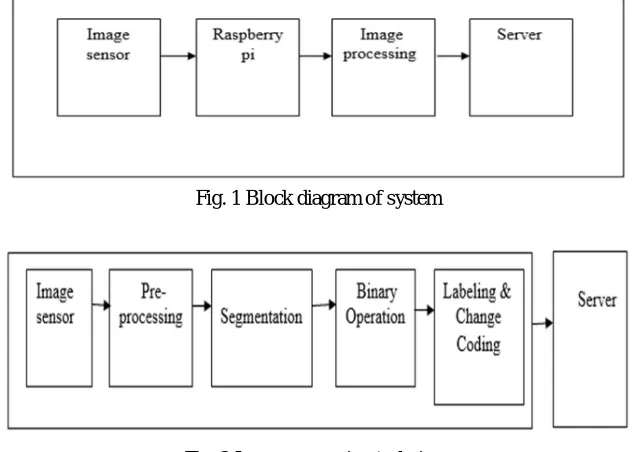
First, image is Capture by using Images Sensor and Store in Local Database using raspberry pi. The Logitech USB camera is used as a image sensor for capturing the images. For reduction of the image, image processing is applied. In image processing, different techniques are used such as pre-processing, segmentation of an image, morphological operations, and change coding. In change coding XOR operation of two adjacent frames is takes place. Finally data will be uploading to the Server, which helps in reducing the energy consumption of the Visual Sensor Network.
[image:2.595.139.456.267.493.2]Fig. 1 Block diagram of system
Fig. 2 Image processing technique
A webcam is used as an image sensor (video camera) which captures image in real time applications. For this system, 2 applications are choose, 1st is agriculture field and 2nd is electrical meter reading. By using the webcam, the video stream or images may be saved, viewed or sent on to other networks travelling through systems such as the internet, and e-mailed as an attachment. Unlike an IP camera (which connects using Ethernet or Wi-Fi), a webcam is generally connected by a USB cable, or similar cable, or built into computer hardware, such as laptops and raspberry pi.
The Raspberry Pi is used as storage device as well as useful for image processing. It is the Broadcom SoC (System on a Chip), which has the main components of the board–CPU, graphics, memory, the USB controller, etc. It performs vital role in the system. It is (SoC) device helps to developers in research because of its unique configuration. It has Inbuilt Wi-Fi helps to connect it to network and internet. Image sensor is connected to the raspberry pi and raspberry pi is already attached to the laptop. By using the command images are captured and store into the raspberry pi. Next part is image processing and image reduction technique.
For the processing of an image OpenCV and python language is used for coding which is analogous to raspberry pi. After completion of image processing next one is image reduction technique. After completion of all the process most important part is to send database to website/ server. So it is easy to access and read that data any time anywhere from the sever. In OpenCV, to perform the thresholding there is the cv2.threshold () function. Take the case of, the image of leaf. For that case its need to recognize the shape of the leaf, but cannot use a histogram. As a first approach try to apply a threshold (a threshold) at random, and then after several attempts able to find an optimal value. In image processing technique, the 1st step is image compression. The original input
©IJRASET: All Rights are Reserved
789
Fig. 3 Compressed image
[image:3.595.194.415.294.389.2]Thresholding is the simplest method of image segmentation. Segmentation is divided into 2 types 1st is continuities based and 2nd is discontinuities based.
Fig. 4 Types of segmentation
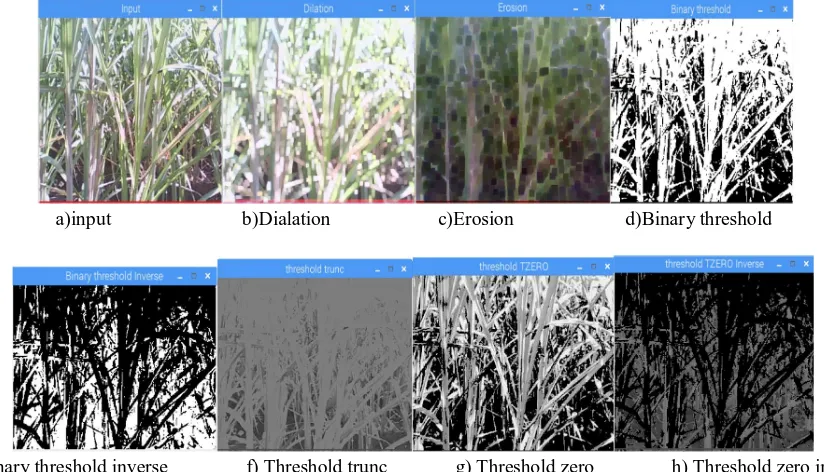
This Technique is useful for the analysis of the images and used to create binary images from a grayscale image. It is also useful for recognizing the regular shapes, contours within an image, divide zones inside the image which is used in a different way in the subsequent processing. For this project edge detection technique is used. By using thresholding technique different types of images are obtained like Binary threshold, Binary threshold inverse Threshold trunc , Threshold zero, Threshold zero inverse etc. The result of image processing technique are as follows:
a)input b)Dialation c)Erosion d)Binary threshold
[image:3.595.91.503.487.723.2]©IJRASET: All Rights are Reserved
790
For some application ,it requires to adding some pixel so dilation is useful. For removing some pixel erosion is useful. So erosion and dilation are the most important morphological image processing techniques for this system.For the agricultural field this system is very useful for recognize the condition of crops, growth of crops, differents disease into the crops.For getting the different versions of an image the code is generated using python language. Input image is takes as an idle image and after applying image processing technique ,different images are obtained.In some applications, the number of objects in the change frame (frame obtained by performing an XOR operation on two adjacent frames) is lower than the number of objects in each of the original adjacent frames. By compressing the change frame generated from two adjacent frames, we expect higher compression performance compared to simply compressing the original frames.
Fig.6 Change coding technique
The change frame between two adjacent frames can be computed by performing an XOR operation on the respective segmented pixels of the current frame from the camera and the pixels of the previous frame from memory. The image obtained after change coding technique is as follows:
Fig.7 Change coding image
For storing the data MySQL server is used. For connecting this server, it required user name, host name and network name. For connecting to the server port is used. In case of server host and client information plays vital role for encoding and decoding the data. Host contains MySQL version, network name and IP Address. Similarly client contains MySQL version, network name and IP Address and operating system.
This all data is saved by online server which is shown in following figure:
©IJRASET: All Rights are Reserved
791
For storing the data MySQL server is used. For connecting this server, it required user name, host name and network name. For connecting to the server port is used. In case of server host and client information plays vital role for encoding and decoding the data. Host contains MySQL version, network name and IP Address. Similarly client contains MySQL version, network name and IP Address and operating system.III.SUMMARY
Wireless visual sensor network (WVSN) is one of the most important applications of the wireless sensor network. WVSNs are applicable to the number of applications such as surveillance, wildlife monitoring, industrial observation and security purpose etc. Visual sensor networks are used for getting a visual view of an object, therefore, a large amount of image data is stored in the system. But every sensor network has some limitation like bandwidth, storage, and energy consumption. There are different data reduction techniques are used for increasing lifetime and bandwidth of wireless sensor network.
Now a days, visual sensor network plays a very important role in wireless sensor network likewise there is a number of challenges and issues are generated. For that purpose, an efficient data reduction technique is required for capturing image, pre-processing and storage purpose.
It was studied that different types of data reduction techniques are used for getting efficiency and power consumption. But there is very less research in wireless visual sensor network. So this system is very useful for wireless visual sensor network for improving performance, power consumption. This system present hardware and software scenario for developing the visual sensor network. It contains sensor and raspberry pi as a embedded devices. Further image processing and change coding is used for the reduction of an image.
IV.ACKNOWLEDGMENT
Author of this paper would thankful to guide Prof. A.L.Renke whose personal enrolment is inspired me for this work. I am thankful for his support and guideline.
REFERENCES
[1] Carl J. Debono, and Nicholas P. Borg, “The Implementation of an Adaptive Data Reduction Technique for Wireless Sensor Networks”, 978-1 -4244-35555/08/$25.00 2008 IEEE.
[2] Mario Cordina and Carl J. Debono, “Maximizing the Lifetime of Wireless Sensor Networks through Intelligent Clustering and Data Reduction Techniques”,978-1-4244-29486/09/$25.00 ©2009 IEEE
[3] Saeed Mirshams, Kamal Jamshidi, Ali Bohlooli, Abbas Dehghani, “Data reduction using clustering method in wireless sensor network”, 9781-4244-3941-6/09/$25.00 ©2009 IEEE
[4] youssef charfi, bell Canada naokiwakamiya and masayukimurata, “CHALLENGING ISSUES INVISUAL SENSOR NETWORKS”, 15361284/09/$25.00 © 2009 IEEE
[5] Muhammad Imran, Khursheed Khursheed, Mattias O’Nils and NajeemLawal, “Exploration of Target Architecture for a Wireless Camera Based Sensor Node” 978-1-4244-8973-2/10/$26.00c 2010 IEEE
[6] Ramona Georgescu, Christian R. Berger, Peter Willett, Mohammad Azam, and Sudipto Ghoshal, “Comparison of Data Reduction Techniques Based on the Performance of SVM-type Classifiers”, IEEEAC Paper #1557, Version 5, Updated January 23, 2010.
[7] Nyoman Putra Sastra, Wirawan, Gamantyo Hendrantoro, “Virtual View Image over Wireless Visual Sensor Network”,TELKOMNIKA, Vol.9, No.3, December 2011, pp. 483~488.
[8] Mohamed O. abdel-Aal, Rabie A. Ramdan, Ahmed A. Shaaban, “Energy saving and reliable data reduction techniques for single and multi-modal Wireless Sensors Networks”, 978-1-4673-4810-2/12/$31.00 ©2012 IEEE.
[9] Khursheed Khursheed, Muhammad Imran, Naeem Ahmad, MattiasO’Nils, “Detecting and Coding Region of Interests in Bi-level Image for Data Reduction in Wireless Visual Sensor Networks”, 978-1-4577-2014-7/12/$26.00 ©2012 IEEE.
[10] Khursheed Khursheed, Muhammad Imran, “Selection of Bi-level Image Compression Method for the Reduction of Communication energy in wireless Visual Sensor networks” SPIE Vol. 8437 84370M-1, CCC code: 0277-786X/12/$18, doi:10.1117/12.923716,2012.
[11] S.Renugadevi, P. S. NithyaDarisin, “Huffman and Lampel-ziv based Data Compression Algorithm for Wireless Sensor Networks”, Proceedings of the 2013 International Conference on Pattern Recognition, Informatics and Mobile Engineering (PRIME), February 2013.
[12] Daniel G. Costa,dIvanovitch Silva and LuizAffonsoGuedes, Paulo Portugal and Francisco Vasques, “Availability Assessment of Wireless Visual Sensor Network for Target Coverage”, 2014.
[13] KhameesKhalafHasan, UmiKalthumNgah, MohdFadzliMohdSalleh, “Efficient Hardware-Based Image Compression Schemes for Wireless Sensor Networks:
A Survey”,Wireless PersCommun, DOI 10.1007/s11277-013-1588-8, 2014.
[14] Thaker Maulik B., Uma Nagaraj, “Data Reduction Techniques in Wireless Sensor Network: A Survey”,International Journal of Innovative Research in Computer and Communication Engineering (IJIRCCE), Vol.no. 2, Issue 11, November 2014.
[15] Daniel G. Costa, LuizAffonsoGuedes, Francisco Vasques and Paulo Portugal, “Research Trends in Wireless Visual Sensor Networks When Exploiting Prioritization”, Sensors 2015, 15, 1760-1784; doi: 10.3390/s150101760.
©IJRASET: All Rights are Reserved
792
[17] Pramod D. Ganjewar, S.Wagh, “Threshold Based Data Reduction Technique (TBDRT) for minimization of energy consumption in WSN”, InternationalConference on Energy Systems and Applications (ICESA) , Nov, 2015.
[18] Liansheng Tan, Mou Wu, “Data reduction in wireless sensor network: hierarchical LMS prediction approach”, DOI 10.1109/JSEN.2015.2504106, IEEE Sensors Journal, 2016.
[19] ShamimYousefi and Samad Najjar Ghabel, “a survey on object detection methods in visual sensor networks”, International Journal of Advanced Smart Sensor Network Systems (IJASSN), Vol 6, No.2,April2016,DOI:10.5121/ijassn.2016.6201.
[20] Shabir Ahmad Sofi,RoohieNaaz, “Data Compression in Wireless Visual Sensor Networks using Wavelets”, 978-1-4673-9338-6/16/$31.00_c 2016 IEEE. [21] S.Aruna Deepthi, E.Sreenivasa Rao, “Image Compression Technique in Wireless Sensor Networks”, IEEE International Conference on Smart Technologies and
Management for Computing, Communication, Controls, Energy and Materials (ICSTM), pp.286-289, August 2017.
[22] AbdallahMakhoul, Hassan Harb, “Data reduction in sensor networks: Performance evaluation in real environment”, ieee embedded systems letters (esl), vol. x, no. x, 2017, DOI 10.1109/LES.2017.2749333.
[23] Reza Ghazalian, Ali Aghagolzadeh, Seyed Mehdi Hosseini Andargoli, “Wireless Visual Sensor Networks Energy Optimization With Maintaining Image Quality”,DOI:10.1109/JSEN.2017.2702121, IEEE Sensors Journal 2017.
[24] Monaem IDOUDI, El-Bay BOURENNANE, Khaled GRAYAA, “Wireless Visual Sensor Network platform for Indoor Localization And Tracking of a Patient for Rehabilitation Task”, DOI 10.1109/JSEN.2018.2838676, IEEE Sensors 2018.